Showing posts with label sample. Show all posts

Thursday, January 15, 2026

Let The Games Begin With This Sample Steiff Lake Placid Olympic Games Mascot!

Steiff's century-spanning anthropomorphic animal dolls are the best of all worlds. But is it possible there is one that is truly worthy of an Olympic gold medal? Steiffgal thinks so - and is over the moon thrilled to welcome one into her hug. This winter-themed wonder was purchased decades ago in Europe by his previous family. Check out this remarkable Steiff raccoon doll and see what makes him so COOL - literally - from the product design and historical perspectives.

Here we have a sample Steiff Roni the Raccoon doll, made as a possible licensed souvenir item for the 1980 Winter Olympic Games.
These were held in Lake Placid, NY from February 13th-24th, 1980. Roni, who was named as a nod to the venue's Adirondack mountain range, was the cartoon mascot for this event and was designed by commercial artist Donald Moss. Roni himself is 25 cm tall, standing, and unjointed. His head is made from short grey plush with an inset velvet facial mask. His pupil eyes are highlighted with black airbrushing to give him his traditional "raccoon bandit" look. He has a black embroidered nose and a pink painted mouth. His ears are lined in velvet and have a little pink airbrushing to them. He has a very long, fluffy, and bushy tail. Roni's winter garb, which is made from velvet and integral to his body, includes green gloves, a blue snowsuit, and red boots with brown soles. He wears a white bib which has the event's official Olympic logo hand rendered in black on either side.

Roni is branded with his Steiff ear tag and button.
Steiffgal doubts he was produced with a chest tag for two reasons; first, he was made as a sample so there really was not need for this tag. Also, his custom bib is so interesting and so integral to his chest, a chest tag would be redundant or even interfere with his presentation. His yellow ear tag is generic and without digits, so this pattern was probably never assigned an article number. This style of ear tag appeared on items made in the c. 1969/1970 through 1980 era. And his thick, brass style ear button with the script word Steiff on it debuted in 1979. So given the games were in 1980, and it could take a year or so for a licensed product to go from idea to production - all of these dates point to his production taking place in 1979.

It is not clear why Steiff's Roni doll never went into production.
He is on brand, matches the official event logo to a "T", isn't terribly complicated or expensive to manufacture, and is super, super cute! Steiffgal suspects it may have something to do with legal or financial complications often associated with international commercial licensing agreements. However, other companies were able to get production licenses to make Roni dolls, including a version on ice skates. Of course, these simpler patterns were nowhere as fabulous as Steiff's full blown interpretation of Roni! It is interesting to note that Steiff was able to produce Olympic branded and licensed items for other Olympic games, including the 1972 Munich games, the 1998 Nagano games, and the 2010 Vancouver games, among others.

It is nearly impossible to find out any additional details on Roni and this stalled Steiff Olympic project.
The only footnote Steiffgal could find was a reference in Dee Hockenberry's, book, Steiff Bears and Other Playthings Past and Present. Concerning the Roni doll, she notes: Prototype Raccoon: 11 inches. In 1978 and 1979, Steiff, through their US representative, made presentations to the American Olympic Committee in order to obtain a license to make 1980 Olympic souvenirs. Three prototype were made incorporating the Lake Placid mascot and Olympic logo. Although the samples were attractive, an official license was never granted. These are the only examples ever made.

Steifgal hopes this discussion on this Roni the Raccoon Olympic prototype doll has been one for the record books for you. 

Have a question about one of your Steiff treasures? Let's talk! Click here to learn more.

Tuesday, August 5, 2025

Check Out This Bearded Beauty From The Steiff Archives!

It's easy to be all smiles over this next Steiff mystery. Check out this note from a friend in Germany, who has just added a very special bearded beauty to his collection. But who exactly is this rarity, and what might be the back story behind him? Orlando writes:

"I bought a sitting Schnauzer from the Steiff archive, which I can't find in any book. He has the number 3530, which is written on the archive tag. He has a leather collar, his breastplate, and his ear flag with a button. The pressure voice, works. Maybe you can tell me something about the dog. Was it perhaps intended for the American market? Thank you for your efforts. I'm looking forward to your reply."


This darling doggie is an unusual version of the Steiff's popular and legacy Tessie Schnauzer design. These pretty pooches were made in 10, 14, 22, and 28 cm from 1954 through 1976. Tessie dogs produced for the standard line were standing and made from long, light grey mohair. They had irresistible faces that came to life with black and brown pupil eyes, a black hand embroidered mouth, a happy pink tongue, and pert triangular shaped ears. Their accessory was a red leather collar.

Orlando's version has the same general look and feel as the standard line issue Tessie dogs, with a few key differences:
  • 1. Standard line Tessie was standing and Orlando's is sitting. 
  • 2. Standard line Tessie was made from mohair and Orlando's appears to be made from a different sort of fabric. 
  • 3. Standard line Tessie has a closed mouth and Orlando's has an open, smiling mouth lined in velvet - sort of like those seen on Steiff's early 1950s Cockie Cocker Spaniels. 
  • 4. Standard line Tessie came in sizes up to 28 cm and Orlando's appears to be larger.
So what does this all mean?
The Steiff archive tag, with the numbers 3530 and 1955 on it, does help to shed some light on the dog. These numbers translate to 3=sitting, 5=wool plush, and 30=30 cm tall. So his fabric is in part wool plush, he is 30 cm tall, and he was made in 1955.

Now let's talk about his unusual form - sitting instead of standing. The sitting version was sampled in 1955, one year after standing Tessie's introduction. Steiffgal has two plausible ideas why Steiff tried out a version of their Tessie 
Schnauzer dog in sitting form.  

The first has to do with growing the company's overseas presence and market position. It was not uncommon for Steiff to make design tweaks to its standard line, postwar dogs and present them as exclusives to F.A.O. Schwarz and other high end stores in the USA in the 1950s and 1960s. For example, Steiff produced a standing Dally Dalmatian (the standard line version was sitting), a sitting black and white Cockie (the standard line version was standing), and an open mouthed Biggie Beagle (the standard line version had a closed mouth) as specials for F.A.O. Schwarz. This sitting Tessie might have been proposed for an exclusive for the USA, but never put into production for one reason or another.

The second has to do with regular business product line extension.
If a design is great and selling well - why not make it in a theme and variation form? The best analogy Steiffgal can come up with here is Steiff's foray into creating a postwar sitting Arco German Shepherd. Postwar, Arco has always appeared in the catalog standing. Steiffgal has seen just a few of the sitting versions here and there, but has never seen them documented in any reference book as a standard line item. In 2020, a 25 cm sitting Arco with all IDs sold at auction; it generated 12 bids and hammered at €2,300 / $2,481. His cataloging read, in part... 

"Arco, button, chest label and cloth tag label, cloth tag label is worn, sitting 25 cm, flat STEIFF button with embossed cursive writing in ear, item-No. 3325, cloth tag label on ear isn't readable, neck mark, Arco, mohair stuffed with wood wool , brown/black glass eyes, black nose/ mouth decoration, always 3 claws, press voice is faulty, red leather collar, this Alsatian Arco in sitting version was planned by the company STEIFF 1963 as novelty in different sizes , but wasn't put into the assortment, it were probably only a few sample items produced, very nice, unused original condition, extremely rare STEIFF rarity, expertise by the company STEIFF GmbH Giengen is enclosed." Here on the left you can see this sitting version of Arco, the image is from LiveAuctioneers

It is not clear why these sitting versions of Tessie and Arco never went into full blown production. Steiffgal suspects it has to do with production and labor costs, and/or market share or other business factors. These kinds of production decisions almost always have an economic element to them. But only they know for sure - and their lips are sealed!

Steiffgal hopes this discussion on Orlando's archival Tessie has been one for the books!

Have a question about one of your Steiff treasures? Let's talk! Click here!

Sunday, May 19, 2024

Keeping It Tru With This Mysterious Prewar Steiff Doll

Hat's off to another great Steiff find! Here we have a lovely prewar Steiff doll that recently joined Steiffgal's hug. Her condition and coloring is stunning, and you can't help but admire her perfectly coordinated outfit - and how well she wears it! But behind this little gal are a number of really big mysteries. Take a look at Trude and see what makes here so intriguing from the product design and historical perspectives.

What we have here is a precious pressed felt faced doll named Trude. She is 35 cm, standing, three ways (head and legs) jointed, and excelsior stuffed. Her face is made from flesh colored felt, while her limbs and trunk are made from flesh colored linen. Her arms are floppy and hang loosely by her sides. Her arms are bent slightly at the elbows, and she has very defined fingers. Her face is highly textured, with chubby cheeks, a realistic mouth, pert nose, and lifelike blue glass eyes embedded in eye sockets. Her facial painting is lovely and done with a gentle hand. Even her little ears are sculpted just like a child's. She is finished with a blond mohair wig, which is seamlessly integrated into her head structure. Trude's IDs include her red rubber bracelet, tan colored tag, and teeny tiny prewar button. You can see her IDs close up in the photo below. 

Trude's outfit is adorable and fits her to a "t". She wears a white cotton "one-sie", which is trimmed with lace around the leg openings and bodice. It has thin little straps which fit over her shoulders to help keep it in place. Her short sleeved white cotton blouse is removable and closes in the back. It is cropped and detailed with red pull strings at the neck and arms. She wears a cotton dress that closes with two metal snaps and is detailed with a ruffle around the waist area. The fabric features yellow, blue, black, white, and green wildflowers on a red background. Her footwear also is removable and consists of white cotton socks and red felt Mary-Jane style shoes. And she retains her original red and yellow wide brimmed hat, which is trimmed and ties with a red silk cord.

Trude is super interesting for number of subtle reasons. Steiff's "pressed felt" face doll line was produced from 1937 through 1943, and then again in 1949 and 1950. Steiffgal cannot locate a c. 1930s-1950s era doll of her construction with that name. The fact that her name was written by hand on her tag suggests that only a few of these dolls with this name were made. But more on that in just a moment! Also of note is her construction. Many to most of these wartime era dolls were made entirely from felt, but this example has a felt head and a linen body and limbs. This may suggest that she was manufactured when fine toy making materials were unavailable or expensive due to wartime rationing or shortages - perhaps in the very 1930s to early 1940s. As a result, matching linen in the place of felt was used instead in less "visible" areas of the doll's anatomy. 

Trude is dressed and resembles one of Steiff's standard line production pressed felt faced dolls named Gretel. Gretel was made in 35 and 43 cm from 1938-1942 overall and is also dressed in a similarly styled red dress with snaps, a white blouse, and red felt shoes with white socks. The most obvious difference between Trude and Gretel in terms of outfits is that Gretel wears a red hairband, and Trude has an oversized felt hat. You can see a picture of Gretel here on the left, the image is from Pfeiffer's Sortiment 1892-1943.

So here is where there are more questions than answers about Trude. Was she made to substitute for Gretel in terms of her materials and construction? Was she perhaps a sample of some sort? Why doesn't she appear in any Steiff materials, as far as Steiffgal can locate? And why does she have a large, glorious felt hat... given the rest of her is constructed to minimize the use of this premier toy making fabric? Well, only she knows for sure... and unfortunately, she's not talking!

Steiffgal hopes this discussion on Steiff's terrific Trude doll has been a playful addition to your day. 

Have a question about one of your Steiff treasures? Let's talk! Click here to learn more.

Sunday, August 20, 2023

What a Devilishly Interesting Steiff Mystery!

The devil made me do it! But in this case, it's all in good fun! Check out this note from a new friend who asks about an unusual item she found among her Mother's things. What do we have here? And could this man in red be made by Steiff? Darcie shares:

"I have a red devil doll with a Steiff tag but it is not attached. So I am not sure if it was made by Steiff. I thought Steiff’s have the metal button/tag on them. Can you help?"


Well hell-o handsome! What a great find! Although not specified, it would be Steiffgal's best bet that this devil doll is nearly identical to the blue felt version Steiff made of the Duke University Blue Devil mascot. The Duke Devil was jointed, with a felt body and a rubber head with horns. He was detailed with a blue felt suit, long blue felt tail, and white felt shoes, and carried a three pointed spear. He appeared in the Steiff line from 1954-1958, and then again from 1959-1963 as part of Steiff's early post war series of university and institutional mascots. These charming mascots were featured in F.A.O. Schwarz's catalogs in the early 1950s. 

So what might be the story behind this uncatalogued red version?
Steiffgal suspects it might be a sample or very low edition as she has never seen or heard of a red version previous to this one. The handwritten number "7128" on the early postwar ear tag provided by Darcie refers to 7= in caricature, 1= felt, and 28= 28 cm tall. This makes sense in terms of this guy for sure. 7128 is also the number of the earliest blue Duke Blue Devil mascot edition. Perhaps this red felt version with the US Zone tag and raised script button was made in the c. 1951-1953 time frame (before the launch of the Duke version) when you see items with the US Zone tag, for the most part. It is entirely possible that Steiff saw greater market potential and interest in making this rubber devil doll in blue as the Duke mascot than simply in generic red.

Steiffgal hopes this discussion on this rare devil doll has fired up your interest in the company's unusual mid-century production.

Have a question about one of your Steiff treasures? Let's talk! Click here to learn more!

Sunday, December 12, 2021

Jumping For Joy Over This Sample Steiff Frog Find!

Steiffgal's simply jumping for joy with her latest auction find.
A few weeks ago, she spotted this funky frog as part of a lot on an online auction. Something about him really called to her, and she knew she had to have him. Thankfully, the auction gods aligned, and she was able to place the winning bid. After an anxious week of waiting for his international delivery, he finally arrived at her doorstep. Check out this unusual amphibian and what makes him so wonderful from the collector's perspective.

It's easy being green when it comes to this sample frog.
He measures about 8 cm tall and about 10 cm long. His body and thighs are made from green mohair. His mohair is airbrushed with black stripes to add texture and dimension to these areas. His arms, hands, lower legs, and feet are made from double thick, die cut tan felt. They are airbrushed green, and then detailed with black airbrushed stripes and fingernails to bring them to life. His distinctly pouty face features an airbrushed mouth and oversized green and black google style cartoon eyes.

When Steiffgal saw him online, she truly did not recognize his hybrid felt and mohair design.
That is because he was - and is - a sample design. His pattern never went on to be produced on a commercial scale. His most unusual IDs include a brass Steiff button and his sample yellow tag located on his leg. The front of this tag looks just like a regular red and yellow single-thick ribbon style tag with the words "made in Germany by Steiff knopf im ohr" and the Steiff logo. However, on the back, the tag notes in German and English, "not for sale, Handmuster (hand sample) property of Margarete Steiff GmbH." Given his button and tag, he probably was produced within the last two decades.

It's difficult - if not impossible - to figure out why he was designed, whether he was envisioned as a stand-alone or accessory item, and why he never was manufactured on a commercial scale.
He is so appealing that Steiffgal is sorry that the rest of the world cannot enjoy his quirky yet irresistible charms. Perhaps - given his hybrid materials - he was a concept for a lower cost frog design, given that felt is less expensive and easier to transform into a product than mohair? It is possible he might have been designed as a keyring or purse dangler, given his petite proportions. Or maybe as a companion for a lucky princess doll or bear? But only he knows for sure - and his lips are sealed.

Steiffgal hopes this discussion on this sample frog has been a one of a kind experience for you!

Have a question about one of your Steiff treasures? Let's talk! Click here to learn more.

Friday, October 22, 2021

One-derful Highlights From Ladenburger Spielzeugauktion November 6th Auction!

The countdown continues towards November 6, 2021 for Ladenburger Spielzeugauktion GmbH's Special Steiff Auction! This amazing sale, offers 367 OFF THE CHARTS vintage button-in-ear temptations. It's so hard to pick highlights here as practically every lot qualifies as a headliner. Steiffgal offered her top Teddy Baby selections a few days ago; now here are her WAH-HOO good favorites. To qualify for today's elite list, these items (as far as Steiffgal can tell) were not produced on a commercial scale and/or have not appeared in any standard Steiff reference book, such as the Sortiment tomes. So here we go!

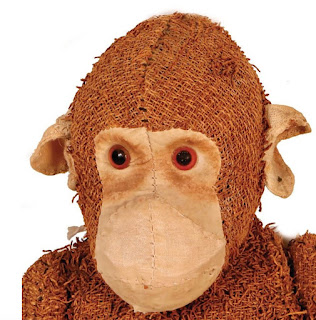
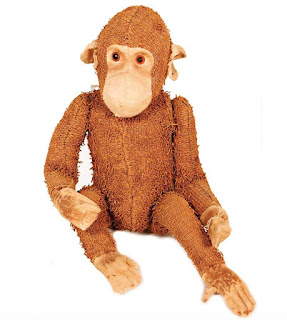
There's no monkeying around when it comes to lot #3967, a Steiff monkey made from paper plush.
The cataloging for this item is: "paper monkey, probably produced from 1919-1920, exceptional monkey, in paper plush substitute, wood pulp plush, jointed, with small button, block letters, long stretched F, glass eyes, seat height 18 cm, used condition, exceptional, extremely rare." The presale estimate for this little guy is €220-€440.

There are many things that make this five ways jointed chimp such a champ. His design, scale, and presentation are really appealing. But of course, you can't help but notice his "unconventional" construction of paper plush and linen. Steiffgal has seen, or has known about, a few paper plush Teddy bears. But nothing like this monkey, ever!

During and immediately following the First World War, Steiff was unable to procure adequate supplies of high end fabrics.
Mohair and felt manufacturing had decreased, and the materials produced were allocated towards military purposes. In order to continue some production, Steiff was forced to come up with some alternative products, as well as materials. Given the abundance of wood in the area, the company started producing things like building sets and furniture for children. Steiff also found a way to produce a tweed-like material from local natural products. This "paper plush" was made from nettles and called "Brennessel." Paper plush items appeared in the line from 1919 through 1921, and included popular models of the company's standard line bears, dogs, cats, and rabbits... and apparently this monkey, too!

Next, size defies with this teeny tiny Lulac rabbit, lot #3993.
This is kind of an oxymoron here, as Lulacs are famous for their size and cartoonishly long limbs. He is cataloged as: "Lulac, '60s, with button, chest label and cloth tag label, number on cloth tag label 1322,00, without damage, this size couldn't be found in the STEIFF-catalog, it is probably a sample item." His presale estimate is €250-€500.

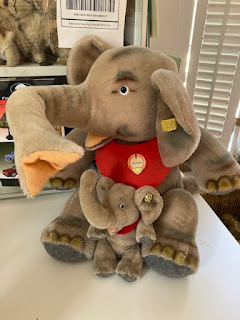
It's difficult to tell just from the photo here, but this guy is like an extra from the movie "Honey I Shrunk The Kids!" This bitty bunny really is only a petite 22 cm tall, measured vertically from the top of his head to his toes. As noted, he probably was a small scaled sample of a popular pattern of the time - created as a possible product line extension. And there is precedent for this; Steifgall has a 15 cm version of Steiff's sitting Jumbo elephant which appeared in the line from 1952-1975. Jumbo was produced commercially at 22 and 35 cm. You can see this little guy along with his 35 cm mama below.

Steiff's wonderful five ways jointed Lulac rabbits debuted in 1952.
It is Steiffgal's best thinking that their name derives from the German verb “to laugh” which is lachen, and the word "smile" which is lächeln. Lulacs are famous for their comically long arms, legs and torsos, goofy eyes, and playful personalities. Standard line Lulac rabbits were produced in produced in 43 cm from 1952-74 and 60 cm from 1964-66. So this 22 cm version is one rare rabbit indeed.

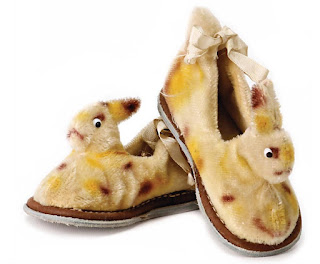
And finally, this last auction rarity is certainly a shoe-in for WAH-HOO good status. Check out lot #4318, a pair of fancy mohair kicks for kids. They are noted as, "exceptional children's hares shoes, probably '50s, very nice, strong colors, sole is 16.5 cm long, unused condition, rare, collection Koskinen." They carry a presale estimate of €120-€240. 

These shoes are worthy of walking the red carpet. And Steiffgal so wishes they were made in her size! They feature a rabbit design which is somewhat like Steiff's lying rabbit pattern. This little cutie is known for her stretched out body position and black and white google eyes. These often have the appearance of giving a side glancing "stink eye." Lying Rabbit was made in 6, 9, and 12 cm from 1953 through 1970.

Steiff's tradition of creating innovative product line extension items goes back to the turn of last century. The company has a long history of creating unusual novelties based on their most popular designs of the time. These things include purses, puppets, tea cosies, roly polys, tail moves head items, music boxes, and other functional and/or fun treasures.

It is entirely possible that someone at Steiff made these shoes as an experiment, for fun, or as simply an end of day or whimsy item - perhaps as a birthday or even Easter gift for a child or grandchild. It is also possible, given that the rabbit pattern's detailing is not exactly identical to Steiff, that they don't seem to have any IDs, and the painting and detailing of them is so unusual to Steiff, that they were made by another very high quality manufacturer also producing really appealing midcentury novelties. For example, the company Felpa Zurich MUTZLI created a series of children's hangers; they were covered in mohair and featured the face of a soft mohair Teddy bear or other animal. Only the shoes know for sure - and it is clear they are keeping their origins deep within their sole!

Steiffgal hopes this discussion on these WAH-HOO good auction picks has totally energized your day!

Have a question about one of your Steiff treasures? Let's talk! Click here to learn more!

Tuesday, September 21, 2021

Good Things Come In Threes With This Precious Prewar Steiff Pup!

They say good things come in threes, and that perfectly describes this week's blog treasure. Check out this amazing, and amazingly interesting, "pup from Pittsburgh." The more you learn about him, the more intriguing he becomes!

This heavenly creature is Steiff's early Saint Bernard dog. He is standing, unjointed, stuffed with excelsior, and made from tan and cinnamon colored mohair. He measures 15 cm tall and 20 cm wide. His proportional tail is positioned downward. He has three brown claws on each of his paws. He comes to life with floppy mohair ears which are tacked to his head, felt backed brown and black glass pupil eyes, a lightly shaved muzzle, and a  brown hand embroidered nose and mouth. He was produced in 17, 22, and 28 cm from 1914-1927. He is described in Pfeiffer's Sortiment as, "mohair plush, white, brown spotted, standing, young, soft stuffed."

So just what makes this guy such a top dog? First, let's start with the obvious. Steiff's prewar pups are always in demand, and those designed and produced in the 'teens and before are highly desirable. That is because they have - for the most part - a distinctively earnest, "literal", and basic look to them. They are also so well constructed and seldom come up for sale on the secondary market. Starting in the mid-1920s, Steiff's canine designs changed significantly and became more "childlike" - often with oversized features and detailing, imaginative coloration, and truly playful personalities. So not only is this example from a key time frame in Steiff's production history, it is also small scaled - another super interesting factor that always calls to collectors.

Now let's move to his second outstanding detail. It is impossible to tell at first glance, but this petite treat also has an amazing secret. He has TWO small silver long trailing "f" buttons in his ear! You can see this illustrated here on the left, One of the buttons has traces of a white paper tag, but the other does not. So why is this? Although the double buttoning in his ear could be an accident, his ear is so small, and the button is so well placed, that the second button truly looks intentional. In the past, Steiff used multiple buttons to keep track of which items were samples, prototypes, and versions of items under development. In the 1920's, this usually took the form of a regular button in one ear, and a "muster button" in the other. It is entirely possible that this dog's multiple button system is an early form of this tracking system - given he was introduced in the 19-teens. Unfortunately, only he knows for sure!

And if you think things couldn't get better than that - guess again! The third amazing thing about this fine example is that it comes with full provenance - that is, documentation regarding his life story. In this case, his provenance includes a letter and several photos - one which is shown below. According to the letter, in part:

"I wanted to share a little bit of history about this Steiff St. Bernard toy dog. It belonged to my father, Robert, who was born in Pittsburgh, PA in June, 1924. My grandmother was sentimental and a "saver," so many things from my father's childhood through his Army service in WWII were passed down and cherished, including his stuffed dog named "Sheppy."

My father always enjoyed reminiscing about his childhood, and he thought his dog was a gift received either for Christmas in 1925 or his second birthday in 1926. Looking at many photos, there was certainly a time period that my father went nowhere without his beloved "Sheppy" in hand."

You can enlarge the provenance letter as well as the photograph here on the left by clicking on them.  

Steiffgal hopes that this discussion on this fantastic Steiff Sheppy has left you quite Peppy!

Have a question about one of your Steiff treasures? Let's talk! Click here to learn more!

Sunday, March 24, 2019

Just Who Is This Cunning Little Vixen?

It's easier to solve a mystery when you have material evidence at hand. And such is the case with today's Steiff conundrum. Check out this sweet, albeit sly, little gal. She's clearly a fox made by Steiff. But she does not appear in any reference books Steiffgal can find, and something about her is quite unusual. Read on to learn more.

This foxy friend is 12 cm, sitting, and unjointed. She is made from dralon and mohair; tan dralon on most of her body and tail, white dralon on her chest, and mohair on her muzzle. Her ears are lined in peach colored trivera velvet. She has lost her button, but has a small hole in her ear where it once resided. The backs of her ears, her feet, and her back are highlighted with black airbrushing. Her pensive face comes to life with brown and black pupil eyes, a black hand embroidered nose and mouth, and a bit of black airbrushing to highlight her eyes.

So just what makes this fox a cunning little vixen? She certainly has a strong resemblance to Steiff's beloved Xorry Desert fox pattern. This sitting, unjointed fox was made in 12 and 17 cm from 1957 through 1970. Xorry Desert fox is different than the company's standing, unjointed Xorry fox, which was produced in 11, 18, and 28 cm from 1960 through 1969. Both Xorry patterns were made from mohair. However, the Xorry under discussion here is made from mostly dralon, and other 1970-era fabrics.

Let's try and outfox her material-mashup. In the 1960s and 1970s, Steiff produced a great number of toy items in dralon materials. At the time, it was a good solution for toy making as it was relatively easy to work with, very durable, washable, and less expensive than fine woolen fabrics. Starting in the early to mid 1970s, Steiff included a touch of mohair fabrics on items that were predominately made from synthetic fabrics - perhaps to give them a more "upscale" presentation. For example the company's 12 and 18 cm Snuffy rabbit from 1974-1982 has mohair on the back of his ears, top of his tail, and on his two front legs. And their mostly dralon 18 and 25 cm Tapsy Bear Cub from 1972-1978 features a mohair muzzle.

Given all of this, it is Steiffgal's best thinking that this little dralon fox with mohair detailing was made as a sample, or in a very low production run, in the mid-1970s. Its mix of materials and familiar pattern strongly suggest that it was designed as possible lower-cost, next version alternative to the company's 1957-1970 timeframe mohair Xorry Desert Fox - but never released on a commercial scale.


Steiffgal hopes this discussion on this unusual Desert Fox has given you the warm and fuzzies. 


Have a question about one of your Steiff treasures? Let's talk! Click here to learn more.

Sunday, September 17, 2017

This Sample Steiff Alien Is Truly Out of This World!

Well, it appears that Steiffgal has had a close encounter of the Steiff kind!  She has recently had the pleasure of welcoming a new Steiff rarity to her collection, one that sent her to the moon and back! But please don't think she's a space-case, but she's not really sure of too much concerning his background or origins. Focus your telescope on this out-of-this-world Steiff creation. Can you believe your eyes?

There's no need to phone home over this Steiff alien.  He stands 30 cm tall and is made from a high quality, brown faux leather.  Most of his visible, decorative stitching is done in orange thread. His head/body is basically round with three "horns" on its top edge.  The middle one is the largest and about twice the size of the ones to the left and right.  It is possible that the middle one is supposed to represent his "nose" while the other two are his eyes. His "face" is defined by a separate rectangular mask of faux leather which is detailed with a small orange patch of orange velour or velvet. This mask can be moved slightly up and down, and is attached to the alien through the his arm joints. 

Alien's body is also of interstellar proportions. His arms are jointed in the traditional Steiff way, with double round cardboard disks and metal wire connectors. His hands are made of two digits, sort of like two thumbs. His legs have thin thighs and thick calves and ankles - the opposite of a typical human form! They not jointed. Both his arms and legs are lined in some sort of metal wires or chains. They are posable and "creak" when moved about. Alien stands on flat circular feet that have magnets on the bottom. These probably help weight him, as well as add a playful touch to where he can stand and how he can be posed. His construction and detailing are really quite spectacular and it is clear that he was made with a most loving, and exacting, touch.  

Also of note is his Steiff ID.  It consists simply of the company's yellow, double sided ribbon tag and a gold, rivet style button. It is pictured here on the left. The back of the tag reads, "Not for Sale!" and "Property of Margarete Steiff GmbH" in both German and English.  It also has a field for a date and a number, but these are not filled in. It is Steiffgal's best guess, based on this ID, that this item was indeed a sample or prototype from the c. 2002 time frame. She has another item with this identical tag and ID arrangement; in that case, the date on the tag is 7.03.02 and the number is 7.  Steiffgal is not sure if "number" refers to the total number of samples produced, or the order of the samples produced; but it is not an EAN or product number.  

So now the questions as big as the universe. Why was he made, and how did he arrive in Steiffgal's collection? Well, only he knows the answers for certain, and he's not talking.  So here are a few down to earth possibilities.  

First, why was he made?  Steiff employs the finest doll and toy designers in the world, and great people do great work. Perhaps the Steiff designers were asked by management to come up with truly out of the box ideas, and this was one result of that challenge. Maybe this design was the result of an independent vision a designer had, or maybe they wanted to test out the faux leather fabric and/or creaking metal skeleton for its toy-making potential. It is a possibility that the company was exploring a collection theme or idea (in this case, space travel or extraterrestrials) but decided not to move forward with it. Or perhaps it was created in response to a customer special order or inquiry which did not make it beyond the prototype phase.  

Steiffgal suspects that the big reason this little guy did not make it into the Steiff line was cost.  After all design, materials, and manpower factors were analyzed, this alien's production expenses were probably astronomical.

And how did the alien make the interstellar journey from Giengen to Steiffgal's hug?  It is Steiffgal's best guess that this item might have been sold during one of Steiff's Sommer Festivals a decade or so ago.  It is at these wonderful annual gatherings where Steiff offers samples, overstocks, overproduction models, and other "oddities" under a giant circus style tent.  Sometimes fantastic finds like this make their way to this sale. This item was purchased from a collector in Europe who found him at a German toy show.  As such, at least geography wise, it is possible that this was his map from there to here.

Steiffgal hopes this story on this unusual Steiff creation was as exciting as a UFO sighting!

Have a question about one of your Steiff treasures? Let's talk! Click here to learn more.
The teddy bear search engine