This blog focuses on vintage Steiff finds, Steiff antiquing and travel adventures, international Steiff happenings, and the legacy and history of the Steiff company.
Collectors, looking for that elusive Steiff piece to add to your hug? Or is it time to find a new home for some of your Steiff treasures? I may be able to help; let's talk! Email Steifflife@gmail.com to start the conversation!
So glad you took some time out of your busy day to visit!
You've found the online place for all things Steiff. Although Steiff bears, animals, and dolls have been around since the 1880's, their collectibility, appeal, and stories are as new as tomorrow.
Sometimes the most unexpected and super-scaled treasures appear almost out of the blue! Such is the case with this fantastic and extremely large prewar Steiff Ted. And just how big is he? Well, Steiffgal could barely pick him up and move him about for his photo session! Take a look at this titan-Ted and see what makes him so fantastic from the design and historical perspectives.
Here we have a HUMUNGOUS classic and traditional five ways jointed Steiff Teddy bear. He measures approximately 115 cm tall or 45 inches tall standing, is made from dark blonde mohair, and solidly stuffed with excelsior. He has a pronounced back hump, a partially trimmed muzzle, long narrow feet with felt pads, proportional brown and black glass pupil eyes, and a black embroidered mouth, nose, and claws. He retains his long trailing "f" button and traces of his white ear tag; these IDs date his production most likely to the mid 19-teens or early 1920s.
This gentle giant is the largest sized standard line bear produced by Steiff prewar; this huge size was made from 1905-1933. This is only the second jumbo mohair prewar Ted Steiffgal has handled - these big boys are super rare. Steiffgal suspects not many were made, and those produced most likely were destined to be showpieces or window displays. It really is not possible that a child could interactively play with a bear of this size given the weight and heft of him.
Big Ted was most recently in the collection of Iris Carter, a passionate Teddy bear and Steiff collector from Virginia. Iris was inspired to start collecting Teddy bears when she read Peter Bull's The Teddy Bear Book, which was first published in 1970. It would be so interesting to learn how and where she adopted this bear, given his rarity and timeline.
Like many old friends, this bear had a few condition issues typical to larger prewar bears. Mostly these had to do with his ankles and feet pads. His ankles had some splits and damages, and his felt pads were dried out and flaking off. Both of these issues can be addressed with gentle and sympathetic restoration.
However, Steiffgal came up with an idea to help stabilize those vulnerable areas until this work happens. Given his feet and legs were so oversized, standard commercial socks were not an option here. However, there is such a thing as bariatric socks, which are soft socks which are designed to cover the feet and ankles of people with extreme Lymphedema - or very, very swollen feet and calves. You can see what these look like here. This protective footwear stretches to 30" at the calf, up to 21" in the foot, and up to 14 E shoe width. These socks fit this big bear really well and provided a somewhat attractive way to cover and protect his pads, feet, and ankles up to almost his knees!
Steiffgal hopes this discussion on Iris Carter's terrific Ted has launched your 2026 in the most supersized way possible!
Have a question about one of your Steiff treasures? Let's talk! Click here to learn more.
Sometimes it's ok to be a little sheepish. Especially when it comes to delightful Steiff button-in-ear mysteries like this one! Check out this fabulous and fuzzy farm friend who just might be larger than life. What do you think? Danna shares,
"Could you offer any assistance in figuring out the mystery of the sheep? His coat is darker and the feet are different than the two I found on the web, his eyes also have different centers and there is no yellow tag in the front. I think it's older. Any help would be appreciated. Thank you!"
This member of the flock truly rocks! What we have here is a great example of one of Steiff's rarer studio, or life-sized sheep. He is standing on all fours, unjointed, and made from now faded brown tipped wool plush. His legs and ears are made from white wool plush. His inset muzzle is detailed with oversized green and black slit pupil eyes, a simple mouth and nose, and airbrushed highlights. He is solidly stuffed with excelsior and most likely has a metal skeleton inside to support his size and weight. He left the factory wearing a Steiff chest tag, but this has been lost to time. These brown tipped sheep were made in 80 and 90 cm from 1966-1967 only. The 80 cm version is also standing but his head his bowed to the ground as if he is nibbling on the grass.
It is interesting to note that Steiff also created a 95 cm standing display ram produced in the same brown tipped wool plush as Danna's life-sized sheep.
Now let's shepherd this sheep discussion to his IDs. Danna's sheep has a product number of 1590,90 which is the 90 cm version made in 1966. Those made in 1967 have a product number of 3459/09. His numbers correspond as... 1= standing, 5= wool plush, 90= 90 cm, 9= display animal or special edition, and 0= normal (in reference to coloring.) Here on the left you can see these tipped sheep as they appeared in Steiff's 1967 studio line catalog.
Steiffgal hopes this discussion on Danna's sheep has put ewe in a great mood today.
Have a question about one of your Steiff treasures? Let's talk! Click here to learn more.
Well, hello handsome! It's been a long time in the making... but a studio sized Steiff Teddy Baby bear named Ralph has finally made it into Steiffgal's hug! Check out this huge and heavy heartthrob and see what makes him fabulous in so many ways.
Remarkable Ralph truly is in a class by himself. He is standing, made from lovely long chocolate brown mohair, 160 cm tall, and arm and head jointed. He is SOLIDLY stuffed with excelsior from head to toe. His hand paw pads are made from a suede-like material. His larger than life face comes to life with brown and black glass pupil eyes; a black hand embroidered nose and mouth; an open, smiling, felt lined mouth; and a light tan mohair inset muzzle. His feet are covered in black felt and Steiffgal suspects that these mommy-made "slippers" cover up some damage on his mohair feet.
Like his namesake, Ralph has all the typical Steiff Teddy Baby design features - on steroids! These include flat feet made for standing, downturned wrists, a chubby belly, and a distinctly toddler-esque personality and presentation. This prehistorically proportioned cub left the factory in Giengen, Germany more than a half century ago wearing a red leather collar with an oversized bell, but those accessories have been lost to time. His silver raised script button is about the size of a US dime and remains in his left ear. It is Steiffgal's best guess that Ralph was probably born in the c. 1960-1967 time frame.
The heyday for Steiff's studio animal production was in the 1960s. In the company's "Display Animals" catalog from the late 1960s, over 70 different models are represented - including this Teddy baby. On his page, which is pictured here on the left, his article number is 0339/15 and he is noted at standing 160 cm or 60 inches tall. It is interesting to note, that although the Teddy baby design has been produced in brown, blonde, and a number of rare mohair color variations since his introduction in the late 1920s, Steiff only rendered their largest display size in brown mohair.
Now, what's the deal with the name Ralph? And why was Ralph's arrival so anticipated? For over 50 years, Ralph lived with a family on the west coast of the USA. Ralph's original owner won him in a contest as a young girl and immediately adopted him as one of the family! She named him Ralph. When asked why, the family said... just because! Perhaps Ralph was the name of a friend, family member, or even childhood crush at the time. Only Ralph knows for sure. And Steiffgal is keeping his name as Ralph to honor his legacy.
Time marched on, and it was time for Ralph to find his next forever home. The family contacted Steiffgal to learn more about their family treasure, and to see if she had a place in her hug for him! Of course she did! But the challenge was moving him from the west to the east coast in a safe and cost effective manner. After almost a year of research and planning, Ralph was packed for a trip to Mars in multiple layers of boxes and made his cross country journey on a large moving van. When he arrived at Steiffgal's doorstep, she could hardly believe her eyes concerning the size and weight of his packaging!
After a long afternoon of careful unpacking, Ralph finally made his proper introduction. You can watch this unboxing on the YouTube video included just above this paragraph. Although loved and cherished as a friend, toy, and confidante, he clearly has many more years of love and joy to give! Steiffgal will give him a good cleaning, fix up a few bumps and bruises on him, and then display him as a crown jewel in her collection.
Steiffgal hopes this discussion on Steiff's studio sized Teddy Baby bear has you living large today.
It's white-out conditions - in a very big way - when it comes to this next SteiffLife blog inquiry. Who knew Polar bears roamed Salt Lake? But apparently they do, at least in this lucky collector's home. Greg from Utah writes:
"Dear Steiffgal, Greetings from Salt Lake. Please find attached photos of a Polar bear we acquired recently. It is almost 6 feet long and 3 feet tall. We found it in Utah. Do you have any ideas on when it was made, where it came from or if he has a name? Thank you in advance for your help here."
Size certainly defies when it comes to this big boy. Given Greg's note, and the bear’s IDs, materials, and presentation, Steiffgal can confirm that this is a Steiff Studio Polar bear, and that it probably dates from the mid 1970s through the early 1980s. The size certainly confirms its Studio status - meaning that the item is life-sized, or created in pre-historic proportions. As far as Steiffgal can tell, he does not have a "name" other than something descriptive like Studio Standing Polar Bear, so Greg has the opportunity to name him anything he'd like! And, for his origins... it is possible that he made his way from Giengen to an area museum, toy store, or zoo awhile back as a display or window feature. But only the Polar bear knows for sure!
The devil is in the details - and their interpretation - when it comes to dating this polar pal, as Steiffgal was not able to find any specific reference to this design in her reference materials at hand. This bear's materials and detailing are consistent with display sized items of the mid 1970s through the early 1980s, with three factors rising to the tip of the iceberg.
1. Material. The "heyday" of premier Steiff Studio animal production was in the 1960s, when the company produced many extraordinary, lifesized species in mohair. As this fabric became more expensive in the 1970s onward, the company started transitioning production towards synthetic materials, including long woven fur like this.
2. Facial detailing. Mid-century Studio items also usually had finely executed facial detailing, including elegant and lifeline hand embroidered noses and mouths. This example has a solid black nose which has been inserted into his facial muzzle. This sort of nose treatment - using cloth, faux leather material, or a 3D plastic or rubber version - is seen frequently on items from the third quarter of the 20th century onward.
3. IDs. The appearance of the item's yellow cloth ear tag and Steiff button is consistent with the time frame under discussion. Throughout the 20th century, it was not unusual for Steiff animals that were not standard line, or that were produced in very small numbers, to have hand-written numbers on their oversized eartags. Steiffgal has several "larger than life" 1950s through 1980s era items with yellow ear tags and hand-written numbers. And for the larger metal script style button - this exact detailing appears on her standing Studio Panda, which was produced most likely in the 1972 through 1980 timeframe.
Steiffgal hopes you found this discussion on this Studio Polar bear a great opportunity to chill out - in the best possible way.
The big man in red is in the house - just about! In honor of Santa's imminent arrival, Steiffgal wanted to share this article on Steiff's vintage Santa dolls with you. She prepared it originally for Auction Daily and also appears on their website.
Margarete Steiff GmbH, the legendary toy company from Germany, has created a number of irresistible Santa dolls over the years. For many families, especially of German descent, Steiff dolls are just as much of a holiday tradition as trees and stockings. That’s easy to understand, given their appeal! Let’s take a look at some of the highlights of Steiff’s Santa Claus dolls.
The earliest references to Christmas in Steiff’s collateral appeared in the early 1910s, when the company produced holiday advertising featuring standard line items under trees and used as ornaments. However, none of the items featured were specifically made for Christmas. The first Santa Claus appeared in the general line in the early 1920s, but it was not a doll in the traditional sense. It was a 20 cm wooden Santa Claus toy on a rocking base. Rocking Santa was featured in the catalog from 1923 through 1927. According to the 1924 catalog, this “wobbly figure“ cost 2.5 marks and was “made of the best wood, finely crafted, and colorfully painted with luminous colors.“ You can see this early Santa pictured here on the far left.
Christmas became a higher priority for Steiff in the early 1950s, when the company was re-establishing its presence as a leading international toymaker post World War II. Like Santa at the helm of his sled, racing across a dark wintery sky, the arrival of a Steiff Santa doll in 1953 was a very welcome sight indeed. Steiff’s earliest Santa doll was 31 cm and five-ways jointed. He had a rubber head, felt body, bright red felt suit and cap, and a white, fluffy mohair beard. By 1955, this design was also produced in 13 and 18 cm. These Santa dolls appeared in the line through 1963 and were, and remain, year-round favorites with collectors worldwide. The 13 and 31 cm versions are pictured here on the left.
Due to his popularity, Steiff’s Santa Claus doll pattern was also made as a 21 cm hand puppet from 1954 through 1961. This puppet had a molded head identical in design to the full-bodied doll. He was detailed with a white full mohair beard and hair, felt hands with stitched digits, and a felt body. He was a little larger in scale than other hand puppets of the time, which generally measured 17 cm. He was dressed in a handsome red felt jacket and hat. His outfit, like the doll from which he was based, was detailed with real white mohair trim down the front of his coat, around his hat, and around his cuffs. His hat was topped off with a white wooly pom-pom. You can see this happy handful, pictured here on the left.
One of the most astonishing of Steiff’s Santa Claus dolls is the company’s display or practically life-sized version. This big daddy- 150 cm, or nearly 5 feet tall -was manufactured in the 1960s. These supersized Steiff Santa dolls were dressed to the nines in fine felt tailored suits trimmed in mohair, just like their rock star namesake! Today, these are extremely rare, as, for the most part, time has not been kind to them. Because their faces were made from rubber, they tend to dry out, sink, and crack as the years go by. Few were made, and not too many are still around, making existing examples as rare as hen’s teeth. Here on the left you can see this display doll; he is pulling a wagon-full of some of the company's most popular mid- 1960s era animal designs.
In the 1970s, due to pressure from other toy manufacturers, Steiff began economizing on their design and production to control costs and stay competitive. They produced a series of unjointed, inexpensive, and cone-shaped plush dolls and animals in the “Buzzel” style. One noteworthy example of Steiff’s 1970-era Buzzel production is the company’s 20 cm standing Buzzel Santa Claus doll. He is made from red and white dralon material and felt, with a long, white dralon beard. His face is precious and simple; he has small blue felt eyes, a round peach colored felt nose, and a tiny red circle for his lips. Santa is wearing his traditional Santa suit which is integral to his body. He carries a brown Santa sack, which has a little bell in it. This particular doll was produced in this size only from 1972 to 1974. These dolls were designed for fun, play, and love so, it is really rare to find one in collectible condition nearly half a century after manufacturing. A nice example of Steiff's Buzzel Santa is pictured here on the left.
From the 1980s onward, Steiff’s line regularly featured Santa Claus-themed items and novelties. Although a few humanized Santa dolls were issued, most of these editions were in the form of Teddy bears dressed as the merry man in red. These have included holiday ornaments, soft baby toys, musical items, and even nutcrackers, smokers, and festive candelabras. Given his legacy status, the company’s 1950s-era Santa doll was reissued in 19 and 28 cm as a US exclusive from 1984 through 1988. This happy fellow is pictured here on the left. However, many enthusiasts who came of age with Steiff consider the company’s 1970 and early-era Santa Claus items to be the most authentic representation of the Steiff holiday spirit.
Steiffgal ho-ho-ho hopes this discussion on Steiff's vintage Santa dolls has put you in the Christmas spirit!
It's feast or famine when it comes to Steiff's terrific turkeys! Steiffgal happens to love turkeys, and not just because they are one of the state birds of Massachusetts (where she lives) or that a flock of wild ones live in the park across the street from her home. Given Thanksgiving is right on the horizon, and these big birds play a starring role in this beloved holiday, it's the perfect time to take a look at the history of turkeys in the Steiff line.
Steiff's debut turkey was hot stuff indeed. He was a 43 cm turkey coffee cozy, which was manufactured from 1912 through 1920. He is standing and made from various shades of brown and tan felt, with glorious hand painted detailing on his body, wings, and tail feathers. The catalogs describe him as having "very magnificent colors." You can see this early bird here on the left; the photo is from Pfeiffer's 1892-1943 Sortiment. At the turn of last century, Steiff produced a significant number of functional and decorative household items. These included egg and tea cozies and potholders for the kitchen. Most were made from colorful felt - Steiff earliest, and legacy material. It is not surprising that Steiff would use felt for as many products as possible... and, when you think about it, felt is a perfect fabric for rendering a turkey's details like their feathers and their snood, the red dangling portion of their face.
It's easy to feel lucky about Steiff's next turkey named Tucky. This fine feathered friend was introduced in 1952 and is pictured here on the left. He is standing and made from long brown tipped mohair that is highlighted with a touch of green airbrushing. He has a very large felt tail and wings; both are detailed with brown and tan stenciling resembling feathers. His eyes are black buttons and he has brown painted metal oversized bird feet. His head, neck, and snood are made from velvet airbrushed with red, blue, black, and green. It is fair to say he has a face that only a mother - or a Steiff collector - could love. Tucky was produced in 10 and 14 cm through 1961. For a relatively small, sort of strange animal, he has amazing detail and the work on him is quite remarkable.
Following in Tucky's funny metal footsteps is Putty, a 14 cm bird manufactured from 1979 through 1983. He is pictured here on the left. Putty is made from various brightly colored plush materials, has nicely stenciled thick brown felt tail and wings, and big yellow plastic bird feet. His head and neck are made from trivera velvet, complemented with a red felt waddle and a tan felt beak. Like Tucky, Putty's manufacturing was quite extraordinary given his size and relative importance in the Steiff line. Putty's design evolution from Tucky is quite typical for the company, and also reflects the style preferences of the time. Given its interest in controlling costs and adding efficiencies in material selection, the company chose a simpler pattern for Putty than Tucky, as well as less expensive materials overall. For example, Putty is plush while Tucky is mohair; Putty has plastic molded feet while Tucky has painted hand formed metal feet; and Putty's head and neck are made from trivera velvet, while Tucky's are made from old fashioned velvet.
A really unusual and amazingly rare Steiff turkey is the company's studio, or life-sized turkey. These are so rare that Steiffgal has only seen or handled one - an example that sold in 2016 at auction for over $5,000! This model is 80 cm, standing, unjointed, and made from tan and black mohair, longer decorative hair, and felt. His legs and feet are made from metal and covered in grey felt. His authentic wings, tail feathers, and body are made from mohair that has been airbrushed in shades of brown, green, and pink - giving the appearance of feathers and feathering. His head and tail feathers are detachable for storage and shipping. His head and neck are made from a solid piece of molded rubber with large shiny black eyes. This whole area is quite authentic looking, and is finished in shades of pink, grey, and tan. You can see this rarity here on the left, the photo is from Morphy Auctions.
And finally, Steiff's most recent turkey - as far as Steiffgal can tell - is a turkey named Tommy who appeared as a North American limited edition in 2005 in an edition size of 1,500. Tommy is 18 cm tall, standing, and made from brown mohair and felt. He has a very large felt tail and wings; both are detailed with painting resembling feathers. His eyes are black buttons backed in orange. His oversized feet and legs are made from felt and are posable. His head and neck are made from carefully painted felt. This guy would be an AWESOME holiday centerpiece or table focal point - he's such a hoot. A little known fact about Tommy is that he was named after a beloved and longtime Steiff salesman from the Midwest in the United States.
Steiffgal hopes this discussion on Steiff's terrific turkeys has put you in a thankful frame of mind.
It's time to set the record straight... no one does dogs better than Steiff! This is especially true when it comes to the company's outstanding 20th century life-sized pooches. These true-to-scale dogs are usually rendered so authentically that they can be confused for their real-life brothers. Take a look at this amazing Steiff Irish Setter. There's no question he'll have your eyes - Irish or not - all a'smiling!
It's no joke - this big, beautiful boy is Steiff Pranko Setter. He measures about 33" tall and about 40" long, not including his impressive tail. He is standing, unjointed, and made from deep reddish-brown woven fur. He is solidly stuffed with a mix of excelsior and polyfill, with an interior metal frame for strength and stability. His head and legs are made from shorter fur, while his earl, tail, body, and leg-feathering are made from longer fur. His personality really shines through his face; it is detailed with brown and black pupil eyes, a lifelike muzzle, dimensional jowls, a large leather like nose, and airbrushed highlights. He wears his original green collar and retains his button in ear and ear tag with EAN 4060/80. Pranko was made in this size only from 1978 through 1981.
Also in the line about the same time as Pranko was a life-sized sitting Irish Setter named Bosco. Like Pranko, he is cataloged at about 33" tall (officially 80 cm) and has the same general appearance, personality, and construction. He appeared from 1979-1983. These realistic Irish Setter dogs were introduced right at the time when Steiff updated how these life-sized animals were named. Steiff launched the name "Studiotiere" or "Studio animal" in 1979/1980. So life sized animals produced before then are technically "Schautiere" or "Display animals" and those produced at, or after that time, are technically "Studio animals."
Irish Setters are a rare dog breed in the Steiff commercial line. The first one appeared in 1933 in 17, 22, 28, and 35 cm. He was standing on all fours, made from long and short mohair, and of course, had the breed's distinctive long floppy ears and tail. This model appeared through 1940. These are pretty rare and the only ones Steiffgal has seen trade hands were a 17 and 28 cm version at a Steiff auction at Christies in London in 2010. You can see the 17 cm version here on the left, the photo is from Christies. Also debuting in the early 1930s was a similarly designed riding Irish Setter on wooden wheels. This model was mounted on a metal carriage and appeared in 35, 43, and 50 cm through 1941. This riding Setter made a brief re-appearance postwar, from 1950 through 1954 in 43 and 50 cm. The key difference between the pre and postwar versions was that the postwar version had rubber, not wooden, tires.
It seems like dog years since an Irish Setter has graced the Steiff catalog. A quick online search suggests that within the last 10 to 15 years, the company introduced an utterly charming 12 cm Irish Setter as part of a miniature canine program. Like his forefathers, this petite prince featured authentic Irish Setter coloring and long, floppy ears. You can see this good boy here on the left.
Steiffgal hopes this discussion on Steiff's lovely Studio Irish Setter has given your day a golden glow.
Can you be a big boar and the life of the party at the same time? Well, yes, definitely if you were made by Steiff! Check out this portly prince - a fine example of Steiff's 1960s era life-sized studio display handiwork - and see what makes him so delightful from the cultural, design, and historical perspectives.
This happy hog is Steiff's lifelike and accurately proportioned Young Wild Boar. He measures 24 inches wide and 12 inches tall, is unjointed, and standing on all fours. His body is made from longish mohair that has been painted and stenciled in various shades of brown and copper. His mouth is open and lined in felt. He has a felt tipped snout and a long, skinny, twisted mohair tail. His face is detailed brown and black pupil eyes and a few touches of airbrushing. This sweet field and forest friend was produced in this size (cataloged at 35 cm) from 1963-1967.
One of the things that makes Steiff's production so legendary is the company's ability to create really authentic looking animals at different points in their lifecycles. This particular example is named Young Boar - and he really looks like his namesake. He was produced alongside an adult boar, who is named Wild Boar. Wild Boar is not just a scaled up version of Young Boar; he has the adult features of this species including a thick brown coat, relatively thin legs and a stocky body, and pronounced tusks. The baby, on the other hand, is most noted for his striped coat as well as more youthful, rounded proportions. You can see the 1967 Steiff Studio display catalog page featuring these two beautiful boars just below. What an impressive family, indeed!
This bears repeating: there's no better place in the world for your Teds right now than in your windows!
Perhaps you've heard of this new movement - where people all over the world are putting Teddy bears and other stuffed friends in the street facing windows of their homes. And the reason for this? So children (and adult children, like us) can spot them on "Teddy bear scavenger hunts" on family walks during this global health crisis. And given that stories about this phenomenon have appeared on media outlets like the BBC, FOX, The New York Times, The Boston Globe, and many others - it just goes to prove what doll and bear collectors have known all along... that there is nothing more universally healing and comforting than a Teddy bear.
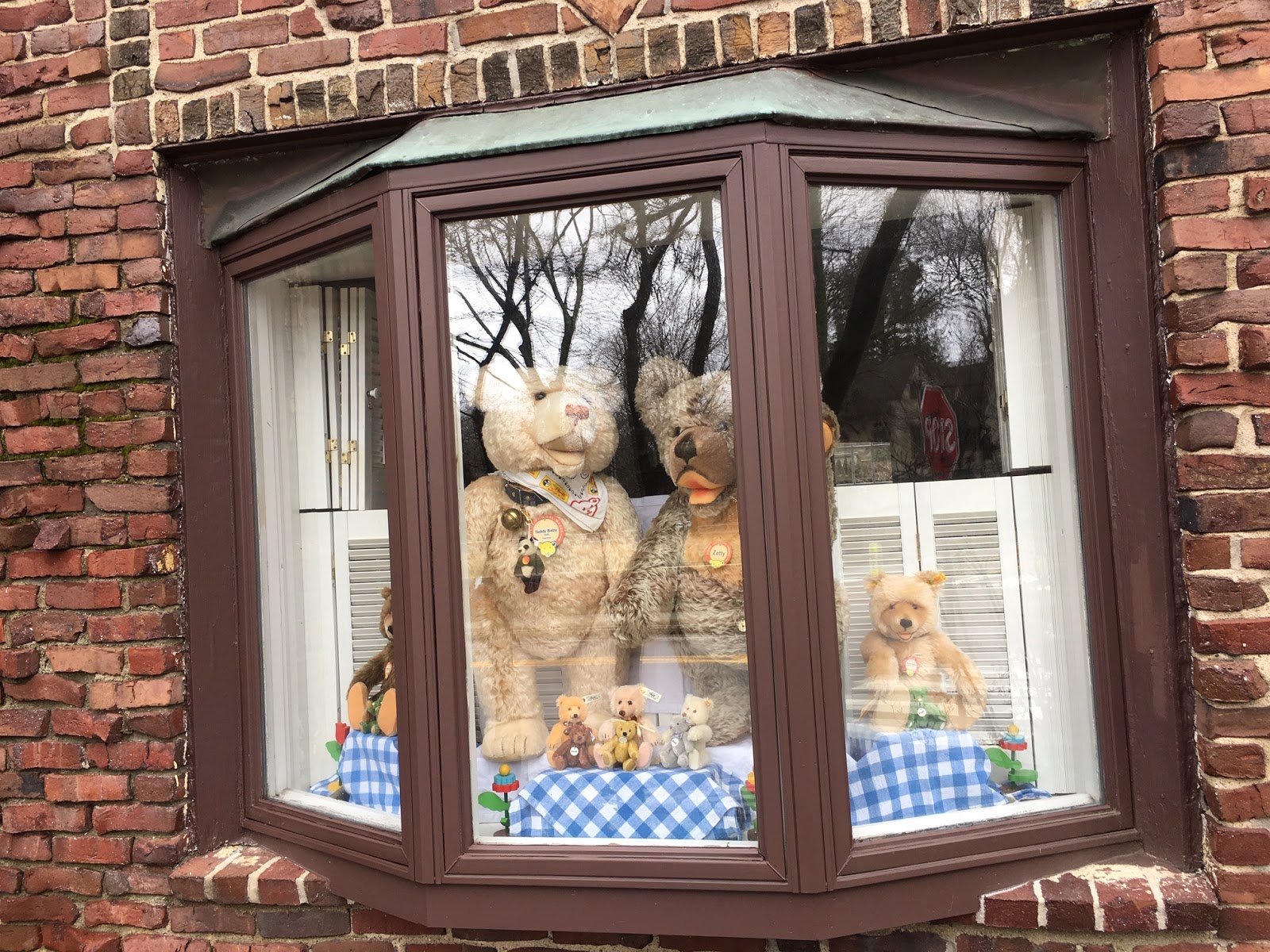
Steiffgal immediately embraced this unusual "window of opportunity" and sprang into action. The front of her home, which has two bay windows, faces a well-travelled street walked by locals and visitors alike. The bays usually display a collection of succulents, given their full sun exposure. Steiffgal moved all the greenery into one bay, so the other could feature bears. The cubs selected for display include a 75 cm replica Teddy baby, an 80 cm studio Zotty, two 35 cm Teddy baby replicas, three 15 cm Teddy baby replicas, and three teeny-tiny 10 cm cubs. All the bears are sitting or standing on blue and white checkered risers - as a nod to their Bavarian heritage. A few wooden flowers - also made by Steiff in the late 1960s - early 1970s as part of a floral construction/puzzle set - add a spot or two of primary color to the display.
The bears chosen for the window display were selected to bring a smile to your face - literally. Most of the cubs have open, smiling mouths. From the collector's perspective, the most interesting one is the 80 cm studio Zotty bear. This fine fellow was made in the mid-1960s and was produced in both 80 cm and a whopping 100 cm. He really translates proportionally well in this huge size, but is quite chunky - definitely too large and heavy to be a hands-on plaything. This handsome hunk retains his original yellow silk ribbon, as well as his huge chest tag, large raised script button, and handwritten, yellow ear tag as his Steiff IDs. The 1967 catalog page for studio Zotty is featured here on the left.
So what's been the feedback on this contribution to the Teddy bear scavenger hunt? It has been delightful to see walkers of all ages stop, point, and study the vignette. Some people take photos, other take selfies with the bear display in the backdrop. One youngster was so excited to see the bears he started squealing in delight (or maybe fear?) The display does seem to offer passers-by a spot of happiness and levity in a period seriously devoid of both.
If you are willing and able, I would ask you to consider also putting a Steiff or two in a visible window in your home, apartment, or condo. Please help spread universal love, goodwill, and kindness through this no-cost gesture.
Steiffgal hopes this discussion on displaying Teddy bears in your windows has been absolutely "pane"-less to you.
Have a question about one of your Steiff treasures? Let's talk! Click here to learn more!
Just in Claus you haven't noticed, its just a few hours until Christmas Day is upon us! And nothing says season’s greetings quite like the main man in red - Santa Claus - at least here in the United States.
Check out this page from a 1967 Steiff catalog featuring an almost life-sized Santa Claus doll. You can click on the image to make it bigger. Many collectors are familiar with the company's popular and beloved smaller Santa Claus dolls, which were produced in 13, 18, and 31 cm from 1953 through 1963 overall. This pattern was also made as a puppet. In the 1960s, Steiff produced this big fellow as a display piece in 150 cm, or about 5 feet. These supersized Steiff Santas were dressed to the nines in fine felt tailored suits trimmed in mohair - just like their rockstar namesake!
Today, these life-sized Santas are extremely rare, as for the most part, time has not been kind to them. Because their faces were made from rubber, they tend to dry out, sink, and crack as the years go by. As such, there are not too many of these still around. Steiffgal only knows of one, and he's having a rough go of it. And speaking of faces, it is interesting to note that the same facial mold used to create this display Santa was also used on the company's display sized shepherd and gnomes which were all produced at the same time as this Santa; you can see two of these "lifesized" gnomes here on the left. You can click on the image to make it bigger.
Steiff's Santa catalog page, like many of Steiff's vintage advertising images, is utterly charming, visually engaging, and tells a happy story. It is also fun to check out the other secondary items in the shot - those toys and articles placed around the featured article to help bring it to life. The selections often represent a "time capsule" of popular line items of the time, which is absolutely true in this case as well.
Santa's delightful deliveries from 1967 include:
*A caramel mohair “mask style" original Teddy bear (made from 1966-93 in sizes ranging from 11-100 cm overall.)
*A grey mohair Snobby poodle (made from 1954-74 in sizes ranging from 10-43 cm overall.)
*A white plush Diva cat (made from 1967-78 in 35 cm.)
*A mohair giraffe (made from 1953-74 in sizes ranging from 14-75 cm overall.)
*A brown mohair jointed Jocko monkey (made from 1949-81 in sizes ranging from 10-80 cm overall.)
*A grey mohair Jumbo elephant (made from 1952-75 in 22 and 35 cm overall.)
*A Mungo multicolored monkey (made from 1957-71 in 17, 25, and 35 cm overall.)
*A tan wool plush camel (made from 1950-69 in 14, 17, 28, and 35 cm overall.)
Steiffgal ho-ho-hopes this life-sized discussion on Steiff's display Santa Claus has put you in a holly-jolly mood!
Have a question about one of your Steiff treasures? Let's talk! Click here to learn more.
What's on your Steiff bucket list? For the longest time, Steiffgal dreamed of adopting a Studio Jocko chimp. She had seen a few in photographs and immediately fell in love with their scale, playful looks, and charming personalities. Whenever Steiffgal asked her what she wanted for a birthday, anniversary, or holiday gift, she would jokingly exclaim, "a Studio Jocko!" Well, be careful what you wish for... because wishes - especially Steiff wishes - can come true. Please meet Studio Jocko, Steiffgal's new beloved Steiff pal. Here he is pictured on the left, relaxing on the couch with a few relatives. It's easy to go bananas over this great ape. He stands 150 cm tall (5 feet) and is head and arm jointed. He is made of really long, chocolate brown mohair. His face, feet, ears, and hands are made from tan felt and are detailed with light airbrushing to give them additional dimension and depth. He has typical Jocko chimp detailing, like pert eyes set into eye pockets, a white mohair chin, and an open, smiling mouth - albeit on a huge scale. Jocko has an internal rod metal skeleton for stability, and he stands on two flat feet. He is solidly stuffed with excelsior, which must have taken several strong men weeks if not months to complete. According to the Sortiment book, this big boy was produced in this size only in 1960 and 1967. Here on the left is the Steiff Display Animal catalog page from 1967 featuring him. Now let's take a brief "guided tour" of Jocko.
As you can see, he really is a very big dude indeed. Here he is pictured with Steiffgal. Just for reference, Steiffgal is 5'5". It is Steiffgal's best estimate that if indeed he were real and made from muscle and bone, his girth and proportions would put him between 300-400 pounds. He actually weighs about 25 pounds.
His handsome, proportionally large face is simply irresistible - and always smiling! It measures 22 inches from his chin to the top of his head, and 20 inches ear to ear.
Here is a close up of his dimensional and very lifelike ear. You can see the smallest 4 inch Jocko resting on it so you get an idea of its scale. Big Jocko's ears measure 5.5 inches high each.
And here is a close up of his hand. Again, the smallest Jocko helps to put his size in context. His hands measure about 8 inches long and 9 inches wide.
Jocko has flat felt feet to help him stand (with a little help.) They measure 14 inches long and 8 inches wide. As you can see, Jocko is extremely photogenic. If you are in the Maryland area on September 28th and 29th, 2018, Jumbo Jocko and Steiffgal will be attending the United Federation of Doll Clubs (UFDC) Region 11 conference in Towson, MD. We will be manning a Steiff table in the salesroom with lots of Steiff temptations for doll and Steiff collectors alike. Jocko looks forward to meeting as many Steiff fans as possible at this great event, and is available for once-in-a-lifetime selfies. Click here for more information on this UFDC celebration. Steiffgal hopes this discussion on her Studio Jocko has been a larger than life experience for you. Have a question about one of your Steiff treasures? Let's talk! Click here to learn more!
Let's not be sheepish here - this week's find is truly awesome. Steiffgal recently added this lovely beast to her collection. He was listed on eBay and with a little luck, she placed the winning bid. However, it wasn't clear from the photos just how large, or how well made he was. It's always a treat to be surprised about those things. Take a look at this fuzzy friend to learn moor!
Let's sound the horn over this amazing rarity. Here we have Steiff's studio Moorland Sheep. He is standing on all fours and unjointed. He measures about 18 inches tall (measured vertically, head to toe) and 27 inches long (measured horizontally, nose to end of tail.) His body is made from ultra long white fuzzy mohair. His tail, ears, legs, and face are made from short black mohair. His huge, curling, 3D horns are made from felt, stuffed with excelsior, and have airbrushed highlights. And his face comes to life with green and black glass pupil eyes and a simple pink hand embroidered nose and mouth. Steiffgal had to provide replacement eyes as he arrived without any at all! This studio Moorland Sheep was produced in 1960 only and technically at 50 cm, which roughly corresponds with his height measurements.
Buttoning up his Steiff identity is his great hand written yellow tag and raised script button. The tag reads 1350,90. This translates to 1=standing, 3=mohair, 50=size of 50 cm, 9=display animal or special edition, and 0=normal coloring (probably meaning color found in nature.) So his article number pretty much captures his characteristics in a nutshell! Often times unusual items, rarer studio items, or special orders have hand written tags. This is so because so few are/were produced, it is not worth the time, effort, or money to have just a handful of eartags printed up for these editions.
Moorland sheep are native to Germany and come in a few genetic variations. This one created by Steiff is based on the "German Grey Heath" sheep, which are known for their distinctive black and white coloration, as well as prominent horns. They are born all white but their ears, face, tail, and legs become black at around two years old. You can see a real German Grey Heath pictured here on the left. Steiff's version is certainly cuter, don't you think?
Now let's play the name game. It is interesting to note that the scientific name of Moorland sheep is "Heidschnucke." Steiff has produced a number of horned black and white sheep over time, the most famous being their "Snucki" mountain sheep. This design, which also features shaggy white mohair, short black mohair, and fantastic horns, was produced in 12, 17, 22, and 28 cm from 1959 through 1974. The 22 cm Snucki is pictured here on the left. Although not identified SPECIFICALLY as a Moorland sheep, it is Steiffgal's best guess that the company's Snucki is based on the design and details of this great German native species.
Steiffgal hopes this discussion on Steiff's Heidschnucke didn't have you counting sheep.
Have a question about one of your Steiff treasures? Let's talk! Click here to learn more!


 Posts
Posts