Showing posts with label tumbler. Show all posts

Friday, April 3, 2026

A Brief Revue Of All Steiff Things 'Goo!

Marsupials are a subclass of mammals, with one key difference: all females deliver their babies prematurely and nurture them in their pouches, sometimes for up to a year.
Today, there are only 344 species of marsupials on the planet; most live in Australia, New Guinea, and the surrounding island nations. Perhaps the best known marsupials are kangaroos - who also happen to have a long history in the Steiff line! A fine example of the company's late midcentury 14 cm Linda Kangaroo is pictured here on the left. 

These “pocketed pretties” were one of the very earliest animals made by Steiff. The first ones were produced in 1897 – only five years after the company published their first catalog in 1892, and nine years before the introduction of the button-in-ear trademark in late 1904. These 1897 standing, unjointed 'goo debuts included a 28 cm version made from short pile plush and a felt model made in 12, 17, and 28 cm. 

Soon after, in 1902, Steiff introduced a velvet kangaroo in 12 and 17 cm that was similar in design to its felt offering.
 The 12 cm velvet version also was produced with a basket on its back as a pincushion from 1902-1905. The 17 cm versions of both the felt and velvet kangaroos were made as tumblers on wooden hemispheres from 1901-1905 overall. You can see an example of that here on the left, the photo is from Pfeiffer's 1892-1943 Sortiment. These turn of last century models may have been male as none had pouches. All were basic in design and in some ways looked more like little rodents than the bouncing beauties intended.   
 
That possible case of “mistaken identity” did not last long. In 1906, Steiff updated their original kangaroo pattern to make it more lifelike; the new model was now five ways jointed, made from short pile plush, had a robust curved tail and shapely limbs, and a much more detailed face. New kangaroo was produced in 35, 43, 50, and 120 cm and was available through 1917. 

It was not until 1929 that Steiff’s kangaroos were again updated; many of these new design features remained on kangaroos through the 1970s. Most importantly, this late 1920’s pattern finally included a pouch and a joey, starting in 1933! These models were made from mohair and were manufactured in 35, 43, and 50 cm through 1939. The joey was 10 cm and also made from mohair; interestingly, his construction consisted just of a head and body and no limbs. He resembled a cute bottle-stopper with a mouse-like head. 

Fast forward to 1953. 
The factory had reopened after the war and Steiff was jumping at the bit to rebuild its toy empire. They introduced Kangaroo “Kangoo”, who was very similar to the prewar design. Mohair Kangoo was made through 1966 in 14, 28, 50, and 65 cm. The biggest one debuted in 1958; here on the left, you can see the 65 cm version as it was introduced in the company's catalog that year. The larger versions were arm jointed; all sizes were made with a pouch. The 14 and 28 cm Kangoos had plastic joeys, the 50 cm size had a velvet joey, and the 65 cm size had a mohair joey; all the joeys were “full body." Kangoo also appeared, albeit less frequently, without a pouch as a male Kangaroo. You can see an example of the "pouchless" Kangoo below on the left. 

A newer but similar kangaroo design named "Linda" took Kangoo’s place in the Steiff line from 1967 through 1974. 
Linda was made in 14, 28, and 50 cm; like Kangoo, the 14 and 28 cm Lindas had plastic joeys and the 50 cm size had a velvet joey. In 1960, Steiff debuted its postwar Studio Kangaroo; this big bouncing beauty was head and arm jointed and had a prominent pouch and darling joey. This model appeared in the line in 150 cm through 1967; she was also made in 120 cm in 1967. 

Steiffgal hopes this discussion on the history of Steiff's 20th century kangaroo evolution has you jumping for joy!

Have a question about one of your Steiff treasures? Let's talk! Click here to learn more.

Saturday, August 24, 2024

Color Me Beautiful With This Fabulous Antique Felt Steiff Rooster

Bird's the word with this next Steiff inquiry. A collector friend with a great eye just added this fine feathered friend to her Steiff hug. His coloration and form are simply outstanding! Julie shares, 


"I just got this adorable little felt Steiff rooster! I am excited to know more about him and to learn when he was made. The closest I can find to him in the Sortiment is on page 546, which is a little rooster on a wheeled platform. The colors are exactly the same. Mine is about 10 cm high, and that's accounting for him being bent over a bit. If he had a button would it have been in his tail? He has a rusty old pin stuck in his side which is interesting. His tail is in really great shape, I don’t see any potential holes for a button in it. Was there maybe something with the style of feet and legs or tail to distinguish him from the very early 1892-1905 production? I see some may have had felt covered feet. The seller said that his great grandmother was born in Austria and brought this rooster with her to the US around 1900 or a little later."


This fantastic find wins Steiffgal's admiration with flying colors! What we have here is one of Steiff's earliest commercially successful legacy animal patterns. This classic, full bodied standing felt rooster was produced for the standard line in 12, 22, 29, and 35 cm from 1892-1929 overall. Very similar patterns were made on eccentric wooden wheels in 12 and 22 cm from 1917-1929 overall; as a tumbling 17 cm version on a weighted wooden hemisphere from 1894-1918; as an 8 cm pull toy on a wheeled wooden cart from 1916-1919; and as the kingpin in a set of hen skittles from 1894-1914 overall. 


What makes this pattern so exceptional, and so timely, is its materials and form. In terms of fabric, Margarete Steiff launched her company in the late 1800s; she initially specialized in producing felt items including garments, functional pockets, and household items. Felt material was readily available and relatively easy to cut and sew. When she started to produce animals a few years later, Margarete discovered that felt also translated perfectly into feathers when precisely cut, layered, and placed in cascading natural hues. In terms of form, Steiff's turn of last century product development was based on "everyday" animals - those farm, field, and forest animals that folks in Giengen would come across on a regular basis. As such, this particular rooster pattern is practically a time capsule example of Steiff's earliest commercial production. 


Given its popularity, Steiff's felt rooster pattern appeared in the line in one form or another for nearly 40 years. As such, it can be challenging to exactly date any given example. The felt supplied for this item certainly had some natural variations in color and quality over time; this can account for minor differences in product appearances. Many artisans cut and sewed this rooster over its four decade long appearance in the catalog; because of this, variations in size, presentation, and button placement are also expected. For the most part, older versions of legacy items have a more distinctive, handmade, and organic look to them than their cousins produced a few years or decades onward. Julie's example has metal feet and legs which are wrapped in string to finish them. This detailing is seen on many of Steiff's earlier birds from the turn of last century, as well as on some smaller and/or baby birds through the 1920s. 


Given these factors, and that his original family can date him to the very beginning of the 20th century, it is Steiffgal's best thinking that this example might date from the pre-button period (i.e., produced before 1904). Also supporting this age guesstimate is the fact that there is no indication anywhere on the rooster of a small hole where a button may have been placed originally. Steiffgal has seen a Steiff button inserted in the tail feathers, waddle, or comb of the company's early felt rooster and hen production. She also thinks that Julie's bird is most likely a 12 cm version that was either made a little on the small side or which bent or shrunk a little over its nearly century and a quarter existence. 


Here's one final point about this barnyard buddy. Interestingly, is possible that this pint-sized rooster was used at one time as a pincushion. This would make sense given his size and materials, and may explain the rusty pin found in his side! And/or, it is possible that this pin could have been used during his production in Giengen and never removed by accident... but only he knows for sure!


Steiffgal hopes this discussion on this antique felt rooster has you crowing about Steiff's earliest production. 

Have a question about one of your Steiff treasures? Let's talk! Click here to learn more.

Sunday, March 24, 2024

Would You Take A Tumble For This Early And Fantastic Feline Steiff Novelty?

This next Steiff inquiry comes in on little cat's feet. A new friend has reached out about a special family heirloom with provenance. Just what is this very early turn of last century treasure? And what makes it so fantastic from the collector's perspectives? Tom shares in part,

"I've attached photos of my Rolly Polly cat. I've had this since I was a child (50+ years ago)... It originally came from a relative who inherited it from their partner who came from a wealthy family from New England."


This guy is simply the cat's meow. But, given his form, he is "technically" a tumbler and not a roly-poly. Steiff's early 20th century roly-polys are all fabric and shaped sort of like an inverted balloon. Most are head and arm jointed, without legs. Examples include mohair cats (made in 16 and 23 cm from 1909 through 1919 overall); mohair Teddy bears (made in 16, 19, 23, and 29 cm from 1909 through 1916 overall)mohair rabbits (made in 23 cm from 1909 through 1918); and a series of mohair and felt dolls from the same basic time frame.

On the other hand, tumblers are full bodied and mounted to a very heavy, weighted wooden half circle base. As such, they wobble about like a weeble but always return to an upright position. Their bases are simply stained and are a natural wood color. Most tumblers measure 12 to 17 cm tall and are standing, sitting, or begging. Steiff did make a few oversized circus bear style tumblers in 35 and 43 cm through 1918 overall.

Tumblers debuted as early as 1894 and appeared in the general line with frequency through the late 19-teens. In the late 1930s, Steiff produced a series of three begging style tumblers on green or red painted wooden bases from 1936 through 1943 overall. Models included a velvet and mohair squirrel, a mohair Waldi Dachshund, and a mohair kitten holding a pom pom ball.

So back to Tom's cat.
 The photos suggest that he is made entirely from felt. Steiffgal suspects he is the company's Tumbling Cat, which appeared in the line in 17 cm (not including his base) from 1894 through 1919. The cat is solidly stuffed with excelsior and features black shoe button eyes and simple facial embroidery. It is hard to tell if he ever had a button, based on the photo of his face. It is entirely possible that he was manufactured pre-1904. Other early Steiff cat tumblers include a spotted velvet version made in 12 cm from 1904 through 1917 and a velvet striped version made in 17 cm from 1901 through 1919.

What makes this tumbler even more remarkable is its condition. He is made from felt, which tends to get grubby over time and attract insects. He was also designed as a toy, but it is clear he received little hands on play. Also of note is his tail. These are actually super thin, not terribly sturdy, and are attached to the animal's rear with just a few stitches. Often, these go missing or break off given their construction and natural aging. However, in this case, Tom's tumbler appears clean and damage free against all odds! Super score all around!

Steiffgal hopes this discussion on Steiff's early tumblers has got you rocking and rolling!

Have a question about one of your Steiff treasures? Let's talk! Click here to learn more.

Friday, September 29, 2023

Moving And Grooving With This Extraordinary Steiff Auction Rarity

No need to brush off this week's special blog guest! Ladenburger Spielzeugauktion GmbH recently held its annual early fall auction on September 22nd and 23rd, 2023. The sale included a number of interesting vintage toys, dolls, and bears... but one incredibly rare and often misunderstood Steiff rarity really rose to the top. It also caught Steiffgal's eye in a major way. Check out this very early turn of last century novelty. It's guaranteed to have you moving and grooving!

This special lot was number 3158, a Steiff "Bristles Bear." It was cataloged as: "Bristles bear, produced between 1902 and 1904, 20 cm, short plush, brown, attending, dancing on a circular wooden board, with feet made of bristles, with elephant button, shoe button eyes, and tip of the nose made of a shoe button, with original label, D.H. Wagner & Sohn, Spielwarenhandlung, Leipzig Grfmmaische Str. 6., Naschmarkt-Gegenüber, unused original condition, very rare, unusual." It had a starting bid of 850 euro and hammered at an amazing 7,700 euro.

So just what makes this guy so important?
Besides its breathtaking condition and extraordinary elephant button, this very early style of bear was one of the inspirations behind Richard Steiff's invention of the fully jointed Teddy bear as we know and love him today. Really! At the turn of last century, Richard was thinking of ways to make his family's toys more fun, interactive, and kinetic. This bear, in the form of a circus bear with a nose ring and chain, stands on a wooden platform which is mounted on little brushes like toothbrush brushes. When the toy is place on a table or flat surface, and the surface is tapped, the vibrations cause the bear to shake and shimmy on the platform. So the bear moves, sort of, but Richard knew there was a better design out there. You can see some of Steiff's earliest turn of last century "moving" bears on the picture above on the left; they include (from left to right) two Bristles bears, a bear on a four wheeled cart, and three tumblers on weighted wooden half spheres. 

Richard also spent a lot of time at the local zoo, watching how animals interact and get around, and making sketches of them in the flesh.
He was very interested in trying to figure out how to reproduce these lifelike movements in his toy designs. Also around this time, in 1903, mohair became available on a commercial level and in supplies adequate enough for the toymaking business. It wasn't long before it became crystal clear that this soft, durable, and furry fabric would be perfect for making world class soft bears and animals. 

So how does this all come together? After a lot of thinking, planning, and creative energy, Richard took the best of his current "moving" product line, his observations of bears ambling about in real life, and the opportunities presented by mohair fabric and came up with the company's first fully jointed string bear in 1902 - PB55. Although this pattern proved not to be commercially viable, it was quickly updated to rod and then cardboard disk style jointing, and the rest - as they say - is history!

Steiffgal hopes this little history lesson, based on Steiff's early Bristles bear, has been a hair raising experience!

Have a question about one of your Steiff treasures? Let's talk! Click here to learn more.

Tuesday, January 15, 2019

Vectis Auctions' Upcoming January 2019 Doll & Teddy Bear Sale To Offer Lots Of Steiff Temptations


Temptations, temptations... as Steiff collectors, we all are excited to learn about interesting sales and opportunities on the horizon. So Steiffgal was delighted to hear from her colleague Joanne McDonald at Vectis Auctions about an upcoming event featuring fantastic vintage Steiff selections. The company's Doll & Teddy Bear Sale will be held on January 29, 2019 starting at 10:30 AM GMT at the Vectis galleries, located in Stockton on Tees in the United Kingdom. Here are three outstanding Steiff lots from that sale that really caught Steiffgal's eye - and why. 

There's no horsing around that this first pick, lot #4616, is one of the mane events of this toy auction. It's a rare, antique Steiff horse on early metal wheels, estimated at £300 - £500 ($385 - $642.) It is cataloged as:

"Steiff vintage rare Muster (sample) horse on wheels, German, circa 1907 (produced from 1907-1920), Art No 1359, with rare Muster button to left ear (also has remains of white fabric tag behind button), Steiff button is missing, cinnamon and white mohair, black boot button eyes, black velveteen inner ears, inserted black cotton mane, tail is missing, upon metal chassis with connecting frame, original cord is still attached to frame (faded), four six-spoked metal wheels, curb bit with long metal shank (inserted within horse's closed mouth), curb chain, bridle is missing, leather saddle with tooled edging, leather girth, stirrups with leathers, crupper, red felt saddle cloth with gold embroidered edge (felt is holed, particularly under the seat of the saddle where a piece is missing), white felt surcingle, mohair is worn and faded / discoloured with some areas of balding overall, muzzle is holed to front, left ear has hole, Fair Plus to Good, 19.75"/50cm. NB: Steiff "Muster" button was used by the company on sample pieces- defining the piece to be a 'sample.'"

Collectors are certain to jockey for position over this eye-catching and unusual example. The size is perfect - not too big, not too small - and won't take up alot of room... which is a issue with many items on wheels. He has an authentic, early presentation and would look would look charming posed alone, or even better, with doll or Teddy riders on his back. It is great that he still retains his accessories, including his stirrups, saddle, blanket, and reins. And buttoning things up here, his seldom seen and desirable "muster" button is the frosting on the cake. It is Steiffgal's understanding that Steiff used the "muster" button pre-WWII on items considered samples, evolving designs, prototypes, or the "gold standard" for production. In general, the button indicated that the item was Steiff property and was not intended for sale or distribution. "Muster" translates loosely from German to English as "template" and in a sense, these "muster" items were just that.  

There's no grey area when it comes to this next auction highlight. It is lot #4621, a Steiff vintage rare Purzel or somersaulting elephant, estimated at £1,000 - £1,500 ($1,285 - $1,927.) It is cataloged as:

"Steiff vintage rare Purzel (somersault) elephant, German, Art No 9323, 1909-1910, button with underscored "f" and remains of white paper tag, grey mohair, black boot button eyes, felt tusks, fully jointed, black toe stitching, mohair and felt tusks a little discoloured, slight bald patch to left forehead, tip of trunk and left hind leg, mechanism is free and partially engaging but does not operate, otherwise Excellent, 12.75"/32cm. NB: The elephant is the rarest of all Steiff tumbling animals- only appearing in the catalogue for two years."

This great tumbler is truly ele-fantastic.  His design itself is really appealing, but his clockwork feature would make any enthusiast go head over heels over him. Steiff's tumblers are all time collector's favorites, and seldom appear on the secondary market. These somersaulting sweeties are activated by an internal clockwork mechanism and literally do somersaults when their arms are wound up. Steiff "purzel" production included bears, monkeys, elephants, and a few doll models, including Eskimos and clowns. For context, in 2016, a similar one changed hands at auction in the USA at $3,300 (£2,568).

And this last auction highlight is more fun than a barrel of monkeys. Check out lot #4622 a rare vintage Steiff Jocko monkey, estimated at £700 - £900 ($900 - $1,156.) It is cataloged as:

"Steiff vintage rare Jocko monkey, German, c 1930, uppercase letters with underscored "f" button (with remains of white tag behind), ginger* mohair, brown and black glass eyes, felt inset face, cream mohair chin, felt ears, hands and feet, fully jointed, slight discolouration / wear to mohair and felt, small hole to felt left cheek, left little felt finger is holed, mohair thinning to right cheek and torso (inoperative press squeaker), otherwise Good Plus to Excellent, 11"/28cm. NB: *This is not a standard Steiff line item and is highly desirable in this colour."

This spicy guy is a ginger prince indeed. Unlike Steiff's regular line Jocko monkeys, which were produced in brown or white mohair, this fantastic rarity was manufactured in an almost orange colored mohair. It is easy to think that he "faded" or "oxidized" to this color, or was somehow treated to produce this color, but indeed he was "born this way." Prewar, Steiff sometimes produced standard line items in small quantities in "un-standard" materials for a few reasons. These include 1) using materials on hand to make an item when its regular materials were not available, 2) testing a new fabric on a standard item to see if it was appealing or made sense from the monetary or product line extension perspectives, and 3) fulfilling an order for a window display, customer special request, or other business purpose. Steiffgal knows of two other 1930-era gloriously hued Jockos like this one, and in both cases, they are considered collection "royalty" by their owners.  

Steiffgal hopes this discussion on Vectis' upcoming sale has given you "lots" to think about. Please check out the company's website at www.vectis.co.uk to learn more and to see the auction's 650+ wonderful toy treats firsthand. 

Have a question about one of your Steiff treasures? Let's talk! Click here to learn more.

Sunday, September 2, 2018

Care to Rock and Roll With This Adorable Antique Steiff Tumbler?

You are sure to take a tumble over this week's featured Steiff rarity! Steiff is well known for producing novelty items based on some of its most popular designs, and this hare-raising piece is a perfect example of that. So steady yourself and check out this wonderful - and totally adorable - Steiff tumbling rabbit.

This bun is truly designed for fun! The rabbit is 12 cm tall and made from velvet. This measurement takes into account the vertical height from his head to his feet and does not include his ears. He is begging and unjointed. His body and presentation are quite simplified, but his form is unmistakably that of a rabbit. His face comes to life with black button eyes, a pink hand embroidered nose and mouth, and clear monofilament whiskers. He is airbrushed with a few brown spots here and there. His bow and bell are original to him. Rabbit sits upon a naturally colored wooden hemisphere which is detailed with a decorative groove around its perimeter. The wooden base is really heavy and shows little wear. Rockin' rabbit retains its tiny long trailing "F" button in ear as his Steiff ID. This novelty was made in velvet in 12 and 17 cm from 1901-1917 overall.

Given its popularity, the number of items using this  basic "heavy bottomed" pattern multiplied like jackrabbits in the Steiff line starting in the late 19th century. It first appeared in felt as early as 1892 and was produced over time in white, spotted white (like this tumbler), grey, black, or brown in sizes ranging from 10 to 28 cm. It was made in a number of other materials, including velvet, short pile plush, wool plush, or mohair through the end of World War I. Some came with a basket on their backs (perhaps to resemble the Easter Rabbit?), and a few of the smallest velvet versions were produced as pincushions or rattles.

This very vertical design was also perfect to mount on the tops of wooden skittles. Steiff made rabbit skittles in both felt and velvet. Sets for the American market featured 10 pins while those for the European market had 9. These sets consisted of 8 or 9 begging rabbits and one rabbit king pin dressed in a red felt top coat and crown. All were mounted on wooden plinths with the king pin on a slightly higher platform. Felt sets appeared from 1892-1912 and the velvet ones from 1901-1916. The picture on the left is from James D. Julia; this set sold for $7,110 in 2014.

Given the history and longevity of this early begging rabbit pattern, it is not terribly unusual to find examples that never had a button as they were produced around 1904 or earlier. As most collectors are aware, Steiff debuted its now ubiquitous branding in 1904 with their "elephant" style button. 

This basic bunny pattern is also a best seller for another important reason. He also represents one of Steiff's earliest, and most important licensing agreements - that of "Peter Rabbit!" in 1902, Beatrix Potter's Peter Rabbit became a worldwide sensation due to its simple, universal story and beautiful illustrations. Ms. Potter created a little Peter Rabbit doll and registered it in the London patent office. Despite numerous attempts, she could not find a manufacturer in England to produce her toy. Steiff got wind of this, and soon became the producer of the "official" Peter Rabbit doll for the English market. The company took their basic rabbit pattern and added a felt topcoat and slippers to his design. Steiff's Peter Rabbit appeared in the company's product line in velvet or wool plush in sizes ranging from 10 to 28 cm from about 1904-1919 overall. Today, an early and all original Steiff Peter Rabbit can easily generate big four figures at auction.

Steiffgal hopes this discussion on this great tumbling rabbit has been a windfall for you.

Have a question about one of your Steiff treasures? Let's talk! Click here to learn more!

Sunday, June 10, 2018

I'll Tumble For You!

Talk about (s)tumbling onto a fantastic Steiff find! Robin was at the right place at the right time when she found this absolutely amazing and extremely rare early Steiff bear novelty. She shares,

"Hi Steiffgal,


Here's the item I told you about. He is pretty cool and definitely something I’ve never seen before. Before I received him, I thought he might be a skittle like the bear ones I already have, and the bear himself is very similar but he’s much bigger and the base is totally different.

The bear himself is 10" tall and about 5" elbow to elbow. The base is 5-1/2" in diameter and 2-1/2" high. The base is wood with some kind of metal weight inset, that allow him to rock and spin without falling over. It is quite heavy."


Wow, it is easy to lose balance over this delightful turn of last century toy. He's actually a wonderful example of Steiff's early Tumbling Bear. He's standing, unjointed, and made from an early plush material. His eyes are black, and his nose and mouth are embroidered in a very early style. He is mounted on a weighted, wooden hemisphere. This allows him to wobble about, like a very early "weeble" but not fall down. He left the factory holding a wooden stick between his paws and a chain connecting his nose to the stick - to resemble a circus bear of the time.  You can see traces of the stitching on his paws that would have held the stick in place. These real-life bears would travel from city to city at the turn of last century as part of roaming circus companies. Robin's tumbling bear was produced in 35 cm from 1899 through 1918 overall. 

Check out this tumbler in action here!

Robin's tumbler has a key role in the history of the development of the jointed Teddy bear as we know him today. In the late 1890's, Steiff produced a number of bear novelties. They were made to give the toys action and movement. The picture on the left shows a few examples of these early bear toys. Left to right, they include bears on platforms with bristles supporting them; a bear on a cart with metal wheels; and three tumblers in different sizes and configurations. The bears on the platforms with bristles would move when someone tapped the table on which they were standing - so they would sort of "shimmy" about.

Richard Steiff wanted to create far more playful, dynamic, and child-friendly versions of these static/moving bears, and he took this challenge very seriously. He studied the way real bears move at the zoo. Mohair, a fabric perfect for soft, durable toys, became available on a commercial level around 1902. He married those two facts, inserted his great creativity, and came up with the patterns for a series of fully jointed bears, starting with string jointing, then rod jointing, then disk jointing. The company's disk jointing system has not changed much since its introduction over a century ago.

Steiffgal hopes this discussion on Robin's tumbler has left you steady on your feet!

Have a question about one of your Steiff treasures? Let's talk! Click here to learn more.

Saturday, January 24, 2015

Having A Ball With This Terrific Steiff Roly Poly Bear

Most Steiff collectors would take a tumble for an unexpected Steiff discovery!  And that's exactly what Steiffgal did when an inquiry from a colleague about this great and very vintage Steiff treasure landed in her email in-box.  Steady yourself and take a look at this marvelous merrymaker!

Oh baby, here we have a delightful "child-proof" item intended for the youngest Steiff enthusiasts.  This is Steiff's "Roly Poly" Bear.  Many of us grew up with "Weebles," those funny egg shaped character toys that "wobble but they don't fall down."  This Roly Poly cub is an early version of this toy idea.  

Roly Poly Bear is made from mohair with a very distinct shape - extremely round (almost ball-like) on the bottom, with a standard jointed Teddy bear head.  He has jointed arms but no legs at all.  His face is detailed with black shoebutton eyes and a brown hand embroidered nose and mouth.  He retains his long trailing "f" button as his Steiff ID. Given his stitching is brown, it is safe to assume that this bear started out life with white mohair - which has aged and mellowed to darker vanilla color over time.  Overall, this pattern was produced in 16, 19, 23, and 29 cm from 1909 through 1916.  During that entire time, it was produced in blond mohair.  However, in 1912 it was also produced in white mohair in the smaller sizes.  So this is one rare bear indeed!

Steiff's soft Roly Polys are great Steiff novelty items.  Models produced over time include rabbits, cats, and dolls. But these are not the first type of "rounded bottom" products that the company produced.  It is possible that Roly Polys are based in part on the company's much older wooden bottom "tumblers," which were smaller, standard line items (usually in the sitting or begging position) that were mounted on a solid wooden hemisphere.  Like the Roly Polys, they swayed and tumbled about, but did not fall completely over - unlike their wooden cousins the "skittles" - which were designed like bowling pins to fall down!  The big difference between the Roly Polys and the tumblers was that Roly Polys had a rounded bottom that was integral to their body and design, while tumblers could be basically any shape - as the featured animal or doll was mounted to a rounded bottom.  Wooden bottomed tumblers appeared in the line as early as 1894, and were produced on and off through the early 1940's. The photo on the left shows a very early wooden bottomed felt clown tumbler; this shot was taken at Margarete Steiff's birth house in Giengen, Germany where this item is also on display.

It is interesting to note that Steiff's Roly Polys made two distinct appearances in the Steiff line.  The first was basically from around 1909 through the late 19-teens... the era of the little white Roly Poly under discussion here.  These ball-like creatures came 'round again from 1937 through 1943 overall, in the form of three designs:  a 20 cm mohair Roly Poly Teddy baby, a 20 mohair Roly Poly Rabbit, and a 25 cm felt Roly Poly clown doll.  Most memorably, an all but pristine example of the Roly Poly Teddy baby realized almost $17,000 at auction at Christie's in London in October, 2010!  This terrific Ted is pictured here on the left.

Steiffgal hopes this discussion on Steiff's Roly Polys and tumblers been a well rounded experience for you.

Have a question about one of your Steiff treasures? Let's talk! Click here to learn more. 

Friday, December 6, 2013

An Exclusive Online Auction Preview, Just For Steifflife Readers!


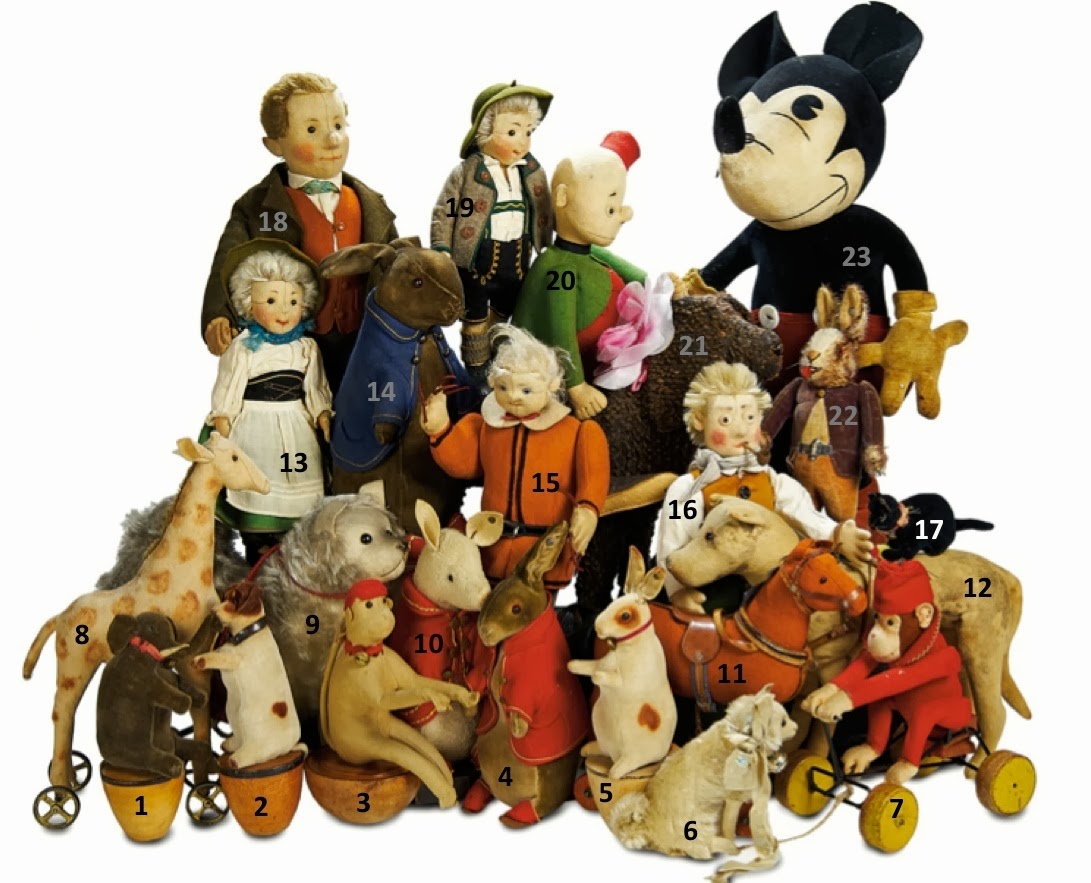
Pssss.... wanna know a (Steiff) secret?  Steiffgal has learned of an AMAZING collection of vintage Steiff items going up for sale early next year... and she wants to share the details with you!  Check out this breathtaking photo of vintage Steiff treasures that will hit the auction block on January 10-12th, 2014.  They are all part of Theriault's Marquis event which will be held at the Westin South Coast Plaza in Newport Beach, CA.  The image reflects just a small sample of the 100+ treasures from the collection of American Steiff enthusiast Helen Welsh Gastaldo.  Let's take a look at these items and see what makes them so interesting, and exciting, from the collector's perspective.

Items 1, 2, and 5:
In this case, it's very good to get off to a shaky start.  What we have here are marvelous examples of Steiff's early skittles.  Skittles as a game was a turn of last century pastime analogous to bowling.  Steiff produced skittle sets from 1892 through 1919. Over that period of time, Steiff made the sets with hens, monkeys, elephants, pigs, rabbits, poodles, pointers, cats, chicks, dachshunds, elephants, pointers, cats, and bears, among others. In all cases - except the hen and the chick versions - the kingpin wore a felt jacket and crown.  The sets produced for the European market had nine total skittles, while those for America had ten total.  All sets came with two felt "bowling" balls. 

These three skittles - an elephant, pointer, and rabbit - are made from velvet and are on a wooden base.  The elephant skittle was made from 1901 through 1916; the pointer was made from 1901 through 1909; and the rabbit was made from 1901 thorough 1916.

Item 3:
Steiffgal is certain most collectors would take a tumble for item #3.  Here we have Steiff's turn of last century tumbling monkey.  Unlike skittles, which were designed to be knocked over, Steiff's tumblers were made to wobble about, but not flip over.   It is interesting to note that the monkey on the top of this tumbler is one of the very earliest Steiff designs ever; it is quite possible that he might even be "pre-button" as this product was made even before Steiff began putting their trademark "Knopf Im Ohr" in all products starting in 1904. 

Tumbling monkey was produced in felt in 17 cm from 1894 through 1917; pre-1912 models resembled the more primitive looking one in the group photo above.  Models produced after 1912 looked much more like Steiff's traditional "Jocko" style chimp, who was debuted in 1909 and received his moniker in 1929.

Items 4 and 14:
These two items will most definitely generate more than just a hare of interest.  These honey bunnies are none other than original Steiff Peter Rabbit dolls!  In 1902, a "little book" written and illustrated by English author Beatrix Potter, hit the market in a big way. This book, Peter Rabbit, became a worldwide sensation due to its simple, universal story and beautiful illustrations. Ms. Potter created a little Peter Rabbit doll and registered it in the London patent office. Despite numerous attempts, she could not find a manufacturer in England to produce her toy. Steiff got wind of this, and soon became the producer of the "official" Peter Rabbit doll for the English market.   

It is generally understood by collectors that a "Steiff Peter Rabbit" is standing and wears a felt topcoat and slippers. According to the Steiff Sortiment, the gold standard Steiff reference book, there are two version of Peter Rabbit. The first is a spotted white velvet version wearing a red or navy topcoat and red slippers; he was produced in 10, 22, and 28 cm from 1904 through 1919.The second is a white wool plush version wearing a green felt topcoat and red slippers; he was produced in 22 cm from 1904 through 1918. 

Item 10:
Interestingly, at the exact time that Steiff was manufacturing its Peter Rabbit dolls, they also produced a similarly designed white wool plush cat, poodle, bulldog, pig, and elephant.  All were 22 cm, sitting, flat bottomed, begging, and dapperly attired in felt topcoats and slippers identical in design to the one worn by the Peter Rabbit.   

Item #10 in the photo is indeed a nice example of the pig; specifically, this design was manufactured from 1904 through 1918.

Items 6 and 9:
These next two items should be treated like royalty!  Here we have two versions of Steiff's early unjointed Spitz or Pomeranian dogs.  See how #9, the one on wheels, has a red cord around his neck?  Most likely #6 did too, when he left the factory in Giengen over a century ago.  Early Steiff Spitz dogs usually wore a red cord with two pom-poms or tassels around their necks, giving them a “regal” appearance. The breed does have some connections to German nobility, which may explain why they are decorated like “little kings.”   

Spritz on wheels was manufactured in 17, 22, 28, 35, 43, and 50 cm from over the 1902 through 1929 time period.  Sitting Spritz was produced in 14, 17, 22, 28, 35, and 43 cm from 1902 through 1927.  This pattern was also produced jointed, as well as on a pincushion.

Items 12 and 21:
Besides bears, dogs are, and have always been, the second most important category in the Steiff line.  There was even a time in the mid to late 1920's where dog production outnumbered bear production at Steiff.  Here we have two exceptional dogs that could be the "blue ribbon" in any Steiff enthusiast's collection. And they even have something quite unusual in common - Steiffgal was not aware of these two items before doing some research on them!   

Item #12 is great for many reasons, including his legacy!  He is Steiff's Lord the Great Dane, who was made from course fabric in 17, 22, and 28 cm from only 1932 through 1936.  Even rarer is item #21, which is Steiff's earliest curled wool plush poodle, which was only made in this brown color from 1892 through 1894.  Overall, this early poodle design was produced in black, grey, brown and white fur in 12, 14, 17, 22, 28, 35, 43, 50, and 60 cm with and without wheels from 1892 through 1905.

Item 17:
Collector's just may get into a cat fight over this most unusual Steiff kitten.  Like dogs, cats are very high up on the company's list of important product cat-agories, no pun intended!  And Steiff's black cats have always held a special place in collector's hearts, due to their rarity and distinctive appearance.  The first black Steiff cat did appear in the company's debut catalog of 1892 in the form of a black standing  plush tabby, with or without wheels.  But this early lying version is a bit of a mystery... 

Despite much searching, Steiffgal was not able to find this small "lying" style black velvet cat in her Steiff archival materials.  However, based on the item's appearance, scale, and placement of bow, it is her best guess that she is an unreferenced black version of the company's early lying cat that debuted in velvet in 1899.  This general style of cat - unjointed, in a relaxed position, with a basic body shape - first appeared in felt in 1898.  Steiff's general line early lying velvet cat was produced in 6, 8, and 10 cm through 1927 in white, grey, spotted, or striped patterns.  It is interesting to note that these lying cats all held tiny woolen balls between their front paws; it is not possible to tell from the photo if this black example has one as well. 

Items 7, 8, and 11:
These three items are the wheel deal indeed.  Here we have three great examples of Steiff's rolling rarities.  Steiff has a very long tradition of producing items on wheels; many felt examples like these were featured in the company's debut catalog of 1892... including #8, the giraffe, and #11, the horse!  Wheels gave an item movement and life, so it is not surprising that Steiff designed some playthings with this feature. The earliest items were produced on metal wheels; wooden wheels made their debut in the 19-teens.  

Rolling right along, the monkey on wheels is Steiff's Record Peter, which was produced in 20 and 25 cm from 1913 through 1938.  His "vehicle" is sometimes referred to as an "Irish Mail Cart." The giraffe was produced with and without wheels in 17, 28, 35, and 65 cm from 1892 through 1909 overall.  And the handsome horse - which was one of the most popular, and prolific prewar items -  was produced overall in 12, 14, 17, 22, 28, 35, 43, 50, 60, and 80 cm from 1892 through 1943.

Items 13, 18, and 19:
Soft dolls debuted in the Steiff line around 1903, and were known as "karikaturpuppen" or character dolls because of their exaggerated features and cartoon-like proportions.  It was not until the early 19-teens that the company started to make dolls on a truly human scale, usually with childlike or charming looks.  Often times these dolls would be boy-girl pairs wearing "everyday" or "Sunday best" attire; the company also made a series of dolls sporting country specific clothing.  These sweet friends were made in sizes ranging from 22 to a whopping 115 cm - and always dressed to the 9's regardless of height! 

Steiffgal's not kid-ing around when it comes to these adorable Steiff youngsters.  Lucky item #13 is Steiff's Lisl, who was produced in 28, 35, 43, 50, 60, and 75 cm from 1909 through 1926.  It is interesting to note that in the Steiff reference books she is pictured with a miniature zither - which was Margarete Steiff's instrument of choice.  Although Steiffgal cannot find an exact reference to item #18 in her Steiff history books, she is confident that he was made in the 1911 through 1920 time frame and is most likely a student or sportsman.  Steiff made a series of very tall, elegant, and sophisticatedly dressed dolls in this timeframe, and his "look and feel" really overlap with these better-known examples.  And finally, item #19 is Anton.  This beautiful Bavarian boy was made in 28, 35, 43, 50, and 60 cm from 1909 through 1927.

Item 16:
Steiff dolls also could have a sense of humor, and this particular example certainly takes the bully pulpit on that point! Here we have Steiff's 35 cm fully jointed Tramp Strolch doll.  It is interesting to note that "strolch" translates from German to English as "Bully."  Clearly, Strolch looks like he's had better days.  His bare feet, patched pants, and "hangover" style eyes accurately reflect, and accentuate, his character. 

Tramp Strolch doll was produced in this size only from 1922 through 1928.

Items 15, 20, 22, and 23:
Finally, Steiff has a very long tradition of partnering with companies, authors, and the media to bring beloved cultural or fictional characters to life - Steiff style! Perhaps the earliest example of this took place in 1913, when Steiff was asked to create “Bibendum” out of felt in two sizes for a company in France. “Bibendum”, or “Bib”, is the Michelin Tire Man! Like the Peter Rabbits discussed previously, newspapers, books, and magazines have also provided Steiff with great ideas for very successful product development ideas.  These four items truly illustrate that point in the best way possible. 

Item #15 is Steiff's Shockheaded Peter doll.  Steiff produced Shockheaded Peter in the 1909 through 1927 time frame in 3 sizes - 30, 35, and 43 cm. He was also available in 20 cm as a ride-on pull toy from 1916 through 1927.  Shockheaded Peter was the central character in a book written by Heinrich Hoffmann in 1845 as a gift to his son. The book was composed of ten richly illustrated tales focusing on children. Each story had a life or societal lesson and graphically illustrated the results of bad behavior in each situation, in an Edward Gorey - like fashion.  

Item #20 is the cartoon strip character "Happy Hooligan."  He was produced in 35 cm only from 1904 through 1927. Happy, who was actually usually unhappy, was character from a comic strip called Happy Hooligan penned by writer Frederick Bur Opper; the series debuted in print in 1900. 

Item #22 is Jack Rabbit, who was produced in 22 and 28 cm from 1927 through 1931.  He was, of course, the central character in a popular series of children's books (of the time) by beloved author Dave Cory. 

Item #23 needs no introduction.  Here we have Steiff's classic velvet Mickey Mouse doll.  Steiff made Mickey Mouse from 1931 through 1936 in 11, 16, 23, 30, 36, and 48 cm. A tail moves head and a 24 cm puppet version were also produced in the same time frame. 

Steiffgal hopes this special preview has put you in the most delightful holiday mood ever!  More information about these items, which are all offered without reserve, will be posted around Christmastime at either www.issuu.com/theriaults or www.proxibid.com/theriaults.  Or, you can call Theriault's at 1-800-638-0422 to order the print catalog, which is scheduled to ship the last week in December. 

Have a question about one of your Steiff treasures, family or otherwise? Let's talk! Click here to learn more.
The teddy bear search engine