Showing posts with label musical. Show all posts

Sunday, May 5, 2024

All Smiles Over This Steiff Midcentury Musical Teddy Baby!

You will quickly understand why Steiffgal is whistling a happy tune over this next fantastic - and most unexpected - find. This sweet gal was found at an estate sale in the New England area in somewhat run down condition. But Steiffgal knew with a little TLC, spit, and polish (and a new spring outfit), she would be nearly her old self again. Take a look at this midcentury singing sweetie and see what makes her so interesting from the design and historical perspectives.

Can you bear it? Yes, what we have here is Steiff's Music-Baer or Music Bear. She is 25 cm tall, head jointed, and standing. Her body is a simple cylinder made from tan wool plush and her brown mohair arms are floppy. She has pink hand embroidered claws on each paw. Her head is based on the beloved and legacy Teddy baby design, originally introduced in the 1920s. Teddy has an internal Swiss music box which plays when her torso is pressed and released up and down like an accordion. When she was new, she left the factory dressed in a white cotton shirt and a red, black, and white rayon skirt with a green felt waistband and matching suspenders. 

This musical marvel was made from 1950 through 1951 only. She retains her original Steiff trailing f button, yellow ear tag with the numbers 9325 on it, and traces of a white linen "Made in the US Zone" tag in her left arm seam. All of these IDs perfectly align with her dates of manufacture - just a few years after the company opened for toy making business again following WWII. It is interesting to note that this musical Teddy baby's ID number translates to... 9=mechanical, 3=mohair, 25=25 cm tall. Steiff also made "girly" versions of this dressed music box product based on their popular Bazi the Doxie and Kitty the cat designs of the period.

This Teddy baby find really benefited from a little spa treatment. Sadly, her rayon skirt and white shirt had all but disintegrated over time; what was left of both items were in tatters. To honor her "plaid" origins, Steiffgal created a little neck scarf out of the skirt's salvageable material. You can see her factory original outfit here on the left, the photo is from Pfeiffer's 1947-2003 Sortiment. 

Music Teddy also was covered in at least a half century of dust and grime. With a little elbow grease and a gentle scrub, her original beauty and personality came shining through again! Her wool plush body and tan muzzle darkened a touch overall and evenly over time, and there's not much anyone can do about that. But her brown mohair really revealed quite a glow upon cleaning. 

As for her clothing, Teddy baby is again donning an all original Steiff outfit. Although these contemporary pieces were produced by Steiff more than a half century onward from Teddy baby's birth year, they still look great, are appropriate, and well scaled to her somewhat unusual body. She wears a green calico dress; the fabric features tiny versions of Steiff's most popular playthings and Steiff bear faced logos. And she's keeping warm with a light blue felt jacket detailed with a collar and round gold buttons; this coat was produced for a Steiff Peter Rabbit a few years ago.

Steiffgal hopes this discussion on this wonderful Teddy find has been music to your ears. 

Have a question about one of your Steiff treasures? Let's talk! Click here to learn more.

Friday, April 5, 2024

Hands In The Air Over This Fabulous Prewar Steiff Find!

The show must go on... and this week it is in the form of a puppet show! Yet another super Steiff surprise hit Steiffgal's inbox this week. Here is something so rare that Steiffgal can count on one hand (yes, pun intended!) the number of examples she knows of in real life. Check out this note from Mariette who shares...

"I read something about your Charly puppet and saw my Petsy puppet in the same advertisement picture. Since you are always interested in more Steiff items I present to you my Steiff puppet from I guess 1928? It is about 24 cm long and made from tipped reddish and white mohair. It has blue glass eyes and a prewar long ff button with red remnants of a tag. On the inside it has a cardboard cylinder where you can put your finger in to move the head. I bought it at an antique market for 85 euros in the Netherlands. Hope you can tell me something about if it is rare because I never saw one before."


Here's a tip - this guy is off the charts great!
What we have here is Steiff's "Punch Petsy," or Petsy as a hand puppet. According to published company records, this cute cub was made in 17 cm from 1928 to 1932. His head and the tips of his paws are stuffed with excelsior, and as Mariette notes, he has a cardboard finger tube embedded in his head. Of course, he is based on the company's beloved brown tipped mohair Petsy the Baby Bear design - one of the true sweethearts of the company's "roaring 20s" era Teddy bear production.

Petsy's design was introduced in the late 1920s and was originally named "Buschy." Thankfully, Steiff's marketing team changed this to "Petsy" to reflect his precious and toddler-esque presentation and personality. Brown tipped Petsy appeared in the catalog from 1928 to 1930 in 10 sizes ranging from 22 to 75 cm, measured standing. This model was fully jointed with tan felt pads. His distinctive facial properties included a prominent center facial seam, blue and black glass pupil eyes, a rose-pink hand embroidered nose and mouth, and proportionally large, rounded, wire rimmed, and posable ears.

In addition to a puppet, Steiff also made a handful of other novelty items based on their brown tipped Petsy pattern.
These included a full bodied musical version, which was produced in 25 and 30 from 1928 to 1930. He also appeared as a pull toy on wheels, called a "Record Petsy." This delightful design appeared in the line in 20 and 25 cm from 1928 to 1929. And finally, Petsy was manufactured as a standing, head jointed handbag in 17 cm from 1927 to 1928. All of these blue eyed novelties are indeed blue ribbon, and as rare as hen's teeth!

Ok, how about a penny for your thoughts here?
Mariette notes that she paid 85 euro for her Petsy puppet. So how did she do? After much research, the only other example Steiffgal could find of a Petsy puppet sold at public auction was in February, 2016. There, one traded hands at over 6,300 euro! Of course, something is worth what someone will pay for it, and Mariette's example has some condition and losses which might impact its ultimate value or price tag. But it is safe to say that she did VERY WELL, and would have no trouble at all selling it at a significant profit if she ever decided to rehome it. 

Steiffgal hopes this discussion on Steiff's amazing Petsy Puppet is worthy of a standing ovation. 

Have a question about one of your Steiff treasures? Let's talk! Click here to learn more.

Monday, May 29, 2023

Simply The Best: Highlights From Ladenburger Spielzeugauktion's July 1, 2023 Steiff Auction Event

Last January, Ladenburger Spielzeugauktion GmbH presented the first installment of the Susan Kilgore Wiley collection of breathtaking, antique Steiff bears, animals, and novelties. This awesome event realized over $475,000 and was the talk of the international vintage Steiff collecting community. Now it's time for the second part of the sale, which is most fittingly being held on July 1st, 2023 in Giengen, Germany in association with Steiff's annual Steiff Sommer celebration. Here are three over the top items on offer as part of that auction. Steiffgal did not even know these items existed until now, they are that rare and that AMAZING. Please sit down, fasten your seatbelt, and read on!

It's the best of all worlds with this first Wiley auction highlight.
Here we have lot #45, an early 20th century Steiff Teddy bear girl doll. It is cataloged by the auction house in part as:

"One of the of the highlights of the auction, probably a prototype by the Fa. STEIFF, unusual doll, felt head, blue glass eyes, bright mohair hair, with button, block letters, long trailing f, bear body, with white mohair, probably original silk ribbon and silk collar, height: 35 cm, small felt faults at the right cheek, exceptional, stronger mohair loss on the reverse of the legs and at the back, otherwise single places with slightly thin mohair, exceptional, probably an unique specimen." It has an opening bid of 1500 €.

This beautiful treasure probably dates around 1912, given her presentation, glass pupil eyes, and facial seaming. It was around that time that Steiff's proportional dolls were becoming very popular. The company was producing a number of adorable student and childlike dolls that were dressed in everyday clothes, Sunday best, and regional attire. These charming examples were even sold through FAO Schwarz in the United States! Steiffgal suspects that Steiff was looking at ways to expand their doll offering through different novelty options, and knows of a Steiff topsy-turvy style doll prototype from c. 1912. It makes perfect sense that Steiff would experiment with a doll head and a Teddy bear body, as the company specialized in both deigns and other manufacturers had these "hybrid" items in their lines. This doll bear probably did not go into production because it was very expensive and labor intensive to manufacture on a commercial scale.

This next highlight is truly on fire.
Here we have lot #49, a most colorful Steiff Teddy on the go. The auction house catalogs it in part as:

"STEIFF Record-teddy, produced 1927-1930, with button, block letters, long trailing f, red fiery mohair, glass eyes, felt paws, except of minimally places in good condition, scattered thin mohair, and mohair loss, swivel head, color is wear down at the wooden wheels, height: 24 cm, length: 24 cm, extremely exceptional, very strong colors, rare." It has an opening bid of 1200 €.

Collectors will recognize this delightful pull toy as an example of the company's legacy Record pattern. This pull toy design debuted around 1912 in the form of Record Jocko, a chimp on wheels. Bears and dolls on wheels quickly followed this introduction as they made for perfect passengers on Steiff's simple but charming four wheeled cart design. According to Pfeiffer's Sortiment, this particular Record Teddy was produced in 20 and 25 cm from 1927-1930. What's so interesting about this time frame is that it exactly corresponds with the "heyday" of the appearance of brilliantly colored, tipped mohair items in the Steiff line. Steiffgal has never seen an orange tipped Steiff bear in this size, and it is possible that they were only created for this novelty, and not as a freestanding item. Other tipped mohair highlights from the "roaring 20s" include rabbits, cats, dogs, and other eye-catching pets. 

And last but not least, please check out lot #54, a musical Teddy clown bear.
The auction house catalogs it in part as:

"Teddy clown, rare, with music mechanism, probably a single-item production, yellow gold mohair plush, glass eyes, bright embroidering at snout, softly stuffed, kapok filling, a rarity, with hat, standing height 39 cm, with button, block letters, long trailing f, scattered small faults at the felt paws, nice, full mohair, with music mechanism, long snaped off arms, on the reverse here and there with places with minimally mohair loss, original ruff and hat, produced c. around 1927." It has an opening bid of 1900 €.

These sorts of rarities make collectors want to break out in song! Teddy Clown bears themselves are quite rare on the market, given they were only made from 1926-1930 overall. In 1928, Steiff debuted a series of "Music-Animals" based on their most popular designs and patterns of the time. These items were standard line animals with a music box imbedded in their torsos. According to company documents, they included a Teddy bear, Petsy, Bully dogs, Molly, Cheerio, Fellow, Charly, Treff, Fluffy, a lamb, and a clown. There is no mention of a musical Teddy Clown in any materials Steiffgal can find. However, given the range of characters and novelties produced as music box toys, it is not out of the question that Steiff would have considered producing Teddy Clown as a musical edition. Perhaps this example was created as a prototype for this product development experiment.

For more information on this amazing sale to be held on July 1, 2023 and to see all of the great lots on offer, please see the auction house's website at https://www.spielzeugauktion.de.

Steiffgal hopes this discussion on these absolute auction rarities has further cataloged your interest in vintage Steiff!

Have a question about one of your Steiff treasures? Let's talk! Click here to learn more.

Sunday, April 17, 2022

Tune In For More Information About This Fabulous Steiff Novelty!

Today's blog post is going to be music to your ears - really! In the prewar era, Steiff produced a number of really marvelous novelties based on their most popular characters of the time. Check out this remarkable find from a new friend across the pond who asks about an antique dog that can carry a tune probably better than most of us. Zoe shares:

"I'm really interested to find out if my lovely dog is a genuine Steiff, I have done a little research but can't seem to find a dog the same as him which contains musical bellows, when his tummy is squeezed he makes a lovely twinkling noise! He has the Steiff button in his ear with the underling f which I've found out that he was made between 1908 and 1920, he also has his original pink ribbon! I have enclosed some pics I'd love to know if he is real? He also has most of his fur but has faded as under his ears is darker. Best wishes, Zoe" 

Let's put the spotlight on this wonderfully talented Steiff dog. What we have here is Steiff's Musical Molly. She is standing, 28 cm tall, and made from long white mohair. When she left the factory over a century ago, her mohair was brown-tipped on her ears, around her eyes, and on her rear back. Sometimes this fades over time. She comes to life with oversized black and brown glass pupil eyes, a black hand embroidered nose and mouth, and folded over ears. She has black embroidered claws on each of her paws. When you squeeze her midsection, she plays a merry tune. Her notes are produced by a "press and release" style music box. 

Zoe's blue ribbon buddy was produced in this size only from 1928-1931. Molly was also produced as a sitting "press and release" musical animal in 25 cm during the same time frame. This production timeline corresponds perfectly to the IDs on this musical dog under review today. Standing musical Molly sports a long trailing "f" button and remains of her red ear tag, both which appeared in tandem on items in the late 1920s-early 1930s. 

Musical animals have been featured sporadically in the Steiff line since the mid-1920s. Given that the company's items were mostly designed as "friends for life" for children, it would make sense that some higher end models would also feature the ability to lull a child to sleep with imbedded musical features. 

High quality, European made music boxes became available on a large, commercial scale in the mid 1920's. Seeing this as a product development opportunity, Steiff created a series of "Music-Animals" in 1928. This chorus included Molly dogs, a Teddy bear, Petsy the baby bear, Bully the bulldog, Cheerio the laughing puppy, Fellow the puppy, Charly the King Charles Spaniel, Treff the bloodhound, Fluffy the cat, a clown, and a standing lamb. Most had a "press and release" style music box; standing Charly's music box was activated by pulling on his tail. These items appeared overall in sizes ranging from 17 through 43 cm. However, despite their charming appearance and musical features, these collectibles were quite expensive and few were made. Unfortunately at the time, sales were minimal - probably because of cost - and they were last featured in the catalog in 1930/1931.

Steiffgal hopes this discussion on Zoe's Musical Molly dog has added a chorus of delight to your day.

Have a question about one of your Steiff treasures? Let's talk! Click here to learn more.

Saturday, January 23, 2021

Tuning Into This Rare And Unusual Musical Steiff Santa Claus Doll

Does this great Steiff Santa doll strike a chord with you? Check out this unusual holiday hero with a very special feature - he's musical! Have you ever seen another one like it? A friend from Pennsylvania shares... 

We bought this 15" Steiff with a music box key wind in the sack. The music box is in the sack attached to his back with a large key protruding from it. I would love to know anything you can tell me about it. Thank you!


Well, let's warm things up with what we know about this friend from the North Pole. The doll itself is based on the company's legacy midcentury Santa doll pattern introduced in 1953. This earliest Santa doll was 31 cm and five-ways jointed. He had a rubber head, felt body, bright red felt suit and cap trimmed in white mohair, and a white, fluffy mohair beard. By 1955, this design was also produced in 13 and 18 cm. These Santa dolls appeared in the line through 1963 and were, and remain, year-round favorites with collectors worldwide. The Santa under discussion today measures 15" tall, or 38 cm, so he was probably not part of Steiff's standard line Santa production. His larger size suggests he was a special order, perhaps intended as a seasonal window or mantel display. 

Now let's tune into his musical feature. With full disclosure that Steiffgal has not handled this item in person and inspected for originality, she can suggest two possible origins for his music box.  

First: Given that the music box is located in his sack, and not in his torso, it is possible that it is not Steiff original to him and was placed there by a previous owner.
 The music box is described as having "a large key." Every wind up music box Steiffgal has handled has a very small, simple turning knob. It's size hints that the music box may not be Steiff original to him. Just about every musical Steiff item Steiffgal can think of from any era has its musical feature embedded in its body - probably to secure it in place, as well as to protect it against bangs and bumps. For example, the musical Basi pictured to the left has her music feature in her bottle shaped body; it is activated by pressing her up and down. As Steiff's midcentury Santa dolls were not distributed with a Santa sack, it wouldn't be that challenging to make one, put a wind up music box in it, and sew it to the doll's body. That would be MUCH easier than opening up the doll, removing stuffing, inserting a music box, and sewing everything up seamlessly. 

Second: It is also possible that the musical feature is all original to the doll.
Most Steiff collectors are familiar with the company's standard line musical Cockie Cocker Spaniel, Teddy Bear, and cat patterns. These were all produced in the mid to late 1950s. However, Steiff also produced a number of other uncatalogued musical rarities based on beloved 1950s era designs, including their Lulac rabbit and lying tiger. "Music Tiger" is pictured here on the left. Given the timeline and popularity of the 38 cm doll design under discussion here, it is not out of the question that the company tried to make a musical Santa Claus doll, too; maybe even in a distinctly larger size. Perhaps the musical machinery was too large or strangely shaped to bury it in the doll's torso so the designers made a sack for him, and hid the music box within it. If the Santa sack is elegantly constructed from period fabric, matches the look and feel of the doll, and has aged in tandem with the rest of the overall doll and clothing, this would suggest that is factory original to the doll. But, in the end, only Santa knows for sure... and he's keeping tight lipped over this!

Steiffgal hopes this discussion of this musical Santa Claus has wound up your interest in this unusual doll. 

Have a question about one of your Steiff treasures? Let's talk! Click here to learn more.

Saturday, January 7, 2017

Getting Around To Solving This Unusual Steiff Mystery

Well, here's a little Steiff history-mystery! Check out this note about Steiff bear with some cryptic writing on his belly. Could this bear be a musical prototype? A new friend, in part, writes...

"I found your blog and thought I would reach out. Today I acquired what, from your blog, I have determined to be a mohair Musical Teddy. Unfortunately, it does not have the ear tag, though still has the made in Germany on the back, and has been signed on one paw by Hans Otto and the other paw is dated 1983. 

Interestingly, there is also writing on the red musical circle that appears to say 1954-55 and then has a series of numbers underneath that. The antiques store where I bought it seemed to think it was a "salesman sample". I just wondered if you had ever run across such a thing?"

Well, let's strike up the band and see what we have here. This bear is 
definitely an example of Steiff's Music Teddy. This bear was produced from 1951 through 1957. He is 35 cm, five ways jointed, and made from caramel colored mohair. His hand and foot pads are made from tannish peach colored felt. His face is detailed with brown and black glass pupil eyes and a brown hand embroidered nose and mouth. Smack dab in the middle of his belly is a red felt circle; when he was new, it had the word "music" in printed in white on it. When this spot was squeezed and released, it played a sweet lullaby. 

Let's paws for a second here and check out the information on the bear's feet. From the writing on the bear's lower pads, it appears that this piece was brought to a Steiff sponsored event in the early 1980's and signed by Hans Otto Steiff. Hans Otto Steiff was the former President of Steiff in Germany and a direct descendant of the founder, Margarete Steiff. Hans Otto and and his wife Brigit toured the USA several times in the 1980's, meeting collectors, attending events, and signing Steiff items.

Now let's circle back to the strange marks on his red felt belly patch. After thinking about this for awhile, it is Steiffgal's strongest suspicion that these numbers do not indicate that this bear is a prototype. The date on the patch, which reads 1954/5, doesn't really align with anything in this bear's production history. This bear was introduced in 1951 and was in the line from 1957. So if it was a prototype, meaning that it was produced prior to general line introduction, the date on the red circle would probably read 1950 or 1951. Or if it were a piece designed for the archives after manufacturing was complete, the date might read 1951/7, or something like that.

So what does this all mean?  Although there is no way to tell for sure, his presentation suggests that he was a beloved toy at one point in his life, based on his playwear pattern. Steiffgal speculates that that the date 1954/5 refers to the year that he was purchased or adopted, and the other numbers (12 9335,3) refer to the numbers that were on his original ear tag, which has since gone missing. These correspond to 12 = bear, 9 = mechanical, 3 = mohair, 35 = 35 cm, and 3 = with music box. Perhaps his owner put the dates and numbers on the red circle so they would forever be attached to his history, as the ear tags very often get lost to time. Or, it is possible that someone bought him from the owner, and asked them about the year they purchased him, or it could have been information from an antique dealer provided to someone at purchase. Besides his red felt circle, there really is no other place to record any writing or marks on him.

Steiffgal hopes her evaluation of this red-bellied mystery has been spot on with you.

Have a question about one of your Steiff treasures? Let's talk! Click here to learn more.

Saturday, March 28, 2015

Catching Spring Fever With Steiff's Wonderful Early Post War Bazi Dachshunds

At last, the snow in the park across the street from Steiffgal's house has started to melt enough that there are more patches of green than white. And no one could be happier about that than Steiffgal, with the pugs a very close second! It is great to see the neighborhood dogs again, who all seem so happy to end their winter-induced home hibernation! To celebrate the onset of spring and its associated "pup parade," let's take a look at one of Steiff's earliest post war dogs - Bazi the Dachshund - and see what makes him so interesting from the design and historical perspectives.

Doxies are a legacy design pattern for Steiff. They have been in the line almost continuously since the late 1890's, with the first version debuting in felt in 1897. This is easy to understand - this breed is especially beloved in Germany, and it seems as if the Steiff family themselves had a particular affinity for them as well! Steiff's first named long haired mohair Doxie, Waldi, debuted in 1933 and was an immediate sensation. Prewar, he was produced standing, sitting, as a hunter dog-doll, and on wheels. It is interesting to note that from what Steiffgal can calculate, Waldi has the honor of being the dog pattern with the longest history of production in the Steiff line. He appeared pretty much continuously in the line from 1933 through 1980 - for a total of 47 years. (Molly the puppy is a close second, with a total of 44 years.) An early standing Waldi is pictured here on the left.  

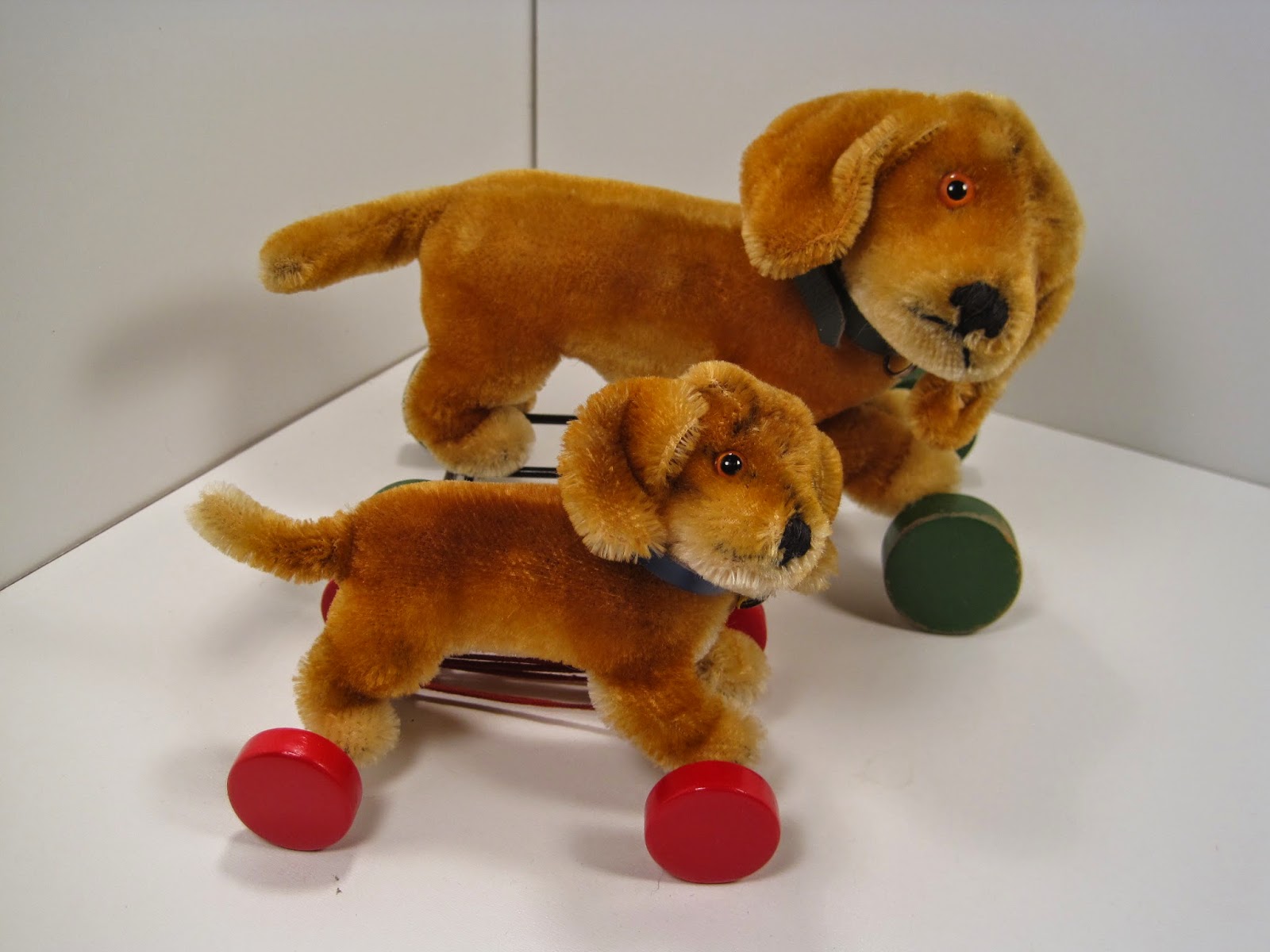
Most likely due to the success and popularity of Waldi, Steiff introduced a new Doxie named Bazi design right after the factory reopened for toy making business in the late 1940's. Two versions were produced - a sitting Bazi and a standing Bazi on wheels. Both were head jointed and made from artificial silk plush which was highlighted with brown and coppery highlights. Sitting Bazi was made in 14 and 17 cm from 1948 through 1949, while Bazi on wheels was produced in 14 cm in 1949 only. And, because of their era of production, these silk plush versions may have a number of Steiff's buttons, including a short or long trailing F button or a blank button. Sitting silk plush Bazi is pictured here on the left; this particular example has a blank button. 
  
Bazi took the collector's world by storm in 1950, and remained a constant in the production line through the mid 1970's.  The early 1950's could be called "the dogs days of Steiff" as this was the time when many new named dog patterns - like Snobby the Poodle, Dally the Dalmatian, and Sarras the Boxer -  were introduced as mohair became more readily available on a commercial scale again.  Starting in 1950, Bazi was made sitting, standing, on wheels, as as a press and release music box, and as a dog-doll.  You can see these blue-ribbon buddies pictured below.  

Sitting mohair Bazi was was produced in 10, 14, and 17 cm from 1950 through 1969. These are very early examples with their red imprinted chest tags and earliest article numbers. The small one also has his US Zone tag.

Standing mohair Bazi was produced in 10 and 14 cm from 1950 through 1975. Like his brothers pictured above, this is a very early example. 

Standing mohair Bazi on wooden eccentric wheels was produced in 10 and 14 cm from 1950 through 1961. This model rides upon four off-center wooden wheels and has the appearance of bobbing up and down as it is pulled along. 

Musical mohair Bazi was produced in 25 cm in 1950 and 1951 only. Please click here to learn more about this really interesting item and her full provenance.
 
Standing mohair Bazi dog-dolls were produced in 25 cm from 1950 through 1954. Please click here to learn more about the story behind this very sweet Bazi couple.

Steiffgal hopes this review of Steiff's beloved Bazi pattern has been as refreshing as a breath of spring air for you!

Have a question about one of your Steiff treasures? Let's talk! Click here to learn more.  

Saturday, August 2, 2014

This Musical Steiff Cocker Spaniel Can't Smile Without You!


They say that music soothes the savage beast. So given all the unsettling news that seems to be everywhere these days, Steiffgal thought this singing sweetie might just add a touch of joy to your day! Perhaps we can wind things down a notch by introducing you to "Music Cockie," who has one of Steiff's more "dynamic" music box feature designs. Come see what makes makes this maestro so interesting from the product design perspective.


This musical Cockie Cocker Spaniel just can't wait to break out in song for you. She is 17 cm, head jointed, and sitting. Cockie is made from black and white mohair. Her ears, rear, and tail are made from long wavy black mohair; the sides of her head are made from short black mohair. Her body and limbs are made from long wavy white mohair, while her muzzle and face are made from short white mohair. Cockie's adorable face is detailed with a huge, open, velvet lined mouth, a hand embroidered nose, and black and brown pupil eyes. She has a tail winding style music box, meaning that her musical talents are "activated" by turning her tail in a circular motion. You can see how that works in the video above.
 

It is interesting to note Steiff only produced one other "tail winding style" musical animal. This was a cat named Kitty. Like Cockie, Kitty was also 17 cm. She had a closed mouth and was made from white and grey mohair. Both Cockie and Kitty appeared in the line from 1955 to 1957, and then again in 1961. It is not unusual to find both models lacking the mohair covering on their tails, probably because this area got so much attention and wear from play. 

Steiff's Musical Cockie represents a relatively unusual example in the range of music box animals the company has produced over time. High quality, European made music boxes became available on a large, commercial scale in the mid 1920's. Seeing the potential in this, Steiff created a line of musical animals based on its most popular items of the era. And, for almost 100 years since then, the company has had musical offerings in the line - although the music box style and activation has changed significantly over the years.

Steiff's "Music-Animals" made their grand stage debut in 1928. This chorus included a five ways jointed Teddy bear, a brown tipped Petsy the baby bear, Bully the bulldog, Molly the puppy, Cheerio the laughing puppy, Fellow the puppy, Charly the King Charles Spaniel, Treff the bloodhound, Fluffy the cat, a clown, and a standing lamb.  Most had a "press and release" style music box; standing Charly's music box was activated by pulling on his tail. These items appeared overall in sizes ranging from 17 through 43 cm. However, despite their charming appearance and musical features, these collectibles were quite expensive and few were made.  Unfortunately at the time, sales were minimal - probably because of cost -  and they were last featured in the catalog in 1930/1931.  


After a two-decade long intermission, Steiff began orchestrating musical animals again in the 1950's.  In 1950, the company featured three new musical animals:  a "Music Bazi," a "Music Teddy Baby," and a "Music Kitty." Their music boxes were activated by gently squeezing their bodies up and down like an accordion.  All of these early post war musical animals appeared in the line in 1950 through 1951 only. Then in 1951, Steiff introduced "Music Teddy," whose design was based on the updated "Original Teddy Bear" pattern that was also introduced in 1951. Right the middle of his belly was a red felt circle that had the word "music" printed in white on it. When this spot was squeezed and released, it played a sweet lullaby.  Music Teddy was so popular that Steiff created "Music Jocko,"  based the company's standard line 35 cm brown mohair chimpanzee. Like Music Teddy, Music Jocko had a squeeze-activated music box implanted in his belly, which was also noted by a red felt disk on his belly. Both Music Jocko and Music Teddy (pictured above on the left) appeared in the line from 1951 through 1957; their production time slightly overlapping with Musical Cockie under discussion here.  

As music box technologies because less expensive and more durable, Steiff began putting them in more playthings designed specifically for babies and children. Since the 1970's, Steiff has made numerous plush, washable cotton, and velour musical items. Unlike Steiff's earlier models, these had wind up or pull cord musical mechanisms, and in some cases, the music box could be removed so the outer shell could be laundered. Today, Steiff frequently puts music boxes into child-friendly products.  Music boxes are also featured in "higher end" collectibles and special editions (like 2004's "American Pride" bear, pictured above on the left), and have become a regular feature in special Christmas and co-branded items

Steiffgal hopes this discussion on Steiff's Musical Cockie has added a happy tune to your day. 

Have a question about one of your Steiff treasures? Let's talk! Click here to learn more.  

Sunday, August 12, 2012

Singing A Happy Tune Over This Vintage Steiff Musical Bear

Some questions are just like music to Steiffgal's ears.  And this question from a reader sounds just like a happy tune.  Check out this note from Danny, who writes...

"Steiffgal,

I’m sure you get a million of these.  I’m looking to identify this bear with no ID ear tag.  The music box works when the red patch is pushed.  I’m only looking for an approximate era.

Thanks, Danny" 

Danny, yes, Steiffgal is fortunate to receive what feels like a million Steiff questions... but your special bear is considered by many collectors to be a one in a million find!  What you have here is simply called Music Teddy.  This bear was produced from 1951 through 1957 only.  He is 35 cm, five ways jointed, and made from caramel colored mohair.  His hand and foot pads are made from tannish peach colored felt.  His face is detailed with brown and black glass pupil eyes and a brown hand embroidered nose and mouth.  Smack dab in the middle of his belly is a red felt circle; when he was new,  it had the word "music" in printed in white on it.  When this spot was squeezed and released, it played a sweet lullaby.  

To see how that worked, please view the YouTube video posted below... This is not Danny's bear but another example of the same model, "for demonstration purposes only!" 


Feeling this bear worthy of an encore, Steiff decided to produce the original Music Teddy as a worldwide limited edition of 7,000 pieces in 1993.  This replica is pictured below.   


This singing sweetheart is a modification of Steiff's extremely popular and beloved "Original Teddy" design. This now classic and highly sought after pattern was produced in gold, blond, caramel, brown, and white mohair in the 1950 through 1966 time frame in 10, 11, 15, 18, 22, 25, 28, 35, 40, 43, 50, 65, and 75 cm.  An example of this bear in caramel is pictured below.


Collectors went ape over Music Teddy in the early 1950's, so Steiff decided to create another musical sensation - this time based on their classic Jocko the chimpanzee. Simply called Music Jocko, he was based the company's standard line 35 cm brown mohair chimpanzee.  A picture of Music Jocko appears below; this particular example sold at auction at Christie's in 2010 for about $700.  Like Music Teddy, Music Jocko had a squeeze-activated music box implanted in his belly, which was also noted by a red felt disk on his belly.  Music Jocko appeared in the line from 1951 through 1957.  


Now the question that gets Steiffgal feeling a little off key - his value.  As always, Steiffgal is not a formal appraiser and believes something is worth what some will pay for it.  She has not seen the item firsthand and cannot account for any details of its aesthetic or structural integrity, all which play an enormous role in his true "worth."  His somewhat worn appearance and lack of ID does subtract from his value.  However, this particular item is of particular interest and appeal to collectors based on his age, limited time in the line, and relative rarity overall.  Given all of that, and based on comparable sales, here in the USA he most likely values in the $450 to $800 range today.  

Steiffgal hopes this discussion on Danny's Music Teddy has you singing a happy tune.  

Have a question about one of your Steiff treasures? Let's talk! Click here to learn more 

Friday, June 1, 2012

Singing A Happy Tune Over This 1950's Steiff Musical Dog Doll

Ever feel like singing a happy tune because something in your Steiff collection makes you smile - for so many reasons?  Such is the case with this delightful and very unusual musical masterpiece that Steiffgal recently welcomed into her collection.  Not only is the treasure a precious find, it is also in remarkable shape for its age, and comes with a full family history.  As Ben Affleck said in the 1997 Oscar winning movie Good Will Hunting... "How do you like them apples?"  Steiffgal likes them alot!  So without further ado, here she is, and here is her story.
 
This top dog is known as Musik-Bazi or Music Bazi.  Bazi is 25 cm tall, unjointed, and standing.   Her body is a simple cylinder and her arms are floppy.  Her head is based on the beloved and endearing Bazi dachshund design, introduced in 1950. Bazi wears a blue cotton blouse, red cotton skirt, and had a sweet floral corsage when she left the factory in Giengen more than 60 years ago.  She has an internal Swiss music box which plays when her torso is pressed and released.  Bazi was made in 1950 and 1951 only.  She retains her original Steiff raised script button, crisp yellow ear tag with the numbers 9325 on it, and a white linen "Made in the US Zone" tag, ID which perfectly align with her dates of manufacture. It is interesting to note that her ID number translates to... 9=mechanical, 3=mohair, 25=25 cm. Steiff also made girly versions of this dressed music box product based on their popular Teddy Baby and Kitty cat designs of the period. 
 
Equally precious to her looks and musical talents are the details of her provenance. Her past owner, whom Steiffgal now calls a friend, provided these details of Bazi's history. They write in part...

"...[I recall as a youngster] that she was always kept out of harm's way on top of my father's chest of drawers. I am now [in my 60's] and there is never a time when I cannot remember her. 
 
[To make her sing, you] press down [on her belly], with a firm but gentle hand, and the musical notes play on the way down, and on the way back up. I have always assumed those beautiful notes played the first bar of "edelweiss", probably because of the little edelweiss flower on her dress.  And I think my father called her edelweiss for those reasons, and thence we children did the same... we children were very rarely allowed to push her down, and only with my father present!"
 
Now for the question that sends Steiffgal to the doghouse... her value.  As always, Steiffgal is not a formal appraiser and feels that something is worth what someone will pay.  On the upside, she is a collector's dream:  a unusual item, in lovely working condition, complete with a family history and legacy.  In addition, Steiff's early post war musical items seldom come on the secondary market and usually demand a premium when they do; the "Teddy Baby" version of this design had a hammer price of close to $3,000 a few years back at an auction at Christie's in London.  On the other side of the coin, over the past two years or so, the collectible market is way down because of the poor global economic situation.  Today, based on sales of other like items, and things from the early 1950's period, and musical examples, Steiffgal guesstimates that she most likely values in the $750 to 1,000 USD range.   
 
Steiffgal hopes this discussion of this wonderful Bazi has been like music to your ears.
 
Have a question about one of your Steiff treasures? Let's talk! Click here to learn more. 
The teddy bear search engine