Showing posts with label tusks. Show all posts

Thursday, November 17, 2022

This 1930s Steiff Tail-Turns-Head Novelty Is Simply Ele-Fantastic!

Steiff wishes can come true! Check out this note from Carey, a new friend from north of the border. She was gifted a jumbo surprise from her husband - one that just happens to be simply ele-fantastic. Steiffgal is certain you'll agree. She shares in part:
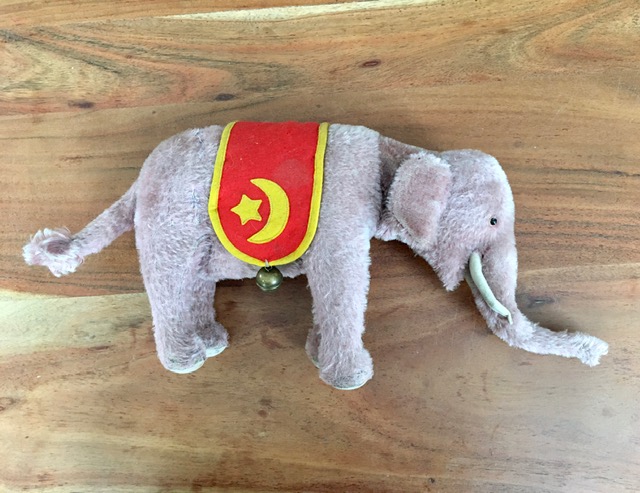
"Hi Steiffgal! I’m emailing from Ontario, Canada. Yesterday my husband gifted me an amazing find from Kijiji from an elderly couple who were downsizing. The elephant belonged to the woman’s father, and they immigrated to Canada from Poland.

Our new blushy pink/mauve Steiff elephant, based on what I could find from the button, is I think from the 30s. The tail makes the head move in a circle and the trunk is posable. It’s stuffed with straw, and due to the wear of the mohair around the foot pads, which are heavy felt, you can see black toes stamped onto the fabric. It’s about 8" tall, and the body excluding the tail and trunk is about 10" long. If it made any sounds when it was new, it doesn’t now."

There's not a drop of junk in the truck when it comes to this playful pachyderm.
This tail-move-head example is standing, head jointed, and made from mohair which has mellowed to a light pink color over time. This sometimes happens with originally grey mohair over time. His pads are made from grey felt, and his prominent tusks are made from white felt. He comes to life with floppy ears, black button eyes (which may be backed in felt - but it’s not clear from his photos) and a smiling, open mouth. His red and yellow felt blanket with bells is original to him. When you twist his mohair tipped tail in a circle, his head moves 360 degrees as well. This amazing tail-moves-head elephant was produced in 18, 23, and 29 cm from 1931-1934 overall; Carey's example is most likely the 18 cm version.


Steiff introduced its patented tail-moves-head line in 1931.
These nifty novelties were made with an internal metal movement mechanism that enabled the heads to move in a circle when the tails were rotated. These items were stuffed with excelsior to hold this mechanism firmly in place. Tail-moves-head animals appeared in the line from the early 1930s - early 1940s; over time, about 25 different examples were made. The line included cats, dogs, rabbits, penguins, goats, and lambs, and even Mickey Mouse! Most were based on popular designs of the ear, but a few - like a bulldog - were brand new patterns. These tail-moves-head items were considered luxury toys of the time. You can see Carey's elephant in action in the video above. 

Carey's elephant appeared on the cover of a 1931 marketing brochure titled "1931 Addendum to the Main Catalogue."
The other "cover girls and boys" included a Scotty, penguin, tabby Bulldog, Rattler Terrier, Molly, chimp, Fox Terrier, lamb, cat, and goat. The copy on the brochure, in part, translates to:

"The year 1931 has presented us with the animals with the new head movement… The simplicity of the mechanism, though which the splendid movement is produced, cannot be beaten, yet it is unbreakable and allows lifelike play, full of variety and mimics… When buying new supply in plush toys please be sure to include the STEIFF animals with the new head movement; all numbers equipped with it are marked ‘H.’" You can see this brochure cover here on the left; you can click on the image to make it bigger. 

Steiffgal hopes this discussion on this really rare elephant has made a huge impression on you.

Have a question about one of your Steiff treasures? Let's talk! Click here to learn more.

Sunday, April 7, 2019

This Petite Steiff Pachyderm Is Simply Unforgettable!

How can something so small be absolutely jumbo at the same time? Well, that's a riddle most Steiff collectors have no trouble answering. The very first "plaything" Margarete Steiff produced - albeit by "accident" - was a felt elephant in 1880. Since then, the company's elephants, regardless of size, have always garnered lots of love and interest from collectors worldwide. Steiffgal challenges you NOT to fall in love with this petite prince under discussion today!

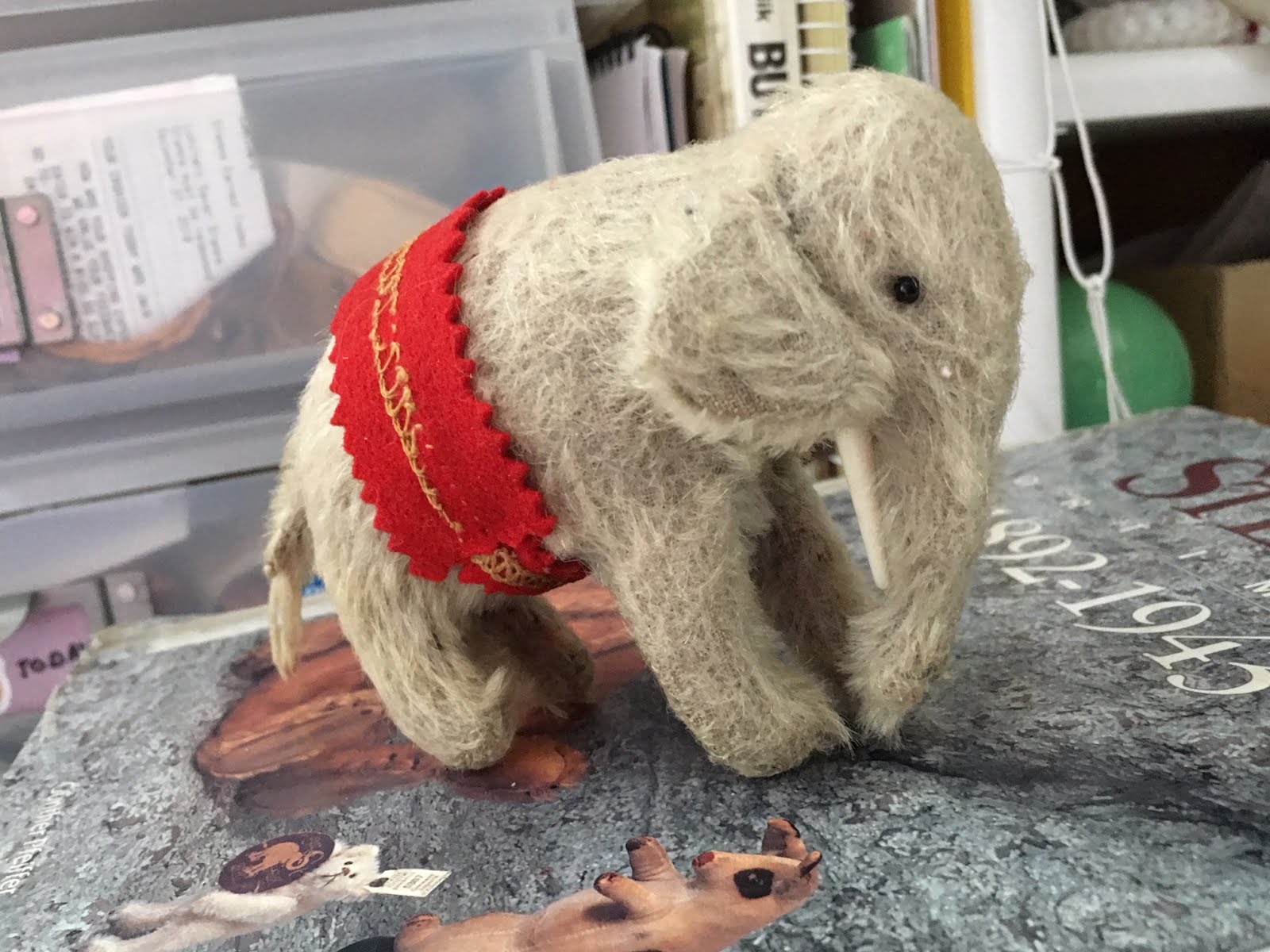
There's not room for much junk in the trunk when it comes to this happy handful. Here we have a 10 cm standing baby elephant. He is unjointed and made from blue mohair. His little face come alive with simple black button eyes, proportional ears, a slightly tucked under trunk, and ivory tusks. His mohair tail is tipped in what feels to be like woolen yarn. His red saddle cloth is vintage, but probably not original to him given its "homemade" presentation. It is decorated with gold colored embroidery. Elephant retains his long trailing "f" button and traces of his red ear tag as his Steiff IDs. 

This little guy is absolutely ele-fantastic, but exactly who is he? It's a little confusing. He doesn't EXACTLY appear in Pfeiffer's 1892-1943 Sortiment. Steiff did produced a blue standing 8 cm elephant as a "pram toy" in 1926 through 1933. He came with a bell on the tip of his trunk, a cord, a pom-pom decoration, and an ivory hanging ring. However, this pram toy did not have tusks and had black and brown glass pupil eyes. So as they say, close but no cigar with a match here. 

A bit more research finds a 10 cm blue mohair elephant with black button eyes and ivory tusks pictured in the Sortiment. However, this model is described as having eccentric wooden wheels. That wheeled model was made in 1924 only. The elephant under discussion today looks very much like the one pictured in the Sortiment, but shows no evidence of ever being on wheels - there are no stitches, holes, or indicators on the bottom of his feet that would suggest he was once "on a roll." It is Steiffgal's best guess that the elephant noted in the Sortiment was produced with or without wheels, and that was just an oversight in his cataloging. This can happen on items that were produced in limited quantities, and/or for a short period of time. 

Now for a little color commentary. Although this elephant looks grey today, if you look in his "nooks and crannies," his baby-blue coloring is obvious. Steiff introduced many items in the mid to late 1920s in happy, jelly bean colors like this, so his hue perfectly aligns with his production period. These colors - especially pink and blue - tend to really fade over time. This probably has to do with the chemistry and properties of the pigments used to make fabric color dyes last century.  

Steiffgal hopes you found this discussion on this little blue elephant absolutely unforgettable. 

Have a question about one of your Steiff treasures? Let's talk! Click here to learn more.
The teddy bear search engine