Showing posts with label eccentric. Show all posts

Sunday, March 3, 2024

Hop-ping To Find Answers About This Fantastic Steiff Prewar Rabbit On Wheels

Orange you glad you checked in with this blog today? Well you will be for sure after learning more about this super cool prewar rarity living with a new friend from far away. Alena shares...

"Hello from the Czech Republic,

I have a question about my toy - rabbit on the wooden wheels. I couldn't find any information whether the Rabbit has been produced in Steiff factory in this color. Toy hasn't got any button neither any else marking. 

Thank you very much in advance for the answer and maybe some more information about that."

This happy hopper is the wheel-deal indeed.
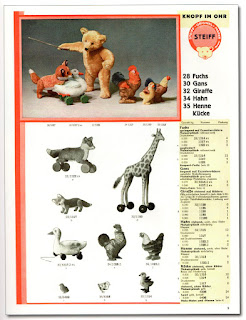
It is Steiffgal's best thinking that he is one of Steiff's standard line rabbits on wheels from the late 1920s. Here on the left, you can see the photo from Pfeiffer's 1892-1943 Sortiment illustrating what Steiffgal believes is this exact item. He is in a "hopping" position, meaning he is on all fours and about ready to take off! The name of this body position was later changed to "running", which also makes alot of sense.

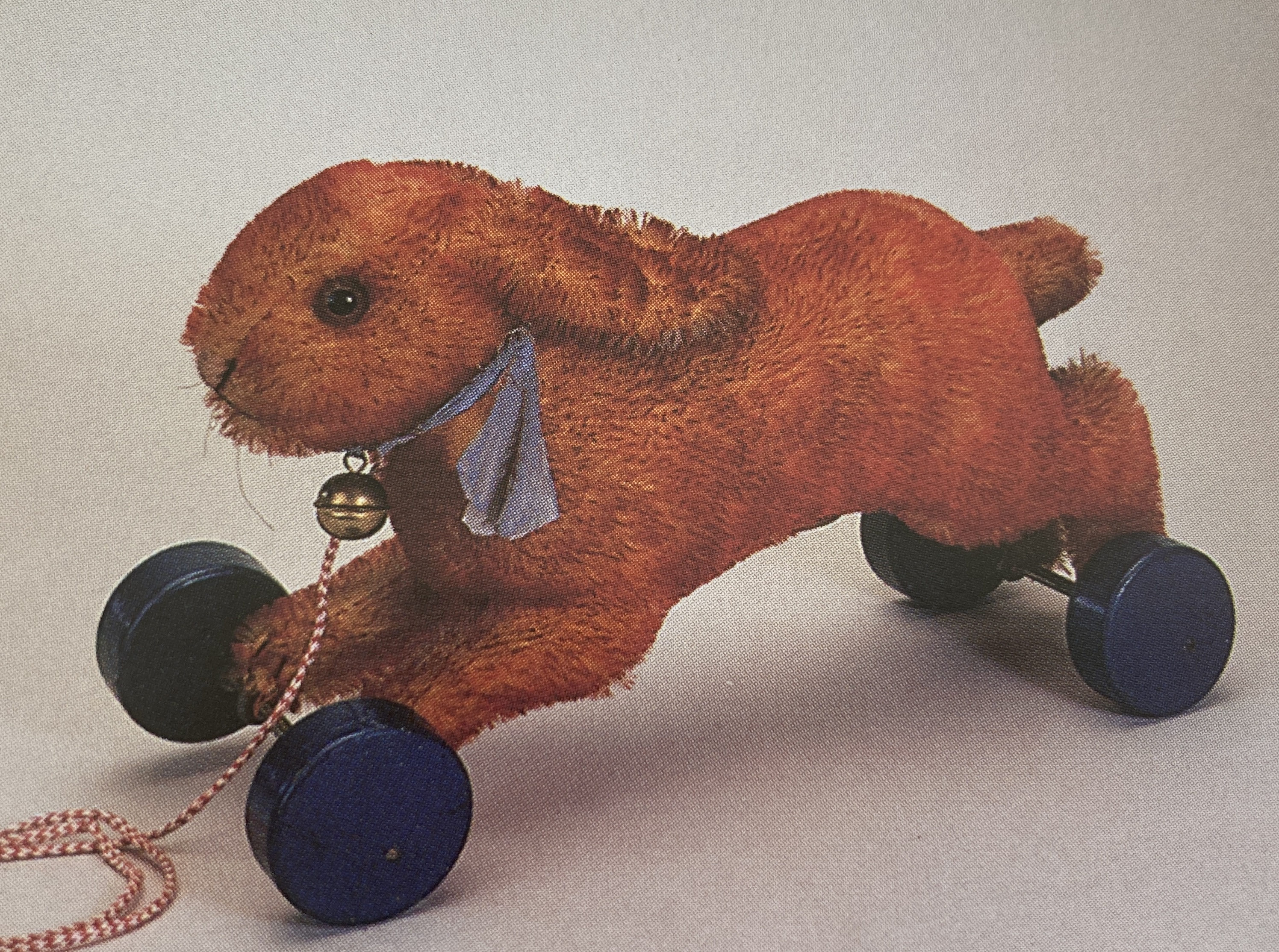
Alena's treasure is one beautiful bunny. Here you can see him relaxing with some WAH-HOO good vintage friends in the photo on the left. Rabbit is unjointed, solidly stuffed with excelsior, and features large brown and black glass pupil eyes, a hand embroidered pink and black nose and mouth, and clear monofilament whiskers. He has once vivid orange mohair. He rides upon four asymmetrical wooden "eccentric" style wheels. As such, he appears to sway back and forth as he is pulled along. This item was produced in 12, 15, 18, and 23 cm (measured vertically, top of the head to toe, not including ears or wheels) from 1927-1930 overall in this stunning color. He was also produced in an almost identical pattern in brown tipped mohair in 14, 17, and 22 cm in 1928.

Brightly colored animals, including rabbits, dogs, cats, and bears - were a delightful feature of Steiff's late 1920s to very early 1930s product line.
These sweet pets appeared in orange, pink, blue, green, gold, or other "jellybean” colored mohair or velvet fabrics, and usually had playful, youthful personalities to match! Tipped mohair - meaning mohair with just the ends or tips dyed a complementary or eye-catching color - also had its heyday in the product line around the same time. You can see a number of these colorful rabbits in the photo on the left, the image is from the company's 1929 product catalog. 

Steiff also produced a few other fun novelties featuring "larger than life" colors like Alena's wheeled rabbit.
One of particular interest is a delightful orange and white begging style rabbit on eccentric wheels. In July, 2023, the auction house Ladenburger Spielzeugauktion GmbH of Ladenburg, Germany sold this 20 cm tall rarity from 1926-1932 for nearly $4,000. He is pictured here on the left, the image is from Ladenburger Spielzeugauktion.

Steiffgal hopes you enjoyed learning about this darling, 24 carrot gold prewar novelty!

Have a question about one of your Steiff treasures? Let's talk! Click here to learn more.

Saturday, October 29, 2022

This Precious Prewar Pug On Wheels Stands And Delivers!

As she continues to celebrate the arrival of her newly adopted sister-pugs, Steiffgal thought it was the perfect moment to share a special button-in ear version of the beloved breed.
Dogs have always been an important design category for Steiff, so it should be no surprise that the first flat-faced cutie was introduced in the Steiff catalog in 1916. Take a look at this very early pug on the go and see what makes him so delightful from the design and product development perspectives.

This happy traveler is 22 cm tall (not including his wheels) and made from grey mohair.
He is standing, unjointed, and solidly stuffed with excelsior. He has black hand embroidered claws on each of his feet. His distinctive face comes to life with proportional brown and black glass pupil eyes (which may be replaced), a black hand embroidered nose and mouth, and black lines on his forehead - to give him his breed-specific wrinkled forehead. His pert ears are lined in velvet, and he has a very curly tail. He retains his small trailing "f" button and traces of his white paper ear tag as his Steiff IDs.

Now let's dig deeper into his detailing.
Pug wears a leather collar, which may or may not be original to him, but is appropriate in materials, design, age, and fit. His pull cord has been lost to time. Pug is mounted to two metal rods and rides upon four wooden eccentric wheels. It is interesting to note that this pattern, unlike many other dog patterns, only came on wheels, and was not produced sitting or in any other configuration. Pug on wheels was produced in 17 cm and 22 cm from 1916-1927.

Like many of the Steiff pets debuting in the 19-teens, this perky pug has a proportional and literal design.
The key pug breed elements - a flat muzzle, wrinkled forehead, and a curly tail - are very well represented in his pattern. For the most part, Steiff's dogs, cats, rabbits, and other popular pets introduced in the c. 1910-1920 time frame were not as basic as the company's earliest patterns, but did not have the youthful, often goofy or playful appearances of those items designed in the 1920s through early 1930s. Items from around 1925 onward often featured oversized eyes, brightly colored materials, and rounded faces, bodies, and limbs. As such, Steiff's second pug - introduced in 1925 as its first pug pattern was being phased out - was a truly silly looking sitting pup with exaggerated facial features and a larger than life red felt tongue. He appeared in the line from 1925 - 1927 in 14 cm. He is pictured on the left; the photo is from Pfeiffer's 1892-1943 Sortiment.

Steiffgal hopes this discussion on the company's early Pug on wheels has captured your interested in a round-about sort of way.

Have a question about one of your Steiff treasures? Let's talk! Click here to learn more!

Saturday, October 8, 2022

Good Things Come In Threes With This Fabulous Prewar Steiff Duck Chain

It's time to get your ducks in a row and check out this next marvelous Steiff find. It's hard to believe that this family of fine feathered friends was most likely made over a century ago - they appear practically brand new today. Who wouldn't want to feather their Steiff nest with them? They are truly "aligned" in so many interesting ways....and here's why!

Good things come in threes with this duck family trio. It consists of a larger mother duck - measuring about 10 cm tall and 14 cm wide - and two baby ducks - measuring about 6 cm tall and 9 cm wide each. All the ducks are unjointed and are solidly stuffed with excelsior. They have grey felt bodies and green felt wings and heads. Their wings are decorated with yellow embroidery to look like feathers. Their beaks, legs, and feet are made from orange felt, and their eyes are little black buttons. The mother retains her original grey silk neck ribbon. The mother is cataloged as article number "2110,42 ex," and the two ducklings are cataloged as article number "2106 ex." These numbers translate to:  2= lying; 1=felt; 10= 10 cm and 06= 6 cm; 42= simple pattern with a voice; and ex= eccentric wheels. The mother and one of the ducklings retain their tiny raised script button in one foot.

Now let's check out their fabulous rides! Mom is mounted on a square metal wire carriage which glides along on four green wooden eccentric wheels. When she is pulled, she waddles and makes a peep which is generated by a little movement activated voice box embedded in her belly. You can see this feature illustrated in the photo at the end of this post. She also has a green and white twine pull string that looks period, if not original, to her. Each of her babies is mounted on a diamond shaped metal wire carriage which rides upon two green wooden eccentric wheels. They also waddle about when they are rolling along. There are loops and hooks at the end of the carriages to keep the family linked together. 

Steiff's beloved felt "duck chain" parade was a legacy item in the early 20th century. It was produced in two standard line versions: a mom with two ducklings or a mom with five ducklings. Both versions appeared in the line from 1917-1932 overall. From 1919-1921, this duck chain was produced in a substitute plush material because felt was in short supply for toy making purposes during and shortly after World War I. Steiff's signature duck chain novelties were marketed as, "This waddling felt duck with brightly colored fathers is fixed onto solidly built, eccentric wooden wheels, which provide the duck with its characteristic waddle. Also fitted with a deceptively realistic "quack-quack" voice. A droll little toy."

Steiffgal hopes this discussion on this duck chain pull toy has really tugged at your heartstrings!

Have a question about one of your Steiff treasures? Let's talk! Click here to learn more!

Saturday, December 25, 2021

Care To Feather Your Steiff Nest With This Grand Goose On Wheels?

This fine feathered Steiff friend is certain to give you goosebumps! Bird's the word when it comes to this adorable goose on wheels. She's flown a little under the radar relative to other birds in the Steiff line, but has a most impressive history worth a honk - or two! Check out her story below. 

This gorgeous goose is 17 cm tall and 23 cm wide. She is lying on her belly and is made from white mohair. Her neck and head are airbrushed with a touch of grey. Her wings are splayed outward, in a most realistic and playful way. Her feet and legs are made from single thick orange felt. Her face comes to life with black button eyes backed in red felt and a proportionally large and dimensional orange felt beak. She rests on a metal carriage and glides along on four green wooden eccentric wheels. When she moves, her back axle activates a squeaker in her belly.  Goose on the go was made postwar in 17 cm from 1949-1964.

This timeless pattern must also have been an unassuming best seller for Steiff.
That is because it appeared both in the prewar and postwar period. Interestingly, it does not seem that this goose model was ever made without wheels. Prewar, it was made in 14 and 17 cm from 1914-1943. It is really likely that the pattern was updated just a bit in the 1914-1943 time frame - given how aesthetics, economics, and manufacturing realities evolved so quickly during that nearly three decade long period of production. Nonetheless, technically this goose on wheels was noted in every Steiff catalog published for a stretch of 50 years! This longevity is right up there with the company's legacy Molly the puppy (1925 - 1969, about 44 years overall), Waldi the Doxi (1933 - 1980, about 47 years overall) and Susi the cat (1936 - 1978, about 42 years overall.) You can see goose on wheels as she was presented in Steiff's 1929 catalog; the image is from C. Esser's Steiff Kataloge 1920-1929. You can click on the photo to make it larger.


Goose's yellow tag is unusually descriptive in this case and helps to nail down her birthyear.
The words on it include "Steiff Original geschuzt (protected)"; this copy was only used in the late 1940s and very early 1950s. And the numbering is quite telling as well. It reads, 6317,2 ex. This means, 6 = young, 3 = mohair, 17 = 17 cm, ,2 = double press voice, growler, or pull cord voice, and ex = on eccentric wheels. She also has her raised script button but no evidence of a US Zone tag. All of this information suggests that this particular goose on wheels was produced probably around 1952 or 1953.

Steiffgal hopes this discussion on this timeless toy has made you feel young at heart today.

Have a question about one of your Steiff treasures? Let's talk! Click here to learn more.

Thursday, April 8, 2021

Rolling Out The Red Carpet For This Precious Prewar Doxie On Wheels!

What goes around, comes around... especially if it's on wheels. This darling Doxie on-the-go recently popped by to say hi and Steiffgal couldn't help but roll out the red carpet for her! Come take a look at this great example of Steiff's prewar novelty production and see what makes her so noteworthy from the historical and product development perspectives. 

Doxie on wheels is standing, unjointed, and constructed from mohair.
The dog itself measures 11 cm vertically and 20 cm horizontally. Her top, forehead, ears, and tail are made from black mohair and her muzzle, limbs, and underbelly are made from brownish tipped mohair. Her face comes to life with proportional brown and black glass pupil eyes and a black hand embroidered nose and mouth. She is mounted on two metal axles. She glides along on four wooden eccentric wheels which are painted blue. She is attached to the axles through metal loops that are inserted into her limbs. Doxie on eccentric wheels was produced in 17, 20, and 22 cm from 1930 through 1933 overall. She was also made on traditional round wheels in 28 and 35 cm from 1929 through 1935 overall.

Doxie on wheels is one of many wonderful prewar Dachshunds produced by Steiff.
 Like Fox Terriers and Pointers, Dachshunds are a legacy breed for Steiff, and perhaps one of the company's most famous and prolific dog lines as well. Steiffgal suspects this is because Dachshunds traditionally have been a very popular pet choice across Germany, and even were the animal companions of choice of the Steiff family at the turn of last century! Although this exact pattern under discussion here today was not produced postwar, if you look closely at her face, you can see it is somewhat similar in size and expression to Bazi, who was introduced in 1950. 

Moving along, this particular example three design characteristics that firmly root its production in the late 1920s to early 1930s. These include:

1. Patched mohair construction. Many items that debuted in the 1920s feature different color mohair that is patched and seamed together to create the visual effect of a multi-hued animal. From the mid-1930s onward, the company was much more likely to create an animal from one shade of fabric and then apply color via paint for a similar effect. This was probably done to create labor and material efficiencies.

2. Mohair coloring. This Doxie's brown mohair is actually more like a deep orange or copper color, and is tipped. This creates a wonderful aesthetic effect of depth and richness. Tipped mohair (think of Petsy the Baby Bear, for example) was a very popular fabric choice and treatment during the "Roaring 20s" era. 

3. Novelty detailing.
This Doxie is a novelty, meaning she has a fun feature not seen on standard line playthings. In this case, she's on eccentric wheels. You can see a closeup of this configuration here on the left. A very similar pattern to this Doxie was produced as another novelty - a tail moves head version. This mover and shaker appeared in 14, 17, and 22 cm from 1931 though 1934 overall. Steiff's novelty production exploded in the mid to late 1920s with the introduction of Molly the Puppy and Bully the Bulldog. These popular designs translated well into charming product line extension items like music boxes, purses, animal dolls, various pull toys, Charleston animals, puppets, and tail-move-head characters. Today, late 1920s-early 1930s dogs, cats, and rabbits with a novelty twist universally top collector's wish lists. 

Steiffgal hopes this discussion on this Dachshund novelty has been tremendously entertaining for you. 

Have a question about one of your Steiff treasures? Let's talk! Click here to learn more.

Sunday, September 6, 2020

This Tiny Steiff Prewar Bully On Wheels Is One Happy Handful Indeed!

What can be tiny and larger than life at the same time? Steiff's utterly charming, miniature sized pets on wheels from the 1920s! Check out this teeny tiny Bully dog on the go. His proportions, presentation, and personality are simply perfect!


This happy handful is the wheel deal indeed. Bully is standing, 10 cm tall, and head jointed. His body is made from black and tan mohair. His face has a velvet inset muzzle. It comes to life with oversized black and brown glass pupil eyes, a black hand embroidered nose, a few airbrushed freckles and highlights, and dimensional jewels. His factory original accessories include his all original horsehair collar and little brass bell. Some came with this horsehair style collar while others had a studded leather collar. Bully is connected to a metal chassis and rides upon four red wooden eccentric wheels. He retains his long trailing "F" button as his Steiff ID. This adorable rarity was produced in 10, 14, 17, and 22 cm from 1927-1935 overall.

One feature that makes this Bully dog design so timeless, and eternally appealing, is that it scales up or down in size so well. This tiny version really does look like an impish pup, ready to get into marvelous mischief. Larger sized Bully dogs take on a more adult personality and presentation. Admit it, you are having a hard time not falling in love with this petite pooch!


It is also interesting to note that this Bully on eccentric wheels novelty was introduced in 1927 - the same year as his general debut. Usually, form and variation items - like versions on wheels, with music boxes, as puppets, and pincushions, for example - come out a year or two after a new design is launched. Clearly, Steiff knew they had a winner on their hands with this beautiful Bull dog, and wasted no time in presenting numerous novelty temptations based on his core pattern. And the numbers rang true - over 250,000 Bully dogs were produced and sold within five years of his introduction.

Steiff's page from their 1929 catalog features a charming illustration featuring a number of Bully dogs - including the one under discussion here today. This image can be seen here on the left, and the photo is from Carsten Esser's Steiff Kataloge 1920-1929. You can click on it to make it bigger. The copy on the page roughly translates to... "The character Bully dog has found many admirers in both children and adults." The model was designed as a toy - for children - but also as a companion and collectible for adults. He did a great job in both roles. The catalog page notes Bully as a standing model, on eccentric wheels, as a riding toy, in velvet and a variety of mohair color combinations, as a long limbed car or boudoir doll, as a puppet, as a purse, as a pincushion, and as a musical dog, among others. 

Steiffgal hopes that size defies when it comes to this discussion on this itty bitty buddy. 


Have a question about one of your Steiff treasures? Let's talk! Click here to learn more. 

Sunday, March 1, 2020

It's Time For A Little Horseplay With This Sweet Steiff Filly On Wheels

Let's saddle up and take a look at this week's delightful vintage Steiff find. Here we have a barnyard friend who's really on the move, and excited to share her story with you. Check out this happy handful and see what makes her so much more than just a dog and pony show!

This pretty pony is the mane event indeed. She's 12 cm, standing, unjointed, and made from tan mohair which has been airbrushed with brown spots. Her tail and mane are made from longer, stiff mohair, and her ears are made from felt. Her face is detailed with brown and black pupil eyes and black airbrushing to indicate her nose, mouth, and other facial contours. She is ready to hit the trail with her red faux leather saddle, red plastic reins, and red string headwear detailed with yellow felt circle decorations. She is mounted on two metal axels which are connected to four blue wooden eccentric wheels. She bobs to and fro, much like a real filly, when she is pulled along. Pony on wheels was made in this size only from 1954-1957 and then again in 1960. 

Hold your horses! It's no coincidence that the information printed on filly's yellow cloth ear tag pretty much describe her to a "T." The code reads, "1312 ex." This stands for 1=standing, 3=mohair, 12= 12 cm, and ex= riding upon four wooden eccentric wheels. And her thin lettered, raised script button, which debuted in 1952, is perfectly period to her as well.

This delightful pull toy is a natural product line extension of a beloved, standard line item introduced in the early 1950s. This of course was the company's pony, which was made in 12 and 17 cm from 1951-1976 overall. The larger and smaller sizes were quite similar in design, with two details setting them apart. The first is that the smaller version had a dark tan mane, and the larger version had a white mane. The second is that the smaller version had a saddle and headwear made from thin red string and decorated with felt, while the larger one did not have a saddle and had headwear made from faux red leather and metal studs. 

Creating petite pull toys on wooden wheels from the smallest, or smaller versions of popular Steiff designs was an efficient way for the company to grow its product range in the c. 1950-1960 time frame. Versions on wheels were usually produced a few years after the animal design was initially introduced - much like in the case of the pony. For example, Cockie the cocker spaniel was introduced in 1952 in 10, 17, and 25 cm. The 10 cm Cockie was made as a pull toy from 1954-1957 and 1960. Bully the bulldog was introduced in 1951 in 10, 17, and 22 cm. The 10 cm version was made as a pull toy from 1954-1957 and 1960. And the company's postwar mohair donkey - made in 14, 22, and 28 cm from 1950 onward, was made as a 14 cm pull toy from 1954-57 and 1961. You can see Bully and Cockie on wheels here on the left.

These pint-sized, mid-century pull toys remain extremely popular with toy collectors worldwide, and for good reason! They are adorable, don't take up too much room, and look precious posed in groups or accompanying vintage dolls from any era. 

Steiffgal hopes this discussion on this pony on wheels made horse-sense to you.

Have a question about one of your Steiff treasures? Let's talk! Click here to learn more!

Sunday, October 27, 2019

Is This Turn of Last Century Mohair Goose The Wheel-Deal?

Heads up - there's a goose on the loose! Steiffgal recently came across a most interesting, and very vintage, goose on wheels. His early and endearing presentation, traditional and legacy set of materials, and turn-of-last century manufacturing details certainly appear very Steiff-like. But he does not have any identification, and does not appear in any Steiff reference book or catalog Steiffgal knows of. Take a peek - what do you think?

This fine feathered friend is certainly on a roll. He is standing, unjointed, and measures about 18 cm tall and 28 cm wide. Goose is made from all white mohair and is solidly stuffed with excelsior. His wings are dimensional, stretch backward, and are tacked to his body with a few stitches. His neck is long and graceful. His face comes to life with black button eyes backed in faded red felt, a yellow felt beak, and prominent brown detail embroidery stitching that goes from his eyes to his beak. He glides along on a carriage with four wheels that have traces of gold paint on them. Steiffgal tested the entire rolling mechanism with a magnet and it is made from solid metal.

After much searching around, Steiffgal came across a good picture of a similarly styled goose that Steiff had in the line at the turn of last century. That long-necked bird was standing and had jointed legs. He was made from white mohair, had a yellow felt beak and legs, and almost the identical facial features and detailing - including stitching from the eyes to the beak - as this one on wheels. Steiff's standing, jointed goose was made in 17, 22, 28, 35, and 43 cm from 1911-1918. You can see this goose here on the left, it was sold at Christie's in 2010 along with a smaller farm friend. Together the pair realized GBP 1,375.

So what's going on with this easy rider? Here is a possible explanation, with the tell-tale hint in his wheels. Steiff introduced its wooden up-and-down "eccentric" wheels around 1912 and holds a patent on this mechanism. Eccentric wheels were discovered accidentally, but Steiff quickly realized the product-development opportunities created by their roller drilling mistakes. Birds of all sorts were ideal for eccentric wheels, given their natural "waddling" tendencies, and you see wooden eccentric wheels on many Steiff bird models from 1912 onward.

Now let's shift the discussion into fifth gear. This goose is clearly on metal, not wooden wheels. His pattern, as noted above and given he is Steiff, was introduced in 1911, BEFORE wooden eccentric wheels were in the line. It is possible that in 1911 or early 1912, Steiff wanted to see if their existing standing white mohair goose pattern could be modified as a pull toy on metal wheels - and this example could be the result of that experiment. It is interesting to note that Steiff introduced a new mohair goose on eccentric wooden wheels soon after in 1914. This updated pattern, having an orange felt beak and feet, grey and white coloring, a shorter neck, and a more compact body, appeared in 14 and 17 cm prewar through 1943 overall. You can see that updated goose on wheels here on the left; the picture is from Pfeiffer's 1892-1943 Sortiment. 

Steiffgal hopes this discussion on this unusual and probably Steiff goose knocked you over with a feather.

Have a question about one of your Steiff treasures? Let's talk! Click here to learn more. 

Saturday, April 8, 2017

Getting Ready For Easter With Some Remarkable Steiff Rabbit Auction Highlights!

Hoppy almost Easter to you! Let's celebrate this much-loved holiday with a look at several really interesting and seldom seen rabbits that recently sold at auction in Germany. This sale, held by Ladenburger Spielzeugauktion on March 31, 2017, featured about 125 lots of vintage Steiff. Here are four "bunny-honeys" to get you in the mood for next week's celebration of renewal, peace, and all things spring.

This first auction highlight is certainly the wheel-deal. Here we have a delightful rabbit on eccentric wooden wheels. He is cataloged as, "hare on wooden excenter-wheels, with button, long stretched F, white/brown mohair, felt paws and shoe button eyes underlaid with red felt, length: 14 cm height: 11 cm, unusual." According to the website Liveauctioneers.com, who hosted the auction online, this rabbit was estimated at 150 to 300 euro and hammered at 800 euro. Adding in the sale's 21% buyer's premium, his final price was 968 euro or about $1,025.

This happy hopper is so appealing in many ways. This wheeled design was made in 6, 8, 10, and 12 cm from 1924-1928 overall. Its hard not to fall for his petite proportions, life-life eye treatment, and patched-in coloration, which is quite typical to his period of production. This model incorporates a standard line Steiff rabbit on all fours which was produced in white and brown mohair or black and brown mohair in 6, 8, 10, 12, and 14 cm from 1923-1928 overall. 

Our second rabbit highlight deserves a standing ovation. Here we have a wooden begging rabbit on wheels. He is cataloged as, "wood hare, on wheels, produced between 1922 - 1934, button, with long stretched F, 15 cm, slightly used, unusual." According to Liveauctioneers, this rabbit was estimated at 120 to 240 euro and hammered at 1,100 euro. Adding in the sale's 21% buyer's premium, his final price was 1,331 euro or about $1,410.

What's not to love about this egg-cellent Steiff rabbit? This ideal Steiff Easter rabbit toy was made in 15 and 20 cm from 1922 through 1934. His colors are bright, fresh, and happy, and his design can't help but make you smile. Although not as well known as their soft plush and mohair dolls, bears, and animals - at least here in the USA - Steiff's wooden toys, scooters, blocks, games, and other playthings were prominent production categories from the late 19-teens through the early 1940's.

Wooden it be nice to add this next rabbit rarity to your Steiff bunny hug? Here we have a delightful and really unusual rabbit cart. He is cataloged as, "Haswag animal car, c. produced between 1927 - 1936, button, with long stretched F, wood paws and tail mechanism are intact, lenght: c. 25 cm, height: 17 cm, depth: 10 cm, unusual, rare." According to Liveauctioneers, this rabbit was estimated at 150 to 300 euro and hammered at 2,800 euro. Adding in the sale's 21% buyer's premium, his final price was 3,388 euro or about $3,588.

This particular rabbit has Steiffgal moving and grooving for sure. This finely constructed and painted cart was produced in this size only from 1927 through 1936, as noted in his cataloging. What's so cool about this piece is that when he is pulled along, the rabbit's paws and tail move in response to his wheels spinning about. Steiffgal suspects that this movement is triggered by some simple gear connection, located on the underside of the cart. Steiff has a long and interesting history of creating movement associated with wheeled items. These including its beloved arm pumping "Record" animals on Irish mail carts and its head bobbing/nodding examples on wooden wheels, among others. 

If candy is dandy, than this last Steiff rabbit auction highlight is simply sugar heaven. Here we have a very large begging Steiff rabbit that truly looks as if he may be made from chocolate! He is cataloged as "hare, produced c. 1927 - 1937, with button, long stretched F, 44 cm, squirted mohair, in very good condition, nice strong colors, swivel head." According to Liveauctioneers, this rabbit was estimated at 300 to 600 euro and hammered at 2,000 euro. Adding in the sale's 21% buyer's premium, his final price was 2,420 euro or about $2,563.

There's not a hare out of place in this delightful Steiff bunny! This begging pattern was produced in light brown, white, gold, purple, pink, and light blue in 11, 15, 18, 23, 29, 36, 44, 50, and 70 cm from 1926 through 1941 overall. The white versions were produced with outstanding pink and red albino eyes; all left the factory with a big bow and a brass bell. This rabbit's coloration is interesting for two reasons. First, it is the only "non-jellybean" color in the series. All the others produced were lighter, more celebratory, and childlike in hue. Second, his fabric is specifically noted as "squirted mohair."  Steiffgal is guessing that this may mean "tipped." It is hard to tell from his photo if the brown fabric on this example is all brown or brown tipped. If it is indeed tipped, than this detailing aligns quite closely with the production time of other beloved Steiff designs of the 1920's that also feature tipped fabric. These include Happy, Petsy, and Teddy Clown - all who are known for their delightful and interesting brown and white mohair.

Steiffgal hopes you have enjoyed this overview of some of Steiff's more unusual Easter-Beasters.

Have a question about one of your Steiff treasures? Let's talk! Click here to learn more.

Sunday, January 31, 2016

Warming Up To Some Of Steiff's More Unusual Dog Designs

Given it's just about the midpoint of the cold, dark winter (at least around these parts!) Steiffgal thought readers might appreciate a few warm fuzzies sent their way.  Perhaps you are aware of the saying "a three dog night?" This historically referred to the number of dogs a person would have to cuddle with at night to stay comfortable during frigid weather.  So, to REALLY help crank up the temperature, here are FIVE interesting and somewhat rare Steiff hounds that just might add a degree or two to your day!

Let's get started by taking a "peek" at this first great Steiff dog.  Here we have a large, lesser known Steiff Pekingese named Peky. Her pattern is very different from the company's better known, more common, and smaller Peky designs.  Peky is 30 cm, head jointed, and sitting. Her ears, back and tail are made from very tan long mohair while her face and legs are made from short mohair. Her face is detailed with huge, round black and white google eyes, a black hand embroidered nose, and airbrushing on her eyebrows and elaborately constructed muzzle. She has the most endearing, pouty expression... she is probably thinking, "Hand me over a taste of whatever you're eating right now!"  This large Peky pattern was made between 1965 and 1976; this example has a raised script button placing her production at or before 1969.  

It's time to hand off the spotlight to this most adorable puppet pup.  This is Steiff's Treff the Bloodhound hand puppet.  Treff is 17 cm tall and made from bright blond mohair. She has three black hand embroidered claws on each hand. Her head is modeled after the company's beloved Treff pattern, and comes to life with long droopy ears, oversized black and brown glass eyes set deep into eye pockets; a black hand embroidered nose; simple jowls; and airbrushed freckles. She retains traces of her original red ribbon.  This happy handful was produced in this size only from 1928 through 1940.  This example retains her long trailing f button, early chest tag, and traces of her red ear tag, putting her at the early part of the production timeline.

Rolling right along, here are two great and early examples of Steiff's wonderful dogs on wooden eccentric wheels.  Both have the appearance of bobbing up and down as they are pulled along.


The first coppery example begs a penny for your thoughts.  Here we have a lovely version of the company's beloved Waldi Dachshund pull toy.  Waldi is standing, 16 cm tall and 30 cm long nose to backside, unjointed, and made from long, glorious copper colored mohair.  His tail adds another 10 cm to his length. His face, arms, and legs are made from shorter copper colored mohair. Waldi has a simple black hand embroidered mouth and nose and black eyes. He glides upon four oversized, blue off-center wooden wheels. Waldi retains his original green leather collar, long trailing f button, and fully legible red ear tag.  Pre-war, Waldi was produced on eccentric wheels in 14, 17, and 22 cm from 1933 through 1943; this example is from the early part of that period. Once the factory opened for toymaking business after the war, he again was produced in 17 and 25 cm from 1949 through 1970. 

This second Steiff dog on wheels comes sealed with a kiss.   This Sealyham is standing, 17 cm tall and 24 cm long nose to backside, unjointed, and made from long white mohair. His tail adds another 5 cm to his length. Sealy has a simple black hand embroidered mouth and nose, brown and black glass pupil eyes, and felt lined ears. He rides on four red off-center wooden wheels. Sealy retains his original red leather collar and brass bell, along with his long trailing f button.  He was produced on eccentric wheels in 17 and 22 cm from 1939 through 1943.  And, like Waldi, this model again appeared in the line post war, but for a much shorter interval.  He was available in 14 and 17 cm from 1949 through 1954.

Today's final highlight is a shoe in as a collector's favorite.  Here we have a nice example of a Hush Puppy Basset hound made for the footwear company of the same name.  He is sitting, unjointed, and is made from tan mohair that has been lovingly airbrushed in multiple shades of tan, brown, and black. He has has wonderfully long, droopy ears; a hand embroidered black nose; and realistic, dimensional soft jowls. Basset has brown airbrushed claws and extremely round, realistic-looking eyeballs that are embedded into his facial mask structure.  He retains his original red collar and all IDs, including his specially imprinted "Hush Puppies" chest tag.  

This delightful customer special was produced in 14 and 14 cm from 1970 through 1972, and is quite similar to Steiff's earlier, standard line 1960s-era Basset hounds.  These were produced from 1961 through 1963 in 12, 14, and 22 cm.  There are three main differences between the standard line Bassets and the Hush Puppy Bassets.  The Hush Puppy Bassets are unjointed, have a red collar, and have a special logo'ed chest tag.  The standard line Bassets are head jointed, have green collars, and have the word "Basset" on their chest tags.  

Steiffgal hopes this tour through Steiff's "kennel club" has lit a bit of a Steiff fire under you!

Have a question about one of your Steiff treasures? Let's talk! Click here to learn more.

Sunday, November 30, 2014

Rolling Towards The Holidays With This Great Steiff Spitz Dog On Wheels

Ever feel like howling in excitement upon a wonderful Steiff find? Even if just in your mind? Well, that just happened to Steiffgal when this delightful Wolfspitz on wheels arrived on her doorstep last week! Take a look at this dynamic dog and see what makes him so interesting from the design and product development perspectives.
 

This vintage pup is the wheel-deal indeed. Wolfspitz measures 20 cm from head to toe and 22 cm including his wheels, measured vertically. He is standing, unjointed, and made from tan mohair. His body and tail are made from long wavy mohair, while his face, ears, and legs are made from matching short mohair. He has very distinctive black hand embroidered claws on his paws, and a full and very prominent tail. He has distinctive mohair "feathering" construction on his front legs; this is pictured here on the left. His somewhat serious face is detailed with black and brown glass pupil eyes, a black hand embroidered nose and mouth, and traces of black airbrush highlighting. He rides upon four red wooden eccentric wheels.  

So how old is this pup, in dog years or otherwise? He retains his short trailing "f" button and traces of his yellow year tag. Given this utterly charming pattern was made in this size only from 1934 through 1943; his combination of IDs suggest he was produced in the 1936 to 1943 time frame.

Spitz, or Pomeranian dogs, are legacy patterns for Steiff. They appeared as early as 1902 in the Steiff line. The earliest Steiff Spitz dogs were produced in felt and mohair. This is most interesting from the historical perspective. And why is this? Felt was Steiff's first toy making fabric, and mohair became available on a commercially viable scale in 1903. Thus, early Spitz dogs truly embody the "old" and "new" material ways of manufacturing at Steiff!

These earliest Spitz dogs were produced in many configurations, including on wheels, sitting, fully jointed, and on a pincushion. They were made from long white curly mohair, with white felt faces, ears, and legs. All had black shoe button eyes and embroidered facial features. Most also left the factory in Giengen with a red cord with two pom-poms or tassels around his neck, giving them a “regal” appearance. The breed does have some connections to German royalty, which may explain why Steiff decorated them like “little kings.” The felt and mohair Spitz dogs appeared in the line in general through the 1920s.  A typical early Steiff Spitz is pictured here on the left; the photo is from Christie's.

Except for one all mohair, 17 cm model produced from 1924 through 1927, it was not until the mid 1930's that the company focused again on Spitz dogs. In 1934, Steiff launched a series of very expressive, all mohair tan colored Spitz dogs. These included a standing version (produced in 22 and 35 cm); a sitting version (produced in 17, 21, 22, and 25 cm) and the 22 cm version on wheels, the topic of this post. At the same time, the company also introduced two new all white Zwergspitz, or Miniature Pomeranians. These included a standing model (produced in 15, 18, and 23 cm) and a 20 cm sitting version. (An example of a lovely white Zwergspitz dog is pictured here on the left, the photo is from Teddy Dorado.) All appeared in the line through 1943, when Steiff ceased toy production due to war constraints and political realities. 

It is interesting to note that despite their popularity and longevity in the line, Steiff did not produce a standard line mohair Spitz after the factory reopened for business after the war in the late 1940's.  More recent Spitz dogs include a 22 cm white dralon "Cosy Spitz Blanko" from 1960 through 1973; a 30 cm woven fur model produced in black, white, or red-brown from 1980 through 1983; and a 60 cm mohair standing display "Polar Pomeranian" dog, produced in 1960 and then again in 1967.

So what's in a name?  According to Wikipedia, the Wolfspitz breed name was formally changed to "Keeshond," in 1926 in England. The breed is described as having "a lion like ruff, spectacles, small and dark triangular ears, definite contrast, and a thick double coat." All of these characteristics truly describe Steiff's Spitz dogs from the very beginning! 

Steiffgal hopes this discussion on Steiff's lovely Spitz dogs has been a warm and fuzzy experience for you.

Have a question about one of your Steiff treasures? Let's talk! Click here to learn more.

Sunday, April 27, 2014

Check Out These WOW-MEOW Cats On Offer At The Upcoming James D. Julia Toy And Doll Auction!

What's not to love about Steiff's pretty kitties? Especially those irresistible examples that truly capture the legacy of Steiff's early design and production standards! Many Steiff enthusiasts are aware of the upcoming James D. Julia auction featuring the world-class Chuck and the late Cathy Steffes collection of outstanding early Steiff bears on June 13, 2014. But this collection also includes a great number of practically purr-fect Steiff cats as well! Let's take a look at some of these most fabulous felines on offer and see what makes them so interesting from the product development and historical perspectives.

Let's get this review on a roll by first checking out this precious 1930's era 15 cm tall Steiff cat on wooden wheels. This charming cat is standing and unjointed. She is made from white and gray mohair which has been spotted in black with wonderful and distinctive highlights. Cat's face is detailed with green and black glass slit pupil eyes, a pink hand embroidered nose and mouth, and clear mono-filament whiskers. She has red hand embroidered claws and wears her original bell and bow. She also retains her original long trailing "f" style button. And boy, does she get around... on for four red wooden eccentric wheels, that is! This item was produced in 15 and 18cm from 1934 through 1937 overall and is very seldom seen on the secondary market. 

What can be up or down and great regardless?  Steiff's items on eccentric wheels!  Steiff has been making items on eccentric wheels, which have irregular axles - since the early 1900s when they mistakenly miss-drilled the axles for pull toys, therefore inventing this distinctive feature.  When items with eccentric wheels are pulled along, they have the appearance of a waddle or natural animal gait.  Eccentric wheels can be found on dogs, cats, ducks, and many farm animal examples.  

This second fantastic feline under review is such a head turner - literally!  Here we have Steiff's circa 1930's mohair tail turns head cat.  This example is really adorable - even more so in person.  She is 22 cm tall, sitting, and has a tail-turns-head mechanism. She is made from white and gray mohair which has been hand striped to give her a most realistic look. Her claws are hand embroidered in red. Cat's sweet face is detailed with green and black slit pupil glass eyes, a pink hand embroidered nose and mouth, and clear mono filament whiskers. The insides of her ears are gently airbrushed with pink highlights. Cat retains her long trailing "F" button and red ear tag as her Steiff IDs. This lovely item was produced in seven sizes ranging from 10 to 35 cm from 1931 through 1936 and like her wheeled cousin mentioned above, is seldom seen on the secondary market. 

This cat really belongs at the head of the class! 
The tail-moves-head feature was used on a number of the most popular early 1930's-era Steiff items, including dogs, cats, and rabbits.  A gentle twist of the tail left or right caused the animal's head to cock in that direction.  This technology - which was a big deal at the time - was used to give these treasures a natural sense of movement as well as create a "higher end" tier of Steiff products.


Paws and take a look at this third and most interesting terrific tabby from the Steffe's collection.  Here we have an extremely rare and very early velvet Steiff rattle cat with AN ELEPHANT button!  This circa 1905 Steiff velvet rattle is truly the cat's meow - yes, the pun is intended!  This sweet cat is is 10cm, lying, unjointed, and made from white velvet that has been painted with black and grey spots and stripes. He has a very long tail which sticks out straight behind him. Cat wears a red bow and bell, and most interestingly, his highly coveted and earliest style button is attached to the red ribbon. Cat holds a tiny grey and red woolen yarn ball between his front paws. Cat's pensive face is detailed with tiny green and black slit pupil eyes, a light tan hand embroidered nose and mouth, and clear mono filament whiskers. Cat also has a rattle in its belly; Steiff created this feature by inserting a tube with beads into the torso of the item. This cat design appeared overall in the Steiff line in 6, 8, 10, 12, and 14 cm in white and grey velvet from 1899 through 1929. 

This pretty kitty is truly "buttoned up" with his original elephant button - most unusually located on his ribbon. This is the first time that Steiffgal has ever seen a button located on a ribbon, as the button is usually located in the left ear of bears and animals. So its placement is a bit of a mystery. If an item does not have ears, or a logical place for a button, it is sometimes placed right on a Steiff tag that is sewn into the seam of the piece. For some dolls with small or inaccessible ears, like Steiff's legacy Micki and Mecki hedgehog dolls, their buttons and yellow ear flags are suspended off of a red rubber wrist bracelet, like a charm.  It is amazing that this item retains his button given the delicate and transient nature of his ribbon!

Steiffgal hopes this review of these cat highlights from the Steffes collection on offer at James D. Julia's upcoming Antique Advertising, Toy, and Doll auction has been a wow-meow experience for you!

Have a question about one of your Steiff treasures? Let's talk! Click here to learn more.
The teddy bear search engine