Showing posts with label begging. Show all posts

Sunday, August 11, 2024

Begging For More Information On This Nearly Century Old Steiff Rabbit

Everyone loves a Steiff bouncing bundle of joy. And the bigger, the better - especially in this case! Check out this note from a new friend from London who asks about a begging bunny purchased at a fundraising event over four decades ago. His owner shares,

"Thank you for the facility to ask about Steiff toys. I'm 73 now and 40 years ago bought an old, straw stuffed toy rabbit at charity sale. He is 50 cm tall, not including his ears. As I'm a bit of a hoarder I only just came across it after some decades. It's large, in good condition, German mohair, has sewn eyes not glass ones and I gave it a new bow and bell. I was working in a youth club which had been established by ex-POW veterans who'd been incarcerated in Brunswick, Germany in WW2. So I wondered if perhaps one of them had brought it back to the UK. Is there anything more you could possibly tell me about it including its value?"


What a cheerful earful!
What we have is Steiff's Hase or Rabbit. He is simply and generically named after his species and does not have a more personal or endearing name. This particular design was made from 1927 through 1941 in 11, 15, 18, 23, 29, 36, 44, 50, and 70 cm. Steiff's rabbits are usually measured vertically from head to toe and do not include the length of the ears. So this example under discussion here is the 50 cm size. Steiff produced this head jointed, excelsior stuffed rabbit in light brown tipped, white, gold, purple pink, and light blue mohair. All examples left the factory in Giengen decorated with a silk ribbon and a bell. 

This pattern was a home run for Steiff at the time, and continues to be a collector's favorite nearly a century onward.
Given how adorable and popular this design was, Steiff also made it in velvet from 1927 through 1932 in 11, 15, and 18 cm in white, purple, orange, light brown, light blue, pink, and yellow. Steiffgal often refers to Steiff's 1920s-era playfully hued rabbits as "the jellybean bunch," given their joyful (and super sweet) colors. You can see examples of the velvet version of this pattern above on the left; the image is from Pfeiffer's 1892-1943 Sortiment. Below to the left is another late 1920's advertising photo for Steiff's rabbit line featuring the jellybean bunch; that image is from Esser's 1920-1929 Steiff Kataloge. 

Now for the question that always sends Steiffgal down a rabbit hole.
How much is he worth? As always, something is worth what someone will pay for it, and Steiffgal has NOT seen or handled this rabbit in person. Condition is key when establishing a valuation, and he might have some issues (like smoke or insect damage) that just don't show up on photos. What we do know about him is that he has a little playwear to him, he is missing his oversized brown and black glass pupil eyes, and he does not appear to have any IDs. He looks like he might have been brown tipped originally, but that has faded a bit over time. It is also possible that his facial stitching has been augmented at some point. Given all that, it is Steiffgal's best estimate (sans a crystal ball) that this guy could trade hands in the c. $250-500 range on an online auction platform like eBay. 

Steiffgal hopes this discussion on this large, prewar rabbit has put a spring in your step today.

Have a question about one of your Steiff treasures? Let's talk! Click here to learn more.

Sunday, March 24, 2024

Would You Take A Tumble For This Early And Fantastic Feline Steiff Novelty?

This next Steiff inquiry comes in on little cat's feet. A new friend has reached out about a special family heirloom with provenance. Just what is this very early turn of last century treasure? And what makes it so fantastic from the collector's perspectives? Tom shares in part,

"I've attached photos of my Rolly Polly cat. I've had this since I was a child (50+ years ago)... It originally came from a relative who inherited it from their partner who came from a wealthy family from New England."


This guy is simply the cat's meow. But, given his form, he is "technically" a tumbler and not a roly-poly. Steiff's early 20th century roly-polys are all fabric and shaped sort of like an inverted balloon. Most are head and arm jointed, without legs. Examples include mohair cats (made in 16 and 23 cm from 1909 through 1919 overall); mohair Teddy bears (made in 16, 19, 23, and 29 cm from 1909 through 1916 overall)mohair rabbits (made in 23 cm from 1909 through 1918); and a series of mohair and felt dolls from the same basic time frame.

On the other hand, tumblers are full bodied and mounted to a very heavy, weighted wooden half circle base. As such, they wobble about like a weeble but always return to an upright position. Their bases are simply stained and are a natural wood color. Most tumblers measure 12 to 17 cm tall and are standing, sitting, or begging. Steiff did make a few oversized circus bear style tumblers in 35 and 43 cm through 1918 overall.

Tumblers debuted as early as 1894 and appeared in the general line with frequency through the late 19-teens. In the late 1930s, Steiff produced a series of three begging style tumblers on green or red painted wooden bases from 1936 through 1943 overall. Models included a velvet and mohair squirrel, a mohair Waldi Dachshund, and a mohair kitten holding a pom pom ball.

So back to Tom's cat.
 The photos suggest that he is made entirely from felt. Steiffgal suspects he is the company's Tumbling Cat, which appeared in the line in 17 cm (not including his base) from 1894 through 1919. The cat is solidly stuffed with excelsior and features black shoe button eyes and simple facial embroidery. It is hard to tell if he ever had a button, based on the photo of his face. It is entirely possible that he was manufactured pre-1904. Other early Steiff cat tumblers include a spotted velvet version made in 12 cm from 1904 through 1917 and a velvet striped version made in 17 cm from 1901 through 1919.

What makes this tumbler even more remarkable is its condition. He is made from felt, which tends to get grubby over time and attract insects. He was also designed as a toy, but it is clear he received little hands on play. Also of note is his tail. These are actually super thin, not terribly sturdy, and are attached to the animal's rear with just a few stitches. Often, these go missing or break off given their construction and natural aging. However, in this case, Tom's tumbler appears clean and damage free against all odds! Super score all around!

Steiffgal hopes this discussion on Steiff's early tumblers has got you rocking and rolling!

Have a question about one of your Steiff treasures? Let's talk! Click here to learn more.

Sunday, August 22, 2021

This Dressed Steiff Rabbit Doll Is The Best Of Both Worlds!

Overall, this next fantastic find is certain to put a joyful spring in your step! Steiffgal found this bitty bun in the recent United Federation of Doll Club's salesroom - lying upside down and backwards in a case piled full of mohair and treasures. All she could see was one very large foot with red claw stitching... and the rest is history. Come take a look at this dolly-delightful bun and see what makes him so interesting from the design and collector's perspectives.

This happy hopper measures 17 cm (without his ears), is begging, and head jointed. He originally was covered in white and tan mohair - but not a hare/hair remains on him! He is detailed with extra long, skinny feet, a tiny pert tail, and oversized ears. His face comes to life with big brown and black glass pupil eyes, a typical 1920s era style hand embroidered nose and mouth, and traces of once brown airbrushed highlights. He dons his original and totally adorable blue cloth overalls. He retains his long trailing "f" button and traces of his red ear tag as his Steiff IDs.

This seldom seen pattern appeared in the line from 1929-1932 overall in 17, 22, 28, and 35 cm. Steiff's rabbits are measured without their ears, so they actually are a little larger in real life than these measurements suggest. This model was produced in one of six documented outfits. According to Pfeiffer's 1892-1943 Sortiment, these included a blue playsuit, a red skirt and white apron, a purple jacket, a red skit and purple jacket, a red and white dress, or a pink dress. This example under discussion here is the one in a blue playsuit - which is detailed with tiny faux front pockets, contrasting tan colored stitching, back black snaps, and a perfect opening for his pert tail. It is interesting to note that this pattern is considered a "doll" in terms of his category - most likely because of his toddler-esque shape, standing form, and the fact that he is dressed. 

This guy is really shy - and seldom if ever appears in public! Despite being launched in 1929, as far as Steiffgal can tell, an example does not appear in the company's primary catalog of that year. The only other one Steiffgal is aware of is one that was sold at Christies in 2010. That particular example was cataloged as, "A STEIFF DRESSED BOY RABBIT, (4317,61), light brown and white mohair, brown and black glass eyes, pink and red stitching, whiskers, swivel head, inoperative squeaker, blue dungarees and FF button with red cloth tag, circa 1930 --6¼in. (16cm.) (some slight fading)." It was estimated at GBP 1,000 - GBP 1,500 and realized GBP 1,375. You can see that listing here on the left, the image is from Christies. You can click on it to make it bigger.

Steiffgal hopes this discussion of this rare and usual animal doll has been the best of both worlds for you.

Have a question about one of your Steiff treasures? Let's talk! Click here to learn more.

Saturday, June 12, 2021

What's The Tattle On This Unexpected Steiff Rattle?

Don't you just love a good surprise? Like when you buy something online, and when it arrives, it's even BETTER than your wildest hopes? That just happened to Steiffgal today, and she can't wait to share this auspicious treat with you. So 'ears what's happening....

Steiffgal took a leap of faith with this purchase. The electronic pictures weren't so great, and the description wasn't glowing. Yet, it called to her!


What we have here is Steiff's late 1920s sitting rabbit. He is head jointed, about 13 cm sans ears and 19 cm with them, and made from faded purple and cream colored velvet. His pert ears are lined in wires and are posable. His darling face comes to life with oversized brown and black pupil eyes, a wide forehead, and Steiff's legacy 1920s era rabbit nose and mouth embroidery. This consists of a horizontally stitched, triangular shaped nose, outlined in a slightly different color floss, and a simple "v" shaped mouth. He retains his long trailing "f" button and bits of his red ear tag. These hoppy handfuls were produced sitting in 11, 15, and 18 cm (measured without ears) in blue, purple, maize, orange, and white velvet from 1927-1933 overall.

So just what makes this purple bunny such a royal find? Two things come to mind. 

The first is his monarchal color - lilac - which is so lovely and typical to Steiff's 1920s era production. In the late 1920s through early 1930s, Steiff made a series of "jellybean" colored velvet and mohair rabbits. In addition to this sitting, velvet version, the company also produced sitting mohair and begging velvet or mohair rabbits in playful colors including orange, pink, yellow, and light blue, among others. These were made to match the aesthetics of the "Roaring 20s." 
You can see a Steiff catalog image from 1929 featuring a number of these "jellybean jumpers" at the bottom of this blog post. Today, many of these items have faced a bit, much like this rabbit. You can usually tell their original color by looking in their cracks and crevices. In this case, the folds in his ears retained their vivid violet color.

And now let's make some noise over his second highlight. Believe it or not, this beautiful bun is also a RATTLE! Yes, when you shake him, he makes a happy plink-plinka noise! This feature was not noted in his listing, which makes it even more thrilling to discover.

To keep things moving and shaking, Steiff sometimes tucked a rattle into some of the smallest or almost smallest versions of its most popular prewar models. As far as Steiffgal can tell, there is/was no formal numbering or ID system to identify those items specifically produced with a rattle feature. In her personal collection, Steiffgal has a velvet sitting Pip dog rattle, a lying wool plush rabbit rattle, a white mohair Teddy rattle, and a velvet and mohair begging squirrel rattle. All were discovered to be rattles by accident... in the best possible way. Next time you handle a small, prewar item, shake it gently.... and you may happily surprised as well!


Steiffgal hopes this discussion on this princely purple rabbit reigned supremely well with you.

Have a question about one of your Steiff treasures? Let's talk! Click here to learn more!

Sunday, November 19, 2017

Is This Cheerful-Earful Rabbit Made By Steiff?

Be a honey-bunny check out this vintage mohair rabbit mystery! Steiffgal recently heard from a new friend over email about a few vintage toys she had just added to her hug. One of them, a striking dark brown/black and white mohair bunny, really caught Steiffgal's eye given its impressive presentation.  But was this great example - clearly without a hare out of place -  made by Steiff?  Let's burrow into the research right now!

The rabbit's owner shares... "The Bunny has the style of a begging rabbit, entirely made of two colored mohair, pink stitched nose, swivel head, has a squeaker in the stomach, the whiskers are made of natural fiber similar to horse hair but thinner, probably pigs hair which is finer. The total high of the Bunny when sitting to the top of the ears is 36 cm or 14 inches.  

The Bunny does not have a button, but it does have a dirty hole in one ear which could have been caused by the button's discoloration due to rust.  This item came from an estate, and has been in the same family for generations.  Some of the toys from this estate had Steiff buttons, and some don't have any indications at all.

Thank you for any help or identification you can provide."

At first glance, this happy hopper has much in common with one of Steiff's most beloved and popular rabbit patterns which launched in 1927. This bunny was in the begging position and head jointed.  Her large, triangular ears were lined in wires and were posable. Her face came to life with oversized glass pupil eyes, clear monofilament whiskers, a hand embroidered simple mouth, and a distinctively shaped, triangular shaped nose. She was manufactured in light brown, white, gold, purple, pink, and light blue mohair. According to Steiff records, she was made through 1941 in 11, 15, 18, 23, 29, 36, 44, 50, and 70 cm overall. Steiff also made this same popular pattern in velvet from 1927 through 1932 in 11, 15, and 18 cm in white, purple, orange, light brown, light blue, pink, and yellow. All models left the factory with a pastel colored silk ribbon and a bell. 

Here on the left you can see the 1929 catalog listing for the begging rabbit; the illustration is from Carsten Esser's Steiff Kataloge 1920-1920. Please click on the image to enlarge it. The page includes both the velvet and mohair version of the item, as well as a 20 cm version on wooden eccentric wheels.  Also check out the well dressed "Jack Rabbit" featured at the bottom of the catalog page.  This great rarity, based on a popular children's book character of the time, is one of the rarest and most sought-after Steiff rabbit of all times! 

Upon close review, there are several subtle differences which suggest the handsome hare under discussion today was not made by Steiff.  

Limbs:  Steiff's larger mohair begging rabbits in this pattern have one color feet with the color ending in a seam right at the rabbits ankles, and one color arms, which are shapely and distinctively downturned. The one under review today has two color feet, and straight, chunky, two color arms. 

Face:  Steiff's begging rabbits in this pattern have very large, childlike brown and black glass pupil eyes; the albino ones have red and pink glass pupil eyes.  All have triangular shaped noses, often outlined in red or black. They also all have triangular-shaped, wire lined ears. The one under review today has relatively proportional eyes, a simple round shaped nose, and long and lean ears.   

Color: Steiff's begging rabbits in this pattern were made in brightly hued, feminine "jellybean" colors, to match the cultural norms and preferences of the "roaring 1920's."  Although a brown version was also produced, it was actually made from brown-tipped mohair, similar to the fabrics used on the popular Teddy Clown and Petsy bears of the time.  There is no indication that Steiff would have made their begging rabbit in a dark color like deep brown or black, as that would not have aligned with the popular trends of the time. 

So for these reasons and just gut, having handled many of the Steiff versions - including this off the chart marvelous light purple example pictured here on the left - Steiffgal thinks that the rabbit under review today is from the late 1920's or early 1930's. And, it was most likely manufactured by another European high-end toy company either to look like a Steiff item, or just because it is a delightful and happy pattern.  

Steiffgal hopes that this discussion on Steiff's late 1920's begging rabbits has been a hare-binger of good things to come. 

Have a question about one of your Steiff treasures? Let's talk! Click here to learn more.

Saturday, April 8, 2017

Getting Ready For Easter With Some Remarkable Steiff Rabbit Auction Highlights!

Hoppy almost Easter to you! Let's celebrate this much-loved holiday with a look at several really interesting and seldom seen rabbits that recently sold at auction in Germany. This sale, held by Ladenburger Spielzeugauktion on March 31, 2017, featured about 125 lots of vintage Steiff. Here are four "bunny-honeys" to get you in the mood for next week's celebration of renewal, peace, and all things spring.

This first auction highlight is certainly the wheel-deal. Here we have a delightful rabbit on eccentric wooden wheels. He is cataloged as, "hare on wooden excenter-wheels, with button, long stretched F, white/brown mohair, felt paws and shoe button eyes underlaid with red felt, length: 14 cm height: 11 cm, unusual." According to the website Liveauctioneers.com, who hosted the auction online, this rabbit was estimated at 150 to 300 euro and hammered at 800 euro. Adding in the sale's 21% buyer's premium, his final price was 968 euro or about $1,025.

This happy hopper is so appealing in many ways. This wheeled design was made in 6, 8, 10, and 12 cm from 1924-1928 overall. Its hard not to fall for his petite proportions, life-life eye treatment, and patched-in coloration, which is quite typical to his period of production. This model incorporates a standard line Steiff rabbit on all fours which was produced in white and brown mohair or black and brown mohair in 6, 8, 10, 12, and 14 cm from 1923-1928 overall. 

Our second rabbit highlight deserves a standing ovation. Here we have a wooden begging rabbit on wheels. He is cataloged as, "wood hare, on wheels, produced between 1922 - 1934, button, with long stretched F, 15 cm, slightly used, unusual." According to Liveauctioneers, this rabbit was estimated at 120 to 240 euro and hammered at 1,100 euro. Adding in the sale's 21% buyer's premium, his final price was 1,331 euro or about $1,410.

What's not to love about this egg-cellent Steiff rabbit? This ideal Steiff Easter rabbit toy was made in 15 and 20 cm from 1922 through 1934. His colors are bright, fresh, and happy, and his design can't help but make you smile. Although not as well known as their soft plush and mohair dolls, bears, and animals - at least here in the USA - Steiff's wooden toys, scooters, blocks, games, and other playthings were prominent production categories from the late 19-teens through the early 1940's.

Wooden it be nice to add this next rabbit rarity to your Steiff bunny hug? Here we have a delightful and really unusual rabbit cart. He is cataloged as, "Haswag animal car, c. produced between 1927 - 1936, button, with long stretched F, wood paws and tail mechanism are intact, lenght: c. 25 cm, height: 17 cm, depth: 10 cm, unusual, rare." According to Liveauctioneers, this rabbit was estimated at 150 to 300 euro and hammered at 2,800 euro. Adding in the sale's 21% buyer's premium, his final price was 3,388 euro or about $3,588.

This particular rabbit has Steiffgal moving and grooving for sure. This finely constructed and painted cart was produced in this size only from 1927 through 1936, as noted in his cataloging. What's so cool about this piece is that when he is pulled along, the rabbit's paws and tail move in response to his wheels spinning about. Steiffgal suspects that this movement is triggered by some simple gear connection, located on the underside of the cart. Steiff has a long and interesting history of creating movement associated with wheeled items. These including its beloved arm pumping "Record" animals on Irish mail carts and its head bobbing/nodding examples on wooden wheels, among others. 

If candy is dandy, than this last Steiff rabbit auction highlight is simply sugar heaven. Here we have a very large begging Steiff rabbit that truly looks as if he may be made from chocolate! He is cataloged as "hare, produced c. 1927 - 1937, with button, long stretched F, 44 cm, squirted mohair, in very good condition, nice strong colors, swivel head." According to Liveauctioneers, this rabbit was estimated at 300 to 600 euro and hammered at 2,000 euro. Adding in the sale's 21% buyer's premium, his final price was 2,420 euro or about $2,563.

There's not a hare out of place in this delightful Steiff bunny! This begging pattern was produced in light brown, white, gold, purple, pink, and light blue in 11, 15, 18, 23, 29, 36, 44, 50, and 70 cm from 1926 through 1941 overall. The white versions were produced with outstanding pink and red albino eyes; all left the factory with a big bow and a brass bell. This rabbit's coloration is interesting for two reasons. First, it is the only "non-jellybean" color in the series. All the others produced were lighter, more celebratory, and childlike in hue. Second, his fabric is specifically noted as "squirted mohair."  Steiffgal is guessing that this may mean "tipped." It is hard to tell from his photo if the brown fabric on this example is all brown or brown tipped. If it is indeed tipped, than this detailing aligns quite closely with the production time of other beloved Steiff designs of the 1920's that also feature tipped fabric. These include Happy, Petsy, and Teddy Clown - all who are known for their delightful and interesting brown and white mohair.

Steiffgal hopes you have enjoyed this overview of some of Steiff's more unusual Easter-Beasters.

Have a question about one of your Steiff treasures? Let's talk! Click here to learn more.

Sunday, December 4, 2016

The Best of The West!

Talk about a California gold rush, Steiff style! Steiffgal recently traveled out west to attend Steiff celebrations on behalf of the company. Attendees were invited to share their personal treasures at these events at fun "show and tell" sessions.  And boy, did they ever! Steiffgal had the pleasure of seeing a number of family heirlooms, some childhood favorites, delightful woolen miniatures, and even one of the company's extremely rare "125 carat" bears, made with real gold mohair. Here are a few of the 14k vintage treasures collectors brought along that really caught Steiffgal's eye!

Sit and stay and take a look at this great King Charles Charly dog. This precious pooch is 14 cm high, sitting, head jointed, and made from white and brownish/orange tipped mohair. His adorable face comes to life with oversized brown and black pupil eyes, a hand embroidered black and white nose and mouth, and an irresistible, "pouty" expression. He was produced in 7 sizes ranging from 10 to 35 cm from 1928 through 1936. Sitting Charly was also produced as a music box in 17 and 22 cm from 1928 through 1931 and on a pincushion in 17 cm from 1929 through 1932.

And what makes this Charly a champion? Steiffgal loves his mile-long ears and huge personality. His size makes him easy to display, and a perfect companion for a larger vintage doll or bear. Plus, a dear friend of hers has a real-life Charly, so this breed and pattern really pulls on her heartstrings.

Rolling right along, this early postwar elephant on wheels also made a huge impression on Steiffgal! This big boy is Steiff's Zieh Elefant or Pull Toy Elephant. He is standing on all fours, unjointed, and made from lovely grey mohair. His face is detailed with black eyes that are backed in pink felt, a smiling mouth, and white felt tusks. The bell on his trunk helps announce his arrival.  Elephant's feet pads are grey felt. He is dressed to the nines in a red and yellow trimmed blanket; this is original to him. His red leather headwear has been lost to time. He glides along on four blue wooden wheels. This elephant on wheels was made in 28 and 35 cm from 1950 through 1961 overall.

Why is this piece so ele-fantasic? This timeless pattern includes design elements from as early as the 19-teens. His condition is the perfect balance between showing some love and play wear, yet still fine enough to have tremendous collector's interest and appeal. And who can resist his open, smiling mouth and delightful felt tusks?  Certainly not Steiffgal!

And finally, size defies with this beautiful baby bunny. This happy hopper is begging, unjoined, and made from white velvet. He is unjointed and decorated with a few brown spots here and there. His face just shines with black shoe button eyes, a simple brown hand embroidered nose and mouth, red airbrushed highlights, and clear monofilament whiskers. His red ribbon is original to him; one way to "test" for this is to see if the ribbon is stitched in place, or if there is evidence if that was once the case. This version of Steiff's velvet begging rabbit was produced in 4 sizes ranging from 10 to 28 cm from 1899 through 1927 overall.

Begging to know what's so cool about this sweet treat? First, his condition is really amazing, showing only minimal darkening over time. He was originally very white, but white velvet tends to become tan or even brown over time, even with careful handling. Kudos to his current owners for keeping him so well protected! Second, his pattern is among the most desirable, early designs produced by Steiff. Collectors can't seem to get enough of the company's small, early, velvet patterns. A similar sized velvet begging rabbit in far less pristine condition recently sold for about $1,000 on eBay. And finally, you can't help but notice his wonderful IDs - his full white ear tag and long trailing "F" style button. The numbers on his ear tag correspond to: 4=begging or standing on back legs; 4=velvet; and 14=14 cm tall. These "small" tag details make all the difference in determining if an item is good or great.  And this begging rabbit is blue ribbon calibre indeed!

Steiffgal hopes this quick peek at event "show and tell" highlights has put you in a festive mood indeed.

Have a question about one of your Steiff treasures? Let's talk! Click here to learn more!

Tuesday, May 17, 2016

Begging For More Information On This Remarkable Steiff Bonzo With All IDs!

Here's one "bucket list" Steiff item most enthusiasts would get on their hands and knees to add to their collection! Check out this truly remarkable velvet begging Bonzo dog from 1927 - with all IDs! Steiffgal's pal Daniel Agnew, of Special Auction Services in the UK, will be auctioning it off as part of his June 9, 2016 sales event. The full catalog for this exciting event will be online in the next week or so.  In the meantime, let's check out this top dog and see what makes him so desirable from the design and historical perspectives.

This comical canine, lot 848 in the upcoming sale, is cataloged as...

"An extremely rare Steiff Begging Bonzo 1927, of cream velvet, clear glass eyes with dark pink and light pink backs, red felt tongue, black velvet right rear, swivel head, jointed limbs, painted and airbrushed facial features and paw pads, inoperative squeaker, original red leather collar with white card tag with metal rim ‘Begging Bonzo Steiff Original’ one side and ‘Germany Copyright G.E. Studdy’ to the reverse, FF button with complete red tag numbered 5417 - 9in. (23cm.) high (very slightly discoloured and stomach seam resewn) - According to Steiff 115 examples of Bonzo was made in eight sizes, all were unsold as G. E. Studdy did not like their samples and the license went with to the Chad Valley version. Seven examples in different sizes are retained in the Steiff archive, but it is not known what happened to the others. Steiff went onto produce a similar looking character dog which they called Cheerio £10,000-£15,000"

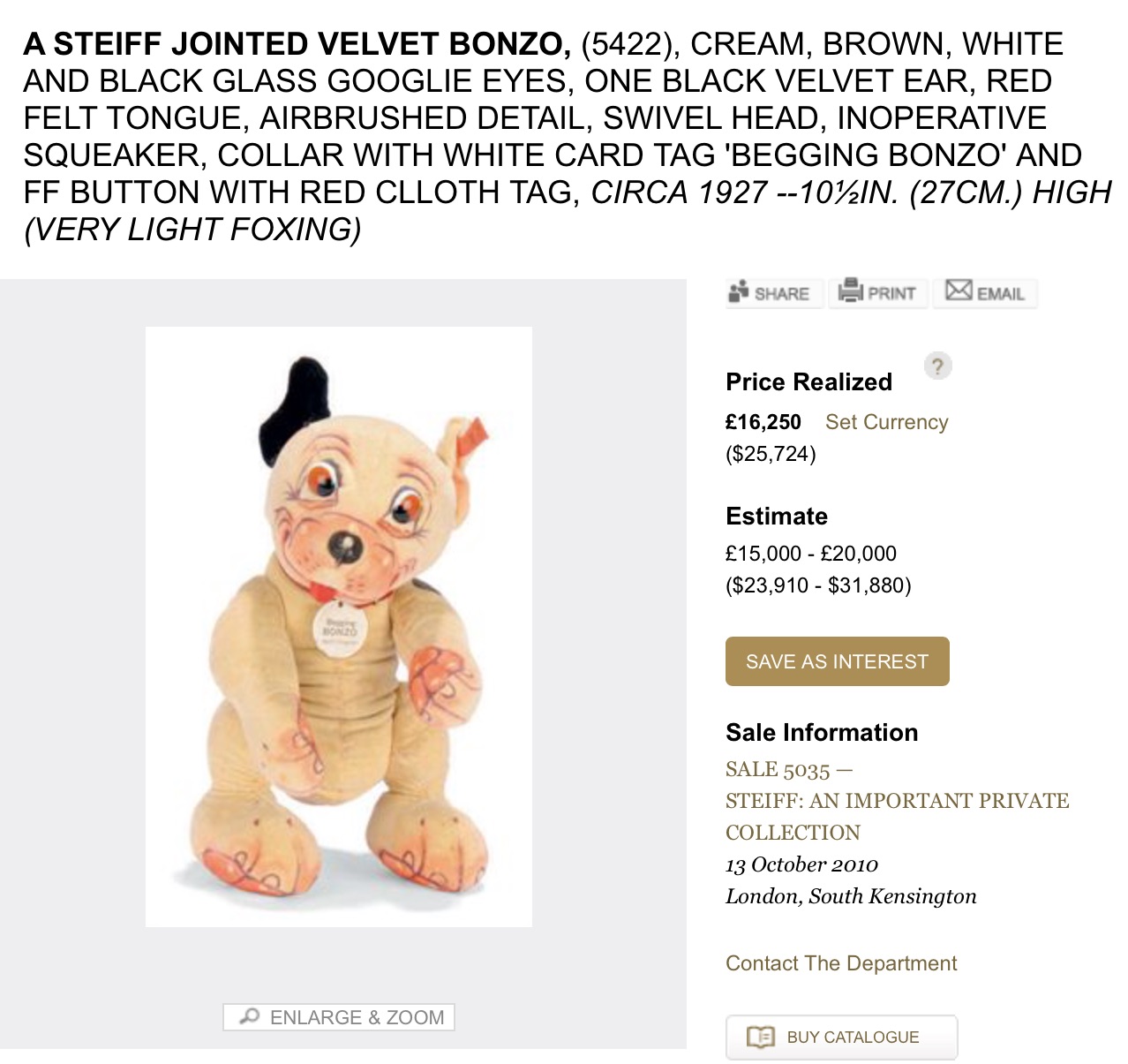
This Bonzo is truly in a class by itself... almost! It is only the second one ever that Steiffgal personally has seen go up for sale, and the first ever in this size. In 2010, Christie's in London sold a 27 cm version with all IDs for £16,250 or $25,724! This Christie's example had his red Steiff tag numbered "5422," meaning 5=jointed, 4=velvet, and 22=22 cm sitting. This big boy appears here on the left; the photo is from Christie's.

Although Bonzo never "officially" made the Steiff line, he did make a little known appearance in another rare novelty pattern of the time. Bonzo was produced as a "Bonzoette," which was a very long limbed, dressed version of his design. These items were called "car and play" dolls or "Charleston Animals," based on the Charleston dance craze of the 1920’s, with its fast moving arm and leg movements. Other "play and car dolls" included Bulliette, the bulldog, Fluffiette, the cat, and Rabbiette, the rabbit. Each doll had the head of the character, mohair or velvet paws and feet, and dangling velvet limbs. Most were available in several bright, happy "jelly bean" colors and in 20, 30, and 43 cm, with the larger sizes having a squeaker. Bonzo was made in 30 and 43 cm in blue or orange in 1928 only and is arguably the rarest of all of these "play and car" dolls. These long legged Steiff novelties appeared overall in the line from 1927 through 1932. A picture of Bonzoette appears on the left, it is taken from Pfeiffer's 1892-1943 Sortiment Book

As noted in the cataloging above, Bonzo is in part responsible for the design and introduction of another late 1920's Steiff rarity, Cheerio the Puppy. This pattern is known for his todder-esque appearance, huge eyes, open mouth, and happy-go-lucky personality. Several versions were produced. A begging version was manufactured in 17, 22, and 28 cm from 1928 though 1931. Begging Cheerio was also made as a press and release music pup in 22 and 28 cm from 1928 through 1930. Cheerio was also manufactured standing on all fours in 10, 14, 17, 22, and 28 cm from 1928 through 1932. Standing Cheerio also appeared as a press and release music box in 17 and 22 cm from 1928 through 1930. And, like Bonzo, Cheerio was also produced as a "car and play doll." "Cheerioette" appeared in the line 30 and 43 cm from 1928 through 1931.  A begging Cheerio, from Steiffgal's collection, is pictured here on the left. 

Be sure to check out Daniel's amazing Steiff Bonzo, and other Steiff and Teddy treasures, at the upcoming SAS toy auction event on June 9th, 2016.  For more information on this sale, please click here!

Steiffgal hopes this discussion on Steiff's fantastic and really rare Bonzo dog has gotten your tail a'wagging!

Have a question about one of your Steiff treasures? Let's talk! Click here to learn more.

Sunday, November 22, 2015

This Most Unusual Steiff Skunk Is Begging For Your Attention

It's never a good idea to see things only in black and white.  Unless of course, you are studying Steiff's wonderful skunks!  So pull out your magnifying glasses and thinking caps, and take a look at this most unusual example.  Have you ever come across one of these two-toned treasures?

No need to hold your breath for information on this little stinker. Here we have the strange, wonderful, and highly unusual Phuy Skunk. And why so unusual? In the Steiff reference books, the only thing listed about him is that he was made in 1965, and his "purpose is unknown." Physically, Phuy is 18 cm. He is in a begging position, although he can also lay down if he gets tired. His body is made from short black and white mohair, while his tail is made from long black and white mohair. He has double-thick felt paws and feet; his feet are stenciled with little foot prints. He has an open, felt lined mouth, a pink hand embroidered nose, brown and black pupil eyes, and mono-filament whiskers. 

Phuy is sometimes confused with another begging buddy named Cosy Skunk. This fellow is 22 cm, unjointed, and can lay down or sit up. His body is made from short black and white dralon. His robust tail is made from long, black and white dralon. His face is detailed with felt ears, black and brown pupil eyes, clear whiskers, and a pink hand embroidered nose and closed mouth. He has white, double thick felt front hand paws, but no feet paws. There is no stenciling on his felt paws. This smelly sweetheart was manufactured from 1960-1974 in this size only.  He is pictured here on the left.

It stinks that there isn't much information available about Phuy. But, it was not unusual for Steiff to produce an animal in a very small edition size, and as a result, not keep detailed records about it. Sometimes these rarities were produced for, or ended up at, specialty retailers such as F.A.O. Schwarz. A good example of this is the company's "Mystery Squirrel" which does not (as far as Steiffgal knows) appear in any of the standard Steiff reference books, but is featured in the F.A.O. Schwarz catalog of 1968-1969. He is pictured here on the left. It is interesting to note that this Mystery Squirrel, like Phuy, is a "field and forest friend," is made from mohair, and is in the same general (begging) body position. Mystery Squirrel is pictured here on the left. 

As rare as Phuy is, he is not the rarest Steiff skunk Steiffgal knows of. Check out this remarkable, and probably one of a kind Steiff Skunk sold by Teddy Dorado in 2013 at the annual Steiff Sommer Auction in Giengen, Germany. He hammered at 950 euro!  This absolute rarity is cataloged as... "Disney character begging skunk, 18 cm, a unique specimen in mint condition from 1978-1979. Art.-No. Art.-No. 7958/18. Made of black, pink & white trevira velvet; chest from pink Dralon plush; white hair on top of head & white-black tail made of long pile woven fur; black-white googly eyes; cord tongue; unjointed in begging position; limbs excelsior stuffed; manufactured without voice & chest tag; small golden coloured Steiff raised script button in ear; Steiff ear tag shows hand written Art.-No. & wrong information about covering material; in mint condition overall; item without report in any Steiff catalogue."  This Disney character skunk is pictured here on the left, the photo is from Teddy Dorado.  

Steiffgal hopes this discussion on Phuy Skunk has been a well deserved breath of fresh air for you. 

Have a question about one of your Steiff treasures? Let's talk! Click here to learn more.  
The teddy bear search engine