Showing posts with label plush. Show all posts

Thursday, January 15, 2026

Let The Games Begin With This Sample Steiff Lake Placid Olympic Games Mascot!

Steiff's century-spanning anthropomorphic animal dolls are the best of all worlds. But is it possible there is one that is truly worthy of an Olympic gold medal? Steiffgal thinks so - and is over the moon thrilled to welcome one into her hug. This winter-themed wonder was purchased decades ago in Europe by his previous family. Check out this remarkable Steiff raccoon doll and see what makes him so COOL - literally - from the product design and historical perspectives.

Here we have a sample Steiff Roni the Raccoon doll, made as a possible licensed souvenir item for the 1980 Winter Olympic Games.
These were held in Lake Placid, NY from February 13th-24th, 1980. Roni, who was named as a nod to the venue's Adirondack mountain range, was the cartoon mascot for this event and was designed by commercial artist Donald Moss. Roni himself is 25 cm tall, standing, and unjointed. His head is made from short grey plush with an inset velvet facial mask. His pupil eyes are highlighted with black airbrushing to give him his traditional "raccoon bandit" look. He has a black embroidered nose and a pink painted mouth. His ears are lined in velvet and have a little pink airbrushing to them. He has a very long, fluffy, and bushy tail. Roni's winter garb, which is made from velvet and integral to his body, includes green gloves, a blue snowsuit, and red boots with brown soles. He wears a white bib which has the event's official Olympic logo hand rendered in black on either side.

Roni is branded with his Steiff ear tag and button.
Steiffgal doubts he was produced with a chest tag for two reasons; first, he was made as a sample so there really was not need for this tag. Also, his custom bib is so interesting and so integral to his chest, a chest tag would be redundant or even interfere with his presentation. His yellow ear tag is generic and without digits, so this pattern was probably never assigned an article number. This style of ear tag appeared on items made in the c. 1969/1970 through 1980 era. And his thick, brass style ear button with the script word Steiff on it debuted in 1979. So given the games were in 1980, and it could take a year or so for a licensed product to go from idea to production - all of these dates point to his production taking place in 1979.

It is not clear why Steiff's Roni doll never went into production.
He is on brand, matches the official event logo to a "T", isn't terribly complicated or expensive to manufacture, and is super, super cute! Steiffgal suspects it may have something to do with legal or financial complications often associated with international commercial licensing agreements. However, other companies were able to get production licenses to make Roni dolls, including a version on ice skates. Of course, these simpler patterns were nowhere as fabulous as Steiff's full blown interpretation of Roni! It is interesting to note that Steiff was able to produce Olympic branded and licensed items for other Olympic games, including the 1972 Munich games, the 1998 Nagano games, and the 2010 Vancouver games, among others.

It is nearly impossible to find out any additional details on Roni and this stalled Steiff Olympic project.
The only footnote Steiffgal could find was a reference in Dee Hockenberry's, book, Steiff Bears and Other Playthings Past and Present. Concerning the Roni doll, she notes: Prototype Raccoon: 11 inches. In 1978 and 1979, Steiff, through their US representative, made presentations to the American Olympic Committee in order to obtain a license to make 1980 Olympic souvenirs. Three prototype were made incorporating the Lake Placid mascot and Olympic logo. Although the samples were attractive, an official license was never granted. These are the only examples ever made.

Steifgal hopes this discussion on this Roni the Raccoon Olympic prototype doll has been one for the record books for you. 

Have a question about one of your Steiff treasures? Let's talk! Click here to learn more.

Monday, January 22, 2024

Jumping For Joy Over This Funky 1980s Era Steiff Toy Rabbit

You may be really surprised at Steiffgal's latest addition to her hug. This softie recently arrived as part of a large auction lot purchase from overseas. Although he doesn't exactly fit in with the age, materials, and era of most of her vintage to antique button-in-ear collection, there's just something really sweet and appealing about him. As such, he's earned a place on Team Steiffgal, and in her heart as well. Come learn more about this happy hopper produced at a key time in Steiff's business history. 


Baby Rabbit is standing, unjointed, and measures 28 cm tall, including his ears. He is made primarily from a vibrant baby blue colored soft plush. His paw pads, chest, muzzle, and the lining of his ears are made from soft white plush. His face comes to life with black button eyes, a black hand embroidered nose, and a spot of pink to highlight his mouth. His squeaker works loud and clear. He left the factory wearing a pink neck bow. Baby Rabbit was made in this size in this color combination, as well as a pink and white version, from 1983 through 1986. The pink version is pictured below on left; the image is from Pfeiffer's Steiff Sortiment 1947-2003. 


This super sweet bunny was clearly produced as a toy for children. In terms of "kidproofing," his practically embedded black plastic eyes, lack of a chest tag and button branding (his tag is stitched into the seam of his ear), and washable, synthetic materials set him up for years of cuddles, play, and roughhousing. And his name, and youthful color, (and that of his twin pink sister,) also hint that this pattern may have been intended as a nice baby or baby shower gift.


What's most interesting about Baby Rabbit is the timing and era in which he was produced. The 1980s through the early 1990s were a period of great transition at Steiff. The company was at an important juncture in terms of business, pricing, and design priorities, and the toy industry as a whole was moving quickly in new directions. 


Two key market realities of this era were the continued influx of inexpensive toy imports from Asia and the emerging interest (and rise in value) of vintage to antique Steiff bears, animals, and dolls. As a result of all of this, Steiff started, and/or tested, several new initiatives to adapt to these changes. These included offering replicas and special limited editions; creating an ongoing line of Christmas items and ornaments; increasing partnerships with key organizations (like Disney and F.A.O. Schwarz) and other toymakers (like Suzanne Gibson); and launching the Steiff Club in 1992. These strategies were rolled out in part to capture the higher end market and gain new collectors. Here on the left you can see Steiff's very first replica, "Papa" bear, from 1980. He was made in a worldwide edition size of 11,000 and was designed to celebrate the 100th anniversary of the Steiff Company.


Steiffgal thinks that Baby Rabbit, and other simple, lower end soft plush items of his era, were probably designed, produced, and distributed to compete with the Asian exports part of the business equation. 


Steiffgal hopes this discussion on the company's 1980s production has you feeling nostalgic, in the best possible way. 


Have a question about one of your Steiff treasures? Let's talk! Click here to learn more!

Wednesday, December 20, 2023

Rockin' Around the Christmas Tree, Steiff Style!

It's the most wonderful time of the year... and Steiffgal is hoping you are celebrating with beloved family and friends, tasty treats, and treasured memories in the making.
For many folks, the dark days associated with the end of the calendar year are practically synonymous with brightly lit Christmas trees. And believe it or not, Steiff has made their own button-in-ear version of this legacy Christmas symbol. Take a look at this most unusual Steiff novelty, one of Steiffgal's most favorite modern editions of all time... so much so, that she leaves it on full display all year long!

This fabulous Steiff collectible gets the green light for its rarity, beauty, and clever design.
Here we have Steiff's Weihnachtsbaumor Christmas tree. It is 25 cm tall and made from soft green velour like material. The branches and limbs are all dimensional but not stuffed. This greenery is arranged around a wooden dowel mounted on a circular wooden stand. The tree is decorated with flat yellow felt stars, round red fabric balls, and a garland of tiny, opal-esque stars. It is topped with a larger yellow felt star. Of course a tree does not have ears, so its "button-in-ear" branding of a tag and button are located on one of its lower green fabric limbs.

This holiday themed rarity was made in 2004.
It was not a limited edition, but manufactured in very small quantities. Steiffgal suspects that it was somewhat challenging to produce on a commercial scale, given its construction and form, as well as the number of seams it requires. As a result, they appear few and far between on the secondary market.

It is pretty unusual for Steiff to create items that are not primarily based on living human or animal forms. The company has made other novelties, like rattles, pram toys, and music boxes resembling flowers (and even fruit!) in the distant past. More recently, the Christmas line has featured Teds in felt Christmas tree suits, and holding trees. But as far as Steiffgal can tell, this is Steiff's only free standing Christmas tree design produced on a somewhat commercial scale to date. 

Steiffgal hopes this discussion on Steiff's soft plush Christmas tree has added a holly-jolly touch to your day!

Have a question about one of your Steiff treasures? Let's talk! Click here to learn more.

Saturday, August 12, 2023

Rolling Along With This Early 1930s Steiff Scotty On Wheels

Great Scot! Check out this utterly charming prewar pup on wheels. Despite his small size, he's got a few interesting "time capsule" details that help to date him to a "T". Read on to learn more.

This bearded beauty is the wheel-deal indeed!
Scotty is 17 cm tall, standing, and head jointed. His body and head are made from grey and light black mohair plush fabric. His ears are made from pitch black mohair. Scotty is detailed with proportional black and brown round glass pupil eyes, a black embroidered nose and mouth, and dark pink embroidered claws on each of his four paws. His ears are lined in black mohair. The dog is mounted on a metal carriage and glides along on four blue wooden eccentric wheels. He retains his original collar and brass bell. His collar is white and dark blue or black leather, and closes with a ring and two (now very rusty) Steiff buttons. He retains his long trailing "f" button in ear and traces of his chest tag as his Steiff IDs. 

This model was made in 14, 17, and 22 cm (measured vertically, without wheels) from 1932-1943. He was produced in grey and black mohair plush from 1932 through 1934; after 1934 he appeared in all black mohair. Given those dates, it is safe to say that this guy was "born" in the 1932-1934 time frame. 

Scotty dogs debuted in the Steiff line in 1930 and were an immediate success with customers.
Their size, personality, and proportions translated well into soft toys designs, and Steiff created a number of sitting, standing, wheeled, and novelty versions over the next decade. Some had round glass pupil eyes like this example, while others had brown, white, and black almond shaped glass eyes. Steiffgal has never been able to figure out why that was the case, but both style of eyes are original to Steiff. 

The Scotty under discussion here has two distinctive early 1930s-era details that Steiffgal has not seen on items produced during any other time. The first is his body fabric, which is a mostly black mohair plush with grey fiber details. It is not "spiky" like traditional mohair, but smoother and more elegant, with the longer fibers really resembling a dog's coat. This lovely material was used for awhile on the company's Scotties, but then disappeared in 1934 - about the time that things really started getting difficult at Steiff - and throughout Germany due to geopolitical realities. It is possible that the grey and black fabric was expensive, and the company was trying to save money on materials, and/or that it was no longer being produced, and/or it was entirely allocated by the government for wartime material production. Through the early 1940s, Scotty dogs would go on to be produced in mohair, wool plush, cotton plush, and silk plush - apparently coming to life in the fabrics available at the time. 

Also of note is this Scotty's prominent leather collar.
Steiffgal has only noted this woven style, light and dark belled collar on dogs from the early 1930s. It is possible that this accessory was designed and produced to give the dogs wearing it a more "upscale" look and feel. The collar, which is not removable, needed to be manually attached to the dog and finished with two inserted buttons. This of course required many more assembly steps than the signature, simple red buckled collar which would be used on the model just a few years later. 

Steiffgal hopes this discussion on this early 1930s Scotty on wheels was a joy ride for you!

Have a question about one of your Steiff treasures? Let's talk! Click here to learn more!

Saturday, December 31, 2022

These Ladenburger Spielzeugauktion Auction Highlights Are Dressed To The Nines!

Three's a charm when it comes to the third post in this blog series of auction highlight from Ladenburger Spielzeugauktion's January 21st, 2023 Collection of Susan Kilgore Wiley sale. It's no secret that Steiffgal goes all hubba-hubba over Steiff's utterly charming dressed dolls and animals. And, this sale offers some of the most appealing ones in memory. Check out this trio of well attired prewar offerings from this auction. Steiffgal is certain you will consider all of them a clothes call indeed.

This first dressed highlight doesn't have a hare out of place.
It is lot #6152, an all original and early Steiff Peter Rabbit. It is estimated at €650-€1,300, and is cataloged in part as:

"One of the highlights of the auction, exceptional hare, Peter, around 1910, with small button, block letters, long trailing f, shoe button eyes, underlaid with red felt, fine brown/beige velvet, attending, with original felt jacket, decorative seams and golden buttons, red slippers, 1 leather sole with original stamp, 1 felt slipper is a bit holey, and small holes on the blue felt jacket, standing height 26 cm, extremely rare, exceptional."

Steiff's turn of last century Peter Rabbit dolls top many collector's bucket lists. This well coutured example is in lovely condition and is a marvelous size. It is interesting to note that the exact details that make up a Steiff "Peter Rabbit" are not specifically identified in Pfeiffer's Sortiment books. It is generally understood amongst collectors that a "Steiff Peter Rabbit" is standing, unjointed, and wears a felt topcoat with buttons and embroidery and felt slippers with leather soles. The Sortiment book pictures two versions of standing rabbits wearing felt topcoats and slippers, but does not identify them as "Peter Rabbit." The first is a spotted velvet version wearing a red or navy topcoat and red slippers; he was produced in 10, 22, and 28 cm from 1904-1919. The second is a white wool plush version wearing a green felt topcoat and red slippers; he was produced in 22 cm from 1904-1918.

This next auction highlight is a pair with flair!
Here we have lot #6181, two early 20th century, fully jointed, center seamed Steiff felt dolls. They are estimated at €330-€660 and are cataloged in part as:

"Felt dolls, Anton & Lisl, Upper Bavarian, produced between 1909 and 1926, 28 cm, with traditional costume, felt-head, mohair-hair, felt body, jointed, arms and legs, original, clothes, very nice condition."

This darling duo are textbook examples of   Steiff's "children" style dolls. 
These guys appeared in the line from 1909 through the late 1920's. Unlike earlier Steiff dolls that were more caricatured, harsh, and designed for adult collectors, these dolls were realistically proportioned, had gentle personalities, and angelic, rosy faces. They truly were designed for child's fun and play. These models were all fully jointed and had felt heads and bodies - except right around WWI when felt was scarce and the bodies were sometimes made from rough cotton or linen type materials. Steiff's children dolls were all dressed head to toe in handmade clothing that included school uniforms, ethnic costumes, sporting attire, and “Sunday best." Steiffgal is certain that the boy is Anton, based on his outfit and presentation. However, she is not 110% certain the identity of the girl is Lisl as her outfit does not match the one pictured in Pfeiffer's Sortiment. Steiffgal also suspects that her clothing, however charming, is not entirely original to her. Nonetheless, the pair is simply wonderful.

And it's tag, you're it! when it comes to our final well dressed auction highlight.
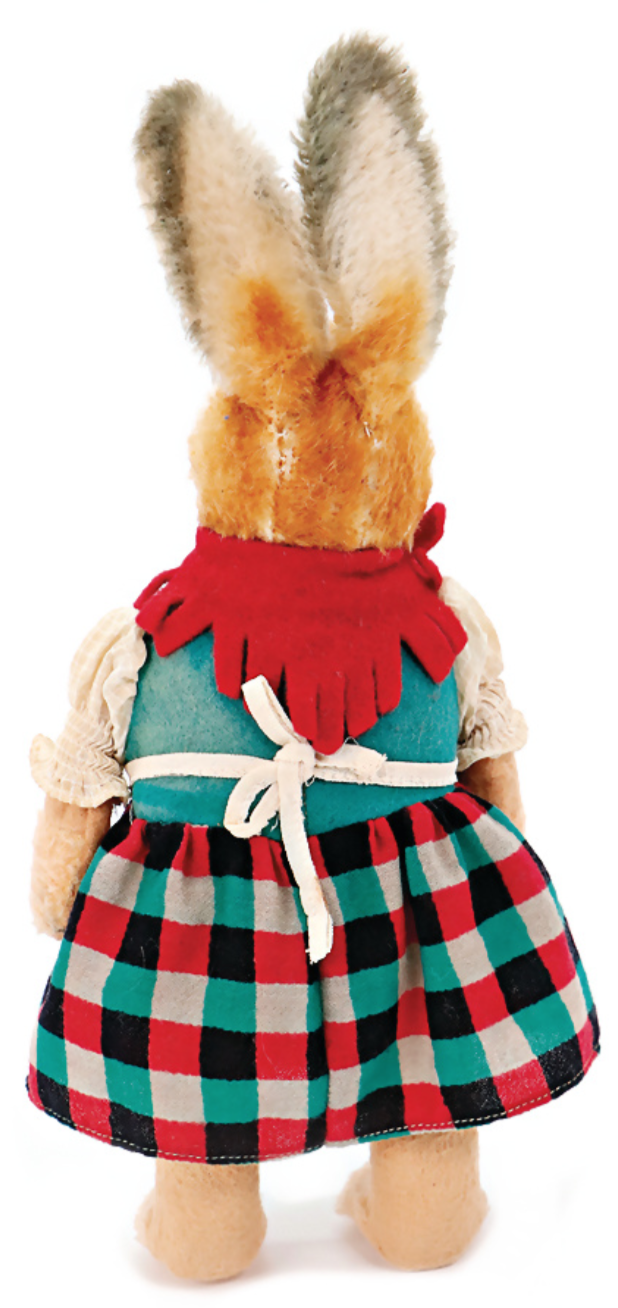
This is lot #6114, a late prewar standing and dressed rabbit doll, estimated at €180-€360. She is cataloged in part as:

"Pupp-hare, Mike, with button, block letters, long trailing f, very nice good preserved, yellow cloth tag label, No. 22, wool plush at hands and feet, original traditional costume, 27 cm, very nice condition."

And just want makes this lovely lady a 10?
She's got a fantastic presentation, and is in delightful, all original condition. And if you look closely at her tag, it is says "22,11." Numbers don't lie here! Her digits mean 22 cm tall (measured without ears), while the number 11 corresponds to her costume as described by the company. Outfit #11 translates to "traditional costume with green checkered skirt, green corsage, and white shirt." Spot on! These utterly charming, dressed rabbit dolls appeared in the line in 14, 22, and 28 cm in maize or white plush from 1932-1943 overall. Eleven total outfits for these rabbits were produced; they ranged from pajamas to playsuits to trousers and dresses through regional outfits like the one featured on this premier example. 

Steiffgal hopes this discussion on these well dressed auction highlights has contributed to the fabric of your collecting life. 


For more information about Ladenburger Spielzeugauktion GmbH's upcoming Special Steiff Auction event on January 21st, please click here!

Have a question about one of your Steiff treasures? Let's talk! Click here to learn more!

Sunday, May 15, 2022

Hold Everything And Check Out This Unusual Steiff Novelty!

Now for something completely different! Steiff is well known for producing functional novelties for home, school, and work use in addition to the company's plush animal, doll, and bear production. This tradition goes back to the late 1800s, when Margarete Steiff produced and marketed a series of oversized, embroidered felt "pockets" designed as newspaper holders, bed wall bags, duster holder bags, and brush holders, among others. You can see some of these fantastic items here on the left. Today's blog feature, despite its unconventional form and psychedelic hues, has its roots in these early and legacy products.

Hold everything and check out this unusual Steiff "thing-a-ma-bob."
This is the first and only example of this oddity Steiffgal knows of or has handled. It measures 25 cm long and is made of yellow and red knitted fur. These colors reflect Steiff's corporate branding hues of the period. It is unjointed and unstuffed. It comes to life with oversized brown and black pupil eyes, a red fabric nose, red felt ears, and a red mouth. It has a 15 cm red zipper on his back which has a silver pull ring. According to Pfeiffer, this item is identified simply as an "accessory case" and appeared in the line from 1979-1981 in this size only. The case retains its button, eartag, chest tag, and hang tag as its Steiff IDs.

So of course there are two mysteries associated with this item. The first is, what animal is it supposed to be.... and the second is... what exactly is it designed to hold?  Neither has a clear cut answer. 

Let's take a closer look at both questions here. As for its identity, it has the physical qualities of several species. It is long and narrow like a snake or eel. Its round ears and muzzle shape sort of have mouse qualities. And its rear end fin is fish-like. So it would be safe to say that it is a "happy hybrid." And for its functionality, it is Steiffgal's best guess that it might have been proportioned to hold pencils and pens for a school child as a pencil case. However, he could just as easily hold a nail file, makeup, and a comb for an adult as a cosmetics bag. Unfortunately, only he knows for sure - and he's not talking!

Steiffgal hopes this discussion on this unusual Steiff novelty case has held your attention from start to finish. 

Have a question about one of your Steiff treasures? Let's talk! Click here to learn more. 

Sunday, April 10, 2022

Monkey See Monkey Do With This Delightful Steiff Prewar Rarity

It's no secret that Steiffgal is simply bananas over Steiff's legacy Jocko the chimp pattern. This happy go lucky primate has been a collector's favorite since its introduction in 1909 - and for good reason! Steiffgal saw today's featured guest listed on an online auction platform in Europe and knew she had to have him. After a few ups and downs, he finally arrived in the USA and was even better than photographed and described. Take a look at this ray of sunshine - literally!

Here's a tip - this Jocko is off the charts great! He measure 30 cm sitting and is fully jointed. He has the design's traditional very long arms and bended at the knee legs. His hands, feet, face, and ears are made from felt. He comes to life with oversized brown and black glass pupil eyes set in eye pocket, a large, open, felt lined mouth, painted features and nostrils, and a white mohair chin. And you can't help but notice his outstanding fabric. He is made from bright orange tipped mohair. This coloration is very prominent on his body and joints and less so on his head and arms. His fading probably happened because of exposure to sunlight, as well as natural fading that occurs with dyes and natural fibers. It is also possible that his torso is less faded because he was wearing clothing that protected these areas from the elements. Only he knows for sure!

Jolly Jocko retains his long trailing "f" button and traces of his yellow ear tag as his Steiff IDs. This is helpful, somewhat, in dating him. The long trailing "f" button appeared from around 1906-1935, and the prewar yellow ear tag appeared around 1934. If you overlay those two data points, they suggest that orange tipped Jocko was most likely "born" in 1934 or 1935.

Colorfully tipped mohair was a prominent design feature starting in the mid-1920s through the early to mid 1930s. Some models of Happy, Teddy Clown, and Petsy featured eye-catching brown tipped mohair. Fluffy the cat is famous for her teal eyes and blue-purple tipped coat, while Bully the bulldog made a name for himself with his orange tipped detailing. Molly the puppy was produced with brown, red, green, or blue tipped mohair, and examples of Charly the King Charles Spaniel with bright orange tipped mohair appear occasionally on the secondary market. Some 1920s rabbits were produced in surreal, tipped hues. and even some field and forest animals sported this distinctive fabric as well.

As far as Steiffgal can see, there is no specific mention of an orange tipped Jocko in any of the standard Steiff reference books. All of his IDs and detailing put him in at the tail end of "the golden age of tipping" at Steiff. However, Jocko monkeys are among the most popular and prolific designs in the Steiff line. Given they've been in production since practically the turn of last century, it would be nearly impossible to capture all of his different versions and variations - especially all the different fabrics he's sported over the years. For example, in her own personal collection, Steiffgal has otherwise undocumented versions of this chimp in artificial silk plush, wool plush, cotton plush, and other woolen combinations - among others! It would be possible to have a collection of just Steiff Jocko monkeys given the enormous range of their appeal, individual personalities, and of course, material presentation.

Orange you glad you checked out this Steiff blog today?

Have a question about one of your Steiff treasures? Let's talk! Click here to learn more.

Sunday, September 26, 2021

Connecting Then And Now With This Adorable Steiff Play Doll

What's old is new again, especially when it comes to this relatively modern Steiff doll under discussion here. Our friends in Giengen started producing fine cloth dolls on a commercial scale at the beginning of the 20th century. These gorgeously rendered playthings appeared through the early 1950s. After that, dolls with rubber faces (and sometimes rubber bodies) represented a significant portion of the Steiff doll line through the 1970s. Moving forward, the company's doll offerings included mostly well-dressed children and characters in synthetic materials as well as artist collaborations.

This Andrea doll is a sweet nod - with a modern twist - to Steiff's legacy doll production. She is 32 cm tall, unjointed, and made from soft woven fur. She is stuffed with a mix of polyfill as well as weighted beans. She comes to life with a shock of longer brown hair decorated with red ribbons, oversized brown and black pupil eyes, a button nose, a pink painted mouth, and airbrushed facial highlights. She wears a white cotton "onesie" that is both underwear and a white t-shirt, a red calico dress decorated with yellow ladybugs, and red shoes which are integral to her body. This sassy lassie appeared in this size only in 1999. At the same time, Steiff produced two other similarly constructed dolls; a girl dressed in blue named Babinchen and a red-headed boy in overalls named Andreas. Both were also 32 cm.

Andrea has three features that connect her with the past.

The first is that she is clearly designed as an appealing child. Starting around 1908, Steiff began producing their most adorable and humanly proportioned child dolls. Before then, Steiff's dolls were more caricatured (for example, had exaggeratedly long legs, arms, or torsos) and often represented adults or professions. Steiff's kids were usually dressed as students or in traditional outfits, and sometimes even in regional attire. They were playful, distinctly youthful, and looked precious in school room vignettes and in the company's print and postcard advertising. Today, these child-inspired antique felt dolls are coveted by Steiff and doll collectors worldwide.

The second is that she is (relatively) finely attired. Steiff has always paid special attention to their doll's clothing and their detailing. For example, Steiff's early 20th century dolls were "dolled" up head to toe, with well-made and finely accessorized outfits. Most girls had shoes and hats, while adults could have layers and layers of clothing to match their real life counterparts and inspirations. Police, soldiers, and firemen had perfectly to scale boots, tools, and helmets. Of course, Andrea - as a play doll - is not on that level. But she does have shoes, underwear, hair accessories, and a dress that is perfectly appropriate to her. Her outfit is well planned and coordinated for what she is. It is also sweet (and probably not a coincidence) that her dress perfectly aligns color-wise with her prominent chest tag. 

And last but not least, she features Steiff's signature center seam facial construction. This is hard to miss if you don't look closely. This means she has a vertical seam going right down the middle of her face. This helps to add to her symmetry, as well as youthful appearance. Steiff introduced this legacy design feature with their debut doll line in 1903. By the late 1930s, this construction was replaced with a seamless, pressed felt faced design. Given today's manufacturing options, Andrea could have been designed and produced without this seam. But in Steiffgal's heart of hearts, she believes she was made with it to remind collectors of her turn of last century relatives - and the beauty and joy they generated... both then and now. 

Steiffgal hopes this discussion on this modern play doll has added a touch of childhood wonder to your day.

Have a question about one of your Steiff treasures? Let's talk! Click here to learn more!

Monday, November 30, 2020

The Boys Are Back In Town!

It's beginning to look a lot like Christmas, at least around these parts. Lights are going up, store windows tempt with seasonal displays and goodies, and traditional treats like candy canes, gingerbread men, and fruitcake line the shelves of most grocery stores. The only thing missing, so far, is a little snow to make the experience complete. But that can be remedied right here! To help nature along, here's a quick look at Steiff's history of snowman production.

Despite producing many snow-related dolls, animals, and accessories in the prewar period, it was not until 1955 that Steiff produced its first actual snowman.
This fellow was 25 cm, very plump, and made from white wool plush. His flat feet, designed for standing, had felt pads. He wore a red felt hat and an orange felt scarf, had white woolie buttons down his front, and carried a tiny Christmas tree in his hands. His face came to life with black glass eyes and a dimensional nose and mouth. His article number 7525, corresponded to 7 = in caricature, 5 = wool plush, and 25 = 25 cm tall. He was made as an exclusive for the US market, is insanely rare, and tops the wish lists of many collectors today. The most recent publicly documented sale Steiffgal could find was in January, 2020 when a nice example sold for $1,143 on eBay. The picture on the left is from Worthpoint.

Steiff's next snowman was also a hands down rarity.
In 1964, Steiff introduced its Sneba Snowman puppet. He was 17 cm, unjointed, and made from white dralon. His fingertips and head were stuffed with excelsior. His face was detailed with black eyes, an orange felt nose, a red stitched mouth, and a touch of pink blush on his cheeks. He had two black "coal" woolen pompoms on his chest, and his proper topper was a black felt hat. Sneba was made for only one year and is one of the most sought after postwar puppets as well as items. Like his wool plush cousin from the 1950s, he is as rare as hen's teeth. 
The picture on the left is from Steiffgal's collection.  

It would not be until the 1990s that snowmen would appear again in the Steiff line, but this time with more regularity.
The largest standard line one to date was the company's 32 cm Teddy Bear Snowman from 1996. He was made from white mohair, head and arm jointed, and wore a black felt top hat. His face was detailed with an orange mohair nose and black button eyes. His accessories included matching black buttons down the front of his body and a broom made from wood and mohair. A few years later, In 2001, the company produced a series of 21 cm snowmen, including one wearing a blue and white cap and scarf for the German market, and one wearing a green and red cap and scarf for the American market. And perhaps the most appealing example from that era was the company's 18 cm Snowman and Raven duo, which was produced in an edition size of 3,000 pieces in 2002-2003. T
hese happy friends from Steiffgal's collection are pictured here on the left. 

Given their universal charm, it was no surprise that Steiff produced smaller scaled mohair snowmen as holiday ornaments.
An early, if not the earliest one, was a 12 cm, arm and head jointed version wearing a red top hat and carrying a straw and wooden broom made as an exclusive for Disney in 1998. A somewhat similarly designed version in 13 cm but wearing a black top hat was made as a limited edition for the USA in 5,000 pieces that same year. In 1999, a 12 cm version wearing a blue enameled hat and carrying a tiny Christmas tree topped many Steiff collector's holiday wish lists. And more recently, the company's "Mr. Winter" white mohair snowman ornament from 2016 held two ski poles; this frosty friend on the go is pictured here on the left. The image is from Amazon.com.

Snowmen were also produced by Steiff as novelties and licensed articles, including Olaf from Disney's Frozen.
 It's kind of interesting to note that Steiff never made a woolen miniature snowman, even though the pom-pom format would have worked well with their traditionally ball-like forms. A fun novelty example - based on a legacy toy pattern from the turn of last century - was the company's limited edition Roly Poly snowman from 2005. He was 18 cm tall, made from white mohair, and was head and arm jointed. He wore a black felt hat and carried a broom. His face came to life with black button eyes, a red button nose, a red embroidered mouth, and a pipe. Within the last few years, Steiff created a series of mohair and plush snowmen based on the Snowman made famous by English illustrator and author Raymond Briggs. A particularly charming one from this collection was a 13 cm tall, white mohair ornament. Like his namesake, he wore a matching woolen scarf and hat. He was detailed with black button eyes, an orange embroidered mouth, and a black embroidered mouth. He had three black embroidered buttons on his chest, and a white ribbon sewn into his back for hanging. This ornament was made in an edition size of in 2015 as a special for the UK and Ireland. The picture on the left is from Steiffgal's collection.  

Steiffgal hopes this snowman seminar has melted your heart, just a bit, in the most delightful way possible. 

Have a question about one of your Steiff treasures? Let's talk! Click here to learn more.


Sunday, August 2, 2020

Ray-zing The Profile Of This Spectacular Special Edition Steiff Sun

Here comes the sun! August is known for its hot days and lazy pace - at least around these parts. This final month of the "official" summer season is best celebrated via barbecues, beach visits, and bikinis - if you dare! Perhaps the finest Steiff item ever created to represent the marvelous month of August is a plush sun. He's pictured here on the left, "hanging out" in Steiffgal's front bay window. Take a look at this super star - literally - and see what makes it so interesting from the design and product development perspectives.

This Steiff rarity is one hot ticket indeed. This Steiff sun is unjointed and made from fuzzy yellow plush. His "body" measures about 17 cm in diameter. He has yellow cloth arms and legs. His simple yet very pleasant face comes to life with black button eyes and a black airbrushed nose and mouth.  His Steiff button and ear tag are located on his corona near where his ears would be, if he had any. And his specially branded chest tag is located on his hip. This most unusual Steiff novelty was produced in 17 and 45 cm in 2001 only. You can see his backside pictured here on the left.

This celestial superstar was created as a promotional product for the Baden wine region in Germany. Germany has thirteen official wine producing regions, and Baden is the most southernmost area of the country. The area is warm and sunny and known for its good quality Pinot Noir, Pinot Gris, and Pinot Blanc. Baden cover an area of about 400km (240 miles) along the Rhine from Lake Constance to Heidelberg, and includes the Black Forest, as well as the vine-clad terraces of the Kaiserstuhl, a volcanic massif. Steiffgal has visited this terraced area with her father and walked among the vineyards along the river. It was a beautiful and memorable experience. She even rode a luge (like a giant skateboard down a cement lined track) down one of the vineyard slopes toward the river which was a fun and once in a lifetime experience. Here on the you can see some of the terraced Baden vineyards; the photo is from www.vinous.com.

Besides his adorable and unique form, this great promotional item has a distinctive chest tag. You can see this tag here on the left. It is illustrated with a large letter B (for Baden) plus a happy sun holding a glass of white wine. How perfect is that? The German writing on the tag roughly translates to, "Baden wine spoiled by the sun."  

Steiff has a long tradition of creating promotional items for companies, brands, and commercial entities. Beloved vintage rarities of this ilk include Peck the Germ made for the pharmaceutical company Merck; Breuni bear, made for the upscale department store Breuninger, and a wool plush and rubber poodle made for Carl Walther GmbH. However, as far as Steiffgal can tell, this is the first "nonliving" advertising item Steiff has produced - a perfect planet! All others have been animals, insects, bears, characters, or human-esque figures. 

Steiffgal hopes this discussion on this bright and happy advertising item has added a spot of sunshine to your day.

Monday, May 11, 2020

A Little Something To Celebrate!

I don't know about you, but the current state of affairs is making Steiffgal a little soft. Soft in the head, soft around the middle, and soft in housekeeping affairs - among a few others. Can you relate? In keeping with the theme of softness, Steiffgal would love to share with you two somewhat recent, but totally irresistible Steiff editions that she keeps around as desk decorations. Both were made as celebratory collaborations with other German companies or organizations. Hopefully you will find joy in them as well!

Check out that mug! Our first plush personality is this sitting, unjointed pug dog. He 12 cm tall and is made from tan and brown soft velvet material. His hugely oversized head comes to life with a tuft of long blonde plush, dimensional jowls, and embroidered features including round, black and white cartoon eyes and a big doggy smile. He has a tiny curly tail just like a real pug. And he wears a brown plush collar. His EAN is 990724, and he was produced in 2011. He does not have a chest tag. This precious pug is a "special edition," but not a numbered, limited edition. 

Ladies and gentlemen, may I introduce "Cobby," the goodwill ambassador for FCI, or Federation Cynologique Internationale. This translates to "World Canine Organization." FCI is an international federation of national kennel clubs, and is based out of Thuin, Belgium. Cobby is FCI's mascot, and he debuted on May 6th, 2011 in honor of the organization's 100 year anniversary event. Cobby was so beloved, and so well received, that he has become part of FCI's general communications and branding outreach. According to FCI's website, "Our mascot, which was designed by the well-known Steiff company in Germany, is perfect as a reward or as a present for anniversary events, but also for any event in general." And the Steiff loving world couldn't agree more!

Now let's turn the page to our second soft sweetie. Here we have "Mikael the bookworm." He is 15 cm long from start to finish and made from tan, brown, light green, and darker green plush. His unjointed body is "s" shaped. Mikael's preciously pensive and very studious face comes to life with a tuft of tan hair, black bead eyes, a pink smile, and black embroidered glasses. His EAN is 674655. His button and yellow tag are located on a tab on his body. He does not have a chest tag. Mikael is a "special edition" and arrived packaged in a commemorative box, but is not a numbered, limited edition.

Marvelous Mikael, like Cobby, was created to honor a centennial event. He was made in 2019 for a chain of bookstores in Germany called Thalia. This business opened in 1919 in Hamburg at the Thalia Theater. According to Wiki, "The Thalia Theater is one of the three state-owned theatres in Hamburg, Germany. It was founded in 1843 by Charles Maurice Schwartzenberger and named after the muse Thalia." Mikael has a special hang tag in German, which translates roughly to, "Here is Mikael the bookworm. He reads for a living. He is a completely original Steiff design and is only available through Thalia as a limited edition in honor of our 100 year anniversary. He feels most comfortable in hands that also like to leaf through books." As such, this Mikael has found a perfect home with Steiffgal. 

Steiffgal hopes this discussion on two sort of silly Steiff editions has added a little humor to your day.

Have a question about one of your Steiff treasures? Let's talk! Click here to learn more!

Saturday, November 10, 2018

Look Who Reappeared On Little Cats Feet?

Reunited, and it feels so good! Childhood and Steiff often go hand in hand, so it is always a sweet treat to come across a old button-in-ear friend from long ago. This just happened to a new friend from across the pond, who asks about her blue-eyed beauty. Vicki from the UK writes...

"Hi, I recently found my childhood toy in my dad's under stair cupboard. She is what appears to me to be a leopard I have attached a photo of front and back. She's a hand puppet with a stuffed head with a solid finger hole in her head (difficult to describe) the button is in her ear with some yellow fabric still present although ragged. She has blue glassy eyes and whiskers. I would like to know if you can tell me the age as I can't find anything similar when I search online just cats but she's not tabby. Thanks for your help. I'm from Hertfordshire. She has no claw stitches but her nose is sewn with pink thread. Inside the fabric is very rough but I'm guessing it's mohair (I wasn't sure if real fur?) I've had her since I was little and I'm 38."

Well, isn't this the cat's meow? What we have here is not actually a leopard but a kitty, although the two probably share alot of the same feline DNA in real life. Steiff has named her "Hand Minka Cat." This oversized puppet measures about 30 cm tall and is made from white and patterned woven fur. Her head is stuffed with soft foam, which has a tendency to break down over time. Her face comes alive with a pronounced white muzzle, oversized blue and black pupil eyes, a pink nose, and dark whiskers. She left the factory wearing a red ribbon. Minka Cat appeared in the line in this size and color combination only from 1978 to 1984. Given Vicki was born in 1980, her ownership timeline corresponds perfectly to the production era of this puppet.

Puppets are legacy novelties for Steiff, and a cat puppet has been in the line since about 1912. As for Vicki's particular cat puppet, it is part of a series of larger, all woven fur puppets from 1978. These included a bear, rabbit, dog, owl, donkey, penguin, and this cat. All were 30 cm in size and had charming, childlike presentations to them. They were more soft and silly than serious - and clearly designed for play. 

The 1970's were a challenging time at Steiff in terms of production and costs, as the competition with products from Japan really disrupted the toy marketplace. The year after Minka debuted, in 1979, Steiff launched its "Hand Cat" puppet, which was 27 cm in size and had a blue trevira velvet body. Only its head and paws were made from patterned plush. His only "detail" was  small white felt collar. All of these updates to the pattern were probably done for the purpose of making a smaller, cheaper, more efficient-to-produce cat puppet for the line. Hand Cat appeared though 1983. You can see this Hand Cat puppet here on the left; the picture is from Pfeiffer's 1947-2003 Sortiment

Like a cat with nine lives, it is interesting to note that in 1984, Steiff re-engineered its trevira bodied Hand Cat puppet - again.  It now featured an even simpler face, which saved on labor costs, and was made in a much more basic grey plush fabric, which saved on material costs. This model appeared in the line from 1984 through 1992 overall. You can see this cat - and other soft plush puppets on offer at the time - pictured here on the left; the photo is from Steiff's "Steiff Collection 1992" customer catalog. 

Steiffgal hopes this discussion on Vicki's cat puppet has been a happy handful for you.

Have a question about one of your Steiff treasures? Let's talk! Click here to learn more!

Saturday, February 3, 2018

This Steiff Honey Bear Is Certain To Sweeten Your Day!

How sweet it is to find a really unusual Steiff treasure? Especially one you've only viewed in photos or read about. So check out this amazing Honey Bear Steiffgal recently had the pleasure of handling. There's no sugar coating it - this rarity truly is the bee's knees!

Have you ever seen anything like this merry mashup before? If an anteater, raccoon, and a Teddy bear all had a love child together, Steiffgal suspects this is what the baby would probably look like. Honey Bear is 40 cm tall, unjointed, and probably designed to sit. His body is made from brown soft knitted plush. His belly is orange soft knitted plush, and his facial mask and nose area are light tan soft knitted plush. His paw pads are brown trevira velvet. His face, which only a mother could love, comes alive with a long pointed snout, brown and black pupil eyes, a peach colored trevira lined open mouth, and light brown airbrushing. He has a long, floppy, raccoon-ish tail. This item was made from 1976 to 1977 and is quite rare, despite its "relative" newness. 


Steiff's Honey Bear is based on a type of real-life animal called a "kinkajou." These mammals live in the Central and South American rain forests and are extremely nocturnal. They range in size from about 3 to 10 pounds. They really enjoy sweet fruit (that's why they are called "Honey Bears") which they eat with the help of their extra long tongues. Like Steiff's version, living kinkajous have an incredibly long tail and a prominent snout. They use their tails to hang from tree branches and as a "fifth hand." They are sometimes kept as pets, but are a bit challenging to domesticate as they dislike sun and daylight and only really go about their business at night. (The real-life one pictured here on the left is clearly only mugging for the camera in daylight conditions in the hopes of scoring a grand treat.)

So the sticky issue here is, why would Steiff ever make a Honey Bear as part of its product line? Well, that's a trick question because the company has actually made two - in 1995 they also produced a 45 cm standing, unjointed version made from woven fur. It does seem that over the years, Steiff has manufactured practically every animal on the planet. With this Honey Bear, things may have more to do with timing than anything else. Looking back, the mid-1970's seemed to be a period of great experimentation in terms of "unconventional" animal production. Other plush "uglies" of that era included the company's 25 or 35 cm "Wizzi" ferret made from imitation fur, a 14 cm "Putty" Turkey made from knitted fur, a 30 cm "Cosy Orangutan" with a plastic face and a very long crylor body, a 28 cm trevira velvet kudu, a 20 cm trevira velvet gnu, and many others. It is interesting to note that like the Honey Bear design, none of these "oddities" lasted for more than a handful of years in the line, either!

Steiffgal hopes this discussion on the company's Honey Bear has helped to sweeten your day.

Have a question about one of your Steiff treasures? Let's talk! Click here to learn more.
The teddy bear search engine