Showing posts with label donkey. Show all posts

Tuesday, January 2, 2024

Farming For Answers About This Unusual Midcentury Steiff Donkey

Let's enter the fray - oops, I mean the bray - of 2024 with a peek at a super sweet and super rare Steiff novelty.
This darling and unusual velvet baby is a recent addition to Steiffgal's collection. He's based on a beloved Steiff pattern, but is accessorized in a most eye-catching way. Take a look at this old-new friend and see what makes him so noteworthy from the design and product development perspectives. 

This barnyard buddy would love to be your beast of burden.
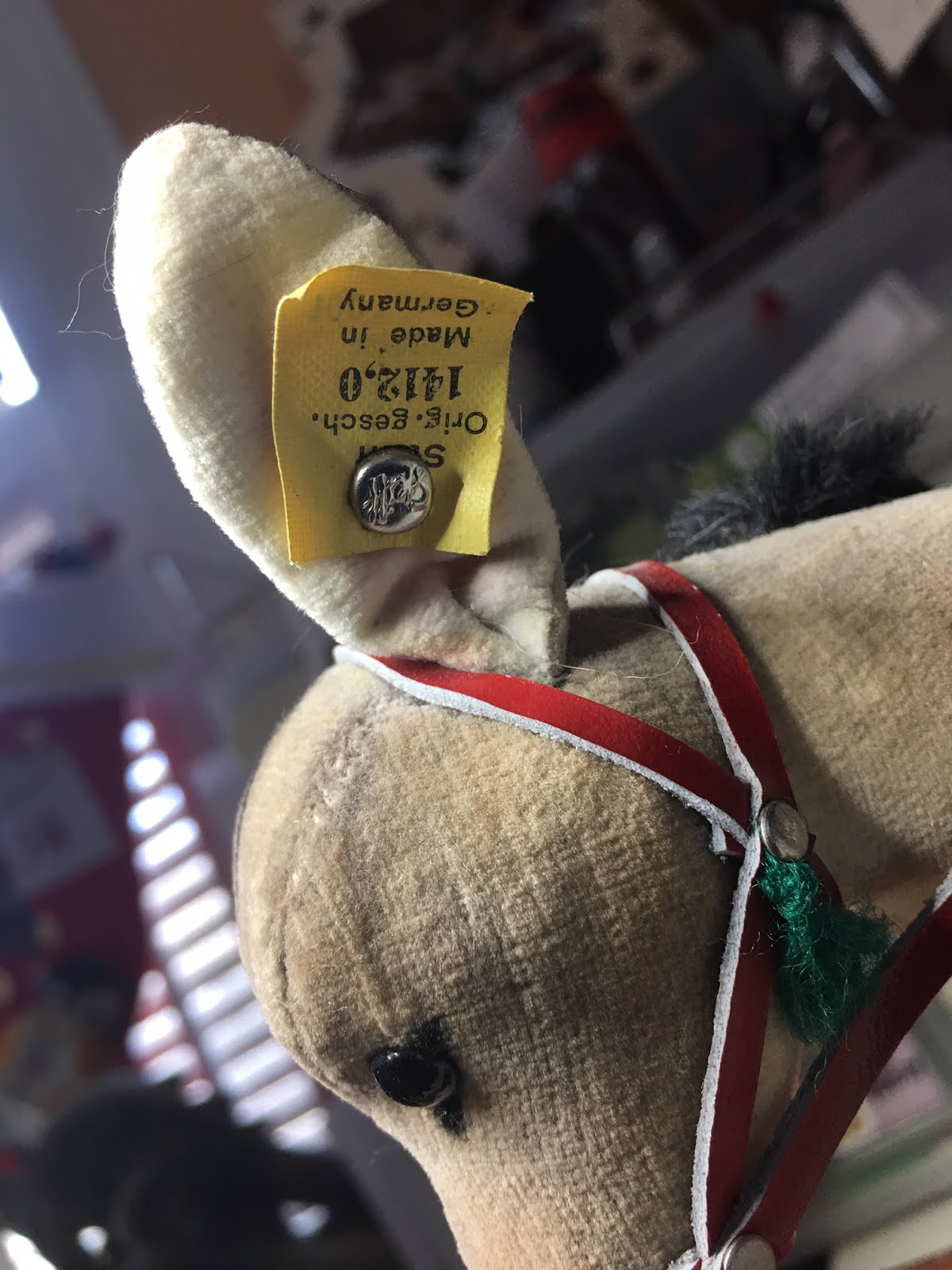
This is a well attired version of Steiff's legacy Esel or Donkey. He is 12 cm, standing, unjointed, and made from velvet that has darkened overall and evenly over time. He has a short black mohair mane. His tail is made from cord. He has black airbrush highlights down his back, on the tips of his ears, and marking his hooves. Esel's face is youthful and endearing; it is detailed with shiny black button eyes and delicate airbrushing to define his nose and mouth area. Esel retains his original accessories, including a red floss and plastic brindle with tiny green felt dots and a red and white checkered sack with a green tie. The bag is stuffed and dimensional, and stitched onto his back. His IDs include a raised script button, very early postwar ear tag, and a chest tag. He does not have a US Zone tag, and there is no evidence that he ever did. 

Steiff's regular line, postwar Donkey appeared in the line in 12, 14, 22, and 28 cm.
The smallest size was made in velvet from 1950 through 1969 while the larger sizes were made in mohair from 1950 though 1961. This particular example under discussion here today does not appear in the standard Steiff Sortiment reference books, as far as Steiffgal can tell. However, he does appear on page 246 of the Cieslik's Button in Ear The History of The Teddy Bear and His Friends. In this image - pictured here on the left - he is simply noted as "Donkey, 5 inches, 1951."

The immediate post war era brought much change and opportunity to Steiff as well as other important European toy manufacturers.
Button-in-ear products designed and manufactured during the c. 1948-1955 time frame bridged the company's prewar quality and appeal, while at the same time introduced new design elements with playful, midcentury vibes. It was also a time of trying new things and experimentation. This Donkey design is a great example of this. 

It is safe to say that most collectors are familiar with the standard line, 12 cm version of this Donkey pattern.
He was made with a cord tail and wore a red leather brindle. However, Steiffgal has handled other 12 cm examples with dimensional, excelsior stuffed felt tails with black mohair tips. And she even has one in her collection donned in his factory original red leather brindle with tiny green tassels and a red and black checkered felt blanket secured to him by a ribbon. You can see this other variation pictured here on the left.

Excelsior stuffed tails and extra accessories require more time and labor.
As a result, Steiffgal suspects that the company's standard line, post 1951 velvet 12 cm Donkey design is a simplified version of the original concept behind this pattern. He may have started out on the drawing board with a fancier tail, detailed brindle, and blankets or sacks, and the earliest examples of may include them. But these "nonessential" elements were quickly jettisoned, with no huge impact on the pattern's integrity or appeal. It is interesting to note that many of the smallest, early postwar animal editions, including the company's zebras and camels, were made from velvet and had cord tails, so this direction is somewhat consistent with trends of the era.

Steiffgal hopes this discussion on this well dressed Donkey has been a clothes call for you.

Have a question about one of your Steiff treasures? Let's talk! Click here to learn more!

Saturday, March 13, 2021

This Old School Steiff Mule Is Nothing But Cool!

Feeling a little stubborn today? Well, that just may come in handy in this particular situation! Take a look at this mysterious Steiff mule. Have you ever seen anything like him before? His rarity alone is worthy of military honors.

What we have here is Steiff's seldom seen, largest sized US Army Mule mascot.
He is standing, unjointed, and excelsior stuffed. He measures 34 cm long and 22 cm high. Mule is made from grey mohair that has been highlighted with darker grey airbrushing on his back and neck. His tail and the lining of his ears are made from dark grey felt. His mane and the tip of his tail are made from long black mohair. Mule's facial mask is made from slightly shorter mohair. He has an open, smiling peach colored felt lined mouth. And of course, you cannot help but notice his amazing eyes! They are made from turquoise and black glass and can be tilted to the left and right to create funny and varying facial expressions. Army mule is detailed with a red cord harness and two long, thin orange wool pom-poms - one on either side of his face. He has a squeaker in his belly. 

As far as Steiffgal can tell, this large mohair Army Mule does not appear in any standard Steiff reference books.
He retains his raised script button, traces of his yellow ear tag, and a frayed US Zone tag as his IDs. Given this configuration of IDs, and the dating available on other similar Steiff mascots, it is Steiffgal's best guess that he was made around 1952.

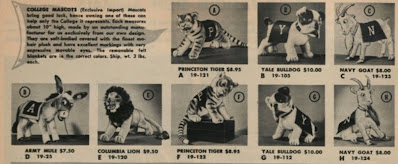
One place this fine fellow has made an appearance is in the F.A.O Schwarz catalog of 1952, along with a number of other Steiff mascots. You can see this catalog page here below; you can click on it to make it bigger. The Steiff Army Mule, on the far left, is listed at $7.50. Adjusted for inflation, $7.50 in 1952 is equal to $73.72 in 2021. The copy for this catalog page reads:

"COLLEGE MASCOTS (Exclusive Import) Mascots bring good luck, hence owning one of these can help only the college it represents. Each measures about 10" high, made by an outstanding manufacturer for us exclusively from our own designs. They are soft-bodied covered with the finest mohair plush and have excellent markings with very expressive, moveable eyes. The removable felt blankets are in the correct colors. Ship. wt. 3 lbs. each."

One thing that really stands out in this design is the Mule's eyes, which are even called out in the F.A.O. Schwarz catalog copy. This eye style appears infrequently on Steiff items, but when it does, it is Steiffgal's opinion that it is the company's way of saying, "don't take this piece too seriously - or literally!" This playful, cartoonish eye style debuted in the 1920's on some of Steiff's Cheerio dogs and Petsy the Baby Bears. Postwar, they appeared on Steiff's 1950's era Lulac rabbit models, as well as these larger mohair 1952 mascots. 

The 1950's and very early 1960's were Steiff's heyday years of producing mascots for the US market.
During this timeframe, Steiff made mascots for institutions including the US Army (mules) and Navy (goats), Columbia University of NY (lions), Princeton University of Princeton, NJ (tigers), Yale University of New Haven, CT (bulldogs), and Duke University of Durham, NC (doll devils), among others. Most of these mascots were based on existing designs in the Steiff portfolio that were modified via different eyes, proportional changes, and/or were accessorized with a lettered felt blanket. The Duke Devil was a completely new design. He was jointed, with a felt body and a rubber head with horns. He was detailed with a blue felt suit, long blue felt tail, and white felt shoes, and carried a pronged spear. You can see this handsome - ah, devil - here on the left; the photo is from Worthpoint. 

Steiffgal hopes this discussion on Steiff's largest mohair military mule ranks highly with you. 

Have a question about one of your Steiff treasures? Let's talk! Click here to learn more.

Sunday, April 19, 2020

This Fantastic Midcentury Steiff Donkey Is All Dressed Up With Nowhere To Go!

It's safe to say that the dress code for many of us has changed recently. For office folks now working from home, pajamas have become the new standard in "business casual," while those conducting business over Skype or Zoom have been "caught" adorned in a coat, tie, shirt... and sweatpants. A bright spot in today's sea of bad news for Steiffgal was a recent Steiff acquisition that's been "dressed for success" for nearly 70 years. Take a look at this delightfully detailed donkey and see why he's so interesting from the design and product development perspectives.

This farm favorite can't help but be your beast of burden. Here we have Steiff's classic Esel or Donkey. He is 12 cm, standing, unjointed, and made from velvet. He has a very short black mane. His dimensional, velvet tail is tipped with long black mohair. He has black airbrush highlights down his back, on the tips of his ears, and marking his hooves. Esel's face is sweet and babylike; it is detailed with shiny black button eyes and delicate airbrushing to define his nose and mouth area. Esel retains his original accessories, including a red leather brindle with tiny green tassels and a red and black checkered felt blanket secured to him by a ribbon. His IDs include a raised script button, very early postwar ear tag, and a US Zone tag. Esel was manufactured in 12, 14, 22, and 28 cm; the smallest size was made in velvet from 1950 through 1969 while the larger sizes were made in mohair from 1950 though 1961.

When it comes to precisely dating this fine fellow, the devil is in the details. This example has two elements that are different from other 12 cm models of his design Steiffgal has handled in the past. First, of course, are his handsome additional accessories: the green wool tassels on his bridle and his styling' blanket. Steiffgal has only seen this model with an un-tasseled red brindle and no blanket. The second is his excelsior stuffed velvet tail tipped in mohair. Steiffgal has only seen this model with a plain cord tail. In Pfeiffer's 1947-2003 Sortiment, this design has unusual cataloging noting "12 cm velvet, 1950/51 with blanket." There is no mention of the tassels, but it is Steiffgal's strongest suspicion that her example - based on this nugget of information and his IDs - is one of these 1950/51 examples.

Given that this donkey design was introduced in 1950, it is possible that the earliest 12 cm versions were made with the more expensive, labor intensive details noted above. Perhaps as early as 1952, the pattern was simplified to a cord tail and minimal accessories - saving time, money, and labor. Many of the smallest, early postwar animal editions, including the company's zebras and camels, were made from velvet and had cord tails, so this direction is somewhat consistent with trends of the era.

Steiffgal hopes this discussion on this sharp dressed donkey has been a clothes call for you.

Have a question about one of your Steiff treasures? Let's talk! Click here to learn more!

Sunday, April 28, 2019

Rolling Along With This Marvelous Miniature Steiff Donkey On Wheels


It's easy to be young at heart, even if you are not technically "young." And Steiff collectors have a knack for being youthful, as these beautiful toys make everyone feel like a kid again! This week we are taking a look at a lovely baby donkey who just happens to be over a century old. Check out this fantastic foal and see what makes her - and her ride - so lovely from the design and historical perspectives.

This happy handful packs alot of detail into a small space. She is about 13 cm tall and 15 cm wide, standing, unjointed, and made from grey mohair. Her mane and the tip of her tail are made from black mohair. Her all-mohair ears are pert and cheerful, and her face comes to life with black button eyes and a touch of airbrushing. She retains her original leather saddle, which is connected to her via two strips of linen ribbon. The saddle is detailed with three buttons, which probably helped to keep additional reins - which have been lost to time - in place. She glides along on four blue wooden wheels that are connected by metal axles.

Buttoning things up here, donkey retains her long trailing “f” knopf im ohr as her Steiff ID. This mohair donkey on wheels pattern was made in 14, 17, 22, 28, 35, 43, 50, 60, 80, and 150 cm from 1914 through 1943 overall and is one of Steiff's most beloved and endearing prewar patterns. It is Steiffgal's best guess that she is a petite version of the 14 cm edition. Given her configuration and detailing, it is suspected she is from the 1920s.


Wooden it be good to know a little more about her great blue wheels? Steiff's earliest wheeled toys were made with metal wheels. But starting in the 19-teens, the company began producing items on wooden wheels, like this darling donkey. Why is that? Steiffgal can come up with three possible business reasons for this significant and material change.

The first was to enable design flexibility. Wooden wheels, unlike metal wheels, could be painted in fun colors, adding to an items appeal, appearance, and perceived value. They also could be drilled slightly off center, becoming the company's beloved "eccentric" wheels. When an eccentric wheeled toy was pulled along, it waddled or shimmied in motion, just like the real animal would. To grow and stay competitive, Steiff needed to constantly come up with new and interesting products for the marketplace. Early wooden wheeled items lead to other rolling toys, including "Record" style, gallop, roly-poly, and wi-wag novelties.

The second was to create distribution efficiencies. Wood is lighter than metal, and that needs to be taken into consideration in terms of transportation. By the 19-teens, Steiff was indeed sending its toys and playthings all over the world. The lighter they could be made, the cheaper it would be to get them from here to there.

The third was to take advantage of available resources. The Steiff factory is located in an area with many trees and forests. Towards the end of WWI, and through the 1930s, Steiff significantly increased the number of exclusively wooden toys, and toys with wooden features, in their catalogs. It is a little known fact that Steiff produced a small line of painted, wooden furniture for children in the early 1920s. Steiff also figured out a way to create stuffed toys made from wood-plush when traditional woolen fabrics were not readily available around 1919. There is no question that the use of wood simplified the supply chain, created efficiencies, and provided factory jobs at a critical time in the company's history.

Steiffgal hopes this discussion of donkeys and wheels has been a real go-getter for you.

Have a question about one of your Steiff treasures? Let's talk! Click here to learn more.

Thursday, June 15, 2017

Cataloging Steiff's Display Rarities From The Mid 1960's

A great way to learn more about vintage button-in-ear rarities is to go to the source - literally! Steiff has always been consistent in producing sales materials, catalogs, and literature about their product line over time, and these original documents are like miniature time capsules of information for collectors. Steiffgal recently purchased a specialty catalog from 1967 which features the company's vast range of lifesized animals produced 50 years ago. The cover, which has a family of display orangutans, is shown here on the left. These include a 130 cm or 52 inch papa, a 120 cm or 48 inch mama, and a 40 cm or 16 inch baby. Let's take a peek inside this great reference and see what it has to say!

The catalog cover itself measures about 23 cm wide and 17 cm tall and is designed like a binder, with metal rings holding the hole-punched sheets in place. The introduction page - which is written in German, French, and English - reads: "Besides the famous toy animals we also manufacture animals in natural until twice natural size. They are most popular for shop windows and stores to draw the attention of the buyers of our mark. Those animals are made of the same good mohair, plush, or nylon  and have a metal frame. If a person wants to sit on them, it would be better to add a metal ring which unites the four legs. This ring must be paid extra.

The catalog is beautifully illustrated with full color photography throughout. The pages are printed single sided, with blank backs. The catalog contains mostly "beauty shots" of the company's display line, but also has a few pages in the front which offer sales and shelving items, including price tags, lighting, signage, and merchandisers. Perhaps the most interesting page is shown here on the left. Check out the range of display pieces for smaller items, including what looks like green metal "cots" for the company's sleeping style cosy items. Steiffgal has never seen these in real life, have you?

Now let's make a big deal over some display animal highlights. The catalog has over 80 individual pages featuring these lifesized lovelies, so its difficult to pick out just a few. Several species, like elephants and the big jungle cats, were well represented with several models of each on offer. Here are some examples that really caught Steiffgal's eye - for their rarity, beauty, or just plain goofiness. (You can click on all the photos to make them bigger and read the catalog page details.)

It's never too early to start putting together your Christmas wish list! And Steiffgal bets just about every vintage Steiff collector would love to find this almost lifesized Santa Claus doll under their holiday tree! Santa stands 150 cm or 60 inches tall and is based on the company's beloved standard line postwar rubber faced Santa doll, who was produced in 13, 18, and 31 cm from 1953 to 1963 overall. Steiffgal has only seen one example of this display sized man in red firsthand - he's as rare as his namesake!

There's not a hare out of place when it comes to this next display highlight. This great mohair pattern looks to be for the most part a prehistoric proportioned Manni rabbit, given his begging position and coloring - with a little bit of Niki rabbit's facial detailing in the mix for good measure. And given that Steiff traditionally does not include ear length when measuring rabbits, this honey bunny is even larger than his 80 cm or 31-1/2 inch "official" size. Just for comparison, check out the teeny tiny Perri squirrel in the photo - he's probably only 12 or 17 cm! 

Now let's cool things down a bit with this jolly sitting polar bear. His body position is quite distinctive - he seems to be squatting on his bent legs. He must be carefully balanced, given the size and scale of his portly midriff. Another picture of him that Steiffgal has seen shows a metal rod base stand mounted strategically on his "bare bottom," probably to help keep him upright. This 180 cm or 72 inch perky polar bear has really prominent rubber claws, faux suede pads, and a million dollar smile. 

This busy pair only want to be your beasts of burden. The display catalog features two donkey designs, but Steiffgal thought this dralon, open-mouthed pattern was a bit more interesting than the other, given its seldom seen accessories. Steiff does a great job with farm animals, and their donkeys have broad and universal appeal. Sometimes they are produced "au naturel," while other models feature brindles and/or saddles. The company's early "Democratic" donkey mascot don a blue felt blanket. Whatever your political affiliation, it's very easy to get carried away over these 120 cm or 48 inch and 90 cm or 35 inch Steiff donkeys adorned with functional, hand-woven raffia baskets!

No need to trash-talk over this fantastic, lifesized black and white mohair Steiff Cockie Cocker Spaniel. It is interesting to note that Steiff's mid to late 20th century sitting black and white Cockers are in the form of rare novelties, including a tail turns head model and a musical version. There is no "standard line" postwar black and white sitting Cocker. So this guy must be pretty special! This catalog page illustration has it all - a great and seldom seen 80 cm or 32 inch display rarity, an authentic situation all dog owners can relate to, and little Steiff friends hidden in the mess.  

Anyone care to dance? It's hard to resist these two humongous and utterly charming mohair Zotty bears. Clearly these big bruins are based on the company's legacy mohair Zotty Teddy bear pattern, which appeared in the line from 1951 through 1978 in sizes ranging from 17 to  100 cm. These cavorting cubs seem to be having the time of their lives. Could that have something to do with the large beer keg and two porcelain steins in the background? These display items measure 80 cm or 35 inches and 100 cm or 40 inches, respectively. 

Bird's the word with this final display pick. Here we have two royal looking Crown Crane birds, measuring in at 140 cm or 56 inches each. Both are standing, unjointed, and elaborately detailed in various colors and lengths of mohair materials. They balance elegantly on metal framed legs that are covered in felt and realistically airbrushed. Steiffgal has seen and handled a number of Steiff display birds from this period, including a flamingo and an ostrich, (both also featured in this catalog) but never the company's cranes. It is her strongest suspicion that like the flamingo and the ostrich, these cranes were designed with removable heads and necks for ease of packing, shipping, and storage. 

Steiffgal hopes you found this discussion on Steiff's 1960-era display items larger than life.

Have a question about one of your Steiff treasures? Let's talk! Click here to learn more. 

Thursday, May 21, 2015

Monkeying Around With This Early 1970's Steiff Riding Chimp

With Memorial Day  - the unofficial first day of summer - coming up next week, it's time to put the top down and go for a spin!  And Steiffgal can't think of a better vehicle to do that with than this utterly marvelous riding chimpanzee.  Let's take a joyride together and learn more about this great primate on wheels!

Let's not monkey around and get right to the point why this chimp on the go is so great.  Here we have Steiff's Reit Schimpanse or Riding Chimpanzee.  He is 50 cm, standing on all fours, and unjointed.  He is solidly stuffed with excelsior and has a grey painted metal grip handle. His body, head, and limbs are made from chocolate brown dralon fabric.   His hands, feet, ears, and face are made from a soft peach colored velour like material.  His face is detailed with friendly brown and black pupil eyes in eye pockets, an open, smiling mouth, a white dralon chin, a brown painted nose, and delightful, realistic airbrushed highlights.  

And what about his snazzy ride? Riding Chimp is mounted upon a black metal carriage with front wheel steering.  His red metal wheels have white rubber tires that say "Steiff 100" on them.  He retains his original red and white pull rope, which is wrapped neatly around his front axle.  This mobile monkey was produced in this size only from 1969 through 1972.  Despite his relative "newness," this design is rather rare and seldom seen on the secondary market.  (And that's understandable - who could part with such a charming treasure?)

This adorable riding animal certainly has great wheel-appeal.  And although not called out by name, the driver has a striking resemblance to Steiff's beloved and popular "Jocko" chimpanzee.  Jocko was produced in 9 sizes ranging from 10 to 80 cm from 1949 through 1990 overall. A whole family of Steiff's Jockos are pictured here on the left. However, there are a few fundamental differences between this item and Steiff's standard line post war Jocko pattern.  First, riding Jocko is made from dralon and soft velour, while standard line Jockos are made from mohair and felt.  Second, riding Jocko is unjointed.  Standard line Jockos are fully (and quite playfully!) jointed.  And finally, riding Jocko is permanently standing on all fours. Standard line Jockos are designed for sitting.  

Riding Chimp was produced during a time of change and challenges at Steiff.  During the late 1960's and early 1970's, many toy companies were starting to produce a great number of lesser priced (and of course, lesser quality) products.  These competitors were taking market share, and in some cases demand, from Steiff.  As a result, the company started trying to create efficiencies in manufacturing.  This was done in several ways, including simplifying patterns, decreasing or eliminating jointings, and using less expensive materials, among others.  

Riding animals have always been legacy patterns for Steiff.  However, given their size, complexity, and material and manufacturing requirements, they are by nature expensive to produce.  As such, starting in the 1960's, the company began transitioning away from woolen mohair, the material traditionally associated with these higher end toys, to dralon - a less expensive and highly durable synthetic fabric.  Dralon riding animals from this period, in addition to this chimpanzee model, included a bear (shown here on the left, with his great red wooden FAO Schwarz tag), Cocker Spaniel, Schnauzer, donkey, pony, goat, fox, and elephant.  Almost all were based on slightly modified versions of well known Steiff patterns of the era.

Steiffgal hopes this discussion on Steiff's Riding Chimpanzee has been more fun than a barrel of monkeys.

Have a question about one of your Steiff treasures? Let's talk! Click here to learn more.  

Saturday, February 7, 2015

Color Your World With This Mysterious Vintage Steiff Donkey

It's a rather gray day around these parts, and the almost four feet (that's over 120 cm for friends abroad!) of snow on the ground already is not helping things.  But this little grayish friend is just the opposite of gloomy - so Steiffgal thought it would be the perfect time to introduce you to this happy-go-lucky fellow.  Take a look at this fantastic vintage farm friend who just arrived on the east coast from Germany.  Although not technically "young" anymore - he is certainly young at heart... and will warm yours, too!

Here we have a most adorable and vintage looking donkey.  This farm friend measures 22 cm tall (top of head to foot) and 30 cm long (tip of nose to backside.)  He is standing, unjointed, and made of tan mohair which has been lovingly airbrushed with grayish-purple highlights.  His tail and mane are made from long, soft, black mohair.   His face comes to life with longer tan mohair on his "sideburns" and forehead, a shorter mohair muzzle, pert black eyes, and a black airbrushed nose and mouth.  The coloring on his face truly gives him him a youthful, playful appearance.  He retains his long trailing "F" button and illegible yellow ear tag (pictured below) as his Steiff IDs.  

Like many things Steiff, this donkey has details that make him hard to date and identify with 110% accuracy.  His long trailing "F" button initially suggests that he may have been manufactured in the c. 1933 - 1935 time period.  If that were the case, he most resembles the company's Jung Esel or Young Donkey, which was made in 22 and 28 cm from 1933 through 1943 overall.  Young Donkey is pictured here on the left; the photo is from Pfeiffer's 1892-1943 Sortiment book.  Like the example under discussion today, Steiff's Young Donkey pattern is famous for his grey-purple highlights and innocent looks.  However, it is clear that there are some key differences between the Young Donkey pattern and the donkey under discussion here.  Young Donkey is made from long grey wool plush; this example is made from highlighted mohair.  Young Donkey has grey felt (or perhaps leather) hooves; this example does not.  Young Donkey has a grey tail and mane; this example has black detailing.  And Young Donkey has his ears positioned forward; this example has the ears positioned to the rear.   

So how do his design elements and early IDs all align?  Well, only this donkey knows for sure, but here are two ideas.  

1.  The mid 1930's through the early 1950's were a really rough time for manufacturing at Steiff, and supplies and fabrics were available on an inconsistent basis.  It is possible that this donkey was indeed made to the Jung Esel pattern as best as possible, but with the materials and technology available on hand, in the late 1930's to early 1940's.  It is not unusual to see wool plush and mohair plush interchanged on items from this time frame.  

2.  Steiffgal thinks it's more probable - given his distinctive overall coloring - that this donkey under discussion today is a transitional model between the company's pre- and post- war donkey models.  As such, he may have been produced in the very late 1940's and given a long trailing "F" button... as that's what was on hand at the time.   Steiff launched its post-war donkey in 1950 in 12, 14, 22, and 28 cm; this updated pattern has several design elements of the pre-war Jung Esel, especially in the muzzle area, but no purple-grey highlights at all.   For comparison, a nice example of Steiff's postwar 22 cm mohair donkey is pictured here on the left.

Steiffgal hopes this discussion of this mystery donkey has added a touch of color to your day!

Have a question about one of your Steiff treasures? Let's talk! Click here to learn more.  

Wednesday, September 24, 2014

On A Roll With These Steiff Hightlights From The Upcoming James D. Julia Auction Event!

The temperature is dropping - but the fall auction season is really starting to heat up!  And that means many opportunities to add a new - or a few - new vintage Steiff treasures to your collection!  

To kick off the sales calendar, Steiffgal is very excited to announce that the next James D. Julia, Inc. toy auction features several collections of simply marvelous button-in-ear rarities and collectibles. These include groupings of exciting Steiff treasures, single items that will take your breath away, and also a bunch of very early "button-in-ear" pull toys. These items are all currently being photographed and cataloged for this event, which will occur in Fairfield, Maine on November 7th, 2014. The online catalog should be available in a few weeks. But with Steiffgal on your side, there's no need to wait for a special preview! Here is a sneak peek at a few exceptional items from a fine collection from New Hampshire that will be featured at this can't miss sale!

Size defies when it comes to this amazing duo of teeny-tiny felt farm animals on wheels! And Steiffgal really did do a happy dance when she first learned of these petite treats! Here we have the smallest sized donkey and horse ever produced by Steiff; both are made as pull toys on wheels. Oh baby - each is only 8 cm tall!! The donkey is c. 1917, standing, unjointed, and made from grey felt. He has a tiny grey felt tail and traces of his grey mohair mane. His face is detailed with black button eyes and felt ears. He rides upon a metal carriage mounted on four natural colored wooden eccentric wheels. He retains the blue leather belt that was part of his saddle cloth detailing, and his tiny Steiff button as his ID. This tiny donkey was manufactured in this size only from 1917-1933.

Donkey's neighhh-bor, the horse is also c. 1917, standing, and unjointed. He is made from rust brown felt. He has a black woolen tail and traces of his black mohair mane. His face is detailed with black button eyes and felt ears. He rides upon a metal carriage mounted on four natural colored wooden eccentric wheels. He retains his blue felt saddle cloth and brown belt. His IDs have been lost to time. This handful-sized horse was manufactured in this size only from 1917-1927. 

The next featured Steiff pull toy in this auction is truly the wheel-deal as well. This blue-ribbon buddy is a charming example of the earliest model German Shepherd dog produced by Steiff. And it is doubly interesting to note that according to the Steiff Sortiment reference book, this pattern was first produced on wheels and then without... it is usually the other way around. Although many collectors assume that Steiff has called their wonderful and popular German Shepherds "Arco" since their introduction, the breed did not actually  official receive its official "Arco" moniker until 1937.

So here are the Shepherd's doggy-details. He is standing, unjointed, and made from brown and tan mohair. His appealing and realistic face is detailed with a prominent brown muzzle, a black hand embroidered nose and mouth, and black and brown glass pupil eyes. He has a curvy tail and black embroidered claws. He rides upon four regular green wooden wheels. He retains his original leather collar, but his IDs have been lost to time. This model, an absolute favorite with vintage Steiff collectors worldwide, was manufactured in 28, 35, 43, and 50 cm from 1923-1928 and due to his limited production and time frame, rarely comes up for sale on the secondary market.

Today's final Julia's auction highlight, a very vintage Steiff zebra on wheels - may just have you seeing stripes. That's just what happened to Steiffgal when she first laid eyes on this jungle gem! These striped sweethearts have been gracing the Steiff catalog since 1899, and collectors have been "lining up" since then to add these beautiful beasts to their hugs.

Here are zebra's facts, in black and white. Here we have an utterly fantastic and seldom seen early woolen plush zebra on wheels. He is standing, unjointed, and made from textured grey material that has been lovingly and painstakingly hand painted with black stripes. He has a grey and black yarn mane and a black mohair tipped tail. His charming and distinctly old fashioned looking face is detailed with black button eyes. He rides upon four early metal wheels. He retains his Steiff button as his ID. This absolute rarity was manufactured in 28, 35, 43, 50, and 60 cm from 1910-1919 and is seldom, if ever, seen up for public auction.  

Steiffgal hopes this preview of some of the wheeled wonders to be sold at James D. Julia's November 2014 toy auction is worthy of a round of applause! The full catalog is now online and can be accessed by clicking here.


Have a question about one of your Steiff treasures? Let's talk! Click here to learn more.

Wednesday, September 10, 2014

This Steiff Goat Is The Wheel-Deal Indeed!

Do Steiff goats float your boat? Well, they certainly do for Steiffgal! It is easy to fall for these charming farm friends who just seem to have a great sense of fun, energy, and humor. Check out this great goat on wheels and see what truly makes him the life of the barnyard!
 

There's no 'kid'ding around when it comes to this beautiful billy! Here we have Steiff's Nachzieh Ziege or pull toy goat. Goat is 12 cm high (head to toe) and 16 cm long, unjointed, and made from off white mohair. His back, tail, legs, and face are lightly airbrushed with brown detailing, making him truly an authentic farm friend. The lining of his ears and the underside of his pert tail are made from peach colored felt. He has black and green slit pupil eyes and a black hand embroidered nose and mouth. His tiny horns are made from wooden beads, and his snout is highlighted with a tiny bit of red accent. He rides upon a black metal framed carriage which is mounted on four red wooden eccentric wheels. He was produced in this size only (officially documented at 14 cm) from 1953 through 1957.
 

Collector's may recognize this baaaa-d boy as Steiff's "Zicky" the goat pattern. And, he does indeed have a small, colorful, named bear faced chest tag with the name "Zicky" imprinted in blue. Overall, standing Zicky was made from 1952 through 1972 in 10, 14, 22, 28, and 35 cm. A family of standing Zicky goats is pictured here on the left. Zicky was also produced in a somewhat rarer "lying" pattern in 10 and 14 cm from 1954 through 1956. The smaller lying version of Zicky is pictured below on the left.

It probably won't get your goat to learn that goats are a legacy design for Steiff. The first ones appeared as early as the late 1800's in felt. In addition to just regular standing models, early and prewar goats were produced as hanging toys, as woolen miniatures, as wooden pull toys, on wheels, as nodding animals, with tail moves head mechanisms, and with special voice boxes that were designed to sound like a real goat. 

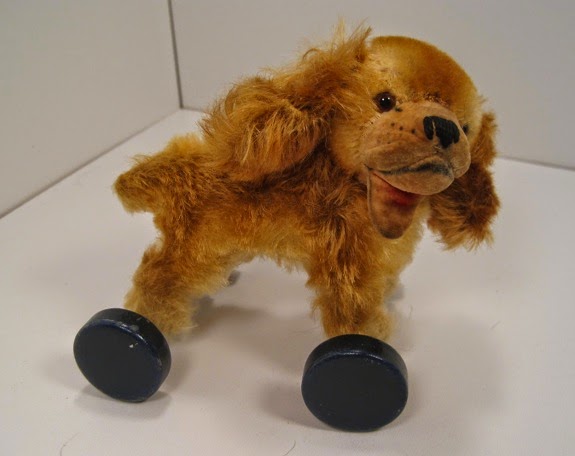
And yes, he is the wheel deal! Steiff has traditionally produced pull toy versions of many of its most popular items.  In the 1950's and 1960's, these were usually made from the smallest or next to smallest versions of the standard line items and on red, blue, or green wooden eccentric or regular style wheels. These petite treats included cats, farm animals like donkeys and ponies, rabbits, and ducks, and dogs. Steiff's tiny 10 cm Cockie Cocker Spaniel on eccentric wheels is pictured here on the left. Larger wooden wheeled treasures from this period included Fox Terriers and elephants.
 

Steiffgal hopes this discussion on Steiff's rolling Zicky helps to move along your day in a most positive way!

Have a question about one of your Steiff treasures? Let's talk! Click here to learn more.

Saturday, January 18, 2014

I Get By With A Little Help From My Steiff Friends!

Steiffgal once had the great pleasure of interviewing author Maureen Stanton about her wonderful book about collectors and collections, called Killer Stuff and Tons of Money Maureen noted during the conversation that there is nothing collectors enjoy more than sharing their collections with other enthusiasts.  And Steiffgal could not agree more!  So earlier this week, she and two other Massachusetts collectors hit the road to visit two other Steiff collectors in Connecticut.  And it is very safe to say "A grand and Steiff-y time was had by all!"  Here are some of the amazing things Steiffgal and gang shared during their button-in-ear play date!

The first stop on the Steiff tour was to view the collection of Sandy Booth, where we were treated to a magnificent and well curated exhibit of Steiff rarities, most in excellent condition with all IDs!  Here is one of her display units - and it's ok to stare!  Which are your favorites?


There were so many great things to see at Sandy's, that Steiffgal felt like a kid in a candy store.  It's hard to pick out highlights when everything is so lovely, but here's a few things that really caught every one's eye. The first was this precious duo of a very large vintage Treff the Bloodhound and her little duckling friend. Treff is 35 cm, made from mohair, and sitting. Sitting Treffs were produced in 7, 10, 14, 17, 22, 28, 35, 43 and 50 centimeters. Treff proved to be a very successful design and was produced in a number of sizes, materials, and models through 1938. The darling duck is Steiff's Spiel Ente or Play duck.  He is standing, made from yellow wool plush, and 22 cm. His big feet and open beak are made from yellow felt.   He has red felt disks behind his black button eyes.  Pre-war, Play duck was produced in this size only from 1933 through 1943.  

Another cool item with wheel - ahem, real - appeal was Sandy's marvelous donkey on wheels. Donkey is 14 cm, standing, unjointed, and made from mohair. He has a very short black mane. His tail is made from felt with a black mohair tip. He has black airbrush highlights down his back, on the tips of his ears, and indicating his hooves. Donkey's face is sweet and baby-like; it is detailed with shiny black button eyes and delicate airbrushing to define his nose and mouth area. He sports his original red leather reins.  Donkey is mounted on a simple metal chassis and glides along on four red wooden eccentric wheels.  This donkey on wheels was produced in this size only from 1954 through 1961.

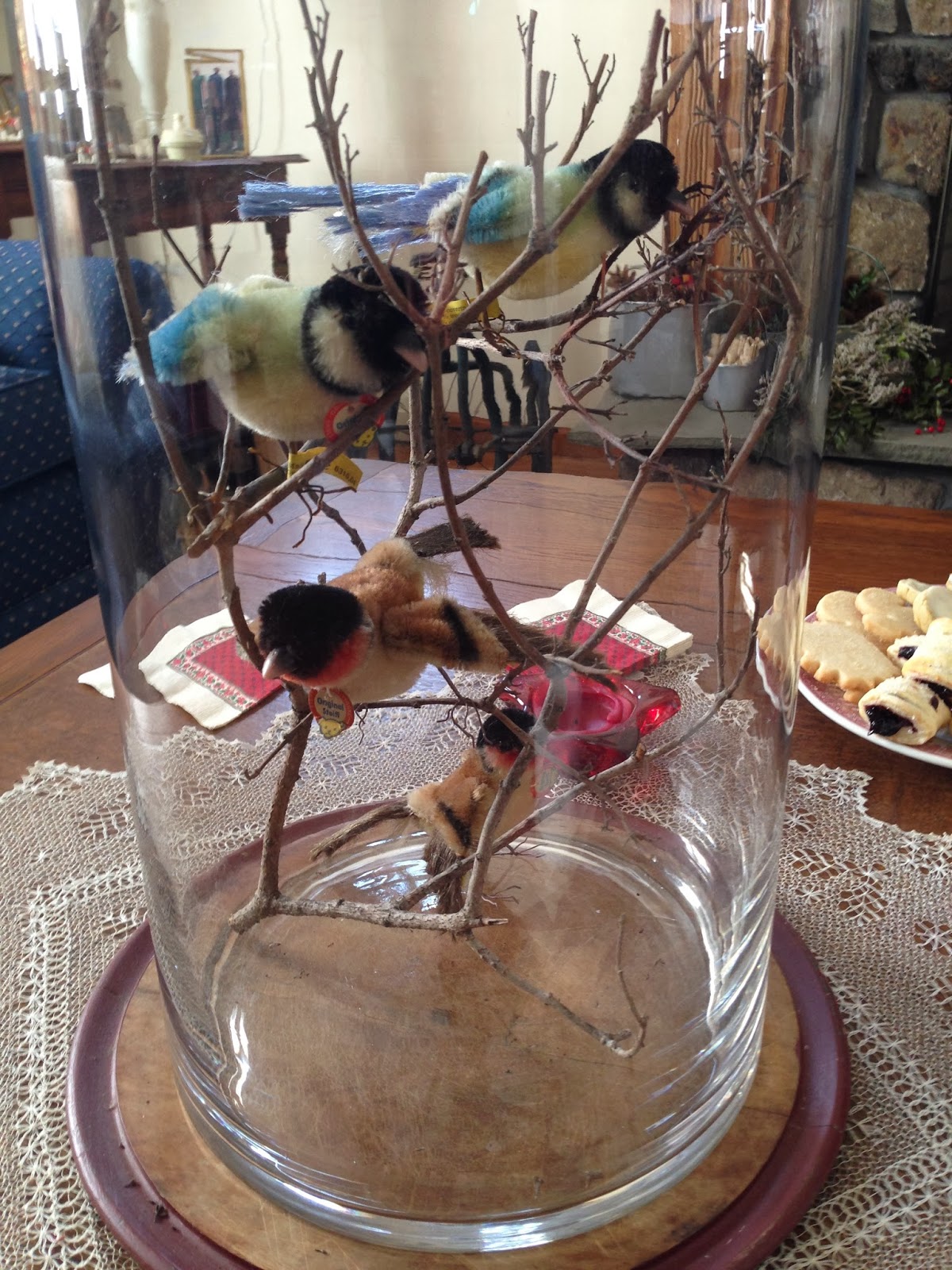
In addition to Sandy's great taste in Steiff, she also has a wonderful sense of how to display her collection.   Take for example, this glass domed vignette of four early Steiff birds perched on just the perfect branch.  Two of the birds are Finches, while the other two are Blue Tits.  The birds are all 10 cm, made from mohair, with stiffened braided hair wing tips, plastic beaks, and early metal feet.  Both the Finches and the Blue Tits were produced in this size from 1959 through 1961.  

After a delicious lunch, the Steiff Superteam was off to their second and final destination of the tour.  After a brief car ride, we arrived at the lovely home museum of Shelley Smith.  In addition to Steiff, Shelley also collects and sells antiques, dolls, miniatures, and Christmas related collectibles.  So viewing this remarkable setting was truly like being in Santa's magical workshop!  Choosing highlights from Shelley's collection was as challenging as it was to do with Sandy's.  Here is just the tip of the iceberg of the things that really called to Steiffgal.


It's hard not to oodle these two marvelous poodles! Here we have spectacular examples of two rare, 1950's era Steiff poodles. The white one on the left is the early version of Snobby. This top dog is standing and made from wool plush. She came in black or white. Her face is detailed with a black glass button nose and round brown and black glass pupil eyes. Her mouth and claws are defined by embroidery. Her coat is in what Steiff refers to as the "French" trim, meaning that it is fluffy basically from the waist area up; her lower torso and backside are more closely cropped. She also has longer tufts of fur around her knees, elbows, and the tip of her tail. This original Snobby was produced in 17 or 22 cm in 1952 only.  The black poodle on the right is Maidy.  She is standing and unjointed, and made from delightful and really unusual "Persian Lamb" style mohair. She has a slightly longer mohair "beard" around her chin. Her mouth and claw stitching is done in mauve colored embroidery floss. She was produced in 25 and 30 cm in 1959 only.

Eye bet you cannot resist this next highlight from Shelley's outstanding collection.  This sitting sweetheart is the early Susi cat.  She is 17 cm, made from grey mohair and is head jointed.  Her little tail wraps gently around her backside.  She his lovingly hand airbrushed with black stripes.  Her face is detailed with bluish-green and black slit pupil eyes, a pink hand embroidered mouth and nose, and large, pert ears.  Susi, who is named for a member of the Steiff family, was produced pre-war in 14, 14, 22, and 28 cm from 1936 through 1943.

You don't have to be from the Boston area to fall in love with this fourth highlight from Shelley's hug.  Here we have Steiff's extremely rare Boston Terrier on metal wheels.  The dog itself is 28 cm, unjointed, standing, and made from brown and tan felt.  His face is detailed with black button eyes and a simple black hand embroidered nose and mouth.  When he was new, he had a few black dots around his muzzle to indicate his whiskers.  Boston Terrier is mounted to metal axles with regular, not eccentric, round wheels.  Although his neckwear is not original, he did leave the factory in Giengen a century ago with a handsome leather collar.  Boston Terrier on wheels was produced in 22, 28, and 35 cm from 1913 through 1919.

Many thanks to Sandy and Shelley for opening up their homes to the Steiff community, as well as providing such gracious hospitality.

Steiffgal hopes this virtual tour has inspired you to share your collection with new friends, too!

Have a question about one of your Steiff treasures? Let's talk! Click here to learn more.
The teddy bear search engine