Showing posts with label tiger. Show all posts

Sunday, April 24, 2022

This Charming Steiff Prewar Find Is Certain To Put A Tiger In Your Tank

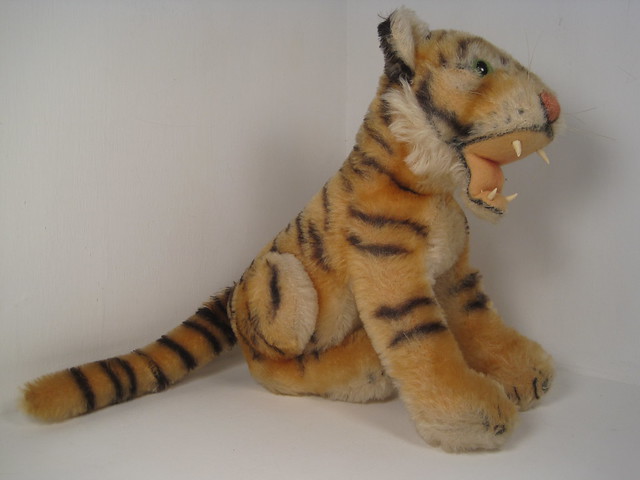
Take a seat and check out this darling and little known Steiff tiger!
Tigers are a popular, legacy item in the Steiff catalog, with the first big beasts of their type debuting in the company's line in 1915. They translate well from real life to plush, and their handsome looks and wild origins bring out the animal instincts in most collectors! Steiffgal stumbled across this unusual prewar example on an online auction. The fates smiled upon her, and now he's part of her permanent hug.

This striped sweetie is quite the looker.
 His official name is "Tiger Cub." He is 22 cm tall (measures vertically from head to toe), sitting, and head jointed. He is made primarily from tawny colored wool plush. His long sideburns are made from longer white mohair. Tiger is stenciled and airbrushed in typical tiger style; he is highlighted in orange with prominent black stripes on his limbs, back, tail, and head. In true cat fashion, his little tail curls up around his backside. He has black hand embroidered claws on each of his paws. His distinctly youthful face is detailed with teal green and black glass eyes, a black hand embroidered nose and mouth, and a spot of pink paint on his lips. His ID is a short trailing "F" Steiff button. Overall, this big cat appeared in the line in 17 and 22 cm from 1939-1943.

It's always fun to discover new Steiff surprises, and this tiger cub definitely qualifies as that for Steiffgal.
This is the first of his kind she's ever handled, or really knew about. According to Pfeiffer's 1892-1943 Sortiment, this model is cataloged as, "woolen mohair, tawny-colored, tiger striped, sitting, soft, young, funny." It is unusual for Steiff or Pfeffer to use endearing adjectives in their descriptions - usually they are quite literal and objective. So the word "funny" really pops here, and in a way it is accurate. This guy does have a playful and mischievous look to him.

Tiger cub's shape and presentation also may ring a bell with collectors interested in Steiff's sitting big cat production over time.
His sitting, head jointed form is also noted on the company's pre- and postwar Young Lion design. This mane event was made in 17 and 22 cm in wool plush from 1938-1943, in artificial silk plush in 17 cm from 1948-1949, in 10 and 17 cm in wool plush from 1949-1954, and finally in mohair in 10 and 17 cm from 1955-1961. You can see the 17 cm, early postwar artificial silk plush version of young lion here on the left. Clearly the sitting young lion design was more popular than the sitting young tiger design, which only appeared in 10 cm from 1951-1961.

Steiffgal hopes this discussion on this prewar, wool plush cub has put a tiger in your tank!

Have a question about one of your Steiff treasures? Let's talk! Click here to learn more.

Saturday, August 14, 2021

Hold Everything And Check Out This Unusual Steiff Poodle PJ Bag!

Care to noodle a most mysterious poodle? Then check out this delightful Steiff Snobby - in the form of a pajama bag! This mohair marvel appeared out of nowhere on an online auction, and Steiffgal had no idea this pattern even existed. She studied her listing closely, first suspecting she was "mommy made" or even a "Frankenstein" item - made of bits and pieces of other items sewn together to make a "new" item. But a careful check of the photos detailing her construction and materials - including her zipper pull, belly lining, and seaming - confirmed she truly was all original. Cue the happy dance!

This nifty napper measures about 23 inches long, is lying flat on her belly, and unjointed. She is in the form of Steiff's legacy, mid-1950s Snobby poodle. Her arms, legs, beard and forehead are made from very long, soft grey mohair while her body, feet, tail, ears, and face are made from shorter matching grey mohair. Her face is detailed with lovely tricolored glass pupil eyes, a black hand embroidered nose and mouth, and a round, red felt tongue. On her belly, she has a long, silver colored zipper; when you pull it open, her hollow belly is lined in a lovely grey colored silken material. This pajama bag retains its raised script button in ear as its Steiff ID. She is in great, clean condition with little or no playwear to her at all. 

Pajama bag Snobby is clearly part of the Steiff Snobby poodle family tree.
This classic Snobby pattern made its debut in 1953 as a full bodied, standing pup and appeared in the line through 1974 in 10, 14, 22, 35, and 43 cm. The design proved so popular that it was soon being produced in a number of novelties, including a riding toy, a puppet, and as a soft, curled up resting animal, among others However, Steiffgal cannot find reference anywhere to a standard line Steiff Snobby pajama bag.

However, there is precedence for sleepers like this.
Steiff produced a fantastic, beautifully rendered mohair pajama bag as an exclusive for F.A.O. Schwarz from 1962 - 1972 in the form of a walrus. Like this Snobby, the walrus also has an identical zipper down its belly and a silk lined interior. And Steiffgal has a similarly constructed and also undocumented large black and white mohair Cockie Cocker Spaniel pajama bag, as well as a mohair lying tiger pajama bag. She does know through the original owner of the Cockie bag that he was purchased at F.A.O Schwarz as well in the late 1960s or early 1970s. This hints that Pajama bag Snobby might have been produced in a very small edition size for F.A.O. Schwarz, or another upscale toy retailer, during this time frame as well.

Steiffgal hopes this discussion on this Steiff Snobby pajama bag has added a little zip to your day.

Have a question about one of your Steiff treasures? Let's talk! Click here to learn more.

Saturday, January 23, 2021

Tuning Into This Rare And Unusual Musical Steiff Santa Claus Doll

Does this great Steiff Santa doll strike a chord with you? Check out this unusual holiday hero with a very special feature - he's musical! Have you ever seen another one like it? A friend from Pennsylvania shares... 

We bought this 15" Steiff with a music box key wind in the sack. The music box is in the sack attached to his back with a large key protruding from it. I would love to know anything you can tell me about it. Thank you!


Well, let's warm things up with what we know about this friend from the North Pole. The doll itself is based on the company's legacy midcentury Santa doll pattern introduced in 1953. This earliest Santa doll was 31 cm and five-ways jointed. He had a rubber head, felt body, bright red felt suit and cap trimmed in white mohair, and a white, fluffy mohair beard. By 1955, this design was also produced in 13 and 18 cm. These Santa dolls appeared in the line through 1963 and were, and remain, year-round favorites with collectors worldwide. The Santa under discussion today measures 15" tall, or 38 cm, so he was probably not part of Steiff's standard line Santa production. His larger size suggests he was a special order, perhaps intended as a seasonal window or mantel display. 

Now let's tune into his musical feature. With full disclosure that Steiffgal has not handled this item in person and inspected for originality, she can suggest two possible origins for his music box.  

First: Given that the music box is located in his sack, and not in his torso, it is possible that it is not Steiff original to him and was placed there by a previous owner.
 The music box is described as having "a large key." Every wind up music box Steiffgal has handled has a very small, simple turning knob. It's size hints that the music box may not be Steiff original to him. Just about every musical Steiff item Steiffgal can think of from any era has its musical feature embedded in its body - probably to secure it in place, as well as to protect it against bangs and bumps. For example, the musical Basi pictured to the left has her music feature in her bottle shaped body; it is activated by pressing her up and down. As Steiff's midcentury Santa dolls were not distributed with a Santa sack, it wouldn't be that challenging to make one, put a wind up music box in it, and sew it to the doll's body. That would be MUCH easier than opening up the doll, removing stuffing, inserting a music box, and sewing everything up seamlessly. 

Second: It is also possible that the musical feature is all original to the doll.
Most Steiff collectors are familiar with the company's standard line musical Cockie Cocker Spaniel, Teddy Bear, and cat patterns. These were all produced in the mid to late 1950s. However, Steiff also produced a number of other uncatalogued musical rarities based on beloved 1950s era designs, including their Lulac rabbit and lying tiger. "Music Tiger" is pictured here on the left. Given the timeline and popularity of the 38 cm doll design under discussion here, it is not out of the question that the company tried to make a musical Santa Claus doll, too; maybe even in a distinctly larger size. Perhaps the musical machinery was too large or strangely shaped to bury it in the doll's torso so the designers made a sack for him, and hid the music box within it. If the Santa sack is elegantly constructed from period fabric, matches the look and feel of the doll, and has aged in tandem with the rest of the overall doll and clothing, this would suggest that is factory original to the doll. But, in the end, only Santa knows for sure... and he's keeping tight lipped over this!

Steiffgal hopes this discussion of this musical Santa Claus has wound up your interest in this unusual doll. 

Have a question about one of your Steiff treasures? Let's talk! Click here to learn more.

Sunday, March 19, 2017

Singing A Happy Tune Over This Unusual Steiff Musical Tiger!

Well, this interesting find should be like music to your ears if you like Steiff tigers. And why is that? This wonderful jungle gem has a secret - he's got a special and most unusual music feature hidden in his belly. Check out this terrific tiger and see what makes him one of the coolest cats around!

It's easy to break out in song over this pretty kitty. "Music Tiger" is unjointed and about 20 cm tall and 30 cm long (not including his tail.) He is in Steiff's "lying" position, meaning he is curled up with his legs resting gently to his side. His face is detailed with piercing green and black eyes, a pink embroidered nose, a black embroidered mouth with a touch of pink airbrushing, and tufts of longer mohair around his jowls. He has many long, clear, monofilament whiskers.  He is made from short mohair, which has been hand airbrushed and stenciled to give his coat a most authentic and realistic look.  Even his paw pads have charming "footprints" on them.  On his underside, there is a small brass winder that activates his happy tunes; it is in working condition. 

Collectors will recognize this beloved pattern as the one identical to Steiff's popular lying tiger cub design, which was produced from 1953 through 1978 in 17, 28, 43, and 60 cm.

Let's take a look at some of the special IDs of this singing sweetie, which does not appear - as far as Steiffgal knows of - in any regularly referenced Steiff book. The first is his eye-catching chest tag.  It is Steiff's regular, colorful bear faced version with his name on it.  Given the "secret location" of his music box, and the fact that his basic pattern is relatively standard in the Steiff line, this tag is essential in identifying him from pictures as something really unique. The second is his special musical item tag.  The tag is metallic silver, red, and blue, and features a Steiff logo and the word "Musicanto" on each side. It is in four languages, and reads, "Contains a genuine Swiss music box. To wind: Turn knob in the tail or underneath tummy."  

It's not polite to ask someone their age, so let's figure out another way to date this Music Tiger. Steiffgal has two other Steiff musical animals that have this tag. The first is the company's Music Kitty. This fancy feline is 17 cm, head jointed, and resembles Steiff's beloved sitting Susi cat pattern. Music Kitty was made in 1955 through 1957, and then again in 1961; she is pictured here on the left. The second is Steiff's Music Cockie Cocker Spaniel. Cockie is 17 cm and sitting. She is made from black and white mohair and is head jointed. She has a large, open, smiling mouth. Her face is detailed with large, friendly brown and black pupil eyes and a black hand embroidered nose.  Music Cockie was produced from 1955 through 1957 only.  Both Music Kitty and Cockie's music features are activated by winding up their tails.  And of course, who can forget Steiff's fabulous Music Teddy, which was made in 35 cm from 1951 through 1957?

Given all of that, it is Steiffgal's best guess that this Music Tiger, like his other talented and performing cousins, was most likely made in the 1955 through 1957 time frame, give or take a pinch.

It was not terribly unusual for Steiff to take some of its most popular patterns and try "theme and variation" items from them. Some of these "experiments" were produced on a commercial level and appeared in the catalog; others were made in extremely limited quantities if at all. For example, Steiffgal also has a larger lying tiger made as a silk-lined and zippered pajama bag. This also does not appear, as far as Steiffgal knows, in any standard Steiff reference book. In 2009, Ladenburger Spielzeugauktion featured two marvelous musical rarities; a musical Lulac rabbit and a very large musical tiger.  The auction house dated each from approximately 1952. Both are pictured here on the left - click on the photo to enlarge it!

Have a question about one of your Steiff treasures? Let's talk! Click here to learn more.

Steiffgal hopes this discussion on this Music Tiger has been a high note in your day.

Saturday, December 31, 2016

Is This Steiff Jungle Gem A Diamond In The Rough?

Let's end 2016 in a wild way! Check out this note from a reader on the east coast who found an Ivy-League tier Steiff treasure and wants to learn more about it. Jacob, in part, writes...

"I was hoping you could tell me a bit more about a Steiff tiger that I found recently. It is similar to one you've written a blog post about already but with some noticeable differences. It is an approximately 40 cm long, 23 cm tall mohair tiger wearing a black felt vest with an orange "Princeton" P. It has a Steiff button in the ear and a tag that says "US Zone Germany." It is standing, rather than sitting and does not have a jointed head as the one you've written about did. However, it does have the "cartoon" eyes."

Wow, Steiffgal is seeing stripes over this cool cat. This indeed is the standing, larger version of Steiff's early 1950's Princeton Tiger. He is unjointed and made from mohair that has been hand airbrushed with black stripes. His face comes to life with a prominent, felt lined open mouth, white wooden teeth, and green and black "squint" style glass eyes. And, of course, what makes him head of the class is his orange and black felt "P" blanket. He was made as an exclusive for the upscale US toy retailer F.A.O. Schwarz in the c. 1951-1952 timeframe.

Now let's take a little trip backwards in time and check out some interesting things about this grrrr-eat example. Here you can see this tiger's original advertising from the 1951 F.A.O. Schwarz catalog. Other Steiff mascots listed with him include the sitting Princeton Tiger, a sitting and standing Yale Bulldog, a sitting and standing Navy Goat, an Army Mule, and a Columbia Lion. They ranged in price at the time from $7.50-10.00. This is the equivalent of $69.62 to $92.83 in 2016 dollars. Steiff is, and always has been, a premium product. Ironically, the mascots pictured just below the Steiff versions that were made in France are more expensive than the Steiff ones upon their introduction. It is Steiffgal's strongest suspicion that they would have mostly sentimental value today.
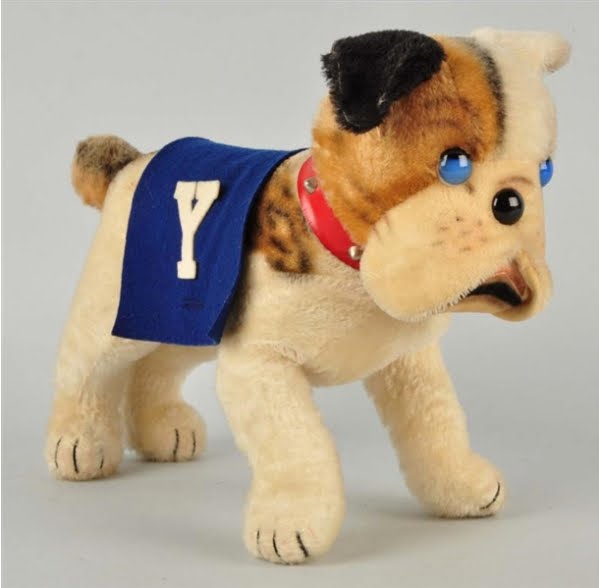
Steiff also created other smaller scaled school and institutional mascots in the late 1950's and early 1960's. These were all standing and included a 14 cm Yale Bulldog in 1957, a 10 cm Princeton Tiger in 1957-1958, 12 and 14 cm Army Donkeys in 1957, a 15 cm Navy Goat in 1957, and a 25 cm Navy Goat in 1957-60.

Is this jungle gem a diamond in the rough? Well, as always, something is worth what someone will pay for it. These marvelous mascots come on the secondary market quite infrequently, so "comps" are hard to come by. However, in June 2016, a standing Yale Bulldog illustrated along with the standing Princeton Tiger in the 1951 F.A.O. Schwarz catalog sold at auction here in the US. Estimated at $600-1,200, it realized $900.  This "Handsome Dan" is pictured here on the left. 

Steiffgal hopes this discussion of Jacob's great tiger puts you on the prowl for some great Steiff finds in 2017! Happy New Year, dear readers!

Have a question about one of your Steiff treasures? Let's talk! Click here to learn more.

Saturday, August 13, 2016

Put A Tiger In Your Tank With These Great And Unusual Steiff Postwar Tiger Designs!

Steiffgal has always had a thing for Steiff tigers. After all, who can resist their friendly/fierce personalities, delightful coloring, and the remarkable detailing that bring these big cats to life? Steiff has featured these grrr-eat wild animals in their line almost continuously since 1915, with the first cubs being made of mohair and fully jointed. Given their history and appeal, Steiffgal thought it would be fun to "catch a tiger by the tail" and check out three of the company's rarer post war examples.


Let's kick things off by sinking our teeth into this large and impressive Steiff Bengal tiger. This handsome cat is sitting, unjointed, 43 cm tall, and made from beautifully hand-airbrushed tan mohair. He has green and black pupil eyes, a pink and black shield-shaped embroidered nose, clear monofilament whiskers, and black embroidered claws. His chin, ears, and sideburns are made from long, white mohair. His most distinctive feature is his well formed and open mouth - which is lined in peach colored felt - and detailed with four large embedded wooden teeth. He is either grinning broadly or yawning; perhaps this depends on the time of the day! 


This beautiful Bengal beast was made in 14, 22, and 43 cm from 1959 through 1961 only. The medium and large ones are quite rare on the secondary market. Only the medium and large examples have wooden teeth; the smallest baby size one is toothless - perhaps Steiff thought he was still teething when he was being designed! All three sizes have impressive, long tails.

Our next tiger highlight truly has spirit - school spirit, that is! Here we have Steiff's seldom seen, 25 cm tall Steiff tiger made as a mascot for Princeton University. Smarty-pants is sitting, head jointed, and made from tan mohair that has been brought to life with realistic orange and black airbrushing. He has green and black pupil eyes "cartoon" style eyes, an early pattern pink nose outlined in black, clear monofilament whiskers, and black embroidered claws. His sideburns are made from  long, white mohair. Like his Bengal buddy, this pattern also features a prominent, well designed open mouth - which is lined in peach colored felt - and detailed with four proportionally sized, embedded wooden teeth. He has a working squeaker in his belly. When he was new, he left the factory in Giengen wearing a black and orange felt "Princeton" blanket. 

This Princeton University Prince was made in this size only in 1952 as a special edition for the United States. Other larger Steiff mascots produced in the early 1950's included a 28 cm lion for Columbia University, a 21 cm lioness for Columbia University, a 28 cm bulldog for Yale University, and a 28 cm goat for the Navy, among others. Smaller 1950's era cataloged mascots included a 14 cm bulldog for Yale University, 12 and 14 cm donkeys for the Army, as well as a 12 cm donkey wearing a "DEM" felt blanket for the US Democratic party! (To keep things balanced, Steiffgal once saw a small Steiff elephant wearing a "REP" felt blanket.  This example was probably made as special item for the US Republican party but somehow did not make it into the standard Steiff reference books or cataloging.)

Well, if this discussion hasn't put you to sleep yet, this final example should do the trick. Here we have a most unusual Steiff tiger pajama bag. He measures about 40 cm long and about 20 cm tall. He is in Steiff’s “lying” position, meaning he is curled up with his legs resting gently to his side. He has piercing green and black eyes, a pink embroidered nose, and tufts of longer mohair around his jowls. Tiger is head jointed and made from short tan mohair, which has been "tiger-ized" with careful orange and black airbrushing. Right down the middle of his back is a long metal zipper that extends from practically his neck to his tail; this hides his internal silk-lined pouch designed to  hold the sleepwear of a toddler!

As far as Steiffgal can tell, this tiger pajama bag does not appear in any of Steiff's standard reference books. It is her guess that this tired tiger is probably a modification of Steiff’s standard-line lying tiger cub, which was produced from 1953 through 1978 in 17, 28, 43, and 60 cm.  Steiffgal has also heard of other uncataloged Steiff pajama bags made from standard line designs including turtles and lions.

Steiffgal hopes this review of rare Bengals, mascots, and novelties has indeed put a tiger in YOUR tank!


Have a question about one of your Steiff treasures? Let's talk! Click here to learn more.

Saturday, September 27, 2014

Cataloging What Makes Steiff's 1970's-era Playthings So Distinctive

A picture is worth a thousand words! And this is especially true when it comes to Steiff, and their marvelous catalogs over the years. These great time-capsules really capture the essence of the brand from decade to decade - in terms of key styles, proportions, fabrics, and designs. When giving a talk on the history of Steiff and the company's product design evolution, Steiffgal often refers to the 1970's (in the most loving way) as the "ugly decade." By this, she means that for the most part, item designed in this time frame have a goofy, nontraditional look about them. Let's look at the items on this cover of a 1971 Steiff catalog and see if you agree, too!

Before we start, it is important to note that this particular catalog cover from 1971 features both legacy and "new to the 1970's" items. Today, Steiff, or really any other company, only features the newest, latest, and greatest items on the cover of any printed materials. In terms of "vintage" items, collectors will surely recognize Zotty, the gymnastics ball, the Lulac style rabbit, the lying tiger, the Jumbo elephant, and the woolen miniature ladybug as beloved items first introduced in the 1950's - or even earlier! These items are made from high quality mohair and have a very youthful, energetic, and "here for the long run" feeling to them - sort of the opposite of the vibe of 1970's items.   

So are you "red"-dy to dive right into the 1970's now? Then let's check out the 70's pieces in above, from left to right. No monkeying around here - the cheerful chimp is Steiff's "Weich-Schimpanse" or soft chimpanzee. He is standing and unjointed. He is made from brown dralon - a very common synthetic material used by Steiff in the 1970's and '80's - and has red overalls. His face, hands, and ears are made from peach colored synthetic velour, another material typical to Steiff for the period. Chimp has a sweet and playful face, highlighted by oversized white and black cartoon-style eyes. He is stuffed with foam chips and is fully washable. He was produced in 30 and 40 cm from 1971-1982 overall.  In addition to his chest tag, button, and yellow ear tag, this chimp - and other foam stuffed, washable dralon items - would have left the factory with an additional silver hang tag, which read, "form formgeschaumt" with the Steiff logo. You can see this on the chimp if you look closely; a sample of this tag is pictured here on the left. (Is it Steiffgal's imagination or does the bear faced logo look uncharacteristically unhappy here?) 

Let's now check out Steiff's "Buzzel Hen," just to the right of the chimp. Hen is 19 cm, unjointed, and sitting on a flat bottom. Like her chimp neighbor, she is made of dralon, stuffed with foam, and is fully washable. Her feathers, beak, face, and comb are made from yellow, red, and white felt. She has a squeaker in her base. She was made in this size only from 1971-1974.

Bird is also the word with the adjacent pair of featured feathered friends. Here we have Steiff's well attired Cosy Duck Boy and Cosy Duck Maid. Both are 25 cm, standing, unjointed, and made from white dralon. Their beaks and webbed feet are orange synthetic velour. Both have airbrushed highlighting on their faces. The boy dons a dapper blue tam-o-shanter and a matching blue sailor collar. The girl is adorable in her green felt hat. They are stuffed with foam and are fully washable. Boy and Girl Duck were both produced in 25 cm only from 1970-1973. 

It's easy to see things in black and white with this next 1970's feature. Here we have Steiff's 17 cm Pinni penguin. He is standing, unjointed, and made from black and white dralon materials. He has a chubby, orange beak and feet, as well as oversized black and white cartoon style eyes. He was made in this size only from 1971-1974.

Can you feel the "buzz" from the last two 1970's cover stars on the far right of the catalog cover? If you guessed that these, like the hen, are also buzzel items, then give yourself a high five! The bunny is Steiff's Buzzel Rabbit. He is made from tan and white dralon and has a face that sort of reminds Steiffgal of Steiff's Pummy Rabbit. The rooster is Steiff's Buzzel Rooster; he is pictured here on the left. He is made from orange and black dralon. He has a yellow felt beak, and a red felt waddle and comb. His tail feathers are made from green felt. He is a very simplified version of the company's legacy mohair and felt rooster model. Both are 20 cm, sit upon a flat bottom, have a squeaker, are stuffed with soft foam, and are fully washable. The rooster was made from 1971-1976; the rabbit from 1971-1978.

When it comes to Steiff, it goes without saying that "the more, the merrier!" In addition to the Buzzel collectibles noted above, the company also produced a Buzzel Cat and a Buzzel Santa, which did not make it into this cover shot. Both are pictured here on the left. The cat is made from grey and white dralon and has a pink hand embroidered nose, clear monofilament whiskers, and adorable green and black slit pupil eyes. Santa is made from red and white dralon material and felt, with a full long white dralon beard. His face is precious and simple; he has small blue felt eyes, a round peach colored felt nose, and a tiny red circle for his lips. Santa is wearing his traditional Santa suit which is integral to his body. He carries a brown Santa sack, which has a little bell in it. Both are 20 cm with typical "Buzzel" construction and features. Cat was made from 1971-1975; Santa from 1972-1974.

Steiffgal hopes this discussion of vintage Steiff treasures from the early 1970's has been a great blast from the past for you.

Have a question about one of your Steiff treasures? Let's talk! Click here to learn more.

Monday, June 2, 2014

This Tiny Tiger Has Huge Steiff Appeal!

Steiffgal's so sorry - this post is a few days late and clearly she is running a little behind!  So to make up for lost time, she thought she'd share a little something with, well, a little behind!  Check out this tiny handful of Steiff adorable-ness and see what makes him so interesting from the design and historical perspectives.

This wee wild beast is Steiff's smallest and fully jointed tiger.  Bitty baby is cataloged at 8 cm, although he actually only measures about 7 cm head to toe and 7 cm nose to rear. He is made from tan mohair that has been highlighted with orange airbrushing and then detailed with black stripes. His face comes to life with mohair ears, green and black slit style pupil eyes, a red hand embroidered nose and mouth, and a few clear monofilament whiskers.  And you can't help but note his tiny tail, which is made from rope that has been lightly striped to match his body and limbs.  This design was produced overall in 8, 10, and 14 cm from 1952 through 1959.  This smallest rope-tailed version was only made from 1956 through 1958; the larger sizes had mohair tails.

This tiger is just one of a handful - literally - of postwar, five ways jointed Steiff treasures less than 10 cm in size.  As a matter of fact, as far as Steiffgal can tell, tiny tiger is a class by himself!  He appears to be the only standard line, five ways jointed animal less than 10 cm produced by Steiff after the factory reopened after the war in the late 1940's.   Steiff has produced a few teensy-weensy five ways jointed Teds in less than 10 cm in that time frame, including some promotional bears for other companies.  Perhaps the best known vintage "little guys" are the company's 9 cm five ways jointed Teddy Babies, which were in the line from 1949 through 1957.

Now for the tail end of this discussion.  Another interesting thing about this petite jungle prince is clearly his rope posterior.  His tail indeed sets him apart from his larger five ways jointed tiger brothers.  However, a rope tail is not terribly unusual for items from his period in the Steiff line.  Similar styled rope tails can be seen on Steiff's lions, zebras, elephants, okapis, and camels, among others.  These are found on the smaller versions of these models, perhaps to give a sense of lightness, simplicity, and youth to the items.

Steiffgal hopes this discussion on Steiff's tiny fully jointed tiger is worthy of a high-five from you.

Have a question about one of your Steiff treasures? Let's talk! Click here to learn more. 

Saturday, November 24, 2012

Honoring A Very Special Veteran and His Steiff Guardian Angel


Every Steiff treasure has a story, but the one Steiffgal is about to share with you is simply astonishing.  A few weeks ago, a woman named Donna Bell contacted Steiffgal to get a little more information about a Steiff lion cub she had seen on a website.  Apparently the one online was identical to one that had helped her father, Don Bell, a US soldier in WWII, survive his tour of duty despite horrendous hardships and near death experiences.   Don was one of the soldiers who stormed the beaches of Normandy on June 6, 1944 and fought heroically in Europe for the allies during the war.  During his early days in France, Don found a little Steiff cat that would be his companion - and guardian angel -  from that moment forward.  Donna, Don, and the Steiff cat are pictured above. 

Don documented the story of how he found his cat and their relationship during the war.  He shares in part...

"Three sleepless nights into the fighting, I came upon a bombed out farmhouse. I dropped to a crouch and studied it carefully. It was an eerie scene. The yard was full of toys and an overturned tricycle. There was a sandbox, but no people anywhere that I could see. I crept closer. That's when I spotted him sitting in the sandbox. He was an orange stuffed toy tiger cat - just sitting there looking at me with shiny glass eyes. Without thinking, I reached out. Maybe it was a combination of fear and exhaustion, but I wanted that tiger cat. I snatched him up and slipped him inside my shirt.  

(The cat pictured above, which was made about 1951, shows what Don's toy most likely looked liked when he found him in the farmhouse.)

I remember saying to him at the time, "Me and you are gonna make it parnder."

We battled through June. In July, we faced elite German paratroopers. The fighting was ferocious. During a break in the siege, I was sitting alone behind a hedgerow eating cold beans from a can. What happened next I don't remember. They say you never hear the gun that gets you, and it's true. Next thing I knew, I lay in the weeds, unable to get up. My right ankle was shattered and my right shoulder didn't work. I looked at my tiger cat peeking from inside my bloody shirt and said, "Looks like we're done for, cat."


I lay there for some time staring at the stuffed toy. Suddenly I remembered Sunday school classes from my childhood, and Ma reading Bible stories to me at bedtime in our little shack on the Colorado plain. I remembered how simple it was to pray back then. I just sat back and talked to God. Nothing fancy. Just talk. Squeezing the tiger cat in my left hand I closed my eyes and tried to bring back that long ago feeling.


The medics didn't find me until after dark. They hauled me back to Omaha Beach for evacuation to England. I was taken to a hospital and prepared for surgery. My cat was black with blood and a nurse took him away from me. Then it was lights out.


My first thought when I came to was for that tiger cat. Sure enough, there was my mascot, washed clean and sitting on a nightstand, staring with those same shiny eyes that had caught my attention back at the farmhouse. I sure was glad to see him.


Months later, I was back in action at the Battle of the Bulge, tiger cat and all.


When I learned I would be heading home, I looked my tiger cat right in his glass eyes, and then yelled into his ear, "We are going home to America, cat! We are going to that freedom loving country called the United States!" I boarded the troopship Liberty for the journey back to the states. When we sailed past the Statue of Liberty, whistles were blowing all over the harbor. I felt so lucky and I gave my toy cat a squeeze through my shirt. I came out of the war with a couple of Bronze Star Medals and returned to Colorado in one piece. After I married and had kids, my cat became my daughter's favorite plaything. Today, he sits on a mantle in her house."


If that story doesn't win medals for bravery, courage, and loyalty, Steiffgal isn't sure what would!  Donna's father's cat is actually a lion, not a tiger and is Steiff's Junglowe or Young Lion. Many people think this model appears more "tiger-ish" than "lion-ish" because of his coloring and stripes. Young Lion debuted in 1938 and was produced in 17 and 22 cm through 1943.  After the war, this king-in-waiting was manufactured in 10 and 17 cm from 1950 through 1954. Both pre- and post-war Young Lions are sitting and head jointed.  Steiffgal has seen examples in both wool plush and mohair  All are carefully hand airbrushed with light and dark stripes, spots, and highlights and are detailed with brown and black pupil eyes, a black hand embroidered nose and mouth, and his clear monofilament whiskers. Larger sized Young Lions are detailed with long white mohair "sideburns;" you can see this feature on the Young Lion pictured to the left. 

Steiffgal hopes this salute to Don Bell's lion cub encourages you to be a hero to somebody today.

Have a question about one of your Steiff treasures? Let's talk! Click here to learn more.  

Saturday, January 21, 2012

Seeing Stripes Over Steiff's Unusual Pint Sized Tigers

It's easy to understand why so many collectors see stripes when it comes to Steiff's terrific tigers.  Although a "relative" latecomer to the Steiff line (they first appeared in the company's catalog in 1915, about 23 years after it was first published in 1892), they were an instant hit.  Today they remain one of the company's most beloved patterns, and some enthusiasts specialize in them alone.  Over the years, Steiff has manufactured tigers in just about every size and configuration you can imagine, raging from a 6 cm sitting Nomotta "woolen miniature" version to a Studio, or life sized, 160 cm model.  

One of the things Steiff has been able to do so successfully with tigers is to design them with unique features - whether lifelike, playful, or just plain adorable - regardless of their size.   Let's take a look at three very different styles of rare, handful-sized tigers Steiff created in the 1950's through the early 1970's and see what makes them so interesting from the collector's perspective. 

Our first pint sized sweetie should have you moving and grooving if nothing else.  This is Steiff's 14 cm,  five ways jointed tiger cub. He is standing on all fours, and made from tan mohair that has been airbrushed with a base of orange with black striped details all over his head, back, and tops of his limbs. Tiger's rather serious looking face is detailed with green and black slit pupil eyes, pert mohair ears, a black hand embroidered nose and mouth, and mono filament whiskers. He has a little red highlighting around his lips and eyes.  Tiger was produced in 8, 10, and 14 cm from 1952 through 1959. The 8 cm version had a cord tail and was a US exclusive product.  

(It is interesting to note that five ways jointed animals are labor intensive and expensive to produce, and Steiff produced fewer and fewer of them over time; by the late 1960's most previously five ways jointed designs had been converted to just head jointed (or none at all) to keep expenses under control.) 

This second Steiff tiger is anything but a "tiny terror!"  Here we have the smallest version of Steiff's distinctive and rare Bengal tiger. He is 14 cm, sitting, unjointed, and made from beautifully hand airbrushed mohair. He has green and black pupil eyes, a pink and black embroidered nose, and black airbrushed claws. You can't help but crack a smile in reference to his most distinctive feature:  his open mouth,  which is lined in peach colored felt; it looks like he is grinning broadly (or yawning, your choice!) This brave baby was made in 14, 22, and 43 cm from 1959 through 1961 only.  His older brothers come four pointy teeth:  two on the top and two on the bottom.  It is quite rare to find the larger sizes in good condition with all of their teeth remaining. 
  
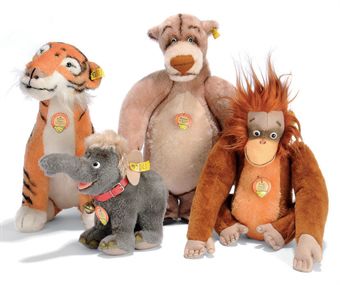
X marks the spot of our final Steiff tiger under discussion today.  Here we have Steiff's "Ponx."  He is 17 cm, sitting, unjointed, and made from dralon.  His belly and undersides, as well as his sideburns and the linings of his ears are pure white, while his back, sides, and face are orange with black hand applied airbrushing.  His face is detailed with green and black slit pupil eyes, clear mono filament whiskers, a pink embroidered nose, and a black mouth.  If Shere Khan (the tiger from the movie The Jungle Book, produced by Steiff in 35 cm from 1968 through 1975) had a son, he probably would look alot like Ponx!  Ponx was made from 1971 through 1974 as part of a series called "der kleine tierversand" - which roughly translates into "the little animal series."  Each item in this series came in a special display box and was accompanied by a little blue booklet which told the story about the animal; the booklet included translations in German, English, and French. Details of Ponx's booklet can be found right below.


Steiffgal hopes this discussion on interesting little vintage Steiff tigers has been the cat's meow for you.  

Have a question about one of your Steiff treasures? Let's talk! Click here to learn more. 
The teddy bear search engine