Showing posts with label skittle. Show all posts

Sunday, September 13, 2020

Begging For More Information About This Prebutton Era Steiff Dachshund

This Dox really rocks! And he's not in bad shape for being 833 years old - in dog years, that is! Check out this petite pooch from the earliest era of Steiff production and see what makes him so interesting from the design and product development perspectives.

This happy handful is 10 cm and unjointed.
He is made entirely from brown painted velvet and is in the begging position - meaning that he's eyeing what you are snacking on and asking for a nibble. His design and proportions are simple and a bit chunky - except for his long, thin, elegant tail and perky, triangular ears. It is very exciting to find an example like this one with his tail still attached, given how delicate and fragile this appendage is, and that it is attached to his body with just a few simple stitches. Doxie's face comes to life with a hand embroidered nose and mouth and tiny bead style black eyes. You only see these tiny bead eyes on the company's earliest products. Doxie wears a simple black leather collar; it probably was accessorized with a little medallion when he left the factory over a century ago.

This pattern was made in 10, 14, and 22 cm from 1901-1927.
Given this little guy does not have a button or any indication that he ever did, he is probably from is from the earliest portion of that timeframe... the "prebutton" era. Steiff collectors love examples like this for their age and presentation, while doll collectors often pose these "VIP" pets with their 19th and 20th century prized dolls.

This design is a beloved, legacy pattern that appeared as several product line extension items through the first quarter of the 20th century. These included a 10 or 14 cm basket-bearing pincushion from 1902-1918, a 12 or 17 cm tumbler on a semispherical wooden base from 1901-1917 overall, and a set of 9 or 10 velvet Doxie skittles from 1901-1912. These novelties are extremely rare overall, and generally do extremely well on the secondary market or at auction.

Steiff also produced a number of other similarly styled dog breeds in velvet in the early 1900s.
These were usually begging or sitting, and differentiated by their detailing and painting. These included a 10, 14, and 22 cm sitting Bulldog from 1901-1927; a 10, 14, or 22 cm sitting Pointer; and a 10, 12, 14, 7, and 22 cm sitting Fox Terrier from 1899-1927. Like the velvet Doxie under discussion today, many of these also appeared as pincushions, tumblers, and skittles given their appeal and popularity.

Steiffgal hopes this discussion on the company's very early velvet Doxie has been puppy-perfection for you.

Have a question about one of your Steiff treasures? Let's talk! Click here to learn more. 

Monday, June 8, 2020

Digging For Details On This Divine Doggy Discovery

And what do we have here? It seems like some of the best vintage Steiff surprises turn up when you least expect them! Such is the case of a new friend from the U.K. who writes about a recent doggy discovery. James shares:

"Hello, I found today in my elderly father's house a toy dog on wheels which I think may have belonged to his mother. I found your site and blog really useful in learning more about it. It has a rusty Steiff button in its left ear with a long trailing F. 

It also has a medallion on a collar. I haven't seen a collar in any of the photos of other Steiff dogs I've found so far on the internet, so I wonder whether it might have been added, and so is not original. I would be interested in what you think about the medallion and if you are able to tell me anything more about the dog."

This cute canine is the wheel deal indeed. Although it's hard to tell from the photos, it is Steiffgal's best guess that given his form and presentation that this is Steiff's early Fox Terrier on wheels. You can see this item pictured here on the left, the photo is from Pfeiffer's 1892-1943 Sortiment book. He is standing, unjointed, and made from white velvet. His material has been precisely painted brown on his ears and around his eyes. Steiffgal suspects he might have had a few other brown spots here and there that faded over time - most notably right on his back. His face comes to life with a somewhat upturned, pointed snout, black shoe button eyes, and a hand embroidered nose and mouth. He glides along on four metal wheels which are connected by metal axles. As noted, he retains his button in ear as his Steiff ID. 

Velvet Fox Terrier on wheels appeared in 14 and 17 cm (measured vertically, top of head to toe, not including wheels) from 1902 to 1917 overall. Given this early timeline, it would align that this toy belonged to someone born right at the beginning of the 1900s.

Now let's complete the circle here and talk about the dog's collar. Yes, Steiff did put fancy neckwear on many of its fine products during the first quarter of the 20th century. Large, colorful silk ribbons started appearing on mohair Teddy bears and other pets around 1925. But as early as the turn of last century, it was not uncommon for the company to decorate primarily velvet or felt dogs, cats, and some animals on skittles with fitted ribbons or collars detailed with bells, simple disks, or more elaborate medallions. Perhaps the "most famous" medallion bearing example was the company's Caesar, the King's Dog - who had his very own custom medallion based on the one worn by his namesake. From what Steiffgal can unearth, most Steiff "hardware" was attached to an animal's collar via rings or elegantly secured though a system of a disk and bead on smaller items. You can see the ribbon, bell, bead, and disk detailed "necklace" of a c. 1902 felt cat skittle cat below. 

So what's going on with this velvet dog's collar and medallion? In this case, Steiffgal suspects that the medallion here MAY be original to the dog, but probably was reconnected to the collar given its "home repair" presentation.

Steiffgal hopes this discussion on this velvet Fox Terrier on wheels has answered James' questions about him, in a round-about sort of way.

Have a question about one of your Steiff treasures? Let's talk! Click here to learn more.

Sunday, June 10, 2018

I'll Tumble For You!

Talk about (s)tumbling onto a fantastic Steiff find! Robin was at the right place at the right time when she found this absolutely amazing and extremely rare early Steiff bear novelty. She shares,

"Hi Steiffgal,


Here's the item I told you about. He is pretty cool and definitely something I’ve never seen before. Before I received him, I thought he might be a skittle like the bear ones I already have, and the bear himself is very similar but he’s much bigger and the base is totally different.

The bear himself is 10" tall and about 5" elbow to elbow. The base is 5-1/2" in diameter and 2-1/2" high. The base is wood with some kind of metal weight inset, that allow him to rock and spin without falling over. It is quite heavy."


Wow, it is easy to lose balance over this delightful turn of last century toy. He's actually a wonderful example of Steiff's early Tumbling Bear. He's standing, unjointed, and made from an early plush material. His eyes are black, and his nose and mouth are embroidered in a very early style. He is mounted on a weighted, wooden hemisphere. This allows him to wobble about, like a very early "weeble" but not fall down. He left the factory holding a wooden stick between his paws and a chain connecting his nose to the stick - to resemble a circus bear of the time.  You can see traces of the stitching on his paws that would have held the stick in place. These real-life bears would travel from city to city at the turn of last century as part of roaming circus companies. Robin's tumbling bear was produced in 35 cm from 1899 through 1918 overall. 

Check out this tumbler in action here!

Robin's tumbler has a key role in the history of the development of the jointed Teddy bear as we know him today. In the late 1890's, Steiff produced a number of bear novelties. They were made to give the toys action and movement. The picture on the left shows a few examples of these early bear toys. Left to right, they include bears on platforms with bristles supporting them; a bear on a cart with metal wheels; and three tumblers in different sizes and configurations. The bears on the platforms with bristles would move when someone tapped the table on which they were standing - so they would sort of "shimmy" about.

Richard Steiff wanted to create far more playful, dynamic, and child-friendly versions of these static/moving bears, and he took this challenge very seriously. He studied the way real bears move at the zoo. Mohair, a fabric perfect for soft, durable toys, became available on a commercial level around 1902. He married those two facts, inserted his great creativity, and came up with the patterns for a series of fully jointed bears, starting with string jointing, then rod jointing, then disk jointing. The company's disk jointing system has not changed much since its introduction over a century ago.

Steiffgal hopes this discussion on Robin's tumbler has left you steady on your feet!

Have a question about one of your Steiff treasures? Let's talk! Click here to learn more.

Saturday, February 4, 2017

Game On With This Unusual And Uncatalogued Steiff Mosaic Ball

With the Superbowl just hours away, many people (at least in the United States) are getting ready to watch one the largest sporting events in the world on TV.  In keeping with the theme of "fun and games," Steiffgal thought it would be the perfect time to take a closer look at an unusual and vintage piece of Steiff "sporting equipment" - a soft ball designed for children's play.  

Let's toss up some basic facts about this Steiff rarity.  Steiffgal purchased this brown beauty at a recent Teddy Dorado auction. The ball itself is 15 cm in diameter and is made from a total of 12, five sided pentagons which are sewn together to make the rounded shape; Steiff calls this their "Mosaic Ball" design. It was described in the catalog as follows: 

"Room & gym ball from the 5 square mosaic fields; four fields are made of dark brown mohair; two fields are made of blond wool mohair; two fields are made of raw white & yellow silk plush; two fields are each different brownish patterned wool mohair; plump & stuffed with wood wool; without Steiff character from Manufactory; with a few bald areas; clean, non-fading & odor-free; overall very well received; Communication without proof of catalog... made without bell or rattle... probably made during or shortly after the Second World War from existing fabric remnants and not intended originally for sale... consignment from  Giengen/Brenz, Germany."

The fabric selections on this particular example, including mohair, artificial silk plush, and wool plush, perfectly align with its estimated date of production.  It is possible that this example was designed as a prototype for an item that never went into full scale production.  But it is more probable, given its origins from a consignor in Giengen, that it was created by an industrious Steiff seamstress on one of her breaks or even at home; these sorts of "one off" pieces are often referred to as "whimsies" or "end of day" items in the antique industry.  The most interesting fabric on this ball is a tan wool plush decorated with what appears to be hand-airbrushed black, brown, and orange spots.  Steiffgal does not recognize this fabric from any other Steiff item.  Have you seen it before?  

In a round-about way, balls designed for play have been part of the Steiff program since the late 19th century. Perhaps their earliest cataloged appearance was in 1892, when felt covered wooden balls were included with the company's standard skittle sets.  Steiff also made soft play balls for children in felt and mohair through the early 19-teens.  All of these earliest balls were designed in two or three colors and were constructed in wedges, like today's beach balls.  You can see two of these early felt skittle set balls here on the right; the photo is from Morphy Auctions.

Let's piece together what happened next. In around 1912, Steiff debuted its "Mosaic Ball" pattern. This ingenious design turned out to be the perfect blend of geometry, visual interest, and material efficiency.  The shape naturally takes form from the way the pentagons are stitched together. Its presentation can include up to twelve different colors, although Steiff traditionally used two pentagons each of white, red, black, blue, yellow, and green mohair.  And in terms of production efficiency, this pattern is ideal, and can incorporate the "left over" and scrap fabric from other items being produced.  From their introduction onward, Steiff frequently featured its Mosaic Balls in its advertising. This is understandable, given their festive and attractive appearance as well as popularity.  You can see a Steiff advertisement from 1912 featuring its Mosaic Balls here on the left, the photo is from Ayers and Harrison's Advertising Art of Steiff Teddy Bears and Playthings. 

Steiff's Mosaic Balls had a practically seamless, almost seventy year long appearance in the line. Pre-war, the company's standard line Mosaic Ball was produced in 13 sizes ranging from 6 to 35 cm from 1912 through 1943 overall.  This pattern was also incorporated into a hanging toy for a baby's crib from 1913 through 1917, and as a "catch toy" on an elastic string from 1914 through 1918.  Just after World War I, when mohair was scarce, Steiff produced its Mosaic Ball design in felt as well as substitute plush; in the early 1930's the ball was produced in lighter pastel colors as well. Once the factory reopened for toy making business in the late 1940's, this beloved pattern again appeared in the catalog in five sizes ranging from 15 to 25 cm from 1950 through 1982.

Steiffgal hopes you've enjoyed kicking around the history of Steiff's delightful play balls.

Have a question about one of your Steiff treasures? Let's talk! Click here to learn more.

Friday, August 26, 2016

This Amazing Steiff Pre-Button Era Skittle Set Is Right On Point!

It's "game on" with this extraordinary auction highlight from the upcoming Premier Toy and Doll Sales Event at Morphy Auctions on September 23rd and 24th, 2016. Although there are many fantastic button-in-ear selections in this sale - including several Steiff automatons - this particular highlight is truly in a league of its own. Check out this amazing set of turn-of-last-century skittles set... Steiffgal is certain they will "strike" a chord with you as well.

Here we have lot #308, a Steiff pre-button era nine pin Pointer skittle set. It is cataloged as...

"This set, designed for the European market, consists of eight begging, unjointed Pointer dogs on wooden skittles and an unjointed Pointer king pin, dressed in a red felt top coat and matching red felt crown decorated with trim and beading. The dogs are made of tan felt and are hand detailed with brown painted patches. Their faces come to life with black eyes, a simple, hand embroidered nose and mouth, and floppy ears. Some of the black eyes may be replaced. All but one dog retains their long, thin tail; these appendages tended to snap off with use. Each pin would have left the factory in Giengen, Germany with a collar decorated with either a small medallion or a bell; all but traces of these accessories have been lost to time. All nine dogs in the set are mounted on wooden plinths with the king pin on a slightly higher platform. The set includes two original skittle balls covered in colorful felt which have significant tears and losses to them. Steiff produced this Pointer skittle set in felt from 1892-1908. This set and assortment is as pictured on page 577 of Gunther Pfeiffer's Steiff Sortiment 1892-1943 reference book. Because none of the pins have Steiff ID and do not appear ever to have had any, they were most likely made in the c. 1892-1904 pre-button time frame. Condition: As noted. One pin with repairs and patches to the head. Wooden plinths with minor losses from playwear. Otherwise in very good condition given the age and the gaming nature of this rare and unusual set."  This lot is estimated at $6,000-12,000.

Although most turn of last century Steiff items were made for fun and interaction, none better exemplify that then the company's skittle sets.  These bowling games were truly designed and constructed for competitive play. Today, they are quite rare and for many reasons - including their distinct shape - are trophies for most vintage Steiff collectors. This pointer example just one of a few complete sets that have come up for auction in the past few years. In 2014, James D. Julia sold a nine piece set of felt rabbit skittles with ID for $7,110. And in June, 2016, Morphy's sold an early nine piece all original Steiff skittle assortment for $11,590; this set is pictured here above on the left. 

The origin of the game of skittles is unclear, but it has roots in similar games played in ancient Egypt, Greece, Italian, and southern Turkey.  Skittles was particularly popular in Great Britain, where  the game was played over several centuries in public houses or clubs.  There were variations in rules and scoring over time and location, but in most cases the game involved bowling a ball about 6.5 meters at nine pins set in a diamond pattern.  Whoever knocked down all the pins in the fewest tosses was the winner. 

Historians are able to pin down that skittles appeared in Steiff's very first catalog of 1892.  The sets produced for the European market had nine total skittles, while those for America had ten total (as in tenpin bowling).  Each set consisted of a series of pins and one kingpin.  The company produced skittles both as standard looking felt bowling pins, as well as in the form of felt, early plush, or velvet animals perched on wooden plinths.  For the sets with animals, Steiff made the sets with hens, monkeys, elephants, pigs, rabbits, poodles, pointers, cats, chicks, dachshunds, elephants, pointers, cats, and bears, among others. The animals appearing on the pins or as kingpins were usually 10 to 15 cm tall, standing or begging, and were otherwise standard line catalog items.  In all practical cases the kingpin wore a felt jacket and crown, and was mounted on a slightly taller plinth, or was otherwise differentiated from the rest of the regular pins. Each skittle set came with two wooden balls that were covered in multicolored felt. Here on the left, you see a c. 1903 "hens and rooster" Steiff skittle set; it sold for $27,702 in 2010 at an auction at Christie's in London.

Steiff began branding its items from 1904 onward with a button-in-ear.  Thus, as in the case of this pointer skittle set, it is possible to find individual pins or even an entire set without the company's famous trademark, given they were produced starting in the very late 1800's!  However, after 1904, all items, including each skittle in a skittle set - would have left the factory in Giengen with Steiff identification. 

Steiffgal hopes this discussion on Steiff's early skittle sets has simply bowled you over.  

Wednesday, August 12, 2015

Good (Steiff) Things Come In Threes At Morphy's Early Fall Toy Auction

Looking to add something really special to your growing Steiff hug?  A good place to do so may be at Morphy's upcoming Toys, Dolls, Trains, and Marbles early fall auction on September 10th - 12th, 2015.  This sales event, which features delightful temptations from every toy category, also has several very fine Steiff lots on offer, too.  Here are three marvelous highlights that truly caught Steiffgal's imagination.  This auction, and these early Steiff treasures,  just may make saying "fairwell" to summer a little easier!

Regular readers of this blog won't be surprised that Steiffgal has a big case of puppy love over this first auction highlight.  It is lot 111A and is cataloged as...  
 "A highly desirable Steiff dog of the early part of the 20th century. This fellow retains his original tag as well as stiff straw collar. Overall his coloring, orange and cream, with a velvet nose, he is in very fine plus condition with only minimal mohair loss in a couple spots. Most likely a grading of 8.5 or 9 out of a 10 point scale would be appropriate? Size 9" to top of head.  Estimated at $1,250 - $1,750."

This top dog is Steiff's wonderful Bully the Bulldog. Bully was launched in 1927 and was an instant sensation with both children (as a plaything) and adults (as a collectible and an accessory). He was modeled on the French Bulldog—the “it” companion of those in the know all across Europe at the time. Like this wonderful example, all vintage Steiff Bullies were head jointed, had oversized brown and black glass pupil eyes, a hand-embroidered black nose, and a simple snout and jaw constructed to give him his requisite jowls. Most were black and white or orange and white. Bully was made in velvet and mohair, as well as sitting and standing, in sizes ranging from 10 to 50 cm.  This original Bully appeared in the Steiff catalog through 1939.  

And just what makes this Bully the pick of the Morphy's litter? Collectors can't help but notice his majestic size, vibrant coloring, and fantastic overall presentation. His spectacular horsehair collar, a traditional accessory of "society dogs" of his period, appears to be in like-new condition. Last, and hardly least, he retains both his long trailing F Steiff button as well as his rare metal rimmed chest tag - in itself a coveted rarity.  Although Steiff records show that 250,000 Bullies were manufactured from 1927 through 1932, this example is truly one in a million.  

If you are looking for some wonderful Teddy hugs, this next selection has your name written all over it.  It is lot 121A and is simply cataloged as...
 

"Fully jointed bear appears to be a Steiff, with sewn nose and black button eyes, felt paw pads with hole in one. Some soil and wear. Very appealing face! Condition (Very Good).  Estimated at $400 - 600."

This bare bear indeed is a Steiff, and given his presentation, is probably from the 1906-1910 or so time frame.  His size is not specified, but because his nose stitching pattern is horizontal, it is Steiffgal's best guess that he probably measures between 12" and 14" tall, plus or minus a smidge.  The company's precious cubs from this early era are known for their long arms, spoon shaped paws, narrow feet, pronounced back humps, and black button eyes.  Steiff bears in this height range from the turn of last century were often called "doll bears." This is so because their size was similar to that of a typical little girl's doll, and to make these bears appealing as toys for both boys and girls. 

This bear has it buttoned up as an auction pick. His mohair has a delightful sheen to it, and he sports that marvelous Steiff "sitting slouch" which only comes with time. Ted's endearing face calls to collectors with its close-set eyes and distinctive, pointy nose. And, if you look closely at his head shot online, you can see that he appears to retains his pièce de résistance, his Steiff Knopf im Ohr.  What's not to love?

This last Morphy's Steiff auction highlight may simply bowl you over.  It is lot 997 and is cataloged as...

"A nice example of an early Steiff 9 Pin in the form of a dog. Velvet covered body with shoe button eyes and still retaining a button in the right ear this fellow has a minor tear/aged repair at his collar on the right side. Overall very nice condition with minimal soiling to velvet. Size 7-1/4''T. Estimated at $250 - 450."  

There's no need to beg for more information on this cute canine. What we have here is a sweet example of an early Steiff velvet Dachshund skittle. The dog itself is in the begging position, unjointed, and made from tan velvet that has been airbrushed with brown highlights. His adorable face comes to life with black button eyes and a simple hand embroidered nose and mouth. Remarkably, this pup retains his tail, which is long and narrow and has a tendency to snap off over time.  The dog is mounted on a solid wooden plinth which is shaped somewhat like a bowling pin and designed to tumble over upon impact; the dog plus the plinth is called a skittle.

This skittle left the factory in Germany as part of a set of skittles, a centuries old parlor game analogous to what we now call bowling.  Skittle sets appeared in Steiff's 1892 debut catalog.  The sets produced for the European market had nine total skittles, while those for America had ten total (as in tenpin bowling).  Steiff's animal skittle sets consisted of a series of pins and one kingpin; the kingpin wore a felt jacket and crown, and was mounted on a slightly taller plinth.   Each skittle set came with two multicolored felt covered balls.  The dachshund on the skittle is a standard line item that was produced in 10, 14, and 22 cm from 1901 through 1927.  However, Steiff's dachshund skittle set was only produced from 1901 through 1912.  Given that early time frame, this example conceivably could have an elephant, blank, or small trailing F button as his Steiff ID.  

This final Steiff selection beats a perfect game anytime.  Steiff skittles are absolute rarities as so few exist today; they were basically designed as a sporting goods to be used and enjoyed, and most were.  As such, this example in lovely vintage condition with ID represents the best of all worlds for collectors, given that it is both a skittle and a dog.  It is interesting to note that a slightly older felt Steiff dachshund skittle realized $1,718.25 at James D. Julia in 2014. Easy to display and impressive in presentation, this Steiff dachshund skittle might just take home a blue ribbon as well in this upcoming sales event.  

Steiffgal hopes this discussion of the finest Steiff collectibles on offer at Morphy's upcoming auction has been a highlight experience for you.

Have a question about one of your Steiff treasures? Let's talk! Click here to learn more!

Sunday, March 22, 2015

Bowled Over By This Fantastic and Early Velvet Steiff Dachshund Skittle

Are you in the mood for a little Steiff game today?  Steiffgal nearly toppled to the ground when she received this email inquiry from a professional colleague from the New England area who asks about a vintage Steiff find.  See if it bowls you over as well!  

Blain writes...

"Steiffgal,  I have a friend who has a Steiff dog, which looks like he is sitting up on his rear legs, perched on a wooden base, who has his original elephant button... this is in VERY good condition...  Dog is two toned, no issues I can see.  Can you tell me a little about him... and what you think he is worth? Thank you!  Blain"

Steiffgal's not playing with you when she says this is one very special treasure!  What we have here is a very early Steiff skittle.  Skittles are analogous to today's modern sporting bowling pins.  The skittle itself is made of a dachshund which is perched on a wooden plinth.  The dog is begging, unjointed, and made from brown and white velvet with airbrushing.  He is rather basic in form and design.  His face is detailed with a simple hand embroidered nose and mouth and black shoe button eyes.  He wears a little leather collar.  Steiffgal has seen these finished with a small medallion or bell; this model has lost his ornamentation to time.  This begging velvet  dachshund mounted on a skittle is identical to Steiff's standard line velvet dachshund; this precious pooch was produced in 10, 14, and 22 cm from 1901 through 1927 overall.  His absolutely remarkable elephant button helps to date this item to 1904!  Although Blain did not mention the size of the dog, it is Steiffgal's best guess that he is the 14 cm version based on other Steiff skittles of the same era.

Wooden it be nice to know more about the dog's plinth?  Well, this base was designed to be knocked over when hit directly with a fast rolling felt ball.  The plinth is solid wood  and finished simply with a little varnish and a black ring around the top circumference.  European skittle sets had 9 skittles while those made for the USA had ten.  In most cases, each set came with a "kingpin" who was slightly taller and dressed in a beaded crown and felt jacket; his wooden plinth was also slightly taller than those of the other pins.  An example of a typical Steiff kingpin is pictured here on the left; this fabulous pre-1904 velvet elephant realized close to $1,500 at the June, 2014 James D. Julia Antique Doll, Toy, and Advertising Auction.
Steiff produced Skittle sets from about 1892 through 1919. Over that period of time, Steiff made the sets with hens, monkeys, elephants, pigs, rabbits, poodles, pointers, chicks, cats, and bears, among others.  The skittle pin under discussion today most likely was made as part of a Dachshund-Kegelspiel or Dachshund Skittle set.  This dog-themed game was manufactured as part of the general product line from 1901 through 1912. 

Now the question that has everyone on pins and needles.  Just what is this little guy worth?  Well, Steiffgal has not seen him firsthand, and cannot account for structural and/or aesthetic issues that do not appear in photos, like odors, weak spots, repairs, insect damage, etc.  However, given that he is as nice in real life as described and presented, his value may just bowl you over!  Here's why.  Skittles like this one are beloved by vintage collectors as they represent a wonderful long gone era of Steiff design and production.  They really don't take up too much room to display, which is an issue for many collectors.  Few survive today because in reality they were produced to be used - and used hard - as playthings.  And remember, this begging beauty retains his crowning glory, his most desirable ELEPHANT button - which is pictured above on the left!  Given all that, and based on relatively recent sales of Steiff skittles, it is Steiffgal's best guesstimate that he may realize in the range of $2,000 to $3,000 at auction today.

Steiffgal hopes this discussion on this velvet begging dachshund skittle has been a real game changer for you!

Have a question about one of your Steiff treasures? Let's talk! Click here to learn more.  

Saturday, January 24, 2015

Having A Ball With This Terrific Steiff Roly Poly Bear

Most Steiff collectors would take a tumble for an unexpected Steiff discovery!  And that's exactly what Steiffgal did when an inquiry from a colleague about this great and very vintage Steiff treasure landed in her email in-box.  Steady yourself and take a look at this marvelous merrymaker!

Oh baby, here we have a delightful "child-proof" item intended for the youngest Steiff enthusiasts.  This is Steiff's "Roly Poly" Bear.  Many of us grew up with "Weebles," those funny egg shaped character toys that "wobble but they don't fall down."  This Roly Poly cub is an early version of this toy idea.  

Roly Poly Bear is made from mohair with a very distinct shape - extremely round (almost ball-like) on the bottom, with a standard jointed Teddy bear head.  He has jointed arms but no legs at all.  His face is detailed with black shoebutton eyes and a brown hand embroidered nose and mouth.  He retains his long trailing "f" button as his Steiff ID. Given his stitching is brown, it is safe to assume that this bear started out life with white mohair - which has aged and mellowed to darker vanilla color over time.  Overall, this pattern was produced in 16, 19, 23, and 29 cm from 1909 through 1916.  During that entire time, it was produced in blond mohair.  However, in 1912 it was also produced in white mohair in the smaller sizes.  So this is one rare bear indeed!

Steiff's soft Roly Polys are great Steiff novelty items.  Models produced over time include rabbits, cats, and dolls. But these are not the first type of "rounded bottom" products that the company produced.  It is possible that Roly Polys are based in part on the company's much older wooden bottom "tumblers," which were smaller, standard line items (usually in the sitting or begging position) that were mounted on a solid wooden hemisphere.  Like the Roly Polys, they swayed and tumbled about, but did not fall completely over - unlike their wooden cousins the "skittles" - which were designed like bowling pins to fall down!  The big difference between the Roly Polys and the tumblers was that Roly Polys had a rounded bottom that was integral to their body and design, while tumblers could be basically any shape - as the featured animal or doll was mounted to a rounded bottom.  Wooden bottomed tumblers appeared in the line as early as 1894, and were produced on and off through the early 1940's. The photo on the left shows a very early wooden bottomed felt clown tumbler; this shot was taken at Margarete Steiff's birth house in Giengen, Germany where this item is also on display.

It is interesting to note that Steiff's Roly Polys made two distinct appearances in the Steiff line.  The first was basically from around 1909 through the late 19-teens... the era of the little white Roly Poly under discussion here.  These ball-like creatures came 'round again from 1937 through 1943 overall, in the form of three designs:  a 20 cm mohair Roly Poly Teddy baby, a 20 mohair Roly Poly Rabbit, and a 25 cm felt Roly Poly clown doll.  Most memorably, an all but pristine example of the Roly Poly Teddy baby realized almost $17,000 at auction at Christie's in London in October, 2010!  This terrific Ted is pictured here on the left.

Steiffgal hopes this discussion on Steiff's Roly Polys and tumblers been a well rounded experience for you.

Have a question about one of your Steiff treasures? Let's talk! Click here to learn more. 

Friday, December 6, 2013

An Exclusive Online Auction Preview, Just For Steifflife Readers!


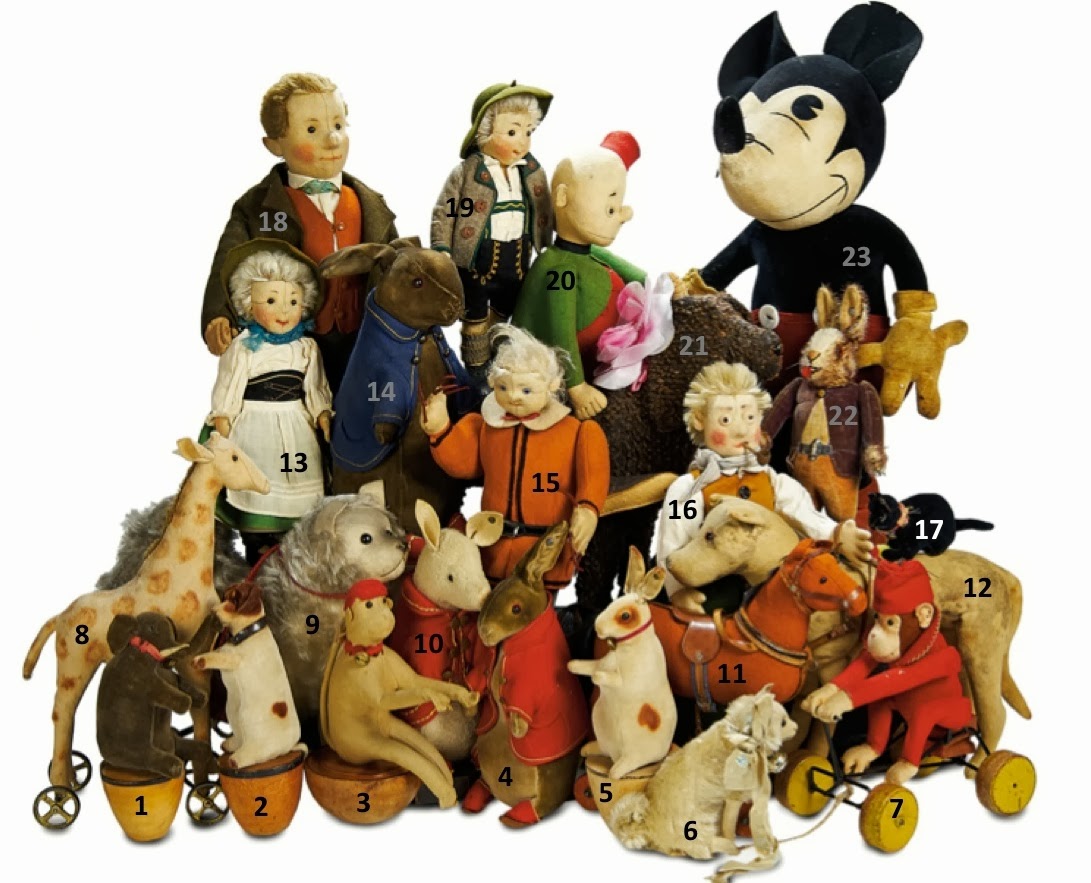
Pssss.... wanna know a (Steiff) secret?  Steiffgal has learned of an AMAZING collection of vintage Steiff items going up for sale early next year... and she wants to share the details with you!  Check out this breathtaking photo of vintage Steiff treasures that will hit the auction block on January 10-12th, 2014.  They are all part of Theriault's Marquis event which will be held at the Westin South Coast Plaza in Newport Beach, CA.  The image reflects just a small sample of the 100+ treasures from the collection of American Steiff enthusiast Helen Welsh Gastaldo.  Let's take a look at these items and see what makes them so interesting, and exciting, from the collector's perspective.

Items 1, 2, and 5:
In this case, it's very good to get off to a shaky start.  What we have here are marvelous examples of Steiff's early skittles.  Skittles as a game was a turn of last century pastime analogous to bowling.  Steiff produced skittle sets from 1892 through 1919. Over that period of time, Steiff made the sets with hens, monkeys, elephants, pigs, rabbits, poodles, pointers, cats, chicks, dachshunds, elephants, pointers, cats, and bears, among others. In all cases - except the hen and the chick versions - the kingpin wore a felt jacket and crown.  The sets produced for the European market had nine total skittles, while those for America had ten total.  All sets came with two felt "bowling" balls. 

These three skittles - an elephant, pointer, and rabbit - are made from velvet and are on a wooden base.  The elephant skittle was made from 1901 through 1916; the pointer was made from 1901 through 1909; and the rabbit was made from 1901 thorough 1916.

Item 3:
Steiffgal is certain most collectors would take a tumble for item #3.  Here we have Steiff's turn of last century tumbling monkey.  Unlike skittles, which were designed to be knocked over, Steiff's tumblers were made to wobble about, but not flip over.   It is interesting to note that the monkey on the top of this tumbler is one of the very earliest Steiff designs ever; it is quite possible that he might even be "pre-button" as this product was made even before Steiff began putting their trademark "Knopf Im Ohr" in all products starting in 1904. 

Tumbling monkey was produced in felt in 17 cm from 1894 through 1917; pre-1912 models resembled the more primitive looking one in the group photo above.  Models produced after 1912 looked much more like Steiff's traditional "Jocko" style chimp, who was debuted in 1909 and received his moniker in 1929.

Items 4 and 14:
These two items will most definitely generate more than just a hare of interest.  These honey bunnies are none other than original Steiff Peter Rabbit dolls!  In 1902, a "little book" written and illustrated by English author Beatrix Potter, hit the market in a big way. This book, Peter Rabbit, became a worldwide sensation due to its simple, universal story and beautiful illustrations. Ms. Potter created a little Peter Rabbit doll and registered it in the London patent office. Despite numerous attempts, she could not find a manufacturer in England to produce her toy. Steiff got wind of this, and soon became the producer of the "official" Peter Rabbit doll for the English market.   

It is generally understood by collectors that a "Steiff Peter Rabbit" is standing and wears a felt topcoat and slippers. According to the Steiff Sortiment, the gold standard Steiff reference book, there are two version of Peter Rabbit. The first is a spotted white velvet version wearing a red or navy topcoat and red slippers; he was produced in 10, 22, and 28 cm from 1904 through 1919.The second is a white wool plush version wearing a green felt topcoat and red slippers; he was produced in 22 cm from 1904 through 1918. 

Item 10:
Interestingly, at the exact time that Steiff was manufacturing its Peter Rabbit dolls, they also produced a similarly designed white wool plush cat, poodle, bulldog, pig, and elephant.  All were 22 cm, sitting, flat bottomed, begging, and dapperly attired in felt topcoats and slippers identical in design to the one worn by the Peter Rabbit.   

Item #10 in the photo is indeed a nice example of the pig; specifically, this design was manufactured from 1904 through 1918.

Items 6 and 9:
These next two items should be treated like royalty!  Here we have two versions of Steiff's early unjointed Spitz or Pomeranian dogs.  See how #9, the one on wheels, has a red cord around his neck?  Most likely #6 did too, when he left the factory in Giengen over a century ago.  Early Steiff Spitz dogs usually wore a red cord with two pom-poms or tassels around their necks, giving them a “regal” appearance. The breed does have some connections to German nobility, which may explain why they are decorated like “little kings.”   

Spritz on wheels was manufactured in 17, 22, 28, 35, 43, and 50 cm from over the 1902 through 1929 time period.  Sitting Spritz was produced in 14, 17, 22, 28, 35, and 43 cm from 1902 through 1927.  This pattern was also produced jointed, as well as on a pincushion.

Items 12 and 21:
Besides bears, dogs are, and have always been, the second most important category in the Steiff line.  There was even a time in the mid to late 1920's where dog production outnumbered bear production at Steiff.  Here we have two exceptional dogs that could be the "blue ribbon" in any Steiff enthusiast's collection. And they even have something quite unusual in common - Steiffgal was not aware of these two items before doing some research on them!   

Item #12 is great for many reasons, including his legacy!  He is Steiff's Lord the Great Dane, who was made from course fabric in 17, 22, and 28 cm from only 1932 through 1936.  Even rarer is item #21, which is Steiff's earliest curled wool plush poodle, which was only made in this brown color from 1892 through 1894.  Overall, this early poodle design was produced in black, grey, brown and white fur in 12, 14, 17, 22, 28, 35, 43, 50, and 60 cm with and without wheels from 1892 through 1905.

Item 17:
Collector's just may get into a cat fight over this most unusual Steiff kitten.  Like dogs, cats are very high up on the company's list of important product cat-agories, no pun intended!  And Steiff's black cats have always held a special place in collector's hearts, due to their rarity and distinctive appearance.  The first black Steiff cat did appear in the company's debut catalog of 1892 in the form of a black standing  plush tabby, with or without wheels.  But this early lying version is a bit of a mystery... 

Despite much searching, Steiffgal was not able to find this small "lying" style black velvet cat in her Steiff archival materials.  However, based on the item's appearance, scale, and placement of bow, it is her best guess that she is an unreferenced black version of the company's early lying cat that debuted in velvet in 1899.  This general style of cat - unjointed, in a relaxed position, with a basic body shape - first appeared in felt in 1898.  Steiff's general line early lying velvet cat was produced in 6, 8, and 10 cm through 1927 in white, grey, spotted, or striped patterns.  It is interesting to note that these lying cats all held tiny woolen balls between their front paws; it is not possible to tell from the photo if this black example has one as well. 

Items 7, 8, and 11:
These three items are the wheel deal indeed.  Here we have three great examples of Steiff's rolling rarities.  Steiff has a very long tradition of producing items on wheels; many felt examples like these were featured in the company's debut catalog of 1892... including #8, the giraffe, and #11, the horse!  Wheels gave an item movement and life, so it is not surprising that Steiff designed some playthings with this feature. The earliest items were produced on metal wheels; wooden wheels made their debut in the 19-teens.  

Rolling right along, the monkey on wheels is Steiff's Record Peter, which was produced in 20 and 25 cm from 1913 through 1938.  His "vehicle" is sometimes referred to as an "Irish Mail Cart." The giraffe was produced with and without wheels in 17, 28, 35, and 65 cm from 1892 through 1909 overall.  And the handsome horse - which was one of the most popular, and prolific prewar items -  was produced overall in 12, 14, 17, 22, 28, 35, 43, 50, 60, and 80 cm from 1892 through 1943.

Items 13, 18, and 19:
Soft dolls debuted in the Steiff line around 1903, and were known as "karikaturpuppen" or character dolls because of their exaggerated features and cartoon-like proportions.  It was not until the early 19-teens that the company started to make dolls on a truly human scale, usually with childlike or charming looks.  Often times these dolls would be boy-girl pairs wearing "everyday" or "Sunday best" attire; the company also made a series of dolls sporting country specific clothing.  These sweet friends were made in sizes ranging from 22 to a whopping 115 cm - and always dressed to the 9's regardless of height! 

Steiffgal's not kid-ing around when it comes to these adorable Steiff youngsters.  Lucky item #13 is Steiff's Lisl, who was produced in 28, 35, 43, 50, 60, and 75 cm from 1909 through 1926.  It is interesting to note that in the Steiff reference books she is pictured with a miniature zither - which was Margarete Steiff's instrument of choice.  Although Steiffgal cannot find an exact reference to item #18 in her Steiff history books, she is confident that he was made in the 1911 through 1920 time frame and is most likely a student or sportsman.  Steiff made a series of very tall, elegant, and sophisticatedly dressed dolls in this timeframe, and his "look and feel" really overlap with these better-known examples.  And finally, item #19 is Anton.  This beautiful Bavarian boy was made in 28, 35, 43, 50, and 60 cm from 1909 through 1927.

Item 16:
Steiff dolls also could have a sense of humor, and this particular example certainly takes the bully pulpit on that point! Here we have Steiff's 35 cm fully jointed Tramp Strolch doll.  It is interesting to note that "strolch" translates from German to English as "Bully."  Clearly, Strolch looks like he's had better days.  His bare feet, patched pants, and "hangover" style eyes accurately reflect, and accentuate, his character. 

Tramp Strolch doll was produced in this size only from 1922 through 1928.

Items 15, 20, 22, and 23:
Finally, Steiff has a very long tradition of partnering with companies, authors, and the media to bring beloved cultural or fictional characters to life - Steiff style! Perhaps the earliest example of this took place in 1913, when Steiff was asked to create “Bibendum” out of felt in two sizes for a company in France. “Bibendum”, or “Bib”, is the Michelin Tire Man! Like the Peter Rabbits discussed previously, newspapers, books, and magazines have also provided Steiff with great ideas for very successful product development ideas.  These four items truly illustrate that point in the best way possible. 

Item #15 is Steiff's Shockheaded Peter doll.  Steiff produced Shockheaded Peter in the 1909 through 1927 time frame in 3 sizes - 30, 35, and 43 cm. He was also available in 20 cm as a ride-on pull toy from 1916 through 1927.  Shockheaded Peter was the central character in a book written by Heinrich Hoffmann in 1845 as a gift to his son. The book was composed of ten richly illustrated tales focusing on children. Each story had a life or societal lesson and graphically illustrated the results of bad behavior in each situation, in an Edward Gorey - like fashion.  

Item #20 is the cartoon strip character "Happy Hooligan."  He was produced in 35 cm only from 1904 through 1927. Happy, who was actually usually unhappy, was character from a comic strip called Happy Hooligan penned by writer Frederick Bur Opper; the series debuted in print in 1900. 

Item #22 is Jack Rabbit, who was produced in 22 and 28 cm from 1927 through 1931.  He was, of course, the central character in a popular series of children's books (of the time) by beloved author Dave Cory. 

Item #23 needs no introduction.  Here we have Steiff's classic velvet Mickey Mouse doll.  Steiff made Mickey Mouse from 1931 through 1936 in 11, 16, 23, 30, 36, and 48 cm. A tail moves head and a 24 cm puppet version were also produced in the same time frame. 

Steiffgal hopes this special preview has put you in the most delightful holiday mood ever!  More information about these items, which are all offered without reserve, will be posted around Christmastime at either www.issuu.com/theriaults or www.proxibid.com/theriaults.  Or, you can call Theriault's at 1-800-638-0422 to order the print catalog, which is scheduled to ship the last week in December. 

Have a question about one of your Steiff treasures, family or otherwise? Let's talk! Click here to learn more.
The teddy bear search engine