Showing posts with label outfit. Show all posts

Saturday, December 31, 2022

These Ladenburger Spielzeugauktion Auction Highlights Are Dressed To The Nines!

Three's a charm when it comes to the third post in this blog series of auction highlight from Ladenburger Spielzeugauktion's January 21st, 2023 Collection of Susan Kilgore Wiley sale. It's no secret that Steiffgal goes all hubba-hubba over Steiff's utterly charming dressed dolls and animals. And, this sale offers some of the most appealing ones in memory. Check out this trio of well attired prewar offerings from this auction. Steiffgal is certain you will consider all of them a clothes call indeed.

This first dressed highlight doesn't have a hare out of place.
It is lot #6152, an all original and early Steiff Peter Rabbit. It is estimated at €650-€1,300, and is cataloged in part as:

"One of the highlights of the auction, exceptional hare, Peter, around 1910, with small button, block letters, long trailing f, shoe button eyes, underlaid with red felt, fine brown/beige velvet, attending, with original felt jacket, decorative seams and golden buttons, red slippers, 1 leather sole with original stamp, 1 felt slipper is a bit holey, and small holes on the blue felt jacket, standing height 26 cm, extremely rare, exceptional."

Steiff's turn of last century Peter Rabbit dolls top many collector's bucket lists. This well coutured example is in lovely condition and is a marvelous size. It is interesting to note that the exact details that make up a Steiff "Peter Rabbit" are not specifically identified in Pfeiffer's Sortiment books. It is generally understood amongst collectors that a "Steiff Peter Rabbit" is standing, unjointed, and wears a felt topcoat with buttons and embroidery and felt slippers with leather soles. The Sortiment book pictures two versions of standing rabbits wearing felt topcoats and slippers, but does not identify them as "Peter Rabbit." The first is a spotted velvet version wearing a red or navy topcoat and red slippers; he was produced in 10, 22, and 28 cm from 1904-1919. The second is a white wool plush version wearing a green felt topcoat and red slippers; he was produced in 22 cm from 1904-1918.

This next auction highlight is a pair with flair!
Here we have lot #6181, two early 20th century, fully jointed, center seamed Steiff felt dolls. They are estimated at €330-€660 and are cataloged in part as:

"Felt dolls, Anton & Lisl, Upper Bavarian, produced between 1909 and 1926, 28 cm, with traditional costume, felt-head, mohair-hair, felt body, jointed, arms and legs, original, clothes, very nice condition."

This darling duo are textbook examples of   Steiff's "children" style dolls. 
These guys appeared in the line from 1909 through the late 1920's. Unlike earlier Steiff dolls that were more caricatured, harsh, and designed for adult collectors, these dolls were realistically proportioned, had gentle personalities, and angelic, rosy faces. They truly were designed for child's fun and play. These models were all fully jointed and had felt heads and bodies - except right around WWI when felt was scarce and the bodies were sometimes made from rough cotton or linen type materials. Steiff's children dolls were all dressed head to toe in handmade clothing that included school uniforms, ethnic costumes, sporting attire, and “Sunday best." Steiffgal is certain that the boy is Anton, based on his outfit and presentation. However, she is not 110% certain the identity of the girl is Lisl as her outfit does not match the one pictured in Pfeiffer's Sortiment. Steiffgal also suspects that her clothing, however charming, is not entirely original to her. Nonetheless, the pair is simply wonderful.

And it's tag, you're it! when it comes to our final well dressed auction highlight.
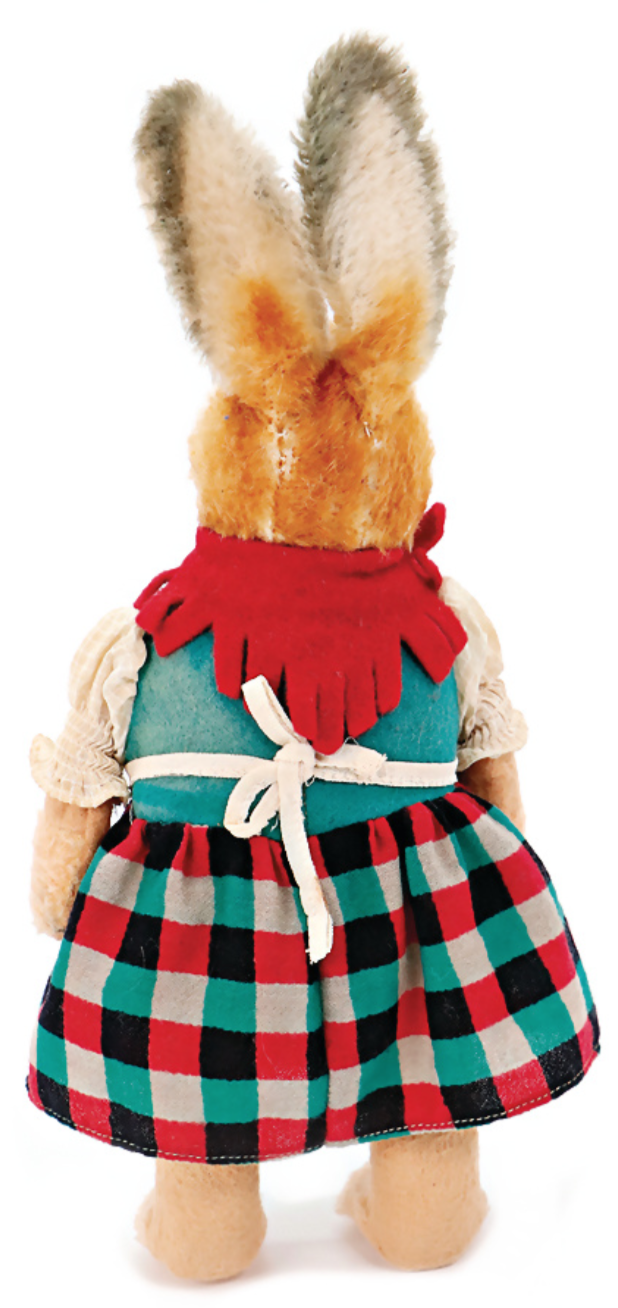
This is lot #6114, a late prewar standing and dressed rabbit doll, estimated at €180-€360. She is cataloged in part as:

"Pupp-hare, Mike, with button, block letters, long trailing f, very nice good preserved, yellow cloth tag label, No. 22, wool plush at hands and feet, original traditional costume, 27 cm, very nice condition."

And just want makes this lovely lady a 10?
She's got a fantastic presentation, and is in delightful, all original condition. And if you look closely at her tag, it is says "22,11." Numbers don't lie here! Her digits mean 22 cm tall (measured without ears), while the number 11 corresponds to her costume as described by the company. Outfit #11 translates to "traditional costume with green checkered skirt, green corsage, and white shirt." Spot on! These utterly charming, dressed rabbit dolls appeared in the line in 14, 22, and 28 cm in maize or white plush from 1932-1943 overall. Eleven total outfits for these rabbits were produced; they ranged from pajamas to playsuits to trousers and dresses through regional outfits like the one featured on this premier example. 

Steiffgal hopes this discussion on these well dressed auction highlights has contributed to the fabric of your collecting life. 


For more information about Ladenburger Spielzeugauktion GmbH's upcoming Special Steiff Auction event on January 21st, please click here!

Have a question about one of your Steiff treasures? Let's talk! Click here to learn more!

Saturday, March 14, 2020

Let These Four Cheerful Cubs Brighten Your Day!

It's hard to bear all the bad news lately. You can't turn on the TV or radio - or check out Facebook - without learning something depressing or scary. In times like this, it's important to take good care of yourself, and surround yourself with loving things. So today's blog has two simple missions - first, to give you a reason to smile and second, to provide a bright spot in your day. Here are a quartet of Steiff friends that are happy to help you with those important goals.

Our first terrific Ted is Penelope. She is one of Steiff's early 1950-era Teddy baby dolls. She stands 22 cm tall and is head jointed. Her unjointed body is made from tan fabric while the tips of her feet and hands are made from brown mohair. Penelope is clearly a fashion plate with her adorable light blue Peter-Pan style blouse, seersucker apron, and blue velvet pants. And this girl loves bling, as you can see from her pendant (which is actually an earring Steiffgal found, but don't tell her!) and her UFDC pocket pin. Steiffgal found Penelope at a doll show in 2016, and they've been close friends ever since. Penelope has accompanied Steiffgal to dreadful things like dentist and doctor visits and the like, and is always a great source of comfort - and conversation.

Here we have Maisy, who's as fresh as a daisy! She is a Steiff Teddy baby bear with really unusual velvety-cloth paw pads. Given this out-of-the-ordinary fabric, she probably dates from just before or just after WWII. Maisy is about 25 cm tall, fully jointed, and made from long and shaggy light maize colored mohair. Her nose and claw stitching is very light brown in color. Like Penelope, she's quite the girly-girl. She loves her pretty denim frock (which was made by Steiff) and is quite proud of her fantastic charm necklace, which features a bunch of playful beaded friends. Steiffgal found Maisy on eBay, and was immediately smitten by her great coloring and eternally optimistic personality. As soon as Maisy jointed the hug, she caught the eye of Charles, a 40 cm white Steiff Teddy baby from around 1930. It's easy to see why. They've been the happy couple ever since.

Our next sweet treat is Candy, who is 28 cm tall, fully jointed, and made from chocolate brown artificial silk plush. Candy was made around 1948 or so. She has very interesting linen paw pads on her hands and feet. She looks a little grumpy, but that's ok if you are a supermodel like she is, and she doesn't want to distract attention away from her totally terrific Teddy bear slippers. These quality kicks are made from brown mohair, have felt soles, and are decorated with brown and tan embroidery; even the bears' ears are dimensional. This slippers were a surprise gift from a friend, so they are even more special! Isn't it interesting how great footwear can make the whole day better? Steiffgal purchased Candy at auction; she wasn't planning on bidding on her, but you know how that goes.

And last but not least is this zany Zooby bear. This little joker is 28 cm and was made in the mid-1960s. He is head and arm jointed. His pointy claws are made from white felt. He is self-standing; the soles of his feet are made from a brown leather-like material; the tops are made from dark brown mohair. From a historical perspective, Zooby’s design is based somewhat on Steiff’s pre-war Zirkus-Baer or Circus Bear, a 32 cm standing bear produced from 1935 through 1939. Zooby likes wearing a felt clown hat, for obvious reasons. You can't help but notice his goofy facial expression, like he's just told a bad joke and is waiting for your hysterical response. Just the thought of that can't help but make you smile, right?

Steiffgal hopes these four cheerful cubs have brought a little humor, levity, and play to your day.

Have a question about one of your Steiff treasures? Let's talk! Click here to learn more!

Saturday, March 30, 2019

Getting All Dolled Up Over This Pretty Steiff Kitty

It's not often that you come across something that is the best of all worlds. But such is the case with this week's special My Steifflife blog visitor! Check out this simply adorable - and remarkable - Steiff cat doll. There's no question you'd want to welcome her into your meow mix!

This pretty kitty is the whole package. Her official Steiff name is PuppKatz Cat Doll. She is is 22 cm tall, standing, and head jointed. Her body is solidly stuffed and made from tan flesh colored fabric that has a slightly velvet-like finish to it. Her feet are flat and designed for standing; they are lined in cardboard. Her arms hang softly at her sides. Her feet and the tops of her paws are made from white mohair. Her mohair head is typical to Steiff's early 1930s cat head designs and is gently tabby striped. Cat's pert ears are lined in felt. Her pensive face comes alive with teal green and black slit style pupil eyes and a pink hand embroidered nose and mouth. Cat's clear monofilament whiskers have been lost to time. PuppKatz was made in 14, 22, and 28 cm from 1931-1943 overall.

This PuppKatz is part of a series of animal dolls Steiff produced in the 1930s and 1940s. Other species represented included bears, rabbits, dogs, elephants, and ducks. All shared the same stationary human form body. Most were made in 14, 22, and 28 cm and had removable clothing. As such, the original clothing was often lost to time, which is the case here with this PuppKatz. However, PuppKatz's current outfit of white underwear and a pretty belted dress, is perfectly scaled and adorable on her. She also came with a little pin with the name "Amy" on it. As such, that is her new name moving forward. 

The strategy behind the PuppKatz, and other animal doll patterns, is quite interesting and reflective of the prewar period in which they were made. These items launched in the early 1930s. Germany at this time was in a period of high unemployment and financial uncertainty. As a response to poor economic conditions, Steiff started making items that were simplified in design, used less expensive or even alternative materials, and were "theme and variation" in nature. The change in tone from items introduced from the end of the 1920s to the early 1930s is absolutely striking. Steiff's 1920-era items for the most part were colorful, fluffy, feminine, and childlike. Their early 1930-era items tended to be a bit glum looking, longer, narrower, and thinner

Steiff's animal dolls fit the needs of the 1930s business environment to a T. They were all on the same easy body that was made from inexpensive fabric and could be detailed in countless ways. In the case of this PuppKatz, she was made in three sizes, and each size was available in up to 11 different outfits over time. This one design ultimately represented 29 different SKUs in the product line. These outfits included sporting clothes, pajamas, suits, dresses, traditional clothing, and swimsuits, among others. These outfits were numbered and noted by a distinct code in the animal doll's article number. By having so many options for this one simple design, the company was able to fill its catalogs efficiently when product design and development resources, as well as raw materials, were severely limited by factors beyond the company's control. Steiff's 1938 catalog featured a whole spread of their animal dolls and various outfits; you can see that page here on the left. Please click on the photo to make it larger and more legible. 

Steiffgal hopes this discussion on PuppKatz has tickled your whiskers in the best possible way.

Sunday, January 14, 2018

This Charming Antique Steiff Doll Is Dressed For Success

Well, that was a clothes call! Steiffgal saw a wonderful antique Steiff doll in a really eye-catching outfit listed online, but the seller would not ship to the United States. After a little back and forth with the seller - including assuring her that this doll would love her new home in America and would have lots of new Steiff friends here - everything worked out and the transaction was completed. All's well that ends well! Now it's your turn to check out this darling girl and see what makes her, and her costume, so appealing.  Does she call to you as well?

This lovely little lady is named Lena. She is 35 cm tall and arm and leg jointed. She is one of Steiff's late 1930's era pressed felt faced dolls. Her seamless face comes to life with inset glass pupil eyes, a well formed and dimensional nose and mouth, and painted eyebrows. Her cheeks and lips are also highlighted to give her more contrast and coloration. Her long-ish blond hair is made from mohair, and her body and limbs are made from flesh colored felt. Lena's Steiff IDs include a small trailing F style button and yellow tag which are worn on a red rubber bracelet around her wrist (as her ears are molded as part of her head and cannot accommodate a button). She may have had a named, watermelon style bear faced chest tag when she left the factory in Giengen almost 80 years ago, but it has been lost to time.  

Lena's all original costume is as pretty as a picture. She wears a blue felt dress and a cotton blouse with white sleeves. Her apron is made from a light blue floral fabric; her bodice is decorated with red, blue, white, and green embroidered trim. Under all these layers she dons a red, white, and blue calico skirt. Her thigh-high white socks are made from cotton, and her black Mary-Jane style shoes are felt. Her "proper topper" is a black head scarf.

Lena, and many of her dolly brothers and sisters, are featured in Steiff's 1938/39 product catalog. You can see the page here on the left; Lena is the middle doll in the middle row. Please click on the illustration to make it bigger. She appears to have caught the attention of a sweet Waldi dog, as well as the handsome boy named Jockel on her right. The numbers around her correspond to 35 = 35 cm tall, 220 g = how much she weighs, and 8.40 = she costs 8.40 German marks. She is the heaviest, and also the most expensive, doll model on the catalog page; in today's dollars she would cost roughly $55. It is also interesting to note that she also has another word in her brief documentation - "Vierlanderin." 

Such a morsel of information made Steiffgal hungry to learn more. It turns out that Vierlande is a four district area of about 77 square kilometers located in Hamburg in southeast Germany. Digging a little deeper, it appears that Lena is wearing a traditional Vierlande outfit which includes a dark dress, white shirt, lighter apron, elaborate bodice, and a large hat. Steiff has a long tradition of producing dolls in national or ethnic clothing, starting at the turn of the 20th century when they made a series of regionally dressed farmers from different areas around Germany. The picture of the Vierlander on the right is from 1900 and is from Museums Victoria in Australia. As always, Steiff has done a masterful job capturing the details and authenticity behind this lovely outfit.

Steiffgal hopes you are totally in-to this great doll out-fit!

Have a question about one of your Steiff treasures? Let's talk! Click here to learn more.

Sunday, September 18, 2016

This Remarkably Costumed Steiff Doll Is Rarer Than Hen's Teeth!


How egg-citing is this?! That was egg-actly Steiffgal's response when she was presented with this most remarkable Steiff rarity.  Check out this not so "Spring Chicken" doll and see what makes her so egg-straordinary from the design and historical perspectives.

Bird's the word with this fantastic Steiff doll which dates from the early part of the 20th century.  She wears what can only be described as a fitted "mohair chicken suit." This most unusual costume cannot be removed from her body and is detailed with sleeves finished like wingtips and a hood featuring a red felt comb and a top and bottom yellow felt beak. Her legs are bare, and it is unclear if she is wearing any undergarments. Steiffgal has never seen anything like this before, have you?

This costumed cutie appears to be one of Steiff's "children" style dolls that debuted in the line around 1908-09. These beloved dolls are best known for their realistic proportions, charming personalities, and angelic faces. They are made from felt, solidly stuffed and fully jointed, and have youthful facial details - including a center seam, pert expressions, rosy complexions, mohair wigs, and black button eyes (the earliest models) or glass pupil eyes (from about 1910 onward.)  Both little boys and little girls were produced, in sizes ranging from 22 to 75 cm over time. All of these standard line children dolls were dressed head to toe in handmade outfits that ranged from school clothes to sporting attire to “Sunday best”; for the most part, girl models also came with matching hats.  Except, of course, for this novel example!

Although Steiffgal has only seen this doll through pictures, and not firsthand, it is her thinking that the chicken suit is most likely original to Steiff. This suspicion is based on three somewhat random and historical facts and coincidences.  These include:

Time frame and concept. There is historical precedent for Steiff to make childlike dolls in mohair suits and costumes, especially in the early 1900's. For example, the company produced a series of fully jointed felt Eskimo dolls from 1908 through 1919. These were made to piggy-back on the commercial excitement surrounding Admiral Peary's race to the geographic north pole. An example of an early Steiff Eskimo doll is pictured here on the left; you can see the similarities in appearance, materials, and presentation between this model and the one under discussion today. 

Materials: The mohair used on the costume is perfect in terms of its scale and texture to resemble feathers. It is also quite playful, and gives the piece a most delightful appearance. It is interesting to note that the same yellow mohair was also used for the same "lighthearted" purpose on another beloved Steiff character doll of the time, Puck the Gnome, who is pictured here on the left. This petite treat was made in 20, 30, and 40 cm from 1914 through 1943.  Although his clothing changed and evolved over his three-decade long appearance in the line, his cheerful yellow mohair cap remained a constant in his design. 

Culture:  For some reason that Steiffgal cannot exactly figure out, dressing up like barnyard fowl was a popular trend in the 19-teens and early 20's. Both adults and children seemed to enjoy doing so, with costumes ranging from simple head wear to head to toe feathers! In 1919, Ladies Home Journal featured an article on party costumes designed after chickens, owls, and peacocks!  This remarkable story is pictured here on the left for your enjoyment.  Net-net, dressing a Steiff doll as a chicken - although a little out of the ordinary today - was not out of the question almost 100 years ago, and Steiff indeed has a strong legacy of reflecting what's happening in the popular culture in its products and designs.  

Another chicken and egg question is, "what's the back story to this adorable doll?" As far as Steiffgal can tell, she does not specifically appear in any Steiff or doll reference books, and there is no formal history on her.  As such, we can only speculate how she came to be.  Here are a few possible scenarios. Perhaps she was created as a sample or trial, and never put into production.  She could have been originally made as part of a one of a kind special order or window display.  She also might have been made as a "whimsy" or "end of day" item - these are one of a kind pieces that Steiff employees created on their own on work breaks or before or after formal work hours just for fun.   Unfortunately, only she knows for sure!

Steiffgal hopes this discussion on this fantastic Steiff dressed doll has been more entertaining than a chick flick for you.

Have a question about one of your Steiff treasures? Let's talk! Click here to learn more.
The teddy bear search engine