Sunday, May 19, 2024
Keeping It Tru With This Mysterious Prewar Steiff Doll
Saturday, September 3, 2022
It's A Teddy Bear Affair At Ladenburger Spielzeugauktion's September 24th, 2022 Steiff Sale!
Is it time to add something really special to your Steiff collection? Of course it is! Then check out the vintage to antique button-in-ear temptations on offer at Ladenburger Spielzeugauktion's upcoming Fall Auction. Over 100 carefully curated Steiff treasures go under the hammer on Saturday, September 24th, 2022. The sale offers some breathtaking examples, including several outstanding prewar bears that caught Steiffgal's eye for their rarity and condition. Check out this terrific trio and just try and resist their charms - and backstories!
This first bear highlight can't help but put you in a jolly mood. This is lot #3040, a lovely and distinctly childlike example of Steiff's Happy bear. He has a starting bid of 1,800 euro. This cub is cataloged in part as, "Happy, one of the highlights of the auction, with button, block letters, long trailing f, big glass eyes, pointed mohair, long snapped off arms, clearly hump, 51 cm, here and there places with mohair loss, very expressive, produced 1926-27, small holes at the felt paws, but otherwise beautiful."
Happy dates from a joyful time in the company's product development history - the mid to late 1920s. It was during this era that several of Steiff's beloved named, novelty bears were introduced. These included Teddy Rose, Teddy Clown, Petsy, Teddy Baby, and of course, Happy! Happy was produced for a short time - from 1926-1927 only - in relatively low numbers. As such, examples are very few and far between on the secondary market. That is one of the reasons that this fine Ted - in an important size and in sweet condition - should catch the eyes of enthusiasts worldwide. FYI: the most famous version of Happy was purchased by an agent for the Volpp family at Sotheby’s in London in 1989 for £50,000 to celebrate a wedding anniversary; the underbidder was the British Royal Family!
It's no joke that original prewar Teddy Clown bears top the wish lists of many vintage Steiff collectors. And this next highlight is really dreamy in many ways. Here we have lot #3050 - a charming and petite brown tipped Steiff Teddy Clown - with an opening bid is 1,300 euro. He is cataloged in part as, "Clown bear, with button, block letters, long trailing f, produced 1926-27, 25 cm, pointed mohair, at 1 felt paw a hole, mohair is except of 1 place at the right shoulder in good condition, very expressive, original hat and ruff, 25 cm."
This bear's factory original accessories make him one well attired Ted. But, one question that Steiffgal often hears is, "How do you know the hat and ruff on a Teddy clown are original to it?" Here are a few guidelines. First, make sure that the hat and the ruff have equal wear, loss, dust, or other condition issues to each other, and also to the bear. Technically, the bear, hat, and ruff should be the same age. As such, they should all have had the identical display, play, or storage history. If things don't align in terms of wear or loss, it is possible that the accessories are replaced. Steiffgal has also noticed that original Teddy Clown felt hats are stuffed with excelsior and have a cardboard disk at their base. This is to hold their shape and to secure them in place. Check for these details. And finally, it has been her observation that for the most part, the color of the pom poms on the hat should match the ruff or its trim. If these are not in the same color family, it is possible that some or all of the accessories are not original to the bear.
And finally, this third terrific Ted is one heavy metal favorite. Here we have lot #3055, a fantastic and very early Steiff rod jointed bear. His bidding starts at 3,500 euro. He is cataloged in part as, "One of the highlights of our auction, with elephant button, shoe button eyes, original sealing wax nose, peach-colored mohair, 5 claws, produced 1904, retouched felt paws at the feet, clearly distinct hump, long snapped off arms, otherwise mohair in very nice condition, extremely expressive, extremely rare in this color."
There's nothing not to love about this extraordinary bear. His color is off the charts great; his deep apricot mohair looks lush and still radiant after all these years. He retains his elephant button - as if there were any doubts on his origins or brand! His gutta percha nose is like a tiny work of art with its one of a kind shape and traces of his maker's fingerprints. And his excelsior stuffed body has aged so well. Such tight and heavy filling was necessary to hold his heavy, large metal jointing solidly in place in his torso. Hubba, hubba, hubba!
Steiffgal hopes this discussion on these museum-quality Steiff cubs has given you the warm and fuzzies!
Have a question about one of your Steiff treasures? Let's talk! Click here to learn more!
Sunday, April 26, 2020
Hat's Off To Steiff's Ever Cheerful Clown Puppets and Dolls!
Steiff continues to bring joy and engagement to collectors all over the world during this ongoing period of social distancing and bad news. Our button-in-ear friends just seem to have a magical way of lifting spirits in a most universal way. In order to keep up this positive energy, Steiffgal wanted to share another happy Steiff treasure with you - the company's delightful Clownie clown as a hand puppet. This cute commedian has been joking around with collectors since his introduction over a half century ago. Take a look at him and just try not to smile!
First a little background on Steiff's playful pranksters, to give you some context for today's "clown chat." Steiff has incorporated clown themes in just about every doll and novelty you can imagine... including ball-dolls (figures with a goofy ball shaped bodies and "normal" limbs), musical figures, pom-pom characters, skittles (perched on wooden pins for a bowling style game), and roly-polys (on half-spheres that wobble about.) From what Steiffgal can tell, the first clown to appear in the Steiff range might have been a 28 cm version with a felt body and colorful felt clothing in 1894. Perhaps the most famous - or perhaps most coveted - antique Steiff clowns are the ones designed by Albert Schlopsnies in the 19-teens as part of his Schlopsnies Circus window displays.
Now let's send in the clowns regarding today's special guest. Clownie puppet is based on a beloved Steiff doll named Clownie that was produced from 1956 through 1975 in 14, 19, and 43 cm. He was also available as a 120 cm display piece by special order in the mid-1960s. Clownie dolls sported blue pants with red and yellow felt patches, a white or calico shirt, white gloved hands, a black rimmed hat, and oversized black shoes. Here on the left, you can see the 1967 catalog page advertising the nearly lifesized (120 cm = c. 4 feet tall) Clownie studio doll.
Steiff has a long tradition of producing hand puppets based on its most popular patterns. So it’s no surprise that Clownie doll would be produced as a puppet as well. Clownie puppet is 17 cm, with a molded head and felt body. He is detailed with red mohair hair, a black felt hat, white felt gloves, and a blue felt top with red and yellow patches. This puppet was produced from 1967 through 1976; earlier versions had plastic heads while those from 1974 had PVC heads. The Clownie under discussion here today has a PVC head.
Steiff also produced another clown puppet - but this one is far rarer and lesser known than Steiff's standard line Clownie puppet. In 1962, in order to celebrate F.A.O. Schwarz's 100 year anniversary, Steiff produced a 30 cm otherwise undocumented “Clownie” puppet. This one, pictured here on the left, had a distinctly feminine appearance, but shared many of the same design elements and outfit details as Clownie. Her head was oversized and elaborately painted, and she had wild, long, red mohair hair. Her Steiff chest tag simply said "Clownie." Girl Clownie puppet appeared in the centennial F.A.O. Schwarz catalog in a section titled “Presenting For Our 100th Anniversary One Hundred Unusual Toys Available Only From F.A.O. Schwarz.”Saturday, August 18, 2018
This Fantastic Steiff Rarity Takes The Pole Position!
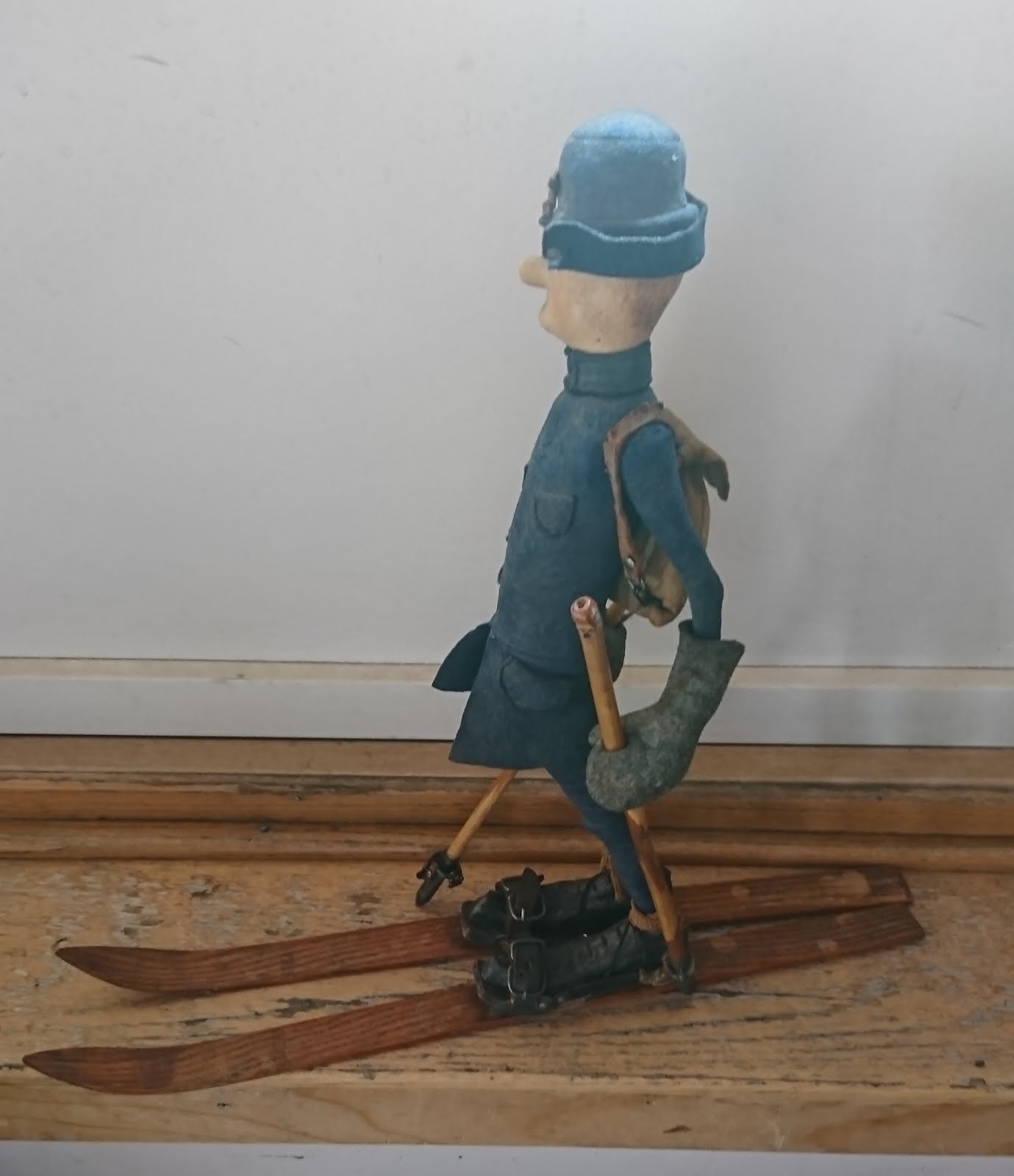
Steiffgal recently got an email question about a Steiff item that literally gave her chills - in the best way possible! Around these parts, the temperature has been averaging about 95 degrees lately, with high humidity, too. So what could be more welcome than a question about a cold weather themed doll! Let's all take a virtual break from this uncomfortable summer heatwave and check out this inquiry from Nils from Norway. Steiffgal thinks you'll agree - his fantastic rarity takes the pole position!Nils simply asks, "I wonder if you can help me with the value and age on my Steiff skier? He is 36 cm tall and his button is in his cap."
Pretty cool, eh? From what she can tell from the photos, Nil's doll is standing, fully jointed, and appears to be in the company's earlier "character" doll scale. This means that his limbs, feet, and torso are not in "typical" human proportions, but exceptionally long and narrow in this case. His face is more "cartoonish" than handsome or realistic as seen in Steiff's later doll models. He has blue glass eyes; this feature became standard on Steiff's dolls from the early 19-teens onward. Also typical to his early era is the fact that his felt outfit is integral to his body. Later models often had partially or fully removable clothing. It is interesting to note that his Steiff button is located on his hat. According to Nils, he does not have ears, so this button's location is "closest" to where his button-in-ear would be. (Steiffgal also has a little Steiff Barney Google doll without ears; his button is located the back of his jacket; these "out of place" buttons are seen infrequently but are still original.)
Dolls from the first quarter of last century are also "famous" for their great detailing and accessories, and Nil's skier is a fine example of that. His blue uniform includes perfectly proportional buttons, pockets, and trims. His skis and poles are made from wood and are original to him; the skis are marked "Steiff" on their top face. These are pictured here on the left. Steiff used wood as a material extensively in their product line throughout much of the pre- WWII war era. For example, consider Steiff's fantastic array of early mohair and felt animals on wooden wheels, wooden animal and vehicle pull toys, skittle and roly-poly novelties, and blocks and puzzles. Nil's skier doll is also wearing a backpack. Some of Steiff's soldier and student dolls from the same era also carried satchels, totes, or backpacks, and Steiffgal is all but certain this accessory is original to him.
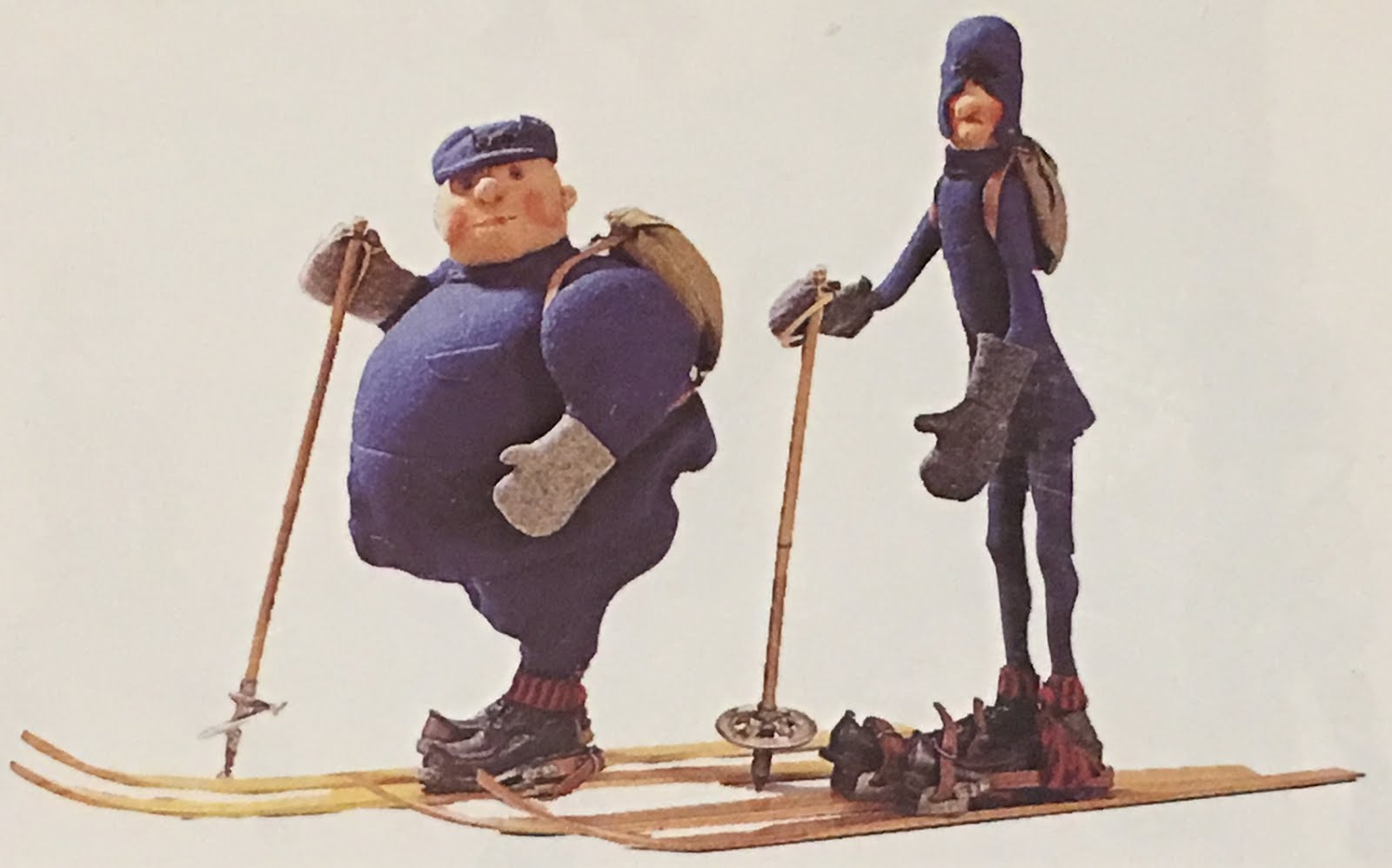
The quest to identify this athletic doll left Steiffgal breathless. As for Nil's doll, Steiffgal initially thought he was Steiff's "Norwegian Skier," given his presentation and current residence! According to Pfeiffer, the Norwegian Skier is.... "felt, jointed, Norwegian skier, blue ski suit, cap, and gloves, skis and ski poles, in box." The Norwegian Skier was made in 50 cm and was in the line from 1913-1918. However, a closer look at the Norwegian Skier shows his body is more humanly proportioned (and includes ears!), while Nil's doll is definitely more "character" in form. A little more research suggests that Nil's doll is most likely the company's "Skinny Skier." According to Pfeiffer, the Skinny Skier is... "felt, jointed, very thin shape, complete winter sports outfit." He is also pictured with oversized gloves and a backpack, just like the ones Nil's doll is wearing. The Skinny Skier was made in 40 cm from 1913-1928; Nil's version is a shade shorter but these dolls were all hand made, so slight variations like this are expected. You can see a picture of the Skinny Skier, along with his pal the Fat Skier, here on the left; the photo is from the Cieslik's Button in Ear: The History of the Teddy Bear and His Friends. Monday, August 21, 2017
Hat's Off To This Absolutely Amazing Early Steiff Lady Doll!
Steiffgal hopes this discussion on this incredible lady doll has given you something to hang your hat on!
Have a question about one of your Steiff treasures? Let's talk! Click here to learn more.
Friday, May 27, 2016
Hunting For Clues About This Great Steiff Outdoorsman Bear
Let's start hunting for clues about this hearty outdoorsman. He is 22 cm, fully jointed, and made of caramel colored mohair. His sweetly serious face comes to life with a brown hand embroidered nose and mouth and glass pupil eyes. He dons an orange felt cap with a wide brim; a green felt jacket detailed with a small collar, scalloped edging, long fringe, and a laced up front; and tall, faux brown leather boots. When he left the factory in Giengen, he had a wooden hunting rifle suspended from a leather cord tacked onto his shoulder.
The Nimrod bears were all based on the company's early postwar, newly redesigned "Original Teddy" pattern. This design, which featured a stockier build and shorter limbs than the company's prewar standard line bears, was produced from 1950 through 1966 in 10, 11, 15, 18, 22, 25, 28, 35, 40, 43, 50, 65, 75, and 100 cm. Overall, four Nimrod bears - in addition to the one under discussion here today - were produced. These included a 22 or 50 white version which donned a green cap, an orange felt shirt, and brown boots; a 22 cm gold version which wore a green cap, a brown felt shirt, and brown boots; and a 22 cm caramel version detailed with an orange cap, green scarf, and very tall brown "wader" style boots. All carried wooden rifles suspended from a leather cord. You can see a few more of these original Nimrod bears here on the left; the photo is from Cieslik's Button in Ear: The History of the Teddy Bear and His Friends. Sunday, November 2, 2014
Taking The Chill Out Of Your Day With This Darling Steiff Snowman Puppet
Let's set the stage and introduce this great Steiff hand puppet. Here we have the company's Hand Sneba. The German word for snow is Schnee, so his name makes perfect sense. Sneba is 17 cm tall and made from a white synthetic fabric called dralon. He is detailed with black pom-pom style buttons up his front, an orange felt nose to resemble a carrot, a red hand embroidered mouth, shiny black eyes, and a black felt hat. When he was new, he had just a touch of pink on his cheeks and you can just barely make that out now on this example. Sneba's head and the tips of his hands are stuffed with excelsior. His button and yellow tag are located on the edge of the front of his body. Like most snowmen, this one only lasted a very short period! He appeared in the Steiff catalog for one year only - 1964 - making him one of the rarer post war puppets created by Steiff.
Like many things we all know and love, Sneba has cold hands but a warm heart! And despite his unassuming looks and personality, he has three very interesting features from the collector's perspective.
First is his design. Unlike the vast majority of Steiff puppets produced by the company before the early 1980's, Sneba appears to be a totally original design and not based on a popular standard line character. The only other somewhat period snowman designed item Steiffgal can think of is the 25 cm white wool plush snowman that the company designed as a US exclusive in 1955, who is pictured here on the left. However, as you can tell, there really isn't any design overlap between him and Sneba. This photo is from Gunther Pfeiffer's 1947-2003 Steiff Sortiment book.
Second is his material. During Sneba's period of production, Steiff made most animal puppets out of mohair, and character puppets with molded heads and felt and/or fabric bodies - not dralon. Sneba is in good - but extremely rare - company with Hand Gora, Steiff's dralon
gorilla puppet from 1961 through 1964. Gora is pictured here on the left for your review. She is 17 cm; her body and head
are made from long and short grey dralon and her hands are made from
short tan dralon. Her face comes to life with peach colored tan felt
ears, black and white google style eyes, and extensive airbrushed
features. And topping up reason number three is his accessory. Sneba wears a handsome black felt chapeau. Like many of Steiff's legacy dolls, Steiff's earlier "people" puppets generally wore head wear to complement their well designed outfits. Except for Steiff's Hand Bear Sailor puppet from 1972 through 1975, Steiffgal cannot think of another Steiff non-human puppet donning a hat. Hand Bear Sailor is pictured her on the left for your review. He is made from a very golden yellow colored mohair. His head is hard stuffed with excelsior, while the rest of his body is floppy. His paws are made of tan velvet material. His face is detailed with large black and white google eyes and a black plastic nose.
Steiffgal hopes this discussion of Steiff's interesting Sneba snowman puppet has taken a bit of the winter chill out of your day!
Have a question about one of your Steiff treasures? Let's talk! Click here to learn more.
Friday, February 14, 2014
A Petite Steiff Treat In Honor Of Valentine's Day
This little lovey certainly gets Steiffgal's heart beating in a big way! Here we have Steiff's gnome named Snik. Snik is 35 cm tall, made of felt, and is leg and head jointed. His oversized hands and feet are remarkably detailed with realistic fingers and toes. His ever-happy face comes to life with a long orange mohair beard and eyebrows, bright green and black glass pupil eyes in felt eye pockets, an impish upturned nose, and a open, red smiling mouth. He wears brown felt shorts, a white cotton shirt, a now faded red pointed cap, and a bright purple belted felt vest that has faded to tan over time. You can't help but notice Snik's enormous wooden and leather clogs - just perfect for yard work (but more on that later!) Snik was produced in 25, 35, and 43 cm from 1927 though 1943.
Steiffgal's Snik is based on another very similar felt dwarf (also named Snik) that Steiff produced from 1911 through 1921. Early Snik was made in 22, 30, 43, and 50 cm; he had a purple felt hat and a slightly different facial expression than later Snik. You can see this first Snik pictured here on the left; the photo is from Gunther Pfeiffer's 1892-1943 Sortiment Book. Early Snik was designed during a most interesting period in the evolution of Steiff dolls. Steiff began commercially producing its first dolls with center-seamed faces around 1904. Most of these were felt; some were velvet. These early dolls were called “caricature” dolls or “charakterpuppe” because they had comical, exaggerated features – such as extremely lean or rotund bodies, huge feet, or cartoon-like faces... much like early and later Snik. In about 1914, Steiff started giving their new doll patterns much more accurate, human proportions, and started moving away from the “charakterpuppe” look. These updated designs became universally embraced for their authenticity, appeal, and charming appearances. So this later Snik, despite his likely production in the late 1920's or early 1930's, is really a nod to Steiff's very early turn of last century “charakterpuppe” doll production and design priorities.
It was a shoe-in that this clog wearing sweetie would be a hit with collectors for over three decades! Gnomes hold a very special place in the hearts of many Germans and have been a part of European popular culture for centuries. These small, humanoid creatures apparently live underground and are considered auspicious (and a bit mischievous) as well as essential for gardening success! Today, it is not uncommon to see small gnome statues in even the most formally planted and tended gardens across Europe! It is said that gnomes have a lifespan of 400 years and "kiss" by rubbings noses and also use nose rubbing as a greeting equivalent to people shaking hands. Like our friend Snik under discussion today, "typical" gnomes have red pointy hats, fluffy beards, dark pants, sturdy working shoes, and a sweet expression that reflects the pleasure that comes from a good day at work.
Steiffgal hopes this discussion on Snik has been a petite treat for you.
Have a question about one of your Steiff treasures? Let's talk! Click here to learn more.