Showing posts with label dachshund. Show all posts

Thursday, October 28, 2021

Bow-Wow Beauties Coming Up For Auction Soon!

Dog-gonnit! The blue ribbon temptations are endless at the Ladenburger Spielzeugauktion GmbH Special Steiff Auction on November 6th! This can't miss event features over 350 simply awesome button-in-ear goodies. The catalog reads like a "who's who" in the vintage Steiff world. Steiffgal recently offered her top Teddy Baby and "one-derfuls" top picks from this sale; now here are her canine cutie favorites.
 
This first pick is the wheel deal indeed.
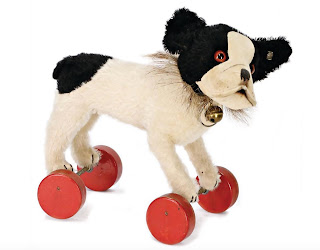
This is lot #4179, a standing Bully the Bulldog on wheels. The cataloging reads, "Bully, on excenter-wheels, black/beige mohair, velvet insert in very good condition, very nice colouring at the snout, with button, long stretched F, minimally rests of the white color, with paper breast sign with metal edge, produced around 1930, length: 23 cm, height: 22 cm, very expressive, except of minimally places mohair in very good condition, original ruff." He carries a presale estimate of €220 to €440.

Steiffgal can't imagine that there is a collector out there who doesn't just love Steiff's legacy Bully pattern. This particular item was produced in 10, 14, 17, and 22 cm from 1927-1935 overall. This guy is the best of all worlds. His condition looks lovely. He is standing - not sitting - and the standing ones are generally seen far less often on the secondary market. He has his original horsehair ruff, and these tend to fall apart or get lost to time. He has his button AND metal rimmed tag. And, like you needed any more reason to love him - he's on wiggly eccentric wheels. This guy is the package indeed. Hubba hubba hubba. 

Steiffgal's next pick is a bit of a "sett-up", but more about that in just a bit.
 This fave is lot #4036 and is cataloged as "
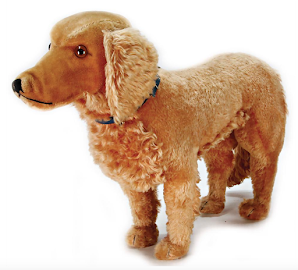
dachshund, with button, rests of the yellow cloth tag label, pull voice, faulty, full mohair, slightly faded, lenght: 53 cm, glass eyes." His presale estimate is €160 to €320. 

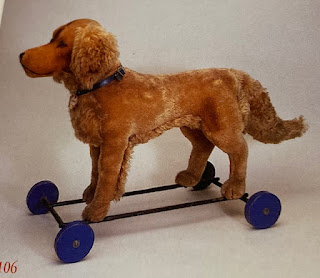
What's not to love about this pretty pooch? But here's a little secret. It is Steiffgal's best guess, given his color, mohair detailing, presentation, and long legs, that he is actually the company's much rarer pre-war Setter. Setter was made in 17, 22, 28, and 35 cm from 1933-1940 overall; he was also made on wheels in 35, 43, and 50 cm from 1933-1941 overall. You can see the wheeled version pictured here on the left; the photo is from Pfeiffer's 1892-1943 Sortiment. See the resemblance? Given the one in the sale noted at 53 cm and has a pull voice, it is very possible that he started out life as a riding animal on wooden wheels. A quick check on the condition of his paw pads would solve that mystery, but that is not possible right now. Steiffgal has never personally handled a prewar Steiff Setter; they so seldom appear on the secondary market.

And now let's raise a glass to today's final prize pup pick.
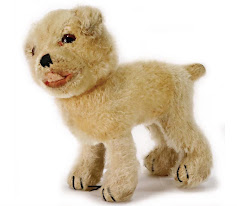
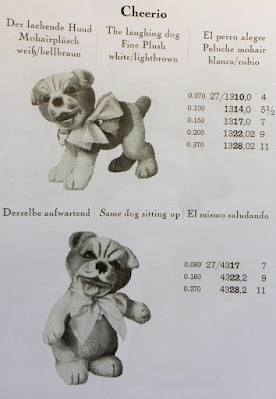
Here we have lot #4024, a standing Cheerio. He is cataloged as, "Cheerio, date of production 1928-1932, mohair-plush, standing, idealized model of a laughing dog, svivel head , inset eyes, opened snout with tongue, standing height 16 cm, mohair good, minimally faded, rare, minimally mohair loss around the eyes, 1 claw is loose, without button, chest label and cloth tag label." He has a presale estimate of €160 to €320.

Blink and you would have missed Cheerio's time in the Steiff product line.
This happy go lucky pooch was inspired by the likeness of Bonzo, who was a popular cartoon character at the time. Steiff was not able to win the license to produce Bonzo, so they designed "Cheerio, the Laughing Puppy" instead. Cheerio's mouth design - open, smiling, and with a prominent tongue - is most unusual in the prewar era. Cheerio was made in a variety of sitting, standing and novelty editions from 1928-1931. You can see the sitting and begging versions as they appeared in a late 1920s catalog here on the left. Cheerio dogs are so rare on the secondary market, probably because folks who have one just love them and don't want to part with them! This example is not pristine, but its rarity, legacy, and presentation still make it incredibly desirable from the collector's perspective. 

Steiffgal hopes this discussion on top dog auction picks has been tail-wagging good for you!

Have a question about one of your Steiff treasures? Let's talk! Click here to learn more!  

Thursday, April 8, 2021

Rolling Out The Red Carpet For This Precious Prewar Doxie On Wheels!

What goes around, comes around... especially if it's on wheels. This darling Doxie on-the-go recently popped by to say hi and Steiffgal couldn't help but roll out the red carpet for her! Come take a look at this great example of Steiff's prewar novelty production and see what makes her so noteworthy from the historical and product development perspectives. 

Doxie on wheels is standing, unjointed, and constructed from mohair.
The dog itself measures 11 cm vertically and 20 cm horizontally. Her top, forehead, ears, and tail are made from black mohair and her muzzle, limbs, and underbelly are made from brownish tipped mohair. Her face comes to life with proportional brown and black glass pupil eyes and a black hand embroidered nose and mouth. She is mounted on two metal axles. She glides along on four wooden eccentric wheels which are painted blue. She is attached to the axles through metal loops that are inserted into her limbs. Doxie on eccentric wheels was produced in 17, 20, and 22 cm from 1930 through 1933 overall. She was also made on traditional round wheels in 28 and 35 cm from 1929 through 1935 overall.

Doxie on wheels is one of many wonderful prewar Dachshunds produced by Steiff.
 Like Fox Terriers and Pointers, Dachshunds are a legacy breed for Steiff, and perhaps one of the company's most famous and prolific dog lines as well. Steiffgal suspects this is because Dachshunds traditionally have been a very popular pet choice across Germany, and even were the animal companions of choice of the Steiff family at the turn of last century! Although this exact pattern under discussion here today was not produced postwar, if you look closely at her face, you can see it is somewhat similar in size and expression to Bazi, who was introduced in 1950. 

Moving along, this particular example three design characteristics that firmly root its production in the late 1920s to early 1930s. These include:

1. Patched mohair construction. Many items that debuted in the 1920s feature different color mohair that is patched and seamed together to create the visual effect of a multi-hued animal. From the mid-1930s onward, the company was much more likely to create an animal from one shade of fabric and then apply color via paint for a similar effect. This was probably done to create labor and material efficiencies.

2. Mohair coloring. This Doxie's brown mohair is actually more like a deep orange or copper color, and is tipped. This creates a wonderful aesthetic effect of depth and richness. Tipped mohair (think of Petsy the Baby Bear, for example) was a very popular fabric choice and treatment during the "Roaring 20s" era. 

3. Novelty detailing.
This Doxie is a novelty, meaning she has a fun feature not seen on standard line playthings. In this case, she's on eccentric wheels. You can see a closeup of this configuration here on the left. A very similar pattern to this Doxie was produced as another novelty - a tail moves head version. This mover and shaker appeared in 14, 17, and 22 cm from 1931 though 1934 overall. Steiff's novelty production exploded in the mid to late 1920s with the introduction of Molly the Puppy and Bully the Bulldog. These popular designs translated well into charming product line extension items like music boxes, purses, animal dolls, various pull toys, Charleston animals, puppets, and tail-move-head characters. Today, late 1920s-early 1930s dogs, cats, and rabbits with a novelty twist universally top collector's wish lists. 

Steiffgal hopes this discussion on this Dachshund novelty has been tremendously entertaining for you. 

Have a question about one of your Steiff treasures? Let's talk! Click here to learn more.

Sunday, September 13, 2020

Begging For More Information About This Prebutton Era Steiff Dachshund

This Dox really rocks! And he's not in bad shape for being 833 years old - in dog years, that is! Check out this petite pooch from the earliest era of Steiff production and see what makes him so interesting from the design and product development perspectives.

This happy handful is 10 cm and unjointed.
He is made entirely from brown painted velvet and is in the begging position - meaning that he's eyeing what you are snacking on and asking for a nibble. His design and proportions are simple and a bit chunky - except for his long, thin, elegant tail and perky, triangular ears. It is very exciting to find an example like this one with his tail still attached, given how delicate and fragile this appendage is, and that it is attached to his body with just a few simple stitches. Doxie's face comes to life with a hand embroidered nose and mouth and tiny bead style black eyes. You only see these tiny bead eyes on the company's earliest products. Doxie wears a simple black leather collar; it probably was accessorized with a little medallion when he left the factory over a century ago.

This pattern was made in 10, 14, and 22 cm from 1901-1927.
Given this little guy does not have a button or any indication that he ever did, he is probably from is from the earliest portion of that timeframe... the "prebutton" era. Steiff collectors love examples like this for their age and presentation, while doll collectors often pose these "VIP" pets with their 19th and 20th century prized dolls.

This design is a beloved, legacy pattern that appeared as several product line extension items through the first quarter of the 20th century. These included a 10 or 14 cm basket-bearing pincushion from 1902-1918, a 12 or 17 cm tumbler on a semispherical wooden base from 1901-1917 overall, and a set of 9 or 10 velvet Doxie skittles from 1901-1912. These novelties are extremely rare overall, and generally do extremely well on the secondary market or at auction.

Steiff also produced a number of other similarly styled dog breeds in velvet in the early 1900s.
These were usually begging or sitting, and differentiated by their detailing and painting. These included a 10, 14, and 22 cm sitting Bulldog from 1901-1927; a 10, 14, or 22 cm sitting Pointer; and a 10, 12, 14, 7, and 22 cm sitting Fox Terrier from 1899-1927. Like the velvet Doxie under discussion today, many of these also appeared as pincushions, tumblers, and skittles given their appeal and popularity.

Steiffgal hopes this discussion on the company's very early velvet Doxie has been puppy-perfection for you.

Have a question about one of your Steiff treasures? Let's talk! Click here to learn more. 

Sunday, December 15, 2019

This Steiff Tail-Moves-Head Dox Really Rocks!

Care to take a little paws from the holiday madness? That's probably an offer you can't refuse right about now! Then have a look at this darling Dachshund. He's truly a head-turner, in more ways than one! Here's why.

This arm and leg jointed Dox really rocks! He measures about 11 cm tall and about 19 cm wide, not including his tail. His paws, underbelly, face, and muzzle are made from orange tipped mohair. His ears, tail, back, and limbs are made from black mohair. He has three hand painted claws on each foot. His puppy-like face comes to life with a black hand embroidered nose and mouth, proportional black and brown glass pupil eyes, and a touch of black airbrushed highlighting. He retains his long trailing "f" button and traces of his red ear tag as his Steiff IDs. And his secret superpower? He's a rare, tail-moves-head example, meaning that when his long tail is rotated in either direction, his head follows suit! This pretty puppy appeared in the line in 14, 17, and 22 cm from 1931-1934 overall.

Dachshunds are legacy Steiff breeds, and have appeared continuously in the line in one form or the other since the late 1800s. This particular black and orange version was introduced in 1929 in the form of a 22 cm standing version. He also appeared on regular or eccentric wheels in five sizes ranging from 17 to 35 cm from 1929-1935 overall, and as a "detachable" variation in 18, 23, and 29 cm from 1936-1939 overall.  

This Doxie has several interesting design elements that align almost perfectly with his launch and production timeline. 

The first, and most obvious, is his tail-moves-head feature. Starting in the early 1930s, Steiff started to produce several of its most popular designs with a tail-moves-head feature. This Doxie puppy pattern, which reflects the late 1920s happy, childlike aesthetic Steiff is known for (think Molly, Charly, Pip, Bully, etc.) must have been a best seller at the time to merit this novelty upgrade. 

The second is his assembly. Doxie is made from two distinctly different mohair fabrics which are patched together. This type of construction was typical for the 1920s, and was more expensive and labor intense than simply making an item from one type of mohair, or airbrushing color(s) onto one type of mohair. For the most part, Steiff's patched construction was all but phased out by the late 1930s and replaced with more efficient production operations. 

And the third is his orange tipped mohair. Joyful, colorfully tipped mohair debuted in Steiff line in the mid-1920s. Items including rabbits, penguins, deer, and even gnomes featured similar orange tipped mohair through the late 1930s. There's no question that this playful fabric added a touch of whimsy to these very period products. 

Steiffgal hopes this discussion on Steiff's two colored dachshund has been more than twice as nice for you.

Have a question about one of your Steiff treasures? Let's talk! Click here to learn more.

Sunday, September 1, 2019

Spicing Things Up With This Very Vintage Steiff Dachshund

You've heard the expression "age before beauty," but today's special blog guest clearly wins hands down in both categories. This delightful doggie is one of the oldest (and most handsome) canines Steiffgal has in her hug. In dog years, he's nearly 750 years old! Come see what makes him such a top dog in every way.

This precious pooch is standing and five ways (arms, legs, and head) jointed. His head, back, tail, and outer limbs are made from vibrantly hued cinnamon mohair. His chest and inner limbs are made from white mohair which has mellowed to a vanilla color over time. He has three black hand embroidered claws on each of his paws. His face and head come alive with long, floppy felt lined mohair ears, black shoe button eyes, and a black hand embroidered nose and mouth. He retains his original tiny long trailing "f" button and traces of his white ear tag. This pattern appeared in the line in 17 and 22 cm from 1911 through 1913; this is the 17 cm version. These dogs were measured vertically, from the top of their heads to their toes. 


It is so cool how his design details perfectly converge on his era of production. Four really pop here. 

The first is his color. This great cinnamon mohair color is seen once in a blue moon, and mostly on items through the 19-teens. Steiffgal has also seen this color on early bears, monkeys, and squirrels. 

The second is his jointing. Through the 19-teens, it was not unusual for Steiff to joint, or "uber-joint" its popular animals. For example, squirrels and cats were head, limb, AND tail jointed. And some rabbit models were fully jointed - plus had each of their ears jointed! This dandy Doxie is head and limb jointed, which adds to his playfulness, but also to his cost. Fully jointed dogs like this are extremely rare in the Steiff line.

The third is his eyes. This great example has black shoe button eyes, like most items produced before c. 1912 or so. Starting in the mid-teens, Steiff primarily produced their items with black glass, or black and brown glass pupil eyes, to add to their appeal, prestige, and authenticity.

And the last is his facial construction and presentation. After studying this pooch for awhile, Steiffgal noticed that his face has a center seam construction, and a shaved muzzle. These two desirable - and clearly period - design elements are most often seen on Steiff's earliest Teddy bears.


Dachshunds have always been a popular breed in the Steiff production kennel. The 1913 English catalog features eight variations of these "badger dogs." Here on the left you can see this five ways jointed example under discussion today. You can click on the photo to make it larger. He is simply noted as "jointed, fine plush, brown &white/brown." Two models are noted; one at 17 cm and one at 22 cm. And just how much is that doggie in the window? The catalog notes that the 17 cm version costs $1.40 (the equivalent of $36.28 in 2019) and the 22 cm version costs $1.90 (the equivalent of $49.24 in 2019.)

Steiffgal hopes this discussion on this darling Doxie has generated a bit of puppy love for you. 

Saturday, December 23, 2017

Reminiscing About Christmas, Steiff Style!

There's no place like home for the holidays - no matter where home may be at the moment! Steiff has always helped to make our annual wintertime celebrations even more special, by finding its way in to stockings, under trees or around the menorah or kinara. Check out this photo and brief story from the December/January 2018 edition of the magazine Reminisce. According to its website, this publication is "The nation’s premier nostalgia magazine, Reminisce celebrates what we loved then and how it shapes our lives now." Do you recognize a few special friends here?

Look what can happen when you get onto Santa's "nice" list! Here we have a vintage photo of two charming young girls and their father posing next to a beautifully decorated Christmas tree. You can click on it to make it larger. The copy reads, "Joyous Noel. In 1960, the year I turned 5, my family celebrated Christmas in Karlsruhe, Germany, where my father, Gabby, an engineer, worked for the Singer sewing machine company. My other sister, Phyrene, 13, loved stuffed animals as much as I did. My mom, Fernanda, took the photo. Phyllis Gebhard, Milwaukee, WI." And dog-gonnit, you can't help but notice the pretty pooches the girls are holding - they are "button in ear" dogs made by our pals in Giengen.  It doesn't get much better than this!

These Steiff dogs would have any collector's tail a-wagging. Phyrene's gift is Steiff's happy Hexie the Dachshund. Hexie is standing and made from light and darker tan mohair which has been detailed with copper colored airbrushed highlights to give her more dimension. She has really jolly black and white google eyes and a black hand embroidered black nose and mouth. All Hexies left the factory wearing a thin red collar. This delightful doggie was originally manufactured in 9, 13, 20, and 25 cm between 1954 and 1974. It is interesting to note that the German word for "witch" is "hexe." Perhaps she was given this name because she was designed to cast a magic spell over collectors with her irresistible looks and impish personality?

Phyllis has it made in the shade with her new friend. Her pup is Steiff's Maidy the Poodle. Maidy is standing, unjointed, and made from Steiff's lovely and unusual black "Persian Lamb" textured mohair. She has a slightly longer mohair "beard" around her chin. Her eyes are lovely and distinctive; they are large hand blown almond shaped and feature a black pupil, brown iris, and white corners. Her ears are lined in black mohair. Maidy is one of those Steiff "One-derful" items, made for just a year or so. Specifically, she appeared in the Steiff catalog in 1959 only in 25 and 30 cm. Collectors may recognize Maidy's distinctive fabric as almost identical to the covering of Steiff's larger "Swapl" Persian lambs. These baa-ing black beauties appeared in the line in 10, 14, 22, 28, and 35 cm from 1957 to 1964 overall.

Stitching thing up here, a little research shows that the Singer factory in Karlsruhe did indeed manufacture sewing machines from 1954 until 1982. This timing perfectly aligns with Phyllis' story. According to singersewinginfo.co.uk, "The Singer factory in Karlsruhe, Germany was in production from 1954 until 1982. In 1954 Singer purchased the factory and sewing machine business of the Haid-und-Neu company in Karlsruhe, Germany. Haid-und-Neu had been manufacturing sewing machines in Karlsruhe since the 1860’s and had purpose built the existing factory in 1893... Machines produced at the Karlsruhe factory were identified by a suffix G added to their model numbers. i.e. 215G. Serial numbers took the form of PA, PB, PC etc. followed by 6 digits starting at 000001 up to 999999." 

Steiffgal hopes that this special season celebrating peace, love, and joy helps bring more of those essential things to the fabric of our lives in 2018.  

Have a question about one of your Steiff treasures? Let's talk! Click here to learn more.

Saturday, May 13, 2017

This Tiny Steiff Bully Dog Has Enormous Wheel-Appeal!


Don't you just love it when you come across a Steiff treasure that you didn't realize even existed? That's the case with this week's fine find, a tiny and early post war Bully Bulldog on wheels. Steiffgal found him hiding amongst a delightful collection of vintage playthings at a booth at a regional doll and antique toy show in the New England area. Come take a look at this petite treat and see what makes him so dog-gone charming from the collector's perspective. 

This diminutive doggie has enormous wheel-appeal. Bully on wheels is based upon Steiff's smallest standard line postwar Bulldog pattern. He is 10 cm, standing, made from tan mohair, and is head jointed. His head, body, and tail are gloriously hand-painted with delightful brown and black spots and striping. He has brown and black pupil eyes, a black hand embroidered nose, felt ears, and an elaborately and realistically constructed velvet muzzle. His airbrushed claws are black. Bully retains his original red collar and raised script style Steiff button as his ID. Steiff's overall Bully Bulldog pattern was produced in 10, 17, and 22 cm from 1951 through 1974; Bully on wheels was produced in 10 cm only from 1954 through 1957 and then again in 1960.

Rolling along, now let's take a look at Bully's dynamic details. Bully glides along on four red off-center wooden eccentric wheels.  The wheels are connected with two silver metal rods - one in the front and one in the back. This wheel configuration gives Bully the appearance of bobbing up and down as he is pulled along. Each of his four feet is connected to the rods with tan thread stitching. There are little grooves in the rods that secure the stitching in place. Bully had a matching pull string attached to his front rod when he left the factory in Giengen, Germany; this unfortunately has been lost to time.  

Steiff has a long and lovely history of putting their most popular animal patterns on wheels. The earliest rolling Steiff treasures were on metal wheels; by the nineteen-teens to early 1920's most if not all examples had wooden wheels. Wooden wheels were sometimes left natural in color, other times they were brightly painted in bright, primary hues including red, green, and blue. 


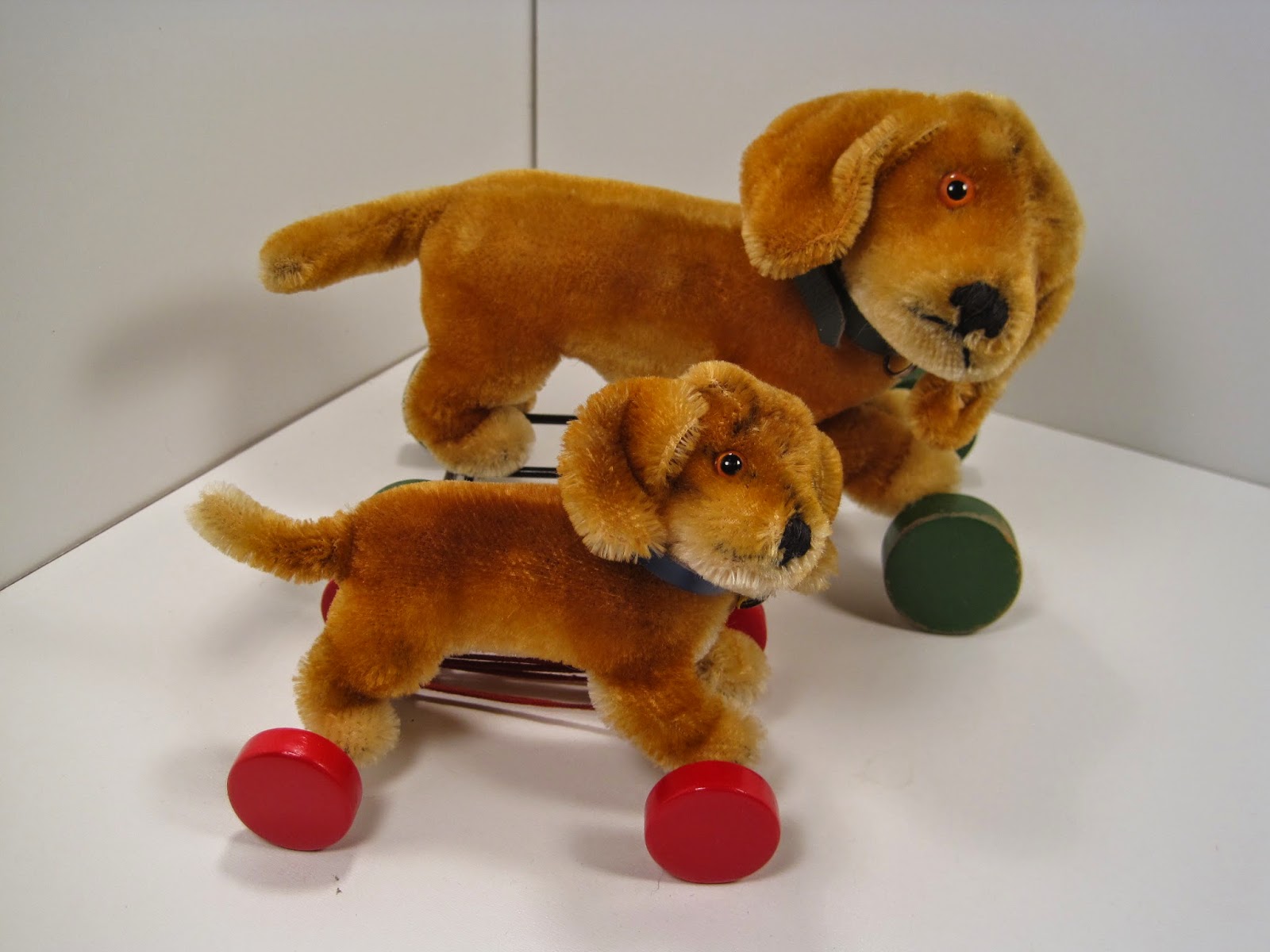
Strangely, Steiff's "eccentric wheel" detailing debuted in 1912. Steiff even holds a patent for this unusual wheel and axle configuration! Eccentric wheels were "invented" accidentally, but Steiff quickly realized the opportunity created by their roller drilling mistakes. Steiff's dogs, cats, birds, and farm animals look particularly charming on eccentric wheels, given the way they waddle and jiggle in real life! The photo on the left shows two of Bully's eccentric wheeled 10 cm "canine colleagues" from his same general timeframe. Bazi the Dachshund (on red wheels) was made in 10 and 14 cm from 1950 to 1961 overall and Cockie the Cocker Spaniel (on blue wheels) was made in 10 cm from 1954 through 1957 and then again in 1960.

Steiffgal hopes this discussion on this unusual Steiff Bully on wheels has been enjoyable to you, even in a roundabout sort of way.  

Have a question about one of your Steiff treasures? Let's talk! Click here to learn more. 

Sunday, July 3, 2016

The Perfect Steiff Hot Dog For This Fourth Of July Weekend!


Well, the Fourth of July weekend is upon us, and summer - at least here in these parts - is in full swing. Many friends and families celebrate this fine holiday with parties and cookouts featuring hamburgers and hot dogs on the grill. So Steiffgal thought the time was perfect to introduce you to her latest warm weather find - also a hot dog - but just not the type you enjoy with mustard. (But feel free to relish her!) Ladies and gentlemen, please meet Gretl!  Gretl is named after a friend's real life Dachshund who also toddles along and has a thing for the UPS delivery man.

Steiffgal is literally jumping for joy over this "Hopping Dachshund." She is 22 cm tall and 30 cm wide, not including her long, skinny tail. She is standing on all fours, unjointed, and made from short brown mohair. She has three black claws on each of her feet. Her face, which has a rather pensive look to it given her forehead-muzzle seam construction, comes to life with brown and black glass pupil eyes and a hand embroidered black nose and mouth. She mounted on two metal dowels and rides upon four oversized, natural colored wooden wheels. Sometimes these types of wheels have some Steiff identification like the company's name carved or stamped on them, but these are plain. Gretl's pull string is attached directly to her neck and is original to her. She left the factory in Giengen with a leather collar, but that has been lost to time. Gretl retains her tiny long trailing "f" button and traces of her white ear tag as her Steiff IDs. 

Gretl was officially made in this size in mohair from 1912 through 1917, and then again from 1923 through 1926. Given her small button and white ear tag fragments, she was produced at the earlier part of this time frame. Her pattern in mohair was brought back into the line in 1927 through 1929, this time in three sizes: 17, 20, and 22 cm. These later versions had larger trailing "f" buttons and white or red ear tags as their Steiff IDs.

It is always interesting to look at manufacturing dates when it comes to Steiff's legacy patterns and characters. Gretl's pattern in mohair seemed to take a hiatus for a few years between 1918 and the early 1920's. And why is this? As a result of World War I, which ended in November, 1918, the company was suffering from the results of the war. Manufacturing, material supplies, inventories, and infrastructure were in disarray as the country was starting to figure out how to manage the postwar rebuilding process. Felt, mohair, and other high end materials were in extremely limited supplies, and for several prior years had been allocated almost exclusively towards military purposes.  

But Steiff, being an amazingly creative and resilient company, found a way to work around those supply chain issues and keep itself busy as well as in business. Given the abundance of wood in the area, the company started producing things like toys, building sets and furniture for children. Steiff also found a way to produce substitute materials from local alternative natural products including nettles and wood. These substitute material selections appeared in the line from 1919 through 1921, and included models of the company's most popular standard line bears, dogs, cats, rabbits, and other favorites. And, given the popularity of the company's "Hopping Dachshund," she too was produced in 1918 through 1920 in substitute, improvised fabrics. You can see Gretl's cousin from this period in the illustration on the left; she is hiding out on the bottom shelf on the far right. This illustration is from Steiff's c. 1919 catalog; the picture is from the Cieslik's Button in Ear:  The History of the Teddy Bear and His Friends, 1989.

Steiffgal hopes this discussion of Hopping Gretl and her interesting product development history has been the wheel-deal for you.

Have a question about one of your Steiff treasures? Let's talk! Click here to learn more. 

Wednesday, August 12, 2015

Good (Steiff) Things Come In Threes At Morphy's Early Fall Toy Auction

Looking to add something really special to your growing Steiff hug?  A good place to do so may be at Morphy's upcoming Toys, Dolls, Trains, and Marbles early fall auction on September 10th - 12th, 2015.  This sales event, which features delightful temptations from every toy category, also has several very fine Steiff lots on offer, too.  Here are three marvelous highlights that truly caught Steiffgal's imagination.  This auction, and these early Steiff treasures,  just may make saying "fairwell" to summer a little easier!

Regular readers of this blog won't be surprised that Steiffgal has a big case of puppy love over this first auction highlight.  It is lot 111A and is cataloged as...  
 "A highly desirable Steiff dog of the early part of the 20th century. This fellow retains his original tag as well as stiff straw collar. Overall his coloring, orange and cream, with a velvet nose, he is in very fine plus condition with only minimal mohair loss in a couple spots. Most likely a grading of 8.5 or 9 out of a 10 point scale would be appropriate? Size 9" to top of head.  Estimated at $1,250 - $1,750."

This top dog is Steiff's wonderful Bully the Bulldog. Bully was launched in 1927 and was an instant sensation with both children (as a plaything) and adults (as a collectible and an accessory). He was modeled on the French Bulldog—the “it” companion of those in the know all across Europe at the time. Like this wonderful example, all vintage Steiff Bullies were head jointed, had oversized brown and black glass pupil eyes, a hand-embroidered black nose, and a simple snout and jaw constructed to give him his requisite jowls. Most were black and white or orange and white. Bully was made in velvet and mohair, as well as sitting and standing, in sizes ranging from 10 to 50 cm.  This original Bully appeared in the Steiff catalog through 1939.  

And just what makes this Bully the pick of the Morphy's litter? Collectors can't help but notice his majestic size, vibrant coloring, and fantastic overall presentation. His spectacular horsehair collar, a traditional accessory of "society dogs" of his period, appears to be in like-new condition. Last, and hardly least, he retains both his long trailing F Steiff button as well as his rare metal rimmed chest tag - in itself a coveted rarity.  Although Steiff records show that 250,000 Bullies were manufactured from 1927 through 1932, this example is truly one in a million.  

If you are looking for some wonderful Teddy hugs, this next selection has your name written all over it.  It is lot 121A and is simply cataloged as...
 

"Fully jointed bear appears to be a Steiff, with sewn nose and black button eyes, felt paw pads with hole in one. Some soil and wear. Very appealing face! Condition (Very Good).  Estimated at $400 - 600."

This bare bear indeed is a Steiff, and given his presentation, is probably from the 1906-1910 or so time frame.  His size is not specified, but because his nose stitching pattern is horizontal, it is Steiffgal's best guess that he probably measures between 12" and 14" tall, plus or minus a smidge.  The company's precious cubs from this early era are known for their long arms, spoon shaped paws, narrow feet, pronounced back humps, and black button eyes.  Steiff bears in this height range from the turn of last century were often called "doll bears." This is so because their size was similar to that of a typical little girl's doll, and to make these bears appealing as toys for both boys and girls. 

This bear has it buttoned up as an auction pick. His mohair has a delightful sheen to it, and he sports that marvelous Steiff "sitting slouch" which only comes with time. Ted's endearing face calls to collectors with its close-set eyes and distinctive, pointy nose. And, if you look closely at his head shot online, you can see that he appears to retains his pièce de résistance, his Steiff Knopf im Ohr.  What's not to love?

This last Morphy's Steiff auction highlight may simply bowl you over.  It is lot 997 and is cataloged as...

"A nice example of an early Steiff 9 Pin in the form of a dog. Velvet covered body with shoe button eyes and still retaining a button in the right ear this fellow has a minor tear/aged repair at his collar on the right side. Overall very nice condition with minimal soiling to velvet. Size 7-1/4''T. Estimated at $250 - 450."  

There's no need to beg for more information on this cute canine. What we have here is a sweet example of an early Steiff velvet Dachshund skittle. The dog itself is in the begging position, unjointed, and made from tan velvet that has been airbrushed with brown highlights. His adorable face comes to life with black button eyes and a simple hand embroidered nose and mouth. Remarkably, this pup retains his tail, which is long and narrow and has a tendency to snap off over time.  The dog is mounted on a solid wooden plinth which is shaped somewhat like a bowling pin and designed to tumble over upon impact; the dog plus the plinth is called a skittle.

This skittle left the factory in Germany as part of a set of skittles, a centuries old parlor game analogous to what we now call bowling.  Skittle sets appeared in Steiff's 1892 debut catalog.  The sets produced for the European market had nine total skittles, while those for America had ten total (as in tenpin bowling).  Steiff's animal skittle sets consisted of a series of pins and one kingpin; the kingpin wore a felt jacket and crown, and was mounted on a slightly taller plinth.   Each skittle set came with two multicolored felt covered balls.  The dachshund on the skittle is a standard line item that was produced in 10, 14, and 22 cm from 1901 through 1927.  However, Steiff's dachshund skittle set was only produced from 1901 through 1912.  Given that early time frame, this example conceivably could have an elephant, blank, or small trailing F button as his Steiff ID.  

This final Steiff selection beats a perfect game anytime.  Steiff skittles are absolute rarities as so few exist today; they were basically designed as a sporting goods to be used and enjoyed, and most were.  As such, this example in lovely vintage condition with ID represents the best of all worlds for collectors, given that it is both a skittle and a dog.  It is interesting to note that a slightly older felt Steiff dachshund skittle realized $1,718.25 at James D. Julia in 2014. Easy to display and impressive in presentation, this Steiff dachshund skittle might just take home a blue ribbon as well in this upcoming sales event.  

Steiffgal hopes this discussion of the finest Steiff collectibles on offer at Morphy's upcoming auction has been a highlight experience for you.

Have a question about one of your Steiff treasures? Let's talk! Click here to learn more!

Saturday, March 28, 2015

Catching Spring Fever With Steiff's Wonderful Early Post War Bazi Dachshunds

At last, the snow in the park across the street from Steiffgal's house has started to melt enough that there are more patches of green than white. And no one could be happier about that than Steiffgal, with the pugs a very close second! It is great to see the neighborhood dogs again, who all seem so happy to end their winter-induced home hibernation! To celebrate the onset of spring and its associated "pup parade," let's take a look at one of Steiff's earliest post war dogs - Bazi the Dachshund - and see what makes him so interesting from the design and historical perspectives.

Doxies are a legacy design pattern for Steiff. They have been in the line almost continuously since the late 1890's, with the first version debuting in felt in 1897. This is easy to understand - this breed is especially beloved in Germany, and it seems as if the Steiff family themselves had a particular affinity for them as well! Steiff's first named long haired mohair Doxie, Waldi, debuted in 1933 and was an immediate sensation. Prewar, he was produced standing, sitting, as a hunter dog-doll, and on wheels. It is interesting to note that from what Steiffgal can calculate, Waldi has the honor of being the dog pattern with the longest history of production in the Steiff line. He appeared pretty much continuously in the line from 1933 through 1980 - for a total of 47 years. (Molly the puppy is a close second, with a total of 44 years.) An early standing Waldi is pictured here on the left.  

Most likely due to the success and popularity of Waldi, Steiff introduced a new Doxie named Bazi design right after the factory reopened for toy making business in the late 1940's. Two versions were produced - a sitting Bazi and a standing Bazi on wheels. Both were head jointed and made from artificial silk plush which was highlighted with brown and coppery highlights. Sitting Bazi was made in 14 and 17 cm from 1948 through 1949, while Bazi on wheels was produced in 14 cm in 1949 only. And, because of their era of production, these silk plush versions may have a number of Steiff's buttons, including a short or long trailing F button or a blank button. Sitting silk plush Bazi is pictured here on the left; this particular example has a blank button. 
  
Bazi took the collector's world by storm in 1950, and remained a constant in the production line through the mid 1970's.  The early 1950's could be called "the dogs days of Steiff" as this was the time when many new named dog patterns - like Snobby the Poodle, Dally the Dalmatian, and Sarras the Boxer -  were introduced as mohair became more readily available on a commercial scale again.  Starting in 1950, Bazi was made sitting, standing, on wheels, as as a press and release music box, and as a dog-doll.  You can see these blue-ribbon buddies pictured below.  

Sitting mohair Bazi was was produced in 10, 14, and 17 cm from 1950 through 1969. These are very early examples with their red imprinted chest tags and earliest article numbers. The small one also has his US Zone tag.

Standing mohair Bazi was produced in 10 and 14 cm from 1950 through 1975. Like his brothers pictured above, this is a very early example. 

Standing mohair Bazi on wooden eccentric wheels was produced in 10 and 14 cm from 1950 through 1961. This model rides upon four off-center wooden wheels and has the appearance of bobbing up and down as it is pulled along. 

Musical mohair Bazi was produced in 25 cm in 1950 and 1951 only. Please click here to learn more about this really interesting item and her full provenance.
 
Standing mohair Bazi dog-dolls were produced in 25 cm from 1950 through 1954. Please click here to learn more about the story behind this very sweet Bazi couple.

Steiffgal hopes this review of Steiff's beloved Bazi pattern has been as refreshing as a breath of spring air for you!

Have a question about one of your Steiff treasures? Let's talk! Click here to learn more.  

Sunday, March 22, 2015

Bowled Over By This Fantastic and Early Velvet Steiff Dachshund Skittle

Are you in the mood for a little Steiff game today?  Steiffgal nearly toppled to the ground when she received this email inquiry from a professional colleague from the New England area who asks about a vintage Steiff find.  See if it bowls you over as well!  

Blain writes...

"Steiffgal,  I have a friend who has a Steiff dog, which looks like he is sitting up on his rear legs, perched on a wooden base, who has his original elephant button... this is in VERY good condition...  Dog is two toned, no issues I can see.  Can you tell me a little about him... and what you think he is worth? Thank you!  Blain"

Steiffgal's not playing with you when she says this is one very special treasure!  What we have here is a very early Steiff skittle.  Skittles are analogous to today's modern sporting bowling pins.  The skittle itself is made of a dachshund which is perched on a wooden plinth.  The dog is begging, unjointed, and made from brown and white velvet with airbrushing.  He is rather basic in form and design.  His face is detailed with a simple hand embroidered nose and mouth and black shoe button eyes.  He wears a little leather collar.  Steiffgal has seen these finished with a small medallion or bell; this model has lost his ornamentation to time.  This begging velvet  dachshund mounted on a skittle is identical to Steiff's standard line velvet dachshund; this precious pooch was produced in 10, 14, and 22 cm from 1901 through 1927 overall.  His absolutely remarkable elephant button helps to date this item to 1904!  Although Blain did not mention the size of the dog, it is Steiffgal's best guess that he is the 14 cm version based on other Steiff skittles of the same era.

Wooden it be nice to know more about the dog's plinth?  Well, this base was designed to be knocked over when hit directly with a fast rolling felt ball.  The plinth is solid wood  and finished simply with a little varnish and a black ring around the top circumference.  European skittle sets had 9 skittles while those made for the USA had ten.  In most cases, each set came with a "kingpin" who was slightly taller and dressed in a beaded crown and felt jacket; his wooden plinth was also slightly taller than those of the other pins.  An example of a typical Steiff kingpin is pictured here on the left; this fabulous pre-1904 velvet elephant realized close to $1,500 at the June, 2014 James D. Julia Antique Doll, Toy, and Advertising Auction.

Steiff produced Skittle sets from about 1892 through 1919. Over that period of time, Steiff made the sets with hens, monkeys, elephants, pigs, rabbits, poodles, pointers, chicks, cats, and bears, among others.  The skittle pin under discussion today most likely was made as part of a Dachshund-Kegelspiel or Dachshund Skittle set.  This dog-themed game was manufactured as part of the general product line from 1901 through 1912. 

Now the question that has everyone on pins and needles.  Just what is this little guy worth?  Well, Steiffgal has not seen him firsthand, and cannot account for structural and/or aesthetic issues that do not appear in photos, like odors, weak spots, repairs, insect damage, etc.  However, given that he is as nice in real life as described and presented, his value may just bowl you over!  Here's why.  Skittles like this one are beloved by vintage collectors as they represent a wonderful long gone era of Steiff design and production.  They really don't take up too much room to display, which is an issue for many collectors.  Few survive today because in reality they were produced to be used - and used hard - as playthings.  And remember, this begging beauty retains his crowning glory, his most desirable ELEPHANT button - which is pictured above on the left!  Given all that, and based on relatively recent sales of Steiff skittles, it is Steiffgal's best guesstimate that he may realize in the range of $2,000 to $3,000 at auction today.

Steiffgal hopes this discussion on this velvet begging dachshund skittle has been a real game changer for you!

Have a question about one of your Steiff treasures? Let's talk! Click here to learn more.  

Sunday, September 29, 2013

Welcome To The SteiffLife Oktoberfest Celebration!

It's the most wonderful time of the year... Oktoberfest!  And even though this fantastic two-plus week long celebration originated in Germany, it has become a global reason for observation around the world.  This weekend, nearly 4,000 miles from Munich, Steiffgal and Steiffguy, (and of course the Steiffpugs!) are hosting 25 friends for an authentic German late afternoon of home brew, a traditional German supper, and good times all around.  And to make the party even more fun, Steiffgal has invited a few Steiff friends to serve as good time ambassadors.  Take a look at these "party animals" and see how they help make any table the best table in the house!


Hat's off, or on in this case, to this great looking Steiff couple! Here we have Steiff's Larifari and Alpa dolls. Larifari is 32 cm and is based on a German book and movie character created by Ferdinand Diehl, the same creative genius who designed the beloved Micki and Mecki hedgehog characters. Larifari is five ways jointed.  His head and arms are made from rubber while his body and legs are made from felt. Larifari only appeared in the line from 1955 through 1957. Alpa is 10 cm and wears a green hat and skirt, white blouse, calico apron, and a black belt. Alpa (and her brother Alpo, who also makes an Oktoberfest appearance in the next photo,) are "cousins" of Steiff's famous Mecki and Micki hedgehog dolls. Alpo and Alpa were produced in this size and in 1964 only, and as a result, are exceptionally hard to find.

Are you in suspense to learn about this next pair of table ambassadors?  Here we have an adorable 25 cm blond, early post war Teddy Baby with felt paws.  He wears a pair of traditionally styled green felt trousers which have brown leather suspenders.  These pants were purchased at the Steiff factory.  This Teddy Baby pattern was produced post war overall in blonde or brown mohair in 9, 22, 28, 30, and 40 cm from 1949 to 1957.  His dinner companion is Alpo, the brother of Alpa mentioned above.  He wears a little felt hat, grey pants, a white shirt, green suspenders, and black shoes and carries a little backpack on his back.  Alpo was manufactured in 10 cm only in 1964.

Here are some sweets for you, my sweet readers!  Here we have Steiff's golden yellow plush 25 cm unjointed Haribo Gummi Bear.  She is unjointed and has a black plush nose and black and white plastic eyes.   Haribo wears a red silk bow. This logo Ted made a short, but clearly sweet, appearance in the Steiff line in 2002 and 2003.  She stands guard upon a vintage silver server filed with - what else - but Haribo Gummi Bears!


It's easy to make small talk with these table friends! Here we have a 30 cm five ways jointed light blond “Münchner Bär” from 1999. He was produced exclusively for Germany in 2001, but not specifically for Oktoberfest. He is wearing very detailed dark grey lederhosen and a grey felt Tyrolean hat. This Teddy also has a wind up music box and plays "In München steht ein Hofbrähaus", a traditional drinking song that roughly translates to "There's A Beer Hall In Munich." And to make sure he's ready for the next round at the Hofbrähaus, he carries his very own miniature glass beer stein featuring the coat of arms of Bavaria. Of course, his faithful companion is a little Steiff Hexie Dachshund, this one is 9 cm but he was produced overall in in 9, 13, 20, and 25 cm between 1954 and 1974.  

Also gracing the main dining room table centerpiece area are two other very special Steiff Dachshunds.  The first is  Bazili the Dachshund Hunter, who appeared in the line from 1950 through 1954.  Bazili is standing and 25 cm tall.  He is head jointed, standing, and wears a little green felt suit and hat.  His jacket is decorated with three leather buttons.  His head and the tops of his hands and feet are mohair, and his body and limbs are made from peach colored felt-like material.  The second, Bazili's date, is Musik-Bazi or Music Bazi.  She is 25 cm tall, unjointed, and standing.   Her body is a simple cylinder and her arms are floppy.  Bazi wears a blue cotton blouse, red cotton skirt, and had a sweet floral corsage when she left the factory in Giengen more than 60 years ago.  She has an internal Swiss music box which plays when her torso is pressed and released.  Bazi was made in 1950 and 1951 only.

Take it to the bar!  Nothing could be more appropriate in the case of Oktoberfest.  And these sweet bier monks are here to welcome party goers to the beer taps, as well as make sure their steins are always full!  These fun loving, trevira velvet “bier monks” are dressed in traditional garb including cotton drawers, long red hooded tunics, and work aprons which are cinched at the waist with a thin rope. The large monk, a whopping 100 cm, has black felt feet, while the smaller 35 cm monk wears tiny leather sandals. These two monks are characters from the Alpirsbacher Klosterbraeu, a 130+ year old brewery located in Germany’s Black Forest. Steiff created these white tag, limited edition drinking buddies in 1999. Just a handful of the 100cm monks were produced, primarily for display and advertising purposes. The smaller version was produced in an edition size of 1,500.

And finally, no need to hunt for a bier coaster at this party!  Here we have a fun collection of every one's favorite beer accessories!  This fun focal point is under the close watch of 20 cm Hubert the Hunter, who was produced in 1978 only as part of Steiff's collection of "dolls in business clothes."  Hubert leans against an authentic 1 liter stein from the Hofbräuhaus - or is it the other way around?  Hubert's sporting friends are Xorry the fox, who was manufactured in 11, 18, and 28 cm from 1960 through 1969, and a tiny 7 cm brown velvet wild boar, who was made only in this size from 1952 through 1973.

Steiffgal hopes this remote Oktoberfest celebration has brought a festive and seasonal spirit to your day!

Have a question about one of your Steiff treasures, found on an adventure or otherwise? Let's talk! Click here to learn more.
The teddy bear search engine