Showing posts with label Wolfspitz. Show all posts

Sunday, September 18, 2022

Check Out All The Doggy Details On This Rare Prewar Steiff Wolfspitz!

What a prize winning beauty!
Steiffgal recently had the pleasure of handling a beautiful prewar pup with the most appealing facial expression and presentation. And she really did come with a blue ribbon - but more about that in a moment! Take a look at this simply lovely sitting sweetie and see what makes her such a top dog in so many ways.

Here we have Steiff's simply wonderful Wolfspitz. She is 22 cm tall, sitting, unjointed, and made from tawny colored mohair. She is solidly stuffed with excelsior. Her face, ears, and legs are made from shorter mohair while her back, tail, back legs, and torso are made from very long matching mohair. She has lifelike brown and black shading on her back and tail. Wolfspitz has three hand embroidered black claws on each paw. Her face comes to life with felt lined ears, brown and black glass pupil eyes, a black embroidered nose and mouth, and brown airbrushed highlights. You can feel her nonworking squeaker in her belly.
This lovely lady was made in 17, 21, 22, and 25 cm from 1934
 
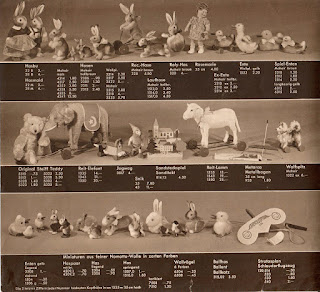
- 1943 overall. She was also made standing on all fours in 22 and 35 cm from 1934 - 1943 overall, and standing on eccentric wheels in 22 cm from 1934 - 1943. You can see a picture of the Wolfspitz on wheels as pictured in a 1938 company brochure here on the left; she is in the middle row and on the very right hand side of the page. Just click on the image to make it larger. The caption under her reads Wolfspitz, Mohair, 1322 ex, 6.-. The ex refers to her eccentric wheels and the 6.- refers to the price in German marks. Today, 6 marks in 1938 is ROUGHLY the equivalent of $50 in 2022, according to the US Inflation Calculator.   

Besides her striking good looks, this Wolfspitz also is in wonderful condition and retains her long trailing "f" button as well as her all original red ear tag as her IDs.
Her article number is 3322,2. This stands for 3=sitting, 3=mohair, 22=22 cm tall, and ,2=squeaker. According to Pfeiffer's Steiff Sortiment 1892-1943 book, this particular Wolfspitz with this exact numbering only appeared in the line from 1934 - 1936.

Now - what's with her blue ribbon?
Wolfspitz retains her all original red leather collar. She also has a light blue ribbon tied to a metal ring which is part of her collar. When Steiffgal first saw this, she thought maybe a previous owner had put that onto her as a decoration. It turns out that all the Wolfspitz dogs pictured in Pfeiffer's Sortiment also are decorated with a blue ribbon. You can spot the blue ribbon on the photo from that book her on the left. As all collectors can attest, it’s very exciting to find an "almost" antique item which retains this sort of factory original accessory!

Steiffgal hopes this discussion on this stunning Steiff Wolfspitz has added a beautiful spot to your day.

Have a question about one of your Steiff treasures? Let's talk! Click here to learn more!

Sunday, November 30, 2014

Rolling Towards The Holidays With This Great Steiff Spitz Dog On Wheels

Ever feel like howling in excitement upon a wonderful Steiff find? Even if just in your mind? Well, that just happened to Steiffgal when this delightful Wolfspitz on wheels arrived on her doorstep last week! Take a look at this dynamic dog and see what makes him so interesting from the design and product development perspectives.
 

This vintage pup is the wheel-deal indeed. Wolfspitz measures 20 cm from head to toe and 22 cm including his wheels, measured vertically. He is standing, unjointed, and made from tan mohair. His body and tail are made from long wavy mohair, while his face, ears, and legs are made from matching short mohair. He has very distinctive black hand embroidered claws on his paws, and a full and very prominent tail. He has distinctive mohair "feathering" construction on his front legs; this is pictured here on the left. His somewhat serious face is detailed with black and brown glass pupil eyes, a black hand embroidered nose and mouth, and traces of black airbrush highlighting. He rides upon four red wooden eccentric wheels.  

So how old is this pup, in dog years or otherwise? He retains his short trailing "f" button and traces of his yellow year tag. Given this utterly charming pattern was made in this size only from 1934 through 1943; his combination of IDs suggest he was produced in the 1936 to 1943 time frame.

Spitz, or Pomeranian dogs, are legacy patterns for Steiff. They appeared as early as 1902 in the Steiff line. The earliest Steiff Spitz dogs were produced in felt and mohair. This is most interesting from the historical perspective. And why is this? Felt was Steiff's first toy making fabric, and mohair became available on a commercially viable scale in 1903. Thus, early Spitz dogs truly embody the "old" and "new" material ways of manufacturing at Steiff!

These earliest Spitz dogs were produced in many configurations, including on wheels, sitting, fully jointed, and on a pincushion. They were made from long white curly mohair, with white felt faces, ears, and legs. All had black shoe button eyes and embroidered facial features. Most also left the factory in Giengen with a red cord with two pom-poms or tassels around his neck, giving them a “regal” appearance. The breed does have some connections to German royalty, which may explain why Steiff decorated them like “little kings.” The felt and mohair Spitz dogs appeared in the line in general through the 1920s.  A typical early Steiff Spitz is pictured here on the left; the photo is from Christie's.

Except for one all mohair, 17 cm model produced from 1924 through 1927, it was not until the mid 1930's that the company focused again on Spitz dogs. In 1934, Steiff launched a series of very expressive, all mohair tan colored Spitz dogs. These included a standing version (produced in 22 and 35 cm); a sitting version (produced in 17, 21, 22, and 25 cm) and the 22 cm version on wheels, the topic of this post. At the same time, the company also introduced two new all white Zwergspitz, or Miniature Pomeranians. These included a standing model (produced in 15, 18, and 23 cm) and a 20 cm sitting version. (An example of a lovely white Zwergspitz dog is pictured here on the left, the photo is from Teddy Dorado.) All appeared in the line through 1943, when Steiff ceased toy production due to war constraints and political realities. 

It is interesting to note that despite their popularity and longevity in the line, Steiff did not produce a standard line mohair Spitz after the factory reopened for business after the war in the late 1940's.  More recent Spitz dogs include a 22 cm white dralon "Cosy Spitz Blanko" from 1960 through 1973; a 30 cm woven fur model produced in black, white, or red-brown from 1980 through 1983; and a 60 cm mohair standing display "Polar Pomeranian" dog, produced in 1960 and then again in 1967.

So what's in a name?  According to Wikipedia, the Wolfspitz breed name was formally changed to "Keeshond," in 1926 in England. The breed is described as having "a lion like ruff, spectacles, small and dark triangular ears, definite contrast, and a thick double coat." All of these characteristics truly describe Steiff's Spitz dogs from the very beginning! 

Steiffgal hopes this discussion on Steiff's lovely Spitz dogs has been a warm and fuzzy experience for you.

Have a question about one of your Steiff treasures? Let's talk! Click here to learn more.
The teddy bear search engine