Showing posts with label Waldi. Show all posts

Sunday, September 15, 2024

Strike Up The Brass Band Over This Mysterious Steiff Fawn

Oh deer!
What do we have here? This charming field and forest friend is not only just lovely and elegant in design, but she also has a less obvious but totally WAH-HOO good surprise element to her as well. Get ready to fawn over this precious prewar rarity!

Here we have Steiff's 22 cm mohair fawn. She is standing, unjointed, and made from tan mohair. The lining of her ears and her tail are made from white mohair. Her face is detailed with black button eyes and a black hand embroidered nose and mouth. Her legs are particularly thin, shapely, and elegant and are made from velvet. She has a gentle, distinctly old fashioned look to her. This pattern was produced in 17 and 22 cm from 1934-1943.

Now for her little secret.
Given her era of production, she would have left the factory with either a long or short trailing "f" style knopf, depending on her specific year of manufacture - with earlier versions having the long trailing "f" version and the later versions having the short trailing "f" version. However, this gal proudly wears an unusual BRASS colored short trailing "f" Steiff button and has traces of her yellow ear tag. The button measures 6 mm in diameter. This seldom seen branding appeared on a few Steiff items from 1933/34 through 1943. You can see that brass button in the photo below.  

So just how rare is this brass prewar button?
It is really hard to quantify, as Steiffgal has only handled - literally - a handful of items with this distinctive ID in memory. In her personal collection, she has one prewar treasure with this distinction. This is a small standing Waldi dog. He 10 cm, unjointed, and made from copper colored mohair. He has long, floppy ears. His face is detailed with shiny black glass eyes and a black hand embroidered nose. His mouth is indicated by a little black airbrushing. Waldi wears his original green leather collar and has his "watermelon" shaped bare faced tag, with his name imprinted in crimson. This guy was made in 10, 14, 17, 22, and 28 cm from 1933 - 1943... the identical time frame as the fawn under discussion today. This prewar Waldi is pictured below on the left. 

It remains a mystery why Steiff used a brass button for branding some of their items during this turbulent geopolitical period.
It might have to do with availability of materials, or shortages, or other rationing reasons. It is also not clear why some items would have a brass button, and others would not - as Steiffgal has seen examples of both the prewar Waldi and this fawn with Steiff's standard silver colored prewar IDs. Only these precious treasures know for sure... and they aren't talking!

Steiffgal hopes this discussion on Steiff's lovely prewar fawn with her unusual button has put the pedal to the metal for you.

Have a question about one of your Steiff treasures? Let's talk! Click here to learn more.

Sunday, September 11, 2022

Fantastic Steiff "Firsts" On Offer Through Ladenburger Spielzeugauktion's September 24th, 2022 Event!

Love at first sight! That's the best way to describe some of the temptations coming up for sale at Ladenburger Spielzeugauktion's Fall event. This can't miss auction features 107 delightful vintage to antique Steiff selections and will be held on Saturday, September 24th, 2022. Here are three wah-hoo good treasures from this auction that Steiffgal has never seen come up for sale before. Enjoy this "one-derful" eye candy!

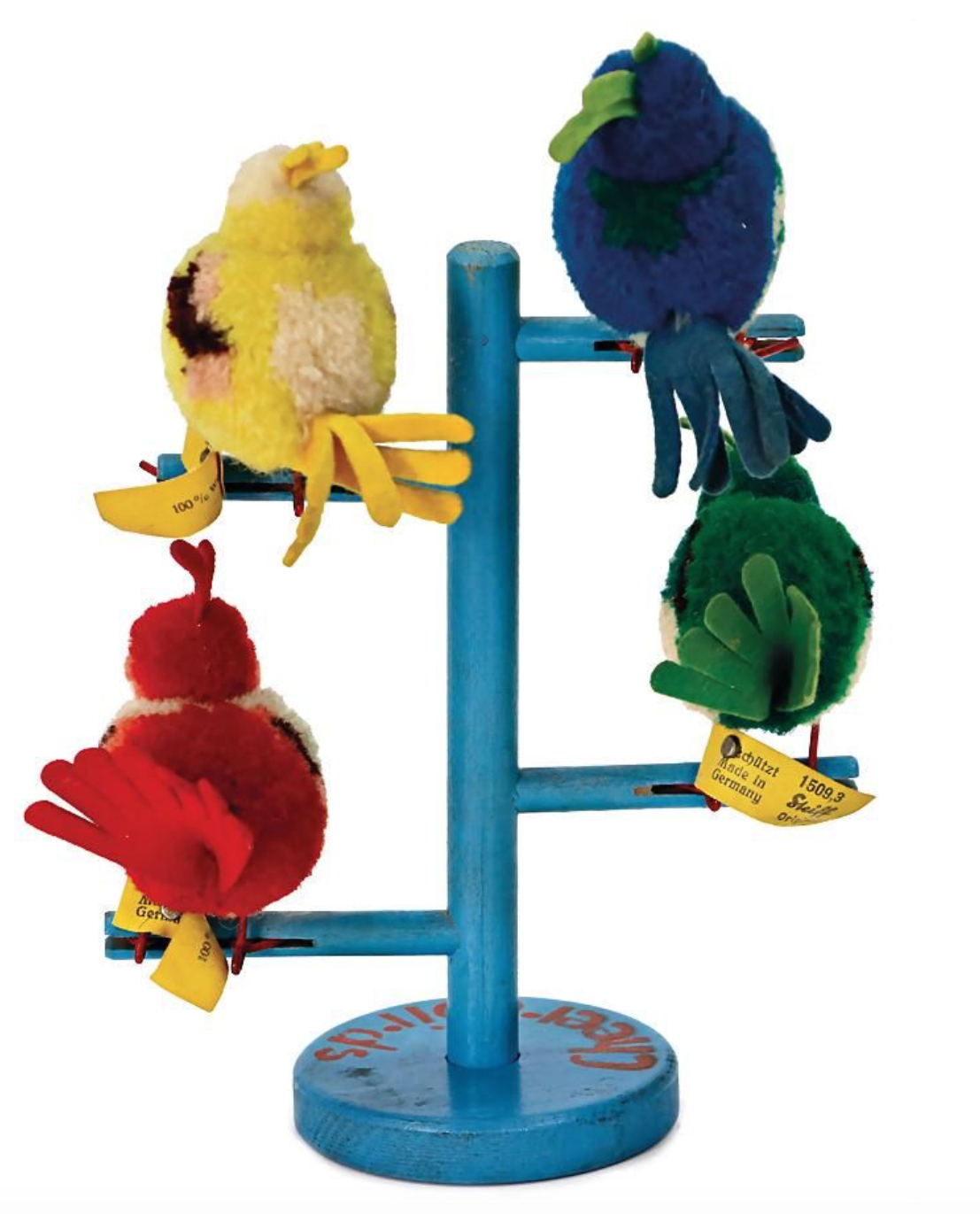
Bird's the word when it comes to this first auction debut item highlight. It is lot #3097, a most unusual woolen miniature bird display, estimated at 220-440 euros. It is cataloged in part as:

"Cheerubirds, rare bird tree, 4 x paradise birds, 100 % wool, with rare original breast sign, Blue Bird No. 1509,2, St. Patrick Bird No. 1509,3, Birthday Bird No. 1509,1, St. Valentine Bird, No. 1509,4, 22 cm, probably special design for the American market, extremely rare, unusual."

Who wouldn't love to feather their nest with this fantastic display? According to the Sortiment, this item appeared in the line from 1953-1956 with its own article number of 5204 Ch. Its overall design gives off a great midcentury vibe. But what makes this rarity so special - in addition to its amazing condition - is that each of the birds not only has a chest tag, but a very custom one. Steiffgal cannot think of any other woolen minis that have chest tags, probably due to their construction and size. The birds featured on this display are otherwise standard line "woolen exotic birds" which appeared in the line from 1953-1966; the earliest ones had red metal feet and legs and those from 1956 onward had plastic feet and legs. 

Now let's take a tumble for this next auction debut highlight. This is lot #3073, a felt, fully jointed circus performer doll, estimated at 280-560 euro. It is cataloged in part as:

"Acrobat, produced between 1911-1918, felt, jointed, from the circus series, with button, block letters, long trailing f, blue glass eyes original clothes, 40 cm, felt is a bit darken, small felt faults at 1 hand, and at stomach and at 1 shoulder, otherwise nice condition, exceptional, rare."

This fine, flexible fellow is a wonderful and seldom seen acrobat doll from Steiff's legacy "Schlopsnies Circus" display. This large scale, dynamic, and extremely popular exhibit was designed and created by Steiff doll freelancer Albert Schlopsnies in the c. 1910-1920 time frame. It consisted of over 30 circus themed dolls and acrobats, based on real life performers at the world famous Circus Sarrasani of Dresden, Germany. The acrobat dolls were often posed in death-defying or upside down poses in the displays. Sometimes they were even animated via camouflaged mechanisms. Steiffgal has seen or handled several of this acrobat's colleagues, including clowns, stagehands, and other performers, but she has never seen or handled this acrobat before. 

And last but hardly least, this final debut auction highlight just begs for attention. Here we have lot #3069, a charming prewar canine themed display, estimated at 280-560 euro. It is cataloged in part as:

"Exceptional show piece, Waldi, on a mohair plate, plate partially with a bit mohair loss, height: 30, width: 30 cm, depth: 22 cm, attending, with huntsman's hat, with button, chest label and a  very beautiful preserved red cloth tag label, with No. 4328,2, probably 1930, nice full mohair, breast sign is a bit faded, with small Treff, sitting, 14 cm, swivel head, exceptional, extremely rare."

This probably one of a kind treasure stands and delivers. It features one of Steiff's most beloved and prolific dog designs, Waldi the Dachshund. Waldi is most often on all fours. However, from 1933-1936, he was produced in a begging position in 17, 22, and 28 cm. His red ear tag numbers perfectly corresponds to that, with 4= begging or standing on back legs, 3= mohair, 28=28 cm tall, and ,2=with a voice. So the dog in itself is a total rarity! The fact that he is mounted on a factory original green mohair mat (probably to resemble grass), wears a  typical German style hat, and is accompanied by a perfectly paired and period Treff friend, make him over the top interesting. 

How this rare pair came to be remains a mystery, though. This charming display could have been produced as part of a larger exhibit, assembled by employees and presented to their friend or colleague as a special tribute gift, or perhaps made as a whimsy, end of day, or prototype that never went into production. Only Waldi and Treff know for sure!


Steiffgal hopes this discussion on these debut Steiff auction treasures has been like an opening night celebration for you. 


For more information about Ladenburger Spielzeugauktion upcoming Steiff event on September 24th, please click here!


Have a question about one of your Steiff treasures? Let's talk! Click here to learn more!

Sunday, January 31, 2016

Warming Up To Some Of Steiff's More Unusual Dog Designs

Given it's just about the midpoint of the cold, dark winter (at least around these parts!) Steiffgal thought readers might appreciate a few warm fuzzies sent their way.  Perhaps you are aware of the saying "a three dog night?" This historically referred to the number of dogs a person would have to cuddle with at night to stay comfortable during frigid weather.  So, to REALLY help crank up the temperature, here are FIVE interesting and somewhat rare Steiff hounds that just might add a degree or two to your day!

Let's get started by taking a "peek" at this first great Steiff dog.  Here we have a large, lesser known Steiff Pekingese named Peky. Her pattern is very different from the company's better known, more common, and smaller Peky designs.  Peky is 30 cm, head jointed, and sitting. Her ears, back and tail are made from very tan long mohair while her face and legs are made from short mohair. Her face is detailed with huge, round black and white google eyes, a black hand embroidered nose, and airbrushing on her eyebrows and elaborately constructed muzzle. She has the most endearing, pouty expression... she is probably thinking, "Hand me over a taste of whatever you're eating right now!"  This large Peky pattern was made between 1965 and 1976; this example has a raised script button placing her production at or before 1969.  

It's time to hand off the spotlight to this most adorable puppet pup.  This is Steiff's Treff the Bloodhound hand puppet.  Treff is 17 cm tall and made from bright blond mohair. She has three black hand embroidered claws on each hand. Her head is modeled after the company's beloved Treff pattern, and comes to life with long droopy ears, oversized black and brown glass eyes set deep into eye pockets; a black hand embroidered nose; simple jowls; and airbrushed freckles. She retains traces of her original red ribbon.  This happy handful was produced in this size only from 1928 through 1940.  This example retains her long trailing f button, early chest tag, and traces of her red ear tag, putting her at the early part of the production timeline.

Rolling right along, here are two great and early examples of Steiff's wonderful dogs on wooden eccentric wheels.  Both have the appearance of bobbing up and down as they are pulled along.


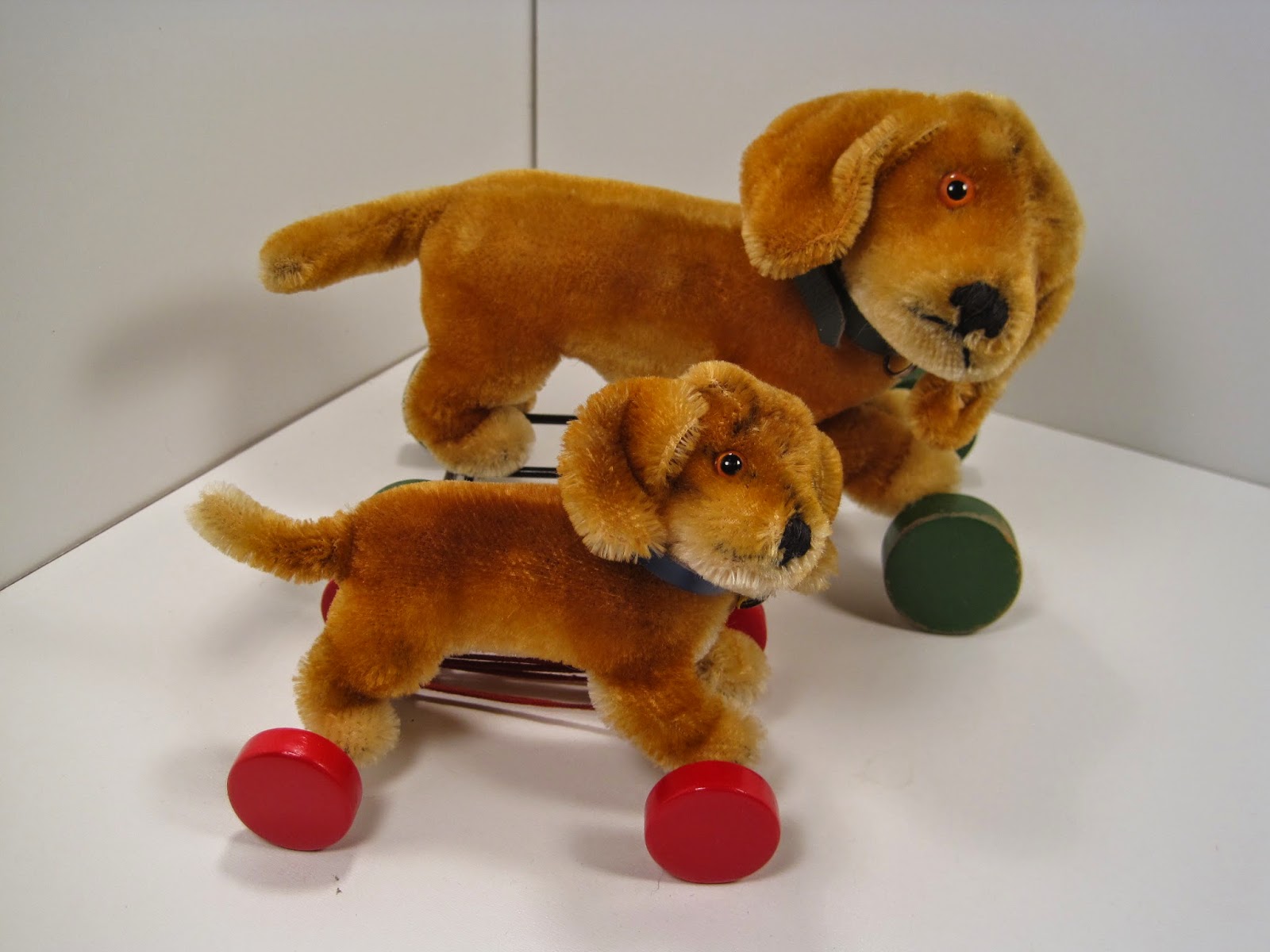
The first coppery example begs a penny for your thoughts.  Here we have a lovely version of the company's beloved Waldi Dachshund pull toy.  Waldi is standing, 16 cm tall and 30 cm long nose to backside, unjointed, and made from long, glorious copper colored mohair.  His tail adds another 10 cm to his length. His face, arms, and legs are made from shorter copper colored mohair. Waldi has a simple black hand embroidered mouth and nose and black eyes. He glides upon four oversized, blue off-center wooden wheels. Waldi retains his original green leather collar, long trailing f button, and fully legible red ear tag.  Pre-war, Waldi was produced on eccentric wheels in 14, 17, and 22 cm from 1933 through 1943; this example is from the early part of that period. Once the factory opened for toymaking business after the war, he again was produced in 17 and 25 cm from 1949 through 1970. 

This second Steiff dog on wheels comes sealed with a kiss.   This Sealyham is standing, 17 cm tall and 24 cm long nose to backside, unjointed, and made from long white mohair. His tail adds another 5 cm to his length. Sealy has a simple black hand embroidered mouth and nose, brown and black glass pupil eyes, and felt lined ears. He rides on four red off-center wooden wheels. Sealy retains his original red leather collar and brass bell, along with his long trailing f button.  He was produced on eccentric wheels in 17 and 22 cm from 1939 through 1943.  And, like Waldi, this model again appeared in the line post war, but for a much shorter interval.  He was available in 14 and 17 cm from 1949 through 1954.

Today's final highlight is a shoe in as a collector's favorite.  Here we have a nice example of a Hush Puppy Basset hound made for the footwear company of the same name.  He is sitting, unjointed, and is made from tan mohair that has been lovingly airbrushed in multiple shades of tan, brown, and black. He has has wonderfully long, droopy ears; a hand embroidered black nose; and realistic, dimensional soft jowls. Basset has brown airbrushed claws and extremely round, realistic-looking eyeballs that are embedded into his facial mask structure.  He retains his original red collar and all IDs, including his specially imprinted "Hush Puppies" chest tag.  

This delightful customer special was produced in 14 and 14 cm from 1970 through 1972, and is quite similar to Steiff's earlier, standard line 1960s-era Basset hounds.  These were produced from 1961 through 1963 in 12, 14, and 22 cm.  There are three main differences between the standard line Bassets and the Hush Puppy Bassets.  The Hush Puppy Bassets are unjointed, have a red collar, and have a special logo'ed chest tag.  The standard line Bassets are head jointed, have green collars, and have the word "Basset" on their chest tags.  

Steiffgal hopes this tour through Steiff's "kennel club" has lit a bit of a Steiff fire under you!

Have a question about one of your Steiff treasures? Let's talk! Click here to learn more.

Sunday, October 4, 2015

Check Out This Out-Standing Tiny Mohair Steiff Dog!

Look at this sweet surprise that popped into Steiffgal's email inbox.  A reader from Germany wonders if her theory that her recent find is a Molly has a leg to stand on.   What do you think?  Check out this note from Edel, who writes from Germany...
 

"I recently acquired a tiny mohair, excelsior-stuffed dog that I think may be a standing Steiff Molly and I would be very grateful for you opinion.  

The little dog stands 8cm high and is 10.5cm from nose tip to tail-tip. She has no tags, ribbon or button, but there is a small hole in her left ear (from her point of view) where a button could have been. Her mohair fur is very worn and thin in many places, but you can still see that she had the typical Molly brushed-on colour. She has brown eyes with black pupils and an embroidered nose. 

Her ears are folded over and sewn down with one or maybe two stitches at the tips. In spite of her very worn condition she oozes charm and character."

Good golly - this does indeed appear to be a Steiff Molly! Molly was introduced in the Steiff line in 1925 in both sitting and standing versions. Unlike other Steiff dogs of the period, she did not specifically have a breed, she was simply known as "a puppy." Steiff gave her this youthful appearance through her shaggy mohair, oversized black and brown glass pupil eyes, folded over ears, and an innocent, almost "pouty" expression. 

It is safe to say that Mollies on all fours are an out-standing find indeed.  Standing Mollies were produced in 8, 12, 14, 17, 22, 28, and 35 cm through 1936. Other standing models included Molly dogs on regular and eccentric wooden wheels, hanging pram toys, musical versions, and barking pull toys; a few of these novelties were manufactured until the early 1940's. However, no version of standing Molly was reintroduced after the factory reopened for business post war in the late 1940's. Sitting Mollies did appear postwar in five sizes ranging from 10 to 25 cm through 1969.

Molly is perhaps the most well known and beloved Steiff dog pattern.  But, despite her legacy, she does not win the blue ribbon for longevity in the line.  Overall, Molly debuted in 1925 and was retired in 1969, providing 44 years of hugs.  However, she is slightly eclipsed by Waldi the long copper colored mohair Dachshund.  A vintage Waldi is pictured here on the left. This dynamic doggie was in introduced in 1933 and retired in 1980, netting in 47 years of service... or the equivalent of 329 dog years!

Steiffgal hopes this discussion on Steiff's rare standing Molly dogs is worthy of some fancy footwork. 

Have a question about one of your Steiff treasures? Let's talk! Click here to learn more.  

Saturday, March 28, 2015

Catching Spring Fever With Steiff's Wonderful Early Post War Bazi Dachshunds

At last, the snow in the park across the street from Steiffgal's house has started to melt enough that there are more patches of green than white. And no one could be happier about that than Steiffgal, with the pugs a very close second! It is great to see the neighborhood dogs again, who all seem so happy to end their winter-induced home hibernation! To celebrate the onset of spring and its associated "pup parade," let's take a look at one of Steiff's earliest post war dogs - Bazi the Dachshund - and see what makes him so interesting from the design and historical perspectives.

Doxies are a legacy design pattern for Steiff. They have been in the line almost continuously since the late 1890's, with the first version debuting in felt in 1897. This is easy to understand - this breed is especially beloved in Germany, and it seems as if the Steiff family themselves had a particular affinity for them as well! Steiff's first named long haired mohair Doxie, Waldi, debuted in 1933 and was an immediate sensation. Prewar, he was produced standing, sitting, as a hunter dog-doll, and on wheels. It is interesting to note that from what Steiffgal can calculate, Waldi has the honor of being the dog pattern with the longest history of production in the Steiff line. He appeared pretty much continuously in the line from 1933 through 1980 - for a total of 47 years. (Molly the puppy is a close second, with a total of 44 years.) An early standing Waldi is pictured here on the left.  

Most likely due to the success and popularity of Waldi, Steiff introduced a new Doxie named Bazi design right after the factory reopened for toy making business in the late 1940's. Two versions were produced - a sitting Bazi and a standing Bazi on wheels. Both were head jointed and made from artificial silk plush which was highlighted with brown and coppery highlights. Sitting Bazi was made in 14 and 17 cm from 1948 through 1949, while Bazi on wheels was produced in 14 cm in 1949 only. And, because of their era of production, these silk plush versions may have a number of Steiff's buttons, including a short or long trailing F button or a blank button. Sitting silk plush Bazi is pictured here on the left; this particular example has a blank button. 
  
Bazi took the collector's world by storm in 1950, and remained a constant in the production line through the mid 1970's.  The early 1950's could be called "the dogs days of Steiff" as this was the time when many new named dog patterns - like Snobby the Poodle, Dally the Dalmatian, and Sarras the Boxer -  were introduced as mohair became more readily available on a commercial scale again.  Starting in 1950, Bazi was made sitting, standing, on wheels, as as a press and release music box, and as a dog-doll.  You can see these blue-ribbon buddies pictured below.  

Sitting mohair Bazi was was produced in 10, 14, and 17 cm from 1950 through 1969. These are very early examples with their red imprinted chest tags and earliest article numbers. The small one also has his US Zone tag.

Standing mohair Bazi was produced in 10 and 14 cm from 1950 through 1975. Like his brothers pictured above, this is a very early example. 

Standing mohair Bazi on wooden eccentric wheels was produced in 10 and 14 cm from 1950 through 1961. This model rides upon four off-center wooden wheels and has the appearance of bobbing up and down as it is pulled along. 

Musical mohair Bazi was produced in 25 cm in 1950 and 1951 only. Please click here to learn more about this really interesting item and her full provenance.
 
Standing mohair Bazi dog-dolls were produced in 25 cm from 1950 through 1954. Please click here to learn more about the story behind this very sweet Bazi couple.

Steiffgal hopes this review of Steiff's beloved Bazi pattern has been as refreshing as a breath of spring air for you!

Have a question about one of your Steiff treasures? Let's talk! Click here to learn more.  

Friday, January 31, 2014

Going For The Gold With A "Could Have Been" Steiff Olympic Mascot

Like many people all over the world, Steiffgal's got the Sochi Olympics on her mind! After all, what's not to enjoy about watching world-class sport competition, the pageantry of it all, and hearing the life stories behind some of the athletes? It's also very interesting to take a look at the Olympic mascots that have been the face of goodwill behind the games over the years. The 2014 Sochi games are represented by the happy trio of a polar bear, snow leopard, and a big white bunny - and are the first mascots decided by popular vote. But you know that the idea of a "logo" to represent the summer and winter games is a relatively new concept, starting only in 1968?

Despite its tradition for creating special edition pieces for important events and occasions, Steiff has made surprisingly few licenced Olympic related souvenir items over the years. The best-known one is Olympic Waldi, who was the mascot for the 1972 summer games in Munich. He was made in a plush and wooden version, and both are highly collectible today. These collectibles are pictured here on the left. But there was another Olympic Steiff close call just a few years later, in 1980. Here's that story! 

The world "crossed the pond" for the 1980 Winter Olympics, which were held in Lake Placid, New York. The mascot for these games was Roni the Raccoon. Roni was designed by artist Donald Moss, and inspired by the appearance of the hats and goggles used by many athletes participating in the winter games. Roni was named after the Adirondack mountain range, which were the mountains on which the competitions took place. 
 
Based on their previous success with Olympic Waldi just a few years prior, Steiff did give it their best in an attempt to get a license to create Roni mascots. According to Steiff records and Dee Hockenberry's Steiff Bears and Other Playthings Past and Present...
 

"In 1978 and 1979, Steiff, through their US representative, made presentations to the American Olympic Committee in order to obtain a license to make 1980 Olympic souvenirs. The prototypes were made incorporating the Lake Placid mascot and Olympic logo. Although the samples were attractive, an official license was never granted."

Steiff proposed an 11 inch standing plush version of Roni, as well as zipper top handbags featuring the soon to be famous raccoon. You can see these items here on the left; the images are from Dee Hockenberry. Neither were created, and it is assumed that the only a handful of samples of these items are tucked away in the company's archives. 

Steiffgal hopes this discussion of these "could have been..." Steiff Lake Placid Roni Olympic souvenirs has been worthy of a gold medal for you!

Have a question about one of your Steiff treasures? Let's talk! Click here to learn more!    

Sunday, August 25, 2013

A Steiff Dog Puzzle Of Olympic Proportions

In the mood for a little Steiff puzzler?  Than take a look at this mysterious wooden Steiff dog!  Steiffgal just had the pleasure of welcoming him into her Steiff hug, but does admit he is really quite different than most things typically produced by the Steiff company these days.  So let's give this a real Olympic effort and learn about his world-class history and background.

It's easy to color your world with this 17 piece standing Steiff puzzle pup.  What we have here is called "Olympic Waldi," and was made by Steiff in 1971 through 1972.  Waldi came in this size only (officially 15 cm) and was packaged in a white cardboard box with a partially "see through" top. Waldi was manufactured in honor of the 1972 Olympics in Munich; this darling dachshund was the official mascot of these games.  

No need to jump through rings for the details of this colorful canine.  Waldi is 5.5" tall and 15" long back to front, including his long curved tail. He is made from solid wood; his body is joined together by one long green plastic straw; his head and ears are attached via this same simple joining technique. A close up of his construction is pictured to the left. He is brightly and happily colored with a teal head and tail; cornflower blue ears and rear; lime green chest; and rings (a loose interpretation of the Olympic rings) of yellow, green, teal and orange around his belly. His face is detailed with plain, simple black dot eyes.  In terms of ID, Waldi somewhat surprisingly does not have a Steiff button, or any Steiff branding at all, in his ear.  On one side of his chest is a white Steiff bear faced logo with the word "Spielzeug" (translates from the German to "toy") and on the other side the official logo of the 1972 Olympic games, a geometric spiral, and the Olympic rings.

Olympic Waldi was one of two "official" items the company produced for the 1972 Olympic games.  Steiff also made a 9" tall and 17" long version of Olympic Waldi in dralon, a synthetic plush material that was very common on Steiff play animals of the time. Dralon Olympic Waldi is pictured here on the left along with Wooden Olympic Waldi for comparison.  As you can see, both dogs are about the same length, from nose to tail.  However, Dralon Waldi is almost twice as tall as Wooden Waldi.

The two dogs have other obvious, and not so obvious, differences as well. The dralon model has simple black button eyes, a hand embroidered nose and mouth, and is hard stuffed with excelsior.  Dralon Olympic Waldi shares somewhat similar coloration as his cousin Wooden Olympic Waldi.  However, unlike Wooden Olympic Wally, Dralon Olympic Waldi does indeed have "traditional" Steiff branding, including a button, yellow ear flag, and chest tag.  Dralon Olympic Waldi also has an additional ID—an official two-sided blue hangtag. The front has the Olympic rings and the overall logo from the 1972 games, while the back has the words “Das offizielle Maskottchen der olympischen Spiele 1972 in Munchen” and the Steiff logo. The German translates roughly to “The official mascot of the 1972 Olympic games in Munich.”  The blue tag from the dralon version is pictured here on the left.


Why wood - er, would - the company make a wooden Olympic mascot when they are best known for their plush and mohair creations?  Steiff actually also has a lesser known, albeit very long and robust history of creating wooden items and toys. The first wooden items appeared around 1910 and were mostly accessories for the Teddy bears, animals, and dolls in the line.  Then in the late 19-teens and early 1920's, Steiff began producing large numbers of wooden items - in part because mohair and other softer materials were in short supply post World War l.  These treasures included block sets; wooden characters on rocking bases and wooden wheels; building sets; trains; pull wagons; and animal-themed wagons - including designs based on popular characters of the time.  (The photo on the left, from Steiff superfans Jenny and Will Frankhouser, shows great examples of early Steiff wooden toys including a go cart, scooter, and pull wagon.) Post war, wooden toys became much less prominent in the line; animal pull toys were manufactured through the 1970's but their designs were far less detailed and interesting than their pre-war cousins. Wooden Olympic Waldi, produced in the early 1970's, was perhaps the last item of note in this long run of wooden toy production.

The first modern Olympics were held in 1896 in Greece. However, it wasn’t until 1968 that the games had “official mascots” such as Waldi. Waldi was designed by Otto Aicher, a German graphic artist, who also designed the overall branding and wayfinding signs for the athletes around Munich’s Olympic village. You can read all about his great Olympic design work here.  Aicher chose the dachshund, which is quite popular across Germany, as he felt the breed represented the attributes required for athletes—resistance, tenacity and agility. It is an interesting coincidence that dachshunds were also a favorite among early members of the Steiff family, including Richard Steiff.

Steiffgal hopes this discussion on Steiff's Olympic Waldi dogs has been worthy of a gold medal for you.

Have a question about one of your Steiff treasures? Let's talk! Click here to learn more!   

Saturday, September 15, 2012

Grabbing The Brass Ring With This Unusual Vintage Steiff Dog

And they call it "puppy love!" Steiffgal's not referring to the famous Donny Osmond song bemoaning a teenage crush here... but about her latest vintage Steiff dog find!  Take a look at this tiny handful of canine cuteness.   Not only is his design blue ribbon quality, his unusual Steiff button is best in show, too!  Sit and stay and take a look at what makes this pooch so interesting from the collector's perspective.


What we have here is Steiff's wonderful Waldi, the long haired Dachshund.  Waldi is 10 cm, standing on all fours, unjointed, and made from copper colored mohair.  He has sweet, longish ears which have been tacked to the side of his head with a stitch or two.  Waldi's face is detailed with shiny black glass eyes and a black hand embroidered nose.  His mouth is indicated by a little black airbrushing.  Waldi wears his original green leather collar and has his red, tan, yellow, and blue "watermelon" shaped bear faced tag, with his name imprinted in crimson.  


This pattern is particularly endearing.  But don't just take Steiffgal's word on it.  Even Steiff describes Waldi in their literature as "a very expressive model."  It is most unusual for the company to comment on their own designs.


Waldi appeared continuously and practically unchanged in the line for almost 50 (people, not dog...) years.  Standing Waldi was made in 10, 14, 17, 22, and 28 cm from 1933 through 1943.  This same design was produced in a "begging" position in 17, 22, and 28 cm from 1933 through 1936, and on wheels from 1933 through 1943.  Post war, standing Waldi was produced in 17, 22,  and 28 cm from 1949 through 1980 and on wooden wheels in 17 and 22 cm from 1949 through 1970. 
 

This pup's mettle - er, metal, is quite apparent. Besides his lovely copper color, his button also has a spectacular glow about it. Waldi sports a most unusual BRASS colored Steiff button. It is the short trailing "f" style and 6 mm in diameter. This button appeared on some Steiff items from 1933/34 through 1943. This is the first time that Steiffgal has ever seen this button, and it is the only item in her collection of 750+ vintage Steiff items bearing this distinctive trademark. Most of the time, for items produced in the mid 1930's through early 1940's time frame, Steiff used a silver colored short trailing "f" button.

Steiffgal hopes this discussion on Steiff's unusually buttoned Waldi has covered the brass tacks of his identification and legacy for you. 

Have a question about one of your Steiff treasures? Let's talk! Click here to learn more.
The teddy bear search engine