Showing posts with label hare. Show all posts

Sunday, August 11, 2024

Begging For More Information On This Nearly Century Old Steiff Rabbit

Everyone loves a Steiff bouncing bundle of joy. And the bigger, the better - especially in this case! Check out this note from a new friend from London who asks about a begging bunny purchased at a fundraising event over four decades ago. His owner shares,

"Thank you for the facility to ask about Steiff toys. I'm 73 now and 40 years ago bought an old, straw stuffed toy rabbit at charity sale. He is 50 cm tall, not including his ears. As I'm a bit of a hoarder I only just came across it after some decades. It's large, in good condition, German mohair, has sewn eyes not glass ones and I gave it a new bow and bell. I was working in a youth club which had been established by ex-POW veterans who'd been incarcerated in Brunswick, Germany in WW2. So I wondered if perhaps one of them had brought it back to the UK. Is there anything more you could possibly tell me about it including its value?"


What a cheerful earful!
What we have is Steiff's Hase or Rabbit. He is simply and generically named after his species and does not have a more personal or endearing name. This particular design was made from 1927 through 1941 in 11, 15, 18, 23, 29, 36, 44, 50, and 70 cm. Steiff's rabbits are usually measured vertically from head to toe and do not include the length of the ears. So this example under discussion here is the 50 cm size. Steiff produced this head jointed, excelsior stuffed rabbit in light brown tipped, white, gold, purple pink, and light blue mohair. All examples left the factory in Giengen decorated with a silk ribbon and a bell. 

This pattern was a home run for Steiff at the time, and continues to be a collector's favorite nearly a century onward.
Given how adorable and popular this design was, Steiff also made it in velvet from 1927 through 1932 in 11, 15, and 18 cm in white, purple, orange, light brown, light blue, pink, and yellow. Steiffgal often refers to Steiff's 1920s-era playfully hued rabbits as "the jellybean bunch," given their joyful (and super sweet) colors. You can see examples of the velvet version of this pattern above on the left; the image is from Pfeiffer's 1892-1943 Sortiment. Below to the left is another late 1920's advertising photo for Steiff's rabbit line featuring the jellybean bunch; that image is from Esser's 1920-1929 Steiff Kataloge. 

Now for the question that always sends Steiffgal down a rabbit hole.
How much is he worth? As always, something is worth what someone will pay for it, and Steiffgal has NOT seen or handled this rabbit in person. Condition is key when establishing a valuation, and he might have some issues (like smoke or insect damage) that just don't show up on photos. What we do know about him is that he has a little playwear to him, he is missing his oversized brown and black glass pupil eyes, and he does not appear to have any IDs. He looks like he might have been brown tipped originally, but that has faded a bit over time. It is also possible that his facial stitching has been augmented at some point. Given all that, it is Steiffgal's best estimate (sans a crystal ball) that this guy could trade hands in the c. $250-500 range on an online auction platform like eBay. 

Steiffgal hopes this discussion on this large, prewar rabbit has put a spring in your step today.

Have a question about one of your Steiff treasures? Let's talk! Click here to learn more.

Sunday, May 7, 2023

All Ears Over This Well Dressed Prewar Steiff Rabbit Doll

It's the best of all worlds when it comes to Steiff's dressed animal dolls. What could be finer than a darling Steiff dog, cat, rabbit, or other fine beast donned in Steiff couture from head to toe? Steiff's rabbits are very well represented in the company's history of dressed animals. The company's debut dressed rabbit was none other than Beatrix Potter's own beloved Peter Rabbit in 1904! Check out this prewar-era happy hopper - perhaps a distant cousin of Peter? - who sets Steiffgal's heart aflutter every time she looks at him.


Overall, this smallest version of Steiff's begging rabbit boy is simply adorable. He is 17 cm tall (sans ears) and head jointed. He originally was covered in white and tan mohair, but now he's simply a bare hare. He has mile long, narrow feet with red embroidered claws, downturned arms, a tiny upcurved tail, and oversized, floppy ears not lined in wires. He comes to life with oversized brown and black glass pupil eyes placed low on his face and Steiff's signature 1920s-era rabbit facial embroidery. This includes a "v" shaped nose and an upside down "v" shaped mouth in one color, and horizontal stitches filling in the "v" shaped nose in another color. You can see a close up of this stitching in the photo at the bottom of this post. Dressed rabbit retains his long trailing "f" button and traces of his red ear tag as his Steiff IDs.

You can't help but notice this bun's all original and darling playsuit. His well-constructed pants have tiny faux front pockets, contrasting tan colored stitching, back black snaps, and a perfectly placed opening for his tail.  This model in this outfit appeared in the catalog from 1929-1932 in 17, 22, 28, and 35 cm. 

Given their short time in the line, and probably low production numbers, these dressed, prewar, begging Steiff rabbit dolls are amazingly rare.
 This is only one of a handful in blue overalls Steiffgal has ever seen or handled. Steiffgal purchased this guy at a UFDC national event salesroom a few years ago. More recently, in January, 2023, a medium sized one hammered at auction for 750 euro/841 USD. This model was also produced in five other outfits; these included a red skirt and white apron, a purple jacket, a red skirt and purple jacket, a red and white dress, or a pink dress. In 2010, Christie's sold one of these rarities dressed in the red skirt and white apron for 1,625 GBP.

Steiffgal hopes you enjoyed this clothes encounter with this well dressed prewar rabbit!

Have a question about one of your Steiff treasures? Let's talk! Click here to learn more!

Sunday, March 7, 2021

Your First Rabbit Sighting Of The Spring Season!

In the mood for a 14 carrot worthy discovery? Then check out this little known Steiff bunny that is certain to satisfy your rabbit-habit! This hoppy handful is certain to put a much welcomed spring in your step.

Here we have Steiff's sitting Sunny the Bunny.
He is also known as Ruebenhase, or Carrot Rabbit. He is 17 cm tall, made from tan mohair, and is head jointed. His arms are lined in wire and are posable. He has chunky thighs and long, narrow feet. His charming, center seamed face comes to life with round, dimensional black, brown, and white glass eyes, a pink hand embroidered nose, a black hand embroidered mouth, clear monofilament whiskers, and long-ish mohair sideburns. His pert ears are lined in felt. Rabbit holds an oversized, dimensional orange felt carrot in his hands, and has another smaller, removable orange felt carrot tucked into a mohair pocket on his back side.

This rare hare was made in 9, 12, 17, and 30 cm from 1954-1956 overall as an exclusive for the US department store R.H. Macy & Co., better known today simply as Macy's.
The 30 cm size also came with a music box. This particular model under discussion today has a raised script button, a yellow ear tag numbered 7317, and a US Zone tag in the seam of his arm as his IDs. These align really well with his early postwar era of production. In this case, 7=in caricature, 3=mohair, and 17=17 cm tall. Pfeiffer's Sortiment shows that sizes from 12 cm onward included the letter "R" in their article number. Steiffgal suspects that the R indicates the presence of a felt carrot (or two) in the design; perhaps the 9 cm version was too small to incorporate this detail.

This sweet design, like many exclusives produced for the US market in the second half of the 20th century, seems to be a modification of one of the company's popular standard line editions of the time.
 This 17 cm Sunny has the general look and feel of Steiff's beloved and popular 17 cm Niki Rabbit, who appeared in the line in 14, 17, 22, 28, and 35 cm from 1951-1964 overall. You can see Niki below, posing with a few springtime friends. Sonny's pert tail, head shape, closed mouth, facial embroidery, whiskers, and long mohair sideburns are quite similar to Niki's. However, the 17 cm Sonny has a few design features that make him more "economical" from a production standpoint than the 17 cm Niki. For example, Sunny is head jointed only, while Niki is fully jointed. Sunny has ears lined in felt, while Niki's are lined in mohair. Niki has felt pads; Sonny does not.

So what does all this mean, maybe?
It is entirely possible that Macy's was looking at ways to produce a fun, playful rabbit exclusive based on Steiff's Niki that didn't break the bank. Sunny's simpler, less expensive, and appealing construction certainly checked all of those boxes. And Sunny's cartoon eyes and fun felt carrot details - neither being expensive or terribly complicated to implement - really brought the design to the next level. 

Steiffgal hopes this discussion on the company's rare Sunny the Bunny has added a little crunch to you day.

Have a question about one of your Steiff treasures? Let's talk! Click here to learn more.

Friday, February 14, 2020

Are You All Ears To Learn About This Unusual Prewar Steiff Rabbit?


Steiffgal's simply jumping for joy over this latest collection addition! This remarkable rabbit, produced during a most challenging era at Steiff, has so many interesting details - including his "colorful" history. Come see what makes this begging bun so much fun!

There's not a hare out of place when it comes to this prewar charmer. He is begging, head jointed, and made from long, shaggy tan artificial silk plush which has been highlighted with black (that has faded to a deep forest green.) He measures 23 cm head to toe, and his tan felt lined ears add another 12 cm to his height. His face is detailed with pink and red glass pupil eyes and a simple red hand embroidered nose and mouth. He has three matching red claws on each of his feet. Rabbit retains his short trailing "f" button in ear. When he left the factory, he wore a large silk ribbon and bell around his neck. This pattern was produced in 18, 23, and 29 cm from 1938-1943 overall. As rabbits are measured WITHOUT ears, today's bun under discussion is the 23 cm version.

According to his original owner, who now lives in Canada, "My Steiff silk stuffed bunny dates from late 1930s and was purchased in Brussels, Belgium."

This rabbit's appearance and construction align well to his provenance, as well as to the manufacturing realities of the late 1930s and early 1940s at Steiff. It goes without saying that these were challenging times all around in Germany. So creating efficiencies in every area of design and manufacturing was imperative for survival. Steiff has always had a remarkable way of producing the most appealing items during down times, and this bunny pattern brings truly illuminates that. Here are four reasons why.

His fabric: 
This hare's hair is made from artificial silk plush, a material that was more readily available and affordable than mohair and felt just before and after WWII. Steiff made many of its "mainstream" items in this material during this period. It translated well, at least in the short run, to Steiff's animal patterns but lost its appeal and luster quickly. 

His embroidery: 
To save costs and labor, Steiff designed his facial embroidery to be as simple as possible - basically a large red "X" on his muzzle. Just a few years prior, typical rabbit facial embroidery was two colored, and involved "filling in" the nose space with stitches. He also only has claws on his feet, even though it would not be challenging to embroider them on his paws as well. 

His shape: 
Rabbit's shape, although unquestionably "rabbit like," has been simplified and made less graceful and curvy than the company's begging bunnies from the c. 1925-mid-1930s overall.

His coloring:
Although he appears green and tan, he did start out life black and tan. His painting details have simply changed hue over time. It is interesting to note, that from the 1920s through the early 1930s, many animals that were multi-colored were constructed in a "patched" way, meaning that each color was its own color of mohair, and the colored fabric swatches were sewn together. Of course, this was beautiful and lifelike, but also very expensive and time consuming. To create significant efficiencies in production, the company started painting instead of patching animals, and this rabbit is a perfect example of that.

Steiffgal hopes this discussion on this charming prewar rabbit has been pure hoppy-ness to you!

Have a question about one of your Steiff treasures? Let's talk! Click here to learn more!

Saturday, March 2, 2019

Taking A Leap Of Faith On This Teeny Tiny Steiff Rabbit


Ok, here's a puzzler for you. How can something so small be such a huge mystery? Well, check out this bitty Steiff bunny pictured here on the left. Do you recognize her? Her origins and purpose are not clear at first glance. It's time to spring down a rabbit hole and see what we can unearth about her.

Size defies when it comes to this petite princess. She measures about 5 cm tall (without ears) and 8 cm wide. She is unjointed, lying, and made of mohair. Her back end and the backs of her ears are silvery-grey, while her front end, face, and tail are white. These fabrics are patched, not airbrushed or colored. Her tiny face comes to life with black button eyes and a pink hand embroidered nose and mouth. She
 is solidly stuffed with excelsior. Her Steiff IDs include a long trailing "f" button and traces of her red ear tag. 

Now it's time for a little leap - of faith - in terms of rabbit's identification. Given her appearance, construction, and IDs, it is Steiffgal's best guess that she is the smallest (or almost smallest) version of a lying rabbit simply called "Hase." Hase is pictured above, the photo is from Pfeiffer's 1892-1943 Sortiment. Hase was officially produced in 6, 8, 10, 12, and 14 cm from 1923-1928 overall in white and brown or white and black. With Steiff, it has been Steiffgal's experience that measurements are seldom "absolute" and can range sometimes as much as +/- 20%. The smaller sized versions of any given Steiff pattern sometimes look a little "simpler" than their larger sized relatives. And vintage brown mohair can oxidize or fade to a silvery color. So those "facts" may explain the coloring and presentation differences between the bitty bunny under discussion today from the "reference" Hase rabbits pictured in the Sortiment book.

But its possible to spin her tail a bit more. In the 1920s, Steiff focused on producing a great number of playful novelties as pull toys on wheels. These included pairs of animals on see-sawing "wiwag" carts, pairs of forward and backward moving animals on "galop" carts, and pairs of spinning animals on "roly droly" carts, among others. The animals featured on these carts for the most part were the smallest versions of standard line animals, like bears, monkeys, and dogs. In 1924 through 1934, Steiff produced a roly droly featuring a chick and a rabbit. And in 1926 through 1934, they made a roly droly featuring two tiny rabbits. If you look at these two photos - pictured here on the left - you can see that the rabbits look almost identical to the rabbit under discussion. Both photos are from Pfeiffer's 1892-1943 Sortiment. For reference, the chick pictured is 8 cm. It is quite possible that this tiny rabbit at one time was a passenger on a spring-themed Steiff roly droly! 

Steiffgal hopes that today's discussion on this tiny rabbit has brought a big smile to your face.

Have a question about one of your Steiff treasures? Let's talk! Click here to learn more.

Friday, August 10, 2018

This Steiff Woolen Miniature Bunny Is A Shoe-In!

There is no question that size defies when it comes to Steiff's wonderful woolen miniature animals, especially those produced before World War II. It is absolutely amazing how much personality and detailing the company was able to include in the design of these tiny treasures - some no more than a few centimeters tall or wide! A few of these charming, larger scaled pets also featured internal wire skeletons, so they were practically as posable as the company's standard line Teddy bears and animals. Steiffgal recently added one very special palm-sized example to her collection, and she's sure you'll be all ears to learn more about him. Check out this handsome hare and see what makes him so special!

This petite treat deserves a standing ovation! He is 9 cm tall, begging, and made from Nomotta wool. His head, upper body, and tail are made from tan colored threads, while his lower body is made from red colored threads. His ears are made from tan felt and his arms, which have been lot to time, would have been made from the same material. He is fully string jointed, meaning that he can move his head and body side to side. His face come to life with brown and black glass pupil eyes and traces of a pink airbrushed nose and mouth. He had clear monofilament whiskers when he left the factory in Giengen, Germany eight decades ago. Rabbit's legs are made from metal and he retains his adorable, all original tan felt slippers, which you can see here on the photo to the left. He retains his tiny, long trailing "f" style button-in-ear. This happy hopper was made in this size only from 1936 through 1941.

This boy bunny was actually produced as a hare pair - really! Steiff launched this little Romeo as half of a "his and her" rabbit couple. The girl, who was the same size and had the same construction as the boy, differed in her coloration. Her upper body was made from red colored thread and her lower body was made from tan colored threads - just the opposite of the boy. And her slippers were red instead of tan, like the boy's footwear. You can see this cute couple on the photo here on the left, it is taken from Pfeiffer's 1892-1943 Sortiment.
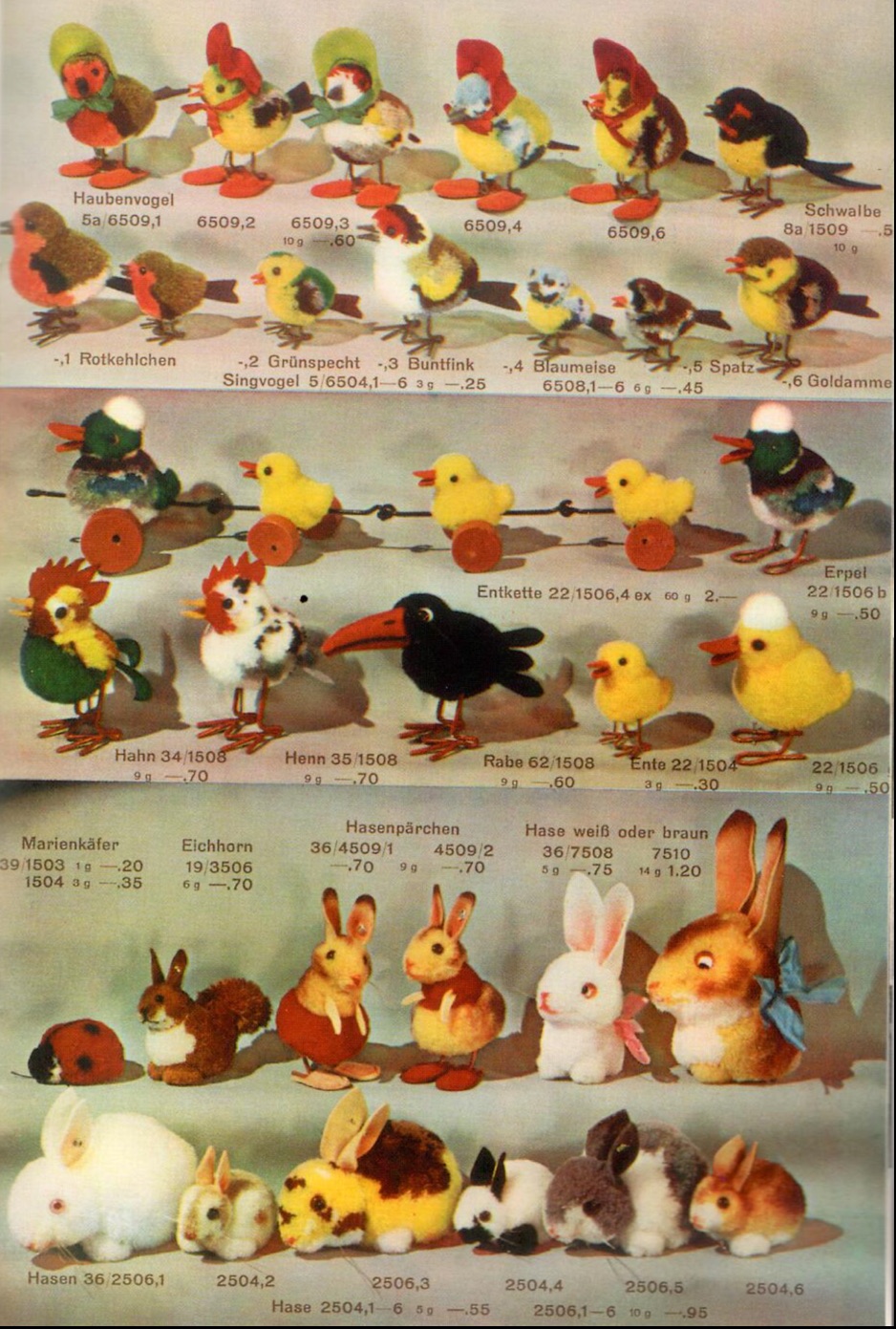
Given their popularity, the number of woolen miniature bunnies in Steiff's pre-war line multiplied like, well, jackrabbits. They were produced in all sorts of sizes and configurations, including lying and hopping versions. A great rarity is the company's "ski rabbit," a 17 cm woolen miniature bunny wearing a scarf and accessorized with wooden skis and ski poles. Others were made into "congratulators" which were designed as gifts to be personalized with messages from the giver to the recipient. A tumbler featuring a 10 cm white or brown woolen miniature begging rabbit was also produced from 1936 through 1941. You can see a few of these variations, along with the rabbit under discussion today, in this page from Steiff's 1938 catalog. You can click on the image to make it bigger and easier to read. 

Steiffgal hopes this discussion on this woolen miniature rabbit in slippers has made you smile from head to toe. 

Have a question about one of your Steiff treasures? Let's talk! Click here to learn more.

Saturday, June 23, 2018

This Steiff Rabbit Is Such A Blue Belle!

In the mood to learn about a bouncing bundle of joy?  Of course you are!  And it's a boy - really!  Steiffgal was delighted to add this big blue baby bunny to her Steiff hug recently.  He's got such a great personality, and exemplifies many of Steiff typical 1920's era characteristics.  Take a look... you'll certainly fall for this cheerful-earful as well!

If this isn't hoppi-ness, then what is?  Here we have Steiff's sitting rabbit. He is head jointed and measures 20 cm tall (not including his ears, which are typically not included in rabbit measurements.) He is made from blue mohair, while his chest and the fronts of his ears are white mohair. He has a proportionally petite tail and short, thin, curvy arms and legs. His face comes to life with oversized brown and black pupil eyes, a pink hand embroidered nose, and a black hand embroidered mouth. He even retains a few mono filament whiskers. His big ears are lined in wire and are posable. He is stuffed with a combination of crunchy excelsior and soft kapok. Rabbit retains his long trailing f button and bits of his red ear tag as his Steiff IDs. 

This design was produced in mohair in 11, 15, 18, and 23 cm from 1926 through 1932. It was also made in velvet in 11, 15, and 18 cm from 1927 through 1933.

So just what makes this rabbit such a blue belle? Colors can be tricky with Steiff. When you have a vintage piece in hand, always look in "places where the sun don't shine" to discover its true and original color. Although this rabbit today looks cream or tan, if you peek in the crotch, deep in the neck joint, under the tail, under the glass eyes, and in its "armpits," you can absolutely see traces of a baby blue color both on its fabric backing and its mohair covering. Dyes used in the first quarter of the 20th century can fade, wash out, or change color dramatically over time, due to the nature of their chemical composition. So don't always assume that your 1920-1930's era Steiff items, although perhaps tan or grey today, didn't start out life in a much more colorful manner. Here on the left you can see traces of his blue coloring on the underside of his tiny tail.

This rabbit is a delightful example of a delightful product development era at Steiff - the mid 1920's through the early 1930's. Here's what makes this beautiful boy so period to the "roaring 20's:"

His color: Steiff did alot with colored and tipped mohair starting in the mid-1920's. It was not unusual to see rabbits, bears, dogs and other popular animals produced in "jelly bean" colored mohair, or tipped mohair though the early 1930's. Think of Teddy Rose, Molly the puppy, Charly the King Charles, and other favorites from that period. These color choices were the result of a directive from Richard Steiff, who insisted in the mid-1920's that the company's products include lighter, happier colors that reflected popular cultural trends of the time. Here on the left, you can see another colorful example from c. 1929, he is the 11 cm version of the blue bunny under discussion today, but in pink (which has also faded a bit over time.)

His proportions: During this period, many of the items produced moved away from lifelike proportions to appealing proportions. Items designed during this period were more round, chubbier, and toddler-esque than in the past. Teddy baby, who debuted in 1929, is a perfect example of this. As you can see with this rabbit, its head and body are quite oversized, while its legs are quite thin and narrow - not lifelike, but very endearing. Here on the left you can see a picture of a number of colorful rabbits that also fit this description; the photo is a 1929 Steiff advertisement and is taken is from Carsten Esser's Steiff Kataloge 1920-1929.

His detailing: Steiff items produced in the mid-1920's through the early 1930's have playful and happy personalities which come alive thorough subtle design elements. In this case, the rabbit's ears are lined in metal wires, making them posable and more interactive.  Think of Petsy the baby bear, who also had this detailing. And his oversized eyes, placed low and wide on his very symmetrical face, give him a distinctly innocent, appealing, and inviting look.  

Steiffgal hopes this discussion on this blue bunny has left you jumping for joy.

Have a question about one of your Steiff treasures? Let's talk! Click here to learn more.

Sunday, November 19, 2017

Is This Cheerful-Earful Rabbit Made By Steiff?

Be a honey-bunny check out this vintage mohair rabbit mystery! Steiffgal recently heard from a new friend over email about a few vintage toys she had just added to her hug. One of them, a striking dark brown/black and white mohair bunny, really caught Steiffgal's eye given its impressive presentation.  But was this great example - clearly without a hare out of place -  made by Steiff?  Let's burrow into the research right now!

The rabbit's owner shares... "The Bunny has the style of a begging rabbit, entirely made of two colored mohair, pink stitched nose, swivel head, has a squeaker in the stomach, the whiskers are made of natural fiber similar to horse hair but thinner, probably pigs hair which is finer. The total high of the Bunny when sitting to the top of the ears is 36 cm or 14 inches.  

The Bunny does not have a button, but it does have a dirty hole in one ear which could have been caused by the button's discoloration due to rust.  This item came from an estate, and has been in the same family for generations.  Some of the toys from this estate had Steiff buttons, and some don't have any indications at all.

Thank you for any help or identification you can provide."

At first glance, this happy hopper has much in common with one of Steiff's most beloved and popular rabbit patterns which launched in 1927. This bunny was in the begging position and head jointed.  Her large, triangular ears were lined in wires and were posable. Her face came to life with oversized glass pupil eyes, clear monofilament whiskers, a hand embroidered simple mouth, and a distinctively shaped, triangular shaped nose. She was manufactured in light brown, white, gold, purple, pink, and light blue mohair. According to Steiff records, she was made through 1941 in 11, 15, 18, 23, 29, 36, 44, 50, and 70 cm overall. Steiff also made this same popular pattern in velvet from 1927 through 1932 in 11, 15, and 18 cm in white, purple, orange, light brown, light blue, pink, and yellow. All models left the factory with a pastel colored silk ribbon and a bell. 

Here on the left you can see the 1929 catalog listing for the begging rabbit; the illustration is from Carsten Esser's Steiff Kataloge 1920-1920. Please click on the image to enlarge it. The page includes both the velvet and mohair version of the item, as well as a 20 cm version on wooden eccentric wheels.  Also check out the well dressed "Jack Rabbit" featured at the bottom of the catalog page.  This great rarity, based on a popular children's book character of the time, is one of the rarest and most sought-after Steiff rabbit of all times! 

Upon close review, there are several subtle differences which suggest the handsome hare under discussion today was not made by Steiff.  

Limbs:  Steiff's larger mohair begging rabbits in this pattern have one color feet with the color ending in a seam right at the rabbits ankles, and one color arms, which are shapely and distinctively downturned. The one under review today has two color feet, and straight, chunky, two color arms. 

Face:  Steiff's begging rabbits in this pattern have very large, childlike brown and black glass pupil eyes; the albino ones have red and pink glass pupil eyes.  All have triangular shaped noses, often outlined in red or black. They also all have triangular-shaped, wire lined ears. The one under review today has relatively proportional eyes, a simple round shaped nose, and long and lean ears.   

Color: Steiff's begging rabbits in this pattern were made in brightly hued, feminine "jellybean" colors, to match the cultural norms and preferences of the "roaring 1920's."  Although a brown version was also produced, it was actually made from brown-tipped mohair, similar to the fabrics used on the popular Teddy Clown and Petsy bears of the time.  There is no indication that Steiff would have made their begging rabbit in a dark color like deep brown or black, as that would not have aligned with the popular trends of the time. 

So for these reasons and just gut, having handled many of the Steiff versions - including this off the chart marvelous light purple example pictured here on the left - Steiffgal thinks that the rabbit under review today is from the late 1920's or early 1930's. And, it was most likely manufactured by another European high-end toy company either to look like a Steiff item, or just because it is a delightful and happy pattern.  

Steiffgal hopes that this discussion on Steiff's late 1920's begging rabbits has been a hare-binger of good things to come. 

Have a question about one of your Steiff treasures? Let's talk! Click here to learn more.

Saturday, March 3, 2012

Rolling Into Spring With This Marvelous Vintage Steiff Rabbit On Wheels


Is anyone else out there about ready to roll into spring and all the delights that come with it?  Steiffgal certainly is, especially after this week's surprise early March snow and ice storm around these parts!  Check out this inquiry from a reader that should help us all of us put a hop-skip-and-a-jump into our seasonal steps!  Brenda writes...
 
"Dear Steiffgal,
 
Perhaps you can help me learn a bit about this toy.  Have you ever seen one before?  Is it rare?  What may it be worth?  When was it made?  
 
 My husband's father got it as a child, in about 1920.  
 
The rabbit is about 12 inches long and 4 inches high and is mounted on four wooden wheels.  It's body appears to be made out of light brown felt.  It has an ear button on the underside of its long floppy ears.
 
Thanks for any help you can give me.  
 
Best, Brenda"
 
Wow, that's one blue ribbon bunny Brenda's got there! This fantastic treasure is an early Steiff felt rabbit on wooden wheels.  The rabbit is standing on all fours and unjointed. Her face was originally detailed with simple black button eyes, a hand embroidered nose and mouth, and clear monofilament whiskers. Her head and body were highlighted a bit of light painting. When she left the factory, she had a red silk bow (the one on her now is probably not original) and a bell around her neck. Her pull cord was most likely a long stretch of red and white twine. This particular pattern was made in light brown in 12, 14, 17, and 22 cm from 1912 through 1936 and grey in 12, 14, and 22 cm from 1916 through 1918.  
 
This beloved and classic pattern was also available without wheels as early as 1892, the first year of the Steiff catalog!

Continuing on this joy ride, this toy is on what Steiff calls "eccentric wheels."  This means that when the rabbit rolls along, it shimmies back and forth, having the appearance  of a somewhat "natural" gate or movement.  This is accomplished by attaching the wheels slightly off center to the supporting axle. You can see that here on the picture on the left.  Although this early innovation was discovered by accident at the turn of last century, it has become a delightful Steiff  detail that is still used on some items today. 

Now to the question that sends Steiffgal down the rabbit hole... her value.  As always, Steiffgal is not a formal appraiser and believes that something is worth what someone will pay.  This is a classic and delightful item. Early rabbits are right up there with collectors as favorite finds and treasures.  You don't see too many of these around today as they are made of felt, which seems to be a moth magnet.  Moths really can destroy  felt collectibles in what seems like a heartbeat, so give your felt treasures extra special care and protection from the elements.  Steiffgal has not actually ever seen one of these rolling rabbits  in person, which is sort of unusual - and speaks to its rarity.  That all being said, given she is in very good condition (i.e., clean, with minimal if any holes, odors, or structural issues) today vintage Steiff rabbits on wheels from this period may  value in the $750 to 1200+ range if grey in color and $600 to 1000+ range if light brown in color.  

Steiffgal hopes that this discussion on Brenda's rabbit  has put you in the mood for the joyful upcoming Easter season.
 
Have a question about one of your Steiff treasures? Let's talk! Click here to learn more.   
The teddy bear search engine