Showing posts with label muster. Show all posts

Thursday, June 20, 2024

Remarkable Rarities At Ladenburger Spielzeugauktion's 2024 Steiff Special Auction!

The countdown is on for the most exciting Steiff auction event of the year - Ladenburger Spielzeugauktion's annual Steiff Sonder Auction or Steiff Special Auction! This event is famous for offering WAH-HOO good temptations - as well as producing world record breaking results. This year, it will be held on June 29, 2024 in Giengen, Germany as part of the Steiff Company's annual Steiff Sommer Festival. For more information on the sale, click here!

This year, nearly 230 premier century-spanning button-in-ear treasures will go under the hammer. In addition to rockstar offerings most of us can only dream about - including a google eyed Petsy Bear, a rod bear, and a full set of early skittles - the sale also features a number of hidden jewels. These are items with very special or unique details that really make them extraordinary from the collector's perspective. Here are three that caught Steiffgal's eye... and what makes them so quietly remarkable. 

Let's twist and shout over this first auction hidden jem.
This is lot #28, a Steiff Turbo "Purzelbär" or somersaulting bear. He has an opening bid of 250 € and is cataloged as follows:

"Turbo "Purzelbär" with clock mechanism, arm-wound mechanism and clock mechanism are intact, only produced in 1951, button and cloth tag label number 9315,4, rests of the US zone cloth tag label, 15 cm, original neck label and felt vest, very nice unused condition, rare, only c. 1000 pieces were produced."

In the early 1950s, Steiff made a handful of little known novelties featuring movements that were introduced prewar. These included tail moves head items (which debuted in the early 1930s) in the form of bears and dogs; musical items (which debuted in the late 1920s) in the form of bears, monkeys, cats, and dogs; and a tumbler (which debuted around 1909) in the form of this bear. It is not clear why the company "reintroduced" these old school style novelties postwar, especially given the emphasis on launching new patterns that reflected the contemporary, forward thinking vibe of the times. These early postwar novelties - including this somersaulting bear - only appeared in the catalog for a year or so. This suggests that they were not commercially successful, and/or were expensive and time consuming to produce. Given their very short production time and output, these tumbling bears are extremely few and far between on the secondary market - especially in nice condition like this with IDs. This would be a delightful addition to a collection of midcentury rarities, mechanical novelties, or Teddy bears. 

Steiffgal doesn't want to let the cat out of the bag here, but be sure to check out lot #181 in this signature summer sale.
It is a woolen miniature cat, with an opening bid of 160 €. He appears in the catalog as:

"Cat, produced 1931-1938, with button inscription: Muster, Nomotta-wool, grey/white, lying, swivel head, green glass eyes, height: 6 cm, length: 8 cm, very nice strong colors, extremely rare, exceptional, unused condition."

This pretty kitty is in such lovely condition, with a great presentation and personality. However, what makes her off the charts great is her Steiff ID, which is a MUSTER button. This form of ID was used by Steiff pre-WWII on items considered samples, evolving designs, or prototypes. In general, the button indicated that the item was Steiff property and was not intended for sale or distribution. "Muster" translates loosely from German to English as "pattern" and in a sense, these "muster" items were just that. And, the button is located on her ribbon. This is probably because her ears are not large enough to handle the button. The combination of her condition, unusual ID, and its atypical placement, truly makes her the cat's meow among the woolen miniatures on offer in this fine sale. Purrr-fect in every way. 

And finally, tag - you're it - with this last auction rarity with a happy ending. 
This lot is #147, a Steiff tail turns head Rattler sitting dog. It has a starting bid of 160 € and is cataloged as:

"Rattler, with mechanism for turning head, produced 1931-1942, with button, chest label and cloth tag label, number on cloth tag label: 3310H, red inscription Raddler INT. PAT. APPID. FOR, and with separate paper label: "dreh mich hier herum, ich schau rundherum", 12 cm, colouring is fine shaded, very nice original condition."

This little fellow has two big features that make him a top dog in this exciting sale. The Rattler tail turns head pattern in itself is charming, but not terribly rare. Overall, he appeared in the Steiff line in 8, 10, 14, 17, 22, 25, 28, and 35 cm in the 1930 through 1943 time period. So, it's not challenging to find one these days. However, this particular example, in addition to being in lovely condition, retains his most coveted "tush tag." This is a round cardboard tag on his tail that reads "turn here and I will move my head." These instructions appear in German, English, and Spanish. What's amazing about this is that these moving marvels were designed as fun toys for kids. So it's a miracle that this tag was not removed or lost to time, given its postioning and ephemeral nature! This guy also gets a shout out for his great IDs, including his legible red ear tag. Noted on its is his article number, which is 3310H. This corresponds to 3=sitting, 3=mohair, 10=10 cm tall, and H=tail moves head feature. 

Steiffgal hopes this discussion on these secretly special auction picks has meant a lot to you!

For more information on this June 29, 2024 sale, please check out the company's website at https://www.spielzeugauktion.de/.

Have a question about one of your Steiff treasures? Let's talk! Click here to learn more.

Tuesday, September 21, 2021

Good Things Come In Threes With This Precious Prewar Steiff Pup!

They say good things come in threes, and that perfectly describes this week's blog treasure. Check out this amazing, and amazingly interesting, "pup from Pittsburgh." The more you learn about him, the more intriguing he becomes!

This heavenly creature is Steiff's early Saint Bernard dog. He is standing, unjointed, stuffed with excelsior, and made from tan and cinnamon colored mohair. He measures 15 cm tall and 20 cm wide. His proportional tail is positioned downward. He has three brown claws on each of his paws. He comes to life with floppy mohair ears which are tacked to his head, felt backed brown and black glass pupil eyes, a lightly shaved muzzle, and a  brown hand embroidered nose and mouth. He was produced in 17, 22, and 28 cm from 1914-1927. He is described in Pfeiffer's Sortiment as, "mohair plush, white, brown spotted, standing, young, soft stuffed."

So just what makes this guy such a top dog? First, let's start with the obvious. Steiff's prewar pups are always in demand, and those designed and produced in the 'teens and before are highly desirable. That is because they have - for the most part - a distinctively earnest, "literal", and basic look to them. They are also so well constructed and seldom come up for sale on the secondary market. Starting in the mid-1920s, Steiff's canine designs changed significantly and became more "childlike" - often with oversized features and detailing, imaginative coloration, and truly playful personalities. So not only is this example from a key time frame in Steiff's production history, it is also small scaled - another super interesting factor that always calls to collectors.

Now let's move to his second outstanding detail. It is impossible to tell at first glance, but this petite treat also has an amazing secret. He has TWO small silver long trailing "f" buttons in his ear! You can see this illustrated here on the left, One of the buttons has traces of a white paper tag, but the other does not. So why is this? Although the double buttoning in his ear could be an accident, his ear is so small, and the button is so well placed, that the second button truly looks intentional. In the past, Steiff used multiple buttons to keep track of which items were samples, prototypes, and versions of items under development. In the 1920's, this usually took the form of a regular button in one ear, and a "muster button" in the other. It is entirely possible that this dog's multiple button system is an early form of this tracking system - given he was introduced in the 19-teens. Unfortunately, only he knows for sure!

And if you think things couldn't get better than that - guess again! The third amazing thing about this fine example is that it comes with full provenance - that is, documentation regarding his life story. In this case, his provenance includes a letter and several photos - one which is shown below. According to the letter, in part:

"I wanted to share a little bit of history about this Steiff St. Bernard toy dog. It belonged to my father, Robert, who was born in Pittsburgh, PA in June, 1924. My grandmother was sentimental and a "saver," so many things from my father's childhood through his Army service in WWII were passed down and cherished, including his stuffed dog named "Sheppy."

My father always enjoyed reminiscing about his childhood, and he thought his dog was a gift received either for Christmas in 1925 or his second birthday in 1926. Looking at many photos, there was certainly a time period that my father went nowhere without his beloved "Sheppy" in hand."

You can enlarge the provenance letter as well as the photograph here on the left by clicking on them.  

Steiffgal hopes that this discussion on this fantastic Steiff Sheppy has left you quite Peppy!

Have a question about one of your Steiff treasures? Let's talk! Click here to learn more!

Tuesday, January 15, 2019

Vectis Auctions' Upcoming January 2019 Doll & Teddy Bear Sale To Offer Lots Of Steiff Temptations


Temptations, temptations... as Steiff collectors, we all are excited to learn about interesting sales and opportunities on the horizon. So Steiffgal was delighted to hear from her colleague Joanne McDonald at Vectis Auctions about an upcoming event featuring fantastic vintage Steiff selections. The company's Doll & Teddy Bear Sale will be held on January 29, 2019 starting at 10:30 AM GMT at the Vectis galleries, located in Stockton on Tees in the United Kingdom. Here are three outstanding Steiff lots from that sale that really caught Steiffgal's eye - and why. 

There's no horsing around that this first pick, lot #4616, is one of the mane events of this toy auction. It's a rare, antique Steiff horse on early metal wheels, estimated at £300 - £500 ($385 - $642.) It is cataloged as:

"Steiff vintage rare Muster (sample) horse on wheels, German, circa 1907 (produced from 1907-1920), Art No 1359, with rare Muster button to left ear (also has remains of white fabric tag behind button), Steiff button is missing, cinnamon and white mohair, black boot button eyes, black velveteen inner ears, inserted black cotton mane, tail is missing, upon metal chassis with connecting frame, original cord is still attached to frame (faded), four six-spoked metal wheels, curb bit with long metal shank (inserted within horse's closed mouth), curb chain, bridle is missing, leather saddle with tooled edging, leather girth, stirrups with leathers, crupper, red felt saddle cloth with gold embroidered edge (felt is holed, particularly under the seat of the saddle where a piece is missing), white felt surcingle, mohair is worn and faded / discoloured with some areas of balding overall, muzzle is holed to front, left ear has hole, Fair Plus to Good, 19.75"/50cm. NB: Steiff "Muster" button was used by the company on sample pieces- defining the piece to be a 'sample.'"

Collectors are certain to jockey for position over this eye-catching and unusual example. The size is perfect - not too big, not too small - and won't take up alot of room... which is a issue with many items on wheels. He has an authentic, early presentation and would look would look charming posed alone, or even better, with doll or Teddy riders on his back. It is great that he still retains his accessories, including his stirrups, saddle, blanket, and reins. And buttoning things up here, his seldom seen and desirable "muster" button is the frosting on the cake. It is Steiffgal's understanding that Steiff used the "muster" button pre-WWII on items considered samples, evolving designs, prototypes, or the "gold standard" for production. In general, the button indicated that the item was Steiff property and was not intended for sale or distribution. "Muster" translates loosely from German to English as "template" and in a sense, these "muster" items were just that.  

There's no grey area when it comes to this next auction highlight. It is lot #4621, a Steiff vintage rare Purzel or somersaulting elephant, estimated at £1,000 - £1,500 ($1,285 - $1,927.) It is cataloged as:

"Steiff vintage rare Purzel (somersault) elephant, German, Art No 9323, 1909-1910, button with underscored "f" and remains of white paper tag, grey mohair, black boot button eyes, felt tusks, fully jointed, black toe stitching, mohair and felt tusks a little discoloured, slight bald patch to left forehead, tip of trunk and left hind leg, mechanism is free and partially engaging but does not operate, otherwise Excellent, 12.75"/32cm. NB: The elephant is the rarest of all Steiff tumbling animals- only appearing in the catalogue for two years."

This great tumbler is truly ele-fantastic.  His design itself is really appealing, but his clockwork feature would make any enthusiast go head over heels over him. Steiff's tumblers are all time collector's favorites, and seldom appear on the secondary market. These somersaulting sweeties are activated by an internal clockwork mechanism and literally do somersaults when their arms are wound up. Steiff "purzel" production included bears, monkeys, elephants, and a few doll models, including Eskimos and clowns. For context, in 2016, a similar one changed hands at auction in the USA at $3,300 (£2,568).

And this last auction highlight is more fun than a barrel of monkeys. Check out lot #4622 a rare vintage Steiff Jocko monkey, estimated at £700 - £900 ($900 - $1,156.) It is cataloged as:

"Steiff vintage rare Jocko monkey, German, c 1930, uppercase letters with underscored "f" button (with remains of white tag behind), ginger* mohair, brown and black glass eyes, felt inset face, cream mohair chin, felt ears, hands and feet, fully jointed, slight discolouration / wear to mohair and felt, small hole to felt left cheek, left little felt finger is holed, mohair thinning to right cheek and torso (inoperative press squeaker), otherwise Good Plus to Excellent, 11"/28cm. NB: *This is not a standard Steiff line item and is highly desirable in this colour."

This spicy guy is a ginger prince indeed. Unlike Steiff's regular line Jocko monkeys, which were produced in brown or white mohair, this fantastic rarity was manufactured in an almost orange colored mohair. It is easy to think that he "faded" or "oxidized" to this color, or was somehow treated to produce this color, but indeed he was "born this way." Prewar, Steiff sometimes produced standard line items in small quantities in "un-standard" materials for a few reasons. These include 1) using materials on hand to make an item when its regular materials were not available, 2) testing a new fabric on a standard item to see if it was appealing or made sense from the monetary or product line extension perspectives, and 3) fulfilling an order for a window display, customer special request, or other business purpose. Steiffgal knows of two other 1930-era gloriously hued Jockos like this one, and in both cases, they are considered collection "royalty" by their owners.  

Steiffgal hopes this discussion on Vectis' upcoming sale has given you "lots" to think about. Please check out the company's website at www.vectis.co.uk to learn more and to see the auction's 650+ wonderful toy treats firsthand. 

Have a question about one of your Steiff treasures? Let's talk! Click here to learn more.

Monday, August 21, 2017

Hat's Off To This Absolutely Amazing Early Steiff Lady Doll!

Hold onto your hat - literally! What Steiffgal has to share with you today just might be head and shoulders above anything that has ever appeared in this blog before! Steiffgal recently had the pleasure of viewing a collection of absolutely outstanding pre-war Steiff dolls. Each was breathtaking in its own way, and she will feature a few in this blog over the coming weeks. She wanted to give the first tip of the hat to this particular one - and after seeing her, you will certainly understand why!

It's a hat-trick when it comes to this lovely Steiff lady. Here we have a magnificent lady doll with an elaborate hat built into her head. She is fully jointed and stands about 42 cm tall; her hat adds another 15 cm or so. She wears fabulous, hand made leather lace up shoes, thigh high socks, a purple felt skirt with orange and green flowers printed on it, a white cotton apron, and a black lace shawl with a matching black lace hanky. Her core body is made from orange felt, and that is how her upper torso appears. Her face comes to life with blue and black glass pupil eyes and very delicately hand painted facial features. 

Her "proper topper," Steiffgal suspects, maybe based on some regional or traditional European design. It is literally built on her head. The core of the hat is made from felt and is stuffed with excelsior. It is trimmed with three bands of brown velvet ribbon. The top and bottom of the hat are made from soft white fabric that has been pleated and folded in the most charming and interesting way possible. She does not have a mohair wig or any indication of painted hair.

There's no question that this doll would be a headliner in any Steiff collection. It is suspected that she was produced in the early to mid 19-teens, given her presentation and materials. After extensive searching, Steiffgal could find no mention of this doll and her remarkable "hat-head" in any of the standard Steiff reference books or materials. However, she was able to locate a photograph of a similar doll sold in 1990 at a Theriault's doll auction; it is shown here on the left and the photos is from Theriault's. It is possible that only a handful of these dolls were produced (the construction is so elaborate and therefore time consuming and expensive), that they were only manufactured in extremely small numbers for a special display, or that she was a prototype of some sort. Any of these factors may in part help explain why there is a dearth of information available about her.

Let's button up this discussion with a quick peek at her ID, which is also quite interesting. It turns out this lovely lady had not one, but TWO small trailing "f" buttons in her left ear. She also has a small hole in her right ear - just the perfect size for yet another button. Although the double buttoning in her left ear could be an accident, her ear is so small, and the button is so well placed, that the second button truly looks intentional. In the past, Steiff used multiple buttons to keep track of which items were samples, prototypes, and versions of items under development. In the 1920's, this usually took the form of a regular button in one ear, and a "muster" button in the other. It is entirely possible that this doll's multiple button system is an early form of this tracking system. Unfortunately, only she knows for sure!

Steiffgal hopes this discussion on this incredible lady doll has given you something to hang your hat on!

Have a question about one of your Steiff treasures? Let's talk! Click here to learn more.

Monday, June 15, 2015

These Are A Few Of My Favorite Things From The 2015 Teddy Dorado Steiff Sommer Auction

Going once, going twice... the countdown to the annual Steiff Sommer Family Event has definitely begun.  This year's celebration will be held on Steiff's campus in Giengen, Germany, from July 3rd through the 5th.  One of the highlights of this annual pilgrimage for many Steiff collectors is the Steiff auction, hosted by Teddy Dorado. The auction takes place on Saturday evening, July 4th.  This year's event features so many fantastic items it is difficult to pick out highlights - each is a winner in its own right.  But here are three that really called to Steiffgal personally.  Do they speak to you as well?

Steiffgal can't help but go nuts over this first example.  Here we have a 17 cm mohair squirrel from 1925.  His adorable face, great jointing including his tail, and delightful overall presentation put him in a class all to himself. Plus, Steiffgal has always dreamed of owning something with the elusive Steiff "muster" or sample button. 

Squirrel is cataloged as...  "made of reddish brown mohair plush with airbrushing in dark brown; front side made of natural white mohair plush; black shoe button eyes underlaid with white felt discs; brown stitched nose, mouth & claws; whiskers; six times jointed: swivel head, arms, legs & tail; very firmly excelsior stuffed; inoperative squeaker; large Steiff "Muster" sample button in right ear; fur without any loss of mohair; very clean, unfaded by daylight, no odor & all original; in mint condition overall without ears ca. 6.7in. (17cm) high."

If this second selection puts you to sleep, then she is doing her job just right.  Here we have a fantastic example of Steiff's 30 cm Cockie Cocker Spaniel pajama bag.  Although "relatively" recent, this playful "zipper" design is seldom if ever seen on the secondary market, is very collectible, and has been on Steiffgal's wish list forever.  

Cockie is cataloged as... "made of white mohair plush with black airbrushing; large black-white Googly glass eyes; black stitched nose; bottom with "Zipp" zipper; body with inlay from light cotton fabric as pyjama pouch & hand puppet; right front paw with squeaker; detachable red collar; large raised script Steiff Button In Ear; yellow ear tag with price area & hand written (price) note on the back; large chest tag "Cockie" with sticker on the back; very clean, unfaded by daylight, no odor & all original; in mint condition overall ca. 14.2in. (36cm) high & arm span ca. 12.6in. (32cm)."

This third and final item really takes the cake - the wedding cake, that is!  Here is a charming and unusual example of an otherwise standard line woolen miniature bird wedding party which has been customized with marvelous extra detailing.  This dear vignette has earned its wings with the addition of delightful felt flowers and a festive ruffled ribbon flourish.  A similar edge treatment was also used on the company's rare and period "couch animals." 

The grouping is cataloged as... "party of four woollen birds all in felt slippers on oval grass green cardboard; according to the consignor once a wedding gift to a Steiff employee; special edition because of flowers from felt on cardboard & its surrounding ruche of yellow taffeta; cardboard with underscored Steiff button; in excellent condition overall; (1) large blue tit as bride with wedding veil; (2) large finch as groom with black hat & flower on chest; (3) small golden bunting; metal feet damaged; (4) small robin with white Steiff tag 6504,1 cardboard measures ca. 7.1in. (18cm) x 4.3in. (11cm)." 

Steiffgal was fortunate to catch up with her friend and colleague Carsten Esser, who is the owner and auctioneer of Teddy Dorado, to speak with him briefly about the upcoming Steiff Sommer Auction.  Here is a bit of their most recent conversation: 

Steiffgal:  I can tell by looking through your catalog that this auction will be spectacular and that you are about to make many collectors very happy!  So what makes this year's Teddy Dorado Steiff Sommer Auction so special to you?  

Carsten:  I think that because Teddy Dorado has been hosting the Steiff Sommer for a number of years now, the items we present get better and better for this very special event. Believe it or not, I reviewed over 7,000 items to select the almost 80 items that will be sold on July 4th! (Note:  this means that just a little over 1% of Steiff items presented made the cut for the this auction!) 

The Steiff Sommer auction also attracts the very finest buyers and sellers. For example, a lot of three really breathtaking and early velveteen rabbits in the auction came from a stunning collection outside of Germany. The consignor is very smart about Steiff and knows that this particular auction would be the very finest to present these rabbits to the world. We are also getting many fine opportunities through referrals, which is a great result of working with more and more satisfied customers over time. This is how four mint, late 1940’s lots came to Teddy Dorado. These “time capsule” treasures include a silk plush Teddy Baby, silk plush Fellow Airedale Terrier, silk plush Sealyham, and a mohair Tabby.  

Steiffgal:  Yes, it is like these items were made yesterday, they are marvelous in every way.  Like these selections, many of the items in this summer's auction seem particularly precious and rare. How do you select which items appear in the summer auction?   

Carsten:  I founded Teddy Dorado from the collector’s perspective, and it is from this viewpoint that I try to present the most interesting items for sale through our events. As such, I select items for this auction just from my personal feeling and my knowledge of the interests of our worldwide bidders - it is that simple! And the stunning positive feedback of our customers - both buyers and sellers - shows us again and again that we are on the right track in doing so.

Steiffgal:  I could not help but notice that there are a great number of vintage woolen miniature items in the Sommer Auction. Why do you think they are so beloved by collectors all over the world?  

Carsten:  Dogs and woolies seem to be a general theme of the upcoming Steiff auction. I personally love these Steiff categories very much, but as always condition, rarity, age, quality, and rarity were our main priorities in selecting them. Woolen miniatures are the ideal Steiff ambassadors, as well as the perfect representation of the best of Steiff with their lovable designs and highest quality craftsmanship. They are also easy to pack and ship, don’t need much display space, and are in great demand with collectors who cherish them as charming companions for other toys, as well as just on their own.

Steiffgal:  And finally, of all the lots in the Sommer auction, if you could have any for your own collection, which one would it be and why?   

Carsten:  When I started Teddy Dorado, I gave up collecting so I could offer all the best finds to our collectors all over the globe. However, many items in this auction truly did catch my eye as wonderful and rare collectibles. Perhaps the best example of this is our opening lot. This very special treasure simply has it all. It is a unique diorama of tiny white mohair bears surrounded by woolen miniatures. It is utterly charming and unique. I see many, many Steiff treasures each year, but I must say, this example is truly Steiff at its very best! I so look forward to beginning our 2015 Steiff Sommer Auction event with this extraordinary offering.   

Steiffgal:  Many thanks for your time, and best of luck!    

Steiffgal hopes this discussion on some of Teddy Dorado's upcoming sale highlights has been almost exciting as a live auction event!  You can check out the entire catalog by clicking here.

Have a question about one of your Steiff treasures? Let's talk! Click here to learn more.

Saturday, May 18, 2013

This Singing Steiff Spaniel Has Things All Buttoned Up

Some Steiff items are worthy of royalty - especially the company's beloved King Charles Spaniels!  So it should come as no surprise that Steiffgal all but rolled out the red carpet when a dear friend and fellow collector brought this musical "Charly" to her attention!  This dog truly is best of show for so many obvious - and not so obvious - reasons.  Let's take a look at this crownworthy canine and see what makes him so interesting from the design and historical perspectives.


You can't help but want to break into song over this delightful doggy.  This "Musik-Charly" is standing, head jointed, and made from long mohair.  His body and legs are white mohair, while his tail, long playful ears, and the sides of his face are made from brown tipped mohair.  Charly has a very detailed facial seam structure which really emphasizes his sweet and innocent look. His face is detailed with oversized black and brown pupil eyes, a black hand embroidered nose and mouth, and a few freckles on his muzzle.  Charly's music box is activated by pulling on his tail.  Overall, this particular model of standing Musik-Charly was produced in 17, 22, and 25 cm from 1928 through 1931.  Steiff also produced a sitting version of Musik-Charly in 17 and 22 cm during the same time frame. 


Charly has two very interesting features that make him top dog.  The first is his musical mechanism.  In the late 1920's and early 1930's, Steiff produced a number of "Musik" animals based on the company's most popular designs of the day.  These included Molly the puppy, Bully the bulldog, Fluffy the cat, and a sweet standing lamb, among others.  These were all activated either by gently squeezing and releasing the midsection or loins of the animals, or by turning the animal's tail.  However, for the standing Musik-Charly, his music was produced by tugging gently on his tail - not by turning it.


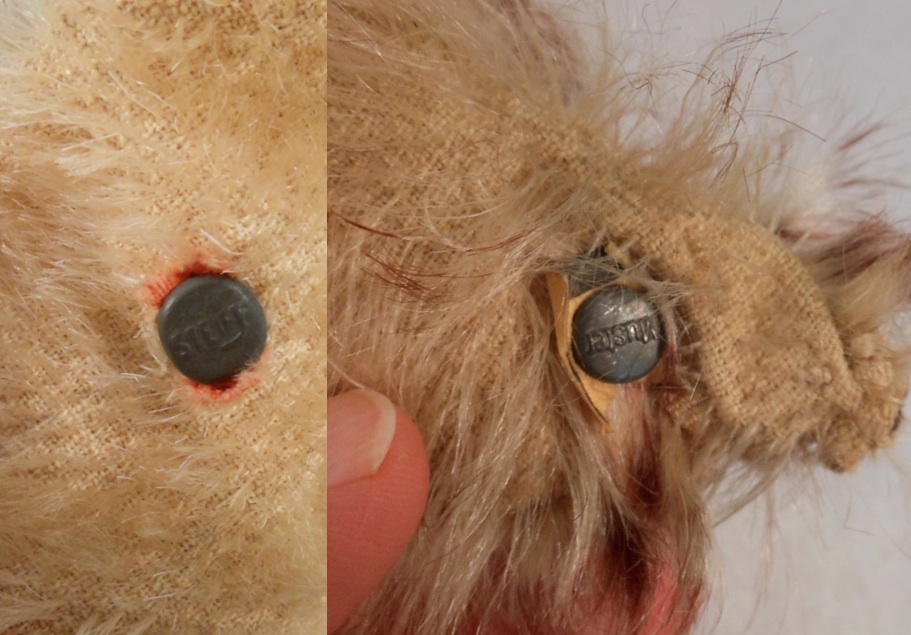
It won't take much to muster your attention towards Charly's second fantastic feature.  In addition to his standard Steiff trailing "f" style button in his ear (on the left size of the photo), Charly also sports a second button in his tail area.  This button, called the "muster" button, was used by Steiff pre-WWII on items considered samples, evolving designs, or prototypes. This is pictured here on the right side of the photo. In general, the button indicated that the item was Steiff property and was not intended for sale or distribution.  "Muster" translates loosely from German to English as "pattern" and in a sense, these "muster" items were just that.  This Charly's "muster" button suggests that he was made in 1928 or before, as the company was gearing up to put this model into production.  

It is interesting to note that Charly didn’t start out as a musical animal, but evolved into one. The original Steiff Charly dog was introduced in the late 1920s. He was produced both sitting (10, 14, 17, 22, 25, 30 and 35 cm) and standing (7, 10, 12, 14, 17 and 22 cm); the two versions were head jointed only. Their filling was soft kapok, meaning that they were lighter in weight and more cuddly than other animals stuffed with crunchy excelsior. An example of the 7 cm standing version is pictured here on the left.  Overall, the Charly pattern appeared in the line through 1936. 

Charly proved to be a great source for highly successful “theme and variation” product introductions, due to his popularity with collectors. He appeared as a 17 cm light brown and white mohair puppet from 1928 through 1939.  Both the sitting and standing versions were produced as pincushions in the 1929 through 1932 time frame.  He was also made as a 10 cm standing or sitting nomotta woolen miniature from 1935 through 1937, a 22 and 25 cm purse from 1927 through 1933, and as a playful, purple dressed 28 cm Pupp-animal doll (pictured on the left, photo from Christie's) from 1929 through 1930.

Steiffgal hopes the discussion on this most amazing vintage Charly dog has been like music to your ears.   

Have a question about one of your Steiff treasures? Let's talk! Click here to learn more.  
The teddy bear search engine