Showing posts with label fabric. Show all posts

Saturday, March 26, 2022

Making A Material Difference At Ladenburger Spielzeugauktion's April 2nd, 2022 Auction

It's nothing short of a bear affair at Ladenburger Spielzeugauktion GmbH's upcoming Special Steiff Auction event on April 2nd, 2022. With over 260 century spanning button-in-ear treasures, there's certainly something on offer for every collector and budget! Of particular interest among all the lots are a group of 20th century bears made from a variety of unconventional or substitute materials. Steiff's Teds are usually rendered in fine mohair fabrics, but there are exceptions - especially around exceptional time periods. Here are three lots that really caught Steiffgal's eye - and why.

The first is lot #5028, a paper plush Teddy bear most likely made just after the conclusion of World War I.
It is cataloged as, "teddy, pre-war era, paper, mohair-plush-substitute, cellulose-plush, brown jointed, shoe button-eyes, strongly used condition, partially fill loss at the disc joints, with button, block letters, long stretched F, 28 cm, in need of restoration, collection Koskinen." This very rare bear has an opening bid of 280 euro.

So just what makes this paper bear worth his weight in gold - despite his apparent condition issues? In order to continue soft toy production in the c. 1918-1920 timeframe, Steiff was forced to come up with some alternative products, as well as materials given the shortage of traditional felt and mohair. Given the abundance of wood in the area, the company started producing things like building sets and furniture for children. Steiff also found a way to produce a tweed-like material from local natural products. This "paper plush" was made from nettles and called "Brennessel." Paper plush items appeared in the line from 1919 through 1921, and included popular models of the company's standard line bears, dogs, cats, and rabbits. 

Size defies with this second sensational Steiff. He is lot #5140, a very big boy made from a seldom seen material. He is cataloged as, "Steiff 1930s-era Teddy bear. Five ways jointed, 100 cm tall, and made from substitute blonde plush fabric. With slightly trimmed muzzle, four claws, glass pupil eyes, and a giant back hump. With long trailing f button and traces of the yellow ear tag as IDs. Extremely impressive and unusual presentation. In excellent condition; with minor playwear and pads with light loss and dust." He has an opening bid of 3,300 euro.

There's so many interesting angles to this rare bear. First, of course, is his size. It is possible that he was intended originally as a display item, or store window display, given his prehistoric proportions. It is somewhat unlikely he was made as a toy, as in some cases he would be larger, and heavier than a child! He was clearly not used as a toy, given his current condition and lack of playwear. Then of course is his materials. As previously noted, Steiff's bears traditionally are made from mohair which gives them a cuddly look and durability to last generations. But this example is made from wartime era substitute blonde plush fabric - and a lot of it. Starting in the early 1930s, items made from wool plush, woolen mohair, silk plush, and other substitute fabrics began appearing in the line. This is the largest - by far - of any item made from alternative fabrics that Steiffgal has ever seen!

And good things come in threes with this third shout out.
Here we have lot #5151, a larger wool plush bear from the 1930s. He is cataloged as, "A most interesting and unusual 60 cm Steiff blonde wool plush bear from the 1930s. Made from war-era materials and featuring long and narrow proportions. With brown and black pupil eyes and black embroidered details. With long trailing F button as ID. In good to very good condition with moderate playwear and generalized thinning." He has an opening bid of 850 euro.

This bear has two key areas of interest - form and fabric. 

First, let’s talk about his presentation. Steiff's bear proportions tend to reflect the period in which they were made. For example, items made in the 1920s were often fluffy, colorful, and upbeat - much like the "roaring twenties" aesthetic, while items introduced in the 1950s tended to reflect the wholesome optimism of the early postwar period. Such is the case for items from the 1930s and 1940s. Steiffgal has noticed that these often have a long, lean, and pensive look to them... reflecting the uncertainty of the time frame in which they were produced. You really can see those distinct elements in this bear.

Now let's focus on his fabric. Wool plush is a distinctive material which holds a key place in the company's product development timeline history, and helps to date this bear pretty accurately. You generally see wool plush items made in the c. 1930 through mid 1950 time frame, but a few models - like the company's Wotan ram - incorporated it through the 1970s. Wool plush is pretty hearty and ages well. Its structure and texture make it less likely to fade, thin, or bald like mohair fabrics. Unlike artificial silk plush, wool plush can also can be cleaned gently like other fine woolen fabrics.

Steiffgal hopes this discussion on rarer fabrics used in Steiff toymaking has made a material difference in your love of the brand!

For more information about Ladenburger Spielzeugauktion GmbH's upcoming Special Steiff Auction event on April 2nd, 2022 please click here!

Have a question about one of your Steiff treasures? Let's talk! Click here to learn more!

Saturday, March 30, 2019

Getting All Dolled Up Over This Pretty Steiff Kitty

It's not often that you come across something that is the best of all worlds. But such is the case with this week's special My Steifflife blog visitor! Check out this simply adorable - and remarkable - Steiff cat doll. There's no question you'd want to welcome her into your meow mix!

This pretty kitty is the whole package. Her official Steiff name is PuppKatz Cat Doll. She is is 22 cm tall, standing, and head jointed. Her body is solidly stuffed and made from tan flesh colored fabric that has a slightly velvet-like finish to it. Her feet are flat and designed for standing; they are lined in cardboard. Her arms hang softly at her sides. Her feet and the tops of her paws are made from white mohair. Her mohair head is typical to Steiff's early 1930s cat head designs and is gently tabby striped. Cat's pert ears are lined in felt. Her pensive face comes alive with teal green and black slit style pupil eyes and a pink hand embroidered nose and mouth. Cat's clear monofilament whiskers have been lost to time. PuppKatz was made in 14, 22, and 28 cm from 1931-1943 overall.

This PuppKatz is part of a series of animal dolls Steiff produced in the 1930s and 1940s. Other species represented included bears, rabbits, dogs, elephants, and ducks. All shared the same stationary human form body. Most were made in 14, 22, and 28 cm and had removable clothing. As such, the original clothing was often lost to time, which is the case here with this PuppKatz. However, PuppKatz's current outfit of white underwear and a pretty belted dress, is perfectly scaled and adorable on her. She also came with a little pin with the name "Amy" on it. As such, that is her new name moving forward. 

The strategy behind the PuppKatz, and other animal doll patterns, is quite interesting and reflective of the prewar period in which they were made. These items launched in the early 1930s. Germany at this time was in a period of high unemployment and financial uncertainty. As a response to poor economic conditions, Steiff started making items that were simplified in design, used less expensive or even alternative materials, and were "theme and variation" in nature. The change in tone from items introduced from the end of the 1920s to the early 1930s is absolutely striking. Steiff's 1920-era items for the most part were colorful, fluffy, feminine, and childlike. Their early 1930-era items tended to be a bit glum looking, longer, narrower, and thinner

Steiff's animal dolls fit the needs of the 1930s business environment to a T. They were all on the same easy body that was made from inexpensive fabric and could be detailed in countless ways. In the case of this PuppKatz, she was made in three sizes, and each size was available in up to 11 different outfits over time. This one design ultimately represented 29 different SKUs in the product line. These outfits included sporting clothes, pajamas, suits, dresses, traditional clothing, and swimsuits, among others. These outfits were numbered and noted by a distinct code in the animal doll's article number. By having so many options for this one simple design, the company was able to fill its catalogs efficiently when product design and development resources, as well as raw materials, were severely limited by factors beyond the company's control. Steiff's 1938 catalog featured a whole spread of their animal dolls and various outfits; you can see that page here on the left. Please click on the photo to make it larger and more legible. 

Steiffgal hopes this discussion on PuppKatz has tickled your whiskers in the best possible way.

Saturday, July 28, 2018

Let Me Call You Sweetheart!

Won't you be my Teddy bear? All Steiff collectors agree - there's no better six words in the entire world! And that's just how Steiffgal felt when a new vintage friend joined her hug a few weeks ago. He was purchased at an auction in Germany sight unseen, and when he crossed the pond and arrived at his new home, he was even BETTER than expected. Don't you just love when that happens? Come meet Marshmallow, and learn why he is so interesting from the historical and product development perspectives.

This precious cub is as sweet as sugar! Marshmallow is 30 cm standing, 20 cm sitting, and fully jointed. He is made from white wool plush and is solidly stuffed with excelsior. His pads are made from flesh colored felt that has faded considerably. His simple but beautiful face comes to life with round black and brown glass pupil eyes and a brown hand embroidered nose and mouth. He has four brown claws on each of his paws. He has a non-working squeaker in his belly. Marshmallow's IDs have been lost to time, but it is Steiffgal's best guess that he was made in the mid-1930's to early 1940's, given his materials and presentation.

Now let's dive into material matters. Although wool plush is a lovely and very durable material, Steiff has usually made items from this fabric just before, during, or after periods of war or hardship. It is considered a "substitute" material, used in the place of more expensive and higher quality mohair. Sometimes these items also have linen or lesser quality felt on their pads or lining their ears as well.  Wool plush has a really old fashioned look to it, and has a "continuous" but bumpy feel on its surface - not like mohair which can feel softly "prickly" like a hooked rug. 

It is interesting to note that Steiff created many of its beloved and most popular 1930's-era designs in wool plush. Sometimes these items, like the company's Teddy baby bears, are specifically called out in the standard Steiff reference books. But others are not. For example, Steiffgal has a wool plush Jocko monkey in her hug; he is identical to the mohair version we all know and love. And as far as Steiffgal can tell, this white wool plush Teddy bear is not noted in the Sortiment books.  She handled a similar blonde wool plush Steiff bear for an auction client several years ago - so they were produced in some volume - but probably not many overall. 

Another factor that makes this wool plush bear quite the "looker" is his general appearance. His body has a distinctly long and lean look to it, and his dear face has quite a pensive expression. After studying bears from every decade, it has been Steiffgal's observation that bears from the mid-1930's to the early 1940's do indeed have this more "austere" look to them - perhaps matching the socio-economic climate of the time in Germany? Bears from this era also are usually produced in very basic hues, like white and blonde. Just for comparison, check out this photo on the left.  It features a similarly sized c.1906 Ted, a c.1929 Teddy Baby, and Marshmallow from the c.mid to late 1930's. What a difference a decade or two makes!

Steiffgal hopes this discussion on this wool plush cub has been beary enjoyable for you.

Have a question about one of your Steiff treasures? Let's talk! Click here to learn more.

Friday, December 23, 2016

Steiffgal's Just Boy Crazy Over This Late 1930's Steiff Doll!

Oh boy!  Literally!  Santa stopped off at Steiffgal's house a tad early, delivering this sweet little guy just in time for the holidays.  He came all the way from Germany and was won at a recent toy sale there. Steiffgal has a thing for Steiff's early felt dolls, but she was particularly excited about this darling little man. Here's a little bit about him, and what makes him so interesting from the collector's perspective.

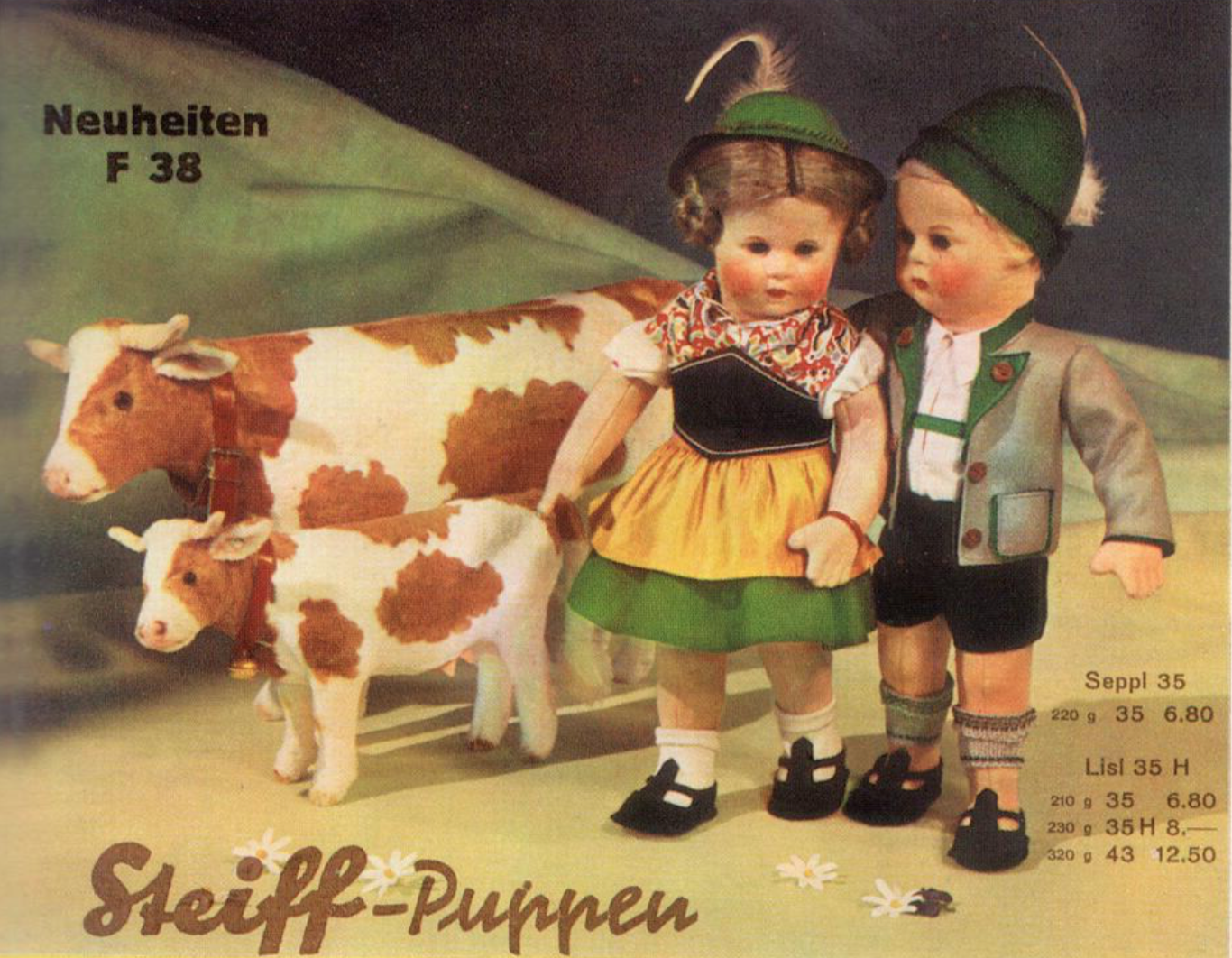
This handsome devil is Steiff's Seppl.  He is a great example of the company's pressed felt faced dolls, which appeared in the line overall from about 1936 through the very early 1950's.  Seppl is 35 cm tall, standing, solidly stuffed with excelsior, leg and head jointed, and made from felt.  He has lovely and very real looking blue, white, and black glass pupil eyes, a mischievous facial expression, and a shock of blond mohair hair.  He wears a very traditional German outfit.  This consists of black wool shorts with green embroidery; green suspenders; a white button down cotton shirt with a collar; a grey wool jacket trimmed in green with leather buttons; a green Alpine style hat; black tie style shoes; and grey and green knitted calf socks.  Seppl was produced in this size only from 1938 through 1943.

Seppl and his fellow seamless felt faced dolls were introduced in the late 1930's and were the "stars" of many of the company's advertising and sales materials at that time. This is understandable, given their charming presentation and personalities.  Here on the left you can spot Seppl and his gal-pal Lisl, who is also dressed in traditional clothing, as they appeared in one of the company's sales catalogs from 1938/1939.  You can see from his information that he is supposed to weigh 220 g (Steiffgal weighed her Seppl, who came in at 213 g); measure 35 cm (true) and cost 6.80 marks at the time. In 1938, 2.49 marks = $1 USD; as such, 6.80 marks = $2.73 USD. According to inflation calculators, $2.73 in 1938 had the same buying power as $44.84 in 2016.

Steiff has a half century of tradition of creating delightful cloth dolls, starting around 1903.  It is interesting to note that Steiff's earliest dolls were, for the most part, overwhelmingly male in gender.  Models included policemen, soldiers, soccer players, scouts, and other truly masculine designs. It wasn't until around 1909 that Steiff started creating both male and female doll models on a relatively large scale.  However, through the late 19-teens or early 1920's, many were still male, as the company's lines of international soldier and police dolls were a major emphasis on production.  You can see three typical male Steiff felt dolls here on the left from the c. 1909 through 1916 time frame. 

After WWI, the gender balance in Steiff's doll production changed significantly.  The soldier and police dolls were no longer of great interest, and Steiff's production of them dropped dramatically.  Female dolls started gaining popularity, and more and more were seen in the catalog.  By the time that seamless pressed felt faced dolls like Seppl appeared in the catalog, the company was really focusing on producing girl dolls for little girls.  For example, Steiff produced 27 versions of its pressed felt faced dolls in the 1938-1943 period.  Of those models produced, only 7 were boys, Seppl being one of them. As such, Steiff boy dolls from this period are quite rare.  You can see Seppl's cousin Rosl, who was produced from 1939 through 1941, here on the left. Once the factory reopened for toy making business in the late 1940's, Steiff again produced these pressed felt faced dolls for a handful of years.  However, all of the post war models were girls.  

Steiffgal hopes that you have enjoyed learning about Seppl, and that Santa also brings you a marvelous vintage Steiff treasure this year as well.  Happy holidays, dear Steiff readers!

Have a question about one of your Steiff treasures? Let's talk! Click here to learn more!

Tuesday, July 29, 2014

Hop Hop Hooray For This Fabulous Steiff Rabbit On Wheels!

Any bunny in the mood for a little fun?  Well, its hard not to be in a playful frame of mind when it comes to Steiff delightful rolling collectibles!  And here's one that wasn't 'round for too long - she was only in the line for one year!  Check out this "smooth as silk" pull toy rabbit on red wooden wheels and see what makes her so cool from the design and historical perspectives.  

It's off to the races with this fabulous vintage Steiff rabbit.  She is standing on all fours, unjointed, and made from tan artificial silk plush.  Her coat is brought to life with tan, grey and black airbrushing.  Her soft ears are lined in peach colored felt.  Her pensive face is detailed with black and brown pupil eyes, a pink hand embroidered nose and mouth that is highlighted with a touch of pink paint. She has a few monofilament whiskers, a non-working squeaker, and retains her original blue ribbon.  Rabbit glides along on four red wooden off center wheels and has a red and white pull string attached to her chest.  For her Steiff IDs, she retains her short trailing "f" Steiff button and traces of her yellow ear tag. A close up of these IDs is shown below. This hoppy-go-lucky charmer was manufactured in this size in 1949 only.

This item certainly has wheel appeal and was made at a most interesting time in the company's history.  Just before the factory closed for toy making business in the early 1940's, and right after it opened again in the late 1940's, Steiff's manufacturing processes were challenged by limited material supplies.  Mohair and felt, traditional Steiff fabrics, were hard if not impossible to source, and had for several years been allocated to military uses, such as uniforms, hats, blankets, and other items.  

But Steiff has always found ways to get the job done, even under the most difficult of supply chain circumstances.  A great example of this is their use of plush made from wooden fibers right after World War I, when they also faced limited access to woolen materials.  The company was also forced to get creative with materials around and just after World War II as well. During this period, Steiff "improvised" with artificial silk plush materials to manufacture some of its most beloved designs traditionally made from mohair - like this rabbit on wheels. Artificial silk plush was a cheaper, lower cost, and poorer quality option, but it was available on commercial scale.  And "silk" most likely refers to the shine and softness of the plush.  However, this synthetic material tended to lose its sheen and good looks quite quickly; as a result, it unusual to find Steiff artificial silk plush items in great condition today. 

Because of the time frame in which artificial silk plush items were made, it is possible to see a number of different Steiff button designs on items besides the short trailing "f" button noted on the rabbit on wheels. The photo to the left shows a few other artificial silk period plush items, including:

  • Front and center, a black and white sitting bunny produced in 15, 18, 22 cm from 1938 to 1943.  His button is STEIFF in all capital letters.  His ID and production dates suggest he might have been made in the early 1940's, put into storage during the war, then buttoned and sold right after the war.
  • Standing tall in the back is a silk plush Teddy baby produced in 22, 25, and 30 cm from 1948 to 1950.  He has a blank Steiff button.
  • On the right, a sitting Bazi Dachshund, produced in 14 and 17 cm from 1948 to 1949.  He also has a blank Steiff button.
  • And on the left, a somewhat rare brown Teddy bear, he is not noted in the Steiff Sortiment but is estimated to be from the late 1940's.  Unfortunately he has lost his button, but one just like him was found with a short trailing "f" button.
It is interesting to note Steiffgal has never seen a US Zone tag on any silk plush item,  even though these tags were technically supposed to be sewn onto any Steiff item leaving the factory from 1947 to 1953.  Have you ever seen this combination?  Alas, another mystery for another day.   

Steiffgal hopes this discussion on Steiff's silk plush fabric items has added a touch of creativity and inspiration to your day.  

Have a question about one of your Steiff treasures? Let's talk! Click here to learn more. 
The teddy bear search engine