Showing posts with label ear tag. Show all posts

Saturday, September 9, 2023

Does This Lifesize Steiff Sheep Call To Ewe?

Sometimes it's ok to be a little sheepish.
Especially when it comes to delightful Steiff button-in-ear mysteries like this one! Check out this fabulous and fuzzy farm friend who just might be larger than life. What do you think? Danna shares, 

"Could you offer any assistance in figuring out the mystery of the sheep? His coat is darker and the feet are different than the two I found on the web, his eyes also have different centers and there is no yellow tag in the front. I think it's older. Any help would be appreciated. Thank you!"

This member of the flock truly rocks!
What we have here is a great example of one of Steiff's rarer studio, or life-sized sheep. He is standing on all fours, unjointed, and made from now faded brown tipped wool plush. His legs and ears are made from white wool plush. His inset muzzle is detailed with oversized green and black slit pupil eyes, a simple mouth and nose, and airbrushed highlights. He is solidly stuffed with excelsior and most likely has a metal skeleton inside to support his size and weight. He left the factory wearing a Steiff chest tag, but this has been lost to time. These brown tipped sheep were made in 80 and 90 cm from 1966-1967 only. The 80 cm version is also standing but his head his bowed to the ground as if he is nibbling on the grass. 

It is interesting to note that Steiff also created a 95 cm standing display ram produced in the same brown tipped wool plush as Danna's life-sized sheep. 

Now let's shepherd this sheep discussion to his IDs.
Danna's sheep has a product number of 1590,90 which is the 90 cm version made in 1966. Those made in 1967 have a product number of 3459/09. His numbers correspond as... 1= standing, 5= wool plush, 90= 90 cm, 9= display animal or special edition, and 0= normal (in reference to coloring.) Here on the left you can see these tipped sheep as they appeared in Steiff's 1967 studio line catalog.

Steiffgal hopes this discussion on Danna's sheep has put ewe in a great mood today. 

Have a question about one of your Steiff treasures? Let's talk! Click here to learn more.

Saturday, May 28, 2022

Getting Egg-Static Over This Steiff Antique Rabbit Novelty!

There's no question you'll warm up right away to today's blog special guest. Not only is he good looking, he's also great at what he does. Intrigued? Here's more about this charming - and functional - Steiff rarity.

It's easy to get egg-static over this adorable rabbit egg cozy.
This happy hopper is 11 cm long, unjointed, and made from tan velvet. He is airbrushed with tan and black highlights. He does not have limbs, but the way he is painted it appears that has dimensional back thighs and legs. He comes to life with curled ears, black shoebutton eyes, and a black painted nose. Rabbit's head is very lightly stuffed with kapok. His inside is hollow - like a tent - to keep one boiled egg warm. Steiff also made egg cozies which could hold up to six eggs! 

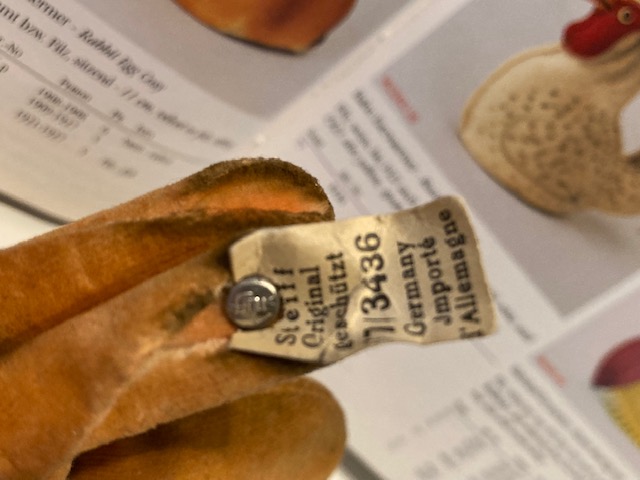
Rabbit retains his long trailing "f" button and fully legible white ear tag as his IDs. This pattern was made in this size only in velvet from 1908-1927 and in felt from 1921-1927. It is one of the very few egg cozies produced by Steiff in velvet fabric; the vast majority of these warmers were produced in felt - which is probably a better insulator. This particular rabbit egg cozy was most likely produced in the 19-teens. 

Now let's take a closer look at rabbit's 14 carrot ear tag.
The numbers on it are: 77/3436. At first, these numbers were a little confusing, as they do not exactly align with how Steiff usually uses digits on ear tags. In this case, it is Steiffgal's best thinking that the numbers represent the following information: The 77 = the classification number for "egg warmers"; 3 = sitting position; 4 = velvet material; and 36 = the classification number for rabbits. Other early egg cozy items have similar four digit numbers after the "77" egg warmer classification. It appears that their final two digits also refer to the classification number of their species, like ducks, roosters, or hens.

Also of interest are the French words "importe' d'allemagne" on rabbit's white ear tag.
This is pretty unusual and only the second or third time Steiffgal has seen this documented on a Steiff ear tag. It is possible, given the socio-economic and political realities of the WWI era, that European companies were required to specifically note in which countries their products were made. And/or perhaps such labeling was necessary for import, export, or duty purposes and regulations. Isn't it amazing how much information - and mystery - can fit on a tiny slip of paper less than one inch long!

Steiffgal hopes this discussion on this rare velvet egg cosy has left you jumping for joy.

Have a question about one of your Steiff treasures? Let's talk! Click here to learn more.

Saturday, November 13, 2021

Hans Down, This Prewar Steiff Teddy Bear Has Amazing ID!

This Steiff blog entry is designed to test your "metal" in the most interesting way possible. Check out this delightful and purely period prewar Steiff Ted that Steiffgal has named Hans. He recently joined Steiffgal's hug and previously belonged to a Canadian collector. Can you believe he's close to 90 years old? Indeed, he does check out in every way as a late prewar cub... with a very special and little known detail that helps to narrow down his dating. But more about that in just a bit.

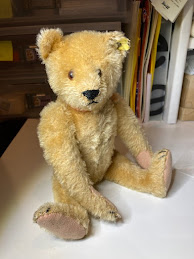
This little love of a cub is a wonderful time capsule of Steiff's mid-1930s to mid-1940s Teddy bear design directives. In terms of his physical properties, Hans stands at 10 inches/25 cm tall and is made from yellow-blonde mohair. He has a back hump, but it is less pronounced than the company's earlier bear editions. He is fully jointed and has both felt hand and foot pads. Each pad is detailed with four black claws. His feet are long and narrow, and his wrists turn slightly upward. Hans' face comes alive with proportional black and brown glass pupil eyes, an unshaven muzzle, and a black hand embroidered nose and mouth. Hans' side-squeeze squeaker works, once in a while.

Hans also has a few "intangible" properties that tie him to the late prewar period. 
He has a very distinctive long, lean, and somewhat "pensive" appearance. He's a "no nonsense" Ted indeed. This "look and feel" is often seen on Steiff's prewar bear production from the early 1930s onward. It is possible that bears created at this time reflected the feelings of the seamstresses making them, as the 1930s and 1940s were very stressful decades in Germany due to challenging and ongoing social, political, and economic realities. In contrast, consider Steiff's early postwar bear production - from the early 1950s onward. Newly introduced midcentury patterns like Zotty and Jackie and the company's re-engineered "Original Teddy Bears" are noted for their jolly faces, rotund bodies, and playful personalities.

Perhaps the most concrete metric in terms of dating Hans is his unexpected branding. He sports an unusual BRASS colored Steiff button. It is the short trailing "f" style and 6 mm in diameter. This button appeared on a few items from 1933/34 through 1943. He also has traces of his yellow linen ear tag, but the information on it is not legible. The yellow tag was introduced around 1934, which suggests Hans' birth year falls roughly between 1934 and 1943. This is one of a handful of times Steiffgal has ever seen this brass button, and Hans is only the second item in her collection of antique Steiff treasures bearing this distinctive trademark. Most of the time, for items produced in the mid 1930's through early 1940's time frame, Steiff used a silver colored short trailing "f" button. It is possible that Steiff substituted brass buttons for silver colored ones during this time for economic or supply chain reasons, but Steiffgal does not know for certain. Whatever the reason, finding items like Hans with this late prewar branding is a rare and wonderful experience for sure!

Steiffgal hopes this discussion on the company's rarer prewar brass buttons has brought the topic full circle for you.

Have a question about one of your Steiff treasures? Let's talk! Click here to learn more.

Sunday, August 26, 2018

Shake A Leg And Check Out This Precious Steiff Rattle Lamb!


How novel! That's how Steiffgal felt when she came across this tiny Steiff treasure at a friend's house recently. It goes without saying that he is adorable, officially qualify as "antique," and has a distinctly playful personality. But more on that later! He lives on a shelf in a beautifully curated collection in New England, along with many fine dolls, bears, and Steiff friends. Take a look at this happy handful and see what would have him a premier plaything more than a century ago.

There's no need to count sheep over this bitty barnyard buddy. Here we have a too cute for words Steiff lamb! It is simply amazing that this item is in such nice shape given its age and that it was designed as a play toy for babies! Steiffgal suspects that it was purchased as a gift for some lucky child and used primarily as a nursery decoration, not a toy. Or, sadly, the child passed away in infancy and never got to enjoy the toy - or life. The lamb measures about 3 inches tall, head to toe. He is standing on all fours, unjointed, and made from lamb's wool plush. His face, ears, and legs are made from felt. His legs are lined in metal wire. His face comes to life with teeny black button eyes and a very simple hand embroidered pink nose and mouth. His bell and ribbon are original to him. He retains all of his original Steiff IDs, including his tiny long trailing "F" button and linen backed white paper ear tag.  

Numbers don't lie! According to the Sortiment books and his prominent ear tag numbering, this lamb was produced from 1902 through 1917 overall, and as a "pram toy." This particular model was made in the 1910 through 1917 time frame. Pram toys were hanging toys designed to dangle from a baby's carriage or crib. Most of Steiff's earliest pram toys were constructed from elastic cord and woolen pom-poms, suspended from a white ivory carved ring. The "1" on the ear tag means "standing" and the "5" means lamb's wool plush. The "75" identifies it as a "hanging toy" while the "46" identifies it as a lamb.  

Now shake a leg and check out his little secret. This lamb actually is also a rattle, elevating him to novelty status! As a rattle, he makes a little "click click" sound when jiggled about. Steiffgal has handled rattle bears, dogs, cats, squirrels, and now this lamb. They all share the similar construction of having a small sealed glass tube filled with beads inserted into their torsos. Usually, but not always, rattles were made from the smallest versions of Steiff's most popular designs. The "youngest" product Steiffgal has seen with a rattle is a c. 1929 velvet sitting "Pip" dog. You can see this "chatty" Pip pictured here on the left. It is her best guess that the company stopped making rattle items in this fashion from the 1930's onward. 

Steiffgal has not been able to figure out any ear tag numerical code that distinctly and specifically identifies an item as having a rattle feature. So finding one, which usually comes about by accident, is always such a delightful surprise!

Steiffgal hopes this discussion on this wonderful Steiff novelty as shaken you up a bit!

Have a question about one of your Steiff treasures? Let's talk! Click here to learn more!

Monday, April 16, 2018

Horsing Around With This 1930's-Era Steiff Pony On Wheels

Whoa Nelly! Can one simple digit make all the difference when identifying and dating vintage Steiff?  In this case - yes!  Check out this lovely vintage horse on wheels. Everything about her goes by the numbers!

This pretty pony belongs to one of Steiffgal's Steiff pals. The horse measures about 28 cm by 28 cm. She is standing, made from soft, very lightly textured brown and white fabric, and comes to life with a black plush mane and tail. She is authentically dressed in red leather reins and a saddle, along with a green felt blanket. She rides upon four red wooden wheels. This is one of Steiff's most beloved and legacy pre-war patterns, and was produced in a number of materials and sizes - ranging from 12 to 80 cm - in the c. 1892 through 1943 time frame. Early on, she was also available paired with a number of complementary items, including a doll, jockey, cart, or sled. Pony retains her long trailing F button and her fully legible red ear tag, dating her initially in the broad c. 1926 to 1934 time frame.

Given her materials, presentation, and age, this is one excellent equine indeed!

But there's something really interesting about this horse that sent Steiffgal into a full gallop. At very first glance, both Steiffgal and her pal thought she was made from felt. If that were the case, her condition truly would be outstanding, given how prewar items made from felt or with felt detailing (like paw pads) almost always have at least a few holes or nibbles in them. But this fabric was flawless! So what's going on here? Check out her red ear tag, which reads "1228." This corresponds to: 1=standing, 2=short pile plush/coat plush, and 28=28 cm. 

Hold your horses! It turns out that Steiff was making their horse on wheels pattern in another fabric called "coat plush" in 22, 28, and 35 cm from 1932 through 1934.  It is interesting to note that in the 1930's, the company started using alot of "substitute" fabrics like wool plush, curled wood plush, and artificial silk plush on some of their most beloved patterns. That was most likely due to supply chain and socio-political issues of the era. These alternative fabrics were still available and affordable. And except for artificial silk plush, all were really quite durable - which helps to explain in part why this horse is in such nice shape. If you look closely at the horse's fabric, you will see that indeed it has a light "fuzzy" texture and feel to it.  And, because the surface is not flat and almost completely even like felt, the seams are not as smooth and "fluid" between the different fabrics. 

Steiffgal hopes this discussion on this great 1930's Steiff horse has set you a'blaze!

Have a question about one of your Steiff treasures? Let's talk! Click here to learn more.

Friday, May 27, 2016

Hunting For Clues About This Great Steiff Outdoorsman Bear

Do you have any plans for the upcoming long holiday Memorial Day weekend holiday? Perhaps you might be headed out for a little camping and outdoor fun to kick off the summer season! Well, that's exactly what this little wilderness-loving Steiff cub has in mind as well! Check out this most unusual and well attired bear and see what makes him so interesting from the design and historical perspectives.

Let's start hunting for clues about this hearty outdoorsman. He is 22 cm, fully jointed, and made of caramel colored mohair. His sweetly serious face comes to life with a brown hand embroidered nose and mouth and glass pupil eyes. He dons an orange felt cap with a wide brim; a green felt jacket detailed with a small collar, scalloped edging, long fringe, and a laced up front; and tall, faux brown leather boots. When he left the factory in Giengen, he had a wooden hunting rifle suspended from a leather cord tacked onto his shoulder. 

This bear was produced in 1953 and 1954 and is one of Steiff's "Nimrod" Teddy bears.  He was designed and manufactured in honor of the 50th anniversary of the introduction of the jointed Teddy bear as we know and love him today.  Also produced at this same time, and for the same reason, was Steiff's far better known "Jackie" style Teddy bear. Jackie, known for her pink nose stitch, distinctive belly button, and impish personality, was made in 17, 25, 35, and 75 cm from 1953 through 1955 only. Like Nimrod Teddies, Jackie bears are exceptionally rare on the secondary market given their appeal, limited production, and their brief time in the line.  A print advertisement featuring these two early, very special edition Teddy bears from 1953 is pictured here on the left.  The photo is from Cieslik's Button in Ear:  The History of the Teddy Bear and His Friends.
  
The Nimrod bears were all based on the company's early postwar, newly redesigned "Original Teddy" pattern. This design, which featured a stockier build and shorter limbs than the company's prewar standard line bears, was produced from 1950 through 1966 in 10, 11, 15, 18, 22, 25, 28, 35, 40, 43, 50, 65, 75, and 100 cm.  Overall, four Nimrod bears - in addition to the one under discussion here today - were produced.  These included a 22 or 50 white version which donned a green cap, an orange felt shirt, and brown boots; a 22 cm gold version which wore a green cap, a brown felt shirt, and brown boots; and a 22 cm caramel version detailed with an orange cap, green scarf, and very tall brown "wader" style boots.  All carried wooden rifles suspended from a leather cord.  You can see a few more of these original Nimrod bears here on the left; the photo is from Cieslik's Button in Ear:  The History of the Teddy Bear and His Friends.  

In addition to their well designed outfits, proper footwear, and outdoorsy personalities, Nimrod bears also have distinctive numbering on their yellow ear tags.  The caramel one under discussion today is numbered 5322 N.  This translates into 5=jointed, 3=mohair, 22=22 cm, and N=Nimrod.  You can see this numbering on the picture here on the left. Steiffgal has seen letters after article numbers, but they usually refer to colors or gender of an item, not its actual name.  So this configuration is quite unusual.  

Why would the company produce a series of hunting themed bears in honor of this special golden anniversary? Most collectors are aware that the Teddy bear got its name (and arguably its popularity) from Theodore Roosevelt, who refused to shoot a baby bear cub on on a hunting adventure in Mississippi at the turn of last century.  These Nimrod bears are a gentle nod to that key happening that in its own way helped to place Steiff on the map as a global company. The Nimrod bears and a Steiff likeness of President Roosevelt were featured on the cover of a Steiff brochure commemorating his 100th birthday in 1958.  The photo is from Cieslik's Button in Ear:  The History of the Teddy Bear and His Friends.  

And last but not least, what about the name Nimrod? Although Steiffgal cannot unearth anything definite about Steiff's choice of this name, she did discover that this might be a reference to an ancient biblical figure. According to scholars, Nimrod was the great-grandson of Noah, who built an ark to save all the animals during the great flood. Nimrod is personally described in the bible as "a mighty hunter."

Steiffgal hopes this discussion on Steiff's rare Nimrod Teddy bears has you on the hunt for one to add to your collection as well!

Have a question about one of your Steiff treasures? Let's talk! Click here to learn more.

Sunday, March 3, 2013

Sit And Stay And Check Out This Fabulous Early Steiff Bulldog

Steiffgal's just going to have to take the bully pulpit here in reference to one of her latest finds.  Always on the lookout for the next great discovery, Steiffgal was floored to spot this delightful doggie on eBay with the most reasonable "buy it now" price.  She didn't think twice before hitting the purchase button... and is she ever glad she did!  Let's take a look at this beautiful Bully and see what makes him so special from a design and historical perspective. 

Bully's Collar and Closure
It's time to sit and stay and check out this 17 cm Steiff bulldog.  Bully is sitting, head jointed, and made from black and white mohair. His face and muzzle area are tan velvet, which has darkened a little over time. His ears are lined in wire and are poseable. Bully has very large brown and black glass pupil eyes and a black, hand-embroidered nose.  He has black hand embroidered claws on his four paws. Most remarkably, Bully retains his original and traditional horsehair collar.  This is made from a long, thin strip of material which is doubled over width-wise; the horsehair fibers are sewn in between the faces of the material.  The collar is held together with a little knot under Bully's chin, and is finished off with a little brass bell.  A close up of the collar's construction is pictured here on the left. The horsehair collar was a typical accessory of the 1920s and indicated a "regal" nature of the item wearing it.  In terms of Steiff ID, this pooch is blue ribbon all around, he has his long trailing “ff” style Steiff button and his crisp, fully legible red ear tag which reads "Steiff Original geschutzt 3317 Made in Germany."

Bully's Ear Tag and Button
Steiff introduced Bully to the world in 1927 and he was an instant sensation. He was modeled on the French Bulldog—the “it” companion of those in the know all across Europe at the time. Like this bulldog under discussion today, all Steiff Bully dogs  were head jointed, had large brown and black glass pupil eyes, a hand-embroidered black nose and a simple snout and jaw constructed to give him his requisite jowls. Most were black and white or orange and white, but a rare blue-and-white version was also produced. Bully was made in velvet and mohair, as well as sitting and standing, in sizes ranging from 10 to 50 centimeters. 

11 cm Bully on a Pincushion, c. 1928-29
Like most popular Steiff patterns, Bully's basic design was integrated into many product variations.  Bully was produced as a pincushion, music box, dog-doll, nightdress bag, and even a puppet, among other product line extensions.  Today, these Bully product line extension characters are of great interest to collectors; a fantastic 11 cm orange and white Bully on a mohair pincushion was a highlight at the 2013 March Teddy Dorado Steiff auction.  This fantastic example is pictured here on the left.  The original Bully appeared in the Steiff catalog through 1939; today, this precious pooch is one of the most universally desirable and sought-after pre-war Steiff designs among collectors.  He has been replicated numerous times over the past few decades - most recently as a 750 piece Worldwide edition in 14 cm in black and tan velvet in 2012.  Even these newer models are coveted by enthusiasts all over the world.

Steiffgal hopes this discussion on Steiff's Bully dogs has been worthy of a blue ribbon for you.

Have a question about one of your Steiff treasures? Let's talk! Click here to learn more.  
The teddy bear search engine