Showing posts with label brass. Show all posts

Sunday, September 15, 2024

Strike Up The Brass Band Over This Mysterious Steiff Fawn

Oh deer!
What do we have here? This charming field and forest friend is not only just lovely and elegant in design, but she also has a less obvious but totally WAH-HOO good surprise element to her as well. Get ready to fawn over this precious prewar rarity!

Here we have Steiff's 22 cm mohair fawn. She is standing, unjointed, and made from tan mohair. The lining of her ears and her tail are made from white mohair. Her face is detailed with black button eyes and a black hand embroidered nose and mouth. Her legs are particularly thin, shapely, and elegant and are made from velvet. She has a gentle, distinctly old fashioned look to her. This pattern was produced in 17 and 22 cm from 1934-1943.

Now for her little secret.
Given her era of production, she would have left the factory with either a long or short trailing "f" style knopf, depending on her specific year of manufacture - with earlier versions having the long trailing "f" version and the later versions having the short trailing "f" version. However, this gal proudly wears an unusual BRASS colored short trailing "f" Steiff button and has traces of her yellow ear tag. The button measures 6 mm in diameter. This seldom seen branding appeared on a few Steiff items from 1933/34 through 1943. You can see that brass button in the photo below.  

So just how rare is this brass prewar button?
It is really hard to quantify, as Steiffgal has only handled - literally - a handful of items with this distinctive ID in memory. In her personal collection, she has one prewar treasure with this distinction. This is a small standing Waldi dog. He 10 cm, unjointed, and made from copper colored mohair. He has long, floppy ears. His face is detailed with shiny black glass eyes and a black hand embroidered nose. His mouth is indicated by a little black airbrushing. Waldi wears his original green leather collar and has his "watermelon" shaped bare faced tag, with his name imprinted in crimson. This guy was made in 10, 14, 17, 22, and 28 cm from 1933 - 1943... the identical time frame as the fawn under discussion today. This prewar Waldi is pictured below on the left. 

It remains a mystery why Steiff used a brass button for branding some of their items during this turbulent geopolitical period.
It might have to do with availability of materials, or shortages, or other rationing reasons. It is also not clear why some items would have a brass button, and others would not - as Steiffgal has seen examples of both the prewar Waldi and this fawn with Steiff's standard silver colored prewar IDs. Only these precious treasures know for sure... and they aren't talking!

Steiffgal hopes this discussion on Steiff's lovely prewar fawn with her unusual button has put the pedal to the metal for you.

Have a question about one of your Steiff treasures? Let's talk! Click here to learn more.

Saturday, November 13, 2021

Hans Down, This Prewar Steiff Teddy Bear Has Amazing ID!

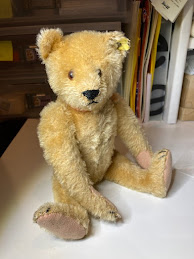
This Steiff blog entry is designed to test your "metal" in the most interesting way possible. Check out this delightful and purely period prewar Steiff Ted that Steiffgal has named Hans. He recently joined Steiffgal's hug and previously belonged to a Canadian collector. Can you believe he's close to 90 years old? Indeed, he does check out in every way as a late prewar cub... with a very special and little known detail that helps to narrow down his dating. But more about that in just a bit.

This little love of a cub is a wonderful time capsule of Steiff's mid-1930s to mid-1940s Teddy bear design directives. In terms of his physical properties, Hans stands at 10 inches/25 cm tall and is made from yellow-blonde mohair. He has a back hump, but it is less pronounced than the company's earlier bear editions. He is fully jointed and has both felt hand and foot pads. Each pad is detailed with four black claws. His feet are long and narrow, and his wrists turn slightly upward. Hans' face comes alive with proportional black and brown glass pupil eyes, an unshaven muzzle, and a black hand embroidered nose and mouth. Hans' side-squeeze squeaker works, once in a while.

Hans also has a few "intangible" properties that tie him to the late prewar period. 
He has a very distinctive long, lean, and somewhat "pensive" appearance. He's a "no nonsense" Ted indeed. This "look and feel" is often seen on Steiff's prewar bear production from the early 1930s onward. It is possible that bears created at this time reflected the feelings of the seamstresses making them, as the 1930s and 1940s were very stressful decades in Germany due to challenging and ongoing social, political, and economic realities. In contrast, consider Steiff's early postwar bear production - from the early 1950s onward. Newly introduced midcentury patterns like Zotty and Jackie and the company's re-engineered "Original Teddy Bears" are noted for their jolly faces, rotund bodies, and playful personalities.

Perhaps the most concrete metric in terms of dating Hans is his unexpected branding. He sports an unusual BRASS colored Steiff button. It is the short trailing "f" style and 6 mm in diameter. This button appeared on a few items from 1933/34 through 1943. He also has traces of his yellow linen ear tag, but the information on it is not legible. The yellow tag was introduced around 1934, which suggests Hans' birth year falls roughly between 1934 and 1943. This is one of a handful of times Steiffgal has ever seen this brass button, and Hans is only the second item in her collection of antique Steiff treasures bearing this distinctive trademark. Most of the time, for items produced in the mid 1930's through early 1940's time frame, Steiff used a silver colored short trailing "f" button. It is possible that Steiff substituted brass buttons for silver colored ones during this time for economic or supply chain reasons, but Steiffgal does not know for certain. Whatever the reason, finding items like Hans with this late prewar branding is a rare and wonderful experience for sure!

Steiffgal hopes this discussion on the company's rarer prewar brass buttons has brought the topic full circle for you.

Have a question about one of your Steiff treasures? Let's talk! Click here to learn more.

Monday, June 3, 2019

This Antique Steiff French Soldier Doll Is Five Stars All The Way!

It's safe to say that this week's topic will have uniform appeal! Check out this absolutely handsome Steiff doll that recently marched into Steiffgal's collection. He was an attic find and listed on eBay, which only proves there's no telling where the next great find will surface.

This soldier doll truly stands and delivers. He is 50 cm tall, five ways jointed, and made from felt. His face comes to life with blue and black glass pupil eyes, a prominent nose, and a ginger inset mohair mustache. His inset mohair hair exactly matches the color, length, and density of his mustache. Soldier's body, legs, and feet are super long and skinny while his ears and nose are exaggerated. He retains his tiny button-in-ear as his Steiff ID. Given his overall presentation, Steiffgal would consider him a "transitional" doll in terms of Steiff's early doll production. This means meaning his aesthetic and production falls between the company's earliest and more cartoon-like "Karikaturpuppen" dolls (c. 1903-1914) and their truly human scale dolls (c. 1908 - 1930).

Not surprisingly, this soldier's timing and production align with military precision here. This doll, called "Kuerassier" and secondarily noted as a French soldier, was only made in this size - about 20 inches tall -  in 1912. Cuirassiers were cavalry equipped with armour, swords, and well embellished helmets. They appeared in late 15th-century Europe through the beginning of WWI. Today they may attend state occasions for ceremonial, non-combat related purposes. When this Kuerassier doll left the factory in Giengen, Germany over a century ago, he did indeed carry a metal sword, much like his namesake. Unfortunately it has been lost to time. 

Kuerassier's military outfit is five stars all the way. It aligns with the uniforms worn by French Calvary soldiers during the late Franco-Prussian era. His fitted jacket is made from blue felt and is integral to his body. It has a loose peplum on the bottom. It is detailed with tiny buttons up the front and on the sleeves, red embroidered piping, and red felt patches on the wrists and collar. Another eye catching features of his coat include its epaulets, which are made from felt, ribbon, and string. They attach to his shoulders via metals buttons that match the ones down the front of his coat. His pants are made from red felt and resemble jodhpurs, which make room in the legs for movement. His black, knee high boot are handmade from leather and have brown leather soles. They are pictured here on the left. His stunning solid brass helmet is decorated with a now lilac colored woolen fringe and resembles the helmets worn by his namesake French Cuirassier Troopers in the late 1800s. It has a partial metal chin strap. You can see an illustration of an early 20th century French Calvary soldier a little bit up and on the left; the similarities between the uniforms are so interesting! The image is from the The Metropolitan Museum of Art.

Steiff’s soldier dolls were an important segment of the company’s line and business in during the first quarter of the 20th century. In a span of about 20 years, Steiff produced examples representing German, Scottish, Moroccan, Turkish, Dutch, Russian, American, Belgian, French, Italian, and Austrian armed forces, among others. Well over 100 distinct designs were produced during this time frame; most of these patterns were made in multiple sizes. However, after WWI, interest in soldier dolls understandably plummeted. The company filled this void in the 1920’s by realigning its doll production efforts towards a series of toddler dolls, dressed animal and bear dolls, popular cartoon inspired dolls, and other happy go lucky novelties.

Steiffgal hopes you found this discussion on this Kuerassier soldier doll worthy of a 21 gun salute.

Have a question about one of your Steiff treasures? Let's talk! Click here to learn more.

Saturday, October 14, 2017

Things Are Spot on With This Delightful Pre-War Steiff Giraffe!


Steiffgal's gonna stick her neck out here and say that you will undoubtedly develop a plush-crush on this week's blog friend. She bought him based on a photo from a sale in Europe, as something about him really called to her. As a fellow collector, she is certain you know that feeling all too well! So how about following a tall order and checking him out?

Things are spot on with this delightful pre-war Steiff giraffe. He is 35 cm tall, unjointed, and made from light orange wool plush. He is hand spotted with darker orange spots. His mane is made from short light orange mohair, while the tip of his tail is made from longer orange mohair. His face comes to life with two pert horns, black button eyes, a painted orange mouth, and ears lined in peach colored felt. This pattern was made in 28 and 35 cm from 1936 through 1943.  

Despite his simple and charming appearance, this delightful example is actually outstanding in two ways. 


First, material matters. Giraffes are a legacy pattern for Steiff. Giraffes were featured in the company's debut 1892 catalog. Wheeled and simple standing ones were available in sizes ranging from 17 cm to 65 cm overall through 1909. This pattern was updated in 1909 and produced in an even greater spectrum of sizes - from 28 to 260 cm through 1942 overall. The larger sizes were designed for riding and were constructed with a stabilizing internal metal frame and detailed with steering and leather saddles. Except for a lone 110 cm example made in 1933, all of these gorgeous giraffes were made of felt.  Given the elegant lines of these animals, as well as their need for precise spot detailing, this makes perfect sense from the manufacturing, economic, and design perspectives. 

So then, what's the big deal with this little guy? This giraffe under discussion today is really the first non-felt version produced as a standard line item for any length of time. And its fabric - wool plush - aligns perfectly with its period of manufacture. Its detailing materials - felt on the ears, and mohair on the mane and tail tip - are used as minimally as possible, yet really add to the giraffe's appeal and sense of quality. Felt and mohair were beginning to become less and less available for toymaking in the mid-1930's due to geo-political reasons. As such, Steiff was very careful with the limited quantities of these upscale fabrics they had available to them. Here on the left is the catalog entry for this giraffe in Steiff's Hauptkatalog (main catalog) dated D 1938/39.

Giraffe's second fantastic feature is a heavy-metal favorite. His "knopf" is the most unusual BRASS colored Steiff button. It is the short trailing "f" style and 6 mm in diameter. This button appeared on some Steiff items from 1933/34 through 1943. This are pretty uncommon; this is only the second item in Steiffgal's collection of vintage Steiff treasures bearing this distinctive trademark. Most of the time, for items produced in the mid 1930's through early 1940's time frame, Steiff used a silver colored short trailing "f" button.  You can see this brass button, with traces of the yellow ear tag, here on the left. 

Steiffgal hopes this discussion on this delightful tall drink of water has whetted your appetite for Steiff's late pre-war wool plush rarities. 

Have a question about one of your Steiff treasures? Let's talk! Click here to learn more.

Saturday, September 15, 2012

Grabbing The Brass Ring With This Unusual Vintage Steiff Dog

And they call it "puppy love!" Steiffgal's not referring to the famous Donny Osmond song bemoaning a teenage crush here... but about her latest vintage Steiff dog find!  Take a look at this tiny handful of canine cuteness.   Not only is his design blue ribbon quality, his unusual Steiff button is best in show, too!  Sit and stay and take a look at what makes this pooch so interesting from the collector's perspective.


What we have here is Steiff's wonderful Waldi, the long haired Dachshund.  Waldi is 10 cm, standing on all fours, unjointed, and made from copper colored mohair.  He has sweet, longish ears which have been tacked to the side of his head with a stitch or two.  Waldi's face is detailed with shiny black glass eyes and a black hand embroidered nose.  His mouth is indicated by a little black airbrushing.  Waldi wears his original green leather collar and has his red, tan, yellow, and blue "watermelon" shaped bear faced tag, with his name imprinted in crimson.  


This pattern is particularly endearing.  But don't just take Steiffgal's word on it.  Even Steiff describes Waldi in their literature as "a very expressive model."  It is most unusual for the company to comment on their own designs.


Waldi appeared continuously and practically unchanged in the line for almost 50 (people, not dog...) years.  Standing Waldi was made in 10, 14, 17, 22, and 28 cm from 1933 through 1943.  This same design was produced in a "begging" position in 17, 22, and 28 cm from 1933 through 1936, and on wheels from 1933 through 1943.  Post war, standing Waldi was produced in 17, 22,  and 28 cm from 1949 through 1980 and on wooden wheels in 17 and 22 cm from 1949 through 1970. 
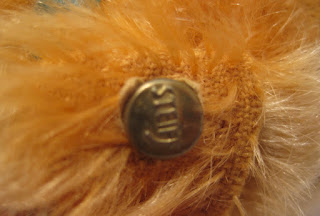
 

This pup's mettle - er, metal, is quite apparent. Besides his lovely copper color, his button also has a spectacular glow about it. Waldi sports a most unusual BRASS colored Steiff button. It is the short trailing "f" style and 6 mm in diameter. This button appeared on some Steiff items from 1933/34 through 1943. This is the first time that Steiffgal has ever seen this button, and it is the only item in her collection of 750+ vintage Steiff items bearing this distinctive trademark. Most of the time, for items produced in the mid 1930's through early 1940's time frame, Steiff used a silver colored short trailing "f" button.

Steiffgal hopes this discussion on Steiff's unusually buttoned Waldi has covered the brass tacks of his identification and legacy for you. 

Have a question about one of your Steiff treasures? Let's talk! Click here to learn more.
The teddy bear search engine