Showing posts with label Shepherd. Show all posts

Sunday, December 5, 2021

Going Green With This Seasonally Hued Steiff Sweetie

"Tis the season for all things green and red!
As such, the timing is perfect to share a recent addition to Steiffgal's hug with you. 
This seasonally hued sweetie is a bit of a mystery but so charming nonetheless. He was on Steiffgal's wish list for awhile given his rarity and somewhat ephemeral construction. Check out this darling doll and see what makes him the perfect 1970s-era ambassador.  

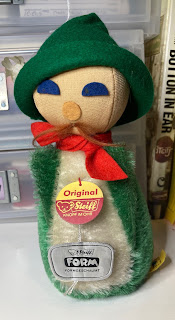
Here we have Steiff's little known "Buzzel Sepp." 
In Germany, "Sepp" is a nickname for someone with the formal name of Joseph. And "Buzzel" refers to his shape and construction. But more about that in just a bit. In all honesty, Steiffgal is not exactly certain who this guy is or who he may represent. He is not obviously a chimney sweep, farmer, or gnome - Steiff's usual cast of male doll suspects. Perhaps he is a shepherd, as he is pictured with a red plastic staff in some reference books. Unfortunately, Steiffgal's Sepp has lost this accessory. 

Buzzel Sepp is upright and unjointed.
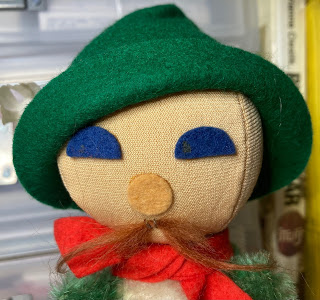
It is not clear if he is standing or sitting as he has no legs. His simple body is made from bright green and white mohair. He rests on a flat bottom. His head is made from a synthetic - probably polyester - fabric. His face comes to life with blue semi-circle felt eyes, a tan circular felt nose, and a long, brown fiber mustache. He is accessorized with a red felt scarf and a green felt hat. His hat has a little daisy on it for decoration. Buzzel Sepp has a working squeaker in his base. This silly guy appeared in the line in this size only from 1972-1974.

It is interesting to note that he is noted in the 1947-2003 Steiff Sortiment as made from dralon but he is clearly made from mohair - at least in this case.

Buzzel Sepp has some distinctive IDs.
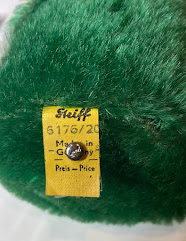
His chest tag is Steiff's red and yellow split style version. This chest tag debuted in 1972, aligning perfectly with Sepp's production date. On the back of this tag, it is noted that Sepp cost 19.90 marks. Given that $1 = DM 3.48 in 1972, this would have been about $5.72 in 1972 dollars; $5.72 in 1972 is worth approximately $37.85 in 2021. This doll also has a silver hangtag with the word "formgeschaumt" or "foam molded" on it. That refers to his pre-formed foam stuffing. And because he does not have any ears, his ear tag is located on the seam of his bottom with his lentil style Steiff button embedded into it. You can see this somewhat unusual configuration here on the left.

Steiff's Buzzel items appeared in the line in 1970s.
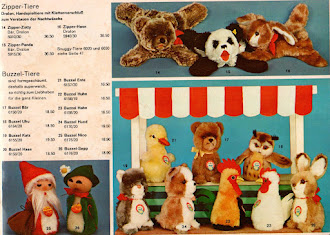
They were all 20 cm, sat upon a flat bottom, had a squeaker, were stuffed with pre-formed foam, and washable. Other Buzzel models created included a rooster, a rabbit, a cat, and a Santa Claus, among others. These items - except for Sepp and Santa - were simplified versions of popular Steiff designs. Steiffgal suspects the Buzzels were created specifically as less expensive and/or lower end toy line for children given how the word "washable" featured so prominently in their marketing. And, in Steiff's 1972 product catalog, their Buzzel line is noted as, "foam-molded, therefore super soft, really to love for the very little ones." You can see Sepp and his other Buzzel friends as they appeared in this vintage catalog here on the left. Just click on the image to make it bigger. 

Steiffgal hopes this discussion on Steiff's quirky Sepp doll has added a joyful buzz to your day.

Have a question about one of your Steiff treasures? Let's talk! Click here to learn more.

Wednesday, September 24, 2014

On A Roll With These Steiff Hightlights From The Upcoming James D. Julia Auction Event!

The temperature is dropping - but the fall auction season is really starting to heat up!  And that means many opportunities to add a new - or a few - new vintage Steiff treasures to your collection!  

To kick off the sales calendar, Steiffgal is very excited to announce that the next James D. Julia, Inc. toy auction features several collections of simply marvelous button-in-ear rarities and collectibles. These include groupings of exciting Steiff treasures, single items that will take your breath away, and also a bunch of very early "button-in-ear" pull toys. These items are all currently being photographed and cataloged for this event, which will occur in Fairfield, Maine on November 7th, 2014. The online catalog should be available in a few weeks. But with Steiffgal on your side, there's no need to wait for a special preview! Here is a sneak peek at a few exceptional items from a fine collection from New Hampshire that will be featured at this can't miss sale!

Size defies when it comes to this amazing duo of teeny-tiny felt farm animals on wheels! And Steiffgal really did do a happy dance when she first learned of these petite treats! Here we have the smallest sized donkey and horse ever produced by Steiff; both are made as pull toys on wheels. Oh baby - each is only 8 cm tall!! The donkey is c. 1917, standing, unjointed, and made from grey felt. He has a tiny grey felt tail and traces of his grey mohair mane. His face is detailed with black button eyes and felt ears. He rides upon a metal carriage mounted on four natural colored wooden eccentric wheels. He retains the blue leather belt that was part of his saddle cloth detailing, and his tiny Steiff button as his ID. This tiny donkey was manufactured in this size only from 1917-1933.

Donkey's neighhh-bor, the horse is also c. 1917, standing, and unjointed. He is made from rust brown felt. He has a black woolen tail and traces of his black mohair mane. His face is detailed with black button eyes and felt ears. He rides upon a metal carriage mounted on four natural colored wooden eccentric wheels. He retains his blue felt saddle cloth and brown belt. His IDs have been lost to time. This handful-sized horse was manufactured in this size only from 1917-1927. 

The next featured Steiff pull toy in this auction is truly the wheel-deal as well. This blue-ribbon buddy is a charming example of the earliest model German Shepherd dog produced by Steiff. And it is doubly interesting to note that according to the Steiff Sortiment reference book, this pattern was first produced on wheels and then without... it is usually the other way around. Although many collectors assume that Steiff has called their wonderful and popular German Shepherds "Arco" since their introduction, the breed did not actually  official receive its official "Arco" moniker until 1937.

So here are the Shepherd's doggy-details. He is standing, unjointed, and made from brown and tan mohair. His appealing and realistic face is detailed with a prominent brown muzzle, a black hand embroidered nose and mouth, and black and brown glass pupil eyes. He has a curvy tail and black embroidered claws. He rides upon four regular green wooden wheels. He retains his original leather collar, but his IDs have been lost to time. This model, an absolute favorite with vintage Steiff collectors worldwide, was manufactured in 28, 35, 43, and 50 cm from 1923-1928 and due to his limited production and time frame, rarely comes up for sale on the secondary market.

Today's final Julia's auction highlight, a very vintage Steiff zebra on wheels - may just have you seeing stripes. That's just what happened to Steiffgal when she first laid eyes on this jungle gem! These striped sweethearts have been gracing the Steiff catalog since 1899, and collectors have been "lining up" since then to add these beautiful beasts to their hugs.

Here are zebra's facts, in black and white. Here we have an utterly fantastic and seldom seen early woolen plush zebra on wheels. He is standing, unjointed, and made from textured grey material that has been lovingly and painstakingly hand painted with black stripes. He has a grey and black yarn mane and a black mohair tipped tail. His charming and distinctly old fashioned looking face is detailed with black button eyes. He rides upon four early metal wheels. He retains his Steiff button as his ID. This absolute rarity was manufactured in 28, 35, 43, 50, and 60 cm from 1910-1919 and is seldom, if ever, seen up for public auction.  

Steiffgal hopes this preview of some of the wheeled wonders to be sold at James D. Julia's November 2014 toy auction is worthy of a round of applause! The full catalog is now online and can be accessed by clicking here.


Have a question about one of your Steiff treasures? Let's talk! Click here to learn more.

Wednesday, April 17, 2013

Using A Little Steiff ESP To Identify A Vintage Dog Friend

Mind you, Steiffgal is no psychic when it comes to Steiff.  The company has made thousands and thousands of different products since the late 1800's when it first started producing playthings for children.  And photos are so important when assessing subtle differences between similar products.  However, in the case of this reader's question, Steiffgal was able to use a little ESP (Essential Steiff Powers) to help identify an old friend simply by description.  Hazel writes:

"Steiffgal:

I don't know if you can assist me. I stumbled upon your website recently whilst trying to find some history re: my little Steiff item.

I have a Steiff German Shepherd measuring 10" or 26 cm from paw to tail. He has a red velvet tongue and he is lying down slightly on one side. He has a yellow Steiff label in his ear with a worn silver looking stud. He has some wear to him and is a lovely shabby shade of browns and darker on his back.

I am sorry I do not know how to add photos to my email so any information you could offer would be great.

Many thanks I look forward to your reply.

Kind regards, Hazel" 


Unless she's in a "dog-daze" Steiffgal is all but certain that Hazel's pooch is Steiff's lying Arco German Shepherd.  This precious pooch is unjointed, lying to one side, and made from tan mohair that has been gloriously and realistically airbrushed with patches of black, brown, and tan.  He has pert ears, large and floppy paws, and an impressive tail.  His face is detailed with black and brown pupil eyes, a well defined muzzle, and a happy open mouth with a large red felt tongue.  Lying Arco was produced in 22, 35, and 50 cm from 1957 through 1976.  Steiff usually doesn't count the tail in measurements, so it is Steiffgal's best guess that Hazel's dog is the 22 cm size.  

Steiffgal is unable to fetch details about Arco's button from Hazel's note.  However, if his button is the raised script version, he would have been produced approximately in the 1957 through 1968 time frame.  If he has the domed lentil style button, he would have been produced approximately in the 1969 through 1976 time frame. 


German Shepherds are one of Steiff's beloved "Best in Show" dogs that have been in the line almost continuously in one form or the other since 1923.   They have appeared over time in mohair and wool plush and standing, sitting, lying, on wheels, as studio (life sized) models, and even as dog-dolls in the late 1930's through early 1940's.  The photo on the left of the Pupp-Arco or Arco Doll is from Pfeiffer's 1892-1943 Steiff Sortiment book.  Pupp-Arco is extremely rare; Steiffgal has never actually seen one in person.  Overall, the presence - or absence - of a tongue on Arco is one of the key clues collectors use to date Steiff's German Shepherds! Those produced before 1957 did not have tongues while those produced from 1957 onward did.

Steiffgal hopes this Arco identification has been an ESP (Exciting, Surprising, and Phenomenal) experience for you!

Have a question about one of your Steiff treasures? Let's talk! Click here to learn more. 

Wednesday, September 26, 2012

All Ears Over This Wonderful And Early Steiff German Shepherd

Listen up!  Steiffgal just got back from a visit with collectors from the Orlando area, at a wonderful Steiff event sponsored by Judy's Dolls of Longwood, Florida.  And guess what just "rolled" into the appraisal clinic?  This fabulous but somewhat mysterious Steiff dog with large floppy ears, perched upon wooden wheels.   When Steiffgal saw him, he sort of rang a bell with her - but something wasn't exactly lining up.  After a few minutes of noodling, she finally figured him out.  So, just who is this delightful doggie?

Hear, hear... what we have here is Steiff's early Arco German Shepherd on wheels.  He is 43 cm standing, made of mohair, and unjointed.  He has an open, felt lined mouth and felt lined ears.  His body is detailed with brown, tan, and black airbrushing, giving his fur and coat nice texture and a realistic appearance.  His face is detailed with brown and black glass pupil eyes and a black hand embroidered nose.  His claws are indicated by black stitches, and he has a thick and impressive tail.  He rides upon a black metal carriage and four red wooden wheels.  Arco has his original red and white pull cord and red wooden handle.  Overall, Arco on wheels was made in 35, 43, 50, 60, and 70 cm from 1937 through 1943.  This design was also called "Police Dog" and some models had this name imprinted on their chest tags.

This blue ribbon beauty is clearly "man's best friend" as well as a "friend for life."  As a result, he has suffered a bit of wear that in some ways made his exact identity a bit challenging initially.  Much of this focuses around his facial area.  One of the details that makes the early Arco design so particularly life-life and irresistible is his ears.  They were made to stand straight up, much like the real dog.  (You can see this here on the left, in a photo from the Steiff Sortiment book, which shows what this example looked like when new.) This was done by lining the ears in a metal wire, much like Steiff's ear construction on their beloved Petsy bears.  However, in this example, the ears were extremely floppy and positioned high up on the dog's head.   It was apparent that over time, the ears had come loose and someone tried to sew them back on, albeit in a somewhat sloppy way.  It is Steiffgal's best guess that when the ears were sewn back on, someone removed the wires so they would not stick out on the ends of repair.  When she felt along the perimeter of the ears, she did feel small pieces of wire; it is also possible that the wire broke over time and when the ears were replaced, the seamstress took out as much of the wire as possible.  

Arco's other facial issue, was, well, easy to see.  His eyes just didn't look right.  One was much larger and rounder than the other.  Steiff traditionally attaches eyes to their products by sewing them securely through the head (yes, this requires a mighty big needle, great skill, and strength!) and tying the two threads in a large knot at the the back base of the neck. You can usually feel this as a significant bump or indent on an item.  However, Steiffgal could not find this feature on this Arco.  She also noticed that when she ran her finger around the perimeter of the eyes, she felt a hard glue-like residue.  It is Steiffgal's best guess that the original eyes had fallen out, and over time, someone had found replacement eyes and glued them back into place. 

To repair, or not to repair, that is the question.  Steiffgal realizes that every collector and enthusiast has their own feelings about this question.  Issues of authenticity, value, cost, and personal preference all come into play here.  However, in this case, Steiffgal recommended to Arco's owners that they consider having him professionally restored, given that the dog is in otherwise really nice condition, is relatively rare in this size and configuration,  and appears to be completely structurally sound.  No surprise here, but they were all ears over this suggestion!  This relatively simple two step facial restoration, if done professionally by an expert, would bring back his absolute charm and help draw attention to his most impressive features.

Steiffgal hopes this discussion on this vintage Steiff Arco has shepherded you into a new way of thinking about restoration.  

Have a question about one of your Steiff treasures? Let's talk! Click here to learn more.
The teddy bear search engine