Showing posts with label replica. Show all posts

Sunday, June 19, 2022

This Steiff Special Edition Chin Chin Is A Win-Win!

The Steiff Sommer Festival will be here before you know it!
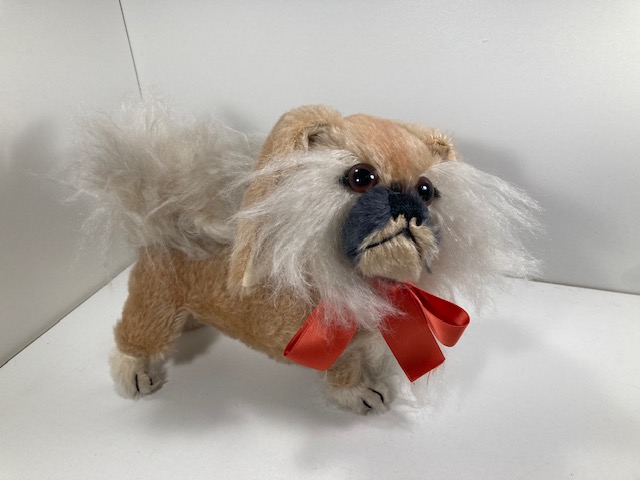
This annual celebration, held this year from June 24th-26th, 2022, will be the first live gathering of its type on the Steiff factory campus in Giengen since 2019! One of the exciting components of this happening - or at least it was in the past - was an extremely limited edition produced in honor of the event. These editions have taken a number of forms over the years, including a series of colorful Teddy baby bears. After several years of searching, Steiffgal finally got her hands on one of the lesser known event editions - a dog modeled on a prewar era button-in-ear-buddy. This pretty pooch was made during the manufacturing demonstration held at the Steiff Festival of 1998. Come take a look at this bow-wow beauty!

This Chin Chin is a win-win!
She is standing on all fours, head jointed, and measures 17 cm tall and 22 cm wide. Her tail, sideburns, and bib are made out of outrageously long, soft blonde mohair. Her body, forehead, ears, and legs are made from shorter blonde mohair, and her feet are made from very short mohair. Her delightfully detailed face comes to life with oversized brown and black eyes; a dimensional, grey and tan mohair inset muzzle; a black and embroidered nose and mouth; and a spot of airbrushed highlights. She has three hand embroidered claws on each foot. Her special event chest tag reads, "Pekinese Chin Chin 1931 Replica." She also has her special ear tag, indicating she is #149 of 300 produced, and the date of the Steiff event. Her hang tag doubles as her certificate. 

Tag- you're it - when it comes to deciphering this dog's somewhat cryptic design inspiration.
She is documented as a "Pekinese Chin Chin" on her chest tag. Let's dig a little deeper into this name game - as these really are two very different dog breeds! Steiff did produced a Pekingese, as well as a Chin Chin, in their prewar line. The company's Pekingese was made in 10, 14, 17, 22, and 25 cm from 1938 - 1943. You can see an example of this dog here on the left. Their Chin Chin was produced in 10, 14, 17, 20, 22, 25, 28, and 35 cm from 1931 - 1939. The designs in many ways were similar - both dog patterns were standing on all fours, head jointed, and featured dramatic tails that curved over their rumps and were stitched in place. However, Peky the Pekingese had short, cropped ears while Chin Chin had long, floppy, triangular shaped ears. So it's not entirely clear why this Festival edition was called both a "Pekinese" and a "Chin Chin"... maybe to appeal to owners of either dog breed?

It is also interesting to note what happened to Steiff's similar Pekingese and Chin Chin patterns over time.
Despite her delightful appeal and personality, a Chin Chin did not appear in the line postwar. Her cousin Peky did, though. The company's Pekingese had a major makeover post war and was reintroduced to the collector's world in 1953. This updated Peky was produced in 8, 10, 14, and 22 cm though 1977. The post-war Peky was standing, made from light brown mohair, had a detailed black muzzle (mostly velvet in the smaller sizes; mohair in the larger ones), and a darling, pouty mouth. This pattern was also produced as an 18 cm hand puppet from 1963 through 1964.

Steiffgal hopes this discussion on this special event dog has put you in a festive mood indeed.

Have a question about one of your Steiff treasures? Let's talk! Click here to learn more.

Saturday, October 10, 2020

The Best of All Worlds: Steiff REAL and Replica!

Are you seeing double? Usually, this is cause for alarm. But not in this case, in terms of these two very fine Steiff fellows. Produced nearly a century apart, these "hairy canaries" prove that good looks, genes, and and remarkable beards are not only timeless and appealing, but great assets, too! Let's take a look at this original turn of last century Steiff doll and his 1990s era replica and see how they compare.


Things are twice as nice when it comes to Steiff's "Hungarian" doll. The original is shown here on the left, and the replica from 1996 is on the right. The early and original Hungarian doll was manufactured by Steiff from 1912 - 1917. According to the Pfeiffer's early Sortiment reference book, he was produced in 50 cm, although this particular example measures 43 cm and the number on his tag reads "Ung 43." It is very possible that he was produced in a number of different sizes during his manufacturing run; not all early records are perfect.

So let's look at the older guy first. Vintage Hungarian - on the left in this photo - is made from felt, stuffed with excelsior, and fully jointed. His uniform is integral to his body. He wears a red felt jacket that is trimmed with curly, jet black mohair and detailed with metal buttons, black and gold embroidery, and cord and orange felt trimmed cuffs. His tan pants are decorated with red embroidered felt stripes. His knee-high leather boots are trimmed with tan string tassels and orange felt. His "proper topper" is a red felt cap embellished with a metal button, orange felt, and a leather brim. Hungarian has a gold rope whip wound around his left shoulder. His face comes to life with Steiff's signature center seam construction, black eyes, a prominent nose, oversized ears, and a full mustache, beard, and head of hair made from the same curly jet black mohair that decorates the bottom circumference of his jacket.

Now let's check out his doppelgänger. This marvelous Steiff replica doll was produced in the late 1990s as part of limited edition doll and horse set. You can see that dynamic duo in the photo here on the left. Although the replica is cataloged at 43 cm, Steiffgal's example actually measures 47 cm tall. In the late 1980s through the late 1990s, Steiff created a series of replicas based on their 19-teen era Schlopsnies Circus program. These replica dolls included clowns, animal trainers, musicians, and performers, among others. The original Schlopsnies Circus was large scale, dynamic, and extremely popular exhibit designed and created by Steiff creative freelancer Albert Schlopsnies. It consisted of over 30 circus themed dolls and acrobats, based on real life performers at the world famous Circus Sarrasani of Dresden, Germany.


So how do the original and the replica align? Keep in mind that it is nearly impossible to recreate something exactly as it was a century onward - given how materials and technology change over time, and how fabrics and fillings oxidize and age. With that as a backdrop, let's compare three factors here: these two doll's detailing and materials, construction, and general aesthetics.

Detailing and materials:
For the most part, the two have a lot in common in these categories. There are a few very minor differences, like the exact embroidery on the back and arms of their jackets and the spacing of the stripes on their cuffs. The original has his button and white paper tag located in his ear, while the replica has his button in ear, and another Steiff button and his white tag located on the edge of his jacket. Clearly, the doll's rope whip and boot tassels cannot be exactly replicated as the materials used for these accessories have evolved over time. The key physical material difference between the early Hungarian and the replica Hungarian is that the replica uses long black plush in the place of long black mohair on the doll's hair, beard, and jacket trim - perhaps as a cost savings measure. 

Construction:
The original Hungarian doll is entirely stuffed with excelsior from head to toe. The replica's head is softly stuffed, while the rest of his body and limbs are stuffed with excelsior. It is really interesting to note that the dolls are nearly identical in weight, with the replica just 4 grams heavier than the antique one. Both dolls have analogous jointing. Here on the left, you can see an original Steiff advertisement from around 1912 featuring the Hungarian astride a camel; the photo is from Ayers and Harrison's Advertising Art of Steiff, Teddy Bears and Playthings.

General aesthetics:
It is obvious that the turn-of-last century doll is slimmer, curvier, and more elegantly scaled than the replica. This is especially noticeable in the face; the original has old fashioned facial contouring and a smaller, to scale nose while the newer version has a fuller, flatter, rounder face with a really bulbous nose. This probably has to do with the fact that excelsior stuffing allows greater contouring than simply polyfill. The replica, although still quite handsome and a wonderful addition to any Steiff collection, is simply a bigger, somewhat streamlined, and boxier interpretation.

Steiffgal hopes this discussion on Steiff's original and replica circus dolls has been one hot ticket for you.

Have a question about one of your Steiff treasures? Let's talk! Click here to learn more.

Saturday, January 10, 2015

Climb Every Mountain For This Great Vintage Steiff St. Bernard Dog!

The excitement of finding wonderful vintage Steiff treasures is certainly universal... and all collectors love to be able to say... "Look what I found!" Check out this note from a reader from Germany who asks for advice on a possible purchase of a very vintage Steiff dog. Leonie writes: 

"Dear Steiffgal, 
Could you give me an advice for a purchase? I saw a Steiff prewar St. Bernard dog on eBay. He lost most of his fur, and his button, too. He is 28 cm high and his price is 95 euro. Should I buy him or is he too expensive? I have also sent a picture. I would appreciate an answer very much. Best regards, Leonie"

Who wouldn't climb every mountain for this wonderful mountain-loving canine?  And yes, Steiffgal says YES, GO FOR IT!  What we have here is a much loved 1930's-era Steiff sitting St. Bernard dog.  This model was made both in white and brownish-copper mohair and white and tan wool plush in 10, 14, 17, 22, 28, and 35 cm.  The mohair version appeared in the line from 1929 through 1937, and the wool plush version from 1929 through 1932.  Given this photo, it is hard to tell if Leonie's pup was originally made from mohair or wool plush.  Both versions were adorable, very puppy-like, and featured realistic fur coloring.  Each model had a dear face that was detailed with expressive brown and black pupil eyes, a black hand-embroidered nose and mouth, and a distinctive muzzle which came to life with black and pink airbrushing. These sitting St. Bernard models had their tails wrapped gently around their backsides, much like how "real" dogs sit... especially when they are on their best behavior!


The mohair version of Steiff's sitting St. Bernard dog - like several very popular models of the 1930's - was also produced as a tail-moves-head model.  The one big difference between the regular and tail-moves-head version of this design is the position of the tail.  The regular versions have wrapped tails, while the tail-moves-head versions have a stretched-out tail.  The sitting tail-moves-head version was made in 11, 15, 18, 23, 29, and 36 cm from 1931 through 1934.  These dynamic doggies in good or better condition are quite rare on the secondary market;  in 2013 Teddy Dorado sold a 29 cm version for over 7,000 euro!  And just how beloved is this moving model?  In 1993,  Steiff made a replica of their special tail-moves-head St. Bernard in in an edition size of 4,000.  This replica is pictured here on the left. 


St. Bernard dogs continue to be collector's favorites today. Many enthusiasts can't get enough of the company's models from the late 1940's through the 60's, and it is easy to see why! It is interesting to note that the first St. Bernard to appear after the factory reopened for business post World War II was a larger standing mohair model on wheels. He was based on the company's pre-war design and was manufactured in 43, 50, 60, and 62 cm from 1949 through 1957. A slightly simplified standing model, also based on the prewar design, was available in 10, 14, and 22 cm from 1953 through 1957.  These early standing post-war St. Bernards are pictured here on the left.

In the early 1960's, Steiff again updated their standard line St. Bernard and even gave him a name for the first time - Bernie. Bernie was made from mohair and available sitting or standing on all fours. New Bernie had a different pattern of facial airbrushing, a chunkier build, and a smaller scale tail; standing Bernie also featured a cask attached to his collar. Standing Bernie is pictured here on the left. Overall, sitting Bernie was produced in 12 and 22 cm from 1963 through 1970 while standing Bernie was made in 22 cm from 1964 through 1966. In about 1970, Steiff also produced a most impressive display sized St. Bernard, perhaps as an exclusive for the high end toy retailer FAO Schwarz. And, since then, St. Bernards have always been a standard feature in the Steiff line, mostly appearing in large size plush models for children's fun and play. 

Steiffgal hopes this discussion on Steiff's wonderful legacy St. Bernards has been a warm and fuzzy experience for you! 

Have a question about one of your Steiff treasures? Let's talk! Click here to learn more.

Sunday, August 11, 2013

Longing For More Information On This Early Steiff Novelty Dog

Steiffgal bets its a long shot that you've ever seen anything like this before!  Take a look - a long look -  at this wonderful, early Steiff dog... isn't he just marvelous?  This comical canine belongs to a collector in the Midwest who seems to specialize in delightful Steiff rarities.  Brad writes over a series of communications...


"Steiffgal:

Attached are some photos of the Ueberdax. 

He is approx. 14.5 inches long if you straighten his tail which is quite fragile as you can see. He is made of brown velvet and is filled with what seems like cotton batting or some other soft material. He is soft when you squeeze him, not crunchy like he's filled with wood shavings. 

He has a few minor issues.  His tail is split in two places and looks to have been maybe reattached at some point.  He also has a small split in the velvet on one side of his face and some worn areas on his velvet coat, but that is to be expected. Also not sure if he had more stitching on his nose. 

The button was hard to photograph.  It is very small but I think you can make out the style and probably date him. You would have a better idea of his age based on the button than I would.  

Thanks for your help!

Brad"

Steiffgal is over the moon, in overdrive, and willing to go overboard to tell you about this Steiff Ueberdax or "overdachshund!" What we have here indeed is Steiff's extremely long and narrow caricatured dachshund.   He is standing, unjointed, and made from brown velvet.  His face is detailed with early black shoebutton eyes and a simple hand embroidered nose and mouth.  From Brad's description, it appears that he is stuffed with kapok, an organic cotton-like material obtained from the seed pods of a tropical tree.  Steiff used this stuffing as a light and fluffy alternative to excelsior at the turn of last century.  

Steiff produced these long lovelies overall from 1903 through 1921.  They were produced in three sizes in brown velvet, two sizes in black and yellow velvet, and as a 22 cm "Buerstendax" or Brush-Dax.  This brush version had the body of the brown velvet dax as part of a clothing brush - perhaps the early version of a lint brush!  The tiny Steiff button Brad describes was in use from about 1906 to 1925; this helps date his piece to the approximately 1906 through 1916 time frame.  You can see this button here on the left, along with tiny traces of his early white ear tag. 

It is interesting to note that the models on all fours were cataloged as 8, 12, and 14 cm.  Clearly, they were much, much bigger (or at least longer!) than that!  The sizes in this case refer to their height from the top of their heads to the ground.  For example, the 8cm version is actually about 21 cm long.  However, the Buerstendax was cataloged at 22 cm, clearly referring to the item's length.  Ah, the never ending mysteries of the company we know and love... 

Dachshunds are an early blue ribbon favorite in the Steiff catalog, and for good reason.  Apparently the Steiff family themselves loved this particular breed, and always had a few (or more!) underfoot.  This comical doxie pattern was designed by Richard Steiff as a novelty and was based on his own beloved companion named Walle.   Dachshunds are great hunting dogs and Richard and Walle spent many happy hours together in the fields and forests around the Giengen, Germany area.  This very vintage design was brought into the collector's spotlight a few years ago when a fine example was sold for around $7,200 at the annual Steiff Sommer Festival auction.  As a follow up to the excitement generated by the transaction,   Steiff produced both a 22 and 60 cm long replica version (pictured here on the left) of Richard's black and gold Ueberdax in 2005; in 2006 this was followed up with a 22 cm long replica version of his brown velvet Brush-Dax.  

Long story short, Steiffgal hopes you've really enjoyed this discussion of Brad's Ueberdax!

Have a question about one of your Steiff treasures? Let's talk! Click here to learn more!   
The teddy bear search engine