Showing posts with label photo. Show all posts

Tuesday, September 21, 2021

Good Things Come In Threes With This Precious Prewar Steiff Pup!

They say good things come in threes, and that perfectly describes this week's blog treasure. Check out this amazing, and amazingly interesting, "pup from Pittsburgh." The more you learn about him, the more intriguing he becomes!

This heavenly creature is Steiff's early Saint Bernard dog. He is standing, unjointed, stuffed with excelsior, and made from tan and cinnamon colored mohair. He measures 15 cm tall and 20 cm wide. His proportional tail is positioned downward. He has three brown claws on each of his paws. He comes to life with floppy mohair ears which are tacked to his head, felt backed brown and black glass pupil eyes, a lightly shaved muzzle, and a  brown hand embroidered nose and mouth. He was produced in 17, 22, and 28 cm from 1914-1927. He is described in Pfeiffer's Sortiment as, "mohair plush, white, brown spotted, standing, young, soft stuffed."

So just what makes this guy such a top dog? First, let's start with the obvious. Steiff's prewar pups are always in demand, and those designed and produced in the 'teens and before are highly desirable. That is because they have - for the most part - a distinctively earnest, "literal", and basic look to them. They are also so well constructed and seldom come up for sale on the secondary market. Starting in the mid-1920s, Steiff's canine designs changed significantly and became more "childlike" - often with oversized features and detailing, imaginative coloration, and truly playful personalities. So not only is this example from a key time frame in Steiff's production history, it is also small scaled - another super interesting factor that always calls to collectors.

Now let's move to his second outstanding detail. It is impossible to tell at first glance, but this petite treat also has an amazing secret. He has TWO small silver long trailing "f" buttons in his ear! You can see this illustrated here on the left, One of the buttons has traces of a white paper tag, but the other does not. So why is this? Although the double buttoning in his ear could be an accident, his ear is so small, and the button is so well placed, that the second button truly looks intentional. In the past, Steiff used multiple buttons to keep track of which items were samples, prototypes, and versions of items under development. In the 1920's, this usually took the form of a regular button in one ear, and a "muster button" in the other. It is entirely possible that this dog's multiple button system is an early form of this tracking system - given he was introduced in the 19-teens. Unfortunately, only he knows for sure!

And if you think things couldn't get better than that - guess again! The third amazing thing about this fine example is that it comes with full provenance - that is, documentation regarding his life story. In this case, his provenance includes a letter and several photos - one which is shown below. According to the letter, in part:

"I wanted to share a little bit of history about this Steiff St. Bernard toy dog. It belonged to my father, Robert, who was born in Pittsburgh, PA in June, 1924. My grandmother was sentimental and a "saver," so many things from my father's childhood through his Army service in WWII were passed down and cherished, including his stuffed dog named "Sheppy."

My father always enjoyed reminiscing about his childhood, and he thought his dog was a gift received either for Christmas in 1925 or his second birthday in 1926. Looking at many photos, there was certainly a time period that my father went nowhere without his beloved "Sheppy" in hand."

You can enlarge the provenance letter as well as the photograph here on the left by clicking on them.  

Steiffgal hopes that this discussion on this fantastic Steiff Sheppy has left you quite Peppy!

Have a question about one of your Steiff treasures? Let's talk! Click here to learn more!

Monday, June 21, 2021

The Power Of Provenance!

What makes a fantastic Steiff find simply extraordinary? When it comes with full provenance. Provenance, which can include documents and/or photos, is "the place of origin or earliest known history of something," "the beginning of something's existence; something's origin," and/or a record of ownership of a work of art or an antique, used as a guide to authenticity or quality," according to Merriam-Webster. In this case, all three truly apply! Come learn more about this amazing Steiff Ted from 1905 through words and images from his original family.

This marvelous and very early Steiff cub stands 16 inches tall, is five ways disk jointed, and made from mohair that has faded from an apricot color to a light blond color. 
You can see hints of his original hue in his cracks and crevices, and places the "sun don't shine." Ted has black wooden shoe button eyes, traces of his black stitched nose, and five black claws on each of his hands and feet. His stitched mouth has been lost to time. His original owners invented in essential, finely rendered professional restorations on him to improve his stability and aesthetics; these included a light restuffing, redoing his felt pads, and restitching his claws.

This turn of last century treasure also has a distinctive physical form to him.
He has a very early shaped face and head, somewhat reflective of the Baerle style. His muzzle is long and pronounced, and a bit less sophisticated (don't take that in the wrong way!) than bears produced just a year or two later. Ted's body is very similar in looks and scale to Steiff's c. 1904 rod bears, with a rounded, almost American football shaped torso. He has very long arms with curved wrists, skinny, narrow feet, a back hump, and spoon shaped pads. He has a really teeny tiny blank button in his ear... it probably measures about 2-3 millimeters in diameter. Given all of these metrics and factors, it is Steiffgal's best guess this bear was produced at the factory in Giengen in c. 1905.

But wait... there's even MORE to love about this ancient cub.
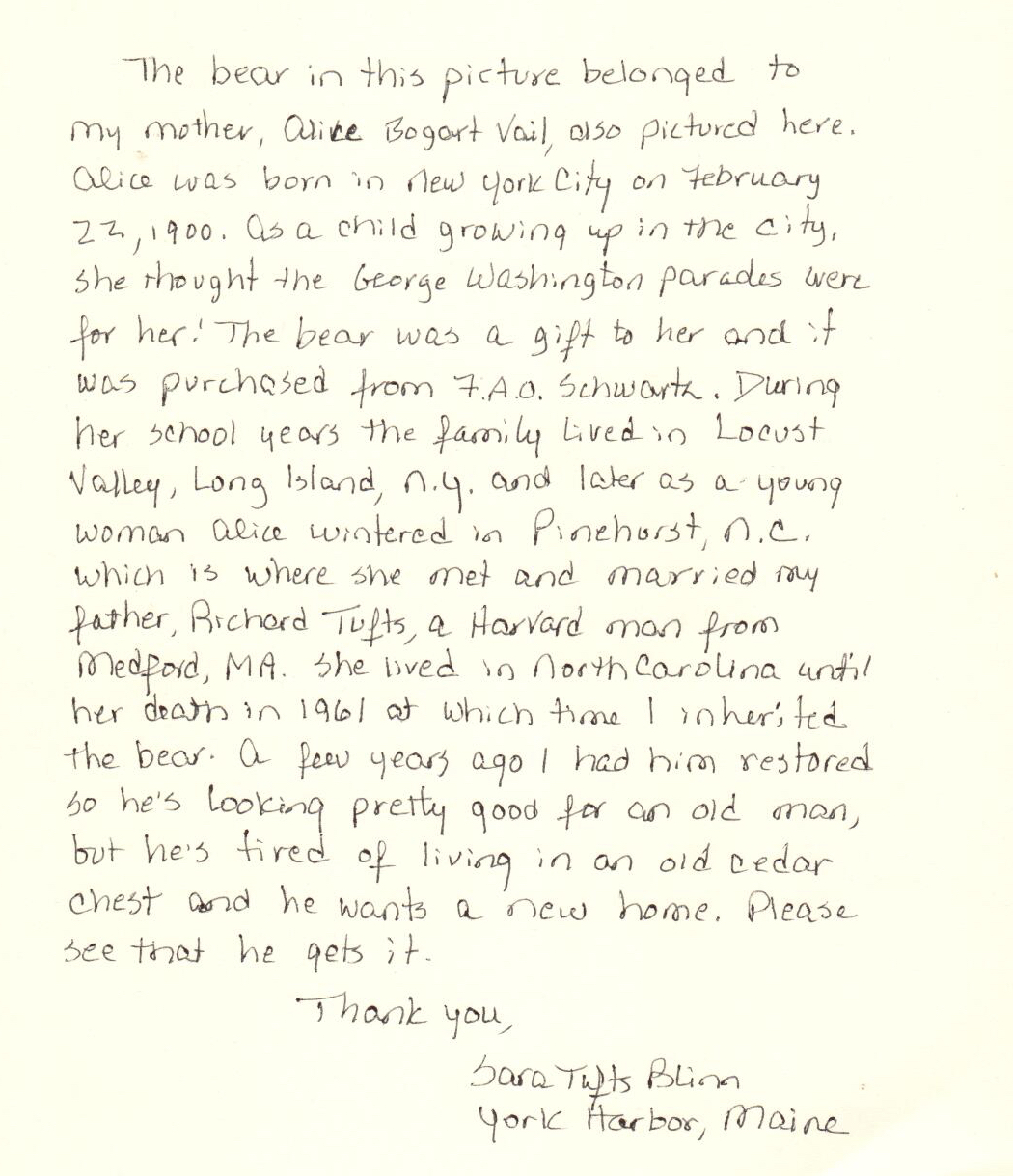
He has a handwritten, full letter of provenance summarizing his history, as well as a photo of him with his original owner. This bear was from the family of Alice Bogart Vail Tufts who was born in NYC in 1900. This bear was given to her as a gift when she was a child, and was purchased at FAO Schwarz. Given Schwarz and Steiff have been doing business together since 1906, this makes this bear one of the earliest Steiff bears extant purchased in America! You can see this photo of Alice and her friend for life from c. 1908-1910 here on the left and the letter below; click on each to enlarge them. In the photo, which appears to have been taken in a studio, Alice is "feeding" this bear with a teaspoon. Don't you just love her HUGE hair bow? 

Steiffgal hopes this fabulous bear and his lifelong documentation has helped to demonstrate the Power of Provenance! For more about this delightful cub, check out this YouTube video on his physical and historical highlights!


Have a question about one of your Steiff treasures? Let's talk! Click here to learn more.

Sunday, March 10, 2019

Prettier Than A Picture!

Picture the next great Steiff mystery! It might involve an unusual shape, size, or color of one of the company's beloved antique rarities. Or, it just might be about... a photograph. Check out this note from Kathryn from New York about this antique family image of her Grandfather and his Teddy bear. How would you frame your response? She shares:

"I’m sending you this beautiful photo of my grandfather who raised me. Unfortunately we do not have the bear anymore. I’m doing an oil painting of this photo and I want to do justice to the Teddy bear in the picture. I think it looks like a Steiff.

The mystery is why is the tag on the right ear instead of the left? It seems to have all the other features of a Steiff. I was hoping for your thoughts on this if you don’t mind.


My grandpa Henry is of German decent and was born in Jersey City in 1899. The photo was taken by a photographer in New York City. I think he is under the age of 10 in the photo so that would give us an idea of the bears age. I would also like to know the color you think it is for the painting. I started to paint it in a beige color with dark brown nose and lips and black eyes which are hard to see from the angle. This is the clearest copy I can get.

I just think this is such a beautiful photo of a child with his beloved Teddy bear.

I’m anxiously looking forward to hearing what you think. Is it some kind of rare thing? Or is it an imitation?

Thank you for your time and knowledge.
Sincerely, Kathryn" 

Ok, let's first focus our attention on the actual photograph. It is Steiffgal's best thinking that the picture was actually "flipped" at some point. This might have happened years ago, during the printing from the negative, or sometime more recent, via an "electronic" step. If you take the mirror image of the photo, the button is clearly in the right place and in the correct ear. And, if you look really, really closely, Steiffgal thinks you can even make out some part of an ear tag, too. You can see both versions of the photograph in the image here - both the "original" and "mirror" image. 

Now for a little color commentary. Given the hue contrasts, appearance, and scale of the bear in the photograph, it is Steiffgal's best thinking that he is most likely a white Steiff bear in the roughly c. 25 to 35 cm range from the c. 1906-1909 timeframe. And why is that?  

(For reference, here on the left we have two white Steiff cubs from about the same era as Henry's; the big boy is 40 cm tall and the little guy is 22 cm tall.) 

1. First, the date is pretty clear given the information provided by Kathryn. The photo is from about 1909. The bear could have been made a few years earlier than that - as early as about 1906, given its presentation. The Schwarz brothers started carrying Steiff in their stores here in America in 1906, and were the first stores to do so. 

2. Now the size. This has to be estimated purely through "back of the envelope" techniques. Today, an "average" 10 year old boy is 55 inches tall or about 140 cm. Henry could have been much taller, or shorter, than this - there is is no way of knowing. But given he was "average," his bear appears to be roughly about 20 to 25% of his height, putting his bear in at c. 28 to 35 cm tall. And although it's impossible to tell with certainty from the antique picture, it appears that Henry's bear may have a horizontally stitched nose - given there is no "prominent" vertical center stitch visible. This also hints that the bear is less than 40 cm tall. 

3.  And last but not least, his color. The bear is pretty much the "lightest" object in the shot. And his nose is not very dark - like Henry's hair or eyes. This suggests the nose is brown - and in turn, that the bear was white. 

Steiffgal hopes this photograph has given you a delightful snapshot of Steiff's enduring quality and appeal.

Have a question about one of your Steiff treasures? Let's talk! Click here to learn more.
The teddy bear search engine