Showing posts with label Bazi. Show all posts

Monday, January 3, 2022

Taking A Joyride With This Midcentury Steiff Car Display

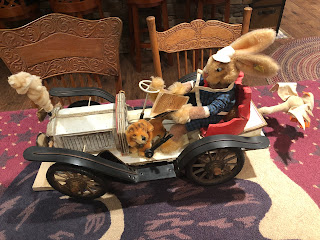
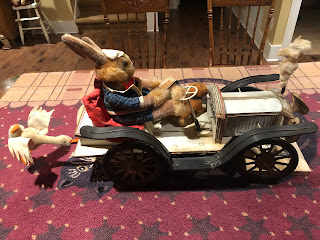
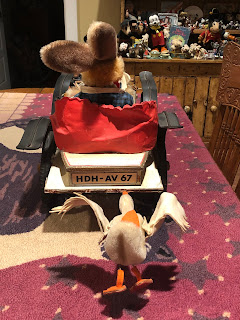
So let's kick off 2022 in fifth gear! It's always so much fun to learn about unusual Steiff display pieces, and this one will make you want to hit the road for sure. What secrets do its design elements hold? Check out this note and photos from Susie in Ohio. She shares, 

"This is a wonderful Steiff display piece I own that I call "Distracted Driving!" It has a Lulac, a Cockie, and a Tulla Goose. When you push the car, the goose wings flap up and down and the cotton smoke stack in the front rotates. It is in pretty great condition although some of it is made from rubber and has become slightly brittle. This does not distract from its irresistible charm. I honestly think this display should be in a museum somewhere!"

A joy ride indeed!
Steiff's tradition of creating still and animated displays goes back to the dawn of the 20th century. These first, early vignettes reflected things like life in a small town, farming, schoolrooms, or sports, among others. In some cases, these were photographed for advertising purposes, while in others, the scenes were actually sold as a package to stores as displays. It wouldn't be long before Steiff's creative team brought these scenes to the next level with movement; in about 1910 the company launched the large-scale, mechanized window display pieces that it would continue to produce throughout the 20th century. Albert Schlopsnies, a design and creative freelancer for the company, is responsible for many of Steiff's most breathtaking museum, retail, exhibit, and special event displays through the mid-1920s. 

Now let's take a closer look at Susie's display.
 
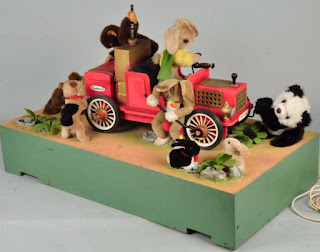
Its passengers include two standard line items and one modified standard line item. Given its form, materials, and detailing, it is Steiffgal's best guess that this display was made sometime in the c. 1955-1965 timeframe. Steiff used the "old jalopy" car concept in its automaton production frequently throughout the third quarter of the 20th century. Here on the left you can see a similarly themed display from the late 1970s or so; the photo is from LiveAuctioneers/Morphy Auctions. 

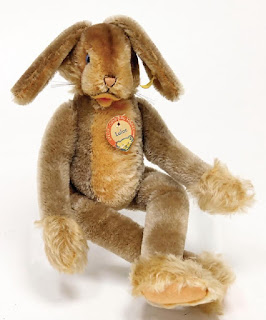
Taking the wheel of this display is Steiff's legacy Lulac rabbit.
This long legged lovely was produced in 43 cm from 1952-74 and 60 cm from 1964-66. Given the scale of display, it is Steiffgal's best guess that this is the smaller version. He is five ways jointed, features comically long arms, legs, and torso, and is made from made from caramel and light orange mohair. His paws are made from longer, shaggy mohair. His face comes to life with an open, peach felt mouth, a pink embroidered nose edged in black, and blue and black googly style eyes. It is possible that his name derives from a combination of the German words associated with laughter, smiling, and a "long and lanky" presentation. You can see Lulac here on the left, the photo is from Liveauctioneers/Ladenburger Spielzeugauktion GmbH.

Lulac's wingman is a standing Bazi dog.
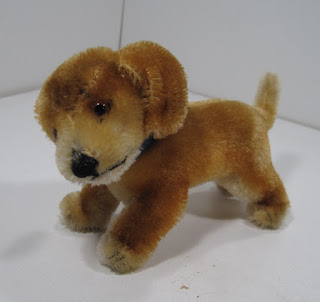
He is made from short tan colored mohair that is accentuated with darker airbrushed highlights on his back, chest, and head. Bazi's face is detailed with black and brown pupil eyes and a hand embroidered nose and mouth. Bazi left the factory in Giengen wearing a blue leather collar with a little brass bell. The standing mohair version of Bazi was produced in 10 and 14 cm from 1950 through 1975. Given the presentation of the display, it is Steiffgal's best guess that this is the 10 cm version. You can see standing Bazi here on the left, the photo is from Steiffgal's collection. 

At the tail end of all of this - and yes, pun intended - looks to be a little Tulla goose, sort of. 
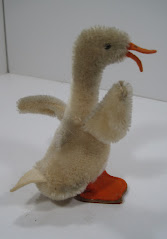
Regular line Tullas are standing, unjointed, and made entirely from white mohair with grey airbrushed highlights, especially on their heads and necks. They feature playful, outstretched mohair wings, oversized orange felt feet, and a thin, happy orange felt beak which really looks like a smile! Their back tail feathers are made from a solid piece of single thick white felt, and their faces are detailed with tiny black button eyes. Tulla goose was made from 1952 through 1974 in 12, 17, and 28 cm. You can see Steiff's 12 cm standard line Tulla goose here on the left, the photo is from Steiffgal's collection.

If you look closely at the goose on this display, you will notice that she has a few small design details that are different than her standard line cousins.
First, her tail is made from orange felt, not white felt. Second, her wings are made from white felt, not white mohair. And finally, her orange beak is much larger and more prominent than the standard line version's beak. It is entirely possible that these simple modifications were made so the goose would have the physical structure, critical mass, and flexibility to hold her position on the display, as well as flap her wings when activated.

Steiffgal hopes this discussion on Susie's animated Steiff automobile display has been the real-wheel-deal for you!

Have a question about one of your Steiff treasures? Let's talk! Click here to learn more.

Saturday, May 13, 2017

This Tiny Steiff Bully Dog Has Enormous Wheel-Appeal!


Don't you just love it when you come across a Steiff treasure that you didn't realize even existed? That's the case with this week's fine find, a tiny and early post war Bully Bulldog on wheels. Steiffgal found him hiding amongst a delightful collection of vintage playthings at a booth at a regional doll and antique toy show in the New England area. Come take a look at this petite treat and see what makes him so dog-gone charming from the collector's perspective. 

This diminutive doggie has enormous wheel-appeal. Bully on wheels is based upon Steiff's smallest standard line postwar Bulldog pattern. He is 10 cm, standing, made from tan mohair, and is head jointed. His head, body, and tail are gloriously hand-painted with delightful brown and black spots and striping. He has brown and black pupil eyes, a black hand embroidered nose, felt ears, and an elaborately and realistically constructed velvet muzzle. His airbrushed claws are black. Bully retains his original red collar and raised script style Steiff button as his ID. Steiff's overall Bully Bulldog pattern was produced in 10, 17, and 22 cm from 1951 through 1974; Bully on wheels was produced in 10 cm only from 1954 through 1957 and then again in 1960.

Rolling along, now let's take a look at Bully's dynamic details. Bully glides along on four red off-center wooden eccentric wheels.  The wheels are connected with two silver metal rods - one in the front and one in the back. This wheel configuration gives Bully the appearance of bobbing up and down as he is pulled along. Each of his four feet is connected to the rods with tan thread stitching. There are little grooves in the rods that secure the stitching in place. Bully had a matching pull string attached to his front rod when he left the factory in Giengen, Germany; this unfortunately has been lost to time.  

Steiff has a long and lovely history of putting their most popular animal patterns on wheels. The earliest rolling Steiff treasures were on metal wheels; by the nineteen-teens to early 1920's most if not all examples had wooden wheels. Wooden wheels were sometimes left natural in color, other times they were brightly painted in bright, primary hues including red, green, and blue. 


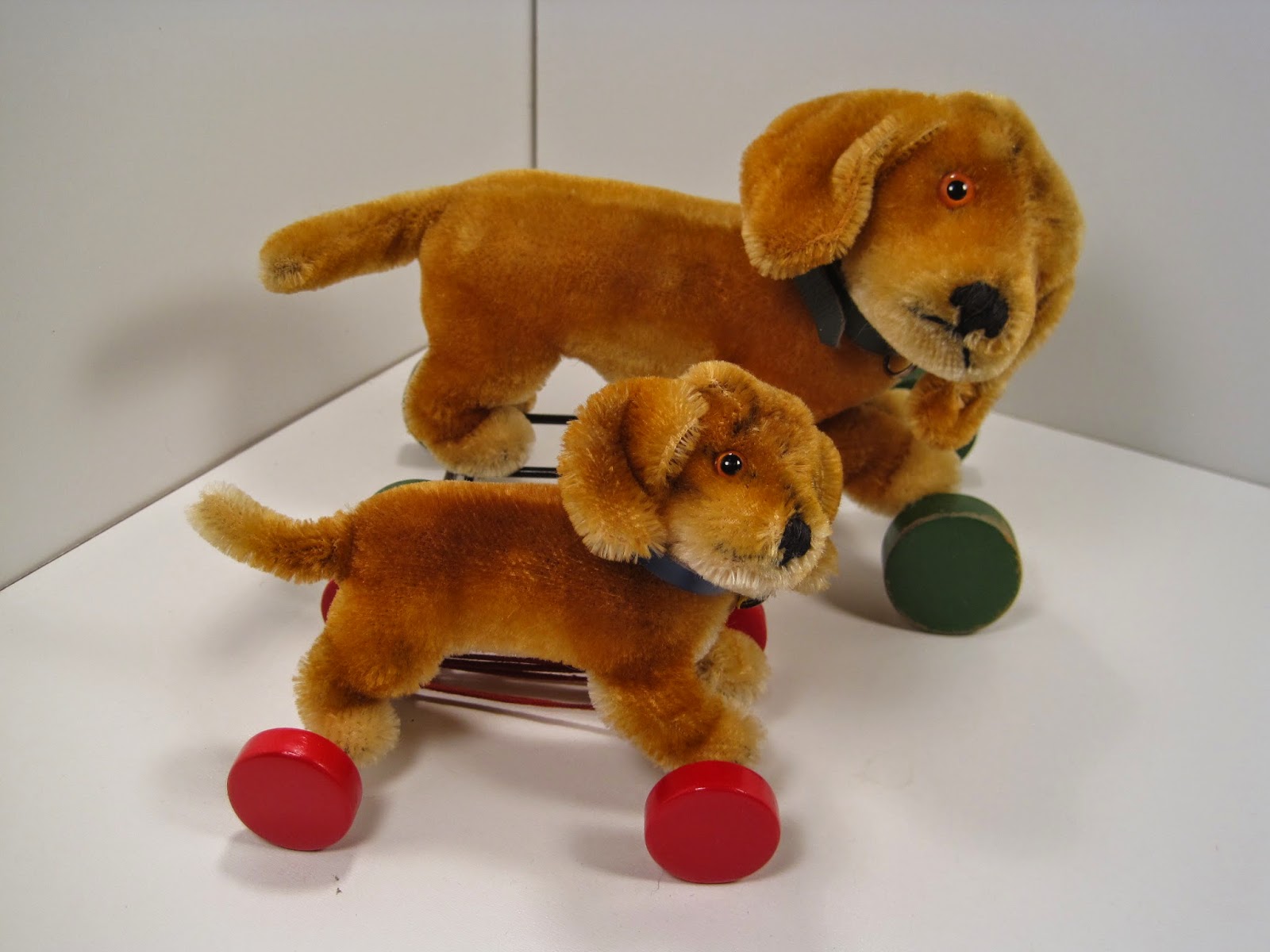
Strangely, Steiff's "eccentric wheel" detailing debuted in 1912. Steiff even holds a patent for this unusual wheel and axle configuration! Eccentric wheels were "invented" accidentally, but Steiff quickly realized the opportunity created by their roller drilling mistakes. Steiff's dogs, cats, birds, and farm animals look particularly charming on eccentric wheels, given the way they waddle and jiggle in real life! The photo on the left shows two of Bully's eccentric wheeled 10 cm "canine colleagues" from his same general timeframe. Bazi the Dachshund (on red wheels) was made in 10 and 14 cm from 1950 to 1961 overall and Cockie the Cocker Spaniel (on blue wheels) was made in 10 cm from 1954 through 1957 and then again in 1960.

Steiffgal hopes this discussion on this unusual Steiff Bully on wheels has been enjoyable to you, even in a roundabout sort of way.  

Have a question about one of your Steiff treasures? Let's talk! Click here to learn more. 

Saturday, March 28, 2015

Catching Spring Fever With Steiff's Wonderful Early Post War Bazi Dachshunds

At last, the snow in the park across the street from Steiffgal's house has started to melt enough that there are more patches of green than white. And no one could be happier about that than Steiffgal, with the pugs a very close second! It is great to see the neighborhood dogs again, who all seem so happy to end their winter-induced home hibernation! To celebrate the onset of spring and its associated "pup parade," let's take a look at one of Steiff's earliest post war dogs - Bazi the Dachshund - and see what makes him so interesting from the design and historical perspectives.

Doxies are a legacy design pattern for Steiff. They have been in the line almost continuously since the late 1890's, with the first version debuting in felt in 1897. This is easy to understand - this breed is especially beloved in Germany, and it seems as if the Steiff family themselves had a particular affinity for them as well! Steiff's first named long haired mohair Doxie, Waldi, debuted in 1933 and was an immediate sensation. Prewar, he was produced standing, sitting, as a hunter dog-doll, and on wheels. It is interesting to note that from what Steiffgal can calculate, Waldi has the honor of being the dog pattern with the longest history of production in the Steiff line. He appeared pretty much continuously in the line from 1933 through 1980 - for a total of 47 years. (Molly the puppy is a close second, with a total of 44 years.) An early standing Waldi is pictured here on the left.  

Most likely due to the success and popularity of Waldi, Steiff introduced a new Doxie named Bazi design right after the factory reopened for toy making business in the late 1940's. Two versions were produced - a sitting Bazi and a standing Bazi on wheels. Both were head jointed and made from artificial silk plush which was highlighted with brown and coppery highlights. Sitting Bazi was made in 14 and 17 cm from 1948 through 1949, while Bazi on wheels was produced in 14 cm in 1949 only. And, because of their era of production, these silk plush versions may have a number of Steiff's buttons, including a short or long trailing F button or a blank button. Sitting silk plush Bazi is pictured here on the left; this particular example has a blank button. 
  
Bazi took the collector's world by storm in 1950, and remained a constant in the production line through the mid 1970's.  The early 1950's could be called "the dogs days of Steiff" as this was the time when many new named dog patterns - like Snobby the Poodle, Dally the Dalmatian, and Sarras the Boxer -  were introduced as mohair became more readily available on a commercial scale again.  Starting in 1950, Bazi was made sitting, standing, on wheels, as as a press and release music box, and as a dog-doll.  You can see these blue-ribbon buddies pictured below.  

Sitting mohair Bazi was was produced in 10, 14, and 17 cm from 1950 through 1969. These are very early examples with their red imprinted chest tags and earliest article numbers. The small one also has his US Zone tag.

Standing mohair Bazi was produced in 10 and 14 cm from 1950 through 1975. Like his brothers pictured above, this is a very early example. 

Standing mohair Bazi on wooden eccentric wheels was produced in 10 and 14 cm from 1950 through 1961. This model rides upon four off-center wooden wheels and has the appearance of bobbing up and down as it is pulled along. 

Musical mohair Bazi was produced in 25 cm in 1950 and 1951 only. Please click here to learn more about this really interesting item and her full provenance.
 
Standing mohair Bazi dog-dolls were produced in 25 cm from 1950 through 1954. Please click here to learn more about the story behind this very sweet Bazi couple.

Steiffgal hopes this review of Steiff's beloved Bazi pattern has been as refreshing as a breath of spring air for you!

Have a question about one of your Steiff treasures? Let's talk! Click here to learn more.  

Sunday, September 29, 2013

Welcome To The SteiffLife Oktoberfest Celebration!

It's the most wonderful time of the year... Oktoberfest!  And even though this fantastic two-plus week long celebration originated in Germany, it has become a global reason for observation around the world.  This weekend, nearly 4,000 miles from Munich, Steiffgal and Steiffguy, (and of course the Steiffpugs!) are hosting 25 friends for an authentic German late afternoon of home brew, a traditional German supper, and good times all around.  And to make the party even more fun, Steiffgal has invited a few Steiff friends to serve as good time ambassadors.  Take a look at these "party animals" and see how they help make any table the best table in the house!


Hat's off, or on in this case, to this great looking Steiff couple! Here we have Steiff's Larifari and Alpa dolls. Larifari is 32 cm and is based on a German book and movie character created by Ferdinand Diehl, the same creative genius who designed the beloved Micki and Mecki hedgehog characters. Larifari is five ways jointed.  His head and arms are made from rubber while his body and legs are made from felt. Larifari only appeared in the line from 1955 through 1957. Alpa is 10 cm and wears a green hat and skirt, white blouse, calico apron, and a black belt. Alpa (and her brother Alpo, who also makes an Oktoberfest appearance in the next photo,) are "cousins" of Steiff's famous Mecki and Micki hedgehog dolls. Alpo and Alpa were produced in this size and in 1964 only, and as a result, are exceptionally hard to find.

Are you in suspense to learn about this next pair of table ambassadors?  Here we have an adorable 25 cm blond, early post war Teddy Baby with felt paws.  He wears a pair of traditionally styled green felt trousers which have brown leather suspenders.  These pants were purchased at the Steiff factory.  This Teddy Baby pattern was produced post war overall in blonde or brown mohair in 9, 22, 28, 30, and 40 cm from 1949 to 1957.  His dinner companion is Alpo, the brother of Alpa mentioned above.  He wears a little felt hat, grey pants, a white shirt, green suspenders, and black shoes and carries a little backpack on his back.  Alpo was manufactured in 10 cm only in 1964.

Here are some sweets for you, my sweet readers!  Here we have Steiff's golden yellow plush 25 cm unjointed Haribo Gummi Bear.  She is unjointed and has a black plush nose and black and white plastic eyes.   Haribo wears a red silk bow. This logo Ted made a short, but clearly sweet, appearance in the Steiff line in 2002 and 2003.  She stands guard upon a vintage silver server filed with - what else - but Haribo Gummi Bears!


It's easy to make small talk with these table friends! Here we have a 30 cm five ways jointed light blond “Münchner Bär” from 1999. He was produced exclusively for Germany in 2001, but not specifically for Oktoberfest. He is wearing very detailed dark grey lederhosen and a grey felt Tyrolean hat. This Teddy also has a wind up music box and plays "In München steht ein Hofbrähaus", a traditional drinking song that roughly translates to "There's A Beer Hall In Munich." And to make sure he's ready for the next round at the Hofbrähaus, he carries his very own miniature glass beer stein featuring the coat of arms of Bavaria. Of course, his faithful companion is a little Steiff Hexie Dachshund, this one is 9 cm but he was produced overall in in 9, 13, 20, and 25 cm between 1954 and 1974.  

Also gracing the main dining room table centerpiece area are two other very special Steiff Dachshunds.  The first is  Bazili the Dachshund Hunter, who appeared in the line from 1950 through 1954.  Bazili is standing and 25 cm tall.  He is head jointed, standing, and wears a little green felt suit and hat.  His jacket is decorated with three leather buttons.  His head and the tops of his hands and feet are mohair, and his body and limbs are made from peach colored felt-like material.  The second, Bazili's date, is Musik-Bazi or Music Bazi.  She is 25 cm tall, unjointed, and standing.   Her body is a simple cylinder and her arms are floppy.  Bazi wears a blue cotton blouse, red cotton skirt, and had a sweet floral corsage when she left the factory in Giengen more than 60 years ago.  She has an internal Swiss music box which plays when her torso is pressed and released.  Bazi was made in 1950 and 1951 only.

Take it to the bar!  Nothing could be more appropriate in the case of Oktoberfest.  And these sweet bier monks are here to welcome party goers to the beer taps, as well as make sure their steins are always full!  These fun loving, trevira velvet “bier monks” are dressed in traditional garb including cotton drawers, long red hooded tunics, and work aprons which are cinched at the waist with a thin rope. The large monk, a whopping 100 cm, has black felt feet, while the smaller 35 cm monk wears tiny leather sandals. These two monks are characters from the Alpirsbacher Klosterbraeu, a 130+ year old brewery located in Germany’s Black Forest. Steiff created these white tag, limited edition drinking buddies in 1999. Just a handful of the 100cm monks were produced, primarily for display and advertising purposes. The smaller version was produced in an edition size of 1,500.

And finally, no need to hunt for a bier coaster at this party!  Here we have a fun collection of every one's favorite beer accessories!  This fun focal point is under the close watch of 20 cm Hubert the Hunter, who was produced in 1978 only as part of Steiff's collection of "dolls in business clothes."  Hubert leans against an authentic 1 liter stein from the Hofbräuhaus - or is it the other way around?  Hubert's sporting friends are Xorry the fox, who was manufactured in 11, 18, and 28 cm from 1960 through 1969, and a tiny 7 cm brown velvet wild boar, who was made only in this size from 1952 through 1973.

Steiffgal hopes this remote Oktoberfest celebration has brought a festive and seasonal spirit to your day!

Have a question about one of your Steiff treasures, found on an adventure or otherwise? Let's talk! Click here to learn more.

Friday, June 1, 2012

Singing A Happy Tune Over This 1950's Steiff Musical Dog Doll

Ever feel like singing a happy tune because something in your Steiff collection makes you smile - for so many reasons?  Such is the case with this delightful and very unusual musical masterpiece that Steiffgal recently welcomed into her collection.  Not only is the treasure a precious find, it is also in remarkable shape for its age, and comes with a full family history.  As Ben Affleck said in the 1997 Oscar winning movie Good Will Hunting... "How do you like them apples?"  Steiffgal likes them alot!  So without further ado, here she is, and here is her story.
 
This top dog is known as Musik-Bazi or Music Bazi.  Bazi is 25 cm tall, unjointed, and standing.   Her body is a simple cylinder and her arms are floppy.  Her head is based on the beloved and endearing Bazi dachshund design, introduced in 1950. Bazi wears a blue cotton blouse, red cotton skirt, and had a sweet floral corsage when she left the factory in Giengen more than 60 years ago.  She has an internal Swiss music box which plays when her torso is pressed and released.  Bazi was made in 1950 and 1951 only.  She retains her original Steiff raised script button, crisp yellow ear tag with the numbers 9325 on it, and a white linen "Made in the US Zone" tag, ID which perfectly align with her dates of manufacture. It is interesting to note that her ID number translates to... 9=mechanical, 3=mohair, 25=25 cm. Steiff also made girly versions of this dressed music box product based on their popular Teddy Baby and Kitty cat designs of the period. 
 
Equally precious to her looks and musical talents are the details of her provenance. Her past owner, whom Steiffgal now calls a friend, provided these details of Bazi's history. They write in part...

"...[I recall as a youngster] that she was always kept out of harm's way on top of my father's chest of drawers. I am now [in my 60's] and there is never a time when I cannot remember her. 
 
[To make her sing, you] press down [on her belly], with a firm but gentle hand, and the musical notes play on the way down, and on the way back up. I have always assumed those beautiful notes played the first bar of "edelweiss", probably because of the little edelweiss flower on her dress.  And I think my father called her edelweiss for those reasons, and thence we children did the same... we children were very rarely allowed to push her down, and only with my father present!"
 
Now for the question that sends Steiffgal to the doghouse... her value.  As always, Steiffgal is not a formal appraiser and feels that something is worth what someone will pay.  On the upside, she is a collector's dream:  a unusual item, in lovely working condition, complete with a family history and legacy.  In addition, Steiff's early post war musical items seldom come on the secondary market and usually demand a premium when they do; the "Teddy Baby" version of this design had a hammer price of close to $3,000 a few years back at an auction at Christie's in London.  On the other side of the coin, over the past two years or so, the collectible market is way down because of the poor global economic situation.  Today, based on sales of other like items, and things from the early 1950's period, and musical examples, Steiffgal guesstimates that she most likely values in the $750 to 1,000 USD range.   
 
Steiffgal hopes this discussion of this wonderful Bazi has been like music to your ears.
 
Have a question about one of your Steiff treasures? Let's talk! Click here to learn more. 
The teddy bear search engine