Showing posts with label clogs. Show all posts

Monday, May 3, 2021

Pipe Up If You Know The Maker Of This Turn Of Last Century Cloth Doll!

Close, but no cigar. Or pipe in this case! Is this distinguished gentleman doll made by Steiff? Apparently someone thought so, a very long time ago. Come take a look at this handsome, turn of last century cloth doll and see what makes him so interesting - and cryptic - from the design and historical perspectives.

Well hello, handsome! This doll stands about 37 cm tall, is excelsior stuffed, and is fully jointed. His head is disk jointed with cardboard and metal joints, his arms are loosely rod jointed, and his legs are string jointed. His head, hands, and feet/shoes are made from felt. His torso and limbs are made from linen. He is dressed to the nines in a felt buttoned jacket; a brown, tan, and purple fabric vest with purple gemstone buttons; tan, brown, and grey calico pants; a brown silk bowtie; and black felt shoes. His face comes to life with a prominent horizontal facial seam; a fringe of brown hair and facial hair; dimensional black button eyes underlaid with felt circles; a simple seamed mouth; pink highlighting; and of course, his great wood and composition pipe.

Upon closer look, it turns out this fine fellow comes with a little information written upon one of his legs.
It reads, "Der Dutchman by Margaret Steiff #630 circa 1900." Although this doll is clearly misidentified as Steiff, it is understandable that someone may have assumed he was, given his prominent facial seam, general appearance, and turn of last century origins. He also has some Steiff "Karikaturpuppen" (i.e., early, cartoon-like) elements to him, including an oversized head with exaggerated features and simple hands and feet. However, Steiff's earliest dolls debuted in 1903, were string jointed, were made of felt and/or velvet, and had clothing integral to their bodies. Steiff usually used linen or other less expensive fabric like muslin on their dolls during times of economic and supply chain hardships, like just before, during, and after World War I. And their Dutch dolls almost always wore removable clogs rendered from felt or wood. 

Now let's light a fire under one of this doll's most intriguing features - his pipe.
It is removable and fits perfectly into a little hole in his face. This construction is also not typical to Steiff. And Steiffgal suspects that if Steiff made a doll pipe, it would have been hand carved entirely from wood. The only "smoking" doll Steiffgal can think of is the company's incredibly rare "Adamson" Swedish cartoon character doll produced between 1925 and 1929. In this case, the doll's felt cigar was sewn directly onto his face. You can see Adamson here on the left, the photo is from Liveauctioneers.com.

So just who is this silly smoker?
Steiffgal has combed the literature and cannot identify him. She's also asked others who are equally stumped. So his origins remain a mystery for now. What Steiffgal does know about him is that he previously belonged to her dear friend who recently gained her wings. This doll now sits on Steiffgal's desk, right near her computer, and "supervises" her daily... or in this case, reminds her of a beloved soul who passed way too soon, and unexpectedly.

Steiffgal hopes this discussion on this early cloth doll has suited you well. 

Have a question about one of your Steiff treasures? Let's talk! Click here to learn more!

Saturday, January 5, 2019

Snips and Snails And Puppy Dog Tails - Steiff Style!

Oh boy! Look what we have here... a delightful dolly inquiry from far away! Check out this note from a new friend about her lovely little fellow. Just who could he be? Adriana writes...

"I mail you from Netherlands. I have this beautiful doll and would like to know more about age and price. All the information you could give me would be very welcome. How old is my piece? What is some of the history around my piece? Is my piece really a Steiff? I would like to thank you for your efforts and wish you a nice day."

Let's button up what we know, and what we don't, about this beautiful boy. For sure, he is made by Steiff, given his general presentation, center seamed felt face, and Steiff button (which can be seen in a photo that does not appear in this blog post.) However, because it is Steiffgal's best thinking that some of his clothing is original to him, and some is not, his EXACT identify is more questionable. Having handled a number of first quarter 20th century Steiff boy dolls, Steiffgal suspects that his socks, pants, and shirt are most likely original to him, while his vest, hat, and necktie, are not. 


As it turns out, Steiffgal has an all original boy doll in her collection who is wearing a very similar shirt, pants, and socks as Adriana's little love. As such, it is possible that they are the same model, although it is not clear from the photos just how tall Adriana's boy is. Steiffgal's doll is 28 cm. This boy doll's name is Harry, and according to Steiff records, he was made from 1908 through 1925 in 28, 35, 43, 50, and 60 cm. Harry is made entirely from felt, is fully jointed with truly human proportions, and has a short, blond mohair wig. He is described as "felt, jointed, Dutch fisherman, original costume." By "original costume" Steiff means that the dolls are dressed in apparel that is traditional to a country - in this case, the Netherlands. You can see Steiffgal's Harry here on the left. Check out his original felt clogs and silk neckerchief.

One thing that is a little different between Adriana's doll and Steiffgal's doll is their age. And you can detect that through a simple, but subtle difference between the two. Steiffgal's doll has black shoebutton eyes, dating him at the earliest part of the production run, say around 1908 to 1910. Adriana's doll has stunning blue and black glass pupil eyes, dating him from roughly 1911 onward. Here on the left you can see Steiffgal's Harry posing with his lifelong friend Alida, a sweet Dutch girl who also sports fine felt clogs. Given her blue and black glass pupil eyes, it is safe to say she's a handful of years younger than handsome Harry.

Adriana also asked about the possible "value" of her doll. As always, something is worth what someone will pay for it, and Steiffgal has not handled this doll in person to fully view and access its condition. What is clear is that he does have a little damage to his face, and that his clothing is not entirely original to him. After doing a little research on current auction sales of antique Steiff dolls in somewhat similar condition, it appears that an example like this could trade hands in the $800-1,200 range.

Steiffgal hopes you enjoyed learning about Adriana's mystery man!

Have a question about one of your Steiff treasures? Let's talk! Click here to learn more.

Saturday, March 12, 2016

It's All In The Family With This Turn Of Last Century Dutch Doll

What makes an heirloom Steiff treasure even more extraordinary?  When it has been been cherished by three generations of the same family, and its provenance helps connect it with the past and the future!  Check out this note from Suzie in Ireland. who has some questions about her family's "Friend for Life."  She writes...

"Dear Steiffgal,

Please give me your advice on this doll! It was given to my Grandmother by a Prisoner of War (POW) who was living in the German POW camp in Dorset around 1910-1914. My Mum was told that the POW had made it. At that time the POWs were allowed to mix in the community and some even helped local trades.
 

This doll has all similarities of Steiff, though it is stuffed with straw. I was wondering could of maybe have been a Steiff worker who had been captured during war duty. Maybe he had access to a sewing machine (maybe a trade in the village?) and made it? 

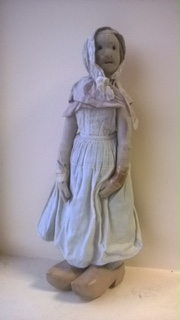
She is beautifully stitched and hand stitched up. She came with knitted socks, wooden clogs, bloomers, combinations, a lemon blouse (missing), a petticoat, a skirt, apron and lace edged bonnet. She stands about 50 cm tall, and has human hair woven into her scalp.  

We undressed her for the first time in nearly 70 years, as you can see she is a bit rough but both my Grandmother and my Mum played with her, my Mum mended her broken bits when she was 7-8 so they are roughly done but do the job. I have contacted Steiff and they say that she definitely looks the part. 

So glad my Mum hung onto her, I think she's lovely.  

Best, Suzie"

This sweet doll is a double Dutch treat indeed!  From her appearance, construction, and proportions, it is Steiffgal's gut feeling that she indeed was made by Steiff in Germany.  And her detailing aligns with a well known Steiff doll named Helma, who is pictured here on the left.  The photo is from Pfeiffer's Sortiment 1892-1943.  Like Suzie's doll, Helma is 50 cm, made from felt, is fully jointed, excelsior stuffed, has a mohair wig, and features Steiff's legacy center seamed face construction.  Helma wears a traditional Dutch outfit, complete with wooden clogs.  According to Steiff records, her outfit was made in a variety of different colors and fabrics, which is why Suzie's doll's clothes don't exactly match the reference photo. Helma was produced from 1911 through 1921; her black shoe button eyes put her at the earliest end of this manufacturing timeline.  So if Suzie's Grandmother received the doll in the 1910-1914 time frame, the logistics do indeed align.  

In addition to Helma, Steiff also produced two other 50 cm, clog wearing Dutch adult dolls around the same time period.  The first was Franz, a fisherman.  The second was Knut, who was dressed like a local farmer and wore a fur cap.  Both Franz and Knut had distinctive mohair beards.  These large Dutch dolls were specifically designed as hardworking adults with grown-up personalities. 

As for the mystery of how Suzie's Grandmother's doll got to Dorset, or if the POW made it... well, only the doll knows for certain!  It is most unlikely that the POW personally constructed the doll in Dorset.  Maybe they or a family member worked at Steiff in Germany, and for some reason they had the doll with them when they were sent off to the camp.  Another possibility is that the POW made some of the clothes or other accessories for the doll and not the actual doll... or that they made the money to buy the doll, either in Germany or near Dorset.  The details of any of these scenarios may have simply gotten lost in translation - or time.  

Steiffgal hopes this discussion on Suzie's third-generation doll has been a delightful family affair for you. 

Friday, February 14, 2014

A Petite Steiff Treat In Honor Of Valentine's Day

In honor of Valentine's Day, the universal holiday of love, Steiffgal thought she'd introduce you to one of her Steiff cupids! Well, this little guy wasn't designed as the sprite with wings and a bow and arrow - but he certainly plays the role of a super sweetheart really well! Come check out this darling Steiff gnome and see what makes him so interesting from the design and historical perspectives.
 

This little lovey certainly gets Steiffgal's heart beating in a big way! Here we have Steiff's gnome named Snik. Snik is 35 cm tall, made of felt, and is leg and head jointed. His oversized hands and feet are remarkably detailed with realistic fingers and toes. His ever-happy face comes to life with a long orange mohair beard and eyebrows, bright green and black glass pupil eyes in felt eye pockets, an impish upturned nose, and a open, red smiling mouth. He wears brown felt shorts, a white cotton shirt, a now faded red pointed cap, and a bright purple belted felt vest that has faded to tan over time. You can't help but notice Snik's enormous wooden and leather clogs - just perfect for yard work (but more on that later!) Snik was produced in 25, 35, and 43 cm from 1927 though 1943.
 

Steiffgal's Snik is based on another very similar felt dwarf (also named Snik) that Steiff produced from 1911 through 1921. Early Snik was made in 22, 30, 43, and 50 cm; he had a purple felt hat and a slightly different facial expression than later Snik. You can see this first Snik pictured here on the left; the photo is from Gunther Pfeiffer's 1892-1943 Sortiment Book. Early Snik was designed during a most interesting period in the evolution of Steiff dolls. Steiff began commercially producing its first dolls with center-seamed faces around 1904. Most of these were felt; some were velvet. These early dolls were called “caricature” dolls or “charakterpuppe” because they had comical, exaggerated features – such as extremely lean or rotund bodies, huge feet, or cartoon-like faces... much like early and later Snik. In about 1914, Steiff started giving their new doll patterns much more accurate, human proportions, and started moving away from the “charakterpuppe” look. These updated designs became universally embraced for their authenticity, appeal, and charming appearances. So this later Snik, despite his likely production in the late 1920's or early 1930's, is really a nod to Steiff's very early turn of last century “charakterpuppe” doll production and design priorities. 

It was a shoe-in that this clog wearing sweetie would be a hit with collectors for over three decades! Gnomes hold a very special place in the hearts of many Germans and have been a part of European popular culture for centuries. These small, humanoid creatures apparently live underground and are considered auspicious (and a bit mischievous) as well as essential for gardening success! Today, it is not uncommon to see small gnome statues in even the most formally planted and tended gardens across Europe! It is said that gnomes have a lifespan of 400 years and "kiss" by rubbings noses and also use nose rubbing as a greeting equivalent to people shaking hands.  Like our friend Snik under discussion today, "typical" gnomes have red pointy hats, fluffy beards, dark pants, sturdy working shoes, and a sweet expression that reflects the pleasure that comes from a good day at work.  

Steiffgal hopes this discussion on Snik has been a petite treat for you. 
  
Have a question about one of your Steiff treasures? Let's talk! Click here to learn more. 

The teddy bear search engine