Showing posts with label 1920. Show all posts

Saturday, July 14, 2018

Patching Up The Story Behind This Early 1930's Steiff Pony


Every girl wants a pony at some point in her life, right? Well, good things come to those who wait. Several decades past childhood, Steiffgal has finally welcomed the perfect horse to her collection.  This particular barnyard buddy doesn't require boarding, special shoes, or exercise, and she certainly won't eat Steiffgal out of house and home! Check out this excellent equine and see what makes her so lovely - and interesting - from the design and historical perspectives. 

No horsing around - this pretty filly is the mane event. She is 17 cm, standing, and unjointed. She is made from short white and brown mohair. Her tail is very long and made from white mohair threads. It's literally a "pony tail" in so much that it could be braided or combed! Her mane is made from short white mohair. Her face comes to life with brown and black glass pupil eyes, little white felt ears, and a pink airbrushed mouth and small nostrils. She was produced in 17, 22, and 28 cm from 1931 through 1939.  This example retains her long trailing "f" button and traces of her red ear tag; you can see those IDs in the picture towards the end of this post. 

Pony was produced at a very interesting transition point in Steiff's history, and has a pair of design elements that span two distinctive periods at Steiff - the 1920s and the 1930s. 


The first is her coloration. Through the very early 1930's, when an animal was multicolored, the company often patched in different hued fabric as part of its construction. As in the case of this horse, her distinctive brown coloring is made from its own piece of brown mohair. Over time, this more expensive, more labor intensive way of constructing multicolored items was replaced by a less expensive method - airbrushing. For the most part, if you see a vintage item that was constructed by dramatically patched or seamed mohair in different colors, it probably dates from before the early 1930s. You can see a great example of that here on the left in this play duck in terms of his construction and detailing. He was produced in 14, 17, and 22 cm from 1925 through 1932.


The second is her general presentation. Starting in the early 1930's, when most everything in Germany started getting more difficult due to the emerging socio-political climate, Steiff also adjusted their design and manufacturing processes to be more economically conservative. You've probably noticed that items designed and produced in the 1930's are far less complicated, jointed, colorful, and detailed than those produced during "the roaring '20s." For example, Teddy bears from the 20's are "fuzzy, fat, and feminine;" some appeared in jellybean colors and tipped mohair. Those from the 30's are leaner, more serious in expression, and made from short mohair or substitute fabrics, like wool plush or artificial silk plush - and usually in more subdued hues. The same is true with this horse pattern, which is clearly designed for simplicity and efficiency. It's lines are very basic, it is unjointed, does not have embroidered features, and doesn't have accessories like a saddle or reins.

Steiffgal hopes this discussion on this Steiff pony has set your heart a-blaze.

Have a question about one of your Steiff treasures? Let's talk! Click here to learn more!

Tuesday, October 9, 2012

A Purr-fect Example Of a 1920's-era Steiff Cat


Now that's one pretty kitty!  Steiffgal recently had the pleasure of meeting a spectacular early Steiff cat.  Her details and design simply took her breath away.  Take a look at this early Steiff sitting sweetheart and see what makes her so special from the design and collector's perspectives.


It's easy to color your world with this lovely 1920's era Steiff cat.  Her name is Fluffy, and she was introduced in 1926. Fluffy is sitting, unjointed, and made in part from bluish tipped mohair, which is just spectacular. Her little tail wraps sweetly around her body. Fluffy's face is detailed with large deep turquoise green and black pupil eyes and a simple hand embroidered pink nose and mouth. This pink stitching may have been some restoration work, but accurately reflects the size and shape of her original features. Her claws are also embroidered in red. This kitty retains her 8mm trailing "f" Steiff button and bits of her red ear tag.  

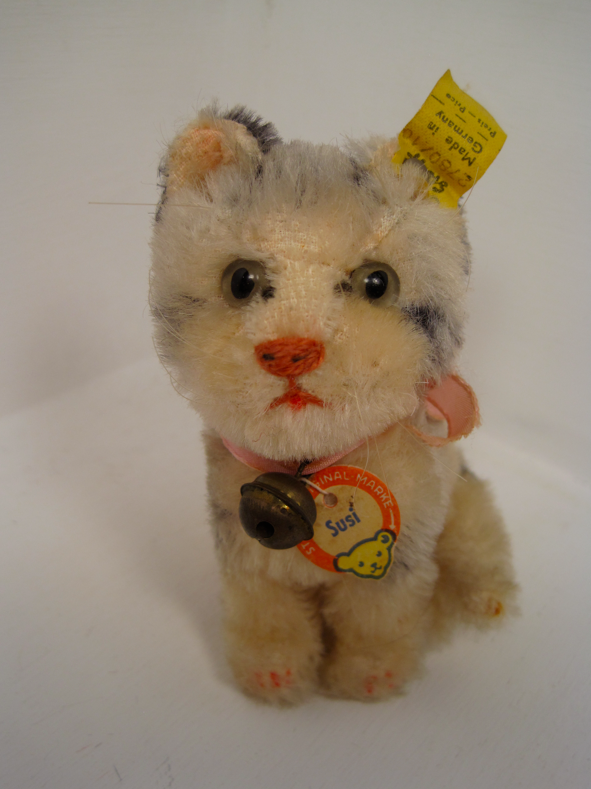
Talk about the cat's meow!  Fluffy was such a favorite that she was produced in nine standard sizes, as well as on a pincushion, as a music box, and as a tail turns head model. Fluffy appeared in the line through 1950. Her design was slowly replaced by Susi, another favorite sitting style cat, who was a line standard through 1978.


Fluffy has details that quite typical of other products Steiff created during "the roaring 20's" - or in this case, the "meowing 20's!  Items designed and produced during this decade tended to have large, childlike eyes; bright colors or details, playful textures, and a distinctly feminine touch to them.   Perfect examples of this include Steiff's Molly the Puppy (introduced in 1925), Teddy Rose (introduced in 1925), Teddy Clown (introduced in 1926), Charly the King Charles Spaniel (introduced in 1928) and Bully the Bulldog (introduced in 1927). All also had collars or ribbons, adding to their festive presentation. 

Steiffgal hopes this discussion on Fluffy has been the cat's meow for you.

Have a question about one of your Steiff treasures? Let's talk! Click here to learn more. 
The teddy bear search engine