Showing posts with label boy. Show all posts

Sunday, July 30, 2023

Less Is More When It Comes To Steiff's Early Felt Doll Production

Size defies with today's blog special guest.
Steiffgal tries to adopt at least one special Steiff bear, doll, or animal tied to major Steiff events, auctions, and happenings she attends. Here is the little button-in-ear buddy that made his way home to the United States with her via the recent Steiff Special Auction held in Giengen, Germany on July 1st, 2023. Read on to hear his story and to see what makes him so precious from many perspectives.

Like many Steiff collectors, Steiffgal poured over the Ladenburger Spielzeugauktion GmbH Special Steiff Auction catalog from their July 1, 2023 sale.
A million things caught her eye online and on the printed catalog pages... but not this tiny treasure for some reason. However, that all changed when she attended the live auction preview, held in the gallery adjacent to Steiff's museum and gift store, right on the company's campus. Here on the left you can see a photo of Steiffgal attending this auction preview the day before the big sale.  

It was an amazing experience touring this preview room filled with world class treasures - in a world class space! All the auction items were stored in rectangular, glass and wooden cases. You could walk all the way around them and see every angle of the treasures on display. Of course, all eyes were on the 1912 black mohair Titanic Mourning Bear and the google eyed Petsy bear - the stars of the show who were displayed right at the entrance to the room.  

Steiffgal saw this little guy sitting on a shelf and she could not look away.
Yes, he was in the catalog, but he presented so differently in real life than in his pictures. This happens a lot, and a good reason to attend live previews! He was TINY! And his size was further in the spotlight as he was posed with medium and larger Steiff felt dolls. His scale and presentation were so adorable, and so unusual, that Steiffgal immediately decided he was the one! Here on the left you can see this little guy as he was displayed for the auction preview event. 

So this little doll, who has since been named Little Eddy, stands a mere 22 cm.
He is made from felt, fully jointed, and comes to life with a blonde inset wig, blue and black glass pupil eyes, painted eyebrows, prominent dimensional ears, and distinctive horizontal (near his eyes, to give him a youthful, rounded look) and vertical (right down the middle of his face) stitching. His hands are simple and fist style. He wears a red and white sweater and shorts set, with white socks and black felt shoes. This outfit is period appropriate but not original to him. Steiff's 22 cm dolls are few and far between, and this is the first one Steiffgal has ever seen - and now owns! They were produced from 1917-1919 in several boy and girl models over that time frame. You can see Little Eddy standing next to his 28 cm big brother and big sister here on the left - that's the best way to highlight his scale and proportions. 

Little Eddy is also very interesting from the design perspective for two quirky reasons. First, he has typical early Steiff style fist hands with stitched digits. Steiff's dolls from his late 19-teens era production usually have fingered hands or at least hands with prominent fingers. Perhaps his scale made it difficult to give him more detailed hands. And, second, his amazingly tiny silver button - which looks original to him based on its placement and condition - also appears to be more of a short trailing "f" button than a long trailing "f" button. The long trailing "f" button appeared the line through the mid-1930s, and the short trailing "f" button appeared in the line from the mid-1930s through the early 1950s. So his ID is bit of a mystery there as well.

This petite prince is the perfect size to be a special traveling companion.
And, he jumped at the opportunity as soon as his adoption was finalized! He fits snugly in a purse or backpack and makes friends wherever he goes. His big first adventure was an eight hour train ride from Heidelberg, Germany to Prague in the Czech Republic. Here you can see him in his "first class" train seat enjoying the scenery as it whizzed by. He looks forward to many more sightseeing trips in the future. 

Steiffgal hopes this story about Little Eddy has brought you big joy!

Have a question about one of your Steiff treasures? Let's talk! Click here to learn more!

Saturday, December 31, 2022

These Ladenburger Spielzeugauktion Auction Highlights Are Dressed To The Nines!

Three's a charm when it comes to the third post in this blog series of auction highlight from Ladenburger Spielzeugauktion's January 21st, 2023 Collection of Susan Kilgore Wiley sale. It's no secret that Steiffgal goes all hubba-hubba over Steiff's utterly charming dressed dolls and animals. And, this sale offers some of the most appealing ones in memory. Check out this trio of well attired prewar offerings from this auction. Steiffgal is certain you will consider all of them a clothes call indeed.

This first dressed highlight doesn't have a hare out of place.
It is lot #6152, an all original and early Steiff Peter Rabbit. It is estimated at €650-€1,300, and is cataloged in part as:

"One of the highlights of the auction, exceptional hare, Peter, around 1910, with small button, block letters, long trailing f, shoe button eyes, underlaid with red felt, fine brown/beige velvet, attending, with original felt jacket, decorative seams and golden buttons, red slippers, 1 leather sole with original stamp, 1 felt slipper is a bit holey, and small holes on the blue felt jacket, standing height 26 cm, extremely rare, exceptional."

Steiff's turn of last century Peter Rabbit dolls top many collector's bucket lists. This well coutured example is in lovely condition and is a marvelous size. It is interesting to note that the exact details that make up a Steiff "Peter Rabbit" are not specifically identified in Pfeiffer's Sortiment books. It is generally understood amongst collectors that a "Steiff Peter Rabbit" is standing, unjointed, and wears a felt topcoat with buttons and embroidery and felt slippers with leather soles. The Sortiment book pictures two versions of standing rabbits wearing felt topcoats and slippers, but does not identify them as "Peter Rabbit." The first is a spotted velvet version wearing a red or navy topcoat and red slippers; he was produced in 10, 22, and 28 cm from 1904-1919. The second is a white wool plush version wearing a green felt topcoat and red slippers; he was produced in 22 cm from 1904-1918.

This next auction highlight is a pair with flair!
Here we have lot #6181, two early 20th century, fully jointed, center seamed Steiff felt dolls. They are estimated at €330-€660 and are cataloged in part as:

"Felt dolls, Anton & Lisl, Upper Bavarian, produced between 1909 and 1926, 28 cm, with traditional costume, felt-head, mohair-hair, felt body, jointed, arms and legs, original, clothes, very nice condition."

This darling duo are textbook examples of   Steiff's "children" style dolls. 
These guys appeared in the line from 1909 through the late 1920's. Unlike earlier Steiff dolls that were more caricatured, harsh, and designed for adult collectors, these dolls were realistically proportioned, had gentle personalities, and angelic, rosy faces. They truly were designed for child's fun and play. These models were all fully jointed and had felt heads and bodies - except right around WWI when felt was scarce and the bodies were sometimes made from rough cotton or linen type materials. Steiff's children dolls were all dressed head to toe in handmade clothing that included school uniforms, ethnic costumes, sporting attire, and “Sunday best." Steiffgal is certain that the boy is Anton, based on his outfit and presentation. However, she is not 110% certain the identity of the girl is Lisl as her outfit does not match the one pictured in Pfeiffer's Sortiment. Steiffgal also suspects that her clothing, however charming, is not entirely original to her. Nonetheless, the pair is simply wonderful.

And it's tag, you're it! when it comes to our final well dressed auction highlight.
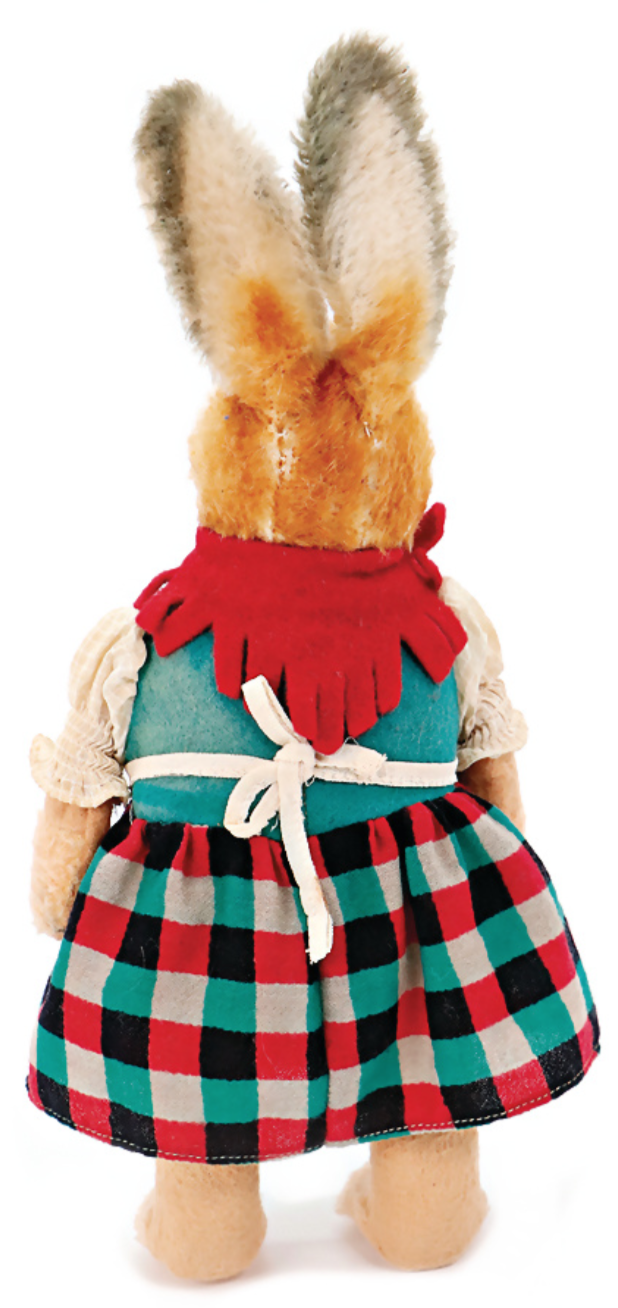
This is lot #6114, a late prewar standing and dressed rabbit doll, estimated at €180-€360. She is cataloged in part as:

"Pupp-hare, Mike, with button, block letters, long trailing f, very nice good preserved, yellow cloth tag label, No. 22, wool plush at hands and feet, original traditional costume, 27 cm, very nice condition."

And just want makes this lovely lady a 10?
She's got a fantastic presentation, and is in delightful, all original condition. And if you look closely at her tag, it is says "22,11." Numbers don't lie here! Her digits mean 22 cm tall (measured without ears), while the number 11 corresponds to her costume as described by the company. Outfit #11 translates to "traditional costume with green checkered skirt, green corsage, and white shirt." Spot on! These utterly charming, dressed rabbit dolls appeared in the line in 14, 22, and 28 cm in maize or white plush from 1932-1943 overall. Eleven total outfits for these rabbits were produced; they ranged from pajamas to playsuits to trousers and dresses through regional outfits like the one featured on this premier example. 

Steiffgal hopes this discussion on these well dressed auction highlights has contributed to the fabric of your collecting life. 


For more information about Ladenburger Spielzeugauktion GmbH's upcoming Special Steiff Auction event on January 21st, please click here!

Have a question about one of your Steiff treasures? Let's talk! Click here to learn more!

Sunday, January 23, 2022

It's Time To Throw The Book At This Amazing Antique Steiff Character Doll!

Let's take it to the Max with this week's blog story! Here we have a darling - but devilish - literary character who is well known throughout Germany. Take a look at this early Steiff doll and see it's always "double trouble" when he makes an appearance.

Here we have Steiff's Max doll. 
He is 30 cm tall, fully jointed, and made primarily from felt. He wears grey felt shoes, cream felt pants, a brown felt shirt, and a blue felt blazer detailed with blue felt buttons. His legs are made from tan linen. His oversized hands and head are made from flesh colored felt. His face comes to life with black bead eyes, prominent horizontal and vertical seaming, painted eyebrows and lips, and pert, oversized ears. You can't help but notice his shock of long, jet black hair which is made from mohair. You can see two slits in his left ear where his Steiff button would have been, but sadly this hardware has been lost to time. Max appeared in the Steiff line in 30 and 35 cm from 1910-1926.

Steiff has a century plus long tradition of interpreting famous fictional and literary characters... and this doll is a perfect example of that.
Max - and his brother Moritz - are the "stars" of a legacy German book called Max and Moritz (A Story of 7 Boyish Pranks). It was written by author Wilhelm Busch (German, 1832-1908). This work was first published in 1865. This darkly comedic tale is written in verse and consists of seven “chapters.” Max and Moritz are the ultimate troublemakers and they cast their shenanigans throughout their town. The book, still a favorite nearly 160 years onward, has become an integral part of the German culture and psyche. Author Rudolph Dirks credits Max and Moritz as the inspiration behind his early and important comic strip The Katzenjammer Kids which debuted in 1897. And even today, some German parents are known to have named their twin sons after this troublemaking team.

Given his appeal, Max (and his brother) were often featured in Steiff's early 20th century advertising.
Here on the left, you can see one of Steiff's print marketing images from around 1912/13. You can click on the image to make it bigger. It features the silly siblings creating havoc at a military post. This is not unexpected, given their reputation for troublemaking! Max has made his way into the soldier's booth - and appears to be picking his nose without a care. And his brother Moritz has somehow gotten his hands on the soldier's firearm and is running away with it. Steiff's marketing images from this period - just like this one - are usually comical, multilayered, ironic, and extremely well executed. The picture is from Dottie Ayers and Donna Harrison's Advertising Art of Steiff, Teddy Bears and Playthings.

It should be no surprise that Steiff really "Max'ed" out on its Max doll production during both the pre- and postwar periods.
Prewar, Max and Moritz were produced as 25 cm “record” or pull toy dolls on wooden wheels from 1916-1926 overall. Fast forward, Steiff produced Max and Moritz as tiny 10 cm rubber dolls from 1962-1967. Their final appearance in Steiff's catalog, as far as Steiffgal can tell, was as a pair of 30 cm tall trevira velvet puppets pictured here on the left. These charming characters appeared in the line from 1979-1982. As you can see, their detailing, materials, and construction were updated to reflect the aesthetic of the era. 

Steiffgal hopes this discussion on Steiff's Max storybook doll has been a good read for you.

Have a question about one of your Steiff treasures? Let's talk! Click here to learn more.

Monday, February 15, 2021

This Delightful Midcentury Steiff Treasure Is Dressed For Success!

There's no need to skirt the issue when it comes to this week's Steiff story! Check out this inquiry from Elizabeth, who asks about the history and timeline associated with an adorably dressed girl doll she recently added to her hug. She shares,

"I purchased and recently received off of eBay this cute little Teddy Baby doll, I think. I'm guessing that she is from the late 40’s because it appears she had the US Zone tag removed/worn off from her leg at some point. Her head and the tops of her paws and feet are mohair and her body is cloth and excelsior stuffed. Her arms are a little floppy. It seems like she did a lot of hand holding in her time. What do you think, am I even close to right?"

This ever-cheerful design always makes Steiffgal's heart happy. Elizabeth's doll was made in 25 cm and appeared in the line from 1950 - 1957. This head jointed model appeared as a boy, dressed in a red jacket, white shirt, and black shorts, or a girl, in a red jacket, white shirt, and green skirt. All the clothes were removable, so it finding an example today in all original clothing is quite rare. They were simply called "Boy Doll Bear" and "Girl Doll Bear" until 1954 when they were more lovingly named "Teddyli." The boy and girl dolls together are pictured here on the left; the image is from Pfeiffer's 1947-2003 Sortiment. A similar pair of boy and girl dressed Teddy baby bears, produced in a blondish-yellow wool plush, appeared in the line from 1951 - 1954.

Teddyli, of course, is based on the company's legacy Teddy Baby bear design that was introduced in the 1920s. This pattern proved so delightful, and so popular, that it because the inspiration for many novelties over the years. Post World War II Teddy baby novelties included a display sized Teddy baby (produced in 150 cm in brown mohair in 1960 and 1967); a press-and-release musical Teddy baby (produced in 25 cm from 1950 - 1951); and a tiny Teddy baby doll on a rubber body named Teddyli (produced in 12 cm in brown mohair from 1955 - 1957.) Tiny rubber and mohair Teddyli is pictured here on the left. Steiff also produced Teddy baby as a 17 cm hand puppet; he appeared in brown and maize mohair from 1929 - 1943 overall; and then again in brown artificial silk plush and then mohair from 1949 - 1978 overall.

Now let's take a closer look at this item's IDs.
When she left the factory in Giengen, she almost certainly had her Steiff button and a yellow ear tag with the article number "325 M" on it. These digits correspond to 3=mohair, 25=25 cm tall, and M=maedel (or "girl" in German.) Steiffgal has never seen one of these midcentury cubs with a chest tag. Elizabeth notes the remains of a US Zone tag in her leg seam. These tags were technically required in all German export products from the end of WWII through the early to mid-1950s to communicate that the item was produced in a "civilian" factory and met business and distribution standards set up by the American military government overseeing the United States' occupational zone in Germany. These usually actually appear on items produced in the c. 1951-1955 time frame. Given that observation, it Steiffgal's best guess that Elizabeth's Teddy Baby doll girl was made in the c. 1951-1955 time frame.

Steiffgal hopes this discussion on Elizabeth's mid-century find has tagged your interest in this collection era!

Have a question about one of your Steiff treasures? Let's talk! Click here to learn more.

Sunday, March 22, 2020

Boy Oh Boy This Is One Interesting Steiff Doll!

Snips and snails and puppy dog tails - that's what little boys are made of. At least according to an early 19th century nursery rhyme. But what about Steiff little boy dolls? What are they made of? Well, that depends on the timeframe in which they were produced. Take a look at this delightful, and unusual, Steiff boy and see how his composition suggests a pretty specific production era.

Well hello handsome! Here we have Steiff's Erich. He is 35 cm tall and fully jointed. He comes to life with brown hair which has faded to silver over time, lovely blue and black glass pupil eyes, delicate painting to define his eyebrows, nostrils, cheeks, and mouth, and Steiff's distinctive and early vertical center seam facial construction. He also has two small horizontal seams by each of his eyes; these are original to his pattern and help add roundness and softness to his head and face shapes.

Erich is dressed for fun and play in his early 20th century style outfit. He dons a white cotton shirt, a cotton "one-sie" consisting of blue shorts and a black vest, a blue cotton jacket, a linen apron with a pocket, and blue and white striped socks and black felt shoes; most, if not all of these accessories are original to him. He retains his tiny long trailing "f" button and traces of his white ear tag as his IDs. This charming pattern was made in 28, 35, 43, and 50 cm from 1912-1927 overall.

So what about his actual composition? With his full permission and consent, Erich is happy to share his noteworthy make-up and is proud of his role in historical research! His head and arms are made from Steiff's traditional high quality felt. His legs are made from smooth, flesh colored linen; their color matches his felt pretty well. And his torso is made from a very coarse, blue and tan colored muslin material. More typically, a pre WWII doll from Steiff has a felt head, torso, and limbs. 

Erich's assembly makes sense if you think about it from the visibility, financial, and historical perspectives... and helps to inform his dating as well. 

  • Visibility: The areas that are most seen - his face and arms - are made from the nicest materials. His legs, which are almost all covered by his shoes, socks, and shorts, are made from a less expensive fabric that somewhat "blends into" the rest of his body. And his torso - which usually never sees the light of day - is made from the cheapest and least elegant material. Overall, when dressed, has the appearance of being a quality, finely designed and produced Steiff doll.
  • Financial: Given his materials, it is likely that Steiff was trying to manufacture him as inexpensively as possible. This suggests that money was tight throughout the German economy - both on the business and consumer sides.
  • Historical: Just before, during, and after WWI, traditional, high quality toy making fabrics like mohair and felt were in short supply, rationed, or simply not available in Germany. Companies used what supplies they had on hand, or what they could source, to keep the business up and running.

Given his presentation, detailing, and body composition, it is Steiffgal's guess that Erich is a "wartime baby" and was born in the c. 1914-1919 time frame. Steiff has always done their best to deliver "only the best for our children" regardless of hardships and supply chain issues. Erich is a great case in point illustrating that business priority. 

Isn't it amazing he still has his boyish good looks, given he's over a century old?

Steiffgal hopes you found this discussion on Erich of material interest.

Have a question about one of your Steiff treasures? Let's talk! Click here to learn more!

Thursday, January 23, 2020

Boys Will Be Boys With This Midcentury Steiff Cowboy Doll


Winston Churchill once said, "No hour of life is wasted that is spent in the saddle." And Steiffgal's certain this rare Steiff cowboy would agree wholeheartedly! Take a look at this marvelous mid-century Steiff doll and see what makes him so interesting from the design and product development perspectives.

Boys will be boys with this precious Steiff "Cowboy." He is 17 cm tall and arm jointed. He has a molded rubber head and a cloth body. His face comes to life with realistic and well contouring painting and details. His handsomely tailored and coordinated shirt, pants, vest, hat, and bandana are made from felt, calico, and leather. These items are not removable from his body. His accessories include a wooden gun housed in a leather holster; these are suspended on his original leather belt. This particular doll design was made in 12 and 17 cm from 1954 through 1957. The smaller size has a rubber body and head, while the larger size has a rubber head and cloth body. The larger one - the one under discussion here today - has the product number "117." This translates to 1=standing and 17=17 cm tall.


Cowboy made his home on the range at a really interesting time in the Steiff product development timeline. Prewar, Steiff''s doll line was primarily felt-centric. From the turn of last century through the mid-1930s, the vast majority of Steiff's standard line dolls had a felt face with either a prominent horizontal or vertical seam. Starting in the mid-1930s, the company produced its dolls with seamless, pressed felt faces.


Postwar, dolls with rubber heads (like Cowboy) took center stage at Steiff. This new way of manufacturing dolls enabled the company to introduce a great number of brand new, contemporary models in just a handful of years. These debut rubber headed models, including a series of dwarfs (Gucki, Lucki, and Lucki), Santa Claus, clowns, and of course the Horzu hedgehogs Mecki and Micki, were far more economical to produce than their labor intensive forefathers, and had a "modern" (for their era) look and feel. It is interesting to note that the dwarfs and Santa share the same facial detailing.

One of the strategies that Steiff adopted to regain its prewar prominence in the toy world postwar was to produce unique offerings exclusively for the US market. Postwar, the company employed two US distributors, Reeves International and the Loucap Company, to insure that their button in ear treasures were represented in as many high quality retail stores as possible. Both Reeves and Loucap created special Steiff exclusives for their retailers. Steiff had also been working with F.A.O. Schwarz in the US since 1906. Geopolitical and trade issues put a huge damper on this relationship from the mid-1930s onward. However, this relationship was reignited in the late 1940s/early 1950s, and a series of delightful Steiff/F.A.O. Schwarz exclusives emerged as a result. A little known one is the “Cowboy Tramp Set” exclusive introduced in 1954; it consisted of the 17 cm Cowboy doll under discussion today and a sweet mohair pony. You can see the catalog photo for this dynamic duo here on the left.

The cataloging for this Cowboy Tramp Set noted, "No rags or cutaways for this young fellow, but a cowboy outfit of matching brown felt chaps and vest, checkered shirt, slouch hat, gay kerchief, felt, and holster. Has molded face with bulbous one and roguish grin - strictly and individualist. Body of his chubby little pony is firm, covered with brown spots. Has a white mane and long white tail. Sports a red leather bridle."

Steiffgal hopes this discussion on the company's 1950s era cowboy doll has been a pleasant ride!

Have a question about one of your Steiff treasures? Let's talk! Click here to learn more

Saturday, January 5, 2019

Snips and Snails And Puppy Dog Tails - Steiff Style!

Oh boy! Look what we have here... a delightful dolly inquiry from far away! Check out this note from a new friend about her lovely little fellow. Just who could he be? Adriana writes...

"I mail you from Netherlands. I have this beautiful doll and would like to know more about age and price. All the information you could give me would be very welcome. How old is my piece? What is some of the history around my piece? Is my piece really a Steiff? I would like to thank you for your efforts and wish you a nice day."

Let's button up what we know, and what we don't, about this beautiful boy. For sure, he is made by Steiff, given his general presentation, center seamed felt face, and Steiff button (which can be seen in a photo that does not appear in this blog post.) However, because it is Steiffgal's best thinking that some of his clothing is original to him, and some is not, his EXACT identify is more questionable. Having handled a number of first quarter 20th century Steiff boy dolls, Steiffgal suspects that his socks, pants, and shirt are most likely original to him, while his vest, hat, and necktie, are not. 


As it turns out, Steiffgal has an all original boy doll in her collection who is wearing a very similar shirt, pants, and socks as Adriana's little love. As such, it is possible that they are the same model, although it is not clear from the photos just how tall Adriana's boy is. Steiffgal's doll is 28 cm. This boy doll's name is Harry, and according to Steiff records, he was made from 1908 through 1925 in 28, 35, 43, 50, and 60 cm. Harry is made entirely from felt, is fully jointed with truly human proportions, and has a short, blond mohair wig. He is described as "felt, jointed, Dutch fisherman, original costume." By "original costume" Steiff means that the dolls are dressed in apparel that is traditional to a country - in this case, the Netherlands. You can see Steiffgal's Harry here on the left. Check out his original felt clogs and silk neckerchief.

One thing that is a little different between Adriana's doll and Steiffgal's doll is their age. And you can detect that through a simple, but subtle difference between the two. Steiffgal's doll has black shoebutton eyes, dating him at the earliest part of the production run, say around 1908 to 1910. Adriana's doll has stunning blue and black glass pupil eyes, dating him from roughly 1911 onward. Here on the left you can see Steiffgal's Harry posing with his lifelong friend Alida, a sweet Dutch girl who also sports fine felt clogs. Given her blue and black glass pupil eyes, it is safe to say she's a handful of years younger than handsome Harry.

Adriana also asked about the possible "value" of her doll. As always, something is worth what someone will pay for it, and Steiffgal has not handled this doll in person to fully view and access its condition. What is clear is that he does have a little damage to his face, and that his clothing is not entirely original to him. After doing a little research on current auction sales of antique Steiff dolls in somewhat similar condition, it appears that an example like this could trade hands in the $800-1,200 range.

Steiffgal hopes you enjoyed learning about Adriana's mystery man!

Have a question about one of your Steiff treasures? Let's talk! Click here to learn more.

Sunday, February 18, 2018

A Steiff Lesson In Love!

Talk about a class act! In addition to collecting interesting Steiff dolls, Teddy bears, and animals, Steiffgal also has a warm place in her heart for vintage Steiff ephemera - old catalogs, photographs, advertising materials, and other paper items produced by Steiff or featuring Steiff products. There is so much to learn from these snapshots of history capturing one brief moment of time. Check out this antique postcard featuring Steiff dolls in a one room schoolhouse.  It has a alot to teach us! 

It's easy to mail in the basics about this tiny treasure. It measures 5.5" wide and 3.5" tall overall. In terms of its image, its front features about 16 Steiff dolls - one tall teacher and probably 15 students, both boys and girls. It is hard to exactly count the students as some are fuzzy towards the back. The card has the company's circular logo and the words "Steiff Original" printed in red in the top left corner. 

This postcard's cream colored back is set up like a standard postcard. The stamp is red and cream and cost 10c; it is interesting to note that in France at that time it did indeed cost 10c to send a postcard within the country and 15c to send one abroad. All the words on the card are in French. On its left size, the words roughly translate to... "Fine toys of all kinds, specializing in animals and fabric dolls. Max Dieckmann, 24 Paradis Road, Paris. My representative Mr. Buat will be by with samples in late July." On the right side, the words translate to "French Republic, Post Card" and then the recipient’s address in Toulouse. Although it’s hard to make out exactly, the stamp appears to be cancelled out on 10-7-09, meaning July 10th, 1909.

It is Steiffgal's best guess that Max Dieckmann was either a toy company or distributor, and that they made this card from a Steiff company image for their own marketing needs, given its imprint.  Steiff also produced their own advertising postcards, but they would usually have Steiff company information imprints. The postage date and message on the card also perfectly aligns to the era of the featured Steiff schoolroom vignette, which was available via special order in the c. 1909-1910 timeframe. 
 
This delightful display has its design origins in the still beloved "Max and Moritz" book by Wilhelm Busch. One of the famous lines from this tale reads, "Good children in pursuit of knowledge apply themselves at school or college." According to the Cieslik's Button in Ear, The History of the Teddy Bear and His Friends, this village school scene came in two designs, "40" x 29" x 29" with nine 11" dolls as pupils and their teacher; the second display was 65" x 50" x 40" with 13 pupils and teacher. All school furniture and accessories could be ordered from Steiff. In 1910 Steiff sold 45 complete school displays.”  The photo of the village school display above - which appears to be a smaller version of the one shown on the advertising postcard - is also from the Cieslik's book. 

So let's take attendance here. The teacher is Teacher Lempel, a key character from Max and Moritz, who was made in 35 and 43 cm from 1909-19. The students are a mix are the company's delightful youngsters, who appeared in the line in standard sizes ranging from 22 to 75 cm from around 1909 through 1926. The boys are in the front desk grouping; you can recognize "Hans" right in front in his red vest, black paints, white socks, and tie shoes. The boys for the most part seem to be paying attention to the teacher. The girls - except one in the front left clearly on a "time out for misbehaving" - are in the back rows of the classroom. They seem more interested in napping or chatting with each other. The student doll pictured here on the left wears her original Steiff backpack and would be of the style used in this display. Like many of Steiff's first quarter of the 20th century advertising, this photograph is a visual treat - absolutely charming, full of warmth and humor, and shows the characters interacting in lifelike and playful ways. 

The display's details bring it even further to life. It is decorated with a back coat and hat rack; various perfectly to scale framed paintings; a map and globe; a chalkboard on a wooden stand; a light; furnace; and clock. Today, complete, or almost complete Steiff village schoolroom displays seldom appear on the secondary market and generate a pretty penny at auction when they do; Steiffgal knows of one that sold for $50,000 at a Theriault's auction in 2012. 

Steiffgal hopes postcard review has been a lesson in (Steiff) love for you.

Have a question about one of your Steiff treasures? Let's talk! Click here to learn more.

Friday, December 1, 2017

Boys To Men: Three Awesome And Extraordinarily Rare Steiff eBay Finds

Rare beyond compare! That was Steiffgal's thought when looking back at a few really captivating and recent sales on eBay. Shopping on this platform is like going to a giant antique mall or store - you never know what's going to turn up. And once in a blue moon, world class collectibles do indeed make an appearance. Here are three recent WAH-HOO good Steiff items that recently traded hands on this ubiquitous global auction website.
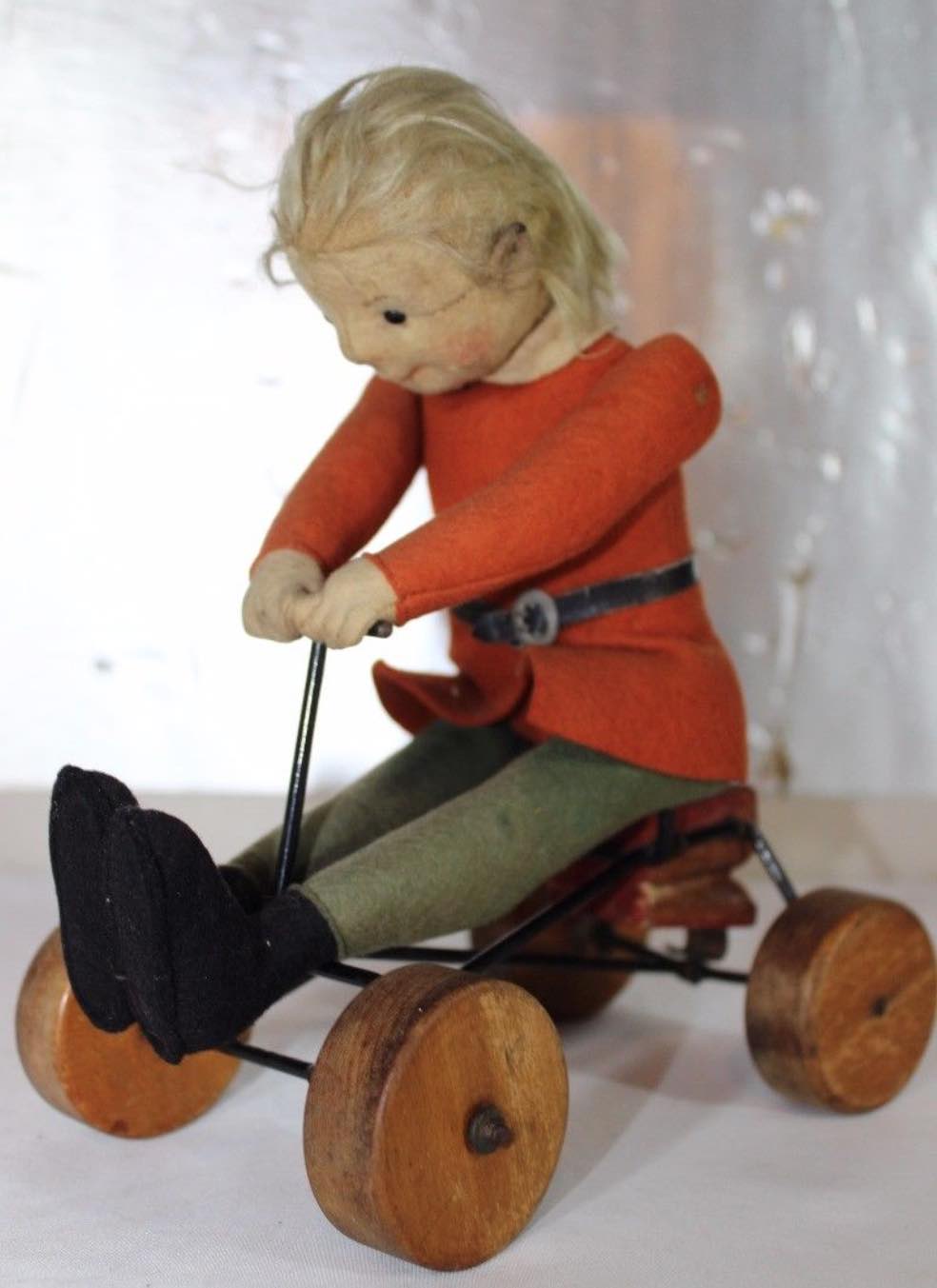
This first fantastic find is the wheel-deal indeed. According to its description, "For your consideration is this rare pull toy Record Boy by Steiff. Plush bean character with felt clothing. He is riding a tricycle and when rolled he moves his torso and heap up and down to action tricycle's propelling lever. Toy has a bellow underneath that produces sound as toy moves. Toy is about 9.5 inches tall by 7.5 inches long by 4.5 inches wide." 
This boy on the go had 4 total bidders, 7 total bids, and sold for $2,150.75.

Does his sale price shock you? It shouldn't, given this character's rarity and cultural status! This item is actually Steiff's Shockheaded Peter doll on a four wheeled cart, from the famous German book of the same name. "Record" refers to these pump and go hand-driven vehicles. This mobile marvel appeared in the Steiff line from 1916 through 1927. Steiff also produced a Shockheaded Peter doll in in 3 sizes ranging from 30 to 43 cm from 1909 though 1927. It is interesting to note that Steiff's Peter dolls had long leather fingernails (like the boy in the book) but this version on a cart does not.  Here on the left you can see a 1916/1917 advertising photo featuring Peter and other "record" friends of the era; the photo is from Cieslik's Button in Ear The History of the Teddy Bear and His Friends. 

Shockheaded Peter is a German folkloric treasure. It is written in distinctive, versed “chapters.” The book debuted in 1845 and was authored by Heinrich Hoffmann, a German psychiatrist who penned the tale for his three year old son as a Christmas gift when he could not find one he liked commercially. Each of the book’s ten tales has a distinct lesson, with the story demonstrating what happens when that lesson is not followed. For example, in story #3, a girl plays with matches and burns to death. The book’s title refers to story #1, where a boy (Peter) does not follow hygienic practices (for example, trimming his fingernails, combing his hair, and bathing) and as a result is an outcast. 

It's no game when it comes to this next auction find - a turn of last century Steiff footballer. He is described in part as, "Rare Antique Steiff Felt Jointed Doll. Doll was handed down from my Great Grandfather 30 - 40 years ago. I have not been able to find another one so that I would be able to describe it. Looks like a rugby player or hobo? Doll is in original condition just like I received it. I believe the inside composition is straw. Clothes show wear and fading in areas. Missing Right Arm. Eyes are glass and the right eye has come unattached but sits in the socket quite well. Leather Boots are very detailed. Top of Boots are split but are still intact with the doll as pics show."

This sports star scored 8 total bidders, 27 total bids, and sold for $1,402.77.

It's a life goal for Steiffgal to add one of these marvelous dolls to her collection! These student athletes were produced in 35, 43, 50, and 60 cm from 1913 through 1920 overall. These were designed to resemble American Ivy League soccer players. Their outfits were available in a variety of different color combinations, including blue for Yale, crimson for Harvard, orange or black for Princeton, and light blue for Columbia. The one under discussion here is probably a Harvard model, given the hue of his sweater. The dolls themselves were playfully configured to have a distinctly youthful, collegiate presentation with their chunky proportions, cherubic faces, and google-style black and white glass eyes. And their outfits reflected the uniform styles of the period; it is interesting to note that their leather shoes had inlaid "treads" on the soles, most likely a nod to early sporting cleats. Here on the left you can see a two early Yale players; the photo is from Cieslik's Button in Ear The History of the Teddy Bear and His Friends. 

Things are going to really heat up with this last Steiff surprise. It is simply noted by the seller as, "This auction is for a vintage Steiff Man figure chimney sweeper. This item is in Very Good condition and is being offered at No Reserve, Final Sale." 

This little fellow caught fire with 9 total bidders, 21 total bids, and sold for $1,276.13.

The lucky winning bidder did indeed hit the sweep-stakes with this petite treat.  This doll, made entirely from felt, is 15 cm tall and was designed to hang from the rear view mirror of a car. His unjointed body and traditional top hat are made from black felt and his charming flesh colored face comes to life with black button eyes and simple hand-painted features. He carries his own to-scale ladder and hand-brush.  This sweep appeared in the line from 1936 through 1943.

Chimney sweeps have a long and interesting history, especially in Europe. It is considered quite auspicious if a bride sees one on her wedding day. And friends often exchange chimney sweep toys and tokens as good luck charms, especially during the winter holidays. Another example of this pre-war Steiff chimney sweep sold for 474 British pounds at an auction at Christies in London in 2010. This roughly translate into about $750 in today's dollars.

Steiffgal hopes this discussion on these three very rare Steiff finds has helped to sharpen your treasure hunting skills!

Have a question about one of your Steiff treasures? Let's talk! Click here to learn more.

Friday, December 23, 2016

Steiffgal's Just Boy Crazy Over This Late 1930's Steiff Doll!

Oh boy!  Literally!  Santa stopped off at Steiffgal's house a tad early, delivering this sweet little guy just in time for the holidays.  He came all the way from Germany and was won at a recent toy sale there. Steiffgal has a thing for Steiff's early felt dolls, but she was particularly excited about this darling little man. Here's a little bit about him, and what makes him so interesting from the collector's perspective.

This handsome devil is Steiff's Seppl.  He is a great example of the company's pressed felt faced dolls, which appeared in the line overall from about 1936 through the very early 1950's.  Seppl is 35 cm tall, standing, solidly stuffed with excelsior, leg and head jointed, and made from felt.  He has lovely and very real looking blue, white, and black glass pupil eyes, a mischievous facial expression, and a shock of blond mohair hair.  He wears a very traditional German outfit.  This consists of black wool shorts with green embroidery; green suspenders; a white button down cotton shirt with a collar; a grey wool jacket trimmed in green with leather buttons; a green Alpine style hat; black tie style shoes; and grey and green knitted calf socks.  Seppl was produced in this size only from 1938 through 1943.

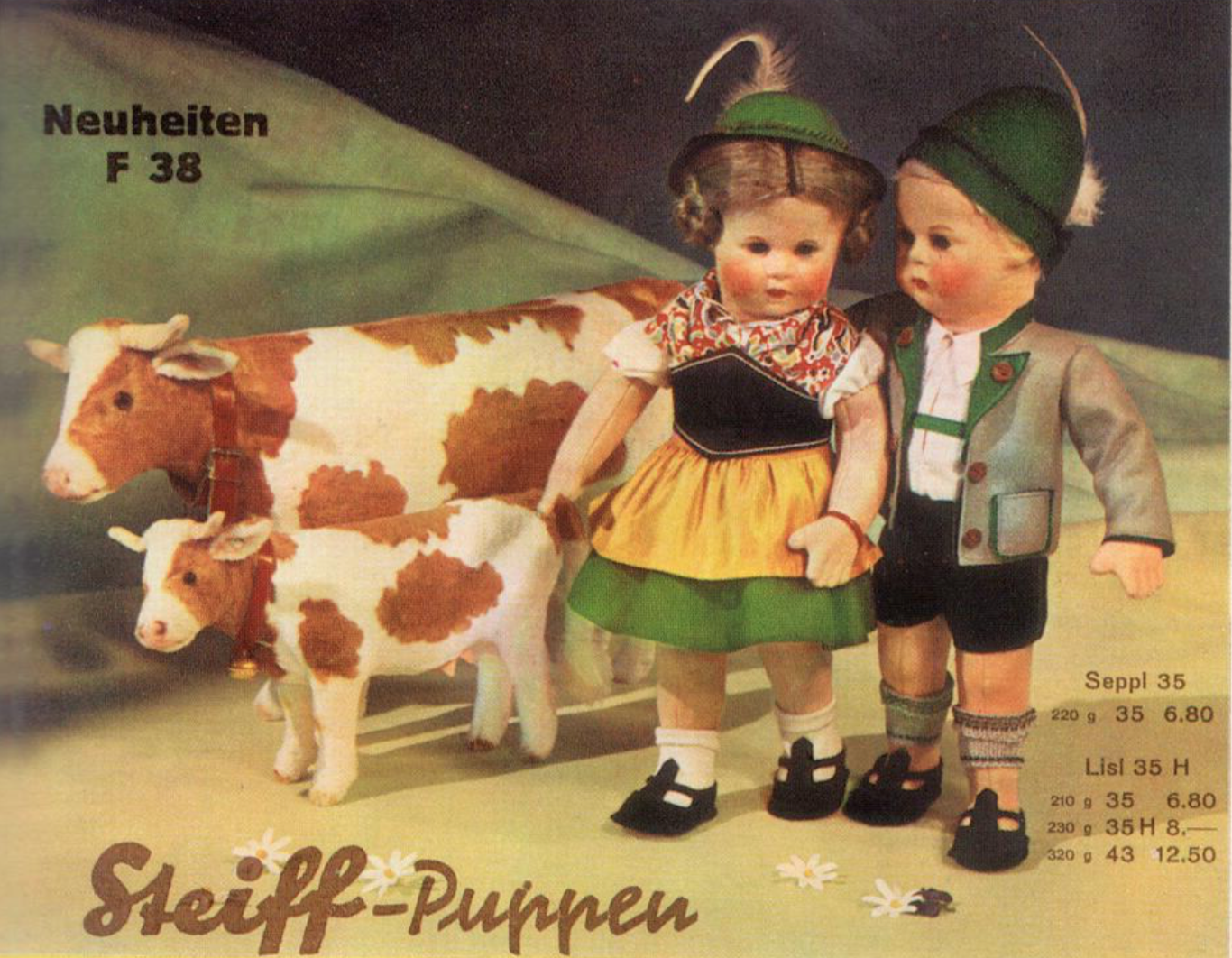
Seppl and his fellow seamless felt faced dolls were introduced in the late 1930's and were the "stars" of many of the company's advertising and sales materials at that time. This is understandable, given their charming presentation and personalities.  Here on the left you can spot Seppl and his gal-pal Lisl, who is also dressed in traditional clothing, as they appeared in one of the company's sales catalogs from 1938/1939.  You can see from his information that he is supposed to weigh 220 g (Steiffgal weighed her Seppl, who came in at 213 g); measure 35 cm (true) and cost 6.80 marks at the time. In 1938, 2.49 marks = $1 USD; as such, 6.80 marks = $2.73 USD. According to inflation calculators, $2.73 in 1938 had the same buying power as $44.84 in 2016.

Steiff has a half century of tradition of creating delightful cloth dolls, starting around 1903.  It is interesting to note that Steiff's earliest dolls were, for the most part, overwhelmingly male in gender.  Models included policemen, soldiers, soccer players, scouts, and other truly masculine designs. It wasn't until around 1909 that Steiff started creating both male and female doll models on a relatively large scale.  However, through the late 19-teens or early 1920's, many were still male, as the company's lines of international soldier and police dolls were a major emphasis on production.  You can see three typical male Steiff felt dolls here on the left from the c. 1909 through 1916 time frame. 

After WWI, the gender balance in Steiff's doll production changed significantly.  The soldier and police dolls were no longer of great interest, and Steiff's production of them dropped dramatically.  Female dolls started gaining popularity, and more and more were seen in the catalog.  By the time that seamless pressed felt faced dolls like Seppl appeared in the catalog, the company was really focusing on producing girl dolls for little girls.  For example, Steiff produced 27 versions of its pressed felt faced dolls in the 1938-1943 period.  Of those models produced, only 7 were boys, Seppl being one of them. As such, Steiff boy dolls from this period are quite rare.  You can see Seppl's cousin Rosl, who was produced from 1939 through 1941, here on the left. Once the factory reopened for toy making business in the late 1940's, Steiff again produced these pressed felt faced dolls for a handful of years.  However, all of the post war models were girls.  

Steiffgal hopes that you have enjoyed learning about Seppl, and that Santa also brings you a marvelous vintage Steiff treasure this year as well.  Happy holidays, dear Steiff readers!

Have a question about one of your Steiff treasures? Let's talk! Click here to learn more!

Saturday, September 3, 2016

This Well Accessorized Steiff Infantryman Has Uniform Appeal!

Do you need a few marching orders? Then Steiffgal insists you take a look at this perfectly accessorized Steiff Infantryman doll! The detailing on this miniaturized military doll is simply astounding. Check out his great presentation and posture, among other highlights. Steiffgal's certain you will agree he has uniform appeal!

This youthful Steiff fellow is called Infantryman. He is 28 cm tall, fully jointed, and made from felt. He has truly human proportions. His olive green uniform is integral to his body. It is trimmed in red felt and tiny brass buttons that are detailed with tiny stripes. His matching felt hat is "stenciled" with the number 28, most likely to coordinate with his size in cm. He wears light brown oilcloth boots that have tan felt heels and soles. His face and hands are made from flesh colored felt. His face comes to life with piercing blue and black glass pupil eyes, a pert nose, a painted mouth, and rosy cheeks. Infantryman was made in 28, 35, 43, and 50 cm from 1914 through 1920 overall. 

In addition to his breathtaking appearance and condition, this doll also deserves a salute for his absolutely incredible, and all original, field equipment. It is really unbelievable that all of these tiny objects have survived together, and intact, for a century. These include two perfectly scaled wooden ammunition boxes on the front of his leather belt; a wooden rifle with a leather shoulder strap; a grey felt water canteen; a buttoned canvas rucksack; a metal sword suspended from a decorated leather scabbard; a rolled up, grey felt blanket wrapped with leather ties; and a brown short pile plush backpack on leather straps. This fully functional backpack closes with metal fittings. The canteen, rucksack, and sword and scabbard all hang from the back of his leather belt on leather straps.

Steiff made many military themed dolls in the early part of the 20th century.  In a span of about two decades, starting in the early 1900's, Steiff produced examples representing German, Scottish, Moroccan, Turkish, Dutch, Russian, American, Belgian, French, Italian, and Austrian armed forces, among others. Well over 100 distinct designs were produced over this time frame; most of these patterns were produced in multiple sizes. In tribute to some heavy hitting militaries, like Germany, England, and the USA, Steiff produced dolls at numerous ranks and in various uniform types.  The doll's uniforms, for the most part, closely matched those of their real-life counterparts, down to colors, trims, and styles. 

However, this particular Infantryman style doll is among the most detailed of all the models produced, given the amazing attention given to its accessories, scale, and overall presentation.  

It is interesting to note how distinctly "friendly" and youthful this doll appears. This is absolutely on purpose. As mentioned previously, this doll design debuted in 1914. At this point in history, World War I had begun. Because of this geopolitical reality, Steiff’s doll designers were instructed to update their soldier doll patterns - which to this point were somewhat caricatured - and make them good looking, charming, and credible.  The company's previous, more "cartoonish" soldier designs were seen as disrespectful to the real life men fighting in the trenches for their country.

Steiffgal hopes this discussion on this well accessorized Steiff soldier has filled in all the details for you. 

Have a question about one of your Steiff treasures? Let's talk! Click here to learn more.
The teddy bear search engine