Saturday, April 20, 2019

All Smiles Over This Latest Steiff Teddy Baby Find!


Baby love! It's no secret that Steiff's wonderful prewar Teddy Baby bears and their novelties really float Steiffgal's boat. Like many Steiff enthusiasts, she simply cannot resist these dear cubs and their impish, carefree, and endearing personalities. And because of their unique construction, no two ever look exactly alike, only adding to their collectibility. Here's her latest adoption - a precious, pint sized cub with a distinctly old fashioned look and feel to him. It's hard to believe that he's nearly nine decades old despite his youthful name and appearance.

There's no question this is one beautiful baby. Teddy Baby is made from brown mohair, stands 17 cm tall, and is fully jointed. He has all of the beloved characteristics of Steiff's legacy Teddy Baby pattern: a distinctive, well defined muzzle; flat, broad, feet made for standing; downturned wrists; and sweet, toddler-like features and proportions. His irresistible face comes to life with an open, smiling mouth detailed with red (in his mouth) and brown (around his eyes and mouth) airbrushing; a black hand embroidered nose; and proportional brown and black glass pupil eyes placed right on the seam where his velvet and mohair facial fabrics come together. 

This smiling sweetie is also one well accessorized cub. He wears a red leather collar that is decorated with six dimensional metal studs, two long trailing "f" Steiff buttons, and a little brass bell. These wonderful and period compliments are all original to him, and are often lost to time. Teddy Baby retains his long trailing "f" Steiff button in ear and named chest tag with the words "ges. gesch" right under the words "Teddy Baby." "Ges. Gesch" is shorthand for "Gesetzlich Geschutzt." These German words translate roughly to the concept of a "trademark" as we have here in the USA. Teddy Baby examples with "ges. gesch" chest tags suggest that they were manufactured around 1930 or shortly after. It is Steiffgal's guess that the Teddy Baby under discussion here is a large 15 cm version, given his construction and detailing.

Keeping it all in the family, Steiffgal thought it would be fun to compare two versions of Steiff's 15 cm brown mohair prewar Teddy Baby bears - one with an open mouth and one with a closed mouth. Today's open mouth, standard line Teddy Baby bear debuted in 1930 and was produced in 9, 12, 13, 15, 20, 22, 25, 30, 35, 38, 40, 45, and 65 cm through 1943 overall. Steiff also made a closed mouth version of its brown mohair Teddy Baby bear. These were manufactured in 15, 20, 25, 30, 38, and 45 cm from 1929 through 1931 overall. Here are a few subtle design differences between the two cousins...

  • Muzzle: The open mouth version has a velvet muzzle and the closed mouth version has a mohair muzzle.
  • Hand pads: The open mouthed version has velvet hand pads and the closed mouth version has felt hand pads.
  • Feet: The open mouthed version has all velvet feet and the closed mouth version has mohair feet and felt foot pads.
  • Claws: The open mouthed version has painted foot claws and no hand claws, and the closed mouth version has black hand embroidered foot and hand claws. 
Steiffgal hopes this discussion on Steiff's 15 cm prewar brown Teddy Baby bears has been sweeter than chocolate!

Have a question about one of your Steiff treasures? Let's talk! Click here to learn more. 

Saturday, April 13, 2019

Check Out This Fez-tive Steiff Rarity!

Have you ever felt really good about a Steiff purchase? Well, Steiffgal recently has - in  more ways than one! Check out this marvelous, and marvelously dressed, Steiff monkey on wheels. There's no question you'll enjoy the ride!

This early 20th century Steiff "Record Peter" is the wheel-deal. First let's talk about the chimp. He is fully jointed, made entirely from felt, and is stuffed with excelsior. He measures 20 cm tall sitting, not including his cart. His face, hands, and feet are made from brown and dark tan felt. His body is made from red felt and is designed as if he's wearing a one-piece outfit that is integral to his design. It is decorated with a large, scalloped edged collar. The edges of his collar and outfit are trimmed in yellow floss. His face comes to life with black shoe button eyes, seams to indicate his nose and mouth, and a little pink and black paint highlighting. His proper-topper is a removable red felt fez with a black tassel. It is absolutely amazing that he still retains this accessory probably a century or more after he left the factory in Giengen, Germany! Felt Record Peter retains his tiny, long trailing "F" button-in-ear as his Steiff ID.

Rolling along, let's take a look at his fine ride. The carriage itself is made out of metal and is painted black. It glides along on four natural colored wooden wheels. The monkey does not actually "sit" directly on anything; he is mounted to the carriage via his backside and legs. This configuration allows his torso to move back and forth when the cart is pulled along. He holds the cart handle with both of his hands; his fingers have been sewn into place to hold this grip position. His "seat" is a red painted wooden rectangle that also doubled as a "squeaker" when he was new. The up and down motion of the wheels would have caused the bellows on the bottom of the wooden seat to let out a little noise with each rotation. Overall, this fantastic felt monkey on the go appeared in the line in 20 and 25 cm from 1913 through 1938. 

Let's dig a little deeper into the record of this legacy Steiff design. “Record” refers to a Steiff item on an "Irish Mail Cart" style vehicle, while “Peter” is the name of the monkey design. Steiff introduced its "Record" range of products in 1912, starting with an all brown mohair chimp on wheels. This "newfangled" design proved extremely popular. Record-style Teddy bears, rabbits, and dolls, including Max and Moritz, appeared in the catalog soon after. Over time, even Mickey Mouse and Felix the Cat were made in "Record" form! Like Record Peter under discussion here today, each of these wonderful Steiff novelties rode upon a black metal, four-wheeled cart with a handle. When any Steiff "Record" item was rolled about, his arms and torso would pump back and forth vigorously, giving the appearance that he was working hard to keep his cart moving.


And finally, picture this. You can see red felt Record Peter's debut image here above. You can click on it to make it bigger. The photo is taken from an original Steiff catalog for the American market dated 1913. At the time, the 20 cm version cost $1.50 and the 25 cm version cost $2.00. In 2019 dollars, that's the equivalent of $38.52 and $51.35. 

Steiffgal hopes you found this discussion on this rare felt Record Peter quite moving.

Have a question about one of your Steiff treasures? Let's talk! Click here to learn more.

Sunday, April 7, 2019

This Petite Steiff Pachyderm Is Simply Unforgettable!

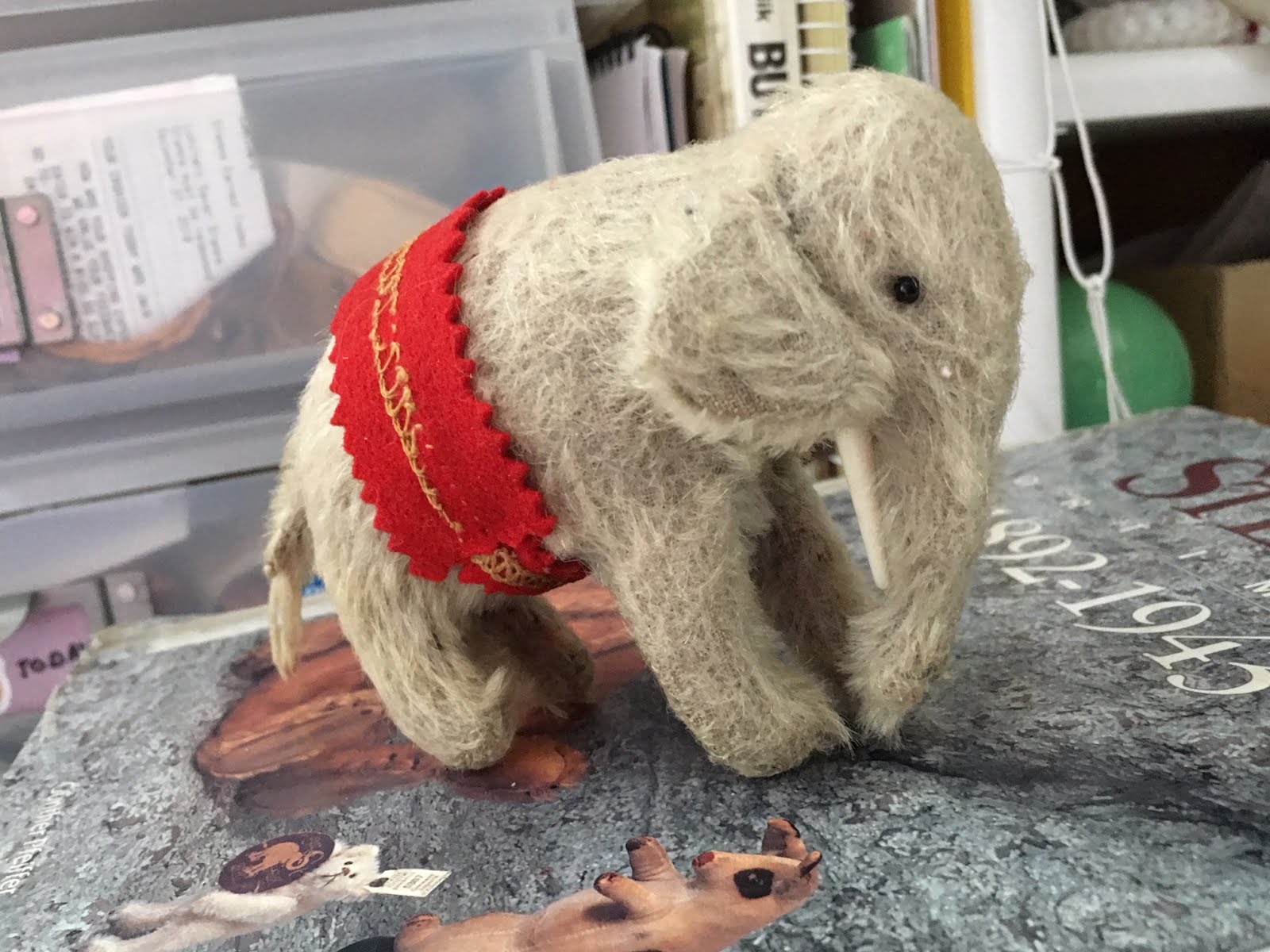
How can something so small be absolutely jumbo at the same time? Well, that's a riddle most Steiff collectors have no trouble answering. The very first "plaything" Margarete Steiff produced - albeit by "accident" - was a felt elephant in 1880. Since then, the company's elephants, regardless of size, have always garnered lots of love and interest from collectors worldwide. Steiffgal challenges you NOT to fall in love with this petite prince under discussion today!

There's not room for much junk in the trunk when it comes to this happy handful. Here we have a 10 cm standing baby elephant. He is unjointed and made from blue mohair. His little face come alive with simple black button eyes, proportional ears, a slightly tucked under trunk, and ivory tusks. His mohair tail is tipped in what feels to be like woolen yarn. His red saddle cloth is vintage, but probably not original to him given its "homemade" presentation. It is decorated with gold colored embroidery. Elephant retains his long trailing "f" button and traces of his red ear tag as his Steiff IDs. 

This little guy is absolutely ele-fantastic, but exactly who is he? It's a little confusing. He doesn't EXACTLY appear in Pfeiffer's 1892-1943 Sortiment. Steiff did produced a blue standing 8 cm elephant as a "pram toy" in 1926 through 1933. He came with a bell on the tip of his trunk, a cord, a pom-pom decoration, and an ivory hanging ring. However, this pram toy did not have tusks and had black and brown glass pupil eyes. So as they say, close but no cigar with a match here. 

A bit more research finds a 10 cm blue mohair elephant with black button eyes and ivory tusks pictured in the Sortiment. However, this model is described as having eccentric wooden wheels. That wheeled model was made in 1924 only. The elephant under discussion today looks very much like the one pictured in the Sortiment, but shows no evidence of ever being on wheels - there are no stitches, holes, or indicators on the bottom of his feet that would suggest he was once "on a roll." It is Steiffgal's best guess that the elephant noted in the Sortiment was produced with or without wheels, and that was just an oversight in his cataloging. This can happen on items that were produced in limited quantities, and/or for a short period of time. 

Now for a little color commentary. Although this elephant looks grey today, if you look in his "nooks and crannies," his baby-blue coloring is obvious. Steiff introduced many items in the mid to late 1920s in happy, jelly bean colors like this, so his hue perfectly aligns with his production period. These colors - especially pink and blue - tend to really fade over time. This probably has to do with the chemistry and properties of the pigments used to make fabric color dyes last century.  

Steiffgal hopes you found this discussion on this little blue elephant absolutely unforgettable. 

Have a question about one of your Steiff treasures? Let's talk! Click here to learn more.

Saturday, March 30, 2019

Getting All Dolled Up Over This Pretty Steiff Kitty

It's not often that you come across something that is the best of all worlds. But such is the case with this week's special My Steifflife blog visitor! Check out this simply adorable - and remarkable - Steiff cat doll. There's no question you'd want to welcome her into your meow mix!

This pretty kitty is the whole package. Her official Steiff name is PuppKatz Cat Doll. She is is 22 cm tall, standing, and head jointed. Her body is solidly stuffed and made from tan flesh colored fabric that has a slightly velvet-like finish to it. Her feet are flat and designed for standing; they are lined in cardboard. Her arms hang softly at her sides. Her feet and the tops of her paws are made from white mohair. Her mohair head is typical to Steiff's early 1930s cat head designs and is gently tabby striped. Cat's pert ears are lined in felt. Her pensive face comes alive with teal green and black slit style pupil eyes and a pink hand embroidered nose and mouth. Cat's clear monofilament whiskers have been lost to time. PuppKatz was made in 14, 22, and 28 cm from 1931-1943 overall.

This PuppKatz is part of a series of animal dolls Steiff produced in the 1930s and 1940s. Other species represented included bears, rabbits, dogs, elephants, and ducks. All shared the same stationary human form body. Most were made in 14, 22, and 28 cm and had removable clothing. As such, the original clothing was often lost to time, which is the case here with this PuppKatz. However, PuppKatz's current outfit of white underwear and a pretty belted dress, is perfectly scaled and adorable on her. She also came with a little pin with the name "Amy" on it. As such, that is her new name moving forward. 

The strategy behind the PuppKatz, and other animal doll patterns, is quite interesting and reflective of the prewar period in which they were made. These items launched in the early 1930s. Germany at this time was in a period of high unemployment and financial uncertainty. As a response to poor economic conditions, Steiff started making items that were simplified in design, used less expensive or even alternative materials, and were "theme and variation" in nature. The change in tone from items introduced from the end of the 1920s to the early 1930s is absolutely striking. Steiff's 1920-era items for the most part were colorful, fluffy, feminine, and childlike. Their early 1930-era items tended to be a bit glum looking, longer, narrower, and thinner

Steiff's animal dolls fit the needs of the 1930s business environment to a T. They were all on the same easy body that was made from inexpensive fabric and could be detailed in countless ways. In the case of this PuppKatz, she was made in three sizes, and each size was available in up to 11 different outfits over time. This one design ultimately represented 29 different SKUs in the product line. These outfits included sporting clothes, pajamas, suits, dresses, traditional clothing, and swimsuits, among others. These outfits were numbered and noted by a distinct code in the animal doll's article number. By having so many options for this one simple design, the company was able to fill its catalogs efficiently when product design and development resources, as well as raw materials, were severely limited by factors beyond the company's control. Steiff's 1938 catalog featured a whole spread of their animal dolls and various outfits; you can see that page here on the left. Please click on the photo to make it larger and more legible. 

Steiffgal hopes this discussion on PuppKatz has tickled your whiskers in the best possible way.
The teddy bear search engine