Showing posts with label gnome. Show all posts

Sunday, December 5, 2021

Going Green With This Seasonally Hued Steiff Sweetie

"Tis the season for all things green and red!
As such, the timing is perfect to share a recent addition to Steiffgal's hug with you. 
This seasonally hued sweetie is a bit of a mystery but so charming nonetheless. He was on Steiffgal's wish list for awhile given his rarity and somewhat ephemeral construction. Check out this darling doll and see what makes him the perfect 1970s-era ambassador.  

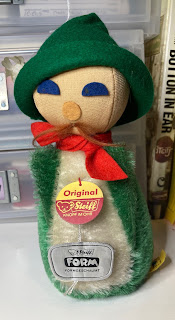
Here we have Steiff's little known "Buzzel Sepp." 
In Germany, "Sepp" is a nickname for someone with the formal name of Joseph. And "Buzzel" refers to his shape and construction. But more about that in just a bit. In all honesty, Steiffgal is not exactly certain who this guy is or who he may represent. He is not obviously a chimney sweep, farmer, or gnome - Steiff's usual cast of male doll suspects. Perhaps he is a shepherd, as he is pictured with a red plastic staff in some reference books. Unfortunately, Steiffgal's Sepp has lost this accessory. 

Buzzel Sepp is upright and unjointed.
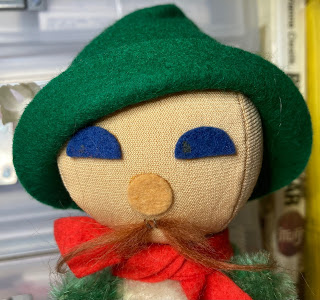
It is not clear if he is standing or sitting as he has no legs. His simple body is made from bright green and white mohair. He rests on a flat bottom. His head is made from a synthetic - probably polyester - fabric. His face comes to life with blue semi-circle felt eyes, a tan circular felt nose, and a long, brown fiber mustache. He is accessorized with a red felt scarf and a green felt hat. His hat has a little daisy on it for decoration. Buzzel Sepp has a working squeaker in his base. This silly guy appeared in the line in this size only from 1972-1974.

It is interesting to note that he is noted in the 1947-2003 Steiff Sortiment as made from dralon but he is clearly made from mohair - at least in this case.

Buzzel Sepp has some distinctive IDs.
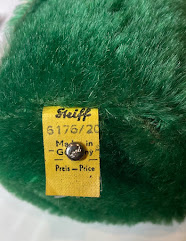
His chest tag is Steiff's red and yellow split style version. This chest tag debuted in 1972, aligning perfectly with Sepp's production date. On the back of this tag, it is noted that Sepp cost 19.90 marks. Given that $1 = DM 3.48 in 1972, this would have been about $5.72 in 1972 dollars; $5.72 in 1972 is worth approximately $37.85 in 2021. This doll also has a silver hangtag with the word "formgeschaumt" or "foam molded" on it. That refers to his pre-formed foam stuffing. And because he does not have any ears, his ear tag is located on the seam of his bottom with his lentil style Steiff button embedded into it. You can see this somewhat unusual configuration here on the left.

Steiff's Buzzel items appeared in the line in 1970s.
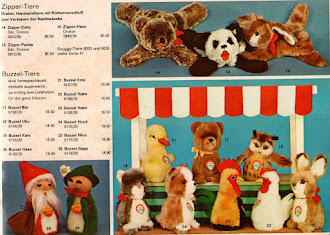
They were all 20 cm, sat upon a flat bottom, had a squeaker, were stuffed with pre-formed foam, and washable. Other Buzzel models created included a rooster, a rabbit, a cat, and a Santa Claus, among others. These items - except for Sepp and Santa - were simplified versions of popular Steiff designs. Steiffgal suspects the Buzzels were created specifically as less expensive and/or lower end toy line for children given how the word "washable" featured so prominently in their marketing. And, in Steiff's 1972 product catalog, their Buzzel line is noted as, "foam-molded, therefore super soft, really to love for the very little ones." You can see Sepp and his other Buzzel friends as they appeared in this vintage catalog here on the left. Just click on the image to make it bigger. 

Steiffgal hopes this discussion on Steiff's quirky Sepp doll has added a joyful buzz to your day.

Have a question about one of your Steiff treasures? Let's talk! Click here to learn more.

Sunday, September 22, 2019

So Many Elements Make This Steiff' "Sulphur Mate" Doll So Fantastic!

Cute as a button! There's simply no better description of this darling, and diminutive, Steiff doll. This petite treat recently joined Steiffgal's hug, and she couldn't be more excited about it. Please say hello to Sulphur Mate, and see what makes him so interesting from the design and historical perspectives.

Hat's off to this fine fellow! Bitty Sulphur Mate is 14 cm, standing, head jointed, and made primarily from felt. His body and outfit are one in the same and made from yellow felt. His oversized slip-in shoes are made from light orange felt. He dons a teal colored, removable hat decorated with tan paper buttons. His darling face beams with its horizontal shaped seam, side glancing, google-style black and white glass cartoon eyes, a pink stitched and painted mouth, and airbrushed features. His hair and beard are made from bright orange tipped mohair, which has faded a bit over time. 

In terms of IDs, this Sulphur Mate retains his trailing "f" button and yellow ear tag marked "114". In this case, the 1=standing and the 14=14cm. It is not clear if this pattern ever had a chest tag. This lucky charm was produced in 14 and 25 cm from 1933 through 1936 overall. The 25 cm version has tri-colored glass eyes, but is almost identical in every other way. Sulphur Mate's design was also repurposed as a coffee warmer in 44 cm in 1934. 

Sulphur Mate has several design features that are elemental to his appeal, and reflect the timeframe in which he was produced and sold. 

The first is his delightfully tipped orange mohair beard and hair. This type of happy, eye-catching material was very typical to the late 1920s/early 1930s; for example, think of Steiff's "Petsy" the Baby Bear, and Molly the Puppy - both are famous, in part, for their great tipped fabrics. 

The second is his accessories. His oversized slip-in shoes - which are most likely a nod to the clogs made famous by Steiff's earlier and well healed gnomes Snik and Snak - are made from orange felt. Steiff's earliest clogs were made from wood and leather; Sulphur Mate's are simple and made from felt. And his hat is inexpensively decorated with small, glued on cardboard circles. Earlier details like this would have been embroidered or painted. With Steiff, over time, it was not unusual for accessories to be sampled and streamlined over time as cost savings measures. This was especially true starting in the early 1930s.

The third is his facial construction. It is interesting to note that this gnome doll was one of the very last dolls designed and produced with Steiff's traditional horizontal or vertical seam face construction. His prominent horizontal seam was necessary create his prominent, large, flat nose; this seaming dates from the early 1900s and can be seen also on some of the company's early farmer dolls.  The company's dolls introduced from the mid-1930's onward all had seamless, pressed felt face assemblies. 

Despite his impish presence and personality, Sulphur Mate has a somewhat scandalous history with Steiff. According to the Cieslik's Button in Ear book, this doll pattern was originally designed by artist Charlotte M. Kirchhoff as a logo for a Bavarian hotel chain owned by Anton Gross. In the early 1930s, Gross asked Steiff to produce Sulphur Mate as a toy. A sample was made, but Gross never placed an order. The sample was placed in the archives. 

In 1933, Otto Steiff came across the sample, really liked it, and put it into production. Between 1933 and 1936, 1,315 Sulphur Mate dolls were made. In 1936, Steiff received a cease and desist letter from Kirchhoff's lawyer, accusing the company of plagiarizing the design. Recognizing the error, Steiff immediately stopped Sulphur Mate's production, and paid Kirchhoff based on their sales of her pattern. Steiff replaced Sulphur Mate in its line with another little gnome in 1937; he was called "Lucky Fellow." He had a somewhat similar body to Sulphur Mate but had a pressed felt face and a mushroom looking hat. You can see Lucky Fellow here on the left; the picture of this little guy is from LiveAuctioneers.

Steiffgal hopes this discussion of this well-heeled Sulphur Mate doll has been a "shoe-in" for you!

Have a question about one of your Steiff treasures? Let's talk! Click here to learn more!

Sunday, July 21, 2019

Hat's Off To This Tiny And Absolutely Adorable Steiff Dwarf Doll!

Do clothes make the man? No, not always, but they can suggest some very interesting things about him! Check out this happy handful - a well attired Steiff dwarf doll - that recently joined Steiffgal's hug. His outfit, materials, and impish good looks make him quite the cover boy!

This petite treat stands 22 cm tall and is fully jointed. His entire body, including his face, is made from flesh colored linen. His oversized hands and feet are remarkably detailed with realistic fingers and toes. His ever-happy face comes to life with a long, light brown mohair beard and eyebrows, bright green and black glass slit pupil eyes, a charming upturned nose, and a open, red smiling mouth. His cheeks are very rosy and he even has a little razor stubble to him! He wears brown velvet shorts, a white cotton shirt, a bright yellow mohair cap, and a bright blue felt vest. His accessories include a leather belt and a Steiff-branded satchel; this is pictured below. When he left the factory in Giengen, Germany over a century ago, he wore oversized wooden and leather clogs. Dwarf retains his tiny, long trailing "f" button in ear as his Steiff ID.

So just who is this dapper dwarf? Steiffgal has two theories.  First, perhaps he is a hybrid of the company's early 20th century Snak and Snik dwarf designs. Snak was made in 22, 30, 43, and 50 cm from 1911-1915. He is known for his mohair cap and pointy nose. Snik was made in 22, 30, 43, and 50 cm from 1911-1920. He is known for his floppy felt hat and upturned nose. This little guy has a mohair cap and upturned nose - suggesting that he shares key traits from both patterns.

It is also entirely possible, given how every Snak Steiffgal has ever seen has a bright yellow mohair cap, that he is 100% Snak. Sometimes, the smallest versions of a Steiff item have little design tweaks from the larger versions. This usually involves simplification of seaming, body shape, or jointing relative to scale. In this case, this diminutive dwarf does not have eye pockets like the larger versions do, and his nose is definitely not crooked! Perhaps Snak's distinctive, long crooked nose just didn't translate well to the 22 cm version. Only this dwarf knows for certain, and he's not talking!

What is certain is his "birth date" and what that means in terms of his presentation. Given his materials, this dwarf was most certainly made in the World War I era (c. 1914-1918.) During this period, traditional, high quality woolen materials used for toy making like mohair and felt were in very short supply. Most of these fabrics were rationed for war purposes like uniforms and blankets; what was available commercially was very expensive and challenging to obtain.  

During peacetime, this dwarf's entire body and head would have been made from felt; here they are made from inexpensive linen. And his pants, which typically appear in felt, are made from velvet. These substitutions saved a significant amount of costly fabrics, and didn't really change his appearance or personality. It is interesting to note that his "signature" and highly visible elements - his hat, beard, and vest - are still made from woolen fabrics. However, the amount of materials needed for these "key" elements was quite small, and these details could have been pieced together from scraps for efficiency. 

Steiffgal hopes this discussion on this tiny linen dwarf has added to the fabric of your day!

Have a question about one of your Steiff treasures? Let's talk! Click here to learn more!

Friday, February 14, 2014

A Petite Steiff Treat In Honor Of Valentine's Day

In honor of Valentine's Day, the universal holiday of love, Steiffgal thought she'd introduce you to one of her Steiff cupids! Well, this little guy wasn't designed as the sprite with wings and a bow and arrow - but he certainly plays the role of a super sweetheart really well! Come check out this darling Steiff gnome and see what makes him so interesting from the design and historical perspectives.
 

This little lovey certainly gets Steiffgal's heart beating in a big way! Here we have Steiff's gnome named Snik. Snik is 35 cm tall, made of felt, and is leg and head jointed. His oversized hands and feet are remarkably detailed with realistic fingers and toes. His ever-happy face comes to life with a long orange mohair beard and eyebrows, bright green and black glass pupil eyes in felt eye pockets, an impish upturned nose, and a open, red smiling mouth. He wears brown felt shorts, a white cotton shirt, a now faded red pointed cap, and a bright purple belted felt vest that has faded to tan over time. You can't help but notice Snik's enormous wooden and leather clogs - just perfect for yard work (but more on that later!) Snik was produced in 25, 35, and 43 cm from 1927 though 1943.
 

Steiffgal's Snik is based on another very similar felt dwarf (also named Snik) that Steiff produced from 1911 through 1921. Early Snik was made in 22, 30, 43, and 50 cm; he had a purple felt hat and a slightly different facial expression than later Snik. You can see this first Snik pictured here on the left; the photo is from Gunther Pfeiffer's 1892-1943 Sortiment Book. Early Snik was designed during a most interesting period in the evolution of Steiff dolls. Steiff began commercially producing its first dolls with center-seamed faces around 1904. Most of these were felt; some were velvet. These early dolls were called “caricature” dolls or “charakterpuppe” because they had comical, exaggerated features – such as extremely lean or rotund bodies, huge feet, or cartoon-like faces... much like early and later Snik. In about 1914, Steiff started giving their new doll patterns much more accurate, human proportions, and started moving away from the “charakterpuppe” look. These updated designs became universally embraced for their authenticity, appeal, and charming appearances. So this later Snik, despite his likely production in the late 1920's or early 1930's, is really a nod to Steiff's very early turn of last century “charakterpuppe” doll production and design priorities. 

It was a shoe-in that this clog wearing sweetie would be a hit with collectors for over three decades! Gnomes hold a very special place in the hearts of many Germans and have been a part of European popular culture for centuries. These small, humanoid creatures apparently live underground and are considered auspicious (and a bit mischievous) as well as essential for gardening success! Today, it is not uncommon to see small gnome statues in even the most formally planted and tended gardens across Europe! It is said that gnomes have a lifespan of 400 years and "kiss" by rubbings noses and also use nose rubbing as a greeting equivalent to people shaking hands.  Like our friend Snik under discussion today, "typical" gnomes have red pointy hats, fluffy beards, dark pants, sturdy working shoes, and a sweet expression that reflects the pleasure that comes from a good day at work.  

Steiffgal hopes this discussion on Snik has been a petite treat for you. 
  
Have a question about one of your Steiff treasures? Let's talk! Click here to learn more. 

The teddy bear search engine