Showing posts with label embroidery. Show all posts

Saturday, June 24, 2023

Keeping It In The Family With This Nearly Century-Old Steiff Bear

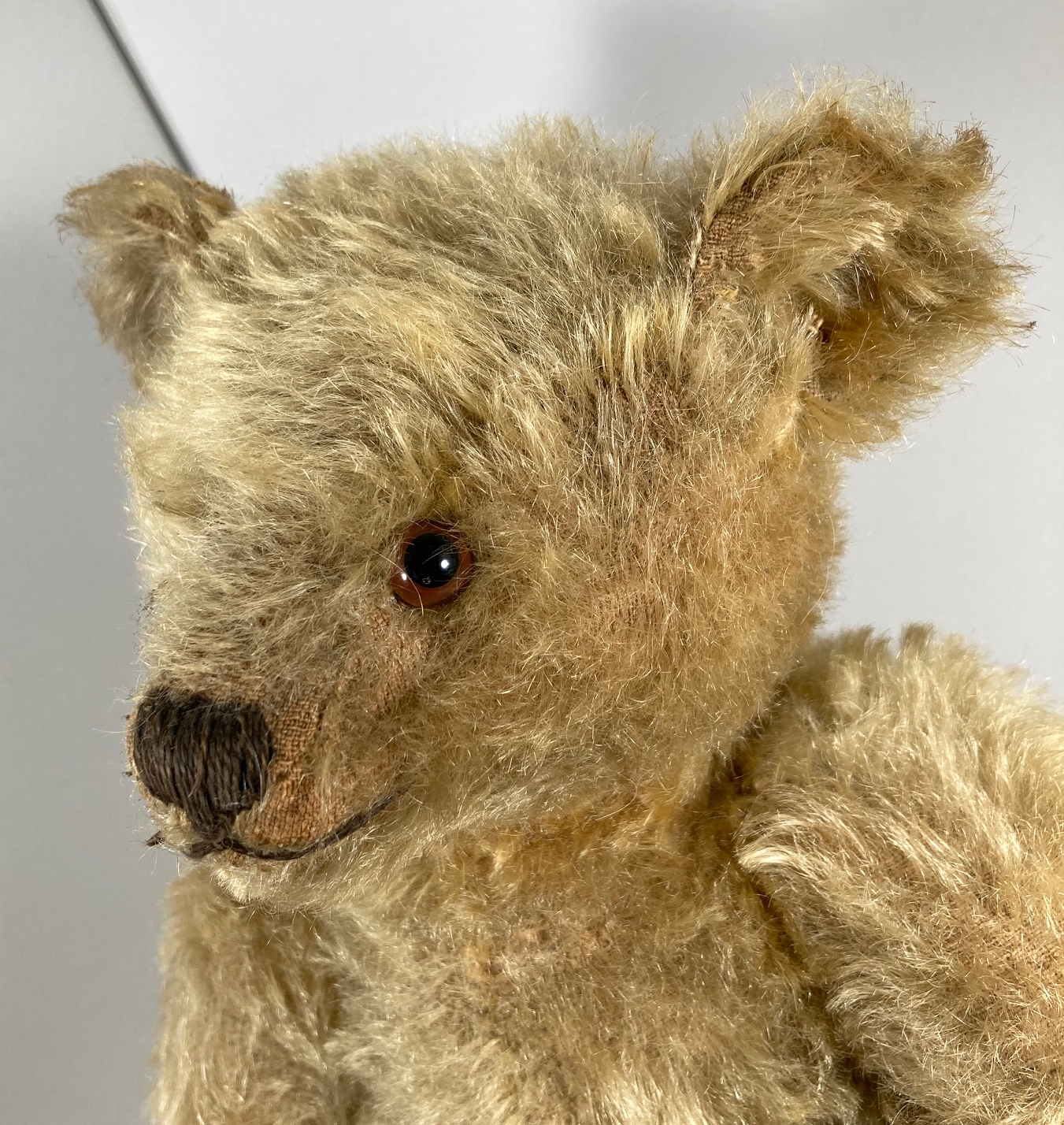
Old friends make for the best of friends. And so it is with this heirloom who calls the Western part of the USA home. He has lived his nearly century long life with the same family, which is wonderful for both the bear and his people! His owners simply write...

"We are interested in getting more info on a red tag bear who measures approximately 28” standing and 20" sitting. He's been in the family since the 1930s. Thank you."


This delightful and most appealing five ways jointed cub is Steiff's legacy, standard line blonde mohair Teddy bear. This pattern in this color was made in 10, 15, 18, 22, 25, 30, 32, 35, 40, 46, 50, 60, 70, and 115 cm from 1906-1933. Like most prewar blonde Steiff bears, he has black hand embroidered nose, mouth, and claw stitching. He has longish arms with spoon shaped paws and a moderately sized back hump. His paw pads are made from felt and appear to be original to him. His eyes are brown and black glass pupil style, perhaps slightly oversized in proportion.

Bear's red ear tag, long trailing "f" button, and proportions date his production to the c. 1926-1933 time frame.
This aligns really well with the history his family shared. Steiffgal suspects that he was born probably towards the beginning of that time frame as he has more of a 1920s era look to him. Bears from the 1920s tend to be more fuzzy, full figured, and youthful looking. Those from the 1930s often are less fuzzy, more serious looking, and leaner all around. You can check out an image of Steiff's bears from the company's 1929 catalog here on the left for reference. As you can see, they really have a fun and upbeat look to them. 

Given Ted's dimensions - 20 inches/50 cm sitting and 28 inches/70 cm standing - this bear is technically the company's 70 cm version.
This suggests his article number would be 5350,2. This translates to 5=jointed, 3=mohair, 50=size sitting, and ,2=has a growler (noisemaker) in the belly. Sometimes these growlers work but often they break over time. It is not clear if this Ted still talks. However, 5350,2 is the number that would be most likely on his red tag if it were still legible.

As for value, something is worth what someone will pay for it. Steiffgal has not seen or handled this bear firsthand, and does not know if he has any significant losses or condition issues, including those that don't show up in pictures. These include things like dry mohair, smoke damage, or insect damage. However, given he is as nice - and as "healthy" - as he appears in his photos, Steiffgal suspects he may trade hands in the c. $2,500-4,500 range.

Steiffgal hopes this discussion on this heirloom prewar Ted has timeless appeal to you.

Have a question about one of your Steiff treasures? Let's talk! Click here to learn more.

Sunday, February 19, 2023

The His-Story Behind A Marvelous Turn of Last Century Steiff Cub

Provenance can add such an interesting dimension to a precious Steiff item. Here's the story behind a beloved family heirloom Steiffgal recently handled for a new friend from the western part of the USA. She was looking to find a new forever home for her Grandmother's bear - a gorgeous, 19-teens era cub. Here's his story!

Maggie shares:

"Here is a little history on this bear, which has been in my family for over 100 years. He was given to my Grandmother by her older brother, when he came home from World War I. She said that he had gotten the bear in France. My Grandmother called him Buster, probably after Buster Brown, and my mother and I called him Mr. Bear.

I put the little black ribbon on him when my Grandmother passed away in 1981. He's never been like professionally cleaned or refreshed or anything like that. I can remember my mother once shaking him in a brown paper bag with oatmeal to clean him off, that would be in the late sixties.

I took him once to an open casting call for Antiques Roadshow, but they said that they didn't want to do any stuffed toys that particular season. They valued him at somewhere between $2,000 and $10,000 BUT they misidentified him as being from the early 1920s.

I've had him for a really long time, and he does remind me of my Grandmother, but as I am nearing 60 now, I realize that I have no one to pass him down to. And I know that 99% of what people leave behind ends up at Goodwill. I would just be interested in maybe selling him to someone who collects bears and loves them."


Now here's more about Buster Brown, or Mr. Bear!
This handsome dude is 40 cm tall standing, fully jointed, and made from lovely dark blonde mohair. Typical to his era, he has a prominent back hump, long thin felt padded feet, pert proportional brown and black glass pupil eyes, a sort of fuzzy muzzle, and a now faded black hand embroidered mouth, nose, and claws. He is stuffed with excelsior, with a nonworking squeaker in his belly. He has a distinctly sweet and childlike look to him. He retains his long trailing "f" button as his Steiff ID. Given his details and history, this charming cub was born in the c. 1915-1919 time frame. A picture of this bear is here on the left - before he hit the spa. 

As Maggie notes, this bear has never had a proper bath in over a century.
So Steiffgal got to work on this. With the understanding that every item is different, and that pre-existing condition issues really matters when it comes to cleaning, this bear totally qualified for a light but comprehensive scrub. His mohair and backing were lush and intact, with no signs whatsoever of dry mohair or rot. Using the technique outlined in this blog and/or in this video, Steiffgal gave him a good cleaning and fluff, and now he looks even more marvelous than ever! The picture here on the left is the bear post cleaning. Look how his fur just glows!

Now Buster Brown, or Mr. Bear, is off to his new home, far far away, where he will be loved and cherished forever per Maggie's wishes.
And look how happy he looks about that!

Have a question about one of your Steiff treasures? Let's talk! Click here to learn more.

Friday, February 14, 2020

Are You All Ears To Learn About This Unusual Prewar Steiff Rabbit?


Steiffgal's simply jumping for joy over this latest collection addition! This remarkable rabbit, produced during a most challenging era at Steiff, has so many interesting details - including his "colorful" history. Come see what makes this begging bun so much fun!

There's not a hare out of place when it comes to this prewar charmer. He is begging, head jointed, and made from long, shaggy tan artificial silk plush which has been highlighted with black (that has faded to a deep forest green.) He measures 23 cm head to toe, and his tan felt lined ears add another 12 cm to his height. His face is detailed with pink and red glass pupil eyes and a simple red hand embroidered nose and mouth. He has three matching red claws on each of his feet. Rabbit retains his short trailing "f" button in ear. When he left the factory, he wore a large silk ribbon and bell around his neck. This pattern was produced in 18, 23, and 29 cm from 1938-1943 overall. As rabbits are measured WITHOUT ears, today's bun under discussion is the 23 cm version.

According to his original owner, who now lives in Canada, "My Steiff silk stuffed bunny dates from late 1930s and was purchased in Brussels, Belgium."

This rabbit's appearance and construction align well to his provenance, as well as to the manufacturing realities of the late 1930s and early 1940s at Steiff. It goes without saying that these were challenging times all around in Germany. So creating efficiencies in every area of design and manufacturing was imperative for survival. Steiff has always had a remarkable way of producing the most appealing items during down times, and this bunny pattern brings truly illuminates that. Here are four reasons why.

His fabric: 
This hare's hair is made from artificial silk plush, a material that was more readily available and affordable than mohair and felt just before and after WWII. Steiff made many of its "mainstream" items in this material during this period. It translated well, at least in the short run, to Steiff's animal patterns but lost its appeal and luster quickly. 

His embroidery: 
To save costs and labor, Steiff designed his facial embroidery to be as simple as possible - basically a large red "X" on his muzzle. Just a few years prior, typical rabbit facial embroidery was two colored, and involved "filling in" the nose space with stitches. He also only has claws on his feet, even though it would not be challenging to embroider them on his paws as well. 

His shape: 
Rabbit's shape, although unquestionably "rabbit like," has been simplified and made less graceful and curvy than the company's begging bunnies from the c. 1925-mid-1930s overall.

His coloring:
Although he appears green and tan, he did start out life black and tan. His painting details have simply changed hue over time. It is interesting to note, that from the 1920s through the early 1930s, many animals that were multi-colored were constructed in a "patched" way, meaning that each color was its own color of mohair, and the colored fabric swatches were sewn together. Of course, this was beautiful and lifelike, but also very expensive and time consuming. To create significant efficiencies in production, the company started painting instead of patching animals, and this rabbit is a perfect example of that.

Steiffgal hopes this discussion on this charming prewar rabbit has been pure hoppy-ness to you!

Have a question about one of your Steiff treasures? Let's talk! Click here to learn more!

Sunday, November 12, 2017

Age Is Just A Number When It Comes To Steiff's Delightful Prewar Teddy Bears


You've certainly heard the expression, "What a difference a day makes." Well, with Steiff, design changes over time took a little longer than that for the most part. But pre-war, these changes did happen, but in a very slow and subtle way. So how can you tell when an early Steiff bear was "born?" Let's take a look at two petite treats to get some general guidelines.

First, please say hello to lovely Lilly. She's about 25 cm tall standing, and 18 cm tall sitting. She is made from white mohair and is fully jointed. She has four hand embroidered brown claws on each of her paws; her pads are made from light peach colored felt. Her pensive face is detailed with a somewhat pointed and shaved muzzle, black shoebutton eyes, and a brown hand embroidered nose and mouth. Lilly retains her blank Steiff button and white ear tag as her Steiff IDs. On her ear tag, you can see the numbers "53" but the last two digits are under the button; given her height these are most likely "17." The 17 refers to her size sitting, which is how Steiff measured their bears through through 1933. (To calculate a bear's approximate standing height given this number, multiply its sitting height by 1.46.) Also printed on Lilly's tag is the word "geschutzt" which means "patented" in German. Given all of this data, it is most likely that Lilly was manufactured around 1906.

Second, but only in chronological order, is sweet Sigi. Like Lilly, she is also about 25 cm tall standing, and 18 cm tall sitting. She is made from white mohair and is fully jointed. She has four hand embroidered brown claws on each of her paws; her pads are made from light peach colored felt. Her sweet and more "toddler-esque" face comes to life with a full and rounded muzzle, brown and black glass pupil eyes, and a brown hand embroidered nose and mouth. Sigi retains her long trailing "F" button and traces of her red ear tag as her Steiff IDs. Her presentation and ID configuration all seem to suggest that Sigi was most likely made in the late 1920's to early 1930's timeframe.

So, about a quarter century of time separates the birthyear of these two cute cubs, with only a few obvious design details differentiating them. This is sort of interesting to think about in terms of product development of other items and technologies over time - imagine fashion styles, car designs, or even smart phones NOT being updated on a yearly, if not monthly, basis? 

Heads up! It's clear that the most striking physical differences between Lilly and Sigi appear in their faces. Steiff's turn of last century bears, like Lilly, (on the left) are beloved for their shoebutton eyes, pointy and shaved muzzles, and distinctly "old fashioned" look, for lack of a better term. Fast forward a few years, Steiff's bears began to take on a more youthful appearance, like Sigi (on the right). By the early 19-teens, most had glass pupil eyes, and by the 1920's they had fuller and rounder faces, usually with unshaven muzzles. 

Another set of metrics to evaluate between these two cute cubs are their body proportions. Of course, Steiff bears are all made by hand, so there will be differences between bears and over years, just by the nature of their production. However, Steiff's earliest bears are well known for their long, slender limbs (as they were originally designed to stand on all fours) and long narrow feet. Due to cultural preferences and company directives, Steiff bears became rounder and more playfully proportioned over time, while keeping the same overall heights in the line for consistency. You can see this trend in Lilly and Sigi's measurements here.  

Lilly's measurements:
  • Legs, top of leg to heel: 11 cm 
  • Arms, top of arm to paw tip: 14 cm
  • Foot size, heel to toe: 5 cm 
  • Head height: 7 cm 
Sigi's measurements:
  • Legs, top of leg to heel 10.5 cm
  • Arms, top of arm to paw tip: 13 cm
  • Foot size, heel to toe: 4.75 cm
  • Head height: 8 cm
Because these bears are relatively small, the differences are somewhat subtle; however, they are much more pronounced on larger examples, especially from about 35 cm onward. 

Steiffgal hopes you've enjoyed this Steiff special edition of "The Dating Game!"

Have a question about one of your Steiff treasures? Let's talk! Click here to learn more.

Monday, November 10, 2014

Live From New York - It's The First Ever North American Steiff Teddy Bear Making Workshop!

Here's a question for you. Do you know how long it actually takes to make a Steiff Teddy bear from start to finish? The answer might surprise you... usually in the 8 to 9 HOUR range! Can you believe it? Well, Steiffgal wouldn't have either... until last weekend when she participated in the first ever North American Steiff Teddy bear making workshop in New York City. The workshop, which was arranged by Steiff North America's Club Manager and Superpal Carolyn Smith, was lead by Ralf Fahrig, Steiff's Area Sales Manager at Margarete Steiff GmbH, and his team of two amazing Steiff seamstresses.  

Overall, two workshops were held:  one starting at 9am, and one starting at 1pm.  Each was sold out and over 40 Steiff enthusiasts had the great pleasure of customizing and detailing their very own bear.   The room was set up with two large tables; each was draped in a black tablecloth.  In the center of each table were several completed bears for study and inspiration.  Each table was stocked with needles of various sizes, thick tan thread, many floss choices for claw and nose embroidery stitching, bins of different eyes in various sizes and colors, scissors, mohair combs, thimbles, and other tools.  When the workshop attendees entered the room, they found their partially completed bear and name tag, and sat at that designated place. For the most part, people spent the first 10 to 20 minutes of the workshop experimenting with the different floss and eye color combinations to plan out how they would like to detail their bear; you can see Steiffgal's initial thoughts for this here on the left.

The bears all started out the same, except for what was embroidered in brown on the bear's tan felt paw pads.  This was customized per each attendee's request.  The bears were 28 cm, five ways jointed, and excelsior stuffed.  They were made from long, curly, brown tipped mohair with a cropped muzzle.  Each had an open seam up the back, no embroidery on their paws or face, and lacked eyes and a decorative ribbon.  Here to the left you can see Steiffgal and her not-yet-worked upon cub; one paw says, "Steiff Workshop" and the other one says, "My handiwork RK, 11/8/14."

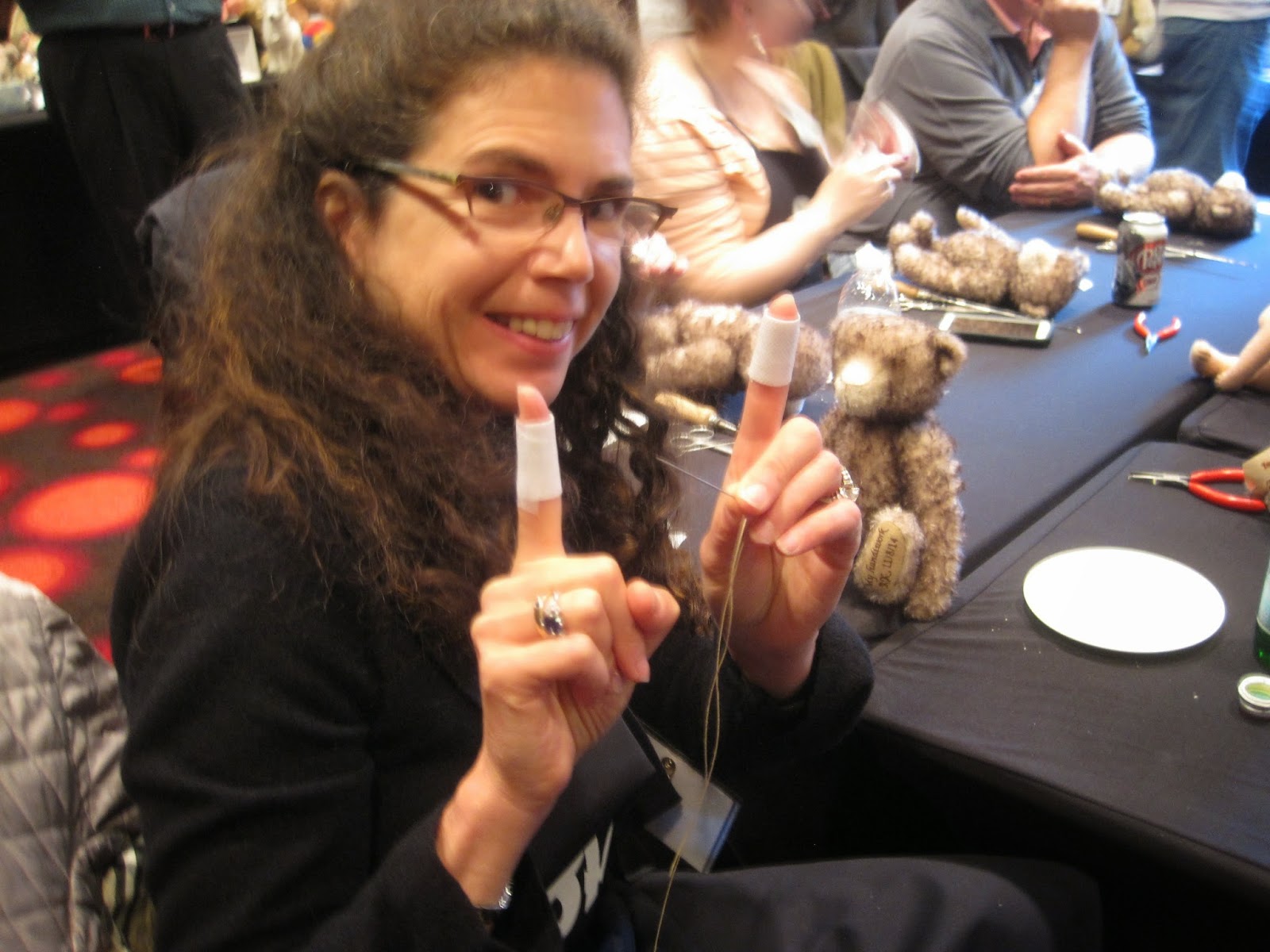
The very first thing attendees were instructed to do was to be careful of sharp pointed objects!  And also to take care of their hands, as their fingers would be doing alot of stitching and thread pulling, which sometimes causes bleeding.  So to prepare for that possibility, Ralf and his team gave everyone white German band-aids to put on their stitching fingers.  Here you can see Steiffgal modeling these giant bandages! 

Our first "hands on" task in the workshop was sewing up the back seam of the bear.  This opening was about 4 inches long.  We were instructed on how to thread the needle and knot the thread, and do a somewhat complicated "ladder" style stitch up the back.  We were to make 3 of these stitches then pull them together tightly, then do another 3, and pull... until the seam was completed.  Because the bear was stuffed with excelsior, attendees had to keep tucking strands back in the body cavity, as it sometimes fell out as part of the sewing process.  This step turned out to be the easiest and most forgiving of all the ones needed to complete the bear - as the long mohair could be "combed over" any crooked seam or stitching on the back.  After the back seam was completed, the stitching was knotted, and that knot was invisibly pulled through the body for durability and aesthetic reasons.  

The next step was to embroider the cub's hands and feet with claws.  Attendees had many choices of the colors in which to do this, including black, red, green, blue, and several shades of tan and brown.  We used a bigger needle and thick embroidery floss to create these stitches.  It was quite difficult to space the claws correctly, as well as make them the same overall length on each paw.  Like with the back seam, the stitching was again knotted and pulled through each limb for durability and aesthetic reasons.  Steiffgal chose to do her cub's foot claws in dark brown, and his hand claws in light brown.   

Finally it was time to face the music and work on the bear's noggin.  Each participant embroidered their bear's nose and mouth with a thinner version of colored floss; the colors were similar to those available for the claws.  Steiffgal chose dark brown for this.  In general, for a bear of this size, his nose has 6 or 7 equal length stitches, then a longer stitch, then another 6 or 7 equal length stitches.  The stitches have to line up on the top and bottom.  Then, once the nose is done, the mouth is formed, using the larger middle stitch as a "hook" for the downward facing mouth stitches. Steiffgal cannot begin to tell you how challenging all of this was.  It was much, much harder than it looks or sounds.  And, as a matter of fact, Steiffgal actually had a fellow participant help her rip out her first attempt at nose stitching, because it was so awful. But practice makes perfect, or in this case, improvement, and her second attempt was much, much better.  In the spirit of creative design, Steiffgal also chose to put a light tan "Jackie" style horizontal nose highlight stitch across her bear's completed dark brown nose.

The almost last step in the workshop was inserting the eyes into the bear's head.  Steiffgal chose gold and black pupil eyes for her cub. This process was completed via a metal tool that looked like a giant thick needle about 6 inches long.  This "weapon" was securely mounted on a sturdy wooden handle.  Participants threaded the giant needle and strung one eye onto the hanging thread ends.  They then jabbed the needle through the area of the bear's eye socket, through his head, to the back of his neck. They then did this again with a second piece of thread and the other eye.  (This sounds cruel, but the Steiff team assured everyone that the bears never feel a thing, and welcome the opportunity to see with their new eyes!) In a perfect world, the eyes landed with the correct spacing and in the desired location... and the threads for each both ended up within a 1/4 inch or so at the same place on the back of the neck.  Like the nose stitching process, this was MUCH more labor intensive than you can imagine, and many participants, including Steiffgal, had to try it a few times to get it right.  It also took tremendous hand strength to drive the needle through the bear's head, as well as tug the two neck strings tightly and knot them correctly.  The ends from this knot were then re-inserted into the bear's head for durability and aesthetic reasons.   After each bear had his new eyes, they were adorned with a large golden ribbon which read "Teddy Bear Workshop" on one end and "New York City 2014" on the other. 

After all that work and worry, it was so exciting to see all the bears truly come to life with their new claws, noses, mouths, and eyes.  And each really reflected the taste, character, and personality of their creator.  Some cubs were very serious, and others were young and more playful looking.  Some people designed their bears to match their favorite colors or even the decor of a special room in their home.  One person in the morning workshop was building a very special bear which was going to be her 25th wedding anniversary present to her husband! 

At this point in the workshop, the bears were almost finished... except for perhaps the most exciting part of all.  The Steiff "buttoning," of course!  Participants picked white ribbon ear tags with red lettering out of a large bucket.  Each was imprinted with numbers ranging from  1 to 150, and it was by luck and chance who got what edition number.  Steiffgal drew number 110.  The buttons used on this edition were the gold plated "elephant" style ones. The button and ear tags were inserted into the bear's ears by a rather simple metal tool that sort of resembled a large vice.  A member of the Steiff team layered the top of the button, then the white ear tag, then the bear's ear, and finally the back of the button and then "squeezed" these items together with the large vice.  The top and bottom of the button sandwiched tightly, securing the bear's forever branding trademark.  And, at long last (just a hair over four hours time...) all the cubs were finally completed and ready to go home with their new "friends for life."

The workshop was amazing in so many ways, and truly a once in a lifetime treat for many of the participants.  For Steiffgal, it gave her a new appreciation for the precision handiwork that goes into every item leaving the Giengen factory, as well as a better understanding about how the company's items are built to last for generations.  For others, it was a time to meet new enthusiasts, catch up with old friends, and discuss all things "button in ear."  But it goes without saying that EVERYONE who participated in the workshop left with a greater passion for the brand, enormous respect for Steiff's professional craftspeople, and a deeper and far more personal understanding about what makes Steiff collectibles so incredibly special.

Steiffgal hopes this review of Steiff's Teddy bear making workshop has inspired you to attend one as well!

Have a question about one of your Steiff treasures? Let's talk! Click here to learn more.
The teddy bear search engine