Showing posts with label Farmer. Show all posts

Wednesday, January 19, 2022

Dressed For Success: Steiff's Early And Fantastic Golliwog Dolls

Good golly! Everyone needs a best friend, and that's just what the Golliwogs - storybook characters invented by author Florence Kate Upton in the late 19th century - were invented for. Steiff has a long tradition of bringing favorite fictional friends to life. One of the first examples of this was in 1904 when Steiff worked with author Beatrix Potter to produce her beloved Peter Rabbit as a soft toy for children. Take a look at this incredibly rare and early Steiff Golliwog based on Upton's tales and see what makes him so interesting from the design and historical perspectives.

You can't help but smile when it comes to this simply charming early felt Golliwog doll.
 He is 43 cm, standing, and fully jointed. His head and oversized hands are made from black felt. His legs, under his pants, are made from a linen type of material. His clothes are primarily integral to his body. He wears black oilcloth shoes with black felt soles, red felt pants, a white felt shirt detailed with black buttons, and a blue felt top coat - which also is decorated with a few buttons on the back and front. His red neck ribbon is all original to him. His jolly face comes to life with black button eyes backed in red and white felt circles, a sewn-on, dimentional red and white felt smile, a prominent horizontal seam, and a head full of black curly mohair. He retains his tiny long trailing f button as his Steiff ID. This classic design was produced in 28, 35, 43, 50, 60, 80, and 100 cm from 1909-1919 overall.

This period design was so popular at the time it was produced in two little known novelty forms.
The first, a roly poly Golliwog, appeared in the line in 29 cm from 1909-1912. This very rotund fellow had the typical Golly head and red, white, and blue outfit, as well as arms and oversized hands, but no legs. He wobbled about but always came to rest upright. And the second was a “snap apart” Golly from around 1909. This doll looked just like the standard line, full bodied Golly but was jointed with metal snaps (not regular cardboard disks and pins) and designed to be taken apart and reassembled as a toy for children. Although there is reference to this unusual toy in reference books and the Steiff archives, it was probably not put into full line production.

It's also fun to take a look at the design elements of Steiff's early 20th century Golliwogs.
Besides their really distinctive facial presentation, they do indeed have many of the same details as the company's felt farmers, who were also produced around the same period.

For example, Steiff's Dachau Farmer has nearly the same proportions, horizontal face construction, body shape, oversized hands, and simple footwear pattern as this Golliwog. This farmer doll is pictured here on the left. Even the clothing looks like they may have been borrowed from the same closet! Such streamlining adds production efficiencies to the manufacturing process, as well as gives the product line a somewhat standard "look and feel" which is important for branding, quality control, and marketing purposes. 

And speaking of marketing... you can see a super sweet print ad from around 1912 or so featuring Steiff's goofy Golliwogs here on the left. 
You can click on the image to make it bigger. The photo is from Dottie Ayers and Donna Harrison's Advertising Art of Steiff, Teddy Bears and Playthings.

Steiffgal hopes this discussion on early Steiff Golliwog dolls has gotten you into a playful mood!

Have a question about one of your Steiff treasures? Let's talk! Click here to learn more.

Sunday, December 5, 2021

Going Green With This Seasonally Hued Steiff Sweetie

"Tis the season for all things green and red!
As such, the timing is perfect to share a recent addition to Steiffgal's hug with you. 
This seasonally hued sweetie is a bit of a mystery but so charming nonetheless. He was on Steiffgal's wish list for awhile given his rarity and somewhat ephemeral construction. Check out this darling doll and see what makes him the perfect 1970s-era ambassador.  

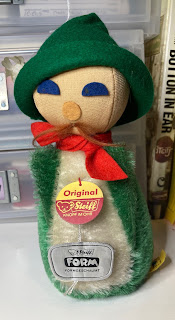
Here we have Steiff's little known "Buzzel Sepp." 
In Germany, "Sepp" is a nickname for someone with the formal name of Joseph. And "Buzzel" refers to his shape and construction. But more about that in just a bit. In all honesty, Steiffgal is not exactly certain who this guy is or who he may represent. He is not obviously a chimney sweep, farmer, or gnome - Steiff's usual cast of male doll suspects. Perhaps he is a shepherd, as he is pictured with a red plastic staff in some reference books. Unfortunately, Steiffgal's Sepp has lost this accessory. 

Buzzel Sepp is upright and unjointed.
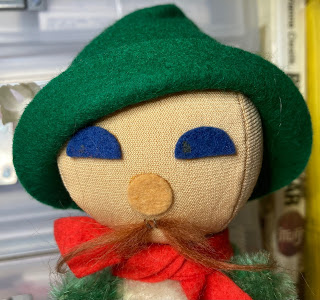
It is not clear if he is standing or sitting as he has no legs. His simple body is made from bright green and white mohair. He rests on a flat bottom. His head is made from a synthetic - probably polyester - fabric. His face comes to life with blue semi-circle felt eyes, a tan circular felt nose, and a long, brown fiber mustache. He is accessorized with a red felt scarf and a green felt hat. His hat has a little daisy on it for decoration. Buzzel Sepp has a working squeaker in his base. This silly guy appeared in the line in this size only from 1972-1974.

It is interesting to note that he is noted in the 1947-2003 Steiff Sortiment as made from dralon but he is clearly made from mohair - at least in this case.

Buzzel Sepp has some distinctive IDs.
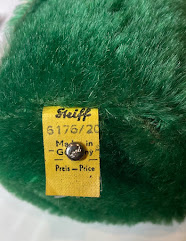
His chest tag is Steiff's red and yellow split style version. This chest tag debuted in 1972, aligning perfectly with Sepp's production date. On the back of this tag, it is noted that Sepp cost 19.90 marks. Given that $1 = DM 3.48 in 1972, this would have been about $5.72 in 1972 dollars; $5.72 in 1972 is worth approximately $37.85 in 2021. This doll also has a silver hangtag with the word "formgeschaumt" or "foam molded" on it. That refers to his pre-formed foam stuffing. And because he does not have any ears, his ear tag is located on the seam of his bottom with his lentil style Steiff button embedded into it. You can see this somewhat unusual configuration here on the left.

Steiff's Buzzel items appeared in the line in 1970s.
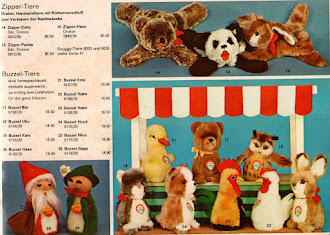
They were all 20 cm, sat upon a flat bottom, had a squeaker, were stuffed with pre-formed foam, and washable. Other Buzzel models created included a rooster, a rabbit, a cat, and a Santa Claus, among others. These items - except for Sepp and Santa - were simplified versions of popular Steiff designs. Steiffgal suspects the Buzzels were created specifically as less expensive and/or lower end toy line for children given how the word "washable" featured so prominently in their marketing. And, in Steiff's 1972 product catalog, their Buzzel line is noted as, "foam-molded, therefore super soft, really to love for the very little ones." You can see Sepp and his other Buzzel friends as they appeared in this vintage catalog here on the left. Just click on the image to make it bigger. 

Steiffgal hopes this discussion on Steiff's quirky Sepp doll has added a joyful buzz to your day.

Have a question about one of your Steiff treasures? Let's talk! Click here to learn more.

Sunday, May 12, 2019

Hans-Down, This Is One Amazing Antique Steiff Doll

Well hello, handsome! Country life certainly agrees with you. Today's special guest is a delightful example of Steiff's extraordinary, first quarter of the 20th century cloth doll production. Please say hello to Hans, the Swabian farmer.

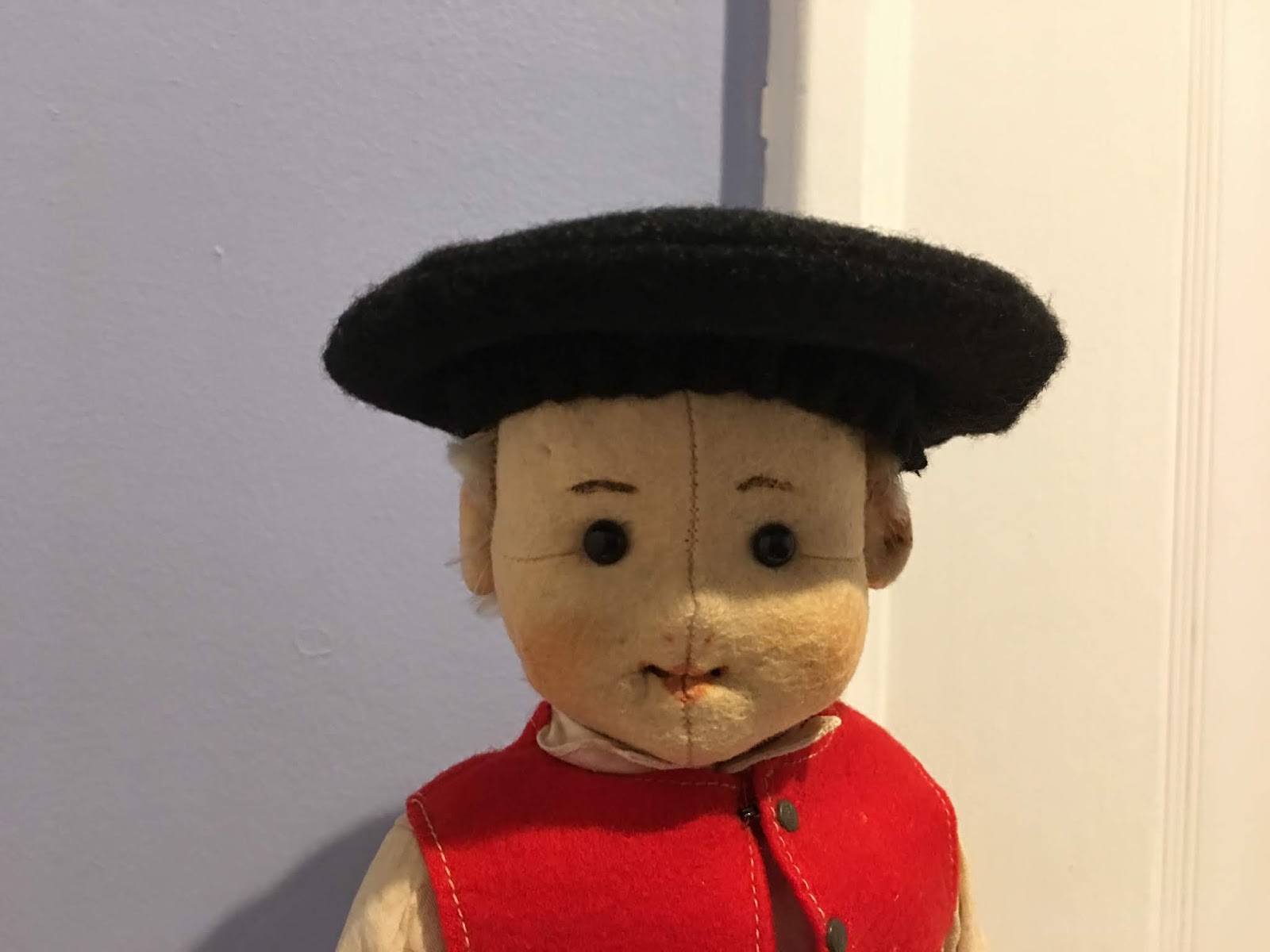
Hans-down, this is one delightful doll. Hans has human proportions and stands 35 cm tall.  He is made from felt and is fully jointed. His hands have stitched fingers. His face comes to life with a brown mohair wig which has faded to silver over time, black button eyes, a prominent vertical facial seam, light blushing to his cheeks, and two horizontal seams by his eyes. His lips and nostrils are delicately defined by pink paint. Hans wears a traditional southern German (Swabian) farmers outfit, including a red buttoned felt vest detailed with five tiny Steiff buttons, black felt pants, a white cotton collared shirt, black tie shoes and white socks, and a black felt hat. He retains his tiny long trailing "f" button-in-ear as his Steiff ID. Hans was made in 28, 35, 43, 50, 60, and 75 cm from 1908-1927. 

Hans appeared in Steiff's line for nearly two decades - and for good reasons! His charming presentation, regional outfit typical to southern Germany (where the Steiff factory is located), and ties to a popular Brothers Grimm fairy tale probably explain why - but more about that in just a bit! So given his long production period, how can you tell roughly when he might have been made?  Here are a few general guidelines to help approximately date Steiff's center-seamed faced cloth dolls from the early 1900s-late 1920s.

1.  Body: The earliest ones had cartoon-like or exaggerated features; starting around 1908 the company started producing children, adults, and soldiers with human proportions.

2.  Clothing: The earliest ones had clothing mostly or entirely integral to their bodies; starting around 1908 children and adult dolls with removable clothing were introduced on a large scale. Soldiers usually had most or all of their uniforms integral to their bodies.

3.  Eyes: The earliest ones had black shoe button eyes; starting around 1910 or so glass pupil eyes became the norm.

4.  Hands: The earliest ones had "fist" style hands; starting around 1910 or so fingered hands became the norm.

5.  Materials: The earliest dolls were produced in felt and/or velvet. Dolls with felt heads and linen bodies and/or limbs were produced during the WWI era (around 1914-1919). All felt dolls appeared in the line from around 1905-1914 and then again from around 1920 through the late 1920s.

If you overlay these guidelines on the Hans under review today, this model was most likely produced in the c. 1909-1911 time frame, give or take a bit.

Colleagues who study both Steiff and the history of literature suggest that Hans just might be the Hans of the Brothers Grimm "Clever Hans" story. The title of the story is meant to be ironic, as Hans is pretty much the opposite of clever. In a nutshell, Hans is "a day late and a dollar short" on a number of common sense tasks. These mis-steps ultimately result in the loss of his fiance. You can read, or listen to that short tale here. In 1913, Steiff created a print ad titled "Clever Hans" featuring this farmer doll doing something both foolish and endearing at the same time. This marketing piece is featured above; you can click on it to make it larger. The picture is from D. Ayers & D. Harrison's Advertising Art of Steiff, Teddy Bears & Playthings.

Steiffgal hopes you've found this Hans the Farmer quite the charmer!

Have a question about one of your Steiff treasures? Let's talk! Click here to learn more.

Friday, February 12, 2016

Old And New Steiff Treasures On Offer At The Upcoming Morphy Auctions' Premier Toy Sale!

It's the most wonderful time to be a Steiff collector - especially if you are looking to add rare and wonderful treats to your growing Steiff hug. Auction season is truly upon us all! Last week Steiffgal shared some highlights with you from an upcoming auction in Germany. Today, let's cross the pond back to the US to check out an upcoming auction a little closer to home that also features a number of wonderful Steiff treats. On March 4th and 5th, Morphy Auctions in Denver, PA is having a premier doll and toy sales event. And there's a few lots there that truly caught Steiffgal's eye. Come take a look, too!

This first Morphy Auction pick - an antique Steiff farmer - is quite the charmer! He is lot 722, and is cataloged as...  
 
"Here we have a Steiff figure in the form of an early 20th century farmer. Starting in 1909, Steiff made a series of fully jointed felt dolls representing farmers from regions around Germany as well as France and Switzerland. Each was authentically dressed in regional clothing. These appeared in the line overall through the 1920's. This example is 12-1/2" tall and is in all original, as found condition. His clothes are integral to his body. He retains his ear button as well as 9 decorative Steiff buttons on his vest. Unlike most Steiff dolls of his era, this one has a most unusual horizontal facial seam. Overall, he is in very good condition with uniform dustiness/soiling, most noticeable to his flesh colored face and hands. His black shoes have lost coloring. His right shoe shows distress and losses and is in need of some attention and repair. However, his felt soles are intact and just lightly soiled. Auction estimate: $1,000-2,000."
 

In addition to his charming looks and personality, this delightful antique doll comes with a robust provenance. According to the consignor, 

"In 1950, when I was about 13, my friend's family was the last tenant to move out of their apartment building which was scheduled to be torn down. After the truck was packed, we explored the empty building. In the attic, we found empty whiskey bottles, clothing, a long auburn hair switch, a shorter blond switch, a porcelain figure of a boy, and this doll.

At that time, I didn't know the significance of Steiff. He was so unusual and fit in with my German heritage. I fell in love with him and had him in my room until I went away to college. When I married, he moved from my mother's home to my new home. I took him to a doll repair shop, trying to find out more about him. The owner found him in a doll book, where I learned that he was first produced in 1909, and at that time he had a value of $848.

To protect him, I made a shadow box from a picture frame. I wired him securely in the box, where he hung on the wall of my home. It is time someone else has the pleasure of getting to know him. I hope he will bring his new owner as much pleasure as he has brought me the last 65 years."


Steiffgal definitely has a plush-crush on this funny felt fellow! Based on his appearance and time frame, he is a great example of Steiff's early character dolls which were sometimes referred to as "Karikaturpuppen."  These dolls had exaggerated proportions (like really long feet, huge hands, very round or very narrow faces, and extremely skinny or quite rotund body shapes) and very playful personalities.  These dolls were prominent in the line through the early 19-teens, when they were slowly replaced by Steiff dolls with more lifelike and/or childlike proportions and appearances. 

This second auction highlight at Morphy's is as welcome as a bouquet of tulips in springtime.  Here we have lot 696, Steiff's Flowers Bear.  She is cataloged as...

"Flowers" was the first in the series of innovative designs produced exclusively for Steiff Club members starting in 2004. These selections were called "Margarete Steiff Editions" and were available for purchase only through the luck of a draw. 500 Flowers bears were produced, with the number of applicants worldwide eclipsing this many times over. Flowers is 33 cm, fully jointed, and made from white mohair that is embroidered with colorful floral motifs overall. She has black button eyes, a red hand embroidered nose and mouth, white felt paw pads, and blue claw stitching. Flowers has a special ear button and a black and silver tag sewn into her side seam as her IDs. This example is number 117/500, and comes complete with her original literature, which is personalized to her first owner, and a special edition box. This is only the second "Flowers" edition that this cataloger has seen at auction in the last decade, and unquestionably the most sought after 21st century Steiff edition today. Condition: As detailed. In excellent to like new condition. Auction estimate: $500-1,000" 

There's no need to soft pedal why this bear is so amazing!  Steiffgal was the US Steiff Club Manager in 2004 when Flowers became available to club members.  The response to this cub was overwhelming, and Steiffgal fielded dozens of phonecalls each day about the bear and the process for winning one.  It seemed at the time club members were willing to get into a fist fight to acquire one!  Steiff came out with a series of innovative Margarete Steiff club bears over time, but none came close to the inherent quality and design of this first one. Everything about this bear is magical, from her practically handmade fabric, to her classic design, to her unique button and tag, to her presentation and packaging.  Because of her design integrity and authenticity, Steiffgal would pick Flowers as the one bear in recent memory that would fit in equally as well in collections that focus on new or vintage Steiff treasures.

It's up, up, and away with this final auction highlight under review today.  Here we have one of Steiffgal's most favorite editions from the early 1990's - Amelia the pilot.  She is one of two bears featured in lot 698, which is cataloged as...

"This lot includes two Steiff limited edition bears that are seldom seen on the secondary market. The first is Hercule, who was produced for the World Association of Children's Friends (AMADE), founded by Princess Grace of Monaco in 1963. This social service organization advocates for children's rights worldwide. Hercule is 28 cm, fully jointed, and made from soft mohair. He wears a gold plated medallion, featuring the logos of both Steiff and AMADE, suspended from his green silken ribbon. Hercule has a particularly sweet, childlike appearance. This design was produced in 1995 in an edition size of 3,000; this example is number 1365. The second item is Steiff's Amelia Earhart bear. She is 35 cm, fully joined, and made from rose-colored mohair. This design was produced overall in an edition size of 1,000 pieces in 1993; of those, 650 were dressed in an authentic, high quality leather pilot outfit for the high end department store I. Magnin & Company; the remaining 350 were detailed with a simple neck ruff. Condition: As detailed. Both editions are complete with all IDs, original packaging, paperwork, and documentation. In excellent to like new condition. Auction estimate: $400-600."

Both Hercule and Amelia are a dynamic duo who are seldom seen on the secondary collector's market.  Amelia is particularly collectible and rare, and gets Steiffgal's vote as the most appealing dressed Steiff bear from the last three decades. Her rose color and lanky frame are quite feminine, and a striking complement to her brown, rugged pilots outfit.  Her outfit takes flight with leather trimmed goggles, a buckled flight hat, a white silk scarf with trim, and a bomber-style jacket detailed brown fur trim, two front pockets, and a zipper and snap front. She even has a tiny golden I. Magnin flight style pin on her collar. Like many early special Steiff items from the 80's and early '90's , she is not numbered, but is designated as a "collector's edition" noted on her special chest tag and ear tag.  She is the only edition ever produced for I. Magnin, which has since been absorbed by the Macy's chain of department stores.   

Steiffgal hopes this review of some of the fine Steiff items up for sale at Morphy's in the next few weeks has generated "lots" of interest with you!  You can check out the entire auction catalog by clicking here.

Have a question about one of your Steiff treasures? Let's talk! Click here to learn more. 

Saturday, April 19, 2014

Strike Up The Band With These Great Steiff Dolls Up For Auction at Bonham's

It's music to Steiffgal's ears when she hears about wonderful vintage Steiff treasures!  And this set of five antique Steiff dolls is certainly worthy of a Grammy award - really!  Take a look at this note from a new friend in the United Kingdom who writes about a collection of marvelous musicians she recently sent to Bonham's for sale.   Helene shares...

"My dad bought the whole stock of a haberdashery shop back in 1970 from a woman, she was 80 years old at the time and she didn't want to get retired, anyway the Steiff dolls were in the shop and she used to sell those brand new, she had the shop for about 60 years...  her shop was in a little village near the border between France and Germany, my parents always knew the dolls where valuable, they both passed away now and when we cleared the house we found those dolls."

How about a special fanfare for this breathtaking quintet?  Here we have what is known as Steiff's "village band" or Dorf Musikkapelle. According to the Steiff Sortiment 1892-1942, this item was in the line from 1911 through 1913 and is simply documented as "village band, 5 dolls with instruments, item [number] states size in cm."  The Sortiment also details that the players include a 35 cm bass fiddler, a 35 cm clarinet player, a 50 cm piston wind player, a 35 cm trombone player, and a 50 cm violin player.  The photo that accompanies this description from the Sortiment is pictured here on the left.


A rare set of five felt Steiff Musicians, 1912-1915
"All having black boot button eyes, printed features and jointed at shoulders and hips each standing on a circular wooden base, the rotund trombone player with a pronounced nose and smiling mouth, black and grey cotton thread hair, black rimmed hat, and with a Steiff button to each ear, wearing a felt red shirt with a further sixteen Steiff buttons in two rows to front, blue jacket, black trousers and leather boots, holding a painted gold trombone, 33cm (13in) tall, the similar contra-bass player having a Steiff button to each ear, round hat with tassel and wearing a cream shirt with black boot buttons in a row to centre, a brown jacket, black trousers and black leather boots, holding a painted wooden stringed bass with bow, 33cm (13in) tall, the slimmer clarinet player with up-turned nose, painted ginger hair and Steiff button to left ear, tall grey hat and wearing a long black jacket with three gold buttons, blue trousers and painted shoes, holding a carved wooden clarinet, 36cm (14in) tall, the older slim violin player with pointed nose and chin, painted grey eyebrows and real shoulder-length grey hair, skull-cap and wearing a white shirt with black bow-tie, jacket and trousers, leather shoes, holding a carved wooden stringed violin and bow, Steiff button to left ear, 40cm (15 3/4in) tall, the tall and slim trumpeter with pointed features, painted ginger hair and flat hat, wearing a black jacket with five buttons and trousers, with white collar and bow-tie, leather shoes and Steiff button in left ear, holding a painted gold wooden trumpet, 43cm (17in) tall."

So let's strike up the band and take a look at these five fantastic fellows - from left to right.   

The musician on the far left with the trombone is probably Steiff's Dachau (an area in Upper Bavaria) Farmer pattern.  This doll is 35 cm and was in the line from 1908 through 1928.  This particular doll has three very interesting details that make him extraordinary from the design perspective:  he has a Steiff button in each ear - not just his left one; a horizontal facial seam instead of the more typical vertical seam; and 16 tiny Steiff buttons decorating his red shirt-vest. The original Dachau Farmer doll is pictured above. 

The musician in the brown felt coat with the bass fiddle is most likely Steiff's Alb (a district in Baden-Württemberg) Farmer.  This doll is 35 cm and was in the line from 1908 through 1919.   It is interesting to note that at the turn of last century, Steiff created a series of dolls representing farmers from different areas of Germany, including Brenz, as well as surrounding countries including France and Switzerland.  The original Alb Farmer doll is pictured above, the photo is from Pfeiffer's 1892-1943 Sortiment book. 

The skinny musician in the middle wearing a dark coat and blue pants and playing the clarinet appears to be Steiff's Alphonse, the character from the comic book series "Happy Hooligans."  This doll is 35 cm and was in the line from 1904 through 1928.   Steiff records show that Alphonse was produced as a pantom or marionette style puppet on roller skates.  The original Steiff Alponse doll had a press voice box hidden under his red felt hat.  Steiff's Alphonse doll is pictured above, the photo is from Pfeiffer's 1892-1943 Sortiment book.

The violin player very closely resembles the teacher from a small series of Steiff display pieces featuring the theme "school" - which were inspired by a quote from Busch's "Max and Moritz" book. In 1910 Steiff sold 45 complete school displays. A portion of this display can be seen above. The photo is from Theriault's; this set sold for $50,000 in 2012.

Steiffgal is not able to find a close doll match to the horn player on the far right, but his design and proportions are very typical to Steiff's “charakterpuppe” or “caricature” style dolls.  These debuted at the Leipzig spring fair in 1908 and appeared in the line through 1914 - also making a brief appearance again in 1925. These dolls are noted for comical, exaggerated features – such as extremely lean or rotund bodies, huge feet, or cartoon-like faces. Models representing sportsmen, postmen, firemen, policemen, and members of the military were all produced in the “caricature” style.  A typical Steiff long and lean "charakterpuppe" of a policeman is pictured above, the photo is from Christie's.

It's clear that each band mate is a rock star all on his own.  But some collectors might wonder why the the members don't exactly match the photo of the band pictured in the Steiff Sortiment book.  In this picture, which is shown above, it appears that all three musicians shown are in the Dachau farmer pattern.  First of all, it is important to note that the Sortiment cannot possibly capture every version of every Steiff item and multi-part edition produced. But even more importantly, it has been Steiffgal's observation that the Steiff company very frequently "repurposed" existing inventory into other items.  For example, it is not unusual to find an early rabbit, dog, or cat available on its own, on a pincushion, on a tumbler, or on a skittle.  And for very early products that involved collections of things -  like skittle sets or ranges - the actual product mix would vary somewhat, depending on what was on hand and what was in production.  Given that all of these great dolls were produced in the same general time frame, it is Steiffgals' strongest suspicion that this is what is happening here as well.  

Steiffgal hopes this discussion of Steiff's early "Village Band" going up for auction at Bonham's in May, 2014 has been a great intermission for you.

Have a question about one of your Steiff treasures? Let's talk! Click here to learn more.

UPDATE, May 28, 2014:  Looks like this set hit the top of the charts - under the hammer, that is!  Click on the photo below to check out their selling price...

Saturday, May 5, 2012

This Vintage Steiff Farmer Is Quite The Charmer!

When it comes to collecting Steiff, it's really important to be "buttoned up" about the legacy behind exceptionally special vintage treasures.   And once in awhile, "the button" itself becomes an important part of the story.  Such is the case - in spades -  with this really special Steiff doll that Steiffgal recently had the pleasure to adopt into her hug.   Let's take a look at this country gentleman and see what makes him so special from the design and historical prospectives.

This vintage farmer is quite the charmer!  Here we have Steiff's 35 cm "Dachau Farmer."   Dachau a town in Upper Bavaria, in the southern part of Germany.  Farmer is five ways jointed and made entirely from felt - except for his footwear.  He is very hard stuffed with excelsior. His face is detailed with black shoebutton eyes, while his other features - mouth, eyebrows, ruddy cheeks, and "needs-a-shave" chin - are all painted by hand.  Farmer wears black pants, a red vest with a white collar, and a blue blazer.  He dons a black floppy hat and has handmade leather boots with tan felt soles.  His clothes are actually part of his body - they cannot be removed.  Steiff produced this design from 1908 through 1928. It is also interesting to note that this particular Dachau farmer design was also produced as a 29 cm roly-poly from 1909-1917.

This doll is really unusual from other dolls produced in the same time period for several reasons.  The three key ones include:


1.  "Button in ear"
It goes without saying that Steiff items are universally known and loved for their "button in ear" branding, which is usually in the left ear or side, if you are facing the item.  However, this particular doll has a button in both ears!  At the turn of last century, Steiff sometimes put a button in each ear of an item if it were a sample of the item.  The button usually said the word "Muster" on it, which means "sample" in German.  This clearly is not the case here!

2.  "Button as decoration"
This item could certainly compete in a Steiff button contest... and even perhaps qualify as having the most buttons on an item - ever!  Including the two ear buttons, Dachau Farmer has a total of eighteen - yes, eighteen - 4mm trailing "f" buttons.  This size button was used in the approximately 1906 through 1925 time frame. His red vest is detailed with sixteen tiny buttons.  Some are right side up, some are upside down.  But they certainly add an interesting touch to his appearance.  Steiffgal has seen Steiff buttons as detailing on shoes, soles, collars, belts, and even some packaging, but never on vests to this extent.


3.  "Facial seam"
Take a close look at Farmer's face.  Notice anything unusual, besides his striking good looks?  Farmer has a HORIZONTAL facial seam.  The vast majority of early turn of last century Steiff felt dolls had VERTICAL facial stitching.  This may be to accommodate the design behind his prominent nose, which is somewhat larger and more pronounced than other Steiff felt dolls of the time.  However, this construction is by far the exception to the rule, and is quite interesting from the collector's perspective.  It wasn't until the early 1930's that Steiff was able to overcome the challenges of felt doll facial construction and produce a doll with a seamless face.

Steiff produced many felt figures from the early 1900's through the 1930's. These models were more reflective of occupations and culture (shepherds, stone cutters, tailors, butchers, shoemakers, soldiers, students, etc.) than playful designs for children. Steiff made at least eight distinct farmers from different geographic areas, indicating how important this profession was at the turn of last century. 

Steiffgal hopes this discussion of The Dachau Farmer has been a barn-burner for you. 

Have a question about one of your Steiff treasures? Let's talk! Click here to learn more.
The teddy bear search engine