Showing posts with label artificial silk plush. Show all posts

Wednesday, March 29, 2023

This Midcentury Steiff Cub Is As Sweet As A Chocolate Kiss!

Now here's something you don't see every day! Check out this sweet and unusual Steiff bear. His construction is quite distinctive, most certainly reflecting the realities of manufacturing in the era in which he was "born." Four different fabrics were used to bring this happy handful to life!

What we have here is a sweet as a chocolate kiss Teddy baby bear. He stands 22 cm tall and is fully jointed. His face is detailed with brown and black glass pupil eyes and a black hand embroidered nose. His claws are also stitched in black. He retains his original red collar and named chest tag, along with his short trailing "f" button, as his Steiff IDs. Although only he knows for certain, it is Steiffgal's very best guess that he left the factory in Giengen around 1947 or 1948 as he does not specifically appear in any Steiff or Teddy bear reference book she can identify. 

Teddy baby has several fabric features that date him to the immediate postwar period. His body, head, and limbs are made from short pile artificial silk plush fabric. According to Pfeiffer's 1947-2003 Sortiment, the company did produce a 30 cm brown artificial silk plush Teddy baby bear in 1949. This guy at 22 cm is much smaller, but could still be his distant cousin. Teddy baby's muzzle and the tops of his feet are made of wartime era wool plush, not mohair. This durable fabric was often used in the place of mohair when it was not available or rationed for military purposes. It is not unusual to find Steiff items traditionally made from mohair from the mid-1930s to early 1950s produced in this substitute fabric. It is also interesting to note that Teddy baby's paw pads are made from an inexpensive, thin linen material. These would traditionally be made from felt, which was also in very short supply in the late 1940s. A loving previous owner has done a wonderful job fixing and stabilizing his linen foot pads with stitches and TLC. 

One thing that makes Teddy baby bears so universally precious is their open, felt lined, smiling mouths. And, like all but the smallest versions of this classic pattern, this one also has this charming feature - despite a felt shortage! Steiffgal thinks felt was used here for two reasons. 

The first is that it is possible that the company tried to make the mouth in linen, but it just did not look right. It is also possible that linen could not hold the shape or form required for the pattern. And the second is just how visible the mouth is. It is one of the first things you see on this design, and is so fundamental to its appeal. Making the mouth out of felt on this pattern only required a little more than a square inch of material. So many Teddy baby bears could be importantly detailed with just a touch of felt when the company had minimal felt in inventory. This bear pattern usually also has its hands and feet pads made from felt. But in this case, those areas are not nearly as visible, prominent, or key to its design. Creating this pattern with felt foot and hand pads would require about five times more felt than one that just had a felt lined mouth. This Teddy baby is equally as precious with linen pads as he would be with felt pads... at least in Steiffgal's humble opinion! 

Steiffgal hopes you found this discussion on this very early postwar Teddy baby bear materially interesting!

Have a question about one of your Steiff treasures? Let's talk! Click here to learn more!

Sunday, April 24, 2022

This Charming Steiff Prewar Find Is Certain To Put A Tiger In Your Tank

Take a seat and check out this darling and little known Steiff tiger!
Tigers are a popular, legacy item in the Steiff catalog, with the first big beasts of their type debuting in the company's line in 1915. They translate well from real life to plush, and their handsome looks and wild origins bring out the animal instincts in most collectors! Steiffgal stumbled across this unusual prewar example on an online auction. The fates smiled upon her, and now he's part of her permanent hug.

This striped sweetie is quite the looker.
 His official name is "Tiger Cub." He is 22 cm tall (measures vertically from head to toe), sitting, and head jointed. He is made primarily from tawny colored wool plush. His long sideburns are made from longer white mohair. Tiger is stenciled and airbrushed in typical tiger style; he is highlighted in orange with prominent black stripes on his limbs, back, tail, and head. In true cat fashion, his little tail curls up around his backside. He has black hand embroidered claws on each of his paws. His distinctly youthful face is detailed with teal green and black glass eyes, a black hand embroidered nose and mouth, and a spot of pink paint on his lips. His ID is a short trailing "F" Steiff button. Overall, this big cat appeared in the line in 17 and 22 cm from 1939-1943.

It's always fun to discover new Steiff surprises, and this tiger cub definitely qualifies as that for Steiffgal.
This is the first of his kind she's ever handled, or really knew about. According to Pfeiffer's 1892-1943 Sortiment, this model is cataloged as, "woolen mohair, tawny-colored, tiger striped, sitting, soft, young, funny." It is unusual for Steiff or Pfeffer to use endearing adjectives in their descriptions - usually they are quite literal and objective. So the word "funny" really pops here, and in a way it is accurate. This guy does have a playful and mischievous look to him.

Tiger cub's shape and presentation also may ring a bell with collectors interested in Steiff's sitting big cat production over time.
His sitting, head jointed form is also noted on the company's pre- and postwar Young Lion design. This mane event was made in 17 and 22 cm in wool plush from 1938-1943, in artificial silk plush in 17 cm from 1948-1949, in 10 and 17 cm in wool plush from 1949-1954, and finally in mohair in 10 and 17 cm from 1955-1961. You can see the 17 cm, early postwar artificial silk plush version of young lion here on the left. Clearly the sitting young lion design was more popular than the sitting young tiger design, which only appeared in 10 cm from 1951-1961.

Steiffgal hopes this discussion on this prewar, wool plush cub has put a tiger in your tank!

Have a question about one of your Steiff treasures? Let's talk! Click here to learn more.

Wednesday, March 2, 2022

Hands In The Air Over This Marvelous Midcentury Puppet!

The theme of this week's Steiff blog has a lot to do with hands! In this case, we're taking about a really unusual very early postwar hand puppet. But the context for all of this is that Steiffgal broke her hand in several places in February, which explains why this blog was a bit on hold for awhile. But things are coming together, and blogging is possible again - finally! So hands in the air about that... and this adorable midcentury marvel!

Here we have one of Steiff's one-derful items... a special toy that only appeared in the catalog for one year. This brown beauty is 17 cm tall and made from long, brown artificial silk plush fabric. His muzzle is made from short tan artificial silk plush. Ted's smiling, open mouth is lined in peach colored felt; it is the same felt as seen on his hand pads. He has brown and black glass pupil eyes, a black hand embroidered nose, and tan embroidered claws. His head and the tips of his paws are stuffed with excelsior. His head is lined in a cardboard finger tube. He most likely was wearing a red ribbon when he left the factory over seventy years ago. This puppet was made in this size only in 1949. His IDs have been lost to time, but MAY have included a short trailing "f" button, a red imprinted chest tag, and a yellow or white linen ear tag. 

This hand puppet sits at a key point in the Steiff product development tree for this puppet design. The full bodied Teddy baby bear debuted in 1929 in a variety of sizes, colors, and materials. He was an immediate sales success, given his appeal, form, and irresistible personality. Like many "home run" products, the company quickly started producing Teddy baby as a series of novelties to further leverage the design's popularity. Of course, puppets were an obvious direction for this patter.  A Teddy baby puppet was produced in maize as a closed mouth version in 17 cm in 1930 only. This puppet was also made in 17 cm in brown mohair in the more familiar open mouth design from 1929-1943. Other prewar Teddy baby novelties included pajama bags, pull toys on wooden wheels, dressed dolls, and roly-polys. 

Given the design's popularity, it is no surprise that a Teddy baby hand puppet would appear in the line in the late 1940s when the factory reopened for toy making business. As mohair was still in short supply, and expensive, Steiff produced this beloved and legacy pattern in brown artificial silk plush in 1949. The puppet under discussion here today is one of these rare models. Then, once mohair became available on a commercial scale, he was made in this traditional fabric again through 1978. A very early postwar brown mohair Teddy baby puppet is pictured here on the left. Its red imprinted chest tag and article number "317" dates it from c. 1949-1952.

This Teddy baby hand puppet design is pretty remarkable as nothing fundamentally changed in its pattern or construction in half a century. This, in some ways, makes brown mohair Teddy baby puppets without IDs somewhat hard to date. Steiffgal can only think of three very minor things that changed on this design in 50 years. First, of course, is their IDs, which would be updated to match their period of production. Second would be the shift from glass eyes to plastic eyes in the 1960s. And third would be the shift from a cardboard finger tube to a plastic finger tube, probably in the late 1960s-early 1970s.

Steiffgal hopes this discussion on Steiff's unusual early postwar Teddy baby puppet has been one happy handful for you.

Have a question about one of your Steiff treasures? Let's talk! Click here to learn more.

Thursday, February 3, 2022

This Marmalade Silk Plush Steiff Susi Kitten Is The Cat's Meow!

Orange you in the mood for something unexpected? Steiff's midcentury kittens are always the cat's meow, but this particular find is purr-fect in every way! Check out this fantastic feline and see what makes her so interesting from the design and historical perspectives.

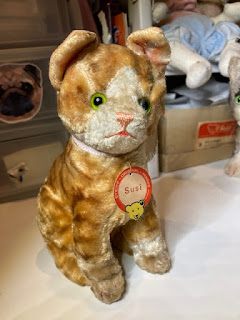
This smooth-as-silk sweetie is an unusual example of Steiff's beloved Susi cat design.
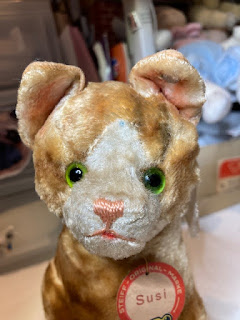
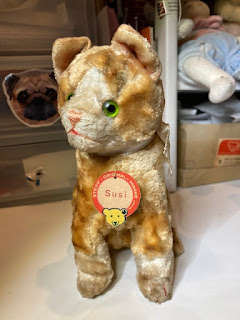
She is 16 cm tall, sitting, and head jointed. Susi is made from artificial silk plush. Her muzzle, front feet, and neck are white while her body, head, and tail are a marmalade color. The marmalade areas are hand airbrushed with dark orange or brown stripes. Her face comes to life with piercing green and black round pupil glass eyes, a pink hand embroidered nose and mouth, traces of a few clear monofilament whiskers, and a touch of pink paint to mark her lips. She has red embroidered claws on her front two paws. She retains her original pink bow. Her IDs include a large, watermelon style red imprinted chest tag, a short trailing f button, and traces of a light yellow or white ear tag.

Steiff's legacy Susi pattern has been a collector's favorite since her debut in 1936.
 It is rumored that this beloved design was named after a member of the Steiff family. Prewar, she was produced in grey and white mohair in 14, 17, 22, and 28 cm through 1943. In Pfeiffer's 1892-1943 Sortiment, she is described as "mohair plush, gray tabby, sitting, very pretty model, round shape." It is very unusual to find subjective or "flattering" descriptions in the Sortiment books as they are almost always entirely factual and literal. So Susi's design must have really caught someone's eye! Shortly after the conclusion of WWII, Steiff began manufacturing just a handful of their most popular prewar patterns - including a version of Susi. Her pattern was first produced in grey and white artificial silk plush in 14, 17, and 22 cm from 1948 to 1949, and then in mohair in 10, 12, 14, 17 and 22 cm from 1948 through 1978.

As far as Steiffgal can tell, this marmalade and white artificial silk plush full bodied Susi cat does not appear in any of the standard Steiff reference books.
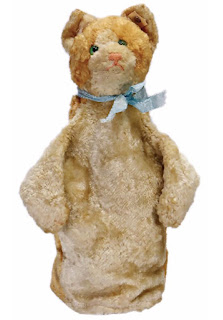
However, it is interesting to note that she resembles a most unusual marmalade and white artificial silk plush Steiff puppet sold at auction in 2019. 
This puppet, which is pictured here on the left, generated 20 bids and realized over $3,000! You can see that they share similar coloring and materials, as well as the same green and black pupil eyes, and other facial detailing. This puppet was described in the catalog as, "hand puppet, faux silk plush, cat, shiny button, rests of the ocher-colored paper sign, was produced during the war, good condition, nice colors." The photo is from Liveauctioneers.com.

So, what's the story with this very pretty, albeit uncatalogued kitty?
Here are a few ideas. It is entirely possible that she is a variation of the grey and white artificial silk plush version from the late 1940s. Her IDs align perfectly to that time frame. Given her stunning but unconventional hue and era of manufacture, she may have been produced as a sample of a design that never went into commercial scale production; was made from the only fabrics available at the time; or perhaps was designed and produced as an item for sale at the PX stores where American soldiers shopped immediately post WWII. However, only she knows for sure!

Steiffgal hopes this discussion on this happily hued Steiff Susi has tickled your whiskers, in the best possible way.

Have a question about one of your Steiff treasures? Let's talk! Click here to learn more.

Sunday, November 21, 2021

Good Things Come In Threes At Teddy Dorado's December 4th, 2021 Sales Event!

Care to go for the gold? Then check out the upcoming Steiff auction presented by our friends at Teddy Dorado auction house! Their signature winter sale, to be held on December 4th, 2021, features more than 400 new, vintage, and antique button-in-ear temptations - with new goodies being listed regularly. Here are three outstanding lots that caught Steiffgal's eye - and why. 

The first lot is a sweet-tweet-treat indeed.
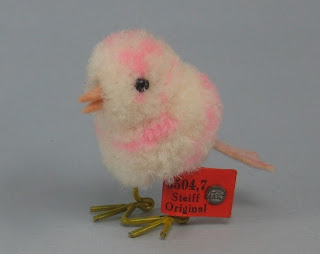
Steiff's earliest prewar woolen miniatures are loved and collected universally - with the rarest ones frequently realizing four figures at auction. Its hard to resist lot #28-4023, which is cataloged as, "Songbird made of white & pink Nomotta wool; black glass eyes; Beak made of skin-colored felt; white felt tail with pink stripes on both sides; Metal legs painted yellow & in perfect condition; Head rotatable & body tillable; approx. 4 mm large FF button slightly rusted, but not visible to the naked eye; red Steiff flag preserved in the best possible way; very clean, absolutely lightfast, odorless & completely unplayed; Premium top condition. approx. 4 cm high." 

This pretty-in-pink treasure has an opening bid of 1,000 Euro.

Bird's the word with this lovely treasure which is fantastic on so many levels. It is amongst the absolute earliest woolen miniatures ever made. This sweet bird design debuted in 1931, the first year Steiff's woolen miniatures were produced on a commercial scale. It was manufactured in six color combinations in 4 or 8 cm. Don't you think his color - pink - is WAH-HOO good? This example is the only Steiff woolen miniature prewar bird that Steiffgal knowns of featuring this great and novel hue. And the condition looks to be as close to like-new as humanly possible. 

You'll be all ears over this next auction highlight.
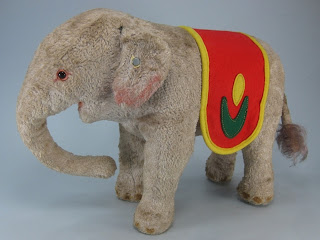
His expression, era, and materials are all so ele-phantastic. He is lot #28-4021, and is cataloged as, "Play elephant, made of light gray rayon plush; black glass eyes underlaid with pink felt; open mouth made of skin-colored felt; Tail tip made of mohair; tightly stuffed with wood wool; large double pressure voice defective; Saddle pad made of red, yellow & dark green felt; approx. 6 mm large, bright silver, shiny & shiny button in the ear; white paper ear tag missing; Artificial silk plush & felt without annoying flaws; very clean, absolutely lightfast, odorless & unplayed; Top condition approx. 21 cm high & without tail approx. 27 cm long." 

This playful pachyderm has an opening bid of 200 Euro. 

It's interesting to note that this distinctive elephant's "birthdate" is not specified. This great design bridged the pre- and postwar periods. It was produced in artificial silk plush in 17, 22, and 28 cm from 1938 through 1943 overall, and postwar in 22 cm only in 1948 though 1949. Given this big baby has a blank button and traces of his yellow ear tag, it is a safe bet that he is a postwar version. He's unforgettable for sure, don't you agree?

And good things come in threes with this final auction highlight.
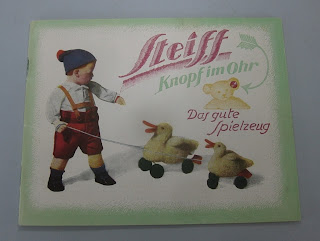
Steiff ephemera - catalogs, photographs, sales sheets, postcards, and other paper items associated with the company - is a fun, educational, and visually exciting complement to a button-in-ear collection of any era. If you are interested in the company's 1920s era production and aesthetic, be sure to check out lot #28-4003, which is cataloged as, "Customer brochure "The good toy" A6 +, 36 pp. 1925–1926 without Steiff printed matter no. German Premium Steiff customer brochure "The good toy" for Germany in the format approx. A6 plus landscape with 36 pages; inside black and white with a light green border; Text in German & without prices; Title shows Schlopsnies doll Theo with two yellow mohair (pulling) ducks, each lying on eccentric wheels; without printer's note or Steiff printed matter no .; original Steiff brochure & no reprint; very clean, absolutely lightfast, odorless & completely unread; Premium top condition." 

This time capsule quality brochure has an opening bid of 100 Euro. 

It's hard to picture a more interesting collection of images than those that appear in this great catalog. It features illustrations of the company's very rare mid-1920s white chimp with a tail, little known wooden toys on wheels, and charming, lifelike, and toddler-esque Schlopsnies dolls, among many other outstanding characters. And what makes these visuals so heartwarming is that they show our favorite button-in-ear favorites in playful and interactive vignettes... as if they were truly alive! Flipping through this period catalog is like taking a trip back in time, in the best possible way.

Steiffgal hopes this discussion on some of Teddy Dorado's upcoming sale highlights has been almost exciting as a live auction event!  Check out the entire catalog for this December 4th sale by clicking here. 

Have a question about one of your Steiff treasures? Let's talk! Click here to learn more.

Sunday, June 27, 2021

Back In The Steiff Saddle, Sort Of!

Hurray! For the first time in nearly eighteen months, Steiffgal finally attended a real live, in person collector's event. This was the Spring Doll, Bear & Miniature Show held at the Sturbridge Host Hotel in Sturbridge, Massachusetts. It was so exciting to walk into a large room chock full of Steiff, toy, and doll temptations, as well as meet and greet friends only seen on Zoom since last March! Attendees seemed genuinely thrilled with the opportunity to again celebrate their shared passions with the toy collecting community.

It wouldn't be a show without a little souvenir, and Steiffgal couldn't help fawning over a little midcentury Steiff treasure she spotted right in one of the first booths she visited.
Check out this 17 cm wool plush Jungreh or fawn. Isn't she lovely! Fawn is standing, unjointed, and made from lumpy-bumpy tan wool plush. Her pert ears are lined in white wool plush. She has delightful, authentic brown airbrushed contrasting on her neck and back, and little black airbrushed feet. Her face is detailed with very large black button eyes and a black hand embroidered nose and mouth, pink highlighting, and a white stitch across her nose. She has a wonderful, quality, old fashioned look to her. Her IDs include a short trailing "f" button and midcentury style yellow ear tag. You can see her button and ear tag in the photo near the end of this post. 

This fawn was one of the earlier items produced after the factory reopened after WW2 for toymaking business.
She was first produced postwar in artificial silk plush in 17 and 22 cm in 1948 through 1949. She was then made in wool plush in 17 and 22 cm from 1949 through 1953. Then, in 1954, her pattern was modernized just a bit and she was made in mohair in 14, 17, and 22 cm through 1978 overall. 

Postwar, you often see this progression from artificial silk plush to wool plush to mohair fabric construction on many of Steiff's legacy and timeless favorites, including rabbits, horses, and bears, among others. Steiffgal even has an early postwar Jocko in artificial silk plush, wool plush, and of course, mohair. They are a darling trio indeed!

Wool plush is a distinctive fabric which holds a key place in the company's product development timeline history.
Steiff used wool plush, a relatively inexpensive and more readily available toymaking fabric, in times of conflict or other hardships when mohair was not being produced, or allocated for military purposes. You generally see wool plush items made in the c. 1930 through mid 1950 time frame, but a few models - like the company's Wotan ram - incorporated it through the 1970s. Wool plush is pretty hearty and ages well. Its structure and texture make it far less likely to fade, thin, or bald like mohair fabrics. Unlike artificial silk plush, wool plush can also can be cleaned gently like other fine woolen fabrics.

Steiffgal deerly hopes you too will be enjoying the fun of live, in person events soon... and finding vintage button-in-ear treasures that make you smile. 


Have a question about one of your Steiff treasures? Let's talk! Click here to learn more.

Saturday, March 14, 2020

Let These Four Cheerful Cubs Brighten Your Day!

It's hard to bear all the bad news lately. You can't turn on the TV or radio - or check out Facebook - without learning something depressing or scary. In times like this, it's important to take good care of yourself, and surround yourself with loving things. So today's blog has two simple missions - first, to give you a reason to smile and second, to provide a bright spot in your day. Here are a quartet of Steiff friends that are happy to help you with those important goals.

Our first terrific Ted is Penelope. She is one of Steiff's early 1950-era Teddy baby dolls. She stands 22 cm tall and is head jointed. Her unjointed body is made from tan fabric while the tips of her feet and hands are made from brown mohair. Penelope is clearly a fashion plate with her adorable light blue Peter-Pan style blouse, seersucker apron, and blue velvet pants. And this girl loves bling, as you can see from her pendant (which is actually an earring Steiffgal found, but don't tell her!) and her UFDC pocket pin. Steiffgal found Penelope at a doll show in 2016, and they've been close friends ever since. Penelope has accompanied Steiffgal to dreadful things like dentist and doctor visits and the like, and is always a great source of comfort - and conversation.

Here we have Maisy, who's as fresh as a daisy! She is a Steiff Teddy baby bear with really unusual velvety-cloth paw pads. Given this out-of-the-ordinary fabric, she probably dates from just before or just after WWII. Maisy is about 25 cm tall, fully jointed, and made from long and shaggy light maize colored mohair. Her nose and claw stitching is very light brown in color. Like Penelope, she's quite the girly-girl. She loves her pretty denim frock (which was made by Steiff) and is quite proud of her fantastic charm necklace, which features a bunch of playful beaded friends. Steiffgal found Maisy on eBay, and was immediately smitten by her great coloring and eternally optimistic personality. As soon as Maisy jointed the hug, she caught the eye of Charles, a 40 cm white Steiff Teddy baby from around 1930. It's easy to see why. They've been the happy couple ever since.

Our next sweet treat is Candy, who is 28 cm tall, fully jointed, and made from chocolate brown artificial silk plush. Candy was made around 1948 or so. She has very interesting linen paw pads on her hands and feet. She looks a little grumpy, but that's ok if you are a supermodel like she is, and she doesn't want to distract attention away from her totally terrific Teddy bear slippers. These quality kicks are made from brown mohair, have felt soles, and are decorated with brown and tan embroidery; even the bears' ears are dimensional. This slippers were a surprise gift from a friend, so they are even more special! Isn't it interesting how great footwear can make the whole day better? Steiffgal purchased Candy at auction; she wasn't planning on bidding on her, but you know how that goes.

And last but not least is this zany Zooby bear. This little joker is 28 cm and was made in the mid-1960s. He is head and arm jointed. His pointy claws are made from white felt. He is self-standing; the soles of his feet are made from a brown leather-like material; the tops are made from dark brown mohair. From a historical perspective, Zooby’s design is based somewhat on Steiff’s pre-war Zirkus-Baer or Circus Bear, a 32 cm standing bear produced from 1935 through 1939. Zooby likes wearing a felt clown hat, for obvious reasons. You can't help but notice his goofy facial expression, like he's just told a bad joke and is waiting for your hysterical response. Just the thought of that can't help but make you smile, right?

Steiffgal hopes these four cheerful cubs have brought a little humor, levity, and play to your day.

Have a question about one of your Steiff treasures? Let's talk! Click here to learn more!

Saturday, March 7, 2020

Are You Smitten With This Midcentury Steiff Kitten?

It's time to let the cat out of the bag concerning this week's fantastic Steiff find. The company's delightful vintage button-in-ear kittens have long headlined Steiff and doll collectors' lists of favorites given their incredible appeal, playful personalities, and ease of display. And there's simply nothing cuter than a kindle** of Steiff kittens! Take a look at this delightful, interestingly ID'ed midcentury example and try not to fall in love with her!

This fantastic feline is an early postwar version of Steiff's beloved Susi cat. She is 17 cm tall, sitting, and head jointed. Susi is made from grey and white 
patched style mohair. Her muzzle, front feet, and chest area are white; her body, head, and tail are grey. Her grey mohair is hand airbrushed with bold, eye catching black stripes. Her front claws are red and hand embroidered. Sweet Susi's face comes to life with green and black slit pupil glass eyes, a pink embroidered nose and mouth, and clear monofilament whiskers. Her belly squeaker works, sometimes! Her dark pink silk ribbon is original to her. This mohair Susi was made in 10, 12, 14, 17, and 22 cm from 1949-1978 overall. This example was produced in the earliest part of that time frame.


Susi is paws-atively a key design in Steiff's century-plus history of cat production. Steiff debuted its original Susi cat in 1936. Prewar, she was produced in mohair in 14, 17, 22, and 28 cm through 1943. In Pfeiffer's 1892-1943 Sortiment, she is described as "mohair plush, gray tabby, sitting, very pretty model, round shape." It is very unusual to find subjective or "flattering" descriptions in the Sortiment books as they are almost always entirely factual and literal. So Susi's design really must be the cat's meow! Early postwar, Susi - like many of Steiff's legacy prewar patterns - was produced in artificial silk plush as that was the fabric that was available for toy product in the late 1940s. Art silk Susi appeared in 14, 17, and 22 cm from 1948-1949 overall.

There is so much to love about this pretty kitty. Her facial expression and presentation are lifelike and irresistible. Her construction has so much integrity, and has a distinctively "old fashioned" quality to it. And her condition is lovely, too; it's amazing she looks almost fresh as a daisy after nearly seven decades. From the historical perspective, Susi's IDs bridge pre- and post-war designs. She has her linen tag style "US Zone" tag sewn into her arm seam; technically, these appeared in items produced in the c. 1947-1953 time frame. She also has her red imprinted, "watermelon" bear faced chest tag. These appeared on items prewar from c. 1928 through the mid 1940s, then again through 1952. This tag features a very angular Teddy bear face with a distinctive "U" shaped muzzle. 


Steiffgal hopes this discussion on this early postwar Susi kitten has made you grin like a Cheshire cat.

Have a question about one of your Steiff treasures? Let's talk! Click here to learn more!

**YES! This is a real word to describe a collection or group of kittens!

Wednesday, November 21, 2018

Hammering Out A Few Steiff Highlights From Special Auction Services' November, 2018 Sales Event!

Is it possible for most Steiff collectors to catalog their interest in the brand? Probably not... but thankfully there are publications that can at least capture some of our Steiff wishes and dreams! Steiffgal just got her hands on one fine example of this - the catalog from the upcoming Special Auction Services (SAS) sale featuring Teddy bears and soft toys. This event, to be held on Tuesday November 27th in London, features almost 600 lots of delightful modern to antique temptations. There is truly something for every Steiff and soft plush enthusiast at this important auction. Here are three Steiff lots that caught Steiffgal's eye - and why!

Something old, something new, something borrowed, something blue. This pretty much sums up this first highlight pick, and NO, it has nothing to do with a wedding. Here we have lot #260, which is cataloged as, "A Steiff limited edition Beatrix Potter Peter Rabbit 100 Years Anniversary Edition, 2922 for the year 2002, in original box with tag certificate." This modern day Peter Rabbit is estimated at 50 - 80 GBP, which equals about $62 - 104.
What's not to love about this happy hopper? Peter Rabbit is a legacy pattern for Steiff, and was one of the company's earliest licensed characters from literature, culture, or the arts. (For more about that, please click here.) This modern edition incorporates the best of the old - blue jacket and slippers - and the new - a felt carrot and a distinctly impish presentation - elements associated with this beloved fictional character. And, for friends outside of London, did you know that Peter is also the "Money Bunny?" He and other Beatrix Potter pals are featured on a series of 50 pence coins created in 2016 and 2017 for the United Kingdom. Steiffgal had the pleasure of discovering one of these coins in a handful of change she received for a transaction made during a recent trip to London.

Tag, you're it with this second selection. Here we have lot #436, an adorable Steiff Jackie bear in the smallest size made. She is cataloged as, "A rare Steiff Jackie Jubilee Teddy Bear 1953, With beige mohair, brown and black glass eyes, brown stitched nose, mouth and claws, cream stitched highlight to nose, swivel head, jointed limbs with felt pads, inoperative squeaker, remains of US Zone tag in arm seam, original pink ribbon and large chest tag with Eulan shop stamp on reverse —6¾in. (17cm.) high (thinning spot to forehead) - Jackie was made in 1953 to celebrate 50 years of the Teddy Bear, stock number 5317 - 22,862 pieces were made in this size." This Steiff Jackie bear is estimated at 300 - 400 GBP, which equals about $383 - 511.

Collectors are universally tickled pink over this legacy Steiff pattern, with fine examples sometimes realizing big four figures at auction.  A 35 cm version sold for €6,400 at the 2018 Steiff Sommer festival auction presented by Ladenburger Spielzeugauktion GmbH. What is particularly appealing about the one on offer at SAS is its impressive and large chest tag. Steiffgal has owned and handled a number of Jackie bears over time, but none retained this key form of identification. There is no Steiff collector on the planet who would say "no" to a Jackie retaining this impressive, and seemingly fleeting, ID. And of course, you can't but help notice this particular Jackie's endearing and pouty facial expression that exudes "take me home!" Steiffgals' current Jackie family is pictured here on the left; for more about Steiff's Jackie bears, please click here. 

And we're really going to the dogs with this third and final auction favorite. Here we have lot #431, a prewar Steiff Sealyham pup made from artificial silk plush. She is cataloged as, "A fine Steiff Sealyham late 1930s-1940s, with light golden artificial silk plush, orange and black glass eyes, black stitched nose and mouth, white mohair muzzle, pink airbrushing to claws, around nose and eyes, swivel head, standing, red leather collar, STEIFF button with yellow cloth tag No.1614,0 and card tag on collar —8in. (20.5cm.) long." This Steiff Sealyham is estimated at 200 - 300 GBP, which equals about $255 - 383.

Artificial silk plush holds a soft spot in Steiffgal's heart. This material, used a few years before and after WWII, was a substitute for higher end, natural fabrics including wool plush, felt, alpaca, and mohair when these materials were not available or limited for toy making due to rationing or wartime priorities. Sometimes artificial silk plush was used for every element of the toy's construction. Other times, this wartime fabric was used on the vast majority of the body, with the small balance constructed out of mohair or felt highlights as is in the case of this dog. For the most part, artificial silk plush looks shiny, silky, and inviting for a very short time.  It thins and looses its gloss and softness quickly even with light playwear. So finding a piece such as this canine - in lovely condition, with all IDs - happens once in a blue moon. And its form, that of a Sealyham, only adds to its appeal. Steiff has done a masterful job on the dog's muzzle, integrating just a touch of longer and slightly contrasting white mohair into the design. This attention to detail really brings the piece to life. A collection of art silk items is shown here above on the left; for more information on this interesting material please click here. 

Steiffgal hopes that three's a charm when it comes to this SAS auction highlight tour! The sale will be held at SAS's Auction Room One, located 81 Greenham Business Park, Newbury, RG19 6HW on November 27th, 2018 starting at 10am. For more information, please see the SAS website, located at www.specialauctionservices.com

Have a question about one of your Steiff treasures? Let's talk! Click here to learn more.

Sunday, May 20, 2018

Heavens To Betsy!

Collecting, and the way we learn about the things that we love, has changed so much over the years. Alot of this is the result of the Internet and social media. These "invisible" resources enable seamless information exchange as well as facilitate new and often unexpected relationships. This is entirely true in the case of Steiff, where mysteries are solved, information shared, and great finds are celebrated worldwide with just the click of a button. Check out this note from a new friend as a case in point here. Judy from St. George, UT shares,

"I saw a YouTube video recently where you were presenting some of your Teddy Baby Steiff bears, and lo and behold, there was the sister to my Betsy Bear, who has been with me for 72 plus years now. I've never seen another one like her, but I knew a little. She has excelsior stuffing, measures 10" tall, and had a Steiff ear tag in her left ear for many years, but it fell out.

I received her for my 5th birthday on Dec. 23, 1945 when I lived in military housing in Mannheim Germany. My Dad probably bought her at the Army PX. I have never received a better birthday present in all my 77 years! 

I even wrote a book about her for my grandkids and family, The Life and Times of Betsy Bear, because her story is really the story of my life as well. In my little book about Betsy's life, I showed her sitting with other dolls that have the same body but with different animal heads. I don't know exactly why I thought that Steiff made interchangeable animals during that phase, but my Dad may have mentioned that he had a choice of dolls and he picked the bear for me.  

I want to give her to my granddaughter, Emily, but so far I can't seem to part with Betsy. I've always told my husband if the house burns, SAVE BETSY! That's how much I love her.

Betsy's mohair is very scant and patchy now. There's still a little color of pink in her open mouth. She has shoebutton eyes. Her original body was like stocking material with mohair paws and I think I remember her original feet as being a little longer, but my mom had to resew her body, arms and legs after Betsy went through a typhoon when we lived on the island of Okinawa in 1948. Later in about the 1960's I hand sewed another set of arms and legs. Like I said, she's had an adventurous life!"

Heavens to Betsy! What a great note, and a wonderful story. Yes, what Judy has here is an example of Steiff's WWII-era silk Plush, rayon, and stockinette animal dolls. They are 22 cm tall, standing, and head jointed. Their bodies are made from stockinette (which looks and feels just like a thick lady's stocking), while their hands, feet, and heads are made from artificial silk plush. They are dressed in simple and inexpensive rayon outfits made from checked or floral prints. They left the factory in Giengen with a button and yellow ear tag as their Steiff IDs. Steiffgal has never seen any company specific cataloging on these items. Given their production timeline, it is most likely that Steiff did not advertise or thoroughly document these dolls in their records. Here on the left you can see a photo of a little boy and girl version of this doll pattern, the photo was taken at the Puppenhaus Museum in Basel, Switzerland.

These animal dolls are extremely ephemeral, and as such, quite rare.  They are based on the company's most popular designs of the time, but every element of their construction was done in very low end, substitute fabrics. This is understandable given the absolute dearth of materials available for toy manufacturing in the 1940's in Germany. Steiffgal actually can't think of any other pattern Steiff item made from this stockinette material. Here on the left is another picture of one of these rarities, it is from our friends at Teddy Dorado.

Given that there is no official documentation, the question that many collectors have about these dolls is when exactly they were made - before, during, or after WWII. The power of the Internet has answered this question, sort of. Judy received her doll in late 1945, just a few months after the conclusion of WWII. According to company records, Steiff announced that the government forbid them to manufacture toys of any form as of 4/15/43.  We also know Steiff started producing a very small number of artificial silk items as early as 1945, and that these items could only be sold to American troops - not to stores or civilians. Given Judy's dating, where Betsy was purchased, and Steiff's manufacturing history timeline, it is Steiffgal's suspicion that these floppy dolls were the first, or one of the absolute earliest, toys produced once the Steiff factory slowly started emerging from the WWII imposed shutdown.  

Another very interesting tidbit shared by Judy is her drawing of Betsy and her friends.  You can see that illustration here on the left. Steiffgal has seen and handled several Teddy Baby style animal dolls.  She also has a rabbit stockinette and artificial silk plush animal doll in her personal collection.  But Betsy's illustration also shows a cat and a dog version of these dolls - in addition to the known versions.  How cool is that?  Is it possible that Steiff also made cat and dog dolls at the same time as the Teddy Baby and rabbit versions?  Well, with Steiff, you never know... but if Judy's father's purchase choice recollection is true... then maybe yes!  

The next great Steiff hunt has begun!

Steiffgal hopes this information on Judy's Steiff friend-for-life and book has been a great read for you!  

Have a question about one of your Steiff treasures? Let's talk! Click here to learn more.

Saturday, September 30, 2017

Purr-haps You Recognize This Unusual Steiff Cat ?

Guess who just walked in on little cat's feet? This charming Steiff kitten! Do you recognize her classic design? She's from a very interesting production era at Steiff. Let's take a closer look at this pretty kitty with an eye towards her period features and place on the Steiff cat "family tree."

This purr-fectly lovely girl is an early version of Steiff's Susi cat. She is 17 cm tall, sitting, and head jointed. Susi is made from artificial silk plush. Her muzzle, front feet, and chest area are (were) white while her body, head, and tail are (were) grey. The grey areas are hand airbrushed with black stripes. Her face comes to life with back painted green and black slit pupil glass eyes and a pink embroidered nose and mouth. Her clear monofilament whiskers and her red claws have been lost to time. You can feel the squeaker in her belly, but it is not working now. This version of Susi was produced in 14, 17, and 22 cm from 1948 to 1949 only.


Let's paws for a moment and take a peek at the history of this fabulous feline. Steiff debuted its original Susi cat in 1936. Prewar, she was produced in mohair in 14, 17, 22, and 28 cm through 1943. In Pfeiffer's 1892-1943 Sortiment, she is described as "mohair plush, gray tabby, sitting, very pretty model, round shape." It is very unusual to find subjective or "flattering" descriptions in the Sortiment books as they are almost always entirely factual and literal. So Susi's design must have really caught someone's eye!

Given cats do have nine lives, and taking into account her date of introduction, it is possible Susi's updated pattern was designed to replace the company's legacy sitting, head jointed "Fluffy" cat pattern. Fluffy was introduced in the mid-1920's and reflected the "roaring 20's" aesthetic ideal of that era. Items designed for that period were often "fat, fluffy, and feminine," and sometimes featured "unnatural" color - like the blue on Fluffy's backside. But the times had clearly changed in the interim. You can see a photo of Fluffy here on the left; this example is from the collection of Shelley Smith.  

Post war, Susi remained the cat's meow.   She was produced in mohair from 1949 through 1978 overall in 10, 12, 14, 17 and 22 cm. Almost 40 years onward, she is still a classic favorite, with the smallest versions especially in demand among Steiff and doll collectors alike.

Now let's get into the meow-mix of Susi's period features.  This Susi is made from artificial silk plush.  This substitute fabric was used in the place of mohair during times of material shortages at Steiff.  It was seen on popular line items from the mid-1930's through the very early 1950's - just before, and just after WWII.  It is safe to say that Steiff items made from artificial silk plush were produced during very difficult political and economic times in Germany. Artificial silk plush wears out and get dirty easily, so its initial shine and good looks fade almost immediately. It is not a very durable or attractive fabric in the long run.  However, it was available for toy production, and to their credit, Steiff always found a way to get their job done - making fine playthings for children. 

This Susi cat's construction also has several "old fashioned" details that are not seen on later versions of this pattern.  These include a prominent white "triangular" shaped forehead and inset white front feet.  It is possible that these seams were eliminated for cost and labor saving reasons as the design evolved over time.  And early Susi's - like this one - were made from distinctly grey and white fabrics, while those produced years or decades later were all white with grey and black airbrushing to produce the same "fur" effects. 

And to button up this discussion, it's important to note artificial silk plush Susi's ID.  She proudly wears the somewhat rare STEIFF all capital letters button.  This button appeared approximately in the 1947 through 1952 timeframe, perfectly aligning with her actual production time.   
Steiffgal hopes this discussion on Steiff's rare early post war silk plush Susi cat has you feline groovy.

Have a question about one of your Steiff treasures? Let's talk! Click here to learn more.

Saturday, February 4, 2017

Game On With This Unusual And Uncatalogued Steiff Mosaic Ball

With the Superbowl just hours away, many people (at least in the United States) are getting ready to watch one the largest sporting events in the world on TV.  In keeping with the theme of "fun and games," Steiffgal thought it would be the perfect time to take a closer look at an unusual and vintage piece of Steiff "sporting equipment" - a soft ball designed for children's play.  

Let's toss up some basic facts about this Steiff rarity.  Steiffgal purchased this brown beauty at a recent Teddy Dorado auction. The ball itself is 15 cm in diameter and is made from a total of 12, five sided pentagons which are sewn together to make the rounded shape; Steiff calls this their "Mosaic Ball" design. It was described in the catalog as follows: 

"Room & gym ball from the 5 square mosaic fields; four fields are made of dark brown mohair; two fields are made of blond wool mohair; two fields are made of raw white & yellow silk plush; two fields are each different brownish patterned wool mohair; plump & stuffed with wood wool; without Steiff character from Manufactory; with a few bald areas; clean, non-fading & odor-free; overall very well received; Communication without proof of catalog... made without bell or rattle... probably made during or shortly after the Second World War from existing fabric remnants and not intended originally for sale... consignment from  Giengen/Brenz, Germany."

The fabric selections on this particular example, including mohair, artificial silk plush, and wool plush, perfectly align with its estimated date of production.  It is possible that this example was designed as a prototype for an item that never went into full scale production.  But it is more probable, given its origins from a consignor in Giengen, that it was created by an industrious Steiff seamstress on one of her breaks or even at home; these sorts of "one off" pieces are often referred to as "whimsies" or "end of day" items in the antique industry.  The most interesting fabric on this ball is a tan wool plush decorated with what appears to be hand-airbrushed black, brown, and orange spots.  Steiffgal does not recognize this fabric from any other Steiff item.  Have you seen it before?  

In a round-about way, balls designed for play have been part of the Steiff program since the late 19th century. Perhaps their earliest cataloged appearance was in 1892, when felt covered wooden balls were included with the company's standard skittle sets.  Steiff also made soft play balls for children in felt and mohair through the early 19-teens.  All of these earliest balls were designed in two or three colors and were constructed in wedges, like today's beach balls.  You can see two of these early felt skittle set balls here on the right; the photo is from Morphy Auctions.

Let's piece together what happened next. In around 1912, Steiff debuted its "Mosaic Ball" pattern. This ingenious design turned out to be the perfect blend of geometry, visual interest, and material efficiency.  The shape naturally takes form from the way the pentagons are stitched together. Its presentation can include up to twelve different colors, although Steiff traditionally used two pentagons each of white, red, black, blue, yellow, and green mohair.  And in terms of production efficiency, this pattern is ideal, and can incorporate the "left over" and scrap fabric from other items being produced.  From their introduction onward, Steiff frequently featured its Mosaic Balls in its advertising. This is understandable, given their festive and attractive appearance as well as popularity.  You can see a Steiff advertisement from 1912 featuring its Mosaic Balls here on the left, the photo is from Ayers and Harrison's Advertising Art of Steiff Teddy Bears and Playthings. 

Steiff's Mosaic Balls had a practically seamless, almost seventy year long appearance in the line. Pre-war, the company's standard line Mosaic Ball was produced in 13 sizes ranging from 6 to 35 cm from 1912 through 1943 overall.  This pattern was also incorporated into a hanging toy for a baby's crib from 1913 through 1917, and as a "catch toy" on an elastic string from 1914 through 1918.  Just after World War I, when mohair was scarce, Steiff produced its Mosaic Ball design in felt as well as substitute plush; in the early 1930's the ball was produced in lighter pastel colors as well. Once the factory reopened for toy making business in the late 1940's, this beloved pattern again appeared in the catalog in five sizes ranging from 15 to 25 cm from 1950 through 1982.

Steiffgal hopes you've enjoyed kicking around the history of Steiff's delightful play balls.

Have a question about one of your Steiff treasures? Let's talk! Click here to learn more.
The teddy bear search engine