Showing posts with label brown. Show all posts

Tuesday, August 26, 2025

Can't Help But Crow Over This Latest Prewar Steiff Find!

Welcome to our next Steiff egg-cellent adventure! Steiffgal spotted this fine feathered friend on an online sales channel and just couldn't resist his impish personality and adorable presentation. Turns out, he's pretty rare, too! Check out this prewar, bitty barnyard buddy and see what makes him so interesting from the design and product development perspectives.

Size defies with this tiny feathered friend! Here we have Steiff's smallest sized prewar rooster. He is about 8 cm, standing, unjointed, and made from blonde mohair. His feet are made from metal which has been painted orange. His tail feathers are made from elegantly cut and shaped brown felt. His face and waddle are made from red felt, and he sports black button eyes. Rooster was produced in 8, 17, 22, and 28 cm in this specific color combination from 1930 through 1937 overall. This smallest size was made for one year only, in 1933. Although this example has lost his IDs to time, these baby birds would have left the factory with their button and tag placed on their felt back feathers or worn like a bracelet around one of their metal legs.  

This little guy has two (well, two and a half) subtle, but interesting features of note. 

First is his coloring. Most people think of Steiff's prewar roosters as being very colorful, often with green feather detailing. And, Steiff did make a very similar rooster design in this more vivid color palate in 8, 17, 22, and 28 cm from 1930 through 1943 overall. The little guy under review here today is from a lesser known series of 1930s-era tan and brown roosters. Given that the ones with the green details were produced for a much longer period suggests that they also sold better and were more popular with customers. 

Second is his legs and feet. They are made from orange painted metal. Steiff has a long history of making their early prewar birds with metal feet and legs, but they were either "slipcovered" in felt or wrapped with string. As far as Steiffgal can tell, these 8 cm mohair roosters introduced in 1933 might have been the first full bodied birds with painted metal legs, complete with their requisite poultry "spurs" just above the ankles.

And the half? Well, coincidence or not, Steiff debuted its line of woolen miniature birds in 1931. These first mini guys, and all the company's prewar standing pom-pom style birds moving forward, had painted metal legs and feet almost identical to the ones seen on the smallest prewar mohair rooster. It is possible that by 1933 - when the smallest mohair roosters debuted - that the company had perfected their metal legs and feet production technology to the point that this design element could be implemented on other more sophisticated patterns. For example, here on the left, you can see tiny rooster's metal legs and somewhat twisted toes (guess he might be having a little foot arthritis after a century!) and the metal legs and toes of his woolen miniature owl friend from 1934.

Steiffgal hopes this discussion on this little bird with interesting leg features has you standing tall. 

Have a question about one of your Steiff treasures? Let's talk! Click here!

Monday, January 13, 2025

Picturing The Possible Design Origins Of Steiff's Beloved Jocko Chimpanzee

Steiffgal was working a project for one of her auction house clients and came across this charming image. Well, actually it came to her... probably because Steiff is usually in her head at any given time!

Image from Potter & Potter Auctions
What we have here is a 28 x 37-¼" printed broadside from around 1913. It was published in Hamburg, Germany by Adolph Friedländer, a man who ran a lithography company that produced over 9,000 posters between 1872 and 1935. Most of these were for performers and traveling acts, including magicians and circus and vaudeville performers. The words on the poster read Every Evening / Jeden Abend / Tous Les Soirs, and it is illustrated with a performing chimpanzee in four vignettes: modeling a tuxedo and top hat with a cane and cigarette; tossing a barrel over his head; riding a bicycle down a flight of stairs; and walking on stilts. The three languages on the poster suggest that this primate performance was international, or at least appeared in the UK, Germany, and France. This item is lot #256 at Potter & Potter Auctions' February 1, 2025 Wunderkammer sale, and is estimated at $2,000-3,000.   

Image from Zwiggelaarauctions.nl

So what is the possible connection to Steiff here? It is interesting to note that starting around 1910 or so, trained, performing chimpanzees were the darlings of the entertainment world. They appeared in circuses, in sideshow and venue acts, and in publicity photos and postcards - usually dressed in scaled human clothing. Steiff has always been aware of current events, media trends, and popular culture as inspirations for new product design. This started around 1904 or so, when the company produced a licensed version of Peter Rabbit - who at the time was making headlines in the children's literature world. Other history/cultural/celebrity productions of basically the same era included a series of dolls based on the Happy Hooligans comic strip; Caesar, the King's dog; and Tige (Buster Brown's dog), among many others. 

Primates have appeared in several forms in the Steiff line since the company's catalog debut in 1894. However, in 1909, Steiff introduced its most realistic, lifelike, and appealing brown mohair chimpanzee. Coincidence or not?

Image from Steiff's 1913 catalog

This fully jointed primate pattern - which would "officially" be named Jocko in 1929 - had authentic body and limb proportions and lifelike felt hands, feet, and facial features. Medium sized Jockos onward sported a white mohair chin and featured felt eye pockets. This ocular detailing meant that their brown and black glass pupil eyes were surrounded by raised felt eyelids. Brown mohair Jocko was produced in 15 sizes, ranging from 10 to 90 cm, from 1909 through 1943 overall.  

Image from Zwiggelaarauctions.nl

Bringing this discussion full circle, Steiffgal found an almost identical version of this poster, except that it had the words "The great consul Patsy" written in large letters across the bottom. She could not discover additional details on Patsy, but infers that the chimp pictured may have been named Patsy. Patsy was a popular boy's name in the early 1900s, and derives from a Latin word meaning “noble,” “nobleman,” or “patrician.” It is intriguing to think that someone from Steiff may have seen this poster, or performance, or one like it, and decided that it was time to elevate the company's chimp design to match the popular aesthetic of the time. And collectors more than a century onward are thanking them for this really wise choice!

Steiffgal hopes this discussion on Jocko's possible design origins has been a feast for your eyes!

Have a question about one of your Steiff treasures? Let's talk! Click here to learn more.

Monday, June 10, 2024

The Tail Of Two Marvelous Steiff Midcentury Weasels

Not every toy design Steiff has made has been as precious and endearing as the company's beloved Teddy bears, family pets, and farm friends. In the late 1950's and early 1960's, Steiff launched a whole series of innovative but unconventional designs that can best be described as "creepy crawlers." Most were from the field and forest product categories, and many were produced from unexpected materials. It's pretty safe to say that these items - in real life - would be the last animals most people would want to keep and cuddle as "friends for life!" 

Two of the more unusual editions from this unofficial series have to be a pair of weasels.
The first, Wiggy, was made from all white dralon. She had a white pipe cleaner style tail that was detailed with a black tip. She is shown here on the left, you can click on the image to enlarge it. The second was Waggy, who was made from white dralon that was airbrushed brown, and had a brown pipe cleaner tail. She is shown just below; please click on her picture for a more detailed view. 

These marvelous mammals both were cataloged at 12 cm; they physically measured about 3 inches tall and 6 inches long.
Both were standing on all fours and unjointed, with felt ears and feet. They came to life with black button eyes, a pink hand embroidered mouth and nose, and clear monofilament whiskers. Both were produced in this size only and for one year in 1962. Today, it is extremely rare to see a Wiggy or Waggy in very good or better condition on the secondary market; their dralon material tends to get dirty and ratty looking, and often times their pipe cleaner tails simply snap off with age and wear.

It is possible that both Wiggy and Waggy are Ermines, which is a woodland animal that lives across North America and Eurasia.
Ermines have different coloration over the course of the year. In the warm weather, their coat is brown, with a whitish throat, chest, and belly. In climates with a very cold winter, the fur turns white, except for the black tail tip. In locations with moderately cold weather, their the fur becomes only partly white. So this pair may represent Steiff's take on a winter Ermine (Wiggy) and a summer Ermine (Waggy.)

It's interesting to note that Wiggy and Waggy may have "royal connections" as well. White Ermine fur was traditionally used to decorate the robes of kings and queens in Europe and was seen as a status symbol for the wealthy. Fast forward to today... these 60 years old oddities often play the aristocratic role as the crown jewels in the collections of vintage Steiff enthusiasts around the world.

Steifgal hopes you've enjoyed this tail of two midcentury Steiff rarities!

Have a question about one of your Steiff treasures? Let's talk! Click here to learn more.

Sunday, April 21, 2024

Jumping For Joy Over This Tiny Steiff Prewar Mystery Rabbit

It's off to the races with this next Steiff mystery. Size defies when it comes to this bitty hare on the go. Her proportions, IDs, and detailing date her to the Roaring Twenties - but who exactly is she? Let's go down the research rabbit hole and see what we can infer about her origins. 

Steiffgal is jumping for joy over this teeny tiny running rascal.
Baby bunny is on all fours and about to spring into action. She measures about 8 cm tall and 10 cm wide. She is unjointed and made from mohair that has faded over time to appear brown with silver tipping. Rabbit has a simple pink hand-embroidered mouth and nose, brown and black glass pupil eyes, and a few remaining clear monofilament whiskers. She also has "rough" stitching on the edge of her ears. You occasionally see that on some mid-1920s era items, including early Molly dogs. Running rabbit retains her long trailing "f" button and traces of her red ear tag as her Steiff IDs. 

As far as Steiffgal can tell, this item does not appear in the Sortiment as a regular line item.
After a little digging, she suspects that it was made especially to be one of the passengers on the company's mid to late 1920s-era pull toy novelties. Specifically, given the rabbit's size, color, era, and presentation, it is possible that she was produced to ride on the company's Galop-Fux novelty. This is pictured here on the left; this wheeled wonder was in production from 1926-1929. This image is from Pfeiffer's 1892-1943 Sortiment.

Galop-Fux consisted of a little grey running rabbit and a red brown fox that were mounted upon an elaborate metal wire chassis. Their cart had four red wooden wheels. When pulled along, passengers on a Galop toy shuffled back and forth in opposite tandem; the rotation of the front wheels was responsible for one animal's movement, while the rotation of the back wheels was responsible for the other one's movement. The running rabbit form would be perfect for this sort of effect. 

Galop style toys appeared in the Steiff product line from 1926-1929 overall.
In addition to this fox and rabbit model, Steiff also made Galop toys with a Molly and black cat; two bears; an elephant and a lion; Barney Google and a bear cub; Barney Google and Sparkplug; and two goats.

It is interesting to note that there is precedence for Steiff making unique items for their 1920s-era pull toy novelties. Like this rabbit, these rarities did not appear in any other sizes or as stand-alones in the line at all. For example, the Galop featuring a Molly and black cat version included a c. 10 cm tall standing and unjointed black Tom cat. He is fabulous for sure - but does not make an appearance anywhere else in the catalog ever, as far as Steiffgal can tell.

Steiffgal hopes this discussion on this mystery rabbit has improved your day by leaps and bounds. 

Have a question about one of your Steiff treasures? Let's talk! Click here to learn more.

Friday, April 5, 2024

Hands In The Air Over This Fabulous Prewar Steiff Find!

The show must go on... and this week it is in the form of a puppet show! Yet another super Steiff surprise hit Steiffgal's inbox this week. Here is something so rare that Steiffgal can count on one hand (yes, pun intended!) the number of examples she knows of in real life. Check out this note from Mariette who shares...

"I read something about your Charly puppet and saw my Petsy puppet in the same advertisement picture. Since you are always interested in more Steiff items I present to you my Steiff puppet from I guess 1928? It is about 24 cm long and made from tipped reddish and white mohair. It has blue glass eyes and a prewar long ff button with red remnants of a tag. On the inside it has a cardboard cylinder where you can put your finger in to move the head. I bought it at an antique market for 85 euros in the Netherlands. Hope you can tell me something about if it is rare because I never saw one before."


Here's a tip - this guy is off the charts great!
What we have here is Steiff's "Punch Petsy," or Petsy as a hand puppet. According to published company records, this cute cub was made in 17 cm from 1928 to 1932. His head and the tips of his paws are stuffed with excelsior, and as Mariette notes, he has a cardboard finger tube embedded in his head. Of course, he is based on the company's beloved brown tipped mohair Petsy the Baby Bear design - one of the true sweethearts of the company's "roaring 20s" era Teddy bear production.

Petsy's design was introduced in the late 1920s and was originally named "Buschy." Thankfully, Steiff's marketing team changed this to "Petsy" to reflect his precious and toddler-esque presentation and personality. Brown tipped Petsy appeared in the catalog from 1928 to 1930 in 10 sizes ranging from 22 to 75 cm, measured standing. This model was fully jointed with tan felt pads. His distinctive facial properties included a prominent center facial seam, blue and black glass pupil eyes, a rose-pink hand embroidered nose and mouth, and proportionally large, rounded, wire rimmed, and posable ears.

In addition to a puppet, Steiff also made a handful of other novelty items based on their brown tipped Petsy pattern.
These included a full bodied musical version, which was produced in 25 and 30 from 1928 to 1930. He also appeared as a pull toy on wheels, called a "Record Petsy." This delightful design appeared in the line in 20 and 25 cm from 1928 to 1929. And finally, Petsy was manufactured as a standing, head jointed handbag in 17 cm from 1927 to 1928. All of these blue eyed novelties are indeed blue ribbon, and as rare as hen's teeth!

Ok, how about a penny for your thoughts here?
Mariette notes that she paid 85 euro for her Petsy puppet. So how did she do? After much research, the only other example Steiffgal could find of a Petsy puppet sold at public auction was in February, 2016. There, one traded hands at over 6,300 euro! Of course, something is worth what someone will pay for it, and Mariette's example has some condition and losses which might impact its ultimate value or price tag. But it is safe to say that she did VERY WELL, and would have no trouble at all selling it at a significant profit if she ever decided to rehome it. 

Steiffgal hopes this discussion on Steiff's amazing Petsy Puppet is worthy of a standing ovation. 

Have a question about one of your Steiff treasures? Let's talk! Click here to learn more.

Sunday, November 19, 2023

This Antique Image Featuring Steiff's Record Peter Is Pretty As A Picture

This reader's question is the real-wheel-deal indeed! And just goes to show you how far back, and how deeply, some of Steiff's legacy patterns resonate with people all around the world. Zuzana from Slovakia writes,

"Good evening,

I have a very special question for you and would be really grateful if you can help me. I am a restoration and conservation student from Academy of Fine Art and Design in Bratislava, Slovakia. I am working on this gelatine photograph of two girls with a goat in the middle. One of the girls has a pull toy monkey and I am guessing it's a Steiff toy. I was just curious, if you maybe will have any kind of information about this specific toy. This photo is the only I have and no more information was attached. Maybe you as a professional will see something I cannot.

I'm looking forward to hearing from you and thank you so so much.

Have a nice day and Greetings from Slovakia, Zuzana."


This delightful inquiry falls beautifully at the intersection of antique ephemera and Steiff history.
It is always fascinating to see Steiff items appearing in photographs of yesterday - or even last century. What you see here in the photo from Zuzana is definitely one of Steiff's most beloved and signature items - a chimpanzee on a four wheeled cart, or what is traditionally called a "Record Peter." Here on the left you can see a very early Steiff print advertisement for this very product, the image is from D. Ayers and D. Harrison's, Advertising Art of Steiff, Teddy Bears and Playthings.

Let's focus on the history and details of this marvelous monkey.
Steiff's Record Peter is unquestionably the most well-known novelty based on the company's legacy Jocko the Chimp pattern. This plaything consists of a Jocko riding upon a metal chassis hand cart which glides along on four wooden wheels - usually painted red. When Record Peter is pulled, his arms and legs swing back and forth in synchrony, giving the appearance that he’s working hard to keep his vehicle in motion. Record Peter made his debut in 1912 in 25 cm. As such, this photo was taken in 1912 at the earliest. Here on the left you can see a lovely legacy and most likely mid-century Steiff Record Peter with his original box, the image is from Invaluable.com.

The Record Peter design was an immediate sensation upon its introduction. Steiff's 1912 catalog described him as: “Record Peter, in silky brown mohair plush, seated on a self-drive chassis with sturdy wooden wheels and automatic sound box. Virtually unbreakable mechanism. Simply has to be pulled along by attached cord.” This novelty also came in a number of cataloged and colorful forms and size variations through the early 1940s. These included examples ranging from 10 to 30 cm, as well as rarities made in red, blue, yellow, white, green, red, and black mohair. Each of these colorful characters was decorated with a festive neck ruff. Given his longevity in the line, he also appeared once in a blue moon in some unconventional and/or not cataloged fabrics, including artificial silk plush and cotton plush. These "non-mohair" fabrics usually suggest that the item was made just before, during, or after one of the world wars. You can see two prewar variations on Steiff's Record Peter design below; the one on the left is made from all felt and wears a matching fez and the one of the right is made from cinnamon colored mohair. The image is from the author's collection. 

Due to his popularity, it is no surprise that Record Peter was one of the first items Steiff manufactured when the factory reopened for toy making business post WWII.
A 25 cm version was produced in brown silk plush in 1949, then in brown mohair through 1970. Even though he has not "officially" appeared full time in the line for nearly half a century, he remains one of the most cherished and timeless Steiff designs amongst collectors today.

Steiffgal hopes this discussion on this fabulous photo (and its contents) has been a picture perfect experience for you.

Have a question about one of your Steiff treasures? Let's talk! Click here to learn more.

Saturday, April 22, 2023

Tag, You're It With This Rare Steiff Badger And Her Equally Fabulous Bonus ID

Steiffgal doesn't want to badger you about this, but have you checked out this fantastic Steiff rarity? This well designed field and forest friend only appeared in the Steiff catalog for two brief years. So blink and you would have missed her! Come Dig a little deeper and learn more about this wonderful member of the weasel family... and her most unusual "bonus" ID. 

This happy handful is Steiff's Diggy badger.
She is 10 cm tall, standing on all fours, unjointed, and made from tipped cream mohair on the top, white mohair on her head area, and black mohair on her bottom section. Her sides and face are beautifully airbrushed with tan and black highlights, giving her a most realistic look. Her tiny ears are made from mohair. She has black felt foot pads, round brown and black pupil eyes, and a simple black nose and mouth. Diggy was produced in 10 and 17 cm from 1963 through 1964 only, making her very rare on the secondary market.

Little Diggy and big Diggy are almost identical, except for one interesting detail. Big Diggy has four white felt triangular shaped claws on each of her limbs, while little Diggy has none. These finger and toe nails remind Steiffgal of those on another Steiff rarity of the same time, Zooby the bear.

In addition to her standard Steiff IDs, this particular example also has an additional tag stapled to her ear.
It is a green linen tag with the word Steiff in cursive letters across the top, and the words Commonwealth of Pennsylvania Department of Labor and Industry in tiny letters encircling a crest with the number "55" on it. What's that all about?

Steiffgal did a little digging (pun intended) and it turns out that the State of Pennsylvania, here in the United States, has something called the Stuffed Toy Law. According to the official PA government website, this law establishes a standard of safety for stuffed toys distributed throughout the Commonwealth. 

This is how this law works, according to this website:
"The Bedding and Upholstery Section receives samples of toys and checks them for flammability, contents and safety of design. Manufacturers of stuffed toys intended for distribution in Pennsylvania by sale or as gifts must be registered with the Department. Stuffed toys must have a tag attached identifying the Pennsylvania registration number of the manufacturer. This tag indicates to the consumer that the toy has been reviewed by the Department and the manufacturer has registered with the Department."

So now let's figure out what we can deduce, and not, concerning this state law. It is interesting to note that  this law was put into place in 1961, just a few years before Diggy debuted in the Steiff catalog. So that timing and her tag align. And it is safe to assume that this particular Diggy started her life in America in PA. But three aspects of her tag remain somewhat of a mystery. 

  • First, it is possible that the number "55" on the tag is Steiff's "official" registration number in the PA system, or it could mean something else. 
  • Second it is not clear who registered Steiff to distribute its products in PA in the early 1960s. It could have been the company itself, or one of its distributors at the time like Reeves International, or it could have been an independent store or business selling Steiff at the time in PA. 
  • And finally, it is difficult to tell whether this tag was put on Steiff's items intended for sale or distribution in PA in Giengen, before they were exported, or in PA, once they arrived in the states.
Steiffgal hopes this discussion on this rare Diggy badger and her great (and mysterious) ear tag has added a pleasant distraction to your day!

Have a question about one of your Steiff treasures? Let's talk! Click here to learn more!

Thursday, August 11, 2022

This Steiff Primate Makes For One Fantastic Tale Of A Tail!

Now we are truly on a roll!
Steiffgal recently returned from a trip to St. Louis, MO to celebrate all things dolls, bears, and toys at the 2022 United Federation of Doll Clubs annual event. The salesroom associated with this gathering always has some of the finest Steiff temptations on offer - and this year did not disappoint! Check out this charming and unusual Steiff primate on wheels Steiffgal found on opening night of the festivities. You'd have to agree - he makes for one heck of a souvenir!

This handsome and unusual prewar Steiff sweetie pull toy is "officially" named Record Peter. He is 18 cm and fully jointed. He is made from white mohair. His hands, feet, face, and ears are made from tan colored felt. His pensive face comes to life with green and black glass pupil eyes, a seamed mouth, and light purple-ish and pink colored airbrushed highlights on his nose area and forehead. He rides upon a black metal, four-wheeled cart. The centered wheels are solid wood and painted red. When Record Peter is pulled along, his arms and legs move back and forth vigorously, giving the appearance that he’s working hard to keep his cart moving. When he left the factory in Giengen, Germany about a century ago, he had a pull cord attached to the front of his vehicle. Record Peter retains his long trailing "f" button and traces of his white ear tag as his Steiff IDs.

Prewar, Record Peter appeared in the standard Steiff catalog in 10, 15, 20, 25, and 30 cm in deep chocolate brown from 1913-1943 and in white in 18 cm from 1925-1934. He was also produced in a few other "surreal" colors, including blue, yellow, green, red, and black! These hues are so incredibly rare that Steiffgal has only seen photos of them. Given this Peter's ID configuration, it is Steiffgal's best thinking that he was "born" in the very beginning of his manufacturing time frame.

Now let's take a step back and look at one of the features that makes this Record Peter so unusual - in addition to his white mohair. If you study his rear end (and its ok to stare in this case) you will notice he has a tail. Unlike many other standard line tail-less primates produced by Steiff, this model indeed has a long, thin mohair tail. This appendage probably was challenging to manufacture, given its size and shape.

Here on the left, you can see the 1929 catalog page advertising some of the company's primate line for the year.
 You can click on the image to make it bigger. This page has a subtle bit of information that adds some insight to the tail issue. Here, items noted as product category "9" are chimpanzees, while items noted as product category "10" are monkeys or Record Peter items. From the scientific perspective, chimps, gorillas, and orangutans do not have tails – classifying them as "apes." Those primates with a tail are classified as "monkeys." That is why the tail-less brown mohair "Jocko" pattern we know and love is considered a "9". However, it is curious that a white, freestanding mohair primate with a tail on this page is classified as a "9," suggesting it should NOT have a tail. Perhaps something here got lost in translation?

On the way bottom on the right of the catalog page, you can spot the white primate on wheels under discussion today.
 A close-up of him is here on the left. 
You can click on the image to make it bigger. The copy reads, "Record-Peter, Speedaway movement of amusing effect. No clockwork or mechanism to get out of order, simply pull cord. Strong colored wire frame, varnished wood wheels, voice, each in a box." He is also noted as product number 10/318 (10 = a Record Peter, 3 = sitting, and 18 = size in cm); that he weighs .31 kilograms (which was important for shipping and logistics) and that he was packed one to a box.

Steiffgal hopes you've enjoyed this tale of a tail detective story!

Have a question about one of your Steiff treasures? Let's talk! Click here to learn more!

Sunday, July 10, 2022

Ralph, Unboxed

Well, hello handsome! It's been a long time in the making... but a studio sized Steiff Teddy Baby bear named Ralph has finally made it into Steiffgal's hug! Check out this huge and heavy heartthrob and see what makes him fabulous in so many ways.

Remarkable Ralph truly is in a class by himself. He is standing, made from lovely long chocolate brown mohair, 160 cm tall, and arm and head jointed. He is SOLIDLY stuffed with excelsior from head to toe. His hand paw pads are made from a suede-like material. His larger than life face comes to life with brown and black glass pupil eyes; a black hand embroidered nose and mouth; an open, smiling, felt lined mouth; and a light tan mohair inset muzzle. His feet are covered in black felt and Steiffgal suspects that these mommy-made "slippers" cover up some damage on his mohair feet.

Like his namesake, Ralph has all the typical Steiff Teddy Baby design features - on steroids! These include flat feet made for standing, downturned wrists, a chubby belly, and a distinctly toddler-esque personality and presentation. This prehistorically proportioned cub left the factory in Giengen, Germany more than a half century ago wearing a red leather collar with an oversized bell, but those accessories have been lost to time. His silver raised script button is about the size of a US dime and remains in his left ear. It is Steiffgal's best guess that Ralph was probably born in the c. 1960-1967 time frame.

The heyday for Steiff's studio animal production was in the 1960s. In the company's "Display Animals" catalog from the late 1960s, over 70 different models are represented - including this Teddy baby. On his page, which is pictured here on the left, his article number is 0339/15 and he is noted at standing 160 cm or 60 inches tall. It is interesting to note, that although the Teddy baby design has been produced in brown, blonde, and a number of rare mohair color variations since his introduction in the late 1920s, Steiff only rendered their largest display size in brown mohair. 

Now, what's the deal with the name Ralph? And why was Ralph's arrival so anticipated? For over 50 years, Ralph lived with a family on the west coast of the USA. Ralph's original owner won him in a contest as a young girl and immediately adopted him as one of the family! She named him Ralph. When asked why, the family said... just because! Perhaps Ralph was the name of a friend, family member, or even childhood crush at the time. Only Ralph knows for sure. And Steiffgal is keeping his name as Ralph to honor his legacy. 

Time marched on, and it was time for Ralph to find his next forever home. The family contacted Steiffgal to learn more about their family treasure, and to see if she had a place in her hug for him! Of course she did! But the challenge was moving him from the west to the east coast in a safe and cost effective manner. After almost a year of research and planning, Ralph was packed for a trip to Mars in multiple layers of boxes and made his cross country journey on a large moving van. When he arrived at Steiffgal's doorstep, she could hardly believe her eyes concerning the size and weight of his packaging!


After a long afternoon of careful unpacking, Ralph finally made his proper introduction. You can watch this unboxing on the YouTube video included just above this paragraph. Although loved and cherished as a friend, toy, and confidante, he clearly has many more years of love and joy to give! Steiffgal will give him a good cleaning, fix up a few bumps and bruises on him, and then display him as a crown jewel in her collection.

Steiffgal hopes this discussion on Steiff's studio sized Teddy Baby bear has you living large today. 

Have a question about one of your Steiff treasures? Let's talk! Click here to learn more.

Sunday, June 26, 2022

The Stuff That Dreams Are Made Of - Four Top Steiff Teds Sold At Auction This Week!

It was a very good week to be a vintage Steiff Teddy bear enthusiast! Two fine European auction houses known for presenting amazing button-in-ear temptations of all sorts held their signature early summer sales. And did they deliver! Let's take a look at four top lot results from these events and see what made these picks the stuff that dreams are made of.

On June 21st, 2022 Special Auction Services from the UK offered lot #40, "a very rare Steiff black mohair teddy bear circa 1912" as part of their Dolls & Teddy Bears early summer sale.
It was cataloged in part as:

"A very rare Steiff black mohair teddy bear circa 1912, with black boot button eyes, red felt discs behind, pronounced clipped muzzle, black stitched nose, mouth and claws, swivel head, jointed elongated limbs, originally with cream felt pads, hump and inoperative growler -16½in. (42cm.) high (balding and thinning to top of head, bald spot at each ankle, piece missing from right heel, bald spot on side of left arm with a slight hole, small hole to top of muzzle, pads recovered, general wear and thinning, fading to front and a some strands missing from nose stitching) - this actual bear was sold at Christie's first Teddy Bear auction in December 1993 as lot 205 and comes with a copy of the catalogue."

The bear was estimated £5,000 - £8,000, generated 22 bids, and hammered at £18,000. Complete with provenance, personality, and presentation, this sweet old man was truly the whole package. Despite his condition issues, his absolute rarity and ties to one of the 20th century's most famous/infamous tragedies still clearly resonated with collectors worldwide. 

Later the same week, Ladenburger Spielzeugauktion GmbH from Germany presented their Special Steiff Auction as part of the annual Steiff Sommer Festival in Giengen on June 25th, 2022. The event generated a number of noteworthy Teddy bear sales - with three head spinning lots taking the gold, silver, and bronze medals here. 

1.  Of great interest - at least to two passionate bidders - was lot #6118, a handsome 1920s-era Steiff cub.
It was cataloged in part as:

"Very nice, dark brown bear, around 1926, with button, long trailing F, with very beautiful preserved red flag, No. 5328,6, glass eyes, very beautiful preserved, dark-brown mohair, long snaped off arms, clearly hump, felt paws in very good condition, 42 cm, very nice, exceptional original condition."

The bear had an estimate of €850-€1,700, generated 83 bids, and hammered at €22,000. Every auction has its up and down surprises, and this sleeper lot caught everyone off guard in the best possible way. Yes, he was beautiful, a great color and size, and had fine IDs. A wonderful example all around. Perhaps he reminded the winning bidder of a long lost childhood friend, or maybe was the last bear needed to complete a series of cubs in a personal collection? Or perhaps he simply called to them in a heart to heart sort of way? Whatever the reason, it is certain that his new owner really, really wanted him! 

2.  Also catching the world's attention was lot #6107, a super-sized Petsy bear with an irresistible and classic presentation. 
It was cataloged in part as:

"One of the highlights of the auction, Petsy-bear, produced 1928-1930, 74 cm, long-haired mohair plush, brown tipped, jointed, big flexible ears, with button, long stretched F, big blue glass eyes, salmon-pink embroidering at snout, seam at the middle of head, nice, full mohair, single places of the mohair are caused by the sitting position flatted, felt paws were partially professional refurbished, 74 cm, with this size is only this bear known to us, extremely rare, very nice."

The bear had an estimate of €6,500-€13,000, generated 78 bids, and hammered at €42,000. Petsy bears continue to capture the imagination and pocketbooks of enthusiasts universally. Their rarity and distinctive childlike looks qualify them as crown jewels in practically every Steiff collection. This beautiful boy - in a remarkable size, lovely condition, and with ID - was outstanding in so many ways. As far as Steiffgal can tell, it is very likely that this exact bear now holds the world's record for the highest price paid for a Steiff Petsy bear sold at public auction!

3. And finally, it's hard to believe that any button-in-ear beauty could top the number two bear at this sale, but the stars really aligned here.
The star of this auction was lot #6104, a remarkable and all but perfect white mohair rod bear with ID. 
It was cataloged in part as:

"Baer(le) PB, produced 1904-1905, an absolute highlight of the auction, a rarity, white mohair, sealing wax nose, below it you can recognize a bright embroidering at snout , shoe button eyes, with elephant button, 5 claws at paws and feet, head, arms and legs with rod jointed, movable connected, except of small places nice full white mohair, standing height: 40 cm, seat height: 29 cm, long snaped off arms, hump, pointed nose, mohair at the snout was shaved, exceptional."

The bear had an estimate of €2,500-€5,000, generated 63 bids, and hammered at €43,000! It was clear that this remarkable example would be a superstar in this sale - but these results are clearly off the charts! Before the sale, Steiffgal personally thought that he may trade hands as high as €25,000... but sometimes its ok to be wrong! And, like his cousin Petsy mentioned above, it is possible that this exact bear now holds the world's record for the highest price paid for a Steiff rod jointed bear sold at public auction! This example really was museum quality in condition, color, presentation, and originality. It was like he was made yesterday - but he was nearly 120 years old. How can that be? And can we all share his secret to the fountain of youth? Congrats to the buyer - this guy's a keeper for sure. 

Steiffgal hopes this discussion of these auction superstars has hammered your interest in these once in a lifetime cubs. 

Have a question about one of your Steiff treasures? Let's talk! Click here to learn more.

Saturday, June 4, 2022

This Earliest Steiff Cub On Wheels Is A Little Rough Around The Edges

Which comes first.... age or beauty? In this case, it's a tie for sure. Check out this very vintage, legacy Steiff bear on wheels. This old man has circled the sun in three separate centuries, and is hardly any worse for the wear. Come see what makes him so interesting from the materials and product development timeline perspectives.

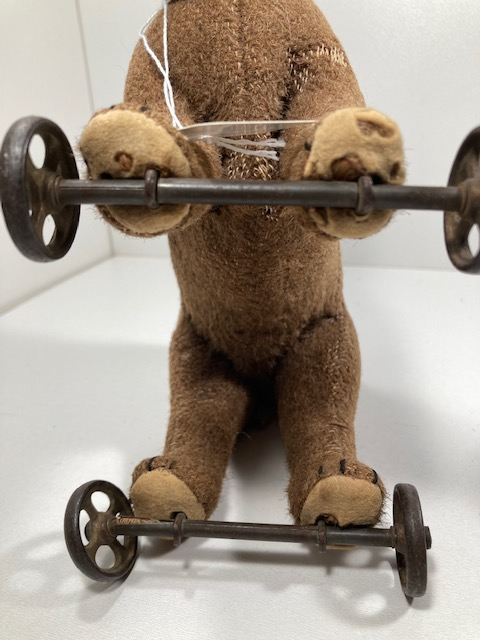
This cheerful cub is standing, head jointed, and is 17 cm tall (measured vertically). He is made from brown short pile plush. His paw pads are made from tan felt. His face comes to life with black button eyes and a black hand embroidered nose and mouth. He also has black hand embroidered claws. He is mounted on two metal axles and rides upon four metal wheels - each is about 1 inch in diameter. You can see a close up of his "ride" at the end of this post. When he left the factory in Giengen, he would have been wearing a leather collar. This accessory has been lost to time. He was made in this brown short pile plush fabric in 10 sizes ranging from 10 to 100 cm from 1894-1926 overall. There is no indication on his ear that he ever had a button; as such, it is entirely possible that he was made in the prebutton era - c. 1894 through 1903/04. 

This bear's fabric represents a materially important time period in Steiff's history.
He is made from a somewhat rough to the touch cloth consisting of thicker brown woolen threads woven with thinner tan cotton threads. The way they come together gives the bear a bit of texture and visual interest. Steiff used this material on some of their earliest bears as it was available, affordable, and was probably the best alternative at the time. Because parts of this fabric are woolen and other parts are not, it ages and manifests losses in an interesting way. When the brown woolen threads are lost to time or insect damage, only the tan thinner cotton threads remain. Unlike mohair, there is no backing to this short pile plush - so you can see the excelsior stuffing between the threaded areas of loss. 

Mohair was really a game changer for Steiff when it became available on a commercial scale in 1903.
This "newfangled" fabric caught the eye of Richard Steiff, who brilliantly realized how well it would translate to the toy making world. And, just a few months later, he would unveil his 55PB bear at the 1904 Leipzig Spring Fair! This cub, which measured 55 cm tall, was made from long, reddish brown mohair, five ways string jointed, and detailed with black boot button eyes and a gutta percha nose. He was very heavy and solidly stuffed with excelsior and made to look like a real bear, not a playful toy. Although 55PB was not a commercial success - his mohair "grandson"... a cardboard disk jointed cub debuting around 1905... would go on to make Steiff one of the most recognized and beloved toy companies on the planet. 

It is interesting to note that the short pile plush bear under discussion today remained in production for more than two decades after the introduction of softer, more playful mohair items in the Steiff line.  This suggests that he sold well and was profitable enough to hold his place in the company's catalog. There's certainly no denying his charm and appeal - almost 130 years onward. 

Steiffgal hopes this discussion on this legacy bear on wheels has come full circle for you.

Have a question about one of your Steiff treasures? Let's talk! Click here to learn more.

Sunday, April 10, 2022

Monkey See Monkey Do With This Delightful Steiff Prewar Rarity

It's no secret that Steiffgal is simply bananas over Steiff's legacy Jocko the chimp pattern. This happy go lucky primate has been a collector's favorite since its introduction in 1909 - and for good reason! Steiffgal saw today's featured guest listed on an online auction platform in Europe and knew she had to have him. After a few ups and downs, he finally arrived in the USA and was even better than photographed and described. Take a look at this ray of sunshine - literally!

Here's a tip - this Jocko is off the charts great! He measure 30 cm sitting and is fully jointed. He has the design's traditional very long arms and bended at the knee legs. His hands, feet, face, and ears are made from felt. He comes to life with oversized brown and black glass pupil eyes set in eye pocket, a large, open, felt lined mouth, painted features and nostrils, and a white mohair chin. And you can't help but notice his outstanding fabric. He is made from bright orange tipped mohair. This coloration is very prominent on his body and joints and less so on his head and arms. His fading probably happened because of exposure to sunlight, as well as natural fading that occurs with dyes and natural fibers. It is also possible that his torso is less faded because he was wearing clothing that protected these areas from the elements. Only he knows for sure!

Jolly Jocko retains his long trailing "f" button and traces of his yellow ear tag as his Steiff IDs. This is helpful, somewhat, in dating him. The long trailing "f" button appeared from around 1906-1935, and the prewar yellow ear tag appeared around 1934. If you overlay those two data points, they suggest that orange tipped Jocko was most likely "born" in 1934 or 1935.

Colorfully tipped mohair was a prominent design feature starting in the mid-1920s through the early to mid 1930s. Some models of Happy, Teddy Clown, and Petsy featured eye-catching brown tipped mohair. Fluffy the cat is famous for her teal eyes and blue-purple tipped coat, while Bully the bulldog made a name for himself with his orange tipped detailing. Molly the puppy was produced with brown, red, green, or blue tipped mohair, and examples of Charly the King Charles Spaniel with bright orange tipped mohair appear occasionally on the secondary market. Some 1920s rabbits were produced in surreal, tipped hues. and even some field and forest animals sported this distinctive fabric as well.

As far as Steiffgal can see, there is no specific mention of an orange tipped Jocko in any of the standard Steiff reference books. All of his IDs and detailing put him in at the tail end of "the golden age of tipping" at Steiff. However, Jocko monkeys are among the most popular and prolific designs in the Steiff line. Given they've been in production since practically the turn of last century, it would be nearly impossible to capture all of his different versions and variations - especially all the different fabrics he's sported over the years. For example, in her own personal collection, Steiffgal has otherwise undocumented versions of this chimp in artificial silk plush, wool plush, cotton plush, and other woolen combinations - among others! It would be possible to have a collection of just Steiff Jocko monkeys given the enormous range of their appeal, individual personalities, and of course, material presentation.

Orange you glad you checked out this Steiff blog today?

Have a question about one of your Steiff treasures? Let's talk! Click here to learn more.

Wednesday, March 2, 2022

Hands In The Air Over This Marvelous Midcentury Puppet!

The theme of this week's Steiff blog has a lot to do with hands! In this case, we're taking about a really unusual very early postwar hand puppet. But the context for all of this is that Steiffgal broke her hand in several places in February, which explains why this blog was a bit on hold for awhile. But things are coming together, and blogging is possible again - finally! So hands in the air about that... and this adorable midcentury marvel!

Here we have one of Steiff's one-derful items... a special toy that only appeared in the catalog for one year. This brown beauty is 17 cm tall and made from long, brown artificial silk plush fabric. His muzzle is made from short tan artificial silk plush. Ted's smiling, open mouth is lined in peach colored felt; it is the same felt as seen on his hand pads. He has brown and black glass pupil eyes, a black hand embroidered nose, and tan embroidered claws. His head and the tips of his paws are stuffed with excelsior. His head is lined in a cardboard finger tube. He most likely was wearing a red ribbon when he left the factory over seventy years ago. This puppet was made in this size only in 1949. His IDs have been lost to time, but MAY have included a short trailing "f" button, a red imprinted chest tag, and a yellow or white linen ear tag. 

This hand puppet sits at a key point in the Steiff product development tree for this puppet design. The full bodied Teddy baby bear debuted in 1929 in a variety of sizes, colors, and materials. He was an immediate sales success, given his appeal, form, and irresistible personality. Like many "home run" products, the company quickly started producing Teddy baby as a series of novelties to further leverage the design's popularity. Of course, puppets were an obvious direction for this patter.  A Teddy baby puppet was produced in maize as a closed mouth version in 17 cm in 1930 only. This puppet was also made in 17 cm in brown mohair in the more familiar open mouth design from 1929-1943. Other prewar Teddy baby novelties included pajama bags, pull toys on wooden wheels, dressed dolls, and roly-polys. 

Given the design's popularity, it is no surprise that a Teddy baby hand puppet would appear in the line in the late 1940s when the factory reopened for toy making business. As mohair was still in short supply, and expensive, Steiff produced this beloved and legacy pattern in brown artificial silk plush in 1949. The puppet under discussion here today is one of these rare models. Then, once mohair became available on a commercial scale, he was made in this traditional fabric again through 1978. A very early postwar brown mohair Teddy baby puppet is pictured here on the left. Its red imprinted chest tag and article number "317" dates it from c. 1949-1952.

This Teddy baby hand puppet design is pretty remarkable as nothing fundamentally changed in its pattern or construction in half a century. This, in some ways, makes brown mohair Teddy baby puppets without IDs somewhat hard to date. Steiffgal can only think of three very minor things that changed on this design in 50 years. First, of course, is their IDs, which would be updated to match their period of production. Second would be the shift from glass eyes to plastic eyes in the 1960s. And third would be the shift from a cardboard finger tube to a plastic finger tube, probably in the late 1960s-early 1970s.

Steiffgal hopes this discussion on Steiff's unusual early postwar Teddy baby puppet has been one happy handful for you.

Have a question about one of your Steiff treasures? Let's talk! Click here to learn more.

The teddy bear search engine