Showing posts with label button. Show all posts

Monday, January 12, 2026

Starting 2026 Off In A Steiff Supersized Way!

Sometimes the most unexpected and super-scaled treasures appear almost out of the blue! Such is the case with this fantastic and extremely large prewar Steiff Ted. And just how big is he? Well, Steiffgal could barely pick him up and move him about for his photo session! Take a look at this titan-Ted and see what makes him so fantastic from the design and historical perspectives. 

Here we have a HUMUNGOUS classic and traditional five ways jointed Steiff Teddy bear. He measures approximately 115 cm tall or 45 inches tall standing, is made from dark blonde mohair, and solidly stuffed with excelsior. He has a pronounced back hump, a partially trimmed muzzle, long narrow feet with felt pads, proportional brown and black glass pupil eyes, and a black embroidered mouth, nose, and claws. He retains his long trailing "f" button and traces of his white ear tag; these IDs date his production most likely to the mid 19-teens or early 1920s. 

This gentle giant is the largest sized standard line bear produced by Steiff prewar; this huge size was made from 1905-1933. This is only the second jumbo mohair prewar Ted Steiffgal has handled - these big boys are super rare. Steiffgal suspects not many were made, and those produced most likely were destined to be showpieces or window displays. It really is not possible that a child could interactively play with a bear of this size given the weight and heft of him.


Big Ted was most recently in the collection of Iris Carter, a passionate Teddy bear and Steiff collector from Virginia. Iris was inspired to start collecting Teddy bears when she read Peter Bull's The Teddy Bear Book, which was first published in 1970. It would be so interesting to learn how and where she adopted this bear, given his rarity and timeline.


Like many old friends, this bear had a few condition issues typical to larger prewar bears. Mostly these had to do with his ankles and feet pads. His ankles had some splits and damages, and his felt pads were dried out and flaking off. Both of these issues can be addressed with gentle and sympathetic restoration. 


However, Steiffgal came up with an idea to help stabilize those vulnerable areas until this work happens. Given his feet and legs were so oversized, standard commercial socks were not an option here. However, there is such a thing as bariatric socks, which are soft socks which are designed to cover the feet and ankles of people with extreme Lymphedema - or very, very swollen feet and calves. You can see what these look like here. This protective footwear stretches to 30" at the calf, up to 21" in the foot, and up to 14 E shoe width. These socks fit this big bear really well and provided a somewhat attractive way to cover and protect his pads, feet, and ankles up to almost his knees!


Steiffgal hopes this discussion on Iris Carter's terrific Ted has launched your 2026 in the most supersized way possible!


Have a question about one of your Steiff treasures? Let's talk! Click here to learn more.

Sunday, September 15, 2024

Strike Up The Brass Band Over This Mysterious Steiff Fawn

Oh deer!
What do we have here? This charming field and forest friend is not only just lovely and elegant in design, but she also has a less obvious but totally WAH-HOO good surprise element to her as well. Get ready to fawn over this precious prewar rarity!

Here we have Steiff's 22 cm mohair fawn. She is standing, unjointed, and made from tan mohair. The lining of her ears and her tail are made from white mohair. Her face is detailed with black button eyes and a black hand embroidered nose and mouth. Her legs are particularly thin, shapely, and elegant and are made from velvet. She has a gentle, distinctly old fashioned look to her. This pattern was produced in 17 and 22 cm from 1934-1943.

Now for her little secret.
Given her era of production, she would have left the factory with either a long or short trailing "f" style knopf, depending on her specific year of manufacture - with earlier versions having the long trailing "f" version and the later versions having the short trailing "f" version. However, this gal proudly wears an unusual BRASS colored short trailing "f" Steiff button and has traces of her yellow ear tag. The button measures 6 mm in diameter. This seldom seen branding appeared on a few Steiff items from 1933/34 through 1943. You can see that brass button in the photo below.  

So just how rare is this brass prewar button?
It is really hard to quantify, as Steiffgal has only handled - literally - a handful of items with this distinctive ID in memory. In her personal collection, she has one prewar treasure with this distinction. This is a small standing Waldi dog. He 10 cm, unjointed, and made from copper colored mohair. He has long, floppy ears. His face is detailed with shiny black glass eyes and a black hand embroidered nose. His mouth is indicated by a little black airbrushing. Waldi wears his original green leather collar and has his "watermelon" shaped bare faced tag, with his name imprinted in crimson. This guy was made in 10, 14, 17, 22, and 28 cm from 1933 - 1943... the identical time frame as the fawn under discussion today. This prewar Waldi is pictured below on the left. 

It remains a mystery why Steiff used a brass button for branding some of their items during this turbulent geopolitical period.
It might have to do with availability of materials, or shortages, or other rationing reasons. It is also not clear why some items would have a brass button, and others would not - as Steiffgal has seen examples of both the prewar Waldi and this fawn with Steiff's standard silver colored prewar IDs. Only these precious treasures know for sure... and they aren't talking!

Steiffgal hopes this discussion on Steiff's lovely prewar fawn with her unusual button has put the pedal to the metal for you.

Have a question about one of your Steiff treasures? Let's talk! Click here to learn more.

Thursday, February 3, 2022

This Marmalade Silk Plush Steiff Susi Kitten Is The Cat's Meow!

Orange you in the mood for something unexpected? Steiff's midcentury kittens are always the cat's meow, but this particular find is purr-fect in every way! Check out this fantastic feline and see what makes her so interesting from the design and historical perspectives.

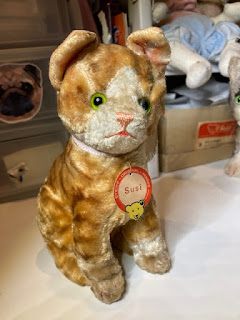
This smooth-as-silk sweetie is an unusual example of Steiff's beloved Susi cat design.
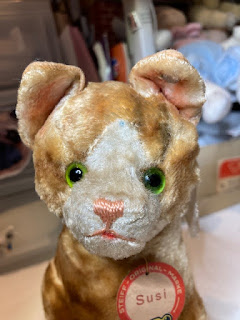
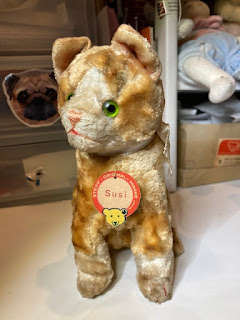
She is 16 cm tall, sitting, and head jointed. Susi is made from artificial silk plush. Her muzzle, front feet, and neck are white while her body, head, and tail are a marmalade color. The marmalade areas are hand airbrushed with dark orange or brown stripes. Her face comes to life with piercing green and black round pupil glass eyes, a pink hand embroidered nose and mouth, traces of a few clear monofilament whiskers, and a touch of pink paint to mark her lips. She has red embroidered claws on her front two paws. She retains her original pink bow. Her IDs include a large, watermelon style red imprinted chest tag, a short trailing f button, and traces of a light yellow or white ear tag.

Steiff's legacy Susi pattern has been a collector's favorite since her debut in 1936.
 It is rumored that this beloved design was named after a member of the Steiff family. Prewar, she was produced in grey and white mohair in 14, 17, 22, and 28 cm through 1943. In Pfeiffer's 1892-1943 Sortiment, she is described as "mohair plush, gray tabby, sitting, very pretty model, round shape." It is very unusual to find subjective or "flattering" descriptions in the Sortiment books as they are almost always entirely factual and literal. So Susi's design must have really caught someone's eye! Shortly after the conclusion of WWII, Steiff began manufacturing just a handful of their most popular prewar patterns - including a version of Susi. Her pattern was first produced in grey and white artificial silk plush in 14, 17, and 22 cm from 1948 to 1949, and then in mohair in 10, 12, 14, 17 and 22 cm from 1948 through 1978.

As far as Steiffgal can tell, this marmalade and white artificial silk plush full bodied Susi cat does not appear in any of the standard Steiff reference books.
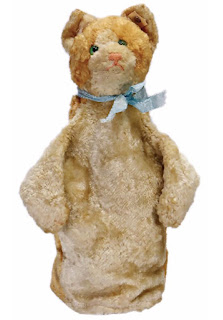
However, it is interesting to note that she resembles a most unusual marmalade and white artificial silk plush Steiff puppet sold at auction in 2019. 
This puppet, which is pictured here on the left, generated 20 bids and realized over $3,000! You can see that they share similar coloring and materials, as well as the same green and black pupil eyes, and other facial detailing. This puppet was described in the catalog as, "hand puppet, faux silk plush, cat, shiny button, rests of the ocher-colored paper sign, was produced during the war, good condition, nice colors." The photo is from Liveauctioneers.com.

So, what's the story with this very pretty, albeit uncatalogued kitty?
Here are a few ideas. It is entirely possible that she is a variation of the grey and white artificial silk plush version from the late 1940s. Her IDs align perfectly to that time frame. Given her stunning but unconventional hue and era of manufacture, she may have been produced as a sample of a design that never went into commercial scale production; was made from the only fabrics available at the time; or perhaps was designed and produced as an item for sale at the PX stores where American soldiers shopped immediately post WWII. However, only she knows for sure!

Steiffgal hopes this discussion on this happily hued Steiff Susi has tickled your whiskers, in the best possible way.

Have a question about one of your Steiff treasures? Let's talk! Click here to learn more.

Sunday, December 12, 2021

Jumping For Joy Over This Sample Steiff Frog Find!

Steiffgal's simply jumping for joy with her latest auction find.
A few weeks ago, she spotted this funky frog as part of a lot on an online auction. Something about him really called to her, and she knew she had to have him. Thankfully, the auction gods aligned, and she was able to place the winning bid. After an anxious week of waiting for his international delivery, he finally arrived at her doorstep. Check out this unusual amphibian and what makes him so wonderful from the collector's perspective.

It's easy being green when it comes to this sample frog.
He measures about 8 cm tall and about 10 cm long. His body and thighs are made from green mohair. His mohair is airbrushed with black stripes to add texture and dimension to these areas. His arms, hands, lower legs, and feet are made from double thick, die cut tan felt. They are airbrushed green, and then detailed with black airbrushed stripes and fingernails to bring them to life. His distinctly pouty face features an airbrushed mouth and oversized green and black google style cartoon eyes.

When Steiffgal saw him online, she truly did not recognize his hybrid felt and mohair design.
That is because he was - and is - a sample design. His pattern never went on to be produced on a commercial scale. His most unusual IDs include a brass Steiff button and his sample yellow tag located on his leg. The front of this tag looks just like a regular red and yellow single-thick ribbon style tag with the words "made in Germany by Steiff knopf im ohr" and the Steiff logo. However, on the back, the tag notes in German and English, "not for sale, Handmuster (hand sample) property of Margarete Steiff GmbH." Given his button and tag, he probably was produced within the last two decades.

It's difficult - if not impossible - to figure out why he was designed, whether he was envisioned as a stand-alone or accessory item, and why he never was manufactured on a commercial scale.
He is so appealing that Steiffgal is sorry that the rest of the world cannot enjoy his quirky yet irresistible charms. Perhaps - given his hybrid materials - he was a concept for a lower cost frog design, given that felt is less expensive and easier to transform into a product than mohair? It is possible he might have been designed as a keyring or purse dangler, given his petite proportions. Or maybe as a companion for a lucky princess doll or bear? But only he knows for sure - and his lips are sealed.

Steiffgal hopes this discussion on this sample frog has been a one of a kind experience for you!

Have a question about one of your Steiff treasures? Let's talk! Click here to learn more.

Saturday, August 28, 2021

This Pretty, Prewar, And Purple Steiff Princess Rains Supreme!!

WARNING! You are about to get all out joint over today's blog special guest!
This pretty kitty has just about everything going for her, including her looks, color, era, and "secret skill." Check out this fine feline and see what makes her so fabulous from the design and collector's perspective. 

This (now) purple kitten rains supreme. Here we have Steiff's fully jointed "Kitty." She is 15 cm tall and 21cm wide, not including her impressive tail. She is made from blue/black tipped mohair that has faded overall and evenly to a delightful, dark purple hue. Her underbelly, ears, muzzle, feet, and the tip of her tail are made from white mohair. Her face comes to life with a pink hand embroidered nose and mouth and teal green and black slit pupil eyes. Kitty was produced in 15, 18, 21, and 23 cm from 1931-1935. This example retains her long trailing "f" button as her Steiff ID. 

But wait, there's more!
Kitty's long tail is functional as well as aesthetic. This model is actually a tail turns head model, meaning that when her tail is rotated in a circle, her head follows in tandem. This technology was patented by the Steiff company in the early 1930s and basically consists a system that connects the head and the tail through a series of internal metal connectors and joints. 

Head jointed animals were an important part of the Steiff line in the early 1930s. Over time, about 25 different tail turns head models were produced through the very early 1940s. For the most part, these were based on the best selling standard line patterns of the time and included cats, dogs, rabbits, penguins, goats, and lambs, and even Mickey Mouse, among others. However, as far as Steiffgal can tell, this Kitty was one of the few tail moves head items that was only made as a tail moves head animal and not produced in any other form. It is interesting to note that she is neither pictured or mentioned in Steiff's 1931 novelty catalog where many of the other tail moves head animals debuted. 

Now, let's use some colorful language to describe her hue.
Today, Kitty is a marvelous shade of deep purple. But she did not start out life that way. According to Pfeiffer's 1892-1943 Steiff Sortiment, this model was produced in "blue/black tipped" mohair. But it has clearly mellowed to a pretty purple color over time. Another wonderful novelty produced with "blue/black" mohair at about the same time as Kitty was Steiff's King Peng penguin. You can see and example of a King Peng here on the left, the photo is from Christies. Today, when you find a King Peng, often his once blue/black mohair has become a similar purple color as Kitty's. As such, Steiffgal suspects that Steiff's 1930-era blue/black mohair was produced with a dye or dyes that oxidized or somehow had a chemical reaction with air or moisture over time. If this color change was due to something simple like direct sunlight, the change would not be so even or so consistent.

Steiffgal hopes that this discussion on this pretty purple princess has crowned your day.

Have a question about one of your Steiff treasures? Let's talk! Click here to learn more.

Sunday, June 27, 2021

Back In The Steiff Saddle, Sort Of!

Hurray! For the first time in nearly eighteen months, Steiffgal finally attended a real live, in person collector's event. This was the Spring Doll, Bear & Miniature Show held at the Sturbridge Host Hotel in Sturbridge, Massachusetts. It was so exciting to walk into a large room chock full of Steiff, toy, and doll temptations, as well as meet and greet friends only seen on Zoom since last March! Attendees seemed genuinely thrilled with the opportunity to again celebrate their shared passions with the toy collecting community.

It wouldn't be a show without a little souvenir, and Steiffgal couldn't help fawning over a little midcentury Steiff treasure she spotted right in one of the first booths she visited.
Check out this 17 cm wool plush Jungreh or fawn. Isn't she lovely! Fawn is standing, unjointed, and made from lumpy-bumpy tan wool plush. Her pert ears are lined in white wool plush. She has delightful, authentic brown airbrushed contrasting on her neck and back, and little black airbrushed feet. Her face is detailed with very large black button eyes and a black hand embroidered nose and mouth, pink highlighting, and a white stitch across her nose. She has a wonderful, quality, old fashioned look to her. Her IDs include a short trailing "f" button and midcentury style yellow ear tag. You can see her button and ear tag in the photo near the end of this post. 

This fawn was one of the earlier items produced after the factory reopened after WW2 for toymaking business.
She was first produced postwar in artificial silk plush in 17 and 22 cm in 1948 through 1949. She was then made in wool plush in 17 and 22 cm from 1949 through 1953. Then, in 1954, her pattern was modernized just a bit and she was made in mohair in 14, 17, and 22 cm through 1978 overall. 

Postwar, you often see this progression from artificial silk plush to wool plush to mohair fabric construction on many of Steiff's legacy and timeless favorites, including rabbits, horses, and bears, among others. Steiffgal even has an early postwar Jocko in artificial silk plush, wool plush, and of course, mohair. They are a darling trio indeed!

Wool plush is a distinctive fabric which holds a key place in the company's product development timeline history.
Steiff used wool plush, a relatively inexpensive and more readily available toymaking fabric, in times of conflict or other hardships when mohair was not being produced, or allocated for military purposes. You generally see wool plush items made in the c. 1930 through mid 1950 time frame, but a few models - like the company's Wotan ram - incorporated it through the 1970s. Wool plush is pretty hearty and ages well. Its structure and texture make it far less likely to fade, thin, or bald like mohair fabrics. Unlike artificial silk plush, wool plush can also can be cleaned gently like other fine woolen fabrics.

Steiffgal deerly hopes you too will be enjoying the fun of live, in person events soon... and finding vintage button-in-ear treasures that make you smile. 


Have a question about one of your Steiff treasures? Let's talk! Click here to learn more.

Sunday, August 2, 2020

Ray-zing The Profile Of This Spectacular Special Edition Steiff Sun

Here comes the sun! August is known for its hot days and lazy pace - at least around these parts. This final month of the "official" summer season is best celebrated via barbecues, beach visits, and bikinis - if you dare! Perhaps the finest Steiff item ever created to represent the marvelous month of August is a plush sun. He's pictured here on the left, "hanging out" in Steiffgal's front bay window. Take a look at this super star - literally - and see what makes it so interesting from the design and product development perspectives.

This Steiff rarity is one hot ticket indeed. This Steiff sun is unjointed and made from fuzzy yellow plush. His "body" measures about 17 cm in diameter. He has yellow cloth arms and legs. His simple yet very pleasant face comes to life with black button eyes and a black airbrushed nose and mouth.  His Steiff button and ear tag are located on his corona near where his ears would be, if he had any. And his specially branded chest tag is located on his hip. This most unusual Steiff novelty was produced in 17 and 45 cm in 2001 only. You can see his backside pictured here on the left.

This celestial superstar was created as a promotional product for the Baden wine region in Germany. Germany has thirteen official wine producing regions, and Baden is the most southernmost area of the country. The area is warm and sunny and known for its good quality Pinot Noir, Pinot Gris, and Pinot Blanc. Baden cover an area of about 400km (240 miles) along the Rhine from Lake Constance to Heidelberg, and includes the Black Forest, as well as the vine-clad terraces of the Kaiserstuhl, a volcanic massif. Steiffgal has visited this terraced area with her father and walked among the vineyards along the river. It was a beautiful and memorable experience. She even rode a luge (like a giant skateboard down a cement lined track) down one of the vineyard slopes toward the river which was a fun and once in a lifetime experience. Here on the you can see some of the terraced Baden vineyards; the photo is from www.vinous.com.

Besides his adorable and unique form, this great promotional item has a distinctive chest tag. You can see this tag here on the left. It is illustrated with a large letter B (for Baden) plus a happy sun holding a glass of white wine. How perfect is that? The German writing on the tag roughly translates to, "Baden wine spoiled by the sun."  

Steiff has a long tradition of creating promotional items for companies, brands, and commercial entities. Beloved vintage rarities of this ilk include Peck the Germ made for the pharmaceutical company Merck; Breuni bear, made for the upscale department store Breuninger, and a wool plush and rubber poodle made for Carl Walther GmbH. However, as far as Steiffgal can tell, this is the first "nonliving" advertising item Steiff has produced - a perfect planet! All others have been animals, insects, bears, characters, or human-esque figures. 

Steiffgal hopes this discussion on this bright and happy advertising item has added a spot of sunshine to your day.

Saturday, March 7, 2020

Are You Smitten With This Midcentury Steiff Kitten?

It's time to let the cat out of the bag concerning this week's fantastic Steiff find. The company's delightful vintage button-in-ear kittens have long headlined Steiff and doll collectors' lists of favorites given their incredible appeal, playful personalities, and ease of display. And there's simply nothing cuter than a kindle** of Steiff kittens! Take a look at this delightful, interestingly ID'ed midcentury example and try not to fall in love with her!

This fantastic feline is an early postwar version of Steiff's beloved Susi cat. She is 17 cm tall, sitting, and head jointed. Susi is made from grey and white 
patched style mohair. Her muzzle, front feet, and chest area are white; her body, head, and tail are grey. Her grey mohair is hand airbrushed with bold, eye catching black stripes. Her front claws are red and hand embroidered. Sweet Susi's face comes to life with green and black slit pupil glass eyes, a pink embroidered nose and mouth, and clear monofilament whiskers. Her belly squeaker works, sometimes! Her dark pink silk ribbon is original to her. This mohair Susi was made in 10, 12, 14, 17, and 22 cm from 1949-1978 overall. This example was produced in the earliest part of that time frame.


Susi is paws-atively a key design in Steiff's century-plus history of cat production. Steiff debuted its original Susi cat in 1936. Prewar, she was produced in mohair in 14, 17, 22, and 28 cm through 1943. In Pfeiffer's 1892-1943 Sortiment, she is described as "mohair plush, gray tabby, sitting, very pretty model, round shape." It is very unusual to find subjective or "flattering" descriptions in the Sortiment books as they are almost always entirely factual and literal. So Susi's design really must be the cat's meow! Early postwar, Susi - like many of Steiff's legacy prewar patterns - was produced in artificial silk plush as that was the fabric that was available for toy product in the late 1940s. Art silk Susi appeared in 14, 17, and 22 cm from 1948-1949 overall.

There is so much to love about this pretty kitty. Her facial expression and presentation are lifelike and irresistible. Her construction has so much integrity, and has a distinctively "old fashioned" quality to it. And her condition is lovely, too; it's amazing she looks almost fresh as a daisy after nearly seven decades. From the historical perspective, Susi's IDs bridge pre- and post-war designs. She has her linen tag style "US Zone" tag sewn into her arm seam; technically, these appeared in items produced in the c. 1947-1953 time frame. She also has her red imprinted, "watermelon" bear faced chest tag. These appeared on items prewar from c. 1928 through the mid 1940s, then again through 1952. This tag features a very angular Teddy bear face with a distinctive "U" shaped muzzle. 


Steiffgal hopes this discussion on this early postwar Susi kitten has made you grin like a Cheshire cat.

Have a question about one of your Steiff treasures? Let's talk! Click here to learn more!

**YES! This is a real word to describe a collection or group of kittens!

Sunday, September 1, 2019

Spicing Things Up With This Very Vintage Steiff Dachshund

You've heard the expression "age before beauty," but today's special blog guest clearly wins hands down in both categories. This delightful doggie is one of the oldest (and most handsome) canines Steiffgal has in her hug. In dog years, he's nearly 750 years old! Come see what makes him such a top dog in every way.

This precious pooch is standing and five ways (arms, legs, and head) jointed. His head, back, tail, and outer limbs are made from vibrantly hued cinnamon mohair. His chest and inner limbs are made from white mohair which has mellowed to a vanilla color over time. He has three black hand embroidered claws on each of his paws. His face and head come alive with long, floppy felt lined mohair ears, black shoe button eyes, and a black hand embroidered nose and mouth. He retains his original tiny long trailing "f" button and traces of his white ear tag. This pattern appeared in the line in 17 and 22 cm from 1911 through 1913; this is the 17 cm version. These dogs were measured vertically, from the top of their heads to their toes. 


It is so cool how his design details perfectly converge on his era of production. Four really pop here. 

The first is his color. This great cinnamon mohair color is seen once in a blue moon, and mostly on items through the 19-teens. Steiffgal has also seen this color on early bears, monkeys, and squirrels. 

The second is his jointing. Through the 19-teens, it was not unusual for Steiff to joint, or "uber-joint" its popular animals. For example, squirrels and cats were head, limb, AND tail jointed. And some rabbit models were fully jointed - plus had each of their ears jointed! This dandy Doxie is head and limb jointed, which adds to his playfulness, but also to his cost. Fully jointed dogs like this are extremely rare in the Steiff line.

The third is his eyes. This great example has black shoe button eyes, like most items produced before c. 1912 or so. Starting in the mid-teens, Steiff primarily produced their items with black glass, or black and brown glass pupil eyes, to add to their appeal, prestige, and authenticity.

And the last is his facial construction and presentation. After studying this pooch for awhile, Steiffgal noticed that his face has a center seam construction, and a shaved muzzle. These two desirable - and clearly period - design elements are most often seen on Steiff's earliest Teddy bears.


Dachshunds have always been a popular breed in the Steiff production kennel. The 1913 English catalog features eight variations of these "badger dogs." Here on the left you can see this five ways jointed example under discussion today. You can click on the photo to make it larger. He is simply noted as "jointed, fine plush, brown &white/brown." Two models are noted; one at 17 cm and one at 22 cm. And just how much is that doggie in the window? The catalog notes that the 17 cm version costs $1.40 (the equivalent of $36.28 in 2019) and the 22 cm version costs $1.90 (the equivalent of $49.24 in 2019.)

Steiffgal hopes this discussion on this darling Doxie has generated a bit of puppy love for you. 

Wednesday, January 30, 2019

And The Blue Ribbon For The Most Unusual Steiff Bully the Bulldog Goes To...

Are you looking for blues clues about a most unusual Steiff treasure? Then check out this fabulous - and fabulously rare - example of Steiff's beloved prewar Bully the Bulldog. There's no doubt he'd be top dog in anyone's Steiff canine kennel!

The sky's the limit with this outstanding blue and white Bully. He's sitting, head jointed, and made from velvet. His blue has oxidized to more of a green color since his "birthday" nine decades ago. You see this often with vintage materials and dye colors. (Check out where the sun doesn't shine - like armpits and crotches - to find areas untouched by time.) Like the Bully dogs of his era, he has large, metal lined, and poseable ears and patched construction. His face comes to life with oversized black and brown glass pupil eyes, a hand embroidered nose, a few freckles, and an elaborately constructed and very detailed muzzle. Blue Bully retains his original horsehair collar and bell, as well as his long trailing "f" button as his ID. This bouncing bundle of joy was produced in 7, 10, 14, and 17 cm from 1927 through 1934 - and is only the second blue Bully Steiffgal has ever seen!

It is interesting to note that in the late 1920s through early 1930s, Steiff produced a number of animal and novelty patterns in fun, "jellybean" hues - both in mohair and velvet. These included rabbits, bears, dogs, pincushions, and other favorites. It is Steiffgal's best guess that these colorful critters were designed to match the mood and aesthetic of the "roaring 20s" and were produced not only as toys for children but as gifts and collectibles for adults. 

Small, unusually hued, prewar Steiff rarities with IDs and accessories like this only surface once in a blue moon - and always generate lots of dollars, and interest, at auction. For example, in 2016, an 8 cm version generated 12 bids and hammered at €2,400 (roughly $2,800) on its €330 - €660 (roughly $376 - $750) estimate. And why is that? Like most marketplace or economic situations, it has to do with supply and demand. For example, consider....

  • Petitely proportioned items are/were often a child's "best friend" and as such, were loved to death as playthings, or lost to time. So there are not alot of them in general still around. 
  • These small treasures span several collecting categories, including general antiques, Christmas items, dollhouse items, dolls, and Steiff. So many people are interested in them. 
  • They don't take up too much space in a collection.  So they are very desirable from the collection management and logistics perspectives, especially amongst more "seasoned" collectors. 
  • And they are simply just plain wonderful. Collectors seldom if ever tire of them, and very rarely sell them unless they absolutely have to.
Steiffgal hopes you've enjoyed learning about this blue ribbon beauty.

Have a question about one of your Steiff treasures? Let's talk! Click here to learn more.

Sunday, September 9, 2018

Your Jaw Will Drop When You See This Turn Of Last Century Steiff Tom Cat!

Mouth agape! That was exactly Steiffgal's reaction when this turn-of-last-century rarity finally made its way into her Steiff collection. Like every Steiff enthusiast, Steiffgal also has a wish list, and this terrific Tom had been on it forever - until now! Check out this cover boy (really - and more about that later!) and see what makes this fantastic feline so interesting from the historical and design perspectives.

They say orange is the new black, but sometimes being old is in vogue, too! Here on the left is Steiff's original Tom Cat in the smallest sized produced. He is standing, unjointed, and made from jet black velvet. Measured vertically, he's 8 cm from the top of his head to his toes and 10 cm from the top of his tush to his toes. His thin, almost straight tail measures 8 cm long and .5 cm wide - and even more astonishingly - it is stuffed with excelsior! How did they do that, given its scale and configuration? Tom Cat wears his original silken bow and bell. This pattern was produced in 10, 14, and 17 cm from 1903 through 1919 in black velvet, and in 14 and 17 cm in white velvet from 1906 through 1908. This example retains his original blank button, dating his production to around 1905 or 1906.

Face it, you can't look away from Tom Cat's distinctive head design and construction. He comes to life with tiny, triangular shaped ears, black seed bead eyes backed in yellow felt, and an open, pink felt lined mouth. The lining is held in place with tiny pinkish-tan colored stitches - perhaps to resemble teeth? You can see where the seamstress tied the knot of pinkish-tan thread for these stitches on the cat's chin area. This is a tiny but interesting detail; it is not unusual to see an embroidery thread  knot on the face of an early Steiff bear or animal. Tom Cat also retains a number of his clear, monofilament whiskers. One could say he has a face only a (Steiff) mother could love! You can see all of these delicate details on the photo trio above. 

This Tom Cat is truly a headliner - from both aesthetic and well as historical angles. This petite treat was featured in an important photograph from the company's 1904/04 product line catalog. But what's so special about that? It's the same picture that debuted PB55... the world's first jointed Teddy bear! Timing is everything, eh? A snapshot of this catalog page is shown here on the left; you can spot the arched back Tom Cat a little to the right of center standing on top of a donkey on wheels. Given the scale of the items in the image, it is Steiffgal's best guess that the Tom Cat pictured is the 17 cm version. What you can't see on the photo is the cat's intricate mouth construction, but you can make out his bow and bell. This picture is from the Cieslik's Button in Ear The History of the Teddy Bear and His Friends reference book, published in 1989.

Now let's paws and look at the details noted on the photo. According to the hand written notes along the bottom of the page, these original black velvet Tom Cats were 14.40 Deutchmark per twelve. That is VERY ROUGHLY equivalent to $0.30 each in 1903.  This translates to approximately $8.59 in today's US dollars, given inflation and other financial and economic factors. 

Steiffgal hopes this discussion of this rare Tom Cat has left you on your toes for your next great find!

Have a question about one of your Steiff treasures? Let's talk! Click here to learn more!

Sunday, January 7, 2018

This Latest Steiff Find Is The Cat's Meow

Sometimes, the best things in life tiptoe in on little cat's feet.  And such is the case with this week's happy find!  Steiffgal popped into an antique show while traveling recently.  There were many great vintage temptations on offer, but hardly any Steiff... until the VERY LAST booth in the hall.  Check out what was hiding out among a bunch of old toys, puzzles, and other vintage childhood favorites.

What a purr-fectly wonderful discovery! Here we have a nice example Steiff's very early post war "Kitty" cat. She is 17 cm tall, fully jointed, and made from mohair. Her body, limbs, tail, and face are made from very light grey mohair, while her paws, chest, muzzle, and ears are off white mohair. Her back, arms, legs, tail, and the sides of her head are lightly airbrushed with darker gray stripes, making her the true Tabby! Her all original and early slit pupil eyes are made from green-teal and black glass. Kitty has pink hand embroidered facial features, with a red dot on her mouth to indicate her lips. Her claws are red and she retains her original clear mono-filament whiskers. Steiff's Kitty was made from 1949 through 1970 in 10, 17, and 22 cm. This example's coloration, eyes, and "Made in the US Zone" put her in the very early portion of this time frame. 

They say cats have nine lives, and in the case of this example, that is exactly true! Today, when a toy is produced, it usually appears on the market for just a handful of years.  This is due to the "limited edition" phenomenon, as well as changes in market preferences - especially for things like licensed characters. But, in the case of Steiff's 20th century production, some items would appear for years, decades, or even generations.  For example, the company's Molly dogs were introduced in the 1920's and were produced through the end of the 1970's.  And Steiff's black "Scary Cat" pattern appeared in the company's debut catalog of 1903, and is still being manufactured on and off to this day!  Post war, this fully jointed cat pattern was clearly a fan favorite, appearing in the line for almost 20 years. 

Despite her longevity, this pattern did experience a few updates and changes over time. These changes were aesthetic, to keep up with modern preferences, but also structural, to help keep her manufacturing costs in check. So what are some differences between the older and newer Kitty cats? Here on the left, you can see a more "modern" Kitty, produced during the early 1970's. As you can tell, the older ones simply have a more "vintage" look to them. But here are three objective, key physical details that may help to date this beloved and legacy pattern. 

Eyes: Older Kitties have distinctive green-teal and black glass slit pupil eyes, while newer ones have olive-green and black slit pupil plastic eyes.

Coloration and ID: Older Kitties have grey and off white coats that are airbrushed in grey stripes, while newer ones have off white coats what are airbrushed in darker grey or black stripes. Older ones tend to have powder pink noses, while newer ones tend to have darker pink noses.  Older ones also often, but not always, have a "US Zone" tag sewn into their front leg seam. 

Materials: The smallest older Kitties have felt ears and a white velvet muzzle, while newer ones have mohair ears and muzzles. You can see two examples of the earliest Kitties with these details here (along with their sweet friend, a woolie mouse from F.A.O. Schwarz!) 

Steiffgal hopes this discussion on Steiff's fully jointed kittens has been the cat's meow for you.

Have a question about one of your Steiff treasures? Let's talk! Click here to learn more.

Saturday, October 14, 2017

Things Are Spot on With This Delightful Pre-War Steiff Giraffe!


Steiffgal's gonna stick her neck out here and say that you will undoubtedly develop a plush-crush on this week's blog friend. She bought him based on a photo from a sale in Europe, as something about him really called to her. As a fellow collector, she is certain you know that feeling all too well! So how about following a tall order and checking him out?

Things are spot on with this delightful pre-war Steiff giraffe. He is 35 cm tall, unjointed, and made from light orange wool plush. He is hand spotted with darker orange spots. His mane is made from short light orange mohair, while the tip of his tail is made from longer orange mohair. His face comes to life with two pert horns, black button eyes, a painted orange mouth, and ears lined in peach colored felt. This pattern was made in 28 and 35 cm from 1936 through 1943.  

Despite his simple and charming appearance, this delightful example is actually outstanding in two ways. 


First, material matters. Giraffes are a legacy pattern for Steiff. Giraffes were featured in the company's debut 1892 catalog. Wheeled and simple standing ones were available in sizes ranging from 17 cm to 65 cm overall through 1909. This pattern was updated in 1909 and produced in an even greater spectrum of sizes - from 28 to 260 cm through 1942 overall. The larger sizes were designed for riding and were constructed with a stabilizing internal metal frame and detailed with steering and leather saddles. Except for a lone 110 cm example made in 1933, all of these gorgeous giraffes were made of felt.  Given the elegant lines of these animals, as well as their need for precise spot detailing, this makes perfect sense from the manufacturing, economic, and design perspectives. 

So then, what's the big deal with this little guy? This giraffe under discussion today is really the first non-felt version produced as a standard line item for any length of time. And its fabric - wool plush - aligns perfectly with its period of manufacture. Its detailing materials - felt on the ears, and mohair on the mane and tail tip - are used as minimally as possible, yet really add to the giraffe's appeal and sense of quality. Felt and mohair were beginning to become less and less available for toymaking in the mid-1930's due to geo-political reasons. As such, Steiff was very careful with the limited quantities of these upscale fabrics they had available to them. Here on the left is the catalog entry for this giraffe in Steiff's Hauptkatalog (main catalog) dated D 1938/39.

Giraffe's second fantastic feature is a heavy-metal favorite. His "knopf" is the most unusual BRASS colored Steiff button. It is the short trailing "f" style and 6 mm in diameter. This button appeared on some Steiff items from 1933/34 through 1943. This are pretty uncommon; this is only the second item in Steiffgal's collection of vintage Steiff treasures bearing this distinctive trademark. Most of the time, for items produced in the mid 1930's through early 1940's time frame, Steiff used a silver colored short trailing "f" button.  You can see this brass button, with traces of the yellow ear tag, here on the left. 

Steiffgal hopes this discussion on this delightful tall drink of water has whetted your appetite for Steiff's late pre-war wool plush rarities. 

Have a question about one of your Steiff treasures? Let's talk! Click here to learn more.

Monday, August 21, 2017

Hat's Off To This Absolutely Amazing Early Steiff Lady Doll!

Hold onto your hat - literally! What Steiffgal has to share with you today just might be head and shoulders above anything that has ever appeared in this blog before! Steiffgal recently had the pleasure of viewing a collection of absolutely outstanding pre-war Steiff dolls. Each was breathtaking in its own way, and she will feature a few in this blog over the coming weeks. She wanted to give the first tip of the hat to this particular one - and after seeing her, you will certainly understand why!

It's a hat-trick when it comes to this lovely Steiff lady. Here we have a magnificent lady doll with an elaborate hat built into her head. She is fully jointed and stands about 42 cm tall; her hat adds another 15 cm or so. She wears fabulous, hand made leather lace up shoes, thigh high socks, a purple felt skirt with orange and green flowers printed on it, a white cotton apron, and a black lace shawl with a matching black lace hanky. Her core body is made from orange felt, and that is how her upper torso appears. Her face comes to life with blue and black glass pupil eyes and very delicately hand painted facial features. 

Her "proper topper," Steiffgal suspects, maybe based on some regional or traditional European design. It is literally built on her head. The core of the hat is made from felt and is stuffed with excelsior. It is trimmed with three bands of brown velvet ribbon. The top and bottom of the hat are made from soft white fabric that has been pleated and folded in the most charming and interesting way possible. She does not have a mohair wig or any indication of painted hair.

There's no question that this doll would be a headliner in any Steiff collection. It is suspected that she was produced in the early to mid 19-teens, given her presentation and materials. After extensive searching, Steiffgal could find no mention of this doll and her remarkable "hat-head" in any of the standard Steiff reference books or materials. However, she was able to locate a photograph of a similar doll sold in 1990 at a Theriault's doll auction; it is shown here on the left and the photos is from Theriault's. It is possible that only a handful of these dolls were produced (the construction is so elaborate and therefore time consuming and expensive), that they were only manufactured in extremely small numbers for a special display, or that she was a prototype of some sort. Any of these factors may in part help explain why there is a dearth of information available about her.

Let's button up this discussion with a quick peek at her ID, which is also quite interesting. It turns out this lovely lady had not one, but TWO small trailing "f" buttons in her left ear. She also has a small hole in her right ear - just the perfect size for yet another button. Although the double buttoning in her left ear could be an accident, her ear is so small, and the button is so well placed, that the second button truly looks intentional. In the past, Steiff used multiple buttons to keep track of which items were samples, prototypes, and versions of items under development. In the 1920's, this usually took the form of a regular button in one ear, and a "muster" button in the other. It is entirely possible that this doll's multiple button system is an early form of this tracking system. Unfortunately, only she knows for sure!

Steiffgal hopes this discussion on this incredible lady doll has given you something to hang your hat on!

Have a question about one of your Steiff treasures? Let's talk! Click here to learn more.
The teddy bear search engine