Take a seat and check out this darling and little known Steiff tiger! Tigers are a popular, legacy item in the Steiff catalog, with the first big beasts of their type debuting in the company's line in 1915. They translate well from real life to plush, and their handsome looks and wild origins bring out the animal instincts in most collectors! Steiffgal stumbled across this unusual prewar example on an online auction. The fates smiled upon her, and now he's part of her permanent hug.
This striped sweetie is quite the looker. His official name is "Tiger Cub." He is 22 cm tall (measures vertically from head to toe), sitting, and head jointed. He is made primarily from tawny colored wool plush. His long sideburns are made from longer white mohair. Tiger is stenciled and airbrushed in typical tiger style; he is highlighted in orange with prominent black stripes on his limbs, back, tail, and head. In true cat fashion, his little tail curls up around his backside. He has black hand embroidered claws on each of his paws. His distinctly youthful face is detailed with teal green and black glass eyes, a black hand embroidered nose and mouth, and a spot of pink paint on his lips. His ID is a short trailing "F" Steiff button. Overall, this big cat appeared in the line in 17 and 22 cm from 1939-1943.
It's always fun to discover new Steiff surprises, and this tiger cub definitely qualifies as that for Steiffgal. This is the first of his kind she's ever handled, or really knew about. According to Pfeiffer's 1892-1943 Sortiment, this model is cataloged as, "woolen mohair, tawny-colored, tiger striped, sitting, soft, young, funny." It is unusual for Steiff or Pfeffer to use endearing adjectives in their descriptions - usually they are quite literal and objective. So the word "funny" really pops here, and in a way it is accurate. This guy does have a playful and mischievous look to him.
Tiger cub's shape and presentation also may ring a bell with collectors interested in Steiff's sitting big cat production over time. His sitting, head jointed form is also noted on the company's pre- and postwar Young Lion design. This mane event was made in 17 and 22 cm in wool plush from 1938-1943, in artificial silk plush in 17 cm from 1948-1949, in 10 and 17 cm in wool plush from 1949-1954, and finally in mohair in 10 and 17 cm from 1955-1961. You can see the 17 cm, early postwar artificial silk plush version of young lion here on the left. Clearly the sitting young lion design was more popular than the sitting young tiger design, which only appeared in 10 cm from 1951-1961.
Steiffgal hopes this discussion on this prewar, wool plush cub has put a tiger in your tank!
Have a question about one of your Steiff treasures? Let's talk! Click here to learn more.
Showing posts with label young. Show all posts
Sunday, April 24, 2022
Saturday, March 11, 2017
This Unusual Steiff Curled Wool Pachyderm is Simply Ele-Fantastic!
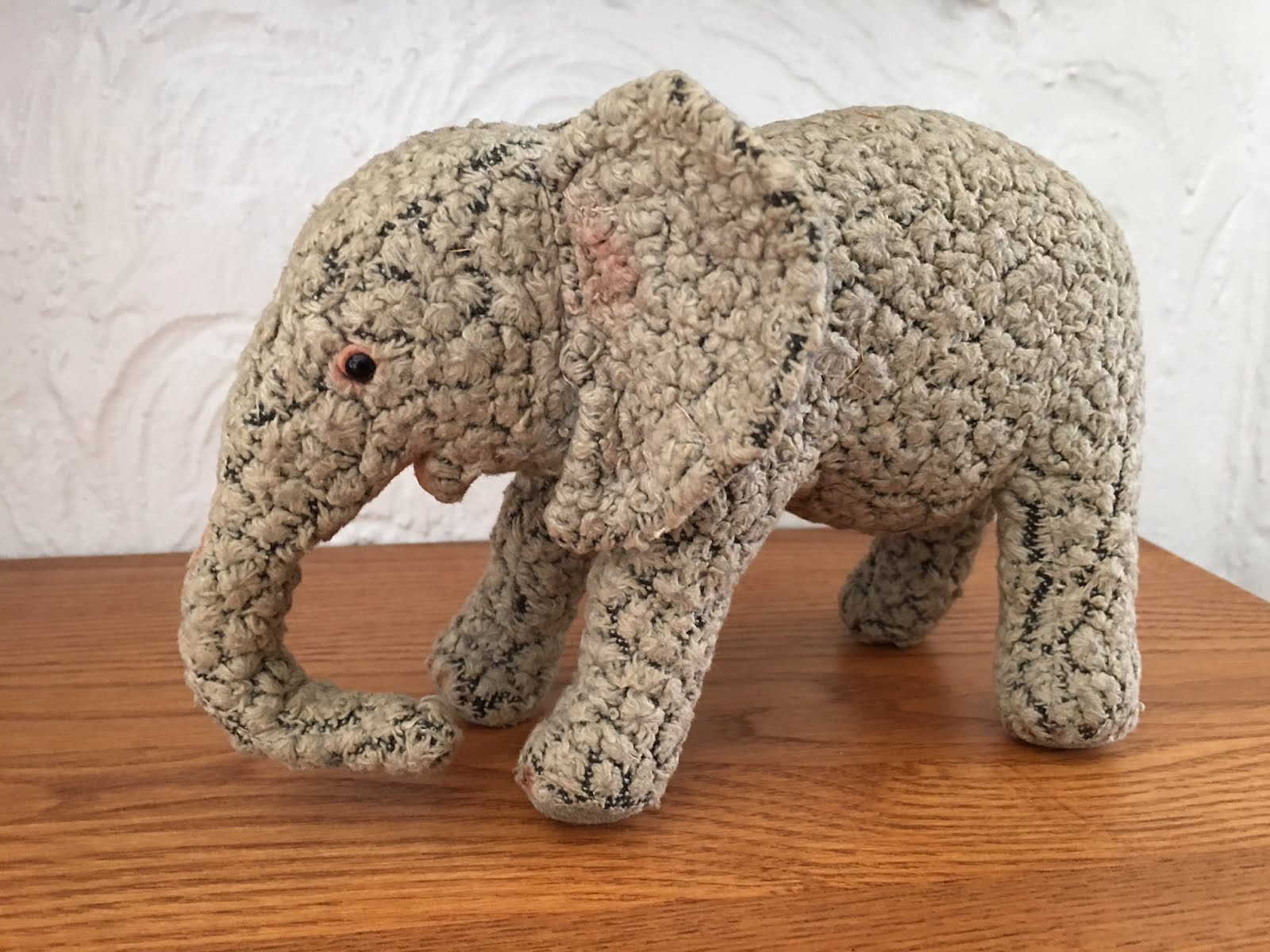
Oh baby! A new vintage friend has arrived from overseas and Steiffgal can't wait to introduce you to him. Steiffgal was checking out some online auctions and came across an interesting find on offer from an auction house in The Netherlands. The stars aligned and she won this somewhat rare prewar Steiff elephant. And, it turns out, he has several very charming and unusual design features that are not obvious from photos or cataloging. Let's check out this petite pachyderm and explore his interesting assembly.
Steiff calls this beautiful baby "Play Elephant." He is 14 cm tall and 20 cm long, standing, and unjointed. His body is made from an interesting material called "curled wool plush." This fabric has the look and of bumpy Persian lamb material, but with a softer, friendlier feel to it. The backing is a dark grey or black, and the front is light grey in color. He has red airbrushed highlighting on his ears, as well as nails on each of his feet. His distinctly babylike face comes to life with simple black button eyes that are backed in pink-airbrushed felt; an open, peach colored felt mouth; and a posable, wire lined trunk. He is excelsior stuffed and has a working squeaker Play Elephant retains his long trailing "F" style Steiff button. When he was new, he had a colorfully striped blanket; sadly, this has been lost to time. Play Elephant in this unusual material appeared in the line from 1935 through 1941 overall in 14 and 17 cm; the 17 cm version was
also produced as a pull toy on eccentric green wooden wheels.
Above on the left you can see a c. 1935 German print advertisement featuring Play Elephant; also pictured is the little known "Dream Baby No. 103" which appeared in the line from 1934 through 1936 and a mohair ball duck, which appeared in the line from 1932 through 1943.
So let's take a closer look at three subtle features that make this elephant a jungle gem.
The first is the use of additional, unusual fabrics on this period item. Elephant's paw pads, tail, and ear backing material is not felt, but another light grey material that has a cotton backing and a soft, velvet-like nap to it. It feels very much like the flesh-colored material used on the bodies of the company's pre- and early postwar animal dolls. The tip of his tiny tail is also detailed in long, soft black material. It looks somewhat like mohair fabric that could be used to represent the mane on a horse or zebra, but it is much softer, easily bendable, and doesn't feel like wool in any way.
The second is some unique stitching detailing on his oversized, floppy ears. Each ear has six simple grey seams which fan out from where the ears join to his head. These are both decorative as well as hold the front and back fabrics making up the ears together. Because of the texture of the curled wool plush, the stitches are not visible on the front of the ears. Steiffgal has several prewar elephants in her collection based on this "Play Elephant" pattern - including a 22 cm silk plush version - and none have this distinctive ear stitching detailing.
The third is a mouthful - literally! Steiff is famous for how the company inserts and secures the eyes on its bears and animals. This is usually done by inserting the eyes into the front of the head, pulling the threads to the rear of the head, and knotting them firmly in the back at the base of the neck. In the case of this particular pre-war curled wool plush elephant, this distinctive knot is located right inside the baby's mouth. This was really hard to photograph but hopefully you can see this feature here on the left. It is the first time Steiffgal has seen this assembly detail on any Steiff item.
Steiffgal hopes you find this sweet baby elephant as unforgettable as she does!
Have a question about one of your Steiff treasures? Let's talk! Click here to learn more!
Saturday, November 26, 2016
This Lovely Steiff Silk Plush Elephant Is Simply Unforgettable
Talk about big love! Steiff has a long and deep history with elephants, with a felt elephant being the animal pattern that catalyzed the company into the toymaking business before the turn of last century. And it is interesting to note that the company chose an elephant with a raised trunk (in the shape of an "S") as its earliest logo, and also put an elephant on its first "button-in-ear" branding.
There's just something unforgettable about the company's elephants from every era, and its always interesting to find Steiff treasures that span pre- and post- war production. So today's elephant under review is jumbo news indeed!
Is it polite to ask his age? Play elephant was produced in 17, 22, and 28 cm from 1938 through 1942, and postwar in 22 cm only in 1948 though 1949. Given he is 22 cm and has a button that was used both before and after the war, it is impossible to tell his exact date of manufacture. And for better or worse, elephants are very good at keeping secrets! Either way, he does have a delightful, innocent, and old fashioned look to him.
Let's change things up a bit and look at the economics behind this excellent elephant. The photo on the left shows a Steiff advertisement from around 1940. (If you click on it, it should be large and legible on your screen.) On the bottom you can see the pre-war version of this silk plush elephant; at the time, the 17 cm version cost 4.30 DM; the 22 cm version cost 6.50 DM; and the 28 cm version cost 9.50 DM. Given that in 1940 there were approximately 2.5 DM to the dollar, these prices roughly translate to $1.72, $2.60, and $3.80 in 1940 US dollars. Using an online inflation calculator which adjusts any given amount of money for inflation, according to the Consumer Price Index, this roughly translates to $29.38, $44.40, and $64.90 in US dollars in 2015. Steiff has always been a premium product at a premium price!Artificial silk plush was used as a less expensive and more readily available alternative fabric by Steiff during periods of manufacturing hardship. So it is not a surprise that this popular elephant design was produced in this fabric both as the country was entering into World War II, and then once the war was over but supply chains of conventional materials had yet to be re-established. References show that this exact play elephant pattern in 22 cm was made in mohair in 1950 through 1951. As such, it does appear that by the early 1950's traditional toy making materials and fabrics were again being manufactured for commercial use, and supply chains were functioning and dependable again.
Steiffgal hopes this discussion on this fantastic pre- and post- war elephant has been a memorable one for you.
Have a question about one of your Steiff treasures? Let's talk! Click here to learn more!
Sunday, October 18, 2015
Be Brave And Check Out This Amazing Steiff Artificial Silk Plush Lion!
No 'lion! A
very rare Steiff big cat just wandered into Steiffgal's collection, and
she couldn't be more pleased. Its time to go on the
prowl and and see what makes this sweet prince so interesting from the
design and product evolution timeline.
This heir to the jungle throne in none other than Steiff's Young Lion. He is 17 cm, sitting, head jointed, and made from tan colored artificial silk plush fabric. This fabric is very soft, silky, and shiny. His back is covered in very lightly airbrushed spots, stripes, and zig-zags. His chin and the lining of his ears are made from white artificial silk plush; his "sideburns" are made from much longer white artificial silk plush. He has three black hand embroidered claws on each foot. His sweet tail wraps around his backside. His adorable face comes to life with black and brown glass pupil eyes, black paint highlighting, and a black hand embroidered nose and mouth. He retains his short trailing "F" style Steiff button. Young Lion was made in this material and this size only in 1948 through 1949.
Despite this exact example's brief appearance, his closest relatives wore the crown for almost three decades in the Steiff line.
Prewar, the first sitting lion cub appeared in the line in 14 and 17
cm from 1932 through 1937. He is pictured here on the left; the photo
is from Gunther Pfeiffer's 1892-1943 Steiff Sortiment book. Like many of Steiff
items of the period, these two cubs were made from wool plush. In 1939, this
sitting pattern was modernized slightly with the addition of sideburns
and more elaborate painting. This updated pattern was manufactured in
17 and 22 cm through 1943.
The Young Lion pattern roared right back on the scene once the factory reopened for toy making business in the late 1940's. The pre-war Young Lion was produced in artificial silk plush instead of woolen fabrics in 17 cm in 1948 and 1949 - this is where the little fellow under discussion here fits into the timeline. Steiff produced many of the company's most popular and beloved pre-war patterns items in this inexpensive, transitional fabric in the late 1940's through the early 1950's. Common examples of this include rabbits, dogs, traditional Teddy bears, and Teddy Babies, among other favorites.
By 1949, woolen fabrics were beginning to be produced again in large enough scale for industrial manufacturing purposes. As such, Steiff was able to begin making the sitting Young Lion pattern in wool plush in 10 and 17 cm from 1949 through 1954. An example of the 10 cm version is pictured here on the left. Then, in its final appearance, the beloved Young Lion pattern was made in mohair 10 and 17 cm through 1961. Even these relatively more recent mohair versions have a delightful, vintage look to them, and remain favorites with collectors of all ages.
Steiffgal hopes this discussion on Steiff's rare and interesting artificial silk plush Young Lion has been the mane event of your day!
Have a question about one of your Steiff treasures? Let's talk! Click here to learn more.
This heir to the jungle throne in none other than Steiff's Young Lion. He is 17 cm, sitting, head jointed, and made from tan colored artificial silk plush fabric. This fabric is very soft, silky, and shiny. His back is covered in very lightly airbrushed spots, stripes, and zig-zags. His chin and the lining of his ears are made from white artificial silk plush; his "sideburns" are made from much longer white artificial silk plush. He has three black hand embroidered claws on each foot. His sweet tail wraps around his backside. His adorable face comes to life with black and brown glass pupil eyes, black paint highlighting, and a black hand embroidered nose and mouth. He retains his short trailing "F" style Steiff button. Young Lion was made in this material and this size only in 1948 through 1949.
Despite this exact example's brief appearance, his closest relatives wore the crown for almost three decades in the Steiff line.
Prewar, the first sitting lion cub appeared in the line in 14 and 17
cm from 1932 through 1937. He is pictured here on the left; the photo
is from Gunther Pfeiffer's 1892-1943 Steiff Sortiment book. Like many of Steiff
items of the period, these two cubs were made from wool plush. In 1939, this
sitting pattern was modernized slightly with the addition of sideburns
and more elaborate painting. This updated pattern was manufactured in
17 and 22 cm through 1943. By 1949, woolen fabrics were beginning to be produced again in large enough scale for industrial manufacturing purposes. As such, Steiff was able to begin making the sitting Young Lion pattern in wool plush in 10 and 17 cm from 1949 through 1954. An example of the 10 cm version is pictured here on the left. Then, in its final appearance, the beloved Young Lion pattern was made in mohair 10 and 17 cm through 1961. Even these relatively more recent mohair versions have a delightful, vintage look to them, and remain favorites with collectors of all ages.
Steiffgal hopes this discussion on Steiff's rare and interesting artificial silk plush Young Lion has been the mane event of your day!
Have a question about one of your Steiff treasures? Let's talk! Click here to learn more.
Labels:
antique,
artificial silk plush,
button in ear,
jointed,
lion,
mohair,
plaything,
sitting,
Steiff,
Steiffgal,
toy,
vintage,
wool plush,
young
Saturday, March 29, 2014
Care To Make A Playdate With This Precious Steiff Pachyderm?
Hey, let's play! What Steiff enthusiast can resist that offer? Of course, most of Steiff's delightful vintage items were designed for fun and play, but here's one who's design and naming origins insist that this is truly the case! Take a look at this dear transitional period Steiff elephant and see what makes her so interesting from the design and historical perspectives.
Care to make a playdate with this precious Pachyderm? Here we have a sweet and distinctively cheerful jungle gem named Young Elephant. She is 22 cm, standing, unjointed, and made from short grey mohair. Her tail is tipped with a tuft of longer grey mohair. She has soft ears placed low on her head, and a simple long trunk which is lined in wire and poseable. Her smiling, open mouth is lined in peach colored felt, and her smallish, black button eyes are backed by pink felt, and have a tiny touch of pink airbrushed highlighting. Young Elephant wears a red felt saddle that is trimmed in yellow and is decorated with a green felt crescent and a yellow felt oval on both sides. This blanket did have a small bell on the ends of either side when she left the factory in Giengen many years ago. Unfortunately, these have been lost to time but the stitches that held the bells in place are still evident on the underside of her blanket. In terms of ID, this piece retains her raised script button and linen US Zone tag in the seam of her right front leg. Young Elephant was made in this size only from 1950 though 1951.
What's old is new when it comes to this great Steiff pattern. Young Elephant is actually based on a relatively vintage design that was introduced in the 1930's called "Play Elephant." This pattern is distinctively childlike and endearing - made so by its simple design, chubby proportions, happy and tusk-less facial expression, and eye treatment. The first Play Elephant debuted in 1935 and was constructed from an interesting material called curled wool plush. This fabric sort of has the look and feel of very bumpy Persian lamb. Play Elephant was made with a colorful striped blanket in 14 and 17 cm; the 17 cm version was also produced as a pull toy on eccentric green wooden wheels. Curled wool plush Play Elephants appeared overall in the line through 1941. You can see an example of the curled wool plush Play Elephant here on the left, this photo is from Christie's.
In 1938, probably as a result of wartime shortages and rationing, Play Elephant was made in grey artificial silk plush in 17, 22, and 28 cm. This version had a red felt blanket which was trimmed in yellow with a yellow and green felt flower and a bell on each side as decorations. Pre-war silk plush Play Elephants appeared in the line through 1943, about the time most Steiff toy manufacturing ceased. You can see an example of a silk plush Play Elephant here on the left, this photo is from eBay. Both the Steiff pre-war curled wool plush and artificial silk plush Play Elephants are very seldom seen on the secondary markets and today are considered quite collectible by Steiff enthusiasts around the world.
Anxious to regain its position as a leading toy manufacturer after the conclusion of WWII, Steiff immediately began producing some of its most beloved and best selling pre-war items as soon as the company reopened for business in the late 1940's. These designs included Molly the puppy, Fluffy the cat, Jocko the chimp, a deer, and the Play Elephant design, among others. Like the pre-war version, the earliest post war version of Play Elephant was also made in silk plush - but in only 22 cm from 1948 through 1949. In 1950, Play Elephant was renamed Young Elephant and produced for the first time in standard grey mohair, also in 22 cm - but just through 1951.
To insure that their gentle giants were indeed kings of the jungle moving forward, Steiff decided to re-engineer their elephant pattern in 1950 to make it more lifelike, easier to manufacture, and scalable in size. Known simply as Elephant, these sweet beasts were standing, unjointed, and made from lovely grey mohair. Depending on their sizes, they had felt or mohair ears, white tusks, black and white google eyes, and a red felt blanket. This classic style of Steiff elephant was manufactured in 7, 10, 17, 22, and 35 cm from cm from 1950 through 1978. The 17 cm version of Elephant is pictured here on the left.
Steiffgal hopes this discussion on Young Elephant has been a playful intermission for you!
Have a question about one of your Steiff treasures? Let's talk! Click here to learn more.
Care to make a playdate with this precious Pachyderm? Here we have a sweet and distinctively cheerful jungle gem named Young Elephant. She is 22 cm, standing, unjointed, and made from short grey mohair. Her tail is tipped with a tuft of longer grey mohair. She has soft ears placed low on her head, and a simple long trunk which is lined in wire and poseable. Her smiling, open mouth is lined in peach colored felt, and her smallish, black button eyes are backed by pink felt, and have a tiny touch of pink airbrushed highlighting. Young Elephant wears a red felt saddle that is trimmed in yellow and is decorated with a green felt crescent and a yellow felt oval on both sides. This blanket did have a small bell on the ends of either side when she left the factory in Giengen many years ago. Unfortunately, these have been lost to time but the stitches that held the bells in place are still evident on the underside of her blanket. In terms of ID, this piece retains her raised script button and linen US Zone tag in the seam of her right front leg. Young Elephant was made in this size only from 1950 though 1951.
What's old is new when it comes to this great Steiff pattern. Young Elephant is actually based on a relatively vintage design that was introduced in the 1930's called "Play Elephant." This pattern is distinctively childlike and endearing - made so by its simple design, chubby proportions, happy and tusk-less facial expression, and eye treatment. The first Play Elephant debuted in 1935 and was constructed from an interesting material called curled wool plush. This fabric sort of has the look and feel of very bumpy Persian lamb. Play Elephant was made with a colorful striped blanket in 14 and 17 cm; the 17 cm version was also produced as a pull toy on eccentric green wooden wheels. Curled wool plush Play Elephants appeared overall in the line through 1941. You can see an example of the curled wool plush Play Elephant here on the left, this photo is from Christie's.
In 1938, probably as a result of wartime shortages and rationing, Play Elephant was made in grey artificial silk plush in 17, 22, and 28 cm. This version had a red felt blanket which was trimmed in yellow with a yellow and green felt flower and a bell on each side as decorations. Pre-war silk plush Play Elephants appeared in the line through 1943, about the time most Steiff toy manufacturing ceased. You can see an example of a silk plush Play Elephant here on the left, this photo is from eBay. Both the Steiff pre-war curled wool plush and artificial silk plush Play Elephants are very seldom seen on the secondary markets and today are considered quite collectible by Steiff enthusiasts around the world.
To insure that their gentle giants were indeed kings of the jungle moving forward, Steiff decided to re-engineer their elephant pattern in 1950 to make it more lifelike, easier to manufacture, and scalable in size. Known simply as Elephant, these sweet beasts were standing, unjointed, and made from lovely grey mohair. Depending on their sizes, they had felt or mohair ears, white tusks, black and white google eyes, and a red felt blanket. This classic style of Steiff elephant was manufactured in 7, 10, 17, 22, and 35 cm from cm from 1950 through 1978. The 17 cm version of Elephant is pictured here on the left.
Steiffgal hopes this discussion on Young Elephant has been a playful intermission for you!
Have a question about one of your Steiff treasures? Let's talk! Click here to learn more.
Labels:
antique,
artificial silk plush,
button in ear,
collectible,
curled wool plush,
elephant,
mohair,
play,
plaything,
Steiff,
Steiffgal,
toy,
vintage,
young
Subscribe to:
Posts (Atom)