Showing posts with label rabbit. Show all posts

Sunday, August 11, 2024

Begging For More Information On This Nearly Century Old Steiff Rabbit

Everyone loves a Steiff bouncing bundle of joy. And the bigger, the better - especially in this case! Check out this note from a new friend from London who asks about a begging bunny purchased at a fundraising event over four decades ago. His owner shares,

"Thank you for the facility to ask about Steiff toys. I'm 73 now and 40 years ago bought an old, straw stuffed toy rabbit at charity sale. He is 50 cm tall, not including his ears. As I'm a bit of a hoarder I only just came across it after some decades. It's large, in good condition, German mohair, has sewn eyes not glass ones and I gave it a new bow and bell. I was working in a youth club which had been established by ex-POW veterans who'd been incarcerated in Brunswick, Germany in WW2. So I wondered if perhaps one of them had brought it back to the UK. Is there anything more you could possibly tell me about it including its value?"


What a cheerful earful!
What we have is Steiff's Hase or Rabbit. He is simply and generically named after his species and does not have a more personal or endearing name. This particular design was made from 1927 through 1941 in 11, 15, 18, 23, 29, 36, 44, 50, and 70 cm. Steiff's rabbits are usually measured vertically from head to toe and do not include the length of the ears. So this example under discussion here is the 50 cm size. Steiff produced this head jointed, excelsior stuffed rabbit in light brown tipped, white, gold, purple pink, and light blue mohair. All examples left the factory in Giengen decorated with a silk ribbon and a bell. 

This pattern was a home run for Steiff at the time, and continues to be a collector's favorite nearly a century onward.
Given how adorable and popular this design was, Steiff also made it in velvet from 1927 through 1932 in 11, 15, and 18 cm in white, purple, orange, light brown, light blue, pink, and yellow. Steiffgal often refers to Steiff's 1920s-era playfully hued rabbits as "the jellybean bunch," given their joyful (and super sweet) colors. You can see examples of the velvet version of this pattern above on the left; the image is from Pfeiffer's 1892-1943 Sortiment. Below to the left is another late 1920's advertising photo for Steiff's rabbit line featuring the jellybean bunch; that image is from Esser's 1920-1929 Steiff Kataloge. 

Now for the question that always sends Steiffgal down a rabbit hole.
How much is he worth? As always, something is worth what someone will pay for it, and Steiffgal has NOT seen or handled this rabbit in person. Condition is key when establishing a valuation, and he might have some issues (like smoke or insect damage) that just don't show up on photos. What we do know about him is that he has a little playwear to him, he is missing his oversized brown and black glass pupil eyes, and he does not appear to have any IDs. He looks like he might have been brown tipped originally, but that has faded a bit over time. It is also possible that his facial stitching has been augmented at some point. Given all that, it is Steiffgal's best estimate (sans a crystal ball) that this guy could trade hands in the c. $250-500 range on an online auction platform like eBay. 

Steiffgal hopes this discussion on this large, prewar rabbit has put a spring in your step today.

Have a question about one of your Steiff treasures? Let's talk! Click here to learn more.

Sunday, April 21, 2024

Jumping For Joy Over This Tiny Steiff Prewar Mystery Rabbit

It's off to the races with this next Steiff mystery. Size defies when it comes to this bitty hare on the go. Her proportions, IDs, and detailing date her to the Roaring Twenties - but who exactly is she? Let's go down the research rabbit hole and see what we can infer about her origins. 

Steiffgal is jumping for joy over this teeny tiny running rascal.
Baby bunny is on all fours and about to spring into action. She measures about 8 cm tall and 10 cm wide. She is unjointed and made from mohair that has faded over time to appear brown with silver tipping. Rabbit has a simple pink hand-embroidered mouth and nose, brown and black glass pupil eyes, and a few remaining clear monofilament whiskers. She also has "rough" stitching on the edge of her ears. You occasionally see that on some mid-1920s era items, including early Molly dogs. Running rabbit retains her long trailing "f" button and traces of her red ear tag as her Steiff IDs. 

As far as Steiffgal can tell, this item does not appear in the Sortiment as a regular line item.
After a little digging, she suspects that it was made especially to be one of the passengers on the company's mid to late 1920s-era pull toy novelties. Specifically, given the rabbit's size, color, era, and presentation, it is possible that she was produced to ride on the company's Galop-Fux novelty. This is pictured here on the left; this wheeled wonder was in production from 1926-1929. This image is from Pfeiffer's 1892-1943 Sortiment.

Galop-Fux consisted of a little grey running rabbit and a red brown fox that were mounted upon an elaborate metal wire chassis. Their cart had four red wooden wheels. When pulled along, passengers on a Galop toy shuffled back and forth in opposite tandem; the rotation of the front wheels was responsible for one animal's movement, while the rotation of the back wheels was responsible for the other one's movement. The running rabbit form would be perfect for this sort of effect. 

Galop style toys appeared in the Steiff product line from 1926-1929 overall.
In addition to this fox and rabbit model, Steiff also made Galop toys with a Molly and black cat; two bears; an elephant and a lion; Barney Google and a bear cub; Barney Google and Sparkplug; and two goats.

It is interesting to note that there is precedence for Steiff making unique items for their 1920s-era pull toy novelties. Like this rabbit, these rarities did not appear in any other sizes or as stand-alones in the line at all. For example, the Galop featuring a Molly and black cat version included a c. 10 cm tall standing and unjointed black Tom cat. He is fabulous for sure - but does not make an appearance anywhere else in the catalog ever, as far as Steiffgal can tell.

Steiffgal hopes this discussion on this mystery rabbit has improved your day by leaps and bounds. 

Have a question about one of your Steiff treasures? Let's talk! Click here to learn more.

Sunday, March 3, 2024

Hop-ping To Find Answers About This Fantastic Steiff Prewar Rabbit On Wheels

Orange you glad you checked in with this blog today? Well you will be for sure after learning more about this super cool prewar rarity living with a new friend from far away. Alena shares...

"Hello from the Czech Republic,

I have a question about my toy - rabbit on the wooden wheels. I couldn't find any information whether the Rabbit has been produced in Steiff factory in this color. Toy hasn't got any button neither any else marking. 

Thank you very much in advance for the answer and maybe some more information about that."

This happy hopper is the wheel-deal indeed.
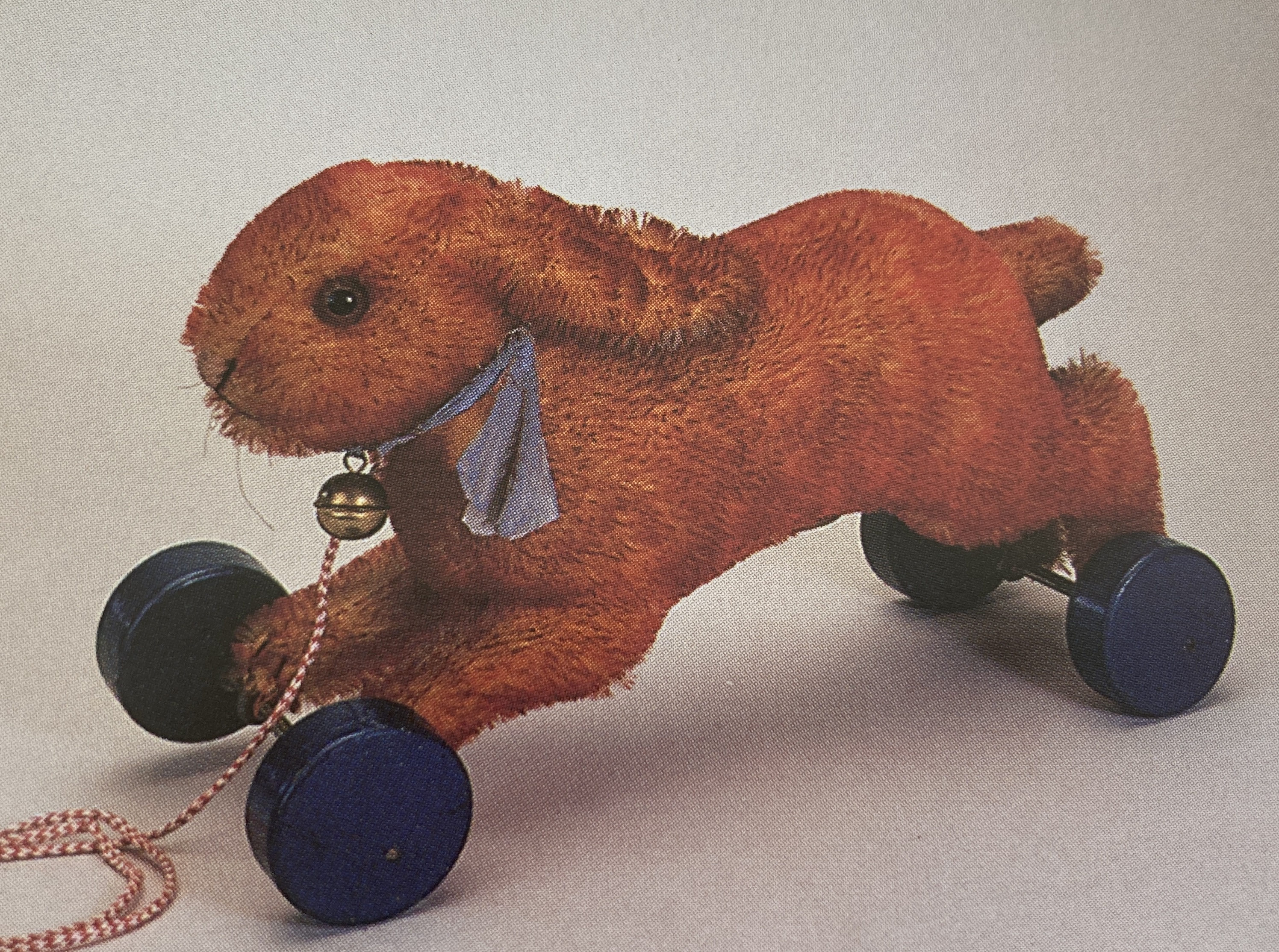
It is Steiffgal's best thinking that he is one of Steiff's standard line rabbits on wheels from the late 1920s. Here on the left, you can see the photo from Pfeiffer's 1892-1943 Sortiment illustrating what Steiffgal believes is this exact item. He is in a "hopping" position, meaning he is on all fours and about ready to take off! The name of this body position was later changed to "running", which also makes alot of sense.

Alena's treasure is one beautiful bunny. Here you can see him relaxing with some WAH-HOO good vintage friends in the photo on the left. Rabbit is unjointed, solidly stuffed with excelsior, and features large brown and black glass pupil eyes, a hand embroidered pink and black nose and mouth, and clear monofilament whiskers. He has once vivid orange mohair. He rides upon four asymmetrical wooden "eccentric" style wheels. As such, he appears to sway back and forth as he is pulled along. This item was produced in 12, 15, 18, and 23 cm (measured vertically, top of the head to toe, not including ears or wheels) from 1927-1930 overall in this stunning color. He was also produced in an almost identical pattern in brown tipped mohair in 14, 17, and 22 cm in 1928.


Brightly colored animals, including rabbits, dogs, cats, and bears - were a delightful feature of Steiff's late 1920s to very early 1930s product line.
These sweet pets appeared in orange, pink, blue, green, gold, or other "jellybean” colored mohair or velvet fabrics, and usually had playful, youthful personalities to match! Tipped mohair - meaning mohair with just the ends or tips dyed a complementary or eye-catching color - also had its heyday in the product line around the same time. You can see a number of these colorful rabbits in the photo on the left, the image is from the company's 1929 product catalog. 

Steiff also produced a few other fun novelties featuring "larger than life" colors like Alena's wheeled rabbit.
One of particular interest is a delightful orange and white begging style rabbit on eccentric wheels. In July, 2023, the auction house Ladenburger Spielzeugauktion GmbH of Ladenburg, Germany sold this 20 cm tall rarity from 1926-1932 for nearly $4,000. He is pictured here on the left, the image is from Ladenburger Spielzeugauktion.

Steiffgal hopes you enjoyed learning about this darling, 24 carrot gold prewar novelty!

Have a question about one of your Steiff treasures? Let's talk! Click here to learn more.

Monday, January 22, 2024

Jumping For Joy Over This Funky 1980s Era Steiff Toy Rabbit

You may be really surprised at Steiffgal's latest addition to her hug. This softie recently arrived as part of a large auction lot purchase from overseas. Although he doesn't exactly fit in with the age, materials, and era of most of her vintage to antique button-in-ear collection, there's just something really sweet and appealing about him. As such, he's earned a place on Team Steiffgal, and in her heart as well. Come learn more about this happy hopper produced at a key time in Steiff's business history. 


Baby Rabbit is standing, unjointed, and measures 28 cm tall, including his ears. He is made primarily from a vibrant baby blue colored soft plush. His paw pads, chest, muzzle, and the lining of his ears are made from soft white plush. His face comes to life with black button eyes, a black hand embroidered nose, and a spot of pink to highlight his mouth. His squeaker works loud and clear. He left the factory wearing a pink neck bow. Baby Rabbit was made in this size in this color combination, as well as a pink and white version, from 1983 through 1986. The pink version is pictured below on left; the image is from Pfeiffer's Steiff Sortiment 1947-2003. 


This super sweet bunny was clearly produced as a toy for children. In terms of "kidproofing," his practically embedded black plastic eyes, lack of a chest tag and button branding (his tag is stitched into the seam of his ear), and washable, synthetic materials set him up for years of cuddles, play, and roughhousing. And his name, and youthful color, (and that of his twin pink sister,) also hint that this pattern may have been intended as a nice baby or baby shower gift.


What's most interesting about Baby Rabbit is the timing and era in which he was produced. The 1980s through the early 1990s were a period of great transition at Steiff. The company was at an important juncture in terms of business, pricing, and design priorities, and the toy industry as a whole was moving quickly in new directions. 


Two key market realities of this era were the continued influx of inexpensive toy imports from Asia and the emerging interest (and rise in value) of vintage to antique Steiff bears, animals, and dolls. As a result of all of this, Steiff started, and/or tested, several new initiatives to adapt to these changes. These included offering replicas and special limited editions; creating an ongoing line of Christmas items and ornaments; increasing partnerships with key organizations (like Disney and F.A.O. Schwarz) and other toymakers (like Suzanne Gibson); and launching the Steiff Club in 1992. These strategies were rolled out in part to capture the higher end market and gain new collectors. Here on the left you can see Steiff's very first replica, "Papa" bear, from 1980. He was made in a worldwide edition size of 11,000 and was designed to celebrate the 100th anniversary of the Steiff Company.


Steiffgal thinks that Baby Rabbit, and other simple, lower end soft plush items of his era, were probably designed, produced, and distributed to compete with the Asian exports part of the business equation. 


Steiffgal hopes this discussion on the company's 1980s production has you feeling nostalgic, in the best possible way. 


Have a question about one of your Steiff treasures? Let's talk! Click here to learn more!

Monday, January 8, 2024

How Do You Make Vintage Steiff Buying Decisions?

Steiffgal had an interesting thought question posed to her the other day by one of her Steiff collecting-colleagues.
This person had been collecting for many years, and had accumulated a significant collection of favorites and rarities. Sensing that they were at a new point in their collecting path, they simply asked, "How do I know when I should buy something for my collection, and when I should pass on an opportunity?" 


Of course, there is no one right (or wrong) answer to this inquiry, and it totally varies from person to person.
Clearly, one's budget, buying patterns, available space, collection management strategies, preferences, and other factors play a huge role in "thumbs up" or "thumbs down" Steiff buying investments. However, after noodling the question for a while, Steiffgal came up with five general guideline recommendations for her colleague. She thought they might be helpful to some SteiffLife blog readers who may also be wondering about these sorts of things as well. 


1. If you have a mature collection, and/or have pivoted your interests to more expensive and rarer items, it is probably time to buy more with your head than with your heart. When many of us started collecting, we bought tons of Steiff items willy-nilly because they were available and we fell in love with them, or with the idea of growing our collection through them. That is buying with your heart. By buying with your head, Steiffgal means that collectors might want to think about each purchase a little more strategically, taking into full consideration the price of the item, the condition of the item, and how it fits into their collection. 


2. If you have been building your hug for a while, aim to have each new addition ELEVATE - not just expand - your collection. Consider purchasing non-redundant pieces that complement your existing inventory or take it in a new and exciting direction. For example, Steiffgal recently started collecting antique Steiff ephemera (catalogs, postcards, advertising materials, etc.) to display with her prewar items. This has opened many new doors as well as research opportunities. 


3. As your collection evolves over time, seriously consider only buying an item if you don't already have an example in your collection, or if it significantly upgrades one you already own. 


4. Following up on recommendation #3... if you are upgrading or replacing an item, rehome the replaced item ASAP. Don't hang onto it. This is one simple way to keep the potential for "collection clutter" in control, as well as paying (perhaps in part) for the replacement. "The more the merrier" doesn't hold true for most well curated collections. Depending on what you are selling, options for moving items along include eBay, Facebook marketplace, Craigslist, doll club sales and events, auctions, and other online channels. 

5. And, if you are still not sure if you should buy something after much consideration, ask yourself "What are the chances I will find another one in the foreseeable future?" All things being equal, if the answer is "slim to none," buy the item. If it is "likely to definitely” don’t buy the item. If it is somewhere in the middle, circle back to recommendations #1-4.


Steiffgal hopes this Steiff food for thought has added a little spice to your collecting outlook. 


Have a question about one of your Steiff treasures? Let's talk! Click here to learn more!

Thursday, July 13, 2023

Rounding Out A Ball Animal Collection With This Unusual Steiff Rabbit

Things are really "hoppening" around here with the addition of this delightful rabbit novelty to Steiffgal's collection. Although not terribly vintage, this was the very first of his type Steiffgal had ever seen in person. She saw him in a booth at the 2023 Steiff Sommer Festival, and knew right away he would be one of her souvenirs from a delightful trip. Take a look at this funny bunny and see if he calls to you as well, even if in just a round-about sort of way.

This cheerful-earful is Steiff's Ball Rabbit.
He is 16 cm tall (not including his ears), sitting, and head jointed. His ears add another 7 cm to his height. He is softly stuffed with foam. Rabbit is made from longer tan dralon. His ears, muzzle, and foot pads are made from shorter dralon, and his fuzzy chest is made from longer mohair. His face is detailed with round black and white plastic cartoon style eyes, a black hand embroidered nose, monofilament whiskers, and a funny little dimensional mouth made from fabric. He has stenciled footprints on his foot pads and light airbrush highlighting here and there to give him a little more dimension. He retains his original blue silken ribbon. He has a non-working squeaker in his belly. This guy appeared in the line from 1960-1961 in this size only.

Steiff made three ball style animals in the 1960-1961 time frame, and this rabbit is one of them.
All were 16 cm, made from dralon, stuffed with foam, and featured a fuzzy mohair chest. The others were Ball Mopsy, a pug, and Ball Sulla, a cat. Overall, these ball animals are really hard to find, especially in good condition — because they were designed to be used as playthings and stuffed with foam, which deteriorates over time, and were made for only a handful of years. Steiffgal is happy to finally have all three versions in her collection. 

Finally, let's take a look at Rabbit's chest tag.
It looks original to the item, with wear and loss commensurate to the toy, and the thread appears consistent to Steiff. It notes that his name is Hoppy, which would make sense given he is a rabbit. However, there is no indication in any reference materials that this model was given a name beyond simply "Ball Rabbit." However, the pug and the cat of the same design and era were given playful names, so it is possible that he was named Hoppy for consistency, but this never made it into the records. This sometimes happens when something appears in the line for a very short time. Hoppy was also the name of a running style mohair Steiff rabbit made in 8, 14 and 17 cm from 1950 through 1976. So there is a little overlap there with the name as well. But only Ball Rabbit knows for sure....

Steiffgal hopes this discussion on this unusual rounded Steiff rabbit has been a ball for you!

Have a question about one of your Steiff treasures? Let's talk! Click here to learn more.

Sunday, May 7, 2023

All Ears Over This Well Dressed Prewar Steiff Rabbit Doll

It's the best of all worlds when it comes to Steiff's dressed animal dolls. What could be finer than a darling Steiff dog, cat, rabbit, or other fine beast donned in Steiff couture from head to toe? Steiff's rabbits are very well represented in the company's history of dressed animals. The company's debut dressed rabbit was none other than Beatrix Potter's own beloved Peter Rabbit in 1904! Check out this prewar-era happy hopper - perhaps a distant cousin of Peter? - who sets Steiffgal's heart aflutter every time she looks at him.


Overall, this smallest version of Steiff's begging rabbit boy is simply adorable. He is 17 cm tall (sans ears) and head jointed. He originally was covered in white and tan mohair, but now he's simply a bare hare. He has mile long, narrow feet with red embroidered claws, downturned arms, a tiny upcurved tail, and oversized, floppy ears not lined in wires. He comes to life with oversized brown and black glass pupil eyes placed low on his face and Steiff's signature 1920s-era rabbit facial embroidery. This includes a "v" shaped nose and an upside down "v" shaped mouth in one color, and horizontal stitches filling in the "v" shaped nose in another color. You can see a close up of this stitching in the photo at the bottom of this post. Dressed rabbit retains his long trailing "f" button and traces of his red ear tag as his Steiff IDs.

You can't help but notice this bun's all original and darling playsuit. His well-constructed pants have tiny faux front pockets, contrasting tan colored stitching, back black snaps, and a perfectly placed opening for his tail.  This model in this outfit appeared in the catalog from 1929-1932 in 17, 22, 28, and 35 cm. 

Given their short time in the line, and probably low production numbers, these dressed, prewar, begging Steiff rabbit dolls are amazingly rare.
 This is only one of a handful in blue overalls Steiffgal has ever seen or handled. Steiffgal purchased this guy at a UFDC national event salesroom a few years ago. More recently, in January, 2023, a medium sized one hammered at auction for 750 euro/841 USD. This model was also produced in five other outfits; these included a red skirt and white apron, a purple jacket, a red skirt and purple jacket, a red and white dress, or a pink dress. In 2010, Christie's sold one of these rarities dressed in the red skirt and white apron for 1,625 GBP.

Steiffgal hopes you enjoyed this clothes encounter with this well dressed prewar rabbit!

Have a question about one of your Steiff treasures? Let's talk! Click here to learn more!

Saturday, December 31, 2022

These Ladenburger Spielzeugauktion Auction Highlights Are Dressed To The Nines!

Three's a charm when it comes to the third post in this blog series of auction highlight from Ladenburger Spielzeugauktion's January 21st, 2023 Collection of Susan Kilgore Wiley sale. It's no secret that Steiffgal goes all hubba-hubba over Steiff's utterly charming dressed dolls and animals. And, this sale offers some of the most appealing ones in memory. Check out this trio of well attired prewar offerings from this auction. Steiffgal is certain you will consider all of them a clothes call indeed.

This first dressed highlight doesn't have a hare out of place.
It is lot #6152, an all original and early Steiff Peter Rabbit. It is estimated at €650-€1,300, and is cataloged in part as:

"One of the highlights of the auction, exceptional hare, Peter, around 1910, with small button, block letters, long trailing f, shoe button eyes, underlaid with red felt, fine brown/beige velvet, attending, with original felt jacket, decorative seams and golden buttons, red slippers, 1 leather sole with original stamp, 1 felt slipper is a bit holey, and small holes on the blue felt jacket, standing height 26 cm, extremely rare, exceptional."

Steiff's turn of last century Peter Rabbit dolls top many collector's bucket lists. This well coutured example is in lovely condition and is a marvelous size. It is interesting to note that the exact details that make up a Steiff "Peter Rabbit" are not specifically identified in Pfeiffer's Sortiment books. It is generally understood amongst collectors that a "Steiff Peter Rabbit" is standing, unjointed, and wears a felt topcoat with buttons and embroidery and felt slippers with leather soles. The Sortiment book pictures two versions of standing rabbits wearing felt topcoats and slippers, but does not identify them as "Peter Rabbit." The first is a spotted velvet version wearing a red or navy topcoat and red slippers; he was produced in 10, 22, and 28 cm from 1904-1919. The second is a white wool plush version wearing a green felt topcoat and red slippers; he was produced in 22 cm from 1904-1918.

This next auction highlight is a pair with flair!
Here we have lot #6181, two early 20th century, fully jointed, center seamed Steiff felt dolls. They are estimated at €330-€660 and are cataloged in part as:

"Felt dolls, Anton & Lisl, Upper Bavarian, produced between 1909 and 1926, 28 cm, with traditional costume, felt-head, mohair-hair, felt body, jointed, arms and legs, original, clothes, very nice condition."

This darling duo are textbook examples of   Steiff's "children" style dolls. 
These guys appeared in the line from 1909 through the late 1920's. Unlike earlier Steiff dolls that were more caricatured, harsh, and designed for adult collectors, these dolls were realistically proportioned, had gentle personalities, and angelic, rosy faces. They truly were designed for child's fun and play. These models were all fully jointed and had felt heads and bodies - except right around WWI when felt was scarce and the bodies were sometimes made from rough cotton or linen type materials. Steiff's children dolls were all dressed head to toe in handmade clothing that included school uniforms, ethnic costumes, sporting attire, and “Sunday best." Steiffgal is certain that the boy is Anton, based on his outfit and presentation. However, she is not 110% certain the identity of the girl is Lisl as her outfit does not match the one pictured in Pfeiffer's Sortiment. Steiffgal also suspects that her clothing, however charming, is not entirely original to her. Nonetheless, the pair is simply wonderful.

And it's tag, you're it! when it comes to our final well dressed auction highlight.
This is lot #6114, a late prewar standing and dressed rabbit doll, estimated at €180-€360. She is cataloged in part as:

"Pupp-hare, Mike, with button, block letters, long trailing f, very nice good preserved, yellow cloth tag label, No. 22, wool plush at hands and feet, original traditional costume, 27 cm, very nice condition."

And just want makes this lovely lady a 10?
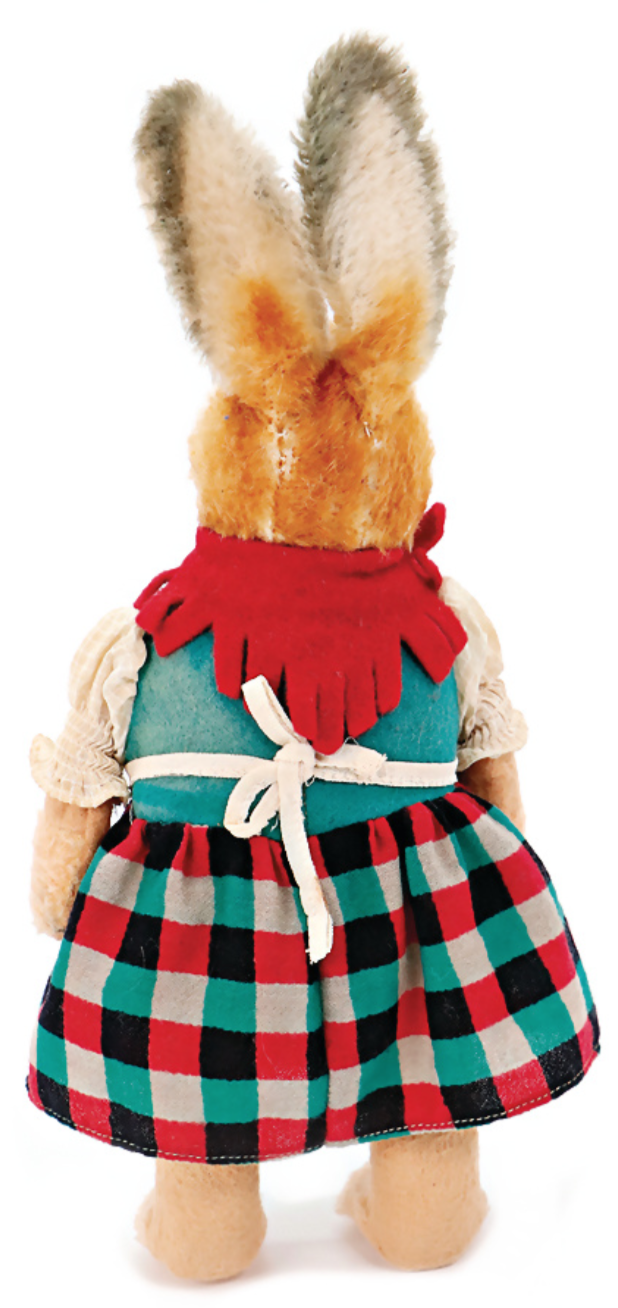
She's got a fantastic presentation, and is in delightful, all original condition. And if you look closely at her tag, it is says "22,11." Numbers don't lie here! Her digits mean 22 cm tall (measured without ears), while the number 11 corresponds to her costume as described by the company. Outfit #11 translates to "traditional costume with green checkered skirt, green corsage, and white shirt." Spot on! These utterly charming, dressed rabbit dolls appeared in the line in 14, 22, and 28 cm in maize or white plush from 1932-1943 overall. Eleven total outfits for these rabbits were produced; they ranged from pajamas to playsuits to trousers and dresses through regional outfits like the one featured on this premier example. 

Steiffgal hopes this discussion on these well dressed auction highlights has contributed to the fabric of your collecting life. 


For more information about Ladenburger Spielzeugauktion GmbH's upcoming Special Steiff Auction event on January 21st, please click here!

Have a question about one of your Steiff treasures? Let's talk! Click here to learn more!

Monday, December 19, 2022

Tag - You're It - With These Amazing Steiff Rarities From Ladenburger Spielzeugauktion's January, 2023 Sale

Here's something incredibly fantastic to look forward to! Mark your calendars for Ladenburger Spielzeugauktion GmbH's Steiff Special Auction on January 21st, 2023. The catalog has just been published online in German and English. It features nearly 200 breathtaking Steiff, Schuco, and Bing rarities from the collection of the late Susan Kilgore Wiley. Mrs. Wiley had an amazing eye for gorgeous prewar toys. Half of her antique plush collection will be sold as part of this January, 2023 event, and the second half will be offered through Ladenburger Spielzeugauktion at their July 1, 2023 Steiff Special Auction in Giengen, Germany. 

This January sale offers so many WAH-HOO GOOD options, it's almost impossible to pick highlights.
That being the case, let's look at the "cream of the crop" per category over the next few weeks. We'll kick off this auction review here today with a peek at extremely rare items with great ID. 

Size defies with this first January auction highlight. It is lot #6074, a supersized, midcentury Lulac rabbit. His starting bid is 180 €. He is cataloged in part as: 

"Lulac, exceptional size, 80 cm, with button, breast sign and yellow cloth tag label, number is partially illegible, breast sign with stronger kinks, cross-eyed with big glass eyes, jointed arms and legs, small faults in the mouth felt insert, exceptional."

It's not going out on a limb to say how exceptional this rabbit truly is.
 His pattern is in Steiff's beloved "lulac" scale. These legacy items have mile-long limbs and torsos. Lulac animals made their debut in 1952. The first to appear was a 43 cm rabbit. Like the example under discussion here, he was made from caramel mohair and his hands and feet were detailed with especially shaggy mohair. This original lulac rabbit pattern was also produced in 60 cm; the 43 cm version was in the line from 1952-1974, while the larger size made a more limited appearance from 1964-1966. Mrs. Wiley's supersized example has awesome adjustable black and blue glass google eyes retains his button, ear tag, and named chest tag as his Steiff IDs. He is the first of his type Steiffgal has ever seen.

As far as Steiffgal can tell, there is no mention in any of the standard reference books of an 80 cm version of this lulac rabbit. It is possible that he was made in very small quantities as a window display animal. Other early 1950s lulac items included a 35 cm donkey, a 40 cm elephant, a 90 cm tiger, an 80 cm poodle, and an 80 cm lion. All of these models were mohair, fully jointed, and were produced exclusively for the United States market and only for a year or so. Given the proportions of some of those early post war lulac exclusives, it is also possible that this extra large lulac rabbit was made as part of that series, but never went into full production for some reason.

This second auction highlight also doesn't have a hare out of place.
Here we have lot #6004, a prewar bunny named Ossi. His starting bid is 60 €. He is cataloged in part as:
 

"Ossi, wool plush, sitting, with button, block letters, long trailing f, swivel head, white/brown spotted, 16 cm seat height, big glass eyes, with breast sign, red inscription, small mohair loss below the right eye."

It's time to play the name game with this hoppy handful. Ossi was produced in five sizes ranging from 4 to 15 cm from 1938-1943 overall. His design elements, including his wartime era fabric, proportional eyes, and his simple hand embroidered nose and mouth, are typical to the late 1930s production era at Steiff. But what's most interesting about Ossi is that he was the first "named" rabbit produced by Steiff. All others before him were simply called "hase" or "rabbit." What are the odds that this example of Steiff's first named rabbit would retain his his "Ossi" chest tag? Steiffgal had never seen an Ossi before this one  - with or without IDs!

Steiff started to give adorable or endearing names to its standard line items starting in the 1920s.
It was at that time that Molly the Puppy, Fluffy the Cat, Charly the King Charles Spaniel, Jocko the Chimp, and many other legacy named patterns were introduced. But it was not until 1938 - about a decade and a half later - that Steiff gave a playful name to a rabbit in its line. It is possible that "Ossi" is a play on the German word "Ostern" which translates to "Easter." It's also just a very sweet name for a bunny in any language.

And three's a charm when it comes to our third auction highlight in this can't bear to miss sale.
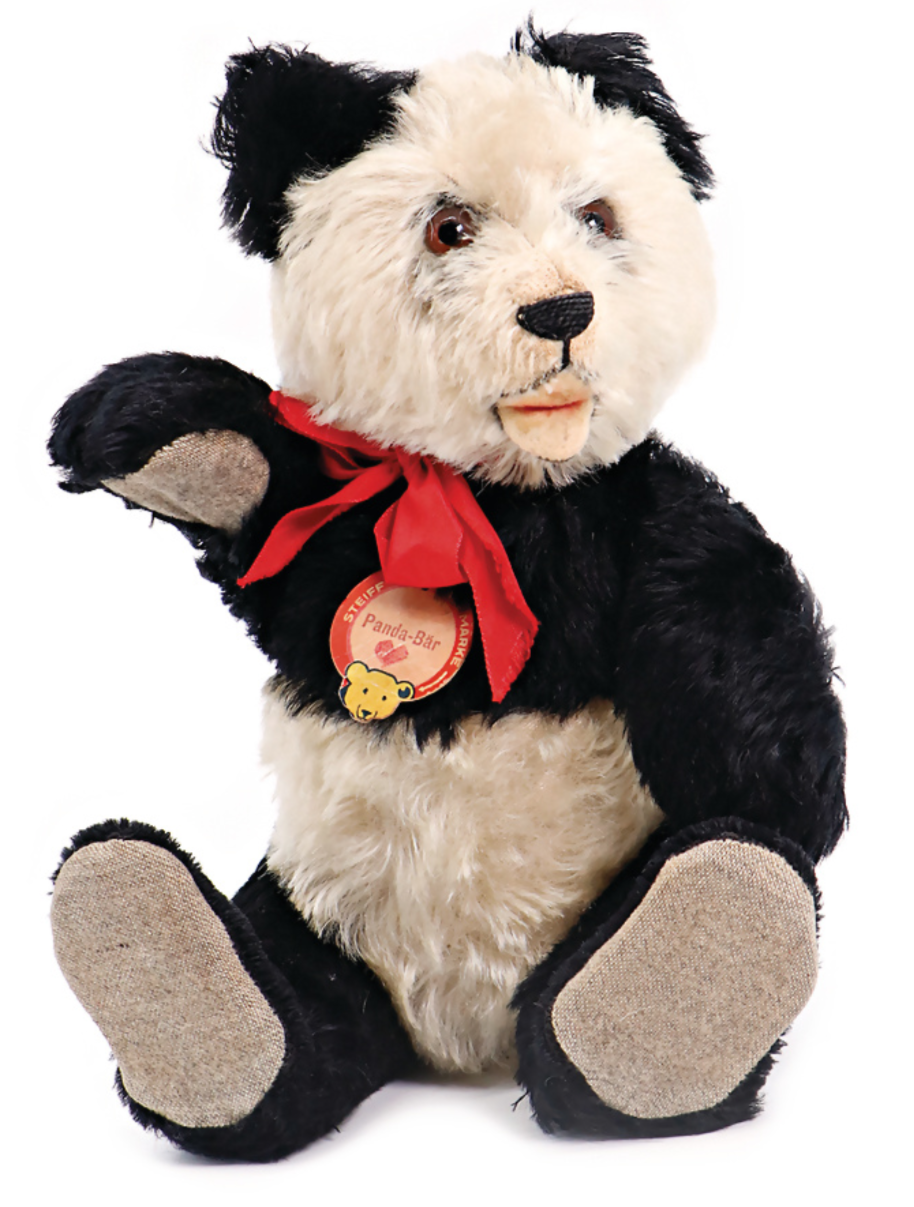
Here we have lot #6045, a precious prewar panda bear. He has an opening bid of 280 €. He is cataloged in part as:

"Panda, with button, long trailing f, writing "Panda-Bär", red with afterwards up-painted heart, mohair-plush, 2-colored, tricot paws, 26 cm, minimally mohair loss around the snout, otherwise very good condition, rare."

Pandas are a great example of Steiff using news headlines and cultural trends for product development ideas. These black and white beauties began appearing "in the flesh" in several major zoos across the globe in the late 1930s. They immediately rocketed to international superstar status. Piggybacking on the success of their real-life cousins, pandas made their debut in the Steiff line in 1938; by 1939, they were being produced in 15 and 30 cm on a commercial scale through 1942 overall. This fantastic example, with his long trailing "f" button and breathtaking named, red imprinted chest tag, is most likely from the earliest part of that time time. 

Steiff's debut pandas were five ways jointed and made from black and white mohair.
Their faces were detailed with brown and black pupil eyes, a black hand embroidered nose, and an small scaled, open, peach colored felt lined mouth. The black circles around their eyes and the black stripe across their backs were created by hand airbrushing. Because of wartime material shortages, some models - like the one under discussion here today - were produced with linen or other alternative fabrics in the place of felt on their hand and foot paw pads.

Steiffgal hopes this discussion on these rare, named Steiff auction lots has bid up your interest in this upcoming sales event!

Sunday, December 11, 2022

You'll Be All Ears Over This Happy Hoppy Hybrid Hare!

Talk about a rare hare... combined with LOVE AT FIRST SIGHT! That's was exactly Steiffgal's reaction when it came to an absolute rarity she spotted on eBay recently. Take a look at this remarkable little Steiff prewar rabbit... and just try not to fall in love with it as well!

This tiny guy is a super cool bunny made as a woolen miniature, but with mohair detailing. He is pictured here on the left and the photo is from ebay. According to the eBay listing, he is a..."Rare Steiff Wool Rabbit is approximately 5 inches high. Has mohair ears with underscored FF button. Glass eyes. 1935-1939." Additionally, he is lined in wires and is poseable, probably head jointed, and detailed with glass pupil eyes and a small painted mouth. Steiffgal suspects he left the factory in Giengen with clear monofilament whiskers. This happy handful was made in 7 and 10 cm (measured without ears) in light brown and white or all white from 1935-1939 overall.

Steiff's woolen miniatures debuted in the very early 1930s. They were introduced as a low cost, entry level priced line for the company at a challenging economic period. The first woolies were birds and bunnies; their natural forms and shapes were easily interpreted in Nomotta wool pom-poms of different sizes and color combinations. As time went on, Steiff produced more and more elaborate woolen miniatures with greater detailing. These included other materials - like lace and ribbons - and accessories - like perches, voice boxes, and aviaries - in their designs in addition to Nomotta pom-poms.

In the mid 1930s, Steiff made a number of woolen miniatures that included relatively expensive woolen mohair fabric.
This material was used to create the ears of several different dogs (including a St. Bernhard, Chin-Chin, and King Charles Spaniel), a few rabbits (including one on skis), and even a really unusual Teddy bear made from long white yarns. Given their elaborate construction, like the rabbit under discussion here today, Steiffgal suspects that the introduction of these "hybrid" mohair/woolen miniatures was Steiff's way of "upscaling" the woolen miniature line a bit. The mohair ears were "stitched into" the core of woolen threads to keep them in place... or at least that is how the mohair ears on the woolen miniature Teddy bear are engineered. You can see this terrific Ted pictured here on the left; he was made in 22 cm from 1936-1938.

Today, it is extremely rare to find Steiff's highly sought after woolen miniatures with mohair features on the secondary market.
That is one reason Steiffgal was tickled pink to see this one on eBay. Given their appeal and petite scale, it is very possible that many were "loved to death" and simply lost to time over the years. Steiffgal also suspects that in reality, very few were actually made. The mid- to late 1930s were really tough years in Germany and it is quite probable that supply chain and labor issues really limited the number actually manufactured and sold during that time. And, of course, any enthusiast lucky enough to have one of these absolute rarities in their collection already is probably not in any rush to move it along! It's just supply vs. demand at its finest. 

Steiffgal hopes this discussion on woolen miniatures with mohair features has been a cheerful earful for you. 

Have a question about one of your Steiff treasures? Let's talk! Click here to learn more.

Wednesday, November 9, 2022

This Cool Cat Novelty Is Really Hot Stuff!

Brrr... the temperature has shifted from 80 degrees to 40 degrees overnight so it’s definitely time to share something Steiff-y to warm the heart and soul! Check out this amazing cat doll that does double duty... making her totally hot stuff indeed. Have you ever seen this hybrid treasure before?

This Steiff functional novelty is called "Cook Cat Coffee Cozy."
She is 43 cm tall and is arm and head jointed. Her body and arms are made from red felt to resemble a shirt, her skirt is made from green felt, and her head and hands are made from white mohair. She wears her original white cotton apron. She come to life with pert triangular felt ears, early style green and black slit pupil glass eyes, and a hand embroidered pink nose and mouth. Her hollow body is lined in double thick felt to keep a pot of coffee, tea, or cocoa warm. She was made in this size only from 1906-1910.

Cook Cat Coffee Cozy was also produced with a bear's head or a rabbit's head. These heads were identical to the current rabbit and bear designs of the early 20th century. These cousins also measured 43 cm tall. The bear appeared in the line from 1906-1908 and the rabbit appeared in the line from 1906-1909. Like the cat version, these featured a mohair head and hands and were dressed in a red felt shirt, a green felt skirt, and a white apron. This happy group is a good example of Steiff's long tradition of "form and variation" - modifying a popular design slightly to produce a number of "new" products for their catalogs. You can see a picture of the "Cook Rabbit Coffee Cosy" here on the left; the photo is from Pfeiffer's 1892-1943 Sortiment book.

Cook Cat Coffee Cozy - and her bear and rabbit friends - are based on Steiff's earliest character coffee warmer which debuted in 1904.
This was a cozy in the form of Mama Katzenjammer from the popular comic strip the Katzenjammer Kids. She was called "Cook Coffee Cozy." Cook Coffee Cozy also wore a red and green felt dress and white apron, but had a felt head and fingered hands that resembled her character. Cook Coffee Cozy was made in four sizes ranging from 43-100 cm from 1904 through 1943 overall. Her longevity in the line indicates how popular she was over nearly four decades. 
You can see a picture of the "Cook Coffee Cosy" here on the left; the photo is from Pfeiffer's 1892-1943 Sortiment book. 

This fantastic feline fits right into Steiff's early 20th century product development timeline and history.
The Giengen company is well known for producing functional novelties for home, school, and work use in addition to the company's plush animal, doll, and bear production. This tradition goes back to the late 1800s, when Margarete Steiff produced and marketed a series of oversized, embroidered felt "pockets" designed as newspaper holders, bed wall bags, duster holder bags, and brush holders, among others. Other early and mostly prewar novelties include egg cosies, pen wipes, and pincushions. These rarities are treasured among collectors today.

Steiffgal hopes you found this discussion on Cook Cat Coffee Cozy the pause that refreshes.


Have a question about one of your Steiff treasures? Let's talk! Click here to learn more.
The teddy bear search engine