Showing posts with label puppet. Show all posts

Friday, April 3, 2026

Going Loopy Over The History Of Steiff's Wolf Production

Some of Steiff's creations leave collector's howling in delight. It is safe to say wolves are one of those very special designs! These majestic creatures did not appear in the Steiff line until 1956 - more than six decades onward from the company's late 1890s debut catalog. Let's join the pack and check out some of these field and forest highlights that have graced the Steiff catalog over the years.

Steiff's debut wolf was a 17 cm tall puppet named Loopy.
His body was made from tan mohair with grey highlights on his back and arms. His face was made from longer tan mohair; it was airbrushed with a few shades of grey, tan, and brown to give it depth and texture. He came to life with black and green slit eyes, a black stitched nose, and an open, felt mouth - complete with four pointy teeth and a red felt tongue. His paws had black hand embroidered claws. This design was produced from 1956 through 1978. You can see this puppet pictured here on the left. 

Steiff's next wolf was based on the company's Loopy puppet, and was a full bodied creature.
This is unusual as Steiff traditionally debuted a full bodied item, and then created a puppet novelty from that item's pattern - not the other way around. Full bodied Loopy was made in 25 and 35 cm. He was unjointed and made from long and short grey mohair, which was detailed with airbrushed highlights. He had black embroidered claws and came to life with an inset facial mask, brown and black pupil eyes, black embroidered facial features, and a touch of airbrushing. The smaller version had a closed mouth; the larger version had an open mouth with a felt tongue. Loopy was produced in 1964 only and today is one of the rarest and most sought after Steiff postwar editions. You can see the 25 cm version of full bodied Loopy here on the left. 

It is not clear why standing Loopy appeared in the catalog for only a year.
He is pictured in the Steiff Button In Ear Brand New Models 1964 catalog on page three of this publication and you can see that entry here on the left. Snurry, the sleeping cat, and a white dralon Cosy Teddy graced the cover of this brochure. Steiff usually put its most important debut items on the cover of these publicity pieces. This suggests that the company never had high hopes for this design.

Other somewhat more recent mohair wolves in the line include the distinctly youthful Loopy wolf, who was 12 cm, sitting, and head jointed.
This happy handful appeared in the line from 1991-1993 and is also relatively rare. You can see him here on the left. And in 2003, Steiff introduced a wolf as part of the company's Last Frontier Animals series for North America. This example was 26 cm tall, standing, and made in an edition size of 1,500 pieces.

It is interesting to note that Steiff's wolf production has traditionally featured wolves as companions to other dolls or animals.
Here are a few examples of that. In 1983, Steiff made a mohair Big Bad Wolf face mask in an edition size of 3,000 to accompany Reeves International's Suzanne Gibson Little Red Riding Hood set. In 1988, the company produced an adorable Teddy baby and wolf set made in an edition size of 1,000 for the toy store Speilwaren Wolff of Giengen, Germany as part of Steiff's 85th anniversary celebration. This mohair wolf was 15 cm tall, standing, and unjointed. And in 1995, Steiff introduced its Polar bear and wolf set - also for Speilwaren Wolff - in an edition size of 2,000 pieces. This wolf was sitting, unjointed, and was detailed with a red collar. You can see this handsome pair here on the left. 

And finally, what is the tie between the word "Loopy" and Steiff's midcentury wolf production? "Lupin" sounds a lot like the name Loopy - and for good reason! Lupin (or lupine) directly translates to wolf or wolf-like, and originates from the Latin word lupus (wolf) and lupinus (of or belonging to a wolf). So that all makes perfect sense from a naming perspective.

Steiffgal hopes this discussion on Steiff's wolf production has you running with the wolves - in the best possible way!

Have a question about one of your Steiff treasures? Let's talk! Click here to learn more.

Sunday, December 1, 2024

This Prewar Steiff Riding Bulldog Is The Wheel-Deal Indeed!

Look at what just rolled under the Christmas tree of this lucky collector! What a bow-wow beauty for sure! But just who is this captive canine, and what is the story behind him? A new friend shares,

"Hi, my name is Jeanette and have been dabbling with collecting bears, etc. for near on 45 years. My latest find is a Steiff pull along Bully Bulldog. He stands 15" tall not including the wooden wheeled frame. From nose to tail, he is 17" long, his ears have long gone. He has a leather collar with remnants of horse hair still attached to it, it also has Steiff buttons all around it, in total 12 buttons are present. He also has his original bell attached to the collar. He has a pull string still attached, but unfortunately no noise is made when it is pulled. He has large amber and black glass eyes, a black stitched nose, and velvet muzzle. The wooden wheels measure 2.5" in diameter. The pull along frame has a moving front axle, so it can change direction. Any help you can give me, i.e. date, etc. would be greatly appreciated. Thanks in advance!"

This dog on the go would take the pole position in any vintage Steiff enthusiast's collection. What Jeanette has here is Steiff's Bully Bulldog riding animal. This fine fellow was made in 28, 35, 43, and 50 cm in black and white, orange and white, or tan and white from 1927-1936 overall. This model is measured vertically from the top of their heads to their toes, not including their wheels. As such, Jeanette's treasure is the either a large version of the 35 cm or a small version of the 43 cm version; it is Steiffgal's best guess he started out life closer to 43 cm and sort of shrunk over time (like the best of us.)

The condition of Jeanette's Bully is commensurate and typical to that of a beloved ride-on animal.
These realities include things like alot of wear on the back/top areas where a child would sit, a silent squeaker from overuse, and the loss of ears which were probably used as handles for much of its working life! Fortunately, it is not terribly difficult to replace the black velvet ears on this pattern, and Steiffgal would consider doing that restoration if this Bully was in her collection.

One thing that really pops on this example is his great BLING! According to Pfeiffer's 1892-1943 Sortiment, this item is described in part as, "mohair plush, horse hair or leather collar, standing, riding animal, wheels, connecting frame, swivel head, squeaker (barks.)" Jeanette's Bully has a fantastic collar featuring a combination of horse hair detailing as well as a cascade of long trailing f buttons - truly the best of all worlds.

The Bully Bulldog that we all know and love was introduced in 1927.
This design was an instant sensation with both children (as a plaything) and adults (as a collectible and an accessory). He was modeled on the French Bulldog—the “it” companion of those in the know at the time. Bully's pattern featured oversized glass pupil eyes, a black embroidered nose, and a snout and jaw constructed to give him his requisite breed jowls. Full bodied Bully was made in velvet and mohair, as well as sitting and standing, in sizes ranging from 10 to 50 cm through 1939 overall. Here on the left, you can see Bully as he appeared in the company's June, 1927 catalog. This image is from Carsten Esser's Steiff Catalogue 1920-1929.

Given his popularity, beautiful Bully was also produced in numerous novelty forms. These included as a pincushion, pull toy, dangling Charleston doll, jointed dog doll, puppet, purse, and pajama bag, among others. Today, prewar Bullies are one of the most universally desirable and sought-after pre-war Steiff designs among collectors - especially those like this one on wheels! Prewar Bully has been replicated numerous times over the past few decades and even these newer models are coveted by collectors.

Steiffgal hopes you've enjoyed this discussion on this Riding Bully, even if just in a roundabout sort of way.

Have a question about one of your Steiff treasures? Let's talk! Click here to learn more.

Sunday, September 1, 2024

Hands In The Air Over This Antique Steiff Felix The Cat Handpuppet

Here's another great addition to Steiff's meow-mix of fantastic prewar puppets!
Check out this black and white beauty. Do you recognize his distinctive face and impish personality? This guy - who is now over a century old - entertained millions of people through the 20th century.

This Fe-line is none other than Felix the Cat in the form of a hand puppet. He is 20 cm tall and mostly made from black mohair. His face is made from white felt with a stitched mouth, big black button eyes, a dimensional black felt nose, and felt ears. He has a little red and black airbrushing on his mouth. His head is firmly stuffed with excelsior and his finger tube is made from cardboard. This puppet design was made from 1925-1926 in this size only.

So what is the history of this happy handful?
In 1919, Pat Sullivan and Otto Messmer introduced their Felix the Cat movie series. By 1926, sensing that Felix would be a great fit for Steiff, Steiff's distribution partner in the USA - George Borgfeldt - asked Steiff to create a series of licensed Felix the Cat toys. Steiff was hesitant and didn't think the line would be a success. Nonetheless, Steiff did end up producing a full bodied 22 cm Felix from 1926-27, a 20 cm Felix hand puppet from 1925-26, and a 20 cm Record Felix from 1926-27. The doll didn't sell well, but the puppet and wheeled versions struck a chord with buyers at the time.

Today, Steiff's Felix the Cat novelties are few and far on the secondary market.
Given their rarity, they often top the wish lists of Steiff collectors worldwide! The most recent Felix hand puppet sold at auction Steiffgal could find hammered for 1700 euro at Ladenburger Spielzeugauktion's Special Steiff Auction in 2018. In 2019, Morphy Auctions sold a full bodied Felix doll; he hammered for $4,000. And in 2010, Christie's sold a Record Felix in delightful condition for GBP 2,375. The photos of the full bodied and record Felix novelties are pictured here on the left; the images are from Morphy's and Christie's respectively.

Steiffgal hopes this discussion on Steiff's rare Felix the Cat hand puppet merits a thumbs up from you!

Have a question about one of your Steiff treasures? Let's talk! Click here to learn more!

Wednesday, April 17, 2024

Swept Away Over This Latest Midcentury Steiff Discovery!

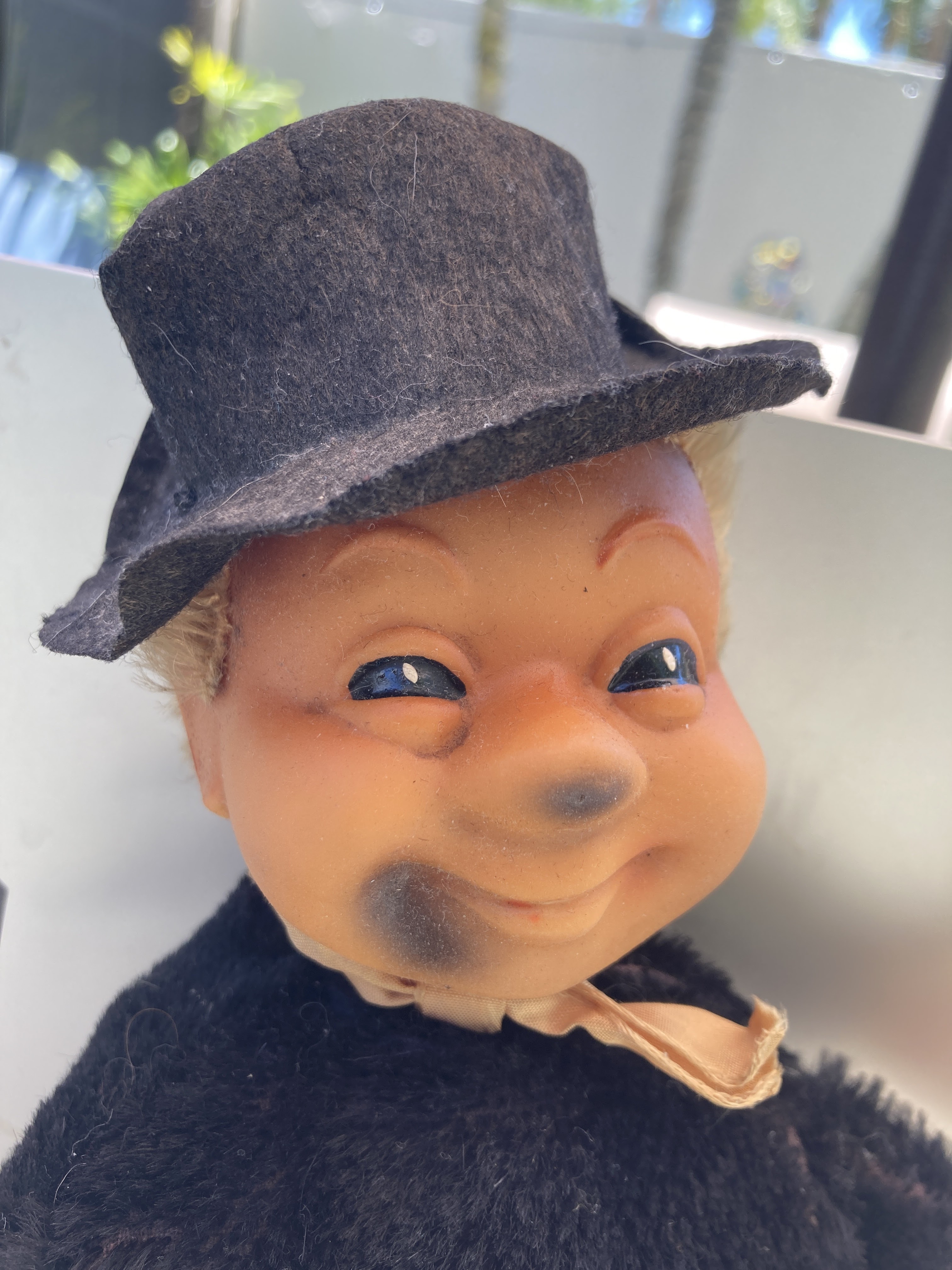
Isn’t this guy simply "one-derful?" Look who just joined Steiffgal's hug. She had been looking for a fine example for decades, and apparently good things come to those who wait. Make it your lucky day and say hello to this super Steiff Sweep!

This adorable chimney sweep puppet named Blacky is 17 cm tall. His head is made from a soft rubbery material. He has a plastic finger tube inside his head. His hair is once copper colored mohair, and his body is jet back mohair. His oversized hands are made from felt and are lightly stuffed with excelsior. He wears a traditional black felt top hat and carries a black plastic ladder. His face comes to life with black and white painted eyes and some not-so-random coal smudges. His "outfit" is accessorized with a partial black leather belt and a neck tie. This puppet rarity was made in this size only in 1964.

The chimney sweep profession goes back as far as the 16th century in Europe. According to legend, chimney sweeps have been associated with ushering in health and happiness. As such, many brides in the past would have their chimney swept on their wedding day. Steiff probably added a chimney sweep to its line because of his centuries-long reputation as a good luck charm. 


Blacky debuted in the company's "New Models 1964" catalog.
This four page, full color brochure featured a number of now rare Steiff novelties, including a few that also were made for one year only. Steiffgal refers to these sorts of treasures as Steiff's "One-derfuls." Blacky is pictured on the back page of the catalog, and you can see that part of that page here above. You can also click on the image to make it bigger. 

His neighbor in this catalog is none other than Steiff's equally as rare and interesting Sneba snowman puppet. Sneba is 17 cm, unjointed, and made from white dralon. His face comes to life with button black eyes, an orange felt carrot nose, a red stitched mouth, and a touch of pink blush on his cheeks. He has two black "coal" woolen pompoms on his chest. Like his buddy Blacky, he wears a black felt hat and was made in one size only in 1964. 

You might just recognize Blacky's mug - as the same mold was used for a number of other rubber headed puppets in the 1960s through 1980s.
These include Happy the clown, Hansel and Gretel puppets, a princess, a modernized Shockheaded Peter, and even a grandmother, among others. It is interesting to see how this mold was used to represent male and female characters of all ages. And there is precedence for "recycling" facial molds on Steiff's dolls and puppets. If you look carefully, Steiff's beloved and legacy Dwarfs Lucki, Pucki, and Gucki all have the same face.... and share those good looks with the company's rubber faced Santa Claus dolls of the same era.

Steiffgal hopes this discussion on Blacky the Sweep has been a happy windfall for you.

Have a question about one of your Steiff treasures? Let's talk! Click here to learn more.

Friday, April 5, 2024

Hands In The Air Over This Fabulous Prewar Steiff Find!

The show must go on... and this week it is in the form of a puppet show! Yet another super Steiff surprise hit Steiffgal's inbox this week. Here is something so rare that Steiffgal can count on one hand (yes, pun intended!) the number of examples she knows of in real life. Check out this note from Mariette who shares...

"I read something about your Charly puppet and saw my Petsy puppet in the same advertisement picture. Since you are always interested in more Steiff items I present to you my Steiff puppet from I guess 1928? It is about 24 cm long and made from tipped reddish and white mohair. It has blue glass eyes and a prewar long ff button with red remnants of a tag. On the inside it has a cardboard cylinder where you can put your finger in to move the head. I bought it at an antique market for 85 euros in the Netherlands. Hope you can tell me something about if it is rare because I never saw one before."


Here's a tip - this guy is off the charts great!
What we have here is Steiff's "Punch Petsy," or Petsy as a hand puppet. According to published company records, this cute cub was made in 17 cm from 1928 to 1932. His head and the tips of his paws are stuffed with excelsior, and as Mariette notes, he has a cardboard finger tube embedded in his head. Of course, he is based on the company's beloved brown tipped mohair Petsy the Baby Bear design - one of the true sweethearts of the company's "roaring 20s" era Teddy bear production.

Petsy's design was introduced in the late 1920s and was originally named "Buschy." Thankfully, Steiff's marketing team changed this to "Petsy" to reflect his precious and toddler-esque presentation and personality. Brown tipped Petsy appeared in the catalog from 1928 to 1930 in 10 sizes ranging from 22 to 75 cm, measured standing. This model was fully jointed with tan felt pads. His distinctive facial properties included a prominent center facial seam, blue and black glass pupil eyes, a rose-pink hand embroidered nose and mouth, and proportionally large, rounded, wire rimmed, and posable ears.

In addition to a puppet, Steiff also made a handful of other novelty items based on their brown tipped Petsy pattern.
These included a full bodied musical version, which was produced in 25 and 30 from 1928 to 1930. He also appeared as a pull toy on wheels, called a "Record Petsy." This delightful design appeared in the line in 20 and 25 cm from 1928 to 1929. And finally, Petsy was manufactured as a standing, head jointed handbag in 17 cm from 1927 to 1928. All of these blue eyed novelties are indeed blue ribbon, and as rare as hen's teeth!

Ok, how about a penny for your thoughts here?
Mariette notes that she paid 85 euro for her Petsy puppet. So how did she do? After much research, the only other example Steiffgal could find of a Petsy puppet sold at public auction was in February, 2016. There, one traded hands at over 6,300 euro! Of course, something is worth what someone will pay for it, and Mariette's example has some condition and losses which might impact its ultimate value or price tag. But it is safe to say that she did VERY WELL, and would have no trouble at all selling it at a significant profit if she ever decided to rehome it. 

Steiffgal hopes this discussion on Steiff's amazing Petsy Puppet is worthy of a standing ovation. 

Have a question about one of your Steiff treasures? Let's talk! Click here to learn more.

Saturday, April 1, 2023

Steiff's Midcentury Dally-Tally!

It's time to cross your "T's" and dot your "I's" with this next Steiff story. Steiff's first Dalmatian dog appeared in the 1953 catalog - nearly 70 years after the company's launch in the late 1800s. This delay is noteworthy as Dalmatians are known as hunting dogs (and hunting is a popular pastime in Germany), and that they originated somewhat locally to Germany in the Dalmatia region of present day Croatia. Better late than never!

Steiff's legacy - and still appealing and collectible today - standard line Dalmatian was named Dally. They debuted at a time when Steiff was actively rebuilding its business postwar; part of this strategy included introducing a number of adorable, smaller sized mohair pet designs that were easy to collect, distribute, and market. Dally was produced 10, 17, and 28 cm. All sizes were sitting, head jointed, and stuffed with excelsior. They were made from white mohair gloriously spotted with black airbrushing. All sizes had an open, smiling mouth, a black stitched nose, and brown and black pupil eyes. Each left the factory in Giengen wearing a red collar. These charmers appeared in the line through 1969. Baby Dally is pictured her on the left.

Given his popularity, Dally's pattern was the inspiration for several product line extensions, most notably two hand puppets. The first was 17 cm and matched the fabric and detailing of Dally - including his signature open mouth. He was simply a head, arms, and hollow body in form, and was in the catalog from 1955 - 1956. Today, he is one of the company's rarer postwar puppets. You can see him here on the left, alongside a baby Dally. The second Dalmatian puppet, Mimic Dally, was 28 cm. Unlike the 17 cm version, this more elaborate plaything had a head, arms, a hollow body, as well as feet and a tail. You could move his mouth with your fingers to make him talk. He was made from 1958 - 1959 and is also quite rare on the secondary market.

Dalmatians also caught the eye of the toy store F.A.O. Schwarz. As such, Steiff created several special edition Dalmatians for the upscale retailer. The first, a standing version of Dally, was made in 11, 22, and 28 cm. The 11 cm size was made in 1953 only, while the 22 and 28 cm sizes were made in 1955 only. Here on the left you can see an 11 cm version and the 28 cm version. If anyone has the 22 cm version, please let me know! LOL! It is interesting to note that both a sitting and standing version of Dally are featured on the cover of Gunther Pfeiffer's 1947-1999 Steiff Sortiment reference book. 

In addition to standing Dally, Schwarz also worked with Steiff to create several other Dalmatian themed novelties for their stores.
One was a 23 cm sitting Dally; he was also based on the standard line Dally design. He was produced in 1953 only. Another was a Dally Family, which consisted of one 23 cm Dally, one 11 cm standing Dally, and two 10 cm sitting Dally pups, all resting on a cushion in a wicker dog bed. This set was only produced in 1953, and is probably the rarest of the pet family baskets, given it includes two exclusive items. This is pictured here on the left. Also of note was a lying Dally. He was curled up on his side in a realistic, resting position. He was made in 28, 43, and 60 cm in 1956 only. And perhaps the most "regal" Dally was Royal Dally, a 14 cm, closed mouth begging Dalmatian wearing a crown and cape. He was available in 1963 only. 

The final midcentury Dalmatian under discussion today is also spotlight worthy.
In 1962, Steiff partnered with Disney to produce a version of Rolly from the movie, 101 Dalmatians. This family favorite flick debuted in 1961 and was based on the 1956 book The Hundred and One Dalmatians by Dodie Smith. Rolly was of the named Dalmatians in the movie. This sweet, playful, and youthful pattern was made in 12 and 22 cm in 1962 only; they are pictured here on the left. Both sizes were standing, unjointed, and had distinctive cartoon style eyes. The larger version had a dimensional nose made from black velvet. Although Steiffgal can think of several pets of the same era with velvet muzzles, most had black embroidered noses. A velvet nose is an unusual detail for a Steiff animal.


Steiffgal hopes you enjoyed the overview of Steiff's Dally tally.

Have a question about one of your Steiff treasures? Let's talk! Click here to learn more!

Wednesday, March 2, 2022

Hands In The Air Over This Marvelous Midcentury Puppet!

The theme of this week's Steiff blog has a lot to do with hands! In this case, we're taking about a really unusual very early postwar hand puppet. But the context for all of this is that Steiffgal broke her hand in several places in February, which explains why this blog was a bit on hold for awhile. But things are coming together, and blogging is possible again - finally! So hands in the air about that... and this adorable midcentury marvel!

Here we have one of Steiff's one-derful items... a special toy that only appeared in the catalog for one year. This brown beauty is 17 cm tall and made from long, brown artificial silk plush fabric. His muzzle is made from short tan artificial silk plush. Ted's smiling, open mouth is lined in peach colored felt; it is the same felt as seen on his hand pads. He has brown and black glass pupil eyes, a black hand embroidered nose, and tan embroidered claws. His head and the tips of his paws are stuffed with excelsior. His head is lined in a cardboard finger tube. He most likely was wearing a red ribbon when he left the factory over seventy years ago. This puppet was made in this size only in 1949. His IDs have been lost to time, but MAY have included a short trailing "f" button, a red imprinted chest tag, and a yellow or white linen ear tag. 

This hand puppet sits at a key point in the Steiff product development tree for this puppet design. The full bodied Teddy baby bear debuted in 1929 in a variety of sizes, colors, and materials. He was an immediate sales success, given his appeal, form, and irresistible personality. Like many "home run" products, the company quickly started producing Teddy baby as a series of novelties to further leverage the design's popularity. Of course, puppets were an obvious direction for this patter.  A Teddy baby puppet was produced in maize as a closed mouth version in 17 cm in 1930 only. This puppet was also made in 17 cm in brown mohair in the more familiar open mouth design from 1929-1943. Other prewar Teddy baby novelties included pajama bags, pull toys on wooden wheels, dressed dolls, and roly-polys. 

Given the design's popularity, it is no surprise that a Teddy baby hand puppet would appear in the line in the late 1940s when the factory reopened for toy making business. As mohair was still in short supply, and expensive, Steiff produced this beloved and legacy pattern in brown artificial silk plush in 1949. The puppet under discussion here today is one of these rare models. Then, once mohair became available on a commercial scale, he was made in this traditional fabric again through 1978. A very early postwar brown mohair Teddy baby puppet is pictured here on the left. Its red imprinted chest tag and article number "317" dates it from c. 1949-1952.

This Teddy baby hand puppet design is pretty remarkable as nothing fundamentally changed in its pattern or construction in half a century. This, in some ways, makes brown mohair Teddy baby puppets without IDs somewhat hard to date. Steiffgal can only think of three very minor things that changed on this design in 50 years. First, of course, is their IDs, which would be updated to match their period of production. Second would be the shift from glass eyes to plastic eyes in the 1960s. And third would be the shift from a cardboard finger tube to a plastic finger tube, probably in the late 1960s-early 1970s.

Steiffgal hopes this discussion on Steiff's unusual early postwar Teddy baby puppet has been one happy handful for you.

Have a question about one of your Steiff treasures? Let's talk! Click here to learn more.

Tuesday, September 7, 2021

Good Looks Run In The Family With Steiff's Prewar King Charles Spaniel Puppets!

Dog-gonnit, where did the summer go? And just like that, it's September, and all things turn to pumpkin spice. Steiffgal's final summer find turned out to be one happy handful indeed. Check out this charming prewar puppet and see what makes him so interesting from the design and historical perspectives. 


This delightful Steiff puppet is certainly of royal status! Here we have Steiff's Punch Charles, or earliest King Charles Spaniel puppet. He is 17 cm tall and made from black and tan mohair. He has a hollow puppet body and arms. His head is solidly stuffed with excelsior and has a cardboard finger tube in it. The tips of his paws have a little excelsior in them to give them form and dimension. Typical to the dog breed, he has adorable, long, and floppy mohair ears. His face comes to life with proportional brown and black glass eyes, a prominent forehead and muzzle, and a black hand embroidered nose and mouth. His IDs, which were a long trailing "f" button and either a white or red ear tag, have been lost to time.  This cheerful Charles appeared in the line from 1911-1929 overall. 


Like many prewar puppets, Punch Charles is based on a popular, full bodied animal design. He is a novelty item inspired by Steiff's precious King Charles Dog. This canine model was fully jointed and also made from black and tan mohair fabrics. He appeared in the line in 17, 22, 28, and 35 cm from 1908 through 1927. Although these were in production for a relatively long time, Steiffgal has only handled one example in decades. She suspects that is the case as they were so adorable, and lifelike, that kids simply loved them to death! You can see the full bodied King Charles Dogs here on the left, the photo is from Pfeiffer's 1892-1943 Sortiment.


Steiff's black and white, fully jointed King Charles Dog pattern was truly a legacy design for the company, appearing consistently in the line for nearly 20 years.
 In 1924, Steiff introduced a very similar looking brown and white mohair standing King Charles Spaniel in 17, 22, and 25 cm. This head jointed pattern was only produced through 1927. 


In 1928, Steiff debuted its named, and totally fantastic, Charly the King Charles Spaniel pattern. The 1924-1927 model seemed to be a transitional design between the earliest black and white King Charles Dog pattern and Charly. Charly was very typical to late 1920s introductions, and featured fluffy mohair, oversized eyes, puppy like proportions, and a distinctly childlike personality. Charly would go on to be made as a puppet in 17 cm from 1928-1939, overlapping Punch Charles production by two years... 1928 and 1929. These two cousins are pictured here. Punch Charles is on the  left, and Charly is on the right. Good looks certainly run in the family!


Steiffgal hopes you are all hands in the air over Steiff's prewar King Charles Spaniel puppet production!


Have a question about one of your Steiff treasures? Let's talk! Click here to learn more!

Tuesday, May 25, 2021

Playing The Dating Game With Steiff's Precious Pre- And Post War Chimp Puppets

How do you tell how old a vintage Steiff collectible is, if it doesn't have tell-tale IDs? For Steiff items produced over a very limited time, this is easy, and can be solved through reference book or online research. However, for some legacy items that appeared in the line for decades, this can be tricky. Dating is an art, and not a science, especially when it comes to timeless items like the company's Jocko chimpanzee puppets. 

Steiff's chimp puppets have been produced almost continuously in mohair from 1911 through 1978 (with a pause in the 1940s for World War II) and are beloved universally.
Steiff's monkey puppet design was produced prewar from 1911-1943. He was called Punch Chimpanzee through 1928 and Jocko from 1929 onward. Greater variants of this puppet were produced prewar than postwar. Prewar, they were made in 17 cm in brown, blonde, and white mohair. Brown was the most popular and prolific color and appeared from 1911-1943. A larger, 28 cm brown mohair version was produced from 1912-1916. The blonde version is super rare and was produced only from 1913-1916. And the white version appeared in the line from 1925-1928 - probably coinciding with the popularity of John Galsworthy’s 1925 best-selling book, “The White Monkey." A sweet 17 cm prewar brown mohair chimp puppet is pictured here on the left. 
 
Steiffgal has also seen prewar Jocko puppets with the traditional mohair head and felt hands, but with a red felt or purple felt body. These were probably made to match the "colorful" aesthetic of their production time - 1921 through 1942. These are relatively rare and seldom seen on the secondary market. You check out these fun novelties here on the left, the photo is LiveAuctioneers. Steiffgal also knows of a few other examples of these felt and mohair puppets, including one that has a blue felt body.

The Jocko puppet was also a mainstay in the postwar Steiff product line through 1978.
He was produced in brown artificial silk plush in early 1949, and then again in brown mohair starting later in 1949 onward. Like the popular, standard line prewar version, he measured 17 cm and basically shared the same general detailing as his earlier ancestors. A sweet 17 cm postwar brown mohair chimp puppet is pictured here on the left. 


So how do you date a Steiff chimp puppet sans IDs? There is no one simple answer here, and every expert probably has their own set of criteria and ways of thinking about this. Steiffgal personally can think of four subtle differences that are distinctive between older versions and more recent ones. They are:

1. Finger tube. As far as Steiffgal can tell, prewar chimp puppets have a cardboard finger tube, while postwar ones have a plastic one.

2. Eyes. For the most part, Steiff used glass pupil eyes on these puppets through the early 1960s; by the end of the 1960s these were almost entirely replaced by plastic ones for health and safety reasons.

3. Fabrics. Steiff produced these monkey puppets in a number of mohair and felt colors prewar, but only in brown postwar. Steiffgal has noticed that occasionally the brown mohair on the prewar versions feels or looks a little different than "traditional" mohair. By that she means it is a bit lighter or darker in color, or has a slightly different touch or feel to it. This may be because of wartime-related production limitations or supply chain issues.

4. Appearance.
Steiffgal has noticed that the prewar versions in her collection have a more "delicate" presence to them than do the post war versions. The prewar ones tend to have longer, leaner heads with more angular felt masks; the postwar ones are a bit more rounded and childlike, with curvy felt masks. The prewar ones have gentle, nuanced painting and shading on the face and ears, while the postwar ones have darker, more prominent shading. The prewar ones have larger, almond shaped eye pockets while the postwar ones have smaller, more circular ones. And for the most part, the prewar versions have their button on the outside of their ears, and the postwar ones have their button on the inside of their ears. Here on the left you can see a closeup on the faces of a prewar Jocko puppet (on the left) and a postwar Jocko puppet (on the right) for comparison. 

Steiffgal hopes this discussion on pre- vs. postwar Jocko hand puppets has been more fun than a barrel full of monkeys. 

Many thanks to Marcus Sampaio of Once Upon A Puppet for his contributions to this article!

Have a question about one of your Steiff treasures? Let's talk! Click here to learn more!

Tuesday, March 23, 2021

Bringing History To Life With These Amazing Gifts From Richard Steiff Himself!

Are you ready for something SUPER STEIFF exciting? Of course you are! Check out this email from Merleen, who writes from Michigan about two precious family treasures with amazing ties to one of Steiffgal's heroes, Richard Steiff. She shares...

"Greetings! My mother Elizabeth Newhouse Jones, who is 92 years old, received 2 Steiff animals when she was a child from one of the Steiff brothers. My mother said the name of the gentleman who gave the toys to her was Richard Steiff and he was the nephew of the woman who founded the company. My mom's father was a pharmacist and Mr. Steiff came into his drug store in Jackson, Michigan back in the 1930s and gave my mother a cow and a fox hand puppet. The name of the pharmacy was the Flat Iron Drug Store." 

Here on the left you can see a photo of Liz holding these incredible treasures today.

Talk about bringing history to life! Richard Steiff lived in Jackson, Michigan at 610 Harwood Avenue from at least the mid-1920s until he passed away in 1939. Awhile back, Steiffgal visited this home. According to Merleen, her grandfather's drug store was a short walking distance from Harwood Avenue. So it makes perfect sense that Richard may have frequented the pharmacy for medication and other home health needs during this timeframe. 

Now let's take a look at the two items that Richard gifted Merleen's mom.
The first is actually an ox, not a cow, at least according to Pfeiffer's 1892-1943 Sortiment reference book. The ox is standing, unjointed, and made from lovely white and copper colored mohair with patched construction. His head and face are detailed with black button eyes and velvet horns. This design was produced in 17, 22, and 28 cm from 1929-1943 overall. From the photos, it appears that Merleen's ox has a red ear tag, suggesting it was produced in the c. 1929-1934 time frame - aligning perfectly time wise with her mom's recollections. 

The second item is a field and forest favorite.
It is Steiff's beloved "Punch Fox" or fox hand puppet. He is 17 cm tall and made from copper and white mohair. He is unjointed and his head, and the tips of his paws, are solidly stuffed with excelsior. When he was new, he would have had a cardboard finger tube in his head. His ears are lined in black mohair, and his face comes to life with black and brown glass pupil eyes and a black hand embroidered nose and mouth. He would have had black hand embroidered claws, but it's hard to tell from the photos if those have been lost to time or not. This mohair puppet was produced from 1913-1927 overall. He is based on the company's legacy full bodied, fully jointed fox who appeared in the line from 1909-1933 overall in 14, 17, 22, 35, and 43 cm.

It is so exciting to learn of these treasures and their direct connection to Richard Steiff.
What is also quite interesting is the nature of these items, particularly the puppet. Richard was a real advocate of hands on, kinetic, interactive play - which is one of the reasons he invented the jointed Teddy bear as we know him today. He also really loved puppets and the role they could play in creativity and storytelling - given how they could be used so interactively and with movement. It is possible he wanted to personally and directly share that belief with Merleen's mom with this puppet gift. In a hand written letter dated December 22, 1926, Richard writes from Jackson to a toy industry colleague here in America about the company's chimp puppet, or Hand Monkey:

“I demonstrated the Hand Monkey for a few days in Jury Rowe’s store. It was very interesting and convinced me that we have a good business to come.... Only one out of a couple hundred persons has ever seen a Hand Monkey! I would not believe this to anyone but I experienced it. Already in Atlantic City I gave Mr. Schaufelberger the idea how to build a simple demonstrating machine for Hand Monkeys.” 

Steiffgal hopes you enjoyed learning about this Steiff ox and fox puppet duo with profound and perfect provenance!

Have a question about one of your Steiff treasures? Let's talk! Click here to learn more.

Sunday, February 21, 2021

Hands In The Air Over This Marvelous Prewar Steiff Charly Puppet!

The eyes have it with this marvelous Steiff creation. Steiffgal recently welcomed a rare Steiff prewar novelty into her collection... this marvelous Charly the King Charles Spaniel puppet! This darling dog has truly captured Steiffgal's heart via her irresistible expression as well as her place in the Steiff product development timeline. Admit it, you can't look away either! Come take a look at what makes this puppet such a top dog!

This happy handful is 17 cm tall, unjointed, and made from mohair.
Her body, ears, arms, and face are made from longer mohair, while her muzzle is made from slightly shorter mohair. Her head is stuffed with excelsior and is lined with a cardboard finger tube. Her ears are long, floppy, and stitched lightly to the sides of her head. Her mohair has faded overall and evenly to a mellow vanilla color. When she was new, her ears and parts of her face were light brown, and the rest of her was white. Charly has three hand embroidered black claws on each of her paws; these each have a little bit of excelsior in the ends to give them some dimension. Her pouty face comes to life with oversized brown and black glass pupil eyes and a black hand embroidered nose and mouth. She retains her long trailing "f" button as her Steiff ID. Her article number is 317, which translates to 3=mohair and 17=17 cm. This lovely puppet appeared in the line from 1928 through 1939 in this size only. 

This Charly puppet, of course, is a novelty based on the company's beloved and best selling prewar Charly the King Charles Spaniel.
Steiff introduced Charly in the late 1920s, a time of great creativity at Steiff. The original Steiff Charly was produced both sitting and standing; the two versions were head-jointed only. Charly dogs were made from light brown or orange-tipped mohair and white mohair; had extremely long fuzzy ears; large, childlike brown and black-pupil eyes; a very detailed facial seam structure; and a prominent tail. Their filling included soft kapok, meaning that they were lighter in weight and more cuddly than other animals stuffed exclusively with excelsior. Here on the left, you can see a picture of this Charly puppet, along with a number of other charming Steiff puppets in this vignette from the company's 1929 catalog. The image is from Carsten Esser's Steiff Kataloge 1920-1929.

Knowing a good thing when they saw it, the designers at Steiff recognized that Charly would be a great source for “theme and variation” product introductions, due to her popularity with collectors. As a result, she appeared as various novelties throughout the line through 1940 or so. In addition to the puppet discussed here today, other highlights included pincushions, music boxes; tiny Nomotta woolen miniatures, a purse, and a pajama bag. Perhaps the rarest Charly of all was a Pupp Animal Doll. This version was 28 cm and dressed in a playful purple outfit. She appeared in the line only from 1929 through 1930. In 2010, a Pupp Charly realized over $8,300 at auction at Christie's in London. She is pictured here on the left; the image is from Christies. 

Steiffgal hopes this discussion on Steiff's prewar Charly puppet has been a very paw-sitive experience for you. 

Have a question about one of your Steiff treasures? Let's talk! Click here to learn more.  

Monday, November 30, 2020

The Boys Are Back In Town!

It's beginning to look a lot like Christmas, at least around these parts. Lights are going up, store windows tempt with seasonal displays and goodies, and traditional treats like candy canes, gingerbread men, and fruitcake line the shelves of most grocery stores. The only thing missing, so far, is a little snow to make the experience complete. But that can be remedied right here! To help nature along, here's a quick look at Steiff's history of snowman production.

Despite producing many snow-related dolls, animals, and accessories in the prewar period, it was not until 1955 that Steiff produced its first actual snowman.
This fellow was 25 cm, very plump, and made from white wool plush. His flat feet, designed for standing, had felt pads. He wore a red felt hat and an orange felt scarf, had white woolie buttons down his front, and carried a tiny Christmas tree in his hands. His face came to life with black glass eyes and a dimensional nose and mouth. His article number 7525, corresponded to 7 = in caricature, 5 = wool plush, and 25 = 25 cm tall. He was made as an exclusive for the US market, is insanely rare, and tops the wish lists of many collectors today. The most recent publicly documented sale Steiffgal could find was in January, 2020 when a nice example sold for $1,143 on eBay. The picture on the left is from Worthpoint.

Steiff's next snowman was also a hands down rarity.
In 1964, Steiff introduced its Sneba Snowman puppet. He was 17 cm, unjointed, and made from white dralon. His fingertips and head were stuffed with excelsior. His face was detailed with black eyes, an orange felt nose, a red stitched mouth, and a touch of pink blush on his cheeks. He had two black "coal" woolen pompoms on his chest, and his proper topper was a black felt hat. Sneba was made for only one year and is one of the most sought after postwar puppets as well as items. Like his wool plush cousin from the 1950s, he is as rare as hen's teeth. 
The picture on the left is from Steiffgal's collection.  

It would not be until the 1990s that snowmen would appear again in the Steiff line, but this time with more regularity.
The largest standard line one to date was the company's 32 cm Teddy Bear Snowman from 1996. He was made from white mohair, head and arm jointed, and wore a black felt top hat. His face was detailed with an orange mohair nose and black button eyes. His accessories included matching black buttons down the front of his body and a broom made from wood and mohair. A few years later, In 2001, the company produced a series of 21 cm snowmen, including one wearing a blue and white cap and scarf for the German market, and one wearing a green and red cap and scarf for the American market. And perhaps the most appealing example from that era was the company's 18 cm Snowman and Raven duo, which was produced in an edition size of 3,000 pieces in 2002-2003. T
hese happy friends from Steiffgal's collection are pictured here on the left. 

Given their universal charm, it was no surprise that Steiff produced smaller scaled mohair snowmen as holiday ornaments.
An early, if not the earliest one, was a 12 cm, arm and head jointed version wearing a red top hat and carrying a straw and wooden broom made as an exclusive for Disney in 1998. A somewhat similarly designed version in 13 cm but wearing a black top hat was made as a limited edition for the USA in 5,000 pieces that same year. In 1999, a 12 cm version wearing a blue enameled hat and carrying a tiny Christmas tree topped many Steiff collector's holiday wish lists. And more recently, the company's "Mr. Winter" white mohair snowman ornament from 2016 held two ski poles; this frosty friend on the go is pictured here on the left. The image is from Amazon.com.

Snowmen were also produced by Steiff as novelties and licensed articles, including Olaf from Disney's Frozen.
 It's kind of interesting to note that Steiff never made a woolen miniature snowman, even though the pom-pom format would have worked well with their traditionally ball-like forms. A fun novelty example - based on a legacy toy pattern from the turn of last century - was the company's limited edition Roly Poly snowman from 2005. He was 18 cm tall, made from white mohair, and was head and arm jointed. He wore a black felt hat and carried a broom. His face came to life with black button eyes, a red button nose, a red embroidered mouth, and a pipe. Within the last few years, Steiff created a series of mohair and plush snowmen based on the Snowman made famous by English illustrator and author Raymond Briggs. A particularly charming one from this collection was a 13 cm tall, white mohair ornament. Like his namesake, he wore a matching woolen scarf and hat. He was detailed with black button eyes, an orange embroidered mouth, and a black embroidered mouth. He had three black embroidered buttons on his chest, and a white ribbon sewn into his back for hanging. This ornament was made in an edition size of in 2015 as a special for the UK and Ireland. The picture on the left is from Steiffgal's collection.  

Steiffgal hopes this snowman seminar has melted your heart, just a bit, in the most delightful way possible. 

Have a question about one of your Steiff treasures? Let's talk! Click here to learn more.


Monday, October 19, 2020

My Favorite Martian - Steiff Style!


So what's the wackiest thing in your Steiff collection? Beauty is definitely in the eye of the beholder, and Steiffgal would bet there are as many answers to this question as there are collectors. Here's one oddity from Steiffgal's hug that just may put you in orbit with his weirdness. Take a look at this mystery Martian and see what makes him so "out there" from the design and product development perspectives.

It's probably very easy being green when it comes to this "space cadet." This majorly-toothed Martian is Steiff's Gruenes Maennchen, or Little Green Man. He is 35 cm tall and made from green colored trevira velvet. His proportions are much like the company's iconic "lulac" style animals, with their long torsos and dangling limbs. His arms and legs have wire armature so they can be posed in playful ways. 


Gruenes Maennchen's face is utterly charming. He has enormous black and white googly eyes, one thick black strand of "hair" (or possibly an antenna) on his forehead, pert ears, a prominent bulbous nose, and an open mouthed ear-to-ear grin. And of course... a huge set of white felt buck teeth. According to the Sortiment, he appeared in the lie from 1982-1984, and that perfectly aligns with his IDs, body shape, and materials.


Like life on other planets, there isn't alot known about this "Man from Mars." Physically, this guy has some similar body characteristics to Steiff's Steiff's Cappy Schlenkerfrosch, or Cappy Dangling Frog. Cappy also is "lulac" styled with his long unjointed arms and legs and internal wire armature. He is also made from green trevira velvet. This "hoppy" friend is 32 cm and appeared in the Steiff line from 1979 through 1984. You can see Cappy posing here on the left. Gruenes Maennchen also shares a few characteristics with Steiff's 35 cm, open mouthed, google-eyed green trevira velvet Hand Dragon puppet. This silly sweetie was made in 1991 for the Oldenburg publishing house. Oldenburg, which is now part of the De Gruyter group, is headquartered in Berlin; its company history spans more than 260 years. You can see this puppet below here on the left. 

We do know for sure that Gruenes Maennchen was designed by the European author and illustrator Pat Malette. Malette wrote a number of popular books charmingly illustrated with these "little green men" in the 1980s. It is possible that Malette's adorable, quirky alien caught the eye of the Steiff design team who decided to bring it to life, Steiff style!  

Steiffgal hopes this discussion on her strange alien Gruenes Maennchen, or Little Green Man, has grounded your day just a bit. 

Have a question about one of your Steiff treasures? Let's talk! Click here to learn more.

The teddy bear search engine