Wednesday, September 24, 2014

On A Roll With These Steiff Hightlights From The Upcoming James D. Julia Auction Event!

The temperature is dropping - but the fall auction season is really starting to heat up!  And that means many opportunities to add a new - or a few - new vintage Steiff treasures to your collection!  

To kick off the sales calendar, Steiffgal is very excited to announce that the next James D. Julia, Inc. toy auction features several collections of simply marvelous button-in-ear rarities and collectibles. These include groupings of exciting Steiff treasures, single items that will take your breath away, and also a bunch of very early "button-in-ear" pull toys. These items are all currently being photographed and cataloged for this event, which will occur in Fairfield, Maine on November 7th, 2014. The online catalog should be available in a few weeks. But with Steiffgal on your side, there's no need to wait for a special preview! Here is a sneak peek at a few exceptional items from a fine collection from New Hampshire that will be featured at this can't miss sale!

Size defies when it comes to this amazing duo of teeny-tiny felt farm animals on wheels! And Steiffgal really did do a happy dance when she first learned of these petite treats! Here we have the smallest sized donkey and horse ever produced by Steiff; both are made as pull toys on wheels. Oh baby - each is only 8 cm tall!! The donkey is c. 1917, standing, unjointed, and made from grey felt. He has a tiny grey felt tail and traces of his grey mohair mane. His face is detailed with black button eyes and felt ears. He rides upon a metal carriage mounted on four natural colored wooden eccentric wheels. He retains the blue leather belt that was part of his saddle cloth detailing, and his tiny Steiff button as his ID. This tiny donkey was manufactured in this size only from 1917-1933.

Donkey's neighhh-bor, the horse is also c. 1917, standing, and unjointed. He is made from rust brown felt. He has a black woolen tail and traces of his black mohair mane. His face is detailed with black button eyes and felt ears. He rides upon a metal carriage mounted on four natural colored wooden eccentric wheels. He retains his blue felt saddle cloth and brown belt. His IDs have been lost to time. This handful-sized horse was manufactured in this size only from 1917-1927. 

The next featured Steiff pull toy in this auction is truly the wheel-deal as well. This blue-ribbon buddy is a charming example of the earliest model German Shepherd dog produced by Steiff. And it is doubly interesting to note that according to the Steiff Sortiment reference book, this pattern was first produced on wheels and then without... it is usually the other way around. Although many collectors assume that Steiff has called their wonderful and popular German Shepherds "Arco" since their introduction, the breed did not actually  official receive its official "Arco" moniker until 1937.

So here are the Shepherd's doggy-details. He is standing, unjointed, and made from brown and tan mohair. His appealing and realistic face is detailed with a prominent brown muzzle, a black hand embroidered nose and mouth, and black and brown glass pupil eyes. He has a curvy tail and black embroidered claws. He rides upon four regular green wooden wheels. He retains his original leather collar, but his IDs have been lost to time. This model, an absolute favorite with vintage Steiff collectors worldwide, was manufactured in 28, 35, 43, and 50 cm from 1923-1928 and due to his limited production and time frame, rarely comes up for sale on the secondary market.

Today's final Julia's auction highlight, a very vintage Steiff zebra on wheels - may just have you seeing stripes. That's just what happened to Steiffgal when she first laid eyes on this jungle gem! These striped sweethearts have been gracing the Steiff catalog since 1899, and collectors have been "lining up" since then to add these beautiful beasts to their hugs.

Here are zebra's facts, in black and white. Here we have an utterly fantastic and seldom seen early woolen plush zebra on wheels. He is standing, unjointed, and made from textured grey material that has been lovingly and painstakingly hand painted with black stripes. He has a grey and black yarn mane and a black mohair tipped tail. His charming and distinctly old fashioned looking face is detailed with black button eyes. He rides upon four early metal wheels. He retains his Steiff button as his ID. This absolute rarity was manufactured in 28, 35, 43, 50, and 60 cm from 1910-1919 and is seldom, if ever, seen up for public auction.  

Steiffgal hopes this preview of some of the wheeled wonders to be sold at James D. Julia's November 2014 toy auction is worthy of a round of applause! The full catalog is now online and can be accessed by clicking here.


Have a question about one of your Steiff treasures? Let's talk! Click here to learn more.

Sunday, September 14, 2014

This Vintage Standing Steiff Molly Is Absolutely Picture Perfect!

Good golly, who doesn't love Steiff's adorable Mollies?  These precious pups have been delighting Steiff collectors since their introduction in 1925.  Most enthusiasts are familiar with the company's sweet sitting style Molly dogs.  However, the company also made lesser known standing versions of this legacy design.  Steiffgal had the great pleasure of adopting one of these standing sweeties over the summer, and this one came with a neat surprise - but more about that later.  Here's a bit more about this fantastic find.

Clearly, there's no need to sit and stay with this marvelous Molly! She is 17 cm tall and 25 cm long, head jointed, and made from long off white mohair. When she was new, her back, sides, face, and bottom and were beautifully airbrushed with brown patches, but those highlights have faded over time. Her ears are made from mohair and are "folded over" as typical to her design. She has very large brown and black pupil eyes and a black hand embroidered nose, mouth, and claws. When she was new, her mouth had a slight touch of red, accenting her lips. She has a nonworking squeaker in her belly. Her collar is not original to her, although it was made by Steiff.

Molly was introduced in the Steiff line in 1925 in both sitting and standing versions.  This standing Molly was produced in 8, 12, 14, 17, 22, 28, and 35 cm through 1936.  Other standing models included Molly dogs on regular and eccentric wooden wheels, hanging pram toys, musical versions, and barking pull toys; a few of these novelties were manufactured until the early 1940's. No version of standing Molly was reintroduced after the factory reopened for business post war in the late 1940's.

This standing Molly has spent her life as a "friend for life," and Steiffgal has the proof!  When she purchased this blue ribbon buddy, she came with a very special treat - provenance, in the form of four vintage, black and white photo postcards of her with her original owner! Each is 13-1/2" cm by 8-1/2 cm and has the words, "Frankfurt a. M. - T. H. Voight. - Bad Homburg v. d. H." printed on the back.  Here are these four charming pictures.

This first photo shows the beautiful little girl resting on a cushion.  She is holding a large doll, and Molly peeks out behind her legs.  This photo is not dated.

This second photo is quite similar to the first one, and you can also make out more details about her doll.  Molly stands right in front and you can see her coloring and perhaps a bit of her original ribbon or chest tag.  This photo is also not dated.

This third photo features the little girl standing up and holding Molly.  Her dress is the same in all three of these photos.  This is probably the best view of the Molly, and you can clearly make out Molly's round, metal rimmed chest tag. This photo is dated February 15, 1928.

This final photo shows the little girl posing with an older woman, perhaps her mom, an aunt, cousin, or even an older sister.  It is hard to tell, and there aren't alot of clues in the photo.  Here she clutches Molly like a toy, and you can make out what is probably the ribbon around Molly's neck.  This photo is dated 1927.    

Steiffgal hopes this discussion on this standing Molly with provenance has been picture perfect for you.

Have a question about one of your Steiff treasures? Let's talk! Click here to learn more.

Wednesday, September 10, 2014

This Steiff Goat Is The Wheel-Deal Indeed!

Do Steiff goats float your boat? Well, they certainly do for Steiffgal! It is easy to fall for these charming farm friends who just seem to have a great sense of fun, energy, and humor. Check out this great goat on wheels and see what truly makes him the life of the barnyard!
 

There's no 'kid'ding around when it comes to this beautiful billy! Here we have Steiff's Nachzieh Ziege or pull toy goat. Goat is 12 cm high (head to toe) and 16 cm long, unjointed, and made from off white mohair. His back, tail, legs, and face are lightly airbrushed with brown detailing, making him truly an authentic farm friend. The lining of his ears and the underside of his pert tail are made from peach colored felt. He has black and green slit pupil eyes and a black hand embroidered nose and mouth. His tiny horns are made from wooden beads, and his snout is highlighted with a tiny bit of red accent. He rides upon a black metal framed carriage which is mounted on four red wooden eccentric wheels. He was produced in this size only (officially documented at 14 cm) from 1953 through 1957.
 

Collector's may recognize this baaaa-d boy as Steiff's "Zicky" the goat pattern. And, he does indeed have a small, colorful, named bear faced chest tag with the name "Zicky" imprinted in blue. Overall, standing Zicky was made from 1952 through 1972 in 10, 14, 22, 28, and 35 cm. A family of standing Zicky goats is pictured here on the left. Zicky was also produced in a somewhat rarer "lying" pattern in 10 and 14 cm from 1954 through 1956. The smaller lying version of Zicky is pictured below on the left.

It probably won't get your goat to learn that goats are a legacy design for Steiff. The first ones appeared as early as the late 1800's in felt. In addition to just regular standing models, early and prewar goats were produced as hanging toys, as woolen miniatures, as wooden pull toys, on wheels, as nodding animals, with tail moves head mechanisms, and with special voice boxes that were designed to sound like a real goat. 

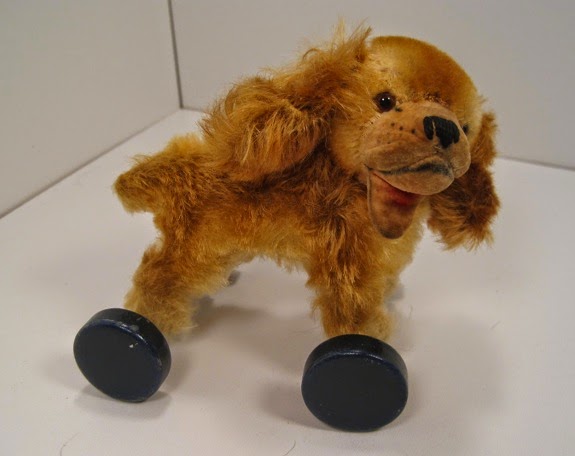
And yes, he is the wheel deal! Steiff has traditionally produced pull toy versions of many of its most popular items.  In the 1950's and 1960's, these were usually made from the smallest or next to smallest versions of the standard line items and on red, blue, or green wooden eccentric or regular style wheels. These petite treats included cats, farm animals like donkeys and ponies, rabbits, and ducks, and dogs. Steiff's tiny 10 cm Cockie Cocker Spaniel on eccentric wheels is pictured here on the left. Larger wooden wheeled treasures from this period included Fox Terriers and elephants.
 

Steiffgal hopes this discussion on Steiff's rolling Zicky helps to move along your day in a most positive way!

Have a question about one of your Steiff treasures? Let's talk! Click here to learn more.

Sunday, August 31, 2014

Size Defies When It Comes To Steiff's Adorable Woolen Miniature Mice!

With  just a handful of summer left, Steiffgal thought it might be fun to take little look at one of Steiff's legacy products that truly would fit in the palm of your hand!  It seems that everyone just loves Steiff's woolen miniatures, and for good reason!  They are completely adorable, gorgeously designed, and of course, don't take up too much room (which tends to be an issue the larger one's collection becomes!)  Perhaps the cutest - in Steiffgal's humble opinion - woolies are Steiff's tiny mice.  Check out this tiny two-some and perhaps you'll agree as well!


Size defies when it comes to these lifelike, miniature master pieces!  Here we have an albino white mouse and a grey mouse.  Both are cataloged as 4 cm, made from wool yarn, are standing on all fours, have long tails, and are head jointed.  Their petite feet, which each have four toes, are made of peach colored felt.  Their tiny faces come to life with airbrushed-highlighted felt ears, playful whiskers, bead eyes, and pink painted noses and mouths.  The grey mouse on the left was produced from 1931 through 1943 overall; he also came in white and brown.  The white mouse on the right was made from 1949 though 1984 overall and also came in grey.

Both mice sport IDs which are appropriate for their era of production.  The white mouse has a tiny raised script button and article number 7354/04 (suggesting a specific 1968 through 1984 manufacture date) while the grey mouse has a tiny trailing F button and article number 2504,1 (suggesting a specific 1937 through 1943 manufacturing date.)  These items never had chest tags, and as far as Steiffgal can see, no woolen miniatures ever did.  However, a handful of woolen miniatures are perhaps the only items in the entire Steiff history of production that did not leave the factory with a “button in ear.” Even birds, which clearly lack ears, had a button securing their label around their leg. Woolie ladybugs and hedgehogs do not, and never had, Steiff buttons. There was simply no place to attach them. But their look, feel, and manufacturing make them undoubtedly Steiff.

It is always fun with Steiff to track how designs change - or don't - over time.  This is especially true with beloved and popular items that are produced over a long period, even decades... as is in the case of these mice!  In general, with these two babies, it is clear that their core, basic pattern did not change over time.  And, given that both mice weigh 5 g, that the critical mass of the pattern remained constant over time.  However, there are a few very subtle differences between them.  These include:

  • Their length from nose to fanny.  The white mouse measures 5 cm while the grey mouse measures 4 cm. 
  • Their tails.  The white mouse has an 8 cm tail made from solid peach colored rubber.  The grey mouse has an 8.5 cm tail made from grayish-black stretchy elastic, like an elastic band.  You can see a close up of their tails in the photo above on the left.
  •  Their whiskers.  The white mouse has numerous long, flexible, clear whiskers, while the grey mouse has just a handful of very short, stiff, brownish whiskers.
Let's talk about the size difference first.  Because each Steiff item is made by hand, it is entirely possible that size differences are a result of the touch of individual craftspeople.  It is also conceivable - because each mouse weighs the same (and clearly their bodies make up most of their mass) - that the composition of the woolen fibers used on these items changed over time, and/or aged differently.  

Now their tails and whiskers.  These differences are most likely attributable to materials available on hand at the time of their production, as well as manufacturing improvements to those materials over the decades. It is most interesting that the older grey mouse's tail, which is made from a stretchy material, has not dried out, cracked, or fallen off - which happens alot with older rubber items.

Steiffgal hopes this discussion on Steiff's tiny woolen mice has made a huge and happy difference in your day!

Have a question about one of your Steiff treasures? Let's talk! Click here to learn more.
  
The teddy bear search engine