Thursday, November 17, 2022

This 1930s Steiff Tail-Turns-Head Novelty Is Simply Ele-Fantastic!

Steiff wishes can come true! Check out this note from Carey, a new friend from north of the border. She was gifted a jumbo surprise from her husband - one that just happens to be simply ele-fantastic. Steiffgal is certain you'll agree. She shares in part:
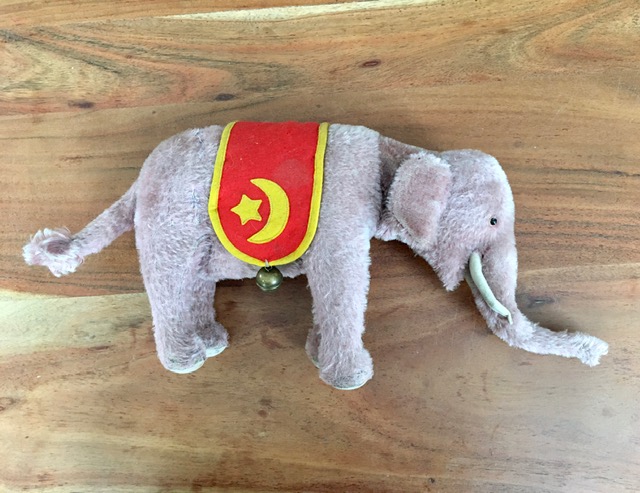
"Hi Steiffgal! I’m emailing from Ontario, Canada. Yesterday my husband gifted me an amazing find from Kijiji from an elderly couple who were downsizing. The elephant belonged to the woman’s father, and they immigrated to Canada from Poland.

Our new blushy pink/mauve Steiff elephant, based on what I could find from the button, is I think from the 30s. The tail makes the head move in a circle and the trunk is posable. It’s stuffed with straw, and due to the wear of the mohair around the foot pads, which are heavy felt, you can see black toes stamped onto the fabric. It’s about 8" tall, and the body excluding the tail and trunk is about 10" long. If it made any sounds when it was new, it doesn’t now."

There's not a drop of junk in the truck when it comes to this playful pachyderm.
This tail-move-head example is standing, head jointed, and made from mohair which has mellowed to a light pink color over time. This sometimes happens with originally grey mohair over time. His pads are made from grey felt, and his prominent tusks are made from white felt. He comes to life with floppy ears, black button eyes (which may be backed in felt - but it’s not clear from his photos) and a smiling, open mouth. His red and yellow felt blanket with bells is original to him. When you twist his mohair tipped tail in a circle, his head moves 360 degrees as well. This amazing tail-moves-head elephant was produced in 18, 23, and 29 cm from 1931-1934 overall; Carey's example is most likely the 18 cm version.


Steiff introduced its patented tail-moves-head line in 1931.
These nifty novelties were made with an internal metal movement mechanism that enabled the heads to move in a circle when the tails were rotated. These items were stuffed with excelsior to hold this mechanism firmly in place. Tail-moves-head animals appeared in the line from the early 1930s - early 1940s; over time, about 25 different examples were made. The line included cats, dogs, rabbits, penguins, goats, and lambs, and even Mickey Mouse! Most were based on popular designs of the ear, but a few - like a bulldog - were brand new patterns. These tail-moves-head items were considered luxury toys of the time. You can see Carey's elephant in action in the video above. 

Carey's elephant appeared on the cover of a 1931 marketing brochure titled "1931 Addendum to the Main Catalogue."
The other "cover girls and boys" included a Scotty, penguin, tabby Bulldog, Rattler Terrier, Molly, chimp, Fox Terrier, lamb, cat, and goat. The copy on the brochure, in part, translates to:

"The year 1931 has presented us with the animals with the new head movement… The simplicity of the mechanism, though which the splendid movement is produced, cannot be beaten, yet it is unbreakable and allows lifelike play, full of variety and mimics… When buying new supply in plush toys please be sure to include the STEIFF animals with the new head movement; all numbers equipped with it are marked ‘H.’" You can see this brochure cover here on the left; you can click on the image to make it bigger. 

Steiffgal hopes this discussion on this really rare elephant has made a huge impression on you.

Have a question about one of your Steiff treasures? Let's talk! Click here to learn more.

Wednesday, November 9, 2022

This Cool Cat Novelty Is Really Hot Stuff!

Brrr... the temperature has shifted from 80 degrees to 40 degrees overnight so it’s definitely time to share something Steiff-y to warm the heart and soul! Check out this amazing cat doll that does double duty... making her totally hot stuff indeed. Have you ever seen this hybrid treasure before?

This Steiff functional novelty is called "Cook Cat Coffee Cozy."
She is 43 cm tall and is arm and head jointed. Her body and arms are made from red felt to resemble a shirt, her skirt is made from green felt, and her head and hands are made from white mohair. She wears her original white cotton apron. She come to life with pert triangular felt ears, early style green and black slit pupil glass eyes, and a hand embroidered pink nose and mouth. Her hollow body is lined in double thick felt to keep a pot of coffee, tea, or cocoa warm. She was made in this size only from 1906-1910.

Cook Cat Coffee Cozy was also produced with a bear's head or a rabbit's head. These heads were identical to the current rabbit and bear designs of the early 20th century. These cousins also measured 43 cm tall. The bear appeared in the line from 1906-1908 and the rabbit appeared in the line from 1906-1909. Like the cat version, these featured a mohair head and hands and were dressed in a red felt shirt, a green felt skirt, and a white apron. This happy group is a good example of Steiff's long tradition of "form and variation" - modifying a popular design slightly to produce a number of "new" products for their catalogs. You can see a picture of the "Cook Rabbit Coffee Cosy" here on the left; the photo is from Pfeiffer's 1892-1943 Sortiment book.

Cook Cat Coffee Cozy - and her bear and rabbit friends - are based on Steiff's earliest character coffee warmer which debuted in 1904.
This was a cozy in the form of Mama Katzenjammer from the popular comic strip the Katzenjammer Kids. She was called "Cook Coffee Cozy." Cook Coffee Cozy also wore a red and green felt dress and white apron, but had a felt head and fingered hands that resembled her character. Cook Coffee Cozy was made in four sizes ranging from 43-100 cm from 1904 through 1943 overall. Her longevity in the line indicates how popular she was over nearly four decades. 
You can see a picture of the "Cook Coffee Cosy" here on the left; the photo is from Pfeiffer's 1892-1943 Sortiment book. 

This fantastic feline fits right into Steiff's early 20th century product development timeline and history.
The Giengen company is well known for producing functional novelties for home, school, and work use in addition to the company's plush animal, doll, and bear production. This tradition goes back to the late 1800s, when Margarete Steiff produced and marketed a series of oversized, embroidered felt "pockets" designed as newspaper holders, bed wall bags, duster holder bags, and brush holders, among others. Other early and mostly prewar novelties include egg cosies, pen wipes, and pincushions. These rarities are treasured among collectors today.

Steiffgal hopes you found this discussion on Cook Cat Coffee Cozy the pause that refreshes.


Have a question about one of your Steiff treasures? Let's talk! Click here to learn more.

Saturday, October 29, 2022

This Precious Prewar Pug On Wheels Stands And Delivers!

As she continues to celebrate the arrival of her newly adopted sister-pugs, Steiffgal thought it was the perfect moment to share a special button-in ear version of the beloved breed.
Dogs have always been an important design category for Steiff, so it should be no surprise that the first flat-faced cutie was introduced in the Steiff catalog in 1916. Take a look at this very early pug on the go and see what makes him so delightful from the design and product development perspectives.

This happy traveler is 22 cm tall (not including his wheels) and made from grey mohair.
He is standing, unjointed, and solidly stuffed with excelsior. He has black hand embroidered claws on each of his feet. His distinctive face comes to life with proportional brown and black glass pupil eyes (which may be replaced), a black hand embroidered nose and mouth, and black lines on his forehead - to give him his breed-specific wrinkled forehead. His pert ears are lined in velvet, and he has a very curly tail. He retains his small trailing "f" button and traces of his white paper ear tag as his Steiff IDs.

Now let's dig deeper into his detailing.
Pug wears a leather collar, which may or may not be original to him, but is appropriate in materials, design, age, and fit. His pull cord has been lost to time. Pug is mounted to two metal rods and rides upon four wooden eccentric wheels. It is interesting to note that this pattern, unlike many other dog patterns, only came on wheels, and was not produced sitting or in any other configuration. Pug on wheels was produced in 17 cm and 22 cm from 1916-1927.

Like many of the Steiff pets debuting in the 19-teens, this perky pug has a proportional and literal design.
The key pug breed elements - a flat muzzle, wrinkled forehead, and a curly tail - are very well represented in his pattern. For the most part, Steiff's dogs, cats, rabbits, and other popular pets introduced in the c. 1910-1920 time frame were not as basic as the company's earliest patterns, but did not have the youthful, often goofy or playful appearances of those items designed in the 1920s through early 1930s. Items from around 1925 onward often featured oversized eyes, brightly colored materials, and rounded faces, bodies, and limbs. As such, Steiff's second pug - introduced in 1925 as its first pug pattern was being phased out - was a truly silly looking sitting pup with exaggerated facial features and a larger than life red felt tongue. He appeared in the line from 1925 - 1927 in 14 cm. He is pictured on the left; the photo is from Pfeiffer's 1892-1943 Sortiment.

Steiffgal hopes this discussion on the company's early Pug on wheels has captured your interested in a round-about sort of way.

Have a question about one of your Steiff treasures? Let's talk! Click here to learn more!

Monday, October 17, 2022

Care To Go On A Date With This Prewar Steiff Scotty?

It's never appropriate to ask someone how old they are - right? But in this case, this vintage Steiff friend proudly advertises his "birthday" in a very special, and very prominent, way. Intrigued? Then check out this little black Scotty and his amazing and informative chest tag to learn more.

Here we have Steiff's 1930s-era Scotty dog. He is standing on all fours, head jointed, and solidly stuffed with excelsior. He has a non-working side squeaker in his torso. He measures 12 cm tall and 18 cm long, not including his tail. He is made from black mohair, with a longer mohair beard. His pert triangular ears are lined in felt. He comes to life with a black hand embroidered nose and lovely white, black, and brown glass pupil eyes in the shape of almonds. He retains his long trailing "f" button, trace of his red ear tag, and his named chest tag as his IDs. This pattern was made in 8, 10, 14, 17, 22, 25, 28, and 35 cm in grey or black or dark grey from 1930-1943 overall.

Now let's take a closer look at his chest tag.
It is amazing how much information is squeezed onto this tiny piece of cardboard measuring just a pinch more than 1/2" in diameter. The design features Steiff's prewar and angular yellow and blue Teddy bear face. Its center copy reads in red: SCOTTY, D.R. Patent, U.S. Patented Jan. 9, 1932. This means that the Scotty pattern was registered in D.R. - which is short for "Deutsches Reich," the constitutional name for the German nation state that existed from 1871 to 1945. The tag also gives the EXACT date that the design was also patented in the United States - January 9, 1932!

The vast number of Steiff prewar chest tags simply had the bears, animal, or doll's name noted in the center of the label. However, it is interesting to note that in some cases, like this one, that the tag also specifically mentioned that the item's patent protection status in the United States. For example, check out the tags on a 14 cm Molly and a 10 cm Tabby from the 1920s as pictured here on the left. Both have the  on this words, "Reg. U.S. Pat. Off." on their chest tags as well.

Scotty, Tabby, and Molly were extremely popular 1920s-era patterns. So it would be reasonable to assume that the Steiff management team in Germany was concerned about other companies - especially those in America - "stealing" these beloved designs. Steiff's business in the USA was really booming in the mid-1920s through early 1930s, partially due to the efforts of Richard Steiff. He moved to the States in the early 1920s with his family to grow the family business, alongside the company's US distributor, George Borgfeldt & Company. For Steiff to take the time and expense to register their designs with the US Patent Office says suggested that they really meant business when it came to design intellectual property, that they were in the United States market for the long run, and that they wanted to perhaps "American-ize" their line, making it less foreign or exotic, to add to its marketing appeal and potential.

Steiffgal hopes this discussion on chest tag details has had patent appeal with you. 

Have a question about one of your Steiff treasures? Let's talk! Click here to learn more!

The teddy bear search engine