Thursday, January 19, 2023

This Marvelous Prewar Steiff Girl is Made of Sugar and Spice and Everything Nice!

A "rosa" by any other name... would ALMOST be as beautiful as this sweet Steiff doll! Steiffgal recently had the pleasure of handling a very vintage button-in-ear doll that came from a fine and well curated collection down south. Take a look at this lovely lady in red... and be tickled pink, for sure!

Here we have Steiff's charming Rosa girl.
She is 28 cm tall, fully jointed, and made from felt. She has a short blonde inset wig, proportional blue and black glass pupil eyes, and a prominent vertical facial seam. Her perfectly to scale nose is dimensional and she has painted eyebrows. Rosa wears a red felt dirndl style dress with black trim, a white cotton blouse, white apron, a white underskirt and underwear, knit socks, red shoes, and a red felt hat that perfectly matches her dress. Steiffgal believes the tan lace on her dress is probably replaced. Rosa retains her tiny long trailing "f" Steiff button in-ear. This beautifully attired doll appeared in the line in 28, 35, 43, 50, 60, and 75 cm from 1908-1926 overall. So this example is the smallest standard sized produced.

Rosa has a few features that make her particularly interesting from the timeline and product development perspectives.

First is her facial stitching.
In addition to her vertical center seam, she has small horizontal seams near her eyes. Steiff specifically added in this design feature to their line of proportional and endearing "children" line, starting around 1908. These extra seams gave the face a pleasing roundness and further emphasized its youthful symmetry.  

Second are her hands.
Rosa has simple, rounded embroidered style hands, suggesting that she was made at the earliest point in her production timeline. Steiff's first dolls had hands that looked more like fists; "fingers" were indicated by embroidery stitches. You can see this in the photo here on the left. By 1910 or so, most Steiff dolls had "conventional" style hands, with prominent and individual fingers.

And finally is her blouse.
Her white cotton shirt fits perfectly, and is correct to her period and design, but is slightly different than the one pictured in the standard Steiff reference books. Rosa's shirt has lace and lots of tucks and details; the one pictured in Pfeiffer's Sortiment is much plainer. Rosa's shirt may be a replacement, or not. This doll model appeared in the line for nearly two decades. Over the years, clothing styles on dolls tended to be updated a bit, and generally were simplified over time. This was usually for cost savings, labor savings, and/or supply chain management issues. Because Rosa was probably "born" around 1908-1909, it is possible that she is wearing a fancy, original blouse that was streamlined to a more simple version over time. Only she knows for sure!

Steiffgal hopes this discussion on Steiff's Rosa has brought a bouquet of happiness to your day.

Have a question about one of your Steiff treasures? Let's talk! Click here to learn more!

Saturday, December 31, 2022

These Ladenburger Spielzeugauktion Auction Highlights Are Dressed To The Nines!

Three's a charm when it comes to the third post in this blog series of auction highlight from Ladenburger Spielzeugauktion's January 21st, 2023 Collection of Susan Kilgore Wiley sale. It's no secret that Steiffgal goes all hubba-hubba over Steiff's utterly charming dressed dolls and animals. And, this sale offers some of the most appealing ones in memory. Check out this trio of well attired prewar offerings from this auction. Steiffgal is certain you will consider all of them a clothes call indeed.

This first dressed highlight doesn't have a hare out of place.
It is lot #6152, an all original and early Steiff Peter Rabbit. It is estimated at €650-€1,300, and is cataloged in part as:

"One of the highlights of the auction, exceptional hare, Peter, around 1910, with small button, block letters, long trailing f, shoe button eyes, underlaid with red felt, fine brown/beige velvet, attending, with original felt jacket, decorative seams and golden buttons, red slippers, 1 leather sole with original stamp, 1 felt slipper is a bit holey, and small holes on the blue felt jacket, standing height 26 cm, extremely rare, exceptional."

Steiff's turn of last century Peter Rabbit dolls top many collector's bucket lists. This well coutured example is in lovely condition and is a marvelous size. It is interesting to note that the exact details that make up a Steiff "Peter Rabbit" are not specifically identified in Pfeiffer's Sortiment books. It is generally understood amongst collectors that a "Steiff Peter Rabbit" is standing, unjointed, and wears a felt topcoat with buttons and embroidery and felt slippers with leather soles. The Sortiment book pictures two versions of standing rabbits wearing felt topcoats and slippers, but does not identify them as "Peter Rabbit." The first is a spotted velvet version wearing a red or navy topcoat and red slippers; he was produced in 10, 22, and 28 cm from 1904-1919. The second is a white wool plush version wearing a green felt topcoat and red slippers; he was produced in 22 cm from 1904-1918.

This next auction highlight is a pair with flair!
Here we have lot #6181, two early 20th century, fully jointed, center seamed Steiff felt dolls. They are estimated at €330-€660 and are cataloged in part as:

"Felt dolls, Anton & Lisl, Upper Bavarian, produced between 1909 and 1926, 28 cm, with traditional costume, felt-head, mohair-hair, felt body, jointed, arms and legs, original, clothes, very nice condition."

This darling duo are textbook examples of   Steiff's "children" style dolls. 
These guys appeared in the line from 1909 through the late 1920's. Unlike earlier Steiff dolls that were more caricatured, harsh, and designed for adult collectors, these dolls were realistically proportioned, had gentle personalities, and angelic, rosy faces. They truly were designed for child's fun and play. These models were all fully jointed and had felt heads and bodies - except right around WWI when felt was scarce and the bodies were sometimes made from rough cotton or linen type materials. Steiff's children dolls were all dressed head to toe in handmade clothing that included school uniforms, ethnic costumes, sporting attire, and “Sunday best." Steiffgal is certain that the boy is Anton, based on his outfit and presentation. However, she is not 110% certain the identity of the girl is Lisl as her outfit does not match the one pictured in Pfeiffer's Sortiment. Steiffgal also suspects that her clothing, however charming, is not entirely original to her. Nonetheless, the pair is simply wonderful.

And it's tag, you're it! when it comes to our final well dressed auction highlight.
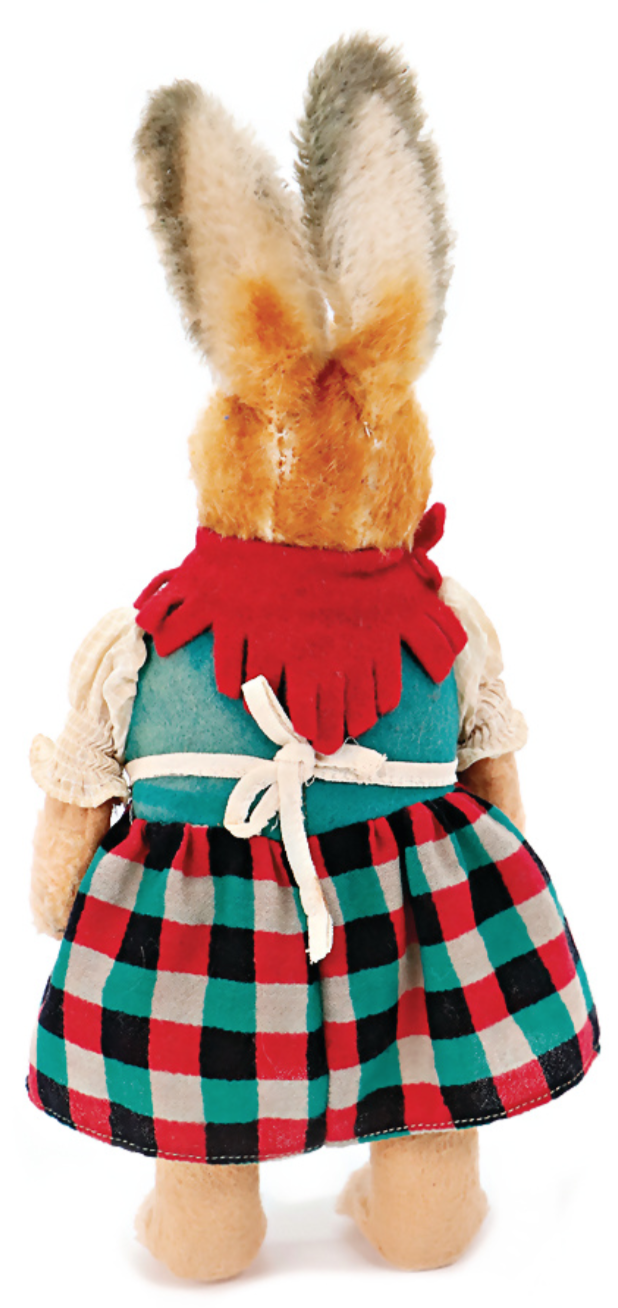
This is lot #6114, a late prewar standing and dressed rabbit doll, estimated at €180-€360. She is cataloged in part as:

"Pupp-hare, Mike, with button, block letters, long trailing f, very nice good preserved, yellow cloth tag label, No. 22, wool plush at hands and feet, original traditional costume, 27 cm, very nice condition."

And just want makes this lovely lady a 10?
She's got a fantastic presentation, and is in delightful, all original condition. And if you look closely at her tag, it is says "22,11." Numbers don't lie here! Her digits mean 22 cm tall (measured without ears), while the number 11 corresponds to her costume as described by the company. Outfit #11 translates to "traditional costume with green checkered skirt, green corsage, and white shirt." Spot on! These utterly charming, dressed rabbit dolls appeared in the line in 14, 22, and 28 cm in maize or white plush from 1932-1943 overall. Eleven total outfits for these rabbits were produced; they ranged from pajamas to playsuits to trousers and dresses through regional outfits like the one featured on this premier example. 

Steiffgal hopes this discussion on these well dressed auction highlights has contributed to the fabric of your collecting life. 


For more information about Ladenburger Spielzeugauktion GmbH's upcoming Special Steiff Auction event on January 21st, please click here!

Have a question about one of your Steiff treasures? Let's talk! Click here to learn more!

Monday, December 26, 2022

These Wheeled Wonders Up For Auction Soon Will Send Your Pulse Into 5th Gear!

We continue our series on auction highlights from Ladenburger Spielzeugauktion's January 21st, 2023 Collection of Susan Kilgore Wiley sale with a focus on AMAZING pull toys. It goes without saying that all the temptations in this sale are simply WAH-HOO good, but some are the "wheel-deal," too! Check out these three breathtaking rarities on the go that send Steiffgal's pulse into fifth gear!

Size defies with this first auction highlight.
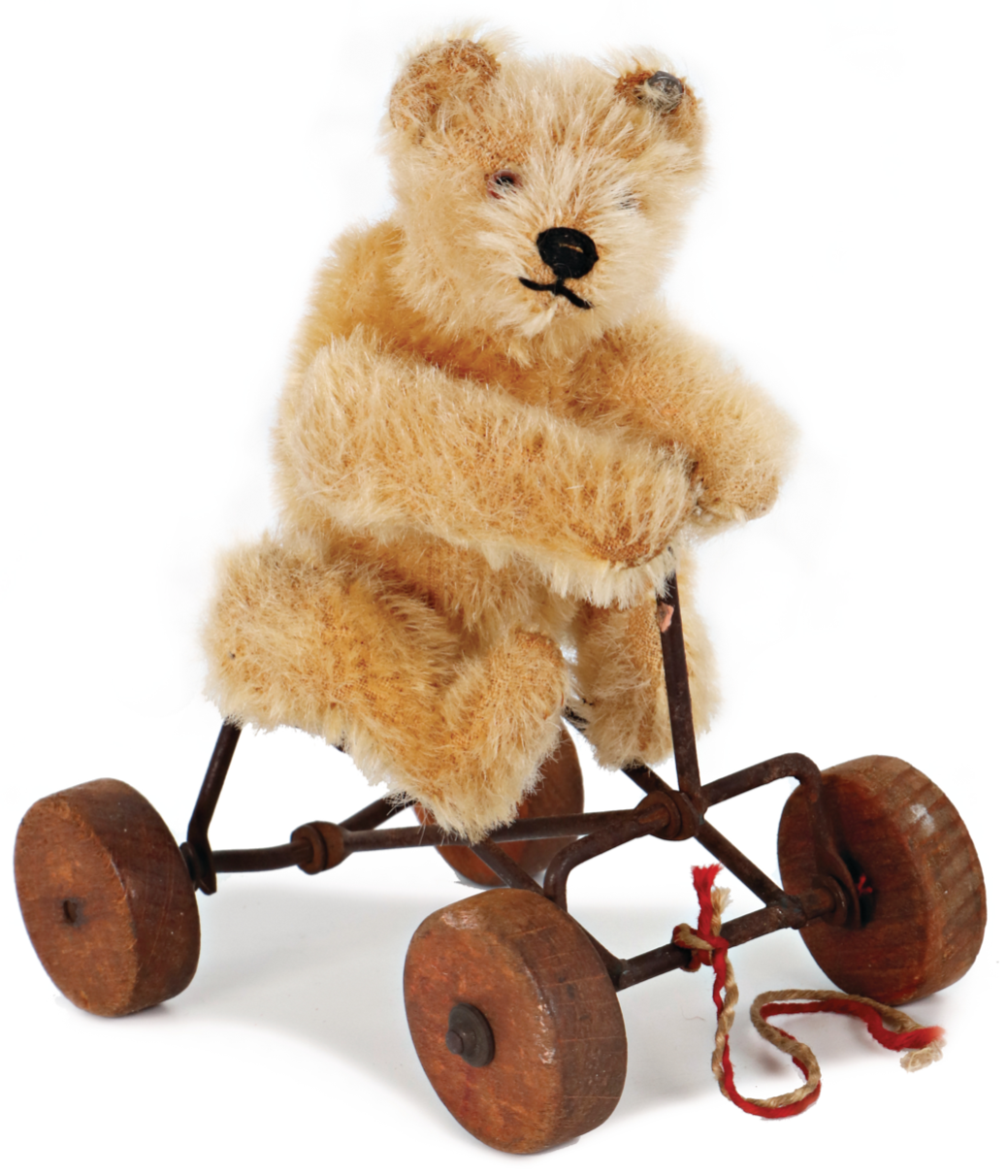
Here we have lot #6187, a happy handful of a bear who is clearly off to the races. He is cataloged in part as: 

"Rare Record teddy, in the small manufactured size, height: 10 cm, 1924-1927, on a self-propelling vehicle with motion, with original drawstring, with button, block letters, long trailing f, glass eyes, a little bit flash rust, mohair is a bit thin." He has an opening bid of 280 €.

Many of us are familiar with Steiff's charming "Record" animals - those sitting sweeties on a four wheeled cart
. They appear to move back and forth as their vehicles are pulled along. This is due in part to their slightly looser jointing and clever engineering. Record animals and dolls are mostly seen in the c. 20 cm+ size. This one is really, really charming given its teeny, tiny proportions - he's the smallest sized Record bear made by Steiff, ever. His pattern was produced in 10 and 15 cm in blond or gold mohair from 1924-1927. He literally fits in the palm of your hand, and would be insanely adorable as the prized toy in the arms of a very lucky medium to larger scaled bear or doll from any era. And he is RARE! The only other tiny Record Teddy Steiffgal knows of sold at Christies in 2010 for 6,250 GBP.

Our next wheeled highlight proves the saying, "two heads are better than one."
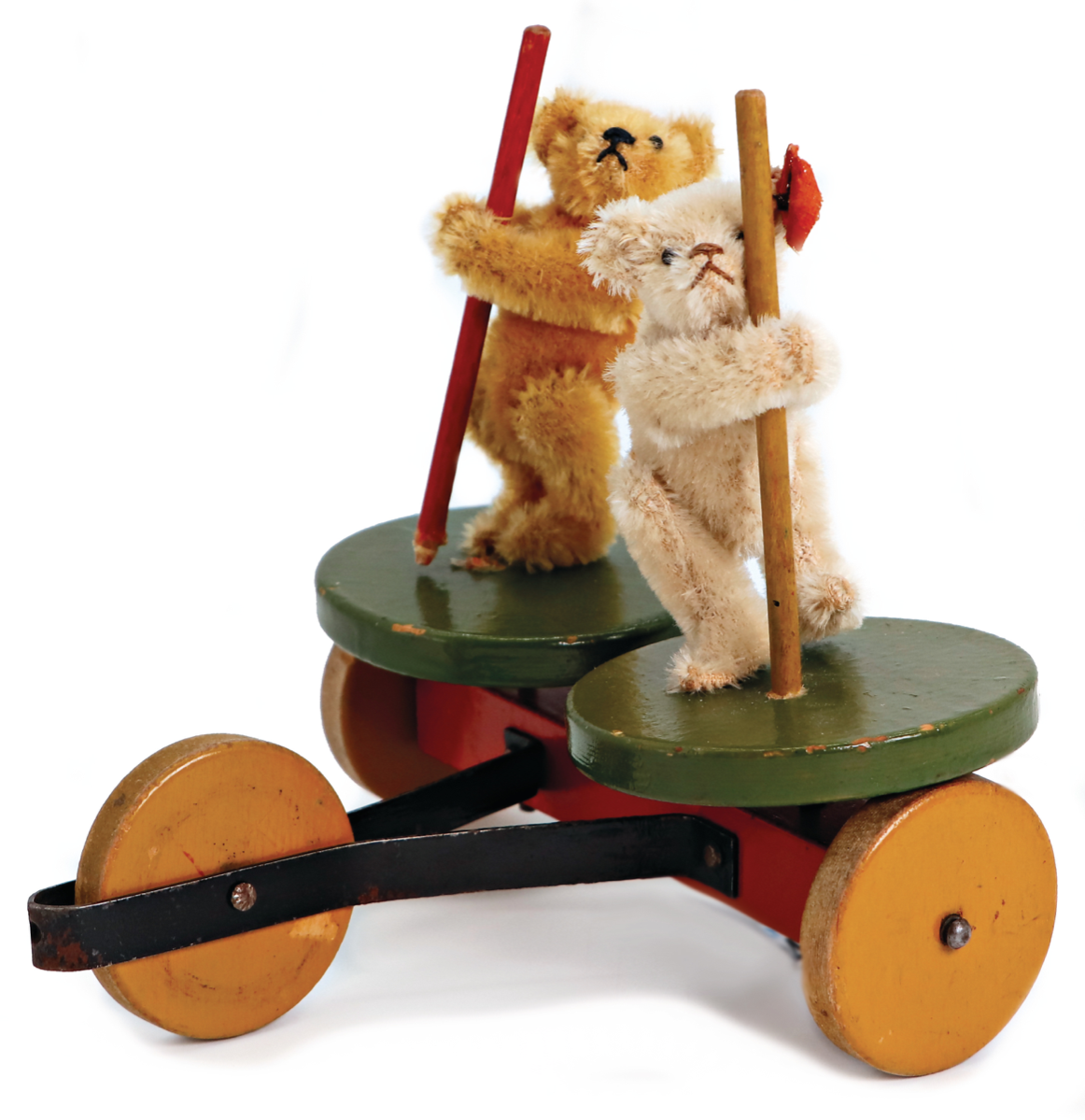
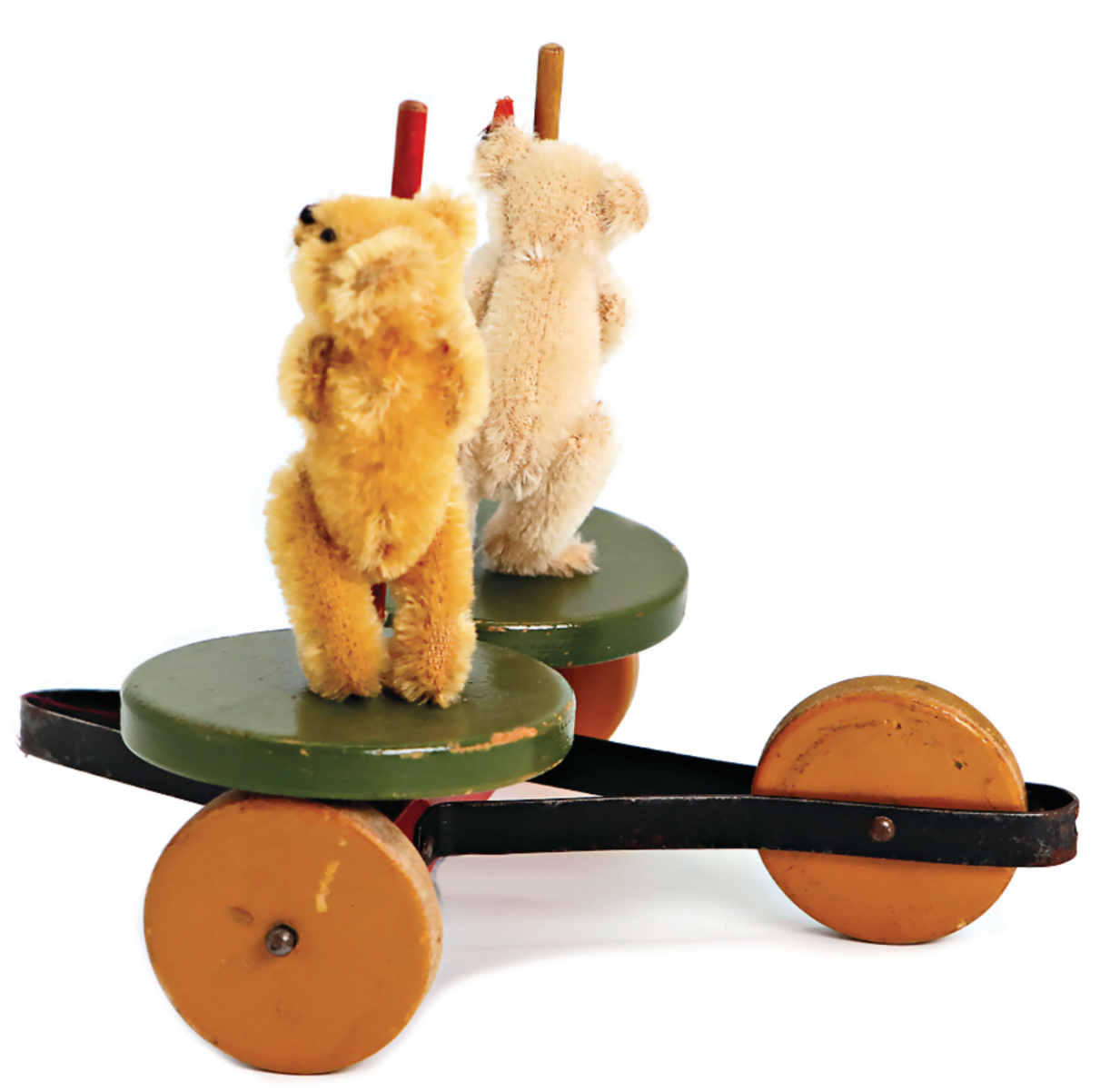
Here we have lot #6050, a stunning Steiff Roly Droly. This bear-pair is cataloged in part as: 

"Tricycle, wood, with 2 turning pre-war bears, 1x golden yellow, 1x white, with button and red cloth tag label, block letters, long trailing f, very nice condition, length: 20 cm, depth: 19 cm, height: 16 cm, extremely rare, sticks were later glued." The Roly Droly has an opening bid of 550 €.

This fantastic novelty is head spinning for a number of reasons, including its rarity, presentation, and condition.
Roly Poly pull toys were made in the mid-1920s through the mid-1930s, and were produced with a number of different "passengers." These included two chicks, two bears, a chick and rabbit, a dog and a cat, and two rabbits, among others. These novelties were specifically produced and designed as hands-on play toys. And toys - especially with moving parts or designed for rough play - wear out, fall apart, or just get lost to time. For example, think about Steiff skittles. Those were designed as a sporting game, so losses and wear on skittle pins and balls are almost expected! This Roly Droly shows just a touch of playwear, and has, or needs, some simple restoration with one of its poles. Nonetheless, this example is so appealing, and so seldom seen, that it just may go into overdrive when the bidding begins.

And finally, let's take a look at just what may be the Maserati of this wheeled category - and maybe the entire sale.
Here we have lot #6071... a breathtakingly rare Record Petsy. It is cataloged in part as:

"Rare Record-Petsy, produced around 1928-1929, length: 25 cm, brown pointed mohair, blue glass eyes, bright embroidering at snout, with seam at the middle of head, with button, block letters, long trailing f, minimally rests of the white cloth tag label, smaller mohair loss at the thighs and at the hand, very nice strong colors of the mohair, red wood wheels, extremely expressive." It has an opening bid of 1,300 €.

Collectors can't seem to get enough of Steiff's Petsy the Baby bear.
 In July, 2022, Ladenburg sold a 72 cm version of this blue-eyed beauty for 42,000
 €! This classic bear design only appeared in the line for a few years in the late 1920s and early 1930s. Like several of the company's mid- to late 1920s popular designs, Petsy was made into several theme and variation novelties, including a music box, a puppet, a purse, and this pull toy. Record Petsy was made in 20 or 25 cm from 1928-1929 only. According to Cieslik's Button In Ear reference book, only 1,462 examples were made. Steiffgal has only seen two of these - ever! One was at the Steiff museum in Giengen (pictured here on the left along with some other fantastic "high rollers") and one at the Spielzeug Welten Museum in Basel. So this Record Petsy is in remarkable, and exclusive, company indeed.

Steiffgal hopes this discussion on these wheeled auction highlights has been thrilling, in a round-about sort of way.

For more information about Ladenburger Spielzeugauktion GmbH's upcoming Special Steiff Auction event on January 21st, please click here!

Have a question about one of your Steiff treasures? Let's talk! Click here to learn more!

Monday, December 19, 2022

Tag - You're It - With These Amazing Steiff Rarities From Ladenburger Spielzeugauktion's January, 2023 Sale

Here's something incredibly fantastic to look forward to! Mark your calendars for Ladenburger Spielzeugauktion GmbH's Steiff Special Auction on January 21st, 2023. The catalog has just been published online in German and English. It features nearly 200 breathtaking Steiff, Schuco, and Bing rarities from the collection of the late Susan Kilgore Wiley. Mrs. Wiley had an amazing eye for gorgeous prewar toys. Half of her antique plush collection will be sold as part of this January, 2023 event, and the second half will be offered through Ladenburger Spielzeugauktion at their July 1, 2023 Steiff Special Auction in Giengen, Germany. 

This January sale offers so many WAH-HOO GOOD options, it's almost impossible to pick highlights.
That being the case, let's look at the "cream of the crop" per category over the next few weeks. We'll kick off this auction review here today with a peek at extremely rare items with great ID. 

Size defies with this first January auction highlight. It is lot #6074, a supersized, midcentury Lulac rabbit. His starting bid is 180 €. He is cataloged in part as: 

"Lulac, exceptional size, 80 cm, with button, breast sign and yellow cloth tag label, number is partially illegible, breast sign with stronger kinks, cross-eyed with big glass eyes, jointed arms and legs, small faults in the mouth felt insert, exceptional."

It's not going out on a limb to say how exceptional this rabbit truly is.
 His pattern is in Steiff's beloved "lulac" scale. These legacy items have mile-long limbs and torsos. Lulac animals made their debut in 1952. The first to appear was a 43 cm rabbit. Like the example under discussion here, he was made from caramel mohair and his hands and feet were detailed with especially shaggy mohair. This original lulac rabbit pattern was also produced in 60 cm; the 43 cm version was in the line from 1952-1974, while the larger size made a more limited appearance from 1964-1966. Mrs. Wiley's supersized example has awesome adjustable black and blue glass google eyes retains his button, ear tag, and named chest tag as his Steiff IDs. He is the first of his type Steiffgal has ever seen.

As far as Steiffgal can tell, there is no mention in any of the standard reference books of an 80 cm version of this lulac rabbit. It is possible that he was made in very small quantities as a window display animal. Other early 1950s lulac items included a 35 cm donkey, a 40 cm elephant, a 90 cm tiger, an 80 cm poodle, and an 80 cm lion. All of these models were mohair, fully jointed, and were produced exclusively for the United States market and only for a year or so. Given the proportions of some of those early post war lulac exclusives, it is also possible that this extra large lulac rabbit was made as part of that series, but never went into full production for some reason.

This second auction highlight also doesn't have a hare out of place.
Here we have lot #6004, a prewar bunny named Ossi. His starting bid is 60 €. He is cataloged in part as:
 

"Ossi, wool plush, sitting, with button, block letters, long trailing f, swivel head, white/brown spotted, 16 cm seat height, big glass eyes, with breast sign, red inscription, small mohair loss below the right eye."

It's time to play the name game with this hoppy handful. Ossi was produced in five sizes ranging from 4 to 15 cm from 1938-1943 overall. His design elements, including his wartime era fabric, proportional eyes, and his simple hand embroidered nose and mouth, are typical to the late 1930s production era at Steiff. But what's most interesting about Ossi is that he was the first "named" rabbit produced by Steiff. All others before him were simply called "hase" or "rabbit." What are the odds that this example of Steiff's first named rabbit would retain his his "Ossi" chest tag? Steiffgal had never seen an Ossi before this one  - with or without IDs!

Steiff started to give adorable or endearing names to its standard line items starting in the 1920s.
It was at that time that Molly the Puppy, Fluffy the Cat, Charly the King Charles Spaniel, Jocko the Chimp, and many other legacy named patterns were introduced. But it was not until 1938 - about a decade and a half later - that Steiff gave a playful name to a rabbit in its line. It is possible that "Ossi" is a play on the German word "Ostern" which translates to "Easter." It's also just a very sweet name for a bunny in any language.

And three's a charm when it comes to our third auction highlight in this can't bear to miss sale.
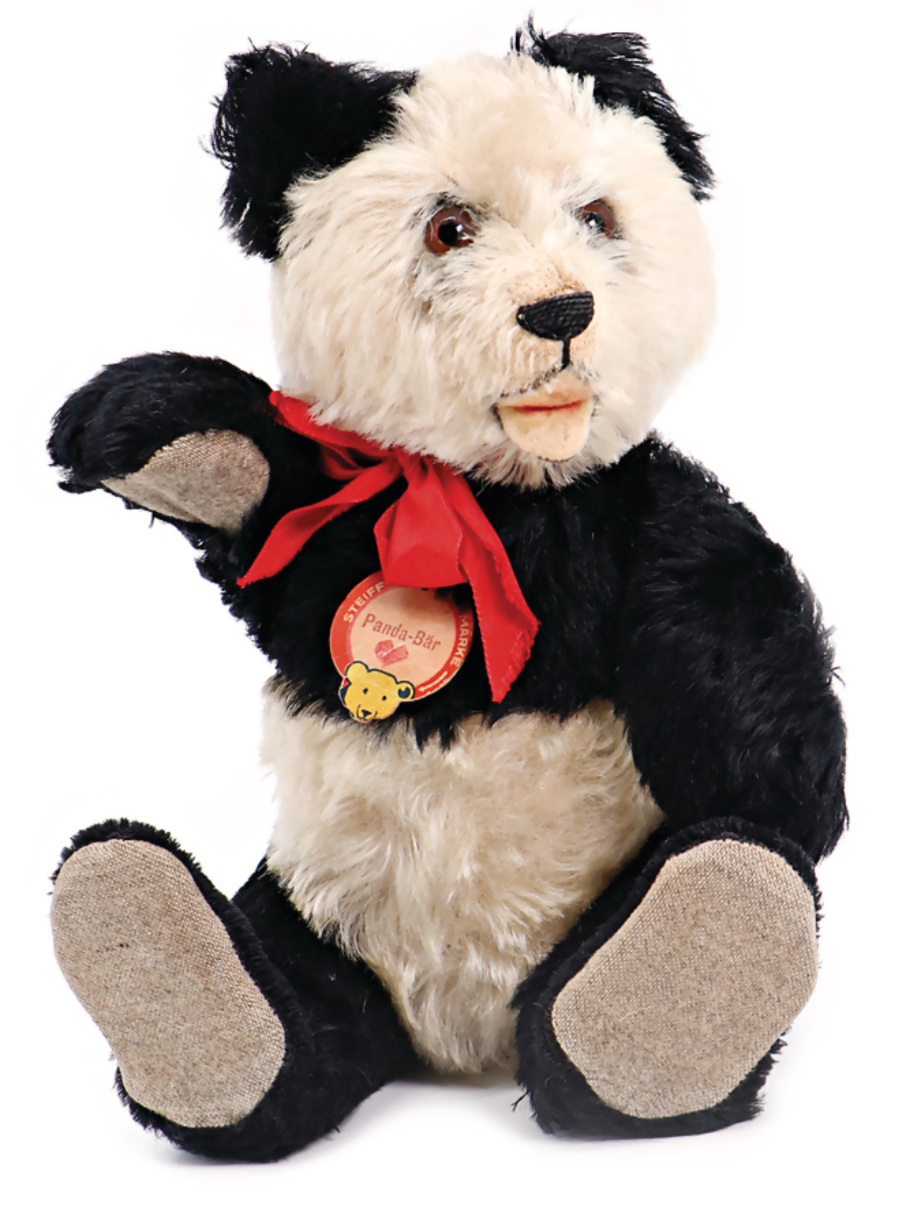
Here we have lot #6045, a precious prewar panda bear. He has an opening bid of 280 €. He is cataloged in part as:

"Panda, with button, long trailing f, writing "Panda-Bär", red with afterwards up-painted heart, mohair-plush, 2-colored, tricot paws, 26 cm, minimally mohair loss around the snout, otherwise very good condition, rare."

Pandas are a great example of Steiff using news headlines and cultural trends for product development ideas. These black and white beauties began appearing "in the flesh" in several major zoos across the globe in the late 1930s. They immediately rocketed to international superstar status. Piggybacking on the success of their real-life cousins, pandas made their debut in the Steiff line in 1938; by 1939, they were being produced in 15 and 30 cm on a commercial scale through 1942 overall. This fantastic example, with his long trailing "f" button and breathtaking named, red imprinted chest tag, is most likely from the earliest part of that time time. 

Steiff's debut pandas were five ways jointed and made from black and white mohair.
Their faces were detailed with brown and black pupil eyes, a black hand embroidered nose, and an small scaled, open, peach colored felt lined mouth. The black circles around their eyes and the black stripe across their backs were created by hand airbrushing. Because of wartime material shortages, some models - like the one under discussion here today - were produced with linen or other alternative fabrics in the place of felt on their hand and foot paw pads.

Steiffgal hopes this discussion on these rare, named Steiff auction lots has bid up your interest in this upcoming sales event!
The teddy bear search engine