Friday, December 1, 2017

Boys To Men: Three Awesome And Extraordinarily Rare Steiff eBay Finds

Rare beyond compare! That was Steiffgal's thought when looking back at a few really captivating and recent sales on eBay. Shopping on this platform is like going to a giant antique mall or store - you never know what's going to turn up. And once in a blue moon, world class collectibles do indeed make an appearance. Here are three recent WAH-HOO good Steiff items that recently traded hands on this ubiquitous global auction website.
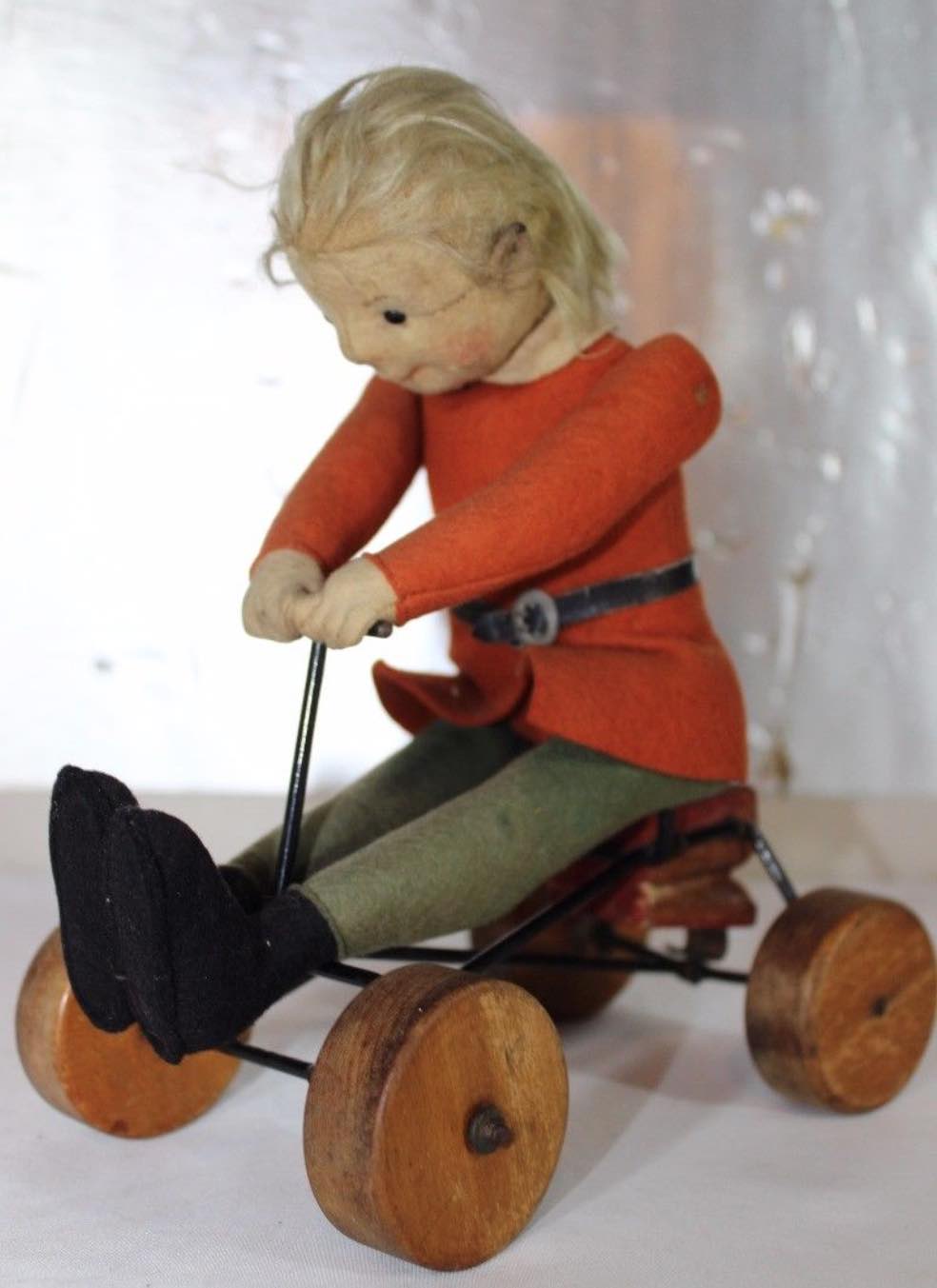
This first fantastic find is the wheel-deal indeed. According to its description, "For your consideration is this rare pull toy Record Boy by Steiff. Plush bean character with felt clothing. He is riding a tricycle and when rolled he moves his torso and heap up and down to action tricycle's propelling lever. Toy has a bellow underneath that produces sound as toy moves. Toy is about 9.5 inches tall by 7.5 inches long by 4.5 inches wide." 
This boy on the go had 4 total bidders, 7 total bids, and sold for $2,150.75.

Does his sale price shock you? It shouldn't, given this character's rarity and cultural status! This item is actually Steiff's Shockheaded Peter doll on a four wheeled cart, from the famous German book of the same name. "Record" refers to these pump and go hand-driven vehicles. This mobile marvel appeared in the Steiff line from 1916 through 1927. Steiff also produced a Shockheaded Peter doll in in 3 sizes ranging from 30 to 43 cm from 1909 though 1927. It is interesting to note that Steiff's Peter dolls had long leather fingernails (like the boy in the book) but this version on a cart does not.  Here on the left you can see a 1916/1917 advertising photo featuring Peter and other "record" friends of the era; the photo is from Cieslik's Button in Ear The History of the Teddy Bear and His Friends. 

Shockheaded Peter is a German folkloric treasure. It is written in distinctive, versed “chapters.” The book debuted in 1845 and was authored by Heinrich Hoffmann, a German psychiatrist who penned the tale for his three year old son as a Christmas gift when he could not find one he liked commercially. Each of the book’s ten tales has a distinct lesson, with the story demonstrating what happens when that lesson is not followed. For example, in story #3, a girl plays with matches and burns to death. The book’s title refers to story #1, where a boy (Peter) does not follow hygienic practices (for example, trimming his fingernails, combing his hair, and bathing) and as a result is an outcast. 

It's no game when it comes to this next auction find - a turn of last century Steiff footballer. He is described in part as, "Rare Antique Steiff Felt Jointed Doll. Doll was handed down from my Great Grandfather 30 - 40 years ago. I have not been able to find another one so that I would be able to describe it. Looks like a rugby player or hobo? Doll is in original condition just like I received it. I believe the inside composition is straw. Clothes show wear and fading in areas. Missing Right Arm. Eyes are glass and the right eye has come unattached but sits in the socket quite well. Leather Boots are very detailed. Top of Boots are split but are still intact with the doll as pics show."

This sports star scored 8 total bidders, 27 total bids, and sold for $1,402.77.

It's a life goal for Steiffgal to add one of these marvelous dolls to her collection! These student athletes were produced in 35, 43, 50, and 60 cm from 1913 through 1920 overall. These were designed to resemble American Ivy League soccer players. Their outfits were available in a variety of different color combinations, including blue for Yale, crimson for Harvard, orange or black for Princeton, and light blue for Columbia. The one under discussion here is probably a Harvard model, given the hue of his sweater. The dolls themselves were playfully configured to have a distinctly youthful, collegiate presentation with their chunky proportions, cherubic faces, and google-style black and white glass eyes. And their outfits reflected the uniform styles of the period; it is interesting to note that their leather shoes had inlaid "treads" on the soles, most likely a nod to early sporting cleats. Here on the left you can see a two early Yale players; the photo is from Cieslik's Button in Ear The History of the Teddy Bear and His Friends. 

Things are going to really heat up with this last Steiff surprise. It is simply noted by the seller as, "This auction is for a vintage Steiff Man figure chimney sweeper. This item is in Very Good condition and is being offered at No Reserve, Final Sale." 

This little fellow caught fire with 9 total bidders, 21 total bids, and sold for $1,276.13.

The lucky winning bidder did indeed hit the sweep-stakes with this petite treat.  This doll, made entirely from felt, is 15 cm tall and was designed to hang from the rear view mirror of a car. His unjointed body and traditional top hat are made from black felt and his charming flesh colored face comes to life with black button eyes and simple hand-painted features. He carries his own to-scale ladder and hand-brush.  This sweep appeared in the line from 1936 through 1943.

Chimney sweeps have a long and interesting history, especially in Europe. It is considered quite auspicious if a bride sees one on her wedding day. And friends often exchange chimney sweep toys and tokens as good luck charms, especially during the winter holidays. Another example of this pre-war Steiff chimney sweep sold for 474 British pounds at an auction at Christies in London in 2010. This roughly translate into about $750 in today's dollars.

Steiffgal hopes this discussion on these three very rare Steiff finds has helped to sharpen your treasure hunting skills!

Have a question about one of your Steiff treasures? Let's talk! Click here to learn more.

Saturday, November 25, 2017

Steiff Dreams Do Come True!

Look what I got! All collectors know that fabulous feeling when something from their Steiff wish list finally makes it into their hugs for real! Check out this note from a new friend from Europe who recently scored her dream piece - at a dream price! Ann-Charlotte shares,

"I wanted to tell you some exciting news. I just added a very special treasure to my collection - an original Steiff Jackie for only $85! Her mohair is intact and she retains her original pink bow, button in ear, and US Zone tag! I have been looking for an original Jackie for a long time but the few I've found have been too expensive. And she is almost in mint condition!

I got her at a nice local auction house specializing in local antiques and folk art at affordable prices. They sometimes have "odd" objects like toys. They hold country auctions every two weeks. The items for sale are posted on the Internet the preceding Friday and you can bid online up until the live auction begin at noon on Sunday. The auctioneers didn’t know what it was. It was advertised as "Steiff softie" - which doesn't sound very interesting - and no one other than me was interested.

Best wishes from Sweden,
Ann-Charlotte"

Such great news has Steiffgal tickled pink! Yes indeed, this is Steiff's delightful Jackie bear. These were produced in 17, 25, 35, and 75 cm from 1953 through 1955 overall. Regardless of size, all original Jackie bears were made from blonde mohair, had felt paw pads, and were five ways jointed.  Their irresistible faces came to life with brown and black glass pupil eyes, a brown hand embroidered nose and mouth, and a touch of airbrushing.  These special cubs are also known for their their lone horizontal pink noses stitches, airbrushed belly buttons, and distinctly impish expressions and personalities.

Jackie has always been a party animal! Steiff produced this design in honor of the golden anniversary of the Teddy bear - specifically the 50th anniversary of the registration of 55PB at the Heidenheim district court in 1903. As such, she was intentionally designed to look significantly different then the company's other Teddy bears of the time. You can't help but notice Jackie's distinctly stocky proportions, especially in reference to her torso and limbs. (This is meant in the most loving way possible - no judgement intended!) And, her chubby arms don't have the clear break at the wrists as many early 1950's Steiff bears do. All original Steiff Jackie bears left the factory in Giengen with a special 50th anniversary chest tag and a celebratory booklet as part of their branding and IDs. Most Jackies also have a US Zone tag, which appeared on Steiff's postwar items through about 1953 or 1954.

Steiffgal has always considered Jackie to be Steiff's unofficial "First Lady." As such, she has for a long time suspected that Jackie may have been named as a nod to another soon-to-be first lady, Jackie Kennedy.  Jackie married Jack Kennedy in 1953.  This wedding and her escalation on the social scene at the time seemed to usher in a new era of optimism, style, and beauty - much like Steiff's hopes for this bear and its post-war business success.  

To keep the company's anniversary celebration twice as nice, Steiff also produced another special edition.  These were a series of "Nimrod" Teddy bears from 1953 through 1954. The Nimrod bears were all based on the company's early postwar, newly redesigned "Original Teddy" pattern. Overall, four Nimrod bears appeared in Steiff's catalogs. These included a 22 or 50 white version which donned a green cap, an orange felt shirt, and brown boots; a 22 cm gold version which wore a green cap, a brown felt shirt, and brown boots; and a 22 cm caramel version detailed with an orange cap, green scarf, and very tall brown "wader" style boots. All carried wooden rifles suspended from a leather cord. 

Although Jackie and the Nimrod brother bears are early post war anniversary editions, they are not the earliest. In 1947, Steiff produced a blonde, fully jointed 10 cm Teddy bear with a special square shaped tag to commemorate the 100 year anniversary of the birth of Margarete Steiff. The tag read, "To commemorate the 100th birthday of Margarete Steiff on 24.7.1947." As far as Steiffgal can tell, this 1947 Teddy bear edition may be the earliest Steiff commemorative or anniversary item ever produced on a commercial scale by the company. You can see the 1947 bear here on the left, the photo is from Pfeifer's 1947-2003 Sortiment.

Steiffgal hopes this discussion of Ann-Charlotte's Jackie auction find has generated lots of goodwill with you!

Have a question about one of your Steiff treasures? Let's talk! Click here to learn more.

Sunday, November 19, 2017

Is This Cheerful-Earful Rabbit Made By Steiff?

Be a honey-bunny check out this vintage mohair rabbit mystery! Steiffgal recently heard from a new friend over email about a few vintage toys she had just added to her hug. One of them, a striking dark brown/black and white mohair bunny, really caught Steiffgal's eye given its impressive presentation.  But was this great example - clearly without a hare out of place -  made by Steiff?  Let's burrow into the research right now!

The rabbit's owner shares... "The Bunny has the style of a begging rabbit, entirely made of two colored mohair, pink stitched nose, swivel head, has a squeaker in the stomach, the whiskers are made of natural fiber similar to horse hair but thinner, probably pigs hair which is finer. The total high of the Bunny when sitting to the top of the ears is 36 cm or 14 inches.  

The Bunny does not have a button, but it does have a dirty hole in one ear which could have been caused by the button's discoloration due to rust.  This item came from an estate, and has been in the same family for generations.  Some of the toys from this estate had Steiff buttons, and some don't have any indications at all.

Thank you for any help or identification you can provide."

At first glance, this happy hopper has much in common with one of Steiff's most beloved and popular rabbit patterns which launched in 1927. This bunny was in the begging position and head jointed.  Her large, triangular ears were lined in wires and were posable. Her face came to life with oversized glass pupil eyes, clear monofilament whiskers, a hand embroidered simple mouth, and a distinctively shaped, triangular shaped nose. She was manufactured in light brown, white, gold, purple, pink, and light blue mohair. According to Steiff records, she was made through 1941 in 11, 15, 18, 23, 29, 36, 44, 50, and 70 cm overall. Steiff also made this same popular pattern in velvet from 1927 through 1932 in 11, 15, and 18 cm in white, purple, orange, light brown, light blue, pink, and yellow. All models left the factory with a pastel colored silk ribbon and a bell. 

Here on the left you can see the 1929 catalog listing for the begging rabbit; the illustration is from Carsten Esser's Steiff Kataloge 1920-1920. Please click on the image to enlarge it. The page includes both the velvet and mohair version of the item, as well as a 20 cm version on wooden eccentric wheels.  Also check out the well dressed "Jack Rabbit" featured at the bottom of the catalog page.  This great rarity, based on a popular children's book character of the time, is one of the rarest and most sought-after Steiff rabbit of all times! 

Upon close review, there are several subtle differences which suggest the handsome hare under discussion today was not made by Steiff.  

Limbs:  Steiff's larger mohair begging rabbits in this pattern have one color feet with the color ending in a seam right at the rabbits ankles, and one color arms, which are shapely and distinctively downturned. The one under review today has two color feet, and straight, chunky, two color arms. 

Face:  Steiff's begging rabbits in this pattern have very large, childlike brown and black glass pupil eyes; the albino ones have red and pink glass pupil eyes.  All have triangular shaped noses, often outlined in red or black. They also all have triangular-shaped, wire lined ears. The one under review today has relatively proportional eyes, a simple round shaped nose, and long and lean ears.   

Color: Steiff's begging rabbits in this pattern were made in brightly hued, feminine "jellybean" colors, to match the cultural norms and preferences of the "roaring 1920's."  Although a brown version was also produced, it was actually made from brown-tipped mohair, similar to the fabrics used on the popular Teddy Clown and Petsy bears of the time.  There is no indication that Steiff would have made their begging rabbit in a dark color like deep brown or black, as that would not have aligned with the popular trends of the time. 

So for these reasons and just gut, having handled many of the Steiff versions - including this off the chart marvelous light purple example pictured here on the left - Steiffgal thinks that the rabbit under review today is from the late 1920's or early 1930's. And, it was most likely manufactured by another European high-end toy company either to look like a Steiff item, or just because it is a delightful and happy pattern.  

Steiffgal hopes that this discussion on Steiff's late 1920's begging rabbits has been a hare-binger of good things to come. 

Have a question about one of your Steiff treasures? Let's talk! Click here to learn more.

Sunday, November 12, 2017

Age Is Just A Number When It Comes To Steiff's Delightful Prewar Teddy Bears


You've certainly heard the expression, "What a difference a day makes." Well, with Steiff, design changes over time took a little longer than that for the most part. But pre-war, these changes did happen, but in a very slow and subtle way. So how can you tell when an early Steiff bear was "born?" Let's take a look at two petite treats to get some general guidelines.

First, please say hello to lovely Lilly. She's about 25 cm tall standing, and 18 cm tall sitting. She is made from white mohair and is fully jointed. She has four hand embroidered brown claws on each of her paws; her pads are made from light peach colored felt. Her pensive face is detailed with a somewhat pointed and shaved muzzle, black shoebutton eyes, and a brown hand embroidered nose and mouth. Lilly retains her blank Steiff button and white ear tag as her Steiff IDs. On her ear tag, you can see the numbers "53" but the last two digits are under the button; given her height these are most likely "17." The 17 refers to her size sitting, which is how Steiff measured their bears through through 1933. (To calculate a bear's approximate standing height given this number, multiply its sitting height by 1.46.) Also printed on Lilly's tag is the word "geschutzt" which means "patented" in German. Given all of this data, it is most likely that Lilly was manufactured around 1906.

Second, but only in chronological order, is sweet Sigi. Like Lilly, she is also about 25 cm tall standing, and 18 cm tall sitting. She is made from white mohair and is fully jointed. She has four hand embroidered brown claws on each of her paws; her pads are made from light peach colored felt. Her sweet and more "toddler-esque" face comes to life with a full and rounded muzzle, brown and black glass pupil eyes, and a brown hand embroidered nose and mouth. Sigi retains her long trailing "F" button and traces of her red ear tag as her Steiff IDs. Her presentation and ID configuration all seem to suggest that Sigi was most likely made in the late 1920's to early 1930's timeframe.

So, about a quarter century of time separates the birthyear of these two cute cubs, with only a few obvious design details differentiating them. This is sort of interesting to think about in terms of product development of other items and technologies over time - imagine fashion styles, car designs, or even smart phones NOT being updated on a yearly, if not monthly, basis? 

Heads up! It's clear that the most striking physical differences between Lilly and Sigi appear in their faces. Steiff's turn of last century bears, like Lilly, (on the left) are beloved for their shoebutton eyes, pointy and shaved muzzles, and distinctly "old fashioned" look, for lack of a better term. Fast forward a few years, Steiff's bears began to take on a more youthful appearance, like Sigi (on the right). By the early 19-teens, most had glass pupil eyes, and by the 1920's they had fuller and rounder faces, usually with unshaven muzzles. 

Another set of metrics to evaluate between these two cute cubs are their body proportions. Of course, Steiff bears are all made by hand, so there will be differences between bears and over years, just by the nature of their production. However, Steiff's earliest bears are well known for their long, slender limbs (as they were originally designed to stand on all fours) and long narrow feet. Due to cultural preferences and company directives, Steiff bears became rounder and more playfully proportioned over time, while keeping the same overall heights in the line for consistency. You can see this trend in Lilly and Sigi's measurements here.  

Lilly's measurements:
  • Legs, top of leg to heel: 11 cm 
  • Arms, top of arm to paw tip: 14 cm
  • Foot size, heel to toe: 5 cm 
  • Head height: 7 cm 
Sigi's measurements:
  • Legs, top of leg to heel 10.5 cm
  • Arms, top of arm to paw tip: 13 cm
  • Foot size, heel to toe: 4.75 cm
  • Head height: 8 cm
Because these bears are relatively small, the differences are somewhat subtle; however, they are much more pronounced on larger examples, especially from about 35 cm onward. 

Steiffgal hopes you've enjoyed this Steiff special edition of "The Dating Game!"

Have a question about one of your Steiff treasures? Let's talk! Click here to learn more.
The teddy bear search engine