Showing posts with label cartoon. Show all posts

Friday, November 15, 2024

These Three Dog Highlights Take The Blue Ribbon At Ladenburger Spielzeugauktion's November, 2024 Steiff Archive Sale

Ladenburger Spielzeugauktion of Ladenburg, Germany is presenting its 415 lot Steiff Archive Auction on November 23rd, 2024. This breathtaking sale features century spanning treasures directly from the Margarete Steiff GmbH archives in Giengen. In an effort to consolidate space within their storage areas, Steiff decided to deaccession some redundant items from their overflowing archives. As such, the Giengen company has partnered with Ladenburger Spielzeugauktion to find new homes for these fine archival items.

Every item on offer in this amazing event is worth a shout out, so it is nearly impossible to select highlights. Given her affinity for all things canine, here are three incredibly rare dogs that are documented in Steiff's literature that Steiffgal has never actually handled or seen in real life (but would love to!)

You can't help but smile when it comes to this first auction doggie selection.
This is lot #4, Steiff's Tino. He is cataloged as: TINO, made in 1936, with button, block letters, unused red flag, number on flag: 3322.2, seat height: 22 cm, yellow/brown mohair plush, black snout, lovely expression, orig. silk bow, rotating head, expressive, hand pattern from the Steiff archive with original Steiff archive trailer. Tino has an opening bid of 360 euro.

It is not exactly clear what breed terrific Tino represents.
According to Pfeiffer's 1892-1943 Steiff Sortiment, he is simply an ingenious dog. This might mean he doesn't have a specific breed - much like the company's legacy and popular Molly design who was simply referred to as a puppy. Molly's gentle, sitting, and fluffy aesthetic opened the floodgates to an influx of prewar dog designs between 1925-1938, when nearly 40 new pup patterns were noted in the Steiff catalog - Tino being one of them. Tino's distinctive black facial mask, ears, and tail, as well as body shape and form, have playful, pug-like qualities - which might be the reason he catches Steiffgal's eye! Tino was produced in 17 and 22 cm from 1936-1939.

The next auction pick has a face only a mother (or any vintage Steiff collector) could love.
Here we have lot #8, Bertha The Cartoon Dog, with an opening bid of 650 euro. She is cataloged as: Siberian cheese hunting dog made in 1927, item no.: 5332, hand sample in a special small size, caricatured dog, brown tipped mohair, 5-fold jointed, felt insert on the face, embroidered eyes, colored outlines of the eyes, nose and mouth area , H: 18 cm, L: 29 cm, orig. red silk bow, extremely rare, exceptional, hand sample from the Steiff archive produced without button, shield and flag, with original Steiff archive trailer.

The auction house also shares:
Bertha is the Steiff-created replica of the funny dog ​​from the American comic "Boob McNutt" by illustrator Rube Goldberg, popular in the 1920s. The little Siberian cheese dog pulled all sorts of pranks in his comics. The comic short stories were published in the Sunday editions of most Western newspapers in the United States from 1915 to 1934. The unusual dog was produced by Steiff in 1927 with 24 copies in two different sizes and variants (with sewn eyes and with glass eyes). Unfortunately, production was stopped due to low demand.

Steiff often used animals or characters from popular comic strips as inspiration for new product introductions, which helps to explain Bertha's origins. You can see one of Bertha's original 1920s era cartoon strips just above... please click on it to make it bigger. This trend began at the turn of last century, when Steiff produced a series of fully jointed dolls based on the comic strip series Happy Hooligan. Steiff's Bertha has several design features that are very typical to the mid-1920s. These include tipped mohair, a dimensional eye treatment, and a distinctive, youthful appearance. According to Pfeiffer, Berta was made commercially in 22 cm in 1926 only. For more information on Bertha, check out:
http://strippersguide.blogspot.com/2022/09/toppers-bertha-siberian-cheesehound.html

There's not a hair out of place with today's final highlight.
Here we have lot #31, Steiff's Puli, with an opening bid of 280 euro. She is cataloged as: Puli, made on September 7th, 1935, dog, with button, shield and flag, block letters, elongated f, unused yellow flag, No. 1328.02, handwritten inscription on the breastplate “Puli”, glass eyes, shaggy long mohair, red original . Leather collar, blue-gray coloring, fixed head, unused condition, H: 26 cm, L: 35 cm, with orig. Steiff archive trailer.

Puli dogs are very smart, loyal dogs - and are best known for their corded, dreadlock style coat.
Their waterproof fur can be kept long or trimmed, but either way requires way more attention than most other dogs. It is possible that Steiff made a Puli for its general line in the 1930s because the dog was starting to gain global popularity as well as visibility at the time. The American Kennel Club (AKC) recognized the Puli as a dog breed in 1936. The company's long, curly mohair was a great material to replicate the breed's distinctive coat. 

Steiffgal hopes this discussion on these amazing and rare canines has been a fetching experience for you!


Have a question about one of your Steiff treasures? Let's talk! Click here to learn more.

Sunday, September 1, 2024

Hands In The Air Over This Antique Steiff Felix The Cat Handpuppet

Here's another great addition to Steiff's meow-mix of fantastic prewar puppets!
Check out this black and white beauty. Do you recognize his distinctive face and impish personality? This guy - who is now over a century old - entertained millions of people through the 20th century.

This Fe-line is none other than Felix the Cat in the form of a hand puppet. He is 20 cm tall and mostly made from black mohair. His face is made from white felt with a stitched mouth, big black button eyes, a dimensional black felt nose, and felt ears. He has a little red and black airbrushing on his mouth. His head is firmly stuffed with excelsior and his finger tube is made from cardboard. This puppet design was made from 1925-1926 in this size only.

So what is the history of this happy handful?
In 1919, Pat Sullivan and Otto Messmer introduced their Felix the Cat movie series. By 1926, sensing that Felix would be a great fit for Steiff, Steiff's distribution partner in the USA - George Borgfeldt - asked Steiff to create a series of licensed Felix the Cat toys. Steiff was hesitant and didn't think the line would be a success. Nonetheless, Steiff did end up producing a full bodied 22 cm Felix from 1926-27, a 20 cm Felix hand puppet from 1925-26, and a 20 cm Record Felix from 1926-27. The doll didn't sell well, but the puppet and wheeled versions struck a chord with buyers at the time.

Today, Steiff's Felix the Cat novelties are few and far on the secondary market.
Given their rarity, they often top the wish lists of Steiff collectors worldwide! The most recent Felix hand puppet sold at auction Steiffgal could find hammered for 1700 euro at Ladenburger Spielzeugauktion's Special Steiff Auction in 2018. In 2019, Morphy Auctions sold a full bodied Felix doll; he hammered for $4,000. And in 2010, Christie's sold a Record Felix in delightful condition for GBP 2,375. The photos of the full bodied and record Felix novelties are pictured here on the left; the images are from Morphy's and Christie's respectively.

Steiffgal hopes this discussion on Steiff's rare Felix the Cat hand puppet merits a thumbs up from you!

Have a question about one of your Steiff treasures? Let's talk! Click here to learn more!

Friday, October 6, 2023

This Rare Steiff Cartoon Doll Is No Laughing Matter!

Steiff certainly has international appeal - and so do many of the company's rarer prewar novelties! Check out this note from a lucky collector who hit it really big with a fantastic doll purchase. Stefan shares:

"I hope this email finds you well and you're doing well. Recently I purchased a figure, which I'm 99% sure it's Steiff. It's a comical character, known as Silent Sam in America, but in Europe known as Adamson. I was just wondering, do you know what year it was manufactured? Thank you so much.  
Kind regards, Stefan"

This delightful cartoon doll is no laughing matter! Here we have Steiff's Adamson doll. This fine fellow is 29 cm tall, fully jointed, and made from felt. His face comes to life with dramatic seaming, blue and black glass pupil eyes backed in large white felt circles, a dimensional nose, and a bald head highlighted with a few remaining black hairs. He smokes a brown and white cigar, which is integral to his mouth. He wears a red and white shirt with cuffs; a white vest detailed with buttons, a collar, and a blue tie; blue pants, and white shoes. These dolls were made from 1925-1929 in this size only. According to the Cieslik's Button in Ear The History of the Teddy Bear and His Friends reference book, 997 examples of this doll were sold. The Ciesliks also note, "In 1925 Steiff adopted Adamson into their program after several trial attempts. For Adamson was not easy to portray; he had a cigar in his mouth which he rarely removed." 

So just who is this cute character?
Adamson, also known as Silent Sam, was the star of a cartoon strip drawn by Oscar Jacobsson (Swedish, 1889–1945). It debuted on October 17, 1920 in the Swedish humor publication Söndags-Nisse. What was so interesting - and universal - about Adamson is that he almost never spoke or used words. Instead, he went about his business and communicated with gestures and movements. As such, Jacobsson's character would go on to be appreciated and enjoyed internationally across all of Europe, the USA, and Asian countries including Japan and China. Silent Sam was a big hit in America starting in 1922. Over time, a series of artists brought the strip to life until it was last published in 1964. 

To honor Jacobsson and his contribution to the art of illustration, the Swedish Academy of Comics founded the Adamson Award in 1965. It is given to one Swedish and one international comic creator every year.  You can see a sample of the Adamson cartoon above on the left. 

Adamson dolls are certainly few and far between, and Stefan is super lucky to have one in his collection.
As far as Steiffgal can tell, only three examples of Steiff's Adamson dolls have come up for public auction from 2017 onward. All were sold by Ladenburger Spielzeugauktion GmbH of Ladenburg, Germany. They ranged in hammer price from 2600 to 4500 euro. The doll pictured here on the left hammered for 4200 euro in 2021; the image is from 
Ladenburger Spielzeugauktion GmbH.

Steiffgal hopes this blog post about this cigar smoking doll has really lit up your day. 

Have a question about one of your Steiff treasures? Let's talk! Click here to learn more.

Sunday, December 12, 2021

Jumping For Joy Over This Sample Steiff Frog Find!

Steiffgal's simply jumping for joy with her latest auction find.
A few weeks ago, she spotted this funky frog as part of a lot on an online auction. Something about him really called to her, and she knew she had to have him. Thankfully, the auction gods aligned, and she was able to place the winning bid. After an anxious week of waiting for his international delivery, he finally arrived at her doorstep. Check out this unusual amphibian and what makes him so wonderful from the collector's perspective.

It's easy being green when it comes to this sample frog.
He measures about 8 cm tall and about 10 cm long. His body and thighs are made from green mohair. His mohair is airbrushed with black stripes to add texture and dimension to these areas. His arms, hands, lower legs, and feet are made from double thick, die cut tan felt. They are airbrushed green, and then detailed with black airbrushed stripes and fingernails to bring them to life. His distinctly pouty face features an airbrushed mouth and oversized green and black google style cartoon eyes.

When Steiffgal saw him online, she truly did not recognize his hybrid felt and mohair design.
That is because he was - and is - a sample design. His pattern never went on to be produced on a commercial scale. His most unusual IDs include a brass Steiff button and his sample yellow tag located on his leg. The front of this tag looks just like a regular red and yellow single-thick ribbon style tag with the words "made in Germany by Steiff knopf im ohr" and the Steiff logo. However, on the back, the tag notes in German and English, "not for sale, Handmuster (hand sample) property of Margarete Steiff GmbH." Given his button and tag, he probably was produced within the last two decades.

It's difficult - if not impossible - to figure out why he was designed, whether he was envisioned as a stand-alone or accessory item, and why he never was manufactured on a commercial scale.
He is so appealing that Steiffgal is sorry that the rest of the world cannot enjoy his quirky yet irresistible charms. Perhaps - given his hybrid materials - he was a concept for a lower cost frog design, given that felt is less expensive and easier to transform into a product than mohair? It is possible he might have been designed as a keyring or purse dangler, given his petite proportions. Or maybe as a companion for a lucky princess doll or bear? But only he knows for sure - and his lips are sealed.

Steiffgal hopes this discussion on this sample frog has been a one of a kind experience for you!

Have a question about one of your Steiff treasures? Let's talk! Click here to learn more.

Sunday, January 12, 2020

This Antique Steiff Doll Is Just A Kid At Heart!

Oh boy! Literally! That was Steiffgal's reaction when she laid eyes on this charming character. Check out this extremely early Steiff doll and see why he's alot more than snips and snails and puppy dog tails.

It's hard to outfox this turn of last century "Foxy Boy." He is 28 cm and arm and leg jointed. He has a felt, center seamed face and felt hands. His feet are very large in proportion to his body. His hands are early and primitive, like fists, with embroidered digits. His body is primarily made from velvet. His simple, integral outfit consists of a green velvet shirt and black socks, red felt pants and tan laced shoes, and a leather buckled belt. He comes to life with an inset blond wig, black shoe button eyes, and painted facial features. This is one of Steiff's earliest doll designs. He appeared in the line from c. 1904 through 1924; given his details, Steiffgal suspects he's from around 1909 or so. The earliest "Foxy Boy" dolls produced were string jointed and had elephant buttons as part of their branding. Unfortunately, this example's IDs have been lost to time.

Foxy Boy is one of the characters from the turn of last century American cartoon series “Foxy Grandpa.” The strip was introduced in 1900 and penned by Carl E. Schultze. It ran through the 1930's. The strip told of the adventures, and misadventures, of a grandfather and his two grandsons. The strip was wildly popular with readers throughout its run.

In the early 20th century, Steiff took much inspiration for its doll line through popular cartoon strips, as the characters and their presentations translated so well into the Steiff aesthetic of the times. This look included exaggerated facial features, big feet, and very fat or very thin torsos. In addition to the Foxy Grandpa crew, beloved Steiff cartoon character dolls from the early 1900s included Happy, Alphonse, and Gaston from Happy Hooligans and Mama (often produced as a tea cosy) and the Fat Captain from the Katzenjammer Kids. 


Age was just a number when it came to Steiff's interest in the Foxy Grandpa cartoon strip. Steiff produced the "star" of Foxy Grandpa, the actual Grandpa, from 1904 through 1915, and the the two grandchildren as dolls in the overall 1904 through 1924 time frame. Here above you can see the catalog page for Foxy Boy in 1913; you can click on it to make it bigger. According to listing, Foxy Boy weighed .10 kg, his item number was Bu28, and he cost $0.85, which is equivalent to $22.10 in 2020. It is interesting to note that "Foxy Boy" was offered as an “aviator doll” in the French catalog, probably because the French were not familiar with him in the context of the American comic strip.

Steiffgal hopes this discussion on Steiff's Foxy Boy has been a blast from the past for you.

Have a question about one of your Steiff treasures? Let's talk! Click here to learn more.

Sunday, October 29, 2017

Feeling Bullish Over This Fantastic and Early Steiff Comic Strip Dog

It's no laughing matter when it comes to Steiff's early cartoon-based creations!  And this one is a canine comic legend.  After many years of searching, Steiffgal finally welcomed this blue-ribbon buddy into her collection.  And besides a few really senior Teddy bears, he is now amongst the oldest Steiff items in her hug. Please say hello to Tige the Bull Terrier!
Things couldn't be merrier when it comes to this Terrier. Tige measures 17 cm tall standing and 25 cm long from head to fanny, not including his long, skinny tail. He is five ways jointed and made from brown short pile plush. This material feels like an itchy old coat or blanket, with its fibers smooth to the surface instead of vertical to it, like mohair. His broad chest and front two paws are made from traditional white mohair. He has three black hand embroidered claws on each of his paws and floppy, brown felt lined ears. Tige's face comes to life with black shoe button eyes, a prominent black hand embroidered nose and mouth, dimensional jowls, and a white stitch to indicate a tooth at the intersection of his mouth lines. He also has black painted lines all over his face most likely to suggests folds and coloration, as well as a few spots and lines on his body and limbs. This Tige was produced in 17, 22, 28, 35, and 43 cm from 1906 through 1917 overall. Tige retains his long trailing "F" button and traces of his white ear tag as his IDs. He left the factory with a collar and leash which unfortunately in this case has been lost to time. He was also available with a muzzle in the place of the collar for a few years.


Steiff went a little bull-istic on this wonderful Bull Terrier design.  In addition to the short pile plush version, he was also produced in the same pattern in brown mohair with a white mohair chest and white front feet.  Like his short pile plush cousin, the mohair Tige was made in 17, 22, 28, 35, and 43 cm but appeared in the line from 1907 through 1918.  Both the short pile plush and the mohair versions were also available with tri-colored (white, brown, and black), round, movable glass "eccentric eyes." These eccentric eyes were available only for a handful of years and are rarer than the shoe button eyes, especially on the short pile plush versions.  

Tige of course is modeled on the forever friend of the comic hero Buster Brown.  This American comic strip debuted in 1902 and was penned by Richard F. Outcault.  It starred the earnest prankster Buster Brown, his gal pal Mary Jane, and a host of well meaning society adults. The cartoon proved so popular and was such a commercial success that the characters were soon used to sell shoes, as well as clothing, books, baked goods, and a huge range of other novelties for children. Did you know that girl's "Mary Jane" style shoes with straps are named after the female lead from this beloved comic strip?

For a wonderful overview of early and original Buster Brown comic strips, please click here to view a great document provided by The Smithsonian Libraries. It takes awhile to load, and the cartoons start around page 7, but all of this is totally worth it!

Seeing how popular Bull Terriers were in America - perhaps because of the "Buster Brown effect" - Steiff began producing their own version of this dog breed for national and international distribution.  However, the company did not secure a licence to produce a Buster Brown or Mary Jane felt doll.  Over time, Steiff produced a few special order dolls in the likeness of Buster Brown for customers in London and New York.  It wasn't until 1913 that the company added their versions of Buster Brown and Mary Jane to their standard catalog offering.  Named Willy and Lilly, both were 43 cm and fully 
jointed. They were designed as elegant playthings and as such, each was detailed with elegantly tailored velvet clothing and long, hand-rooted hair. Lilly is pictured here on the left, the photo is from Ladenburger Spielzeugauktion GmbH. However, according to company records, in 1913 Steiff only sold 27 Willy dolls and 26 Lilly dolls, so their time in the line was extremely short.

Steiffgal hopes this discussion on Steiff's early Tige Bull Terriers has left you feeling bullish.

Have a question about one of your Steiff treasures? Let's talk! Click here to learn more.

Tuesday, May 17, 2016

Begging For More Information On This Remarkable Steiff Bonzo With All IDs!

Here's one "bucket list" Steiff item most enthusiasts would get on their hands and knees to add to their collection! Check out this truly remarkable velvet begging Bonzo dog from 1927 - with all IDs! Steiffgal's pal Daniel Agnew, of Special Auction Services in the UK, will be auctioning it off as part of his June 9, 2016 sales event. The full catalog for this exciting event will be online in the next week or so.  In the meantime, let's check out this top dog and see what makes him so desirable from the design and historical perspectives.

This comical canine, lot 848 in the upcoming sale, is cataloged as...

"An extremely rare Steiff Begging Bonzo 1927, of cream velvet, clear glass eyes with dark pink and light pink backs, red felt tongue, black velvet right rear, swivel head, jointed limbs, painted and airbrushed facial features and paw pads, inoperative squeaker, original red leather collar with white card tag with metal rim ‘Begging Bonzo Steiff Original’ one side and ‘Germany Copyright G.E. Studdy’ to the reverse, FF button with complete red tag numbered 5417 - 9in. (23cm.) high (very slightly discoloured and stomach seam resewn) - According to Steiff 115 examples of Bonzo was made in eight sizes, all were unsold as G. E. Studdy did not like their samples and the license went with to the Chad Valley version. Seven examples in different sizes are retained in the Steiff archive, but it is not known what happened to the others. Steiff went onto produce a similar looking character dog which they called Cheerio £10,000-£15,000"

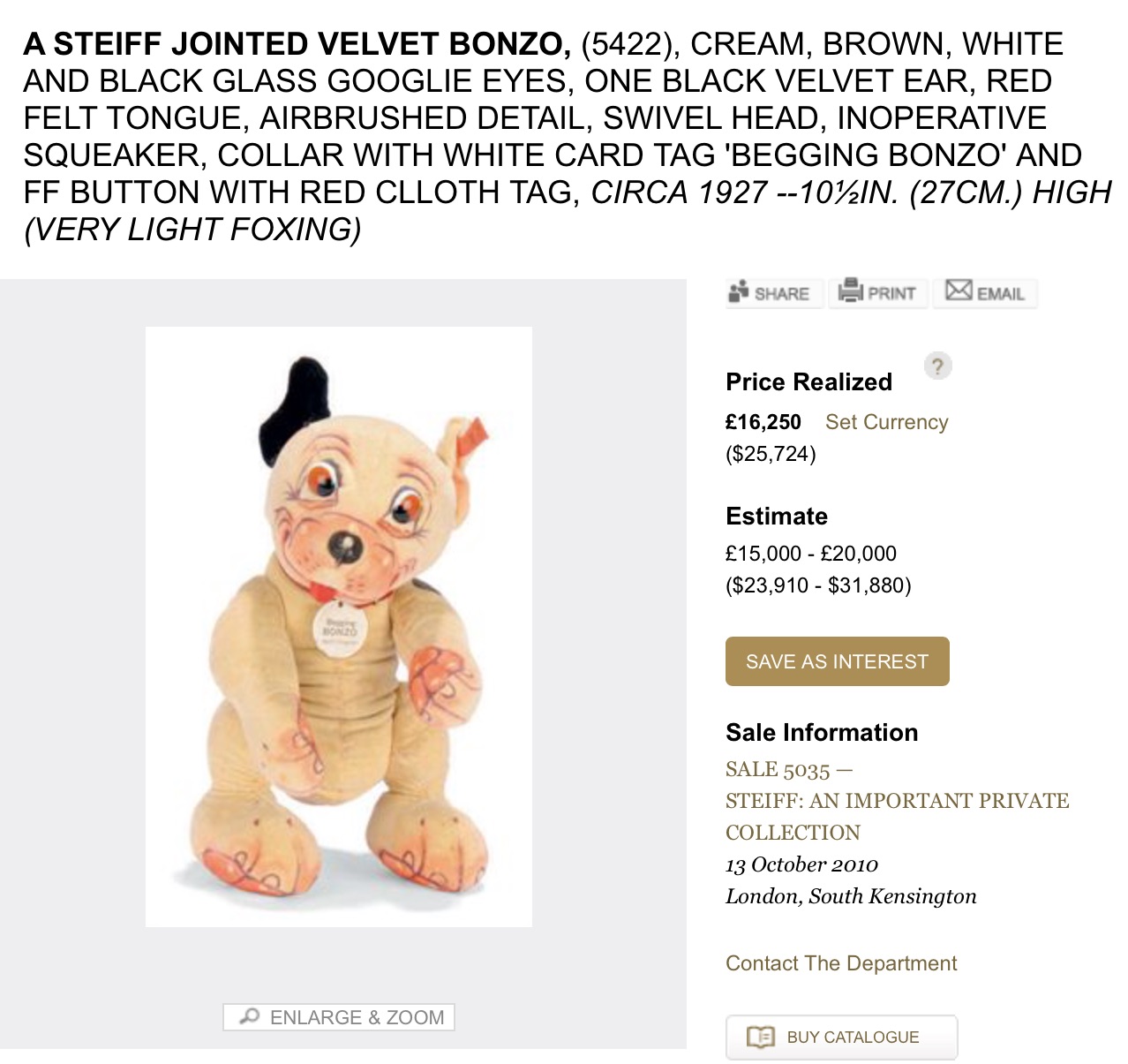
This Bonzo is truly in a class by itself... almost! It is only the second one ever that Steiffgal personally has seen go up for sale, and the first ever in this size. In 2010, Christie's in London sold a 27 cm version with all IDs for £16,250 or $25,724! This Christie's example had his red Steiff tag numbered "5422," meaning 5=jointed, 4=velvet, and 22=22 cm sitting. This big boy appears here on the left; the photo is from Christie's.

Although Bonzo never "officially" made the Steiff line, he did make a little known appearance in another rare novelty pattern of the time. Bonzo was produced as a "Bonzoette," which was a very long limbed, dressed version of his design. These items were called "car and play" dolls or "Charleston Animals," based on the Charleston dance craze of the 1920’s, with its fast moving arm and leg movements. Other "play and car dolls" included Bulliette, the bulldog, Fluffiette, the cat, and Rabbiette, the rabbit. Each doll had the head of the character, mohair or velvet paws and feet, and dangling velvet limbs. Most were available in several bright, happy "jelly bean" colors and in 20, 30, and 43 cm, with the larger sizes having a squeaker. Bonzo was made in 30 and 43 cm in blue or orange in 1928 only and is arguably the rarest of all of these "play and car" dolls. These long legged Steiff novelties appeared overall in the line from 1927 through 1932. A picture of Bonzoette appears on the left, it is taken from Pfeiffer's 1892-1943 Sortiment Book

As noted in the cataloging above, Bonzo is in part responsible for the design and introduction of another late 1920's Steiff rarity, Cheerio the Puppy. This pattern is known for his todder-esque appearance, huge eyes, open mouth, and happy-go-lucky personality. Several versions were produced. A begging version was manufactured in 17, 22, and 28 cm from 1928 though 1931. Begging Cheerio was also made as a press and release music pup in 22 and 28 cm from 1928 through 1930. Cheerio was also manufactured standing on all fours in 10, 14, 17, 22, and 28 cm from 1928 through 1932. Standing Cheerio also appeared as a press and release music box in 17 and 22 cm from 1928 through 1930. And, like Bonzo, Cheerio was also produced as a "car and play doll." "Cheerioette" appeared in the line 30 and 43 cm from 1928 through 1931.  A begging Cheerio, from Steiffgal's collection, is pictured here on the left. 

Be sure to check out Daniel's amazing Steiff Bonzo, and other Steiff and Teddy treasures, at the upcoming SAS toy auction event on June 9th, 2016.  For more information on this sale, please click here!

Steiffgal hopes this discussion on Steiff's fantastic and really rare Bonzo dog has gotten your tail a'wagging!

Have a question about one of your Steiff treasures? Let's talk! Click here to learn more.

Friday, January 4, 2013

Make 'Em Laugh... With Steiff's Vintage Comic Strip Dolls

It's kind of funny, but Steiffgal has always had a fascination with Steiff's interpretation of famous cartoon figures. So of course she was delighted when a colleague gave her the heads up about a great group of vintage Steiff comic strip dolls coming up for auction at Theriault's January, 2013 "Stars - A Celestial Collection of Antique Dolls" three day event.  Three items in particular really caught her eye.  Let's take a look and see what makes them so interesting from the design and historical perspectives. 

Foxy Grandpa, lot #237
This first selection clearly proves it is possible to become more handsome the older you get!  Here we have Steiff's Grosspapa or Grandpa, produced from 1904 through 1915.  He is lot #237 and is described as...

"14" (36 cm.) Felt swivel head with press-modeled facial features, pronounced nose, center seam, stitched ears, black shoe-button eyes on felt pads, mohair wig, attached hat, firm ball-shaped stomach with jointed arms and legs, shaped knees, over-sized feet, wearing original sewn-on blue wool costume. Condition: fair, some fading, few moth holes, wig very sparse. Comments: depicted is the comic character "Foxy Grandpa" from the early 20th century comic series, Steiff, circa 1910. Value Points: very rare early doll by the firm, he has an early Foxy Grandpa celluloid pin and a first prize award from a 1944 doll show."

Original Foxy Grandpa comic strip from 1905, click to enlarge
And just who is this silver fox?  "Foxy Grandpa," a US cartoon series introduced in 1900, was penned by Carl E. Schultze.  It ran through the 1930's.  The strip told of the (mis)adventures of a grandfather and his two grandsons.  You can see an example of the strip above.  Steiff also manufactured the two grandchildren as dolls in the overall 1904 through 1924 time frame.  Steiff produced Foxy Grandpa with both a velvet face and a felt face, but the velvet face is much rarer.  According to Steiff records, both versions had a press voice box hidden under Grandpa's felt hat.  In 1996, Steiff reproduced Foxy Grandpa as a replica in an edition size of 1,200.

Barney Google and Spark Plug, lot #235
It's time to hit the ground running with our next cartoon highlight.  Here we have Barney Google and Spark Plug, his faithful racehorse.  The pair was produced from 1925 through 1927.  They comprise lot #235 and are described as...

"5" (13 cm.) 5"(13 cm.) Barney, 8"l. Spark Plug. The set comprises stockinette Barney with press-shaped and painted features, prominent nose, large felt eye whites with black bead eyes, whiskers, armature padded body, wearing original purple vest and blue jacket, shoes and hat, plaid cotton pants; along with Spark Plug, who has grey mohair coat with sparsely-inset yarn mane, bead eyes on felt pads, felt tongue and feet, harness, and yellow felt blanket with patches and printed Spark Plug name. Condition: generally excellent, bright fresh colors, few moth holes on blanket. Marks: Copyright 1923-1924 by King Features Synd, Inc. DeBeck (muslin pad on one foot) Steiff (silver button in ear). Comments: Steiff, Germany, the set was issued in 1925-1927 only, and according to company archives only 615 sets were sold. Value Points: very rare Steiff comic character set is well-preserved and delightful."


Here's more about this (sort of) dynamic duo.  Barney Google, penned by artist Billy DeBeck, debuted in the Hearst Newspapers in 1919.  Barney was a silly, bumbling little man who seemed to find even the simplest things complicated. In 1922, DeBeck gave Barney a new companion, a race horse named Spark Plug; a few years later they were joined by an ostrich named Rudy.  Barney Google was so popular that he inspired the 1923 hit tune "Barney Google (with the Goo-Goo-Googly Eyes)," as well as the 1923 record, "Come On, Spark Plug!"  You can listen to the song above by pressing on the white arrow in the middle of the record.  In addition to this Barney/Spark Plug set, Steiff also produced several Barney Google themed pull toys on wooden during this same period.  Rudy was made as a sample, but never put into widescale production.  

And just how rare are Steiff Barney Google themed items?  Steiff was asked to set up an exhibit of incredible rarities at the FAO Schwarz store in New York City in honor of the retailer's 150th anniversary in August, 2012.  From the archives, Steiff sent over a Barney Google and Spark Plug on wheels  - along with things like the earliest rod bear, an original hot water bottle Teddy, and a turn of last century tumbling bear.  So even Steiff considers these characters quite legendary!


Happy Hooligan, lot #232
Let's move happily along to our third and final Steiff cartoon auction highlight.  Here we have Steiff's Hoolygan or Happy Hooligan, produced from 1904 through 1927.  He is lot #232 and is described as...

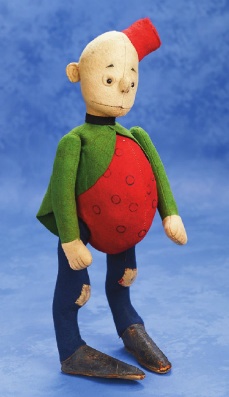
"14" (36 cm.) Firmly-stuffed felt character with egg-shaped head having center-seam, shoe-button eyes, caricature face, upturned nose, stitched-on ears, red attached cap, big plump red felt stomach with painted circle designs, green felt jointed arms and jacket, and long spindly jointed legs with patched knees and over-sized leather feet. Condition: good, some shelf dustiness, few moth holes. Comments: Steiff, from their premiere series of character dolls, representing the popular comic strip character of Happy Hooligan, circa 1910. Value Points: delightful character exactly captures the beloved figure from the comic series."

Original Happy Hooligan comic strip from 1904, click to enlarge
Steiffgal's happy to tell you more about this rare comic character Happy, who is actually usually unhappy, was penned by popular and prolific writer Frederick Bur Opper and introduced in 1900.  According to the artist, Happy is "a sad, smiling victim of wayward children and heartless adults... and a direct ancestor of (Charlie) Chaplin's "little man"."  He and his two brothers, Montmorency and Gloomy Gus, were Irish tramps who traveled across Europe.  They were sometimes joined by two Frenchmen named Alphonse and Gaston.  Steiff produced a 35 cm version of Alphonse from 1904 through 1928 and a 50 cm version of Gaston from 1904 through 1927.  Steiff records also show that these Frenchmen were also produced as pantom or marionette style puppets on roller skates.  Like Foxy Grandpa, Happy Hooligan also had a press voice box hidden under his red felt hat.

Steiffgal hopes this review of Theriault's cartoon doll auction highlights has been as delightful as reading the Sunday newspaper comic section!

Have a question about one of your Steiff treasures? Let's talk! Click here to learn more.
The teddy bear search engine