Showing posts with label canine. Show all posts

Friday, November 15, 2024

These Three Dog Highlights Take The Blue Ribbon At Ladenburger Spielzeugauktion's November, 2024 Steiff Archive Sale

Ladenburger Spielzeugauktion of Ladenburg, Germany is presenting its 415 lot Steiff Archive Auction on November 23rd, 2024. This breathtaking sale features century spanning treasures directly from the Margarete Steiff GmbH archives in Giengen. In an effort to consolidate space within their storage areas, Steiff decided to deaccession some redundant items from their overflowing archives. As such, the Giengen company has partnered with Ladenburger Spielzeugauktion to find new homes for these fine archival items.

Every item on offer in this amazing event is worth a shout out, so it is nearly impossible to select highlights. Given her affinity for all things canine, here are three incredibly rare dogs that are documented in Steiff's literature that Steiffgal has never actually handled or seen in real life (but would love to!)

You can't help but smile when it comes to this first auction doggie selection.
This is lot #4, Steiff's Tino. He is cataloged as: TINO, made in 1936, with button, block letters, unused red flag, number on flag: 3322.2, seat height: 22 cm, yellow/brown mohair plush, black snout, lovely expression, orig. silk bow, rotating head, expressive, hand pattern from the Steiff archive with original Steiff archive trailer. Tino has an opening bid of 360 euro.

It is not exactly clear what breed terrific Tino represents.
According to Pfeiffer's 1892-1943 Steiff Sortiment, he is simply an ingenious dog. This might mean he doesn't have a specific breed - much like the company's legacy and popular Molly design who was simply referred to as a puppy. Molly's gentle, sitting, and fluffy aesthetic opened the floodgates to an influx of prewar dog designs between 1925-1938, when nearly 40 new pup patterns were noted in the Steiff catalog - Tino being one of them. Tino's distinctive black facial mask, ears, and tail, as well as body shape and form, have playful, pug-like qualities - which might be the reason he catches Steiffgal's eye! Tino was produced in 17 and 22 cm from 1936-1939.

The next auction pick has a face only a mother (or any vintage Steiff collector) could love.
Here we have lot #8, Bertha The Cartoon Dog, with an opening bid of 650 euro. She is cataloged as: Siberian cheese hunting dog made in 1927, item no.: 5332, hand sample in a special small size, caricatured dog, brown tipped mohair, 5-fold jointed, felt insert on the face, embroidered eyes, colored outlines of the eyes, nose and mouth area , H: 18 cm, L: 29 cm, orig. red silk bow, extremely rare, exceptional, hand sample from the Steiff archive produced without button, shield and flag, with original Steiff archive trailer.

The auction house also shares:
Bertha is the Steiff-created replica of the funny dog ​​from the American comic "Boob McNutt" by illustrator Rube Goldberg, popular in the 1920s. The little Siberian cheese dog pulled all sorts of pranks in his comics. The comic short stories were published in the Sunday editions of most Western newspapers in the United States from 1915 to 1934. The unusual dog was produced by Steiff in 1927 with 24 copies in two different sizes and variants (with sewn eyes and with glass eyes). Unfortunately, production was stopped due to low demand.

Steiff often used animals or characters from popular comic strips as inspiration for new product introductions, which helps to explain Bertha's origins. You can see one of Bertha's original 1920s era cartoon strips just above... please click on it to make it bigger. This trend began at the turn of last century, when Steiff produced a series of fully jointed dolls based on the comic strip series Happy Hooligan. Steiff's Bertha has several design features that are very typical to the mid-1920s. These include tipped mohair, a dimensional eye treatment, and a distinctive, youthful appearance. According to Pfeiffer, Berta was made commercially in 22 cm in 1926 only. For more information on Bertha, check out:
http://strippersguide.blogspot.com/2022/09/toppers-bertha-siberian-cheesehound.html

There's not a hair out of place with today's final highlight.
Here we have lot #31, Steiff's Puli, with an opening bid of 280 euro. She is cataloged as: Puli, made on September 7th, 1935, dog, with button, shield and flag, block letters, elongated f, unused yellow flag, No. 1328.02, handwritten inscription on the breastplate “Puli”, glass eyes, shaggy long mohair, red original . Leather collar, blue-gray coloring, fixed head, unused condition, H: 26 cm, L: 35 cm, with orig. Steiff archive trailer.

Puli dogs are very smart, loyal dogs - and are best known for their corded, dreadlock style coat.
Their waterproof fur can be kept long or trimmed, but either way requires way more attention than most other dogs. It is possible that Steiff made a Puli for its general line in the 1930s because the dog was starting to gain global popularity as well as visibility at the time. The American Kennel Club (AKC) recognized the Puli as a dog breed in 1936. The company's long, curly mohair was a great material to replicate the breed's distinctive coat. 

Steiffgal hopes this discussion on these amazing and rare canines has been a fetching experience for you!


Have a question about one of your Steiff treasures? Let's talk! Click here to learn more.

Thursday, December 1, 2022

Sit and Stay and Check Out This Tiny Steiff Mechanical Marvel!

Now who is a good dog? Those are every puppy's favorite words, and in some ways, Steiffgal's as well! Check out this happy handful of a Steiff 'herd... German Shepherd, that is! This prewar treasure packs a lot of features and design elements into a very small body. He'll have you smiling ear to ear for sure.

This blue ribbon buddy is Steiff's tail-turns-head German Shepherd dog.
He is 15 cm tall, sitting, and made from wool plush (that has practically been entirely loved off.) His cheerful face comes alive with pert triangular ears; brown and black glass pupil eyes; a black hand embroidered nose; and an open, felt lined, smiling mouth. He is solidly stuffed with excelsior, which is a manufacturing feat in itself, given how small he is, and how narrow his limbs are. The excelsior stuffing holds his metal tail-moves-head apparatus in place; it would tend to shift or settle if it was packed in kapok or other lighter filling. This mechanism enables his head to move in a circle when his sweet little tail is twisted. 
This little lovely was made in 15, 18, 23, 29, and 36 cm from 1931-1935 overall. 

One of the most astonishing things about this example is his IDs.
They are great in themselves, but it is sort of a miracle that they even exist at all, given how much love and use this guy clearly has had over the years. He wears his all original brown leather collar. It is held together with two long trailing "F" Steiff buttons. He also retains his original, red imprinted, watermelon shaped named chest tag. It is interesting that on the back of the chest tag, it is stamped "Int. pat. app. for" meaning "International Patent Applied For". Steiff was very proud of its tail-moves-head technology, and other companies were starting to copy it starting in the early 1930s. It really is amazing that he still has his collar and tag, given how ephemeral they really are, relative to his sturdy overall construction.

This pretty puppy has a great place in Steiff's prewar and early midcentury German Shepherd production history.
German Shepherds have been featured almost continuously in the line since 1923. Perhaps the best known Steiff German Shepherd design is Arco, who was introduced in 1935 but got his name in 1937. Pre-war Arco was made from mohair and had prominent, felt lined ears and a smiling, open, felt lined mouth. He was made standing on wheels (in 35, 43, 50, 60, and 70 cm), standing (in 14, 22, 28, 35, 43, 50, and 60 cm), and sitting (in 17, 22, and 28 cm) from 1937 to 1943. During this time, Arco was sometimes also referred to as "The Police Dog." As one of Steiff's most beloved late pre-war dog designs, early Arco again graced the line from 1951-1956 in the form of a 10, 17, and 22 cm standing version. These guys strongly resembled their pre-war pattern. A 43 and 50 cm standing version on wheels was also manufactured from 1949-1956.

Steiffgal hopes this discussion on this tiny Steiff treasure has brought a big slice of joy to your day.

Have a question about one of your Steiff treasures? Let's talk! Click here to learn more.

Sunday, August 14, 2022

You'll Be All Ears Over This Tiny Prewar Steiff Fox Terrier!

Size defies with this couldn't-be-cuter baby Steiff pup!
Steiffgal has a thing for smaller scaled Steiff pets, like cats and dogs. Probably because they pose so well with other larger Teddy bear and doll companions. And you can never have enough friends - especially these days! Check out this happy handful and see what makes him so irresistible and interesting from several perspectives!

What we have here is Steiff's late 1920s era Foxy Fox Terrier.
He is 10 cm tall, standing, head jointed, and made from white mohair. He has very distinctive jet black mohair ears. His face comes to life with proportional brown and black glass pupil eyes, a black hand embroidered nose and mouth, and black and orange airbrushing around one eye. He also has traces of black airbrushed highlights around the base of his tail. He wears a red collar, but it is not original to him. This darling design was produced in 10, 14, 17, 20, and 22 cm from 1929-1933 overall.

This pup's IDs are very helpful in dating him.
Foxy retains his somewhat rare brass colored trailing "f" button and traces of his yellow ear tag as his IDs. This brass button appeared on some Steiff items from around 1933/34 through 1943. The yellow ear tag debuted on Steiff items starting in the early 1930s. Given all this, it is Steiffgal's best guess that this Foxy pup was "born" at the very end of his production timeline.

This fine Foxy was made at a transitional period in Steiff's product development history.
It is interesting to note that just prior to his introduction in 1929, Steiff debuted another Fox Terrier named Foxy in 1928. 
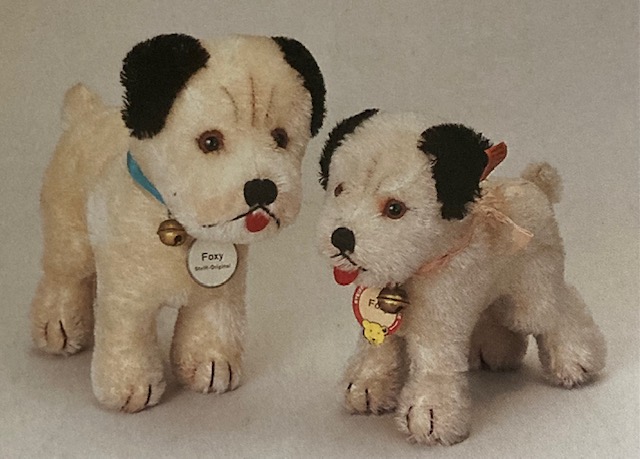
You can see this Foxy from 1928 in the photo here on the left; the image is from Pfeiffer's 1892-1943 Sortiment. The 1928 Foxy design really reflected the playful and optimistic aesthetic of the "roaring 1920s." Like many of the new design introductions of the mid to late 1920s, the 1928 Foxy was very youthful, soft, and playful in design. He had chubby proportions, a round head, oversized eyes placed low on his broad forehead, and a silly felt tongue. He also had distinctive black mohair ears. This "roaring 20s" inspired design was produced sitting and standing through 1933.

Around 1930, Steiff's product design priorities started to take an entirely different direction than those of the 1920s.
Items distributed through the early 1940s tended to be more streamlined, serious, lifelike, and proportional. This probably had something to do with the socio-economic and political realities happening in Germany at the time. The 1929 Foxy under discussion today shares some of the characteristics of his 1928 relative, but is scaled to real life, has smaller eyes, a leaner head shape, and is a bit more pensive in appearance. What a difference a year makes!

Steiffgal hopes this discussion on this petite prince has been a regal learning experience for you.

Have a question about one of your Steiff treasures? Let's talk! Click here to learn more.

Monday, December 9, 2019

Sit and Stay With This Marvelous Prewar White Steiff Sealyham

Do you like things sealed with a kiss? Usually, there's never any downside to that, especially when it comes to all things button-in-ear. So grab a chair and take a look at this tiny sitting sweetie. You're certain to appreciate the leg up on what makes him (and his kissing cousin) so interesting from the pre-war product design perspectives.  

Your seat-mate for today's discussion is this charming sitting Sealyham. He is head jointed and made from white mohair that has mellowed to a vanilla color over time. He measures 10 cm high and 11 cm long, not including his sweet tail. His face comes to life with brown and black glass pupil eyes. a black hand embroidered nose and mouth, and traces of pink airbrushing around his eyes and lips, He wears his original red collar and brass bell and retains his short trailing "f" button as his ID. Sitting Sealyham was produced in 8, 10, 14, 17, 22 and 25 cm from 1930 through 1939. The sitting version of this breed is somewhat rarer than the standing version as it was produced for fewer years. Given this petite pooch has short trailing "f" button, its a safe bet to conclude that he was made post 1935 or so.

Steiff's prewar Scotty and Sealyham dogs have much in common between their two patterns, including their looks, proportions, materials, and sizes produced. Clearly, Sealyhams were made in white, while Scottys were made in grey or black. Besides color, one small design difference between the two that Steiffgal has noticed are their eyes. From the ones she has seen, some prewar Scotty dogs have almond shaped glass eyes, while others have round glass pupil eyes... while all prewar Sealyhams seem to have round glass pupil eyes. 

So picture this! Check out the page from Steiff's 1938/39 catalog featuring Scotty and Sealyham dogs pictured here on the left. You can click on it to make it bigger. It is interesting to see that Scottys are noted on wheels (eccentric at 17 and 22 cm, and riding at 28 and 25 cm) on the breed page, while a Sealyham model on detachable riding wheels appears later on in the catalog, on a page promoting novelties. If you look at the bottom of the page, you see the words, "dasselbe Modell auch in weiss als Sealyham" under an image of a black Scotty. This translates to the "same model in white as Sealyham," further suggesting that the black Scotty and the white Sealyham are basically "cut from the same cloth." 

Steiffgal hopes this discussion on this tiny white pup has been on the up and up.

Have a question about one of your Steiff treasures? Let's talk! Click here to learn more.

Sunday, September 1, 2019

Spicing Things Up With This Very Vintage Steiff Dachshund

You've heard the expression "age before beauty," but today's special blog guest clearly wins hands down in both categories. This delightful doggie is one of the oldest (and most handsome) canines Steiffgal has in her hug. In dog years, he's nearly 750 years old! Come see what makes him such a top dog in every way.

This precious pooch is standing and five ways (arms, legs, and head) jointed. His head, back, tail, and outer limbs are made from vibrantly hued cinnamon mohair. His chest and inner limbs are made from white mohair which has mellowed to a vanilla color over time. He has three black hand embroidered claws on each of his paws. His face and head come alive with long, floppy felt lined mohair ears, black shoe button eyes, and a black hand embroidered nose and mouth. He retains his original tiny long trailing "f" button and traces of his white ear tag. This pattern appeared in the line in 17 and 22 cm from 1911 through 1913; this is the 17 cm version. These dogs were measured vertically, from the top of their heads to their toes. 


It is so cool how his design details perfectly converge on his era of production. Four really pop here. 

The first is his color. This great cinnamon mohair color is seen once in a blue moon, and mostly on items through the 19-teens. Steiffgal has also seen this color on early bears, monkeys, and squirrels. 

The second is his jointing. Through the 19-teens, it was not unusual for Steiff to joint, or "uber-joint" its popular animals. For example, squirrels and cats were head, limb, AND tail jointed. And some rabbit models were fully jointed - plus had each of their ears jointed! This dandy Doxie is head and limb jointed, which adds to his playfulness, but also to his cost. Fully jointed dogs like this are extremely rare in the Steiff line.

The third is his eyes. This great example has black shoe button eyes, like most items produced before c. 1912 or so. Starting in the mid-teens, Steiff primarily produced their items with black glass, or black and brown glass pupil eyes, to add to their appeal, prestige, and authenticity.

And the last is his facial construction and presentation. After studying this pooch for awhile, Steiffgal noticed that his face has a center seam construction, and a shaved muzzle. These two desirable - and clearly period - design elements are most often seen on Steiff's earliest Teddy bears.


Dachshunds have always been a popular breed in the Steiff production kennel. The 1913 English catalog features eight variations of these "badger dogs." Here on the left you can see this five ways jointed example under discussion today. You can click on the photo to make it larger. He is simply noted as "jointed, fine plush, brown &white/brown." Two models are noted; one at 17 cm and one at 22 cm. And just how much is that doggie in the window? The catalog notes that the 17 cm version costs $1.40 (the equivalent of $36.28 in 2019) and the 22 cm version costs $1.90 (the equivalent of $49.24 in 2019.)

Steiffgal hopes this discussion on this darling Doxie has generated a bit of puppy love for you. 

Sunday, October 7, 2018

Let The Good Times Roll With This Vintage Steiff Molly Dog On Wheels

Mark Twain once wrote, “The dog is a gentleman; I hope to go to his heaven not man’s.” And who could disagree? No company can match Steiff's attention to detail, quality, and appeal when it comes to our favorite canines. Next to Teddy bears, dogs have always been Steiff's most beloved and popular editions.  

Steiff's pre-war dogs on wheels could easily be considered the best of all worlds. These endearing, softly proportioned pets are adorable on their own, as well as the perfect pals for turn of last century dolls. Their wheels give them a distinctly playful - and old fashioned - appearance. So Steiffgal was more than delighted to learn of a very large - perhaps lifesized - 1920s era Steiff Molly on the go! This particular Molly on wheels is scaled to be either a large pull toy, or a small riding animal for a toddler. 

This Steiff pretty puppy is the wheel-deal indeed. She is standing, unjointed, and 35 cm tall. She is made from very long tipped tan mohair which has faded overall to a vanilla color over time, but is still very lush and full. Her floppy ears are "folded over" as they have been since her launch in the mid-1920's. She has oversized brown and black pupil eyes and a black hand embroidered nose and mouth. She rides upon four red wooden wheels. Molly on wheels was made in 28 and 35 cm from 1927-1943 overall. This example was made in the earliest part of that time frame, given that she retains her long trailing "f" button and traces of her red ear tag, as pictured here.  

Steiff's Molly the Puppy is a very important design for three key reason.

1.  First, she is one of the very few Steiff dogs that doesn’t have a “breed” associated with her. For example, Terry is the Steiff Airedale, Foxy is the Steiff Fox Terrier, and Snobby is the Steiff Poodle. This model is simply known as Molly the Puppy.

2.  Second, her 1925 introduction was so successful that she can be credited for opening the floodgates to a huge influx of Steiff dog designs. Between 1925 and 1938, close to 40 new canine species were noted in the Steiff catalogs after her debut. These included the now classic Bully Bulldog, Arco the German Shepherd, and Peky the Pekinese, as well as some lesser-known designs including Cheerio, the laughing dog, Putzi, a caricatured standing dog, and Lord the Great Dane.

3.  And third, she was a prime source of highly successful “theme and variation” product launches. Through the early 1940s, Molly appeared sitting and standing and in numerous color combinations, including red and white, green and white, and blue and white. She appeared as a puppet, purse, pincushion, music box, and Charleston animal, among other items. Smaller versions appeared standing on eccentric wheels, while larger ones, like the example under discussion today, appeared on centered wheels. Steiff used her basic appealing, endearing “young dog” pattern on other lesser known dogs of the 1920s and 1930s, including Trolly (a white, yellow, and brown St. Bernhard puppy), Flock (a blonde and white puppy), Zotty (a white puppy) and Fellow (a black and white puppy). A picture of Fellow and Molly are featured here on the left, the photo is from Theriaults. 

Steiffgal hopes this discussion on Steiff's prewar Molly the Puppy on wheels has been more fun than a joyride for you!

Have a question about one of your Steiff treasures? Let's talk! Click here to learn more!

Sunday, April 22, 2018

A Penny For Your Thoughts On This Steiff Copper Canine

Mark Twain once wrote, “The more I know about people, the better I like my dog.” Is it possible he was referring also to Steiff's wonderful line of pooches? As most collectors know, canines have been well represented in the company's product mix from the late 1800's onward... and are probably second only to Teddy bears as Steiff's most favored collectibles worldwide. 

A penny for your thoughts here! Steiffgal recently had the pleasure of welcoming one of the company's blue-ribbon beauties to her collection - a lovely, early 1950's copper-colored "Cockie" Cocker Spaniel. Although not terribly vintage, or extremely rare from the collector's perspective, Cockie's presentation, construction, and detailing really make her one top dog. Come take a look and see if you too don't also feel the "puppy love!" 

It's easy to have a plush crush on this canine-cutie! Cockie is standing on all fours, head jointed, and is made mostly from mohair. Her soft and floppy ears are made from long mohair, her head is made from short mohair, and her body is made from medium length mohair. She simply glows with well executed, fabulous, and realistic looking airbrushed copper colored highlights. She has three black hand embroidered claws on each of her paws. Cockie's expressive face and muzzle are quite detailed. She has pert brown and black glass pupil eyes and a hand embroidered black nose. Her muzzle and mouth are made from mohair and velvet and are remarkably constructed with dimensional jowls. You can see this detailing in the close up photo here on the left. Cockie retains her raised script button, fully legible ear tag, and US Zone tag as her Steiff IDs. This design was manufactured in 10, 17, and 25 cm between 1952 and 1957. 

Knowing copper Cockie was on a roll, Steiff also produced the 10 cm version of her on blue eccentric wooden wheels from 1954 through 1977, and then again in 1960.  She sashays back and forth, much like a real dog, as she is pulled along on her off-center carriage axles and wheels. This happy handful is pictured here on the left.

Steiff's Cocker Spaniel production can be measured in dog-years. It is interesting to note that this breed did not appear in the Steiff line until the early postwar era. However, the company quickly made up for lost time starting in 1951 when the first Steiff Cocker Spaniel was introduced. The company's earliest Cocker Spaniel, also named Cockie, is sitting, head jointed, and made from brown and white mohair. Like her copper colored cousin, debut Cockie has an elaborately constructed muzzle and a smiling, velvet lined mouth. Sitting brown and white Cockie appeared in the line from 1951 through 1959 in 10, 14, 17, 22, 25, 28, and 30 cm.  The smallest version of this pretty puppy is pictured here on the left.

Steiffgal hopes you enjoyed learning about this wonderful copper (show) stopper of a pooch!

Have a question about one of your Steiff treasures? Let's talk! Click here to learn more.

Friday, April 21, 2017

Calculating The Importance Of This Rare Steiff Walther Poodle

Do you know the saying, "April showers bring May flowers?" Well, if that's true, than the month of May is most certainly going to be "coming up roses," at least around these parts. It's been raining cats and dogs for the last few days, so Steiffgal has spent some time indoors checking out interesting Steiff eBay auction listings. You never know what you'll find listed on this worldwide marketplace! One Steiff rarity caught her eye and inspired her to learn more about it. Check out this prized poodle and see what makes it so outstanding from the design and manufacturing perspectives. 

This eye catching and unusual dog is a special promotional item made for Carl Walther GmbH. The poodle is head jointed and made from grey mohair and wool plush. His face is made from rubber, which was a popular Steiff manufacturing material starting in the early to mid 1950's  When the Walther poodle left the Steiff factory, he wore a blue "Walther" logo tag hanging off of its blue leather collar.  This customer special poodle design was produced in 17 cm and 40 cm in 1955 only.  This is the larger version; the smaller version used grey velvet in the place of grey mohair in its design.  

The Walther brand has deep and broad roots across Germany and the world.  The company, still in business today, is most associated with firearms production. Walther started out making guns at the end of the 19th century. It expanded its production to office machines, like calculators, starting in the 1920's. They continued their calculator line of business through the 1970's.  The poodle was the company's logo for the office division of the company, although its probably no coincidence that poodles are good hunting dogs, too! Walther's poodle came to life with a few black lines, and showed the dog running on his hind legs and effortlessly juggling numbers. The logo tried to demonstrate how easy dealing with numbers could be when you have a Walther machine on your desk. You can see this poodle logo here on the left.

Despite its obvious condition issues, this poodle listed on eBay is still a prince among Steiff's rare promotional items, and is only the second one Steiffgal has ever seen. It aligns to its period of manufacture in three interesting ways.  

First, poodles were a very big deal in Steiff's line in the early 1950's. In addition to the company's standard line selections, including Tosi and several iterations of Snobby, Steiff also created a number of exclusive poodle designs for FAO Schwarz here in the USA. These included fully jointed wool plush poodles and an 80 cm Snobbylac poodle. The Walther poodle has a French trim and most resembles the body shape of Steiff's 1952 wool plush Snobby. You can see the Steiff Walther poodle featured on the cover of one of their business machines catalogs here on the left. 

Second, Steiff started producing items with rubber heads, instead of traditional felt, velvet, or mohair heads, in the early 1950's.  This was done in part to decrease costs and labor, as well as to add flexibility to production and design options. Mostly dolls were produced with rubber heads; favorites from this period are HorZu's Micki and Mecki; the gnomes Pucki, Lucki, and Gucki; the Maggi chef, and LariFari, among others. Steiff's animals with rubber heads include Koko the Cat for the magazine TV Hoeren & Sehen.  

And third, the Walther poodle was manufactured at a critical juncture in the company's history. After many years of hardship and war-induced shortages, Steiff again had the infrastructure to partner with other world-class companies and to produce absolutely custom, top tier items without constraints. This all ushered in a very auspicious period in the company's history.

Steiffgal hopes this discussion on Steiff's Walther poodle has inspired a little puppy love with you!

Have a question about one of your Steiff treasures? Let's talk! Click here to learn more!

Sunday, September 27, 2015

For He's A Jolly Good Steiff Fellow!

It's time to break out in a chorus of "for he's a jolly good Fellow!" And why is this? To celebrate a rare and wonderful vintage Steiff dog! Check out this terrific Terrier.  His name is Fellow, and he is from one of the most interesting periods in Steiff's product design and development era - the very late 1940's and early 1950's. Steiffgal is certain you too will find him smooth as silk!  

This mellow Fellow measures 20 cm high and 23 cm wide. He is standing, unjointed, and made from short brown artificial silk plush, which has been hand airbrushed with black highlights. His tail is made from short black artificial silk plush, while his distinctive forehead and sideburns are well represented by longer brown artificial silk plush. He has three black claws on each paw. His face comes to life with brown and black glass pupil eyes and a black hand embroidered nose and mouth. He wears an artificial brown leather collar and retains his early, red imprinted chest tag and short trailing "f" Steiff button. Fellow was produced in 22 and 28 cm from 1948 through 1949 only.
 
Collectible Airedale Terriers have been a breath of fresh air in the Steiff line since the late 1920's. The first version to roll on the scene was simply called "Airedale Terrier." This standing, unjointed model was on regular or eccentric wheels and produced in six sizes ranging from 17 to 35 inches from 1927 through 1930. From 1933 through 1936, the line featured "Jack," a standing wool plush Airedale Terrier produced in five sizes ranging from 17 to 43 cm. Then, in 1935, Steiff introduced a new Airedale Terrier pattern called "Fellow." Fellow was made from mohair and produced with or without wheels. The wheeled versions came in five sizes ranging from 22 to 50 cm while the simply standing models were made in four sizes ranging from 17 to 35 cm. Both versions were featured through 1943.
 

Fellow was one of the first patterns reintroduced once the factory reopened for toy making business post war in about 1948. In addition to the artificial silk plush model under discussion here, he was also made in mohair in 22 and 28 cm in 1949, and as a mohair ride on animal in 43 and 50 cm from 1949 through 1950. Then, in 1950, Steiff updated its traditional Airedale Terrier pattern and renamed it "Terry." In addition to Terry, Steiff launched many new smaller dog and cat models in the early to mid-1950's as part of their global growth strategy of the era. Terry was made from mohair, standing, and unjointed. He was produced overall in six sizes ranging from 8 to 35 cm from 1950 though 1961; he was also made as a ride on toy in four sizes ranging from 28 to 50 cm from 1950 through 1961. All featured the breed's charming "folded over" style ears in mohair, with the smallest versions having felt ears - as pictured above on the left.
 

Steiffgal hopes this discussion on Steiff's transitional Fellow Airedale Terrier has provided an enjoyable change of pace to your day.
 

Have a question about one of your Steiff treasures? Let's talk! Click here to learn more. 

Monday, July 13, 2015

Less Is More When It Comes To Steiff's Teeny Tiny Pre-War Mohair Dogs

Steiffgal’s a little short on time this week for blogging. So this is a perfect moment to introduce you to one of the most petite treats in her collection – a tiny and very early Steiff Molly Dog. Take a big look at this particularly small pup and see what makes her so interesting – and irresistible!

This happy handful is the smallest version of Steiff’s Molly the Puppy dog. She is sitting, unjointed, and just a hair over 6 cm tall from head to toe measured vertically. She is made from white and brown tipped mohair. Her wee face comes to life with brown and black glass pupil eyes, a simple black hand embroidered nose and mouth, and the pattern’s typical “folded over” style ears. And she even retains her long trailing “f” style button after all of these years. This little girl indeed is the smallest version of Molly produced (formally documented as 7 cm), and appeared in the line from 1927 through 1943. Pre-war, this sitting brown and white Molly pattern was produced overall from 1925 through 1943 in 12 sizes ranging from 7 through 80 centimeters. She was one of the very first models reintroduced post war, reappearing again in 1949 in five sizes ranging from 10 to 25 cm through 1969.

Molly the Puppy is arguably that most important dog pattern ever produced by Steiff. The 1925 introduction of Molly proved so popular that she is credited for opening the floodgates to a huge influx of Steiff dog designs. Between 1925 and 1938, close to 40 new canine species were noted in the Steiff catalogs after her debut, many reflecting her wide eyed expression, childlike proportions, and happy disposition. These included the now classic Bully the Bulldog, Charly the King Charles Spaniel, and Treff the Bloodhound, as well as some lesser-known designs including Cheerio, the laughing dog, and Putzi, a caricatured standing dog.  And despite her advanced age and location on the family tree, this Molly still enjoys a good time; she is pictured here on the left enjoying a "Strawberries and cream" iced tea drink at the Mad Hatter's Tea at the Sanderson Hotel in London. 

And what about her size – or lack of it, in this case? She is indeed tiny, so much so that Steiffgal didn’t even notice her the first time she was checking out a remarkable window display of vintage dolls and toys in the shop of a new friend. But upon a second review, there she was, and now Steiffgal can’t take her eyes off of her! (And, according to the picture to the left, Molly can't take her hungry eyes off a tiny quiche from the same Mad Hatter's Tea!) 

Ironically, really small Steiff mohair animals can be harder and more complicated to make than their larger siblings. This is because their scale requires especially careful material cutting, intricate stitching, labor intensive turning, and especially precise stuffing and finishing. There just isn’t a lot of “wiggle room” for mistakes or manufacturing variation with these tiny mohair treasures; and because they are not economically efficient to produce, their small stature usually is accompanied by a larger than expected retail price tag. As a result, Steiff created relatively few 7 cm sized pre-war era canine companions; these included Bully the Bulldog, Charly the King Spaniel (pictured here on the left with her fellow 7 cm Molly companion), a few Fox terriers including Spotty, Treff the Bloodhound, and Fellow the black and white puppy. Post war, as far as Steiffgal can tell, the only 7 cm mohair dog Steiff made was Fox the Fox terrier, who only appeared in the line in this smallest size in 1949.

Steiffgal hopes this little post on this tiny Steiff Molly adds a big smile to your day.

Have a question about one of your Steiff treasures? Let's talk! Click here to learn more.

Saturday, September 15, 2012

Grabbing The Brass Ring With This Unusual Vintage Steiff Dog

And they call it "puppy love!" Steiffgal's not referring to the famous Donny Osmond song bemoaning a teenage crush here... but about her latest vintage Steiff dog find!  Take a look at this tiny handful of canine cuteness.   Not only is his design blue ribbon quality, his unusual Steiff button is best in show, too!  Sit and stay and take a look at what makes this pooch so interesting from the collector's perspective.


What we have here is Steiff's wonderful Waldi, the long haired Dachshund.  Waldi is 10 cm, standing on all fours, unjointed, and made from copper colored mohair.  He has sweet, longish ears which have been tacked to the side of his head with a stitch or two.  Waldi's face is detailed with shiny black glass eyes and a black hand embroidered nose.  His mouth is indicated by a little black airbrushing.  Waldi wears his original green leather collar and has his red, tan, yellow, and blue "watermelon" shaped bear faced tag, with his name imprinted in crimson.  


This pattern is particularly endearing.  But don't just take Steiffgal's word on it.  Even Steiff describes Waldi in their literature as "a very expressive model."  It is most unusual for the company to comment on their own designs.


Waldi appeared continuously and practically unchanged in the line for almost 50 (people, not dog...) years.  Standing Waldi was made in 10, 14, 17, 22, and 28 cm from 1933 through 1943.  This same design was produced in a "begging" position in 17, 22, and 28 cm from 1933 through 1936, and on wheels from 1933 through 1943.  Post war, standing Waldi was produced in 17, 22,  and 28 cm from 1949 through 1980 and on wooden wheels in 17 and 22 cm from 1949 through 1970. 
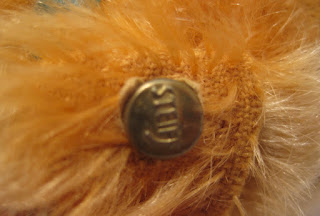
 

This pup's mettle - er, metal, is quite apparent. Besides his lovely copper color, his button also has a spectacular glow about it. Waldi sports a most unusual BRASS colored Steiff button. It is the short trailing "f" style and 6 mm in diameter. This button appeared on some Steiff items from 1933/34 through 1943. This is the first time that Steiffgal has ever seen this button, and it is the only item in her collection of 750+ vintage Steiff items bearing this distinctive trademark. Most of the time, for items produced in the mid 1930's through early 1940's time frame, Steiff used a silver colored short trailing "f" button.

Steiffgal hopes this discussion on Steiff's unusually buttoned Waldi has covered the brass tacks of his identification and legacy for you. 

Have a question about one of your Steiff treasures? Let's talk! Click here to learn more.
The teddy bear search engine