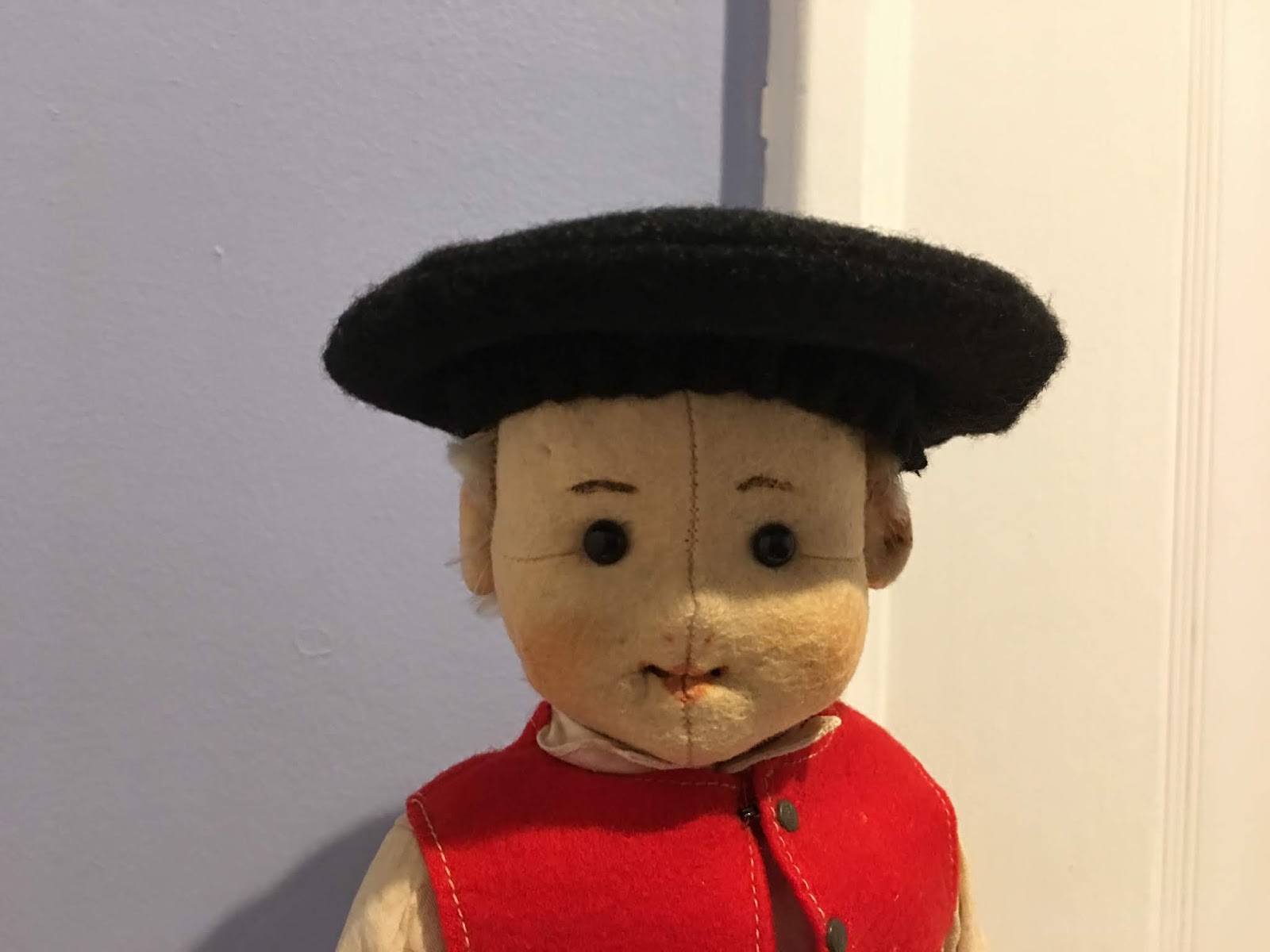
Well hello, handsome! Country life certainly agrees with you. Today's special guest is a delightful example of Steiff's extraordinary, first quarter of the 20th century cloth doll production. Please say hello to Hans, the Swabian farmer.

Hans-down, this is one delightful doll. Hans has human proportions and stands 35 cm tall. He is made from felt and is fully jointed. His hands have stitched fingers. His face comes to life with a brown mohair wig which has faded to silver over time, black button eyes, a prominent vertical facial seam, light blushing to his cheeks, and two horizontal seams by his eyes. His lips and nostrils are delicately defined by pink paint. Hans wears a traditional southern German (Swabian) farmers outfit, including a red buttoned felt vest detailed with five tiny Steiff buttons, black felt pants, a white cotton collared shirt, black tie shoes and white socks, and a black felt hat. He retains his tiny long trailing "f" button-in-ear as his Steiff ID. Hans was made in 28, 35, 43, 50, 60, and 75 cm from 1908-1927.

Hans appeared in Steiff's line for nearly two decades - and for good reasons! His charming presentation, regional outfit typical to southern Germany (where the Steiff factory is located), and ties to a popular Brothers Grimm fairy tale probably explain why - but more about that in just a bit! So given his long production period, how can you tell roughly when he might have been made? Here are a few general guidelines to help approximately date Steiff's center-seamed faced cloth dolls from the early 1900s-late 1920s.
1. Body: The earliest ones had cartoon-like or exaggerated features; starting around 1908 the company started producing children, adults, and soldiers with human proportions.
2. Clothing: The earliest ones had clothing mostly or entirely integral to their bodies; starting around 1908 children and adult dolls with removable clothing were introduced on a large scale. Soldiers usually had most or all of their uniforms integral to their bodies.
3. Eyes: The earliest ones had black shoe button eyes; starting around 1910 or so glass pupil eyes became the norm.
4. Hands: The earliest ones had "fist" style hands; starting around 1910 or so fingered hands became the norm.
5. Materials: The earliest dolls were produced in felt and/or velvet. Dolls with felt heads and linen bodies and/or limbs were produced during the WWI era (around 1914-1919). All felt dolls appeared in the line from around 1905-1914 and then again from around 1920 through the late 1920s.
If you overlay these guidelines on the Hans under review today, this model was most likely produced in the c. 1909-1911 time frame, give or take a bit.
Colleagues who study both Steiff and the history of literature suggest that Hans just might be the Hans of the Brothers Grimm "Clever Hans" story. The title of the story is meant to be ironic, as Hans is pretty much the opposite of clever. In a nutshell, Hans is "a day late and a dollar short" on a number of common sense tasks. These mis-steps ultimately result in the loss of his fiance. You can read, or listen to that short tale here. In 1913, Steiff created a print ad titled "Clever Hans" featuring this farmer doll doing something both foolish and endearing at the same time. This marketing piece is featured above; you can click on it to make it larger. The picture is from D. Ayers & D. Harrison's Advertising Art of Steiff, Teddy Bears & Playthings.
Steiffgal hopes you've found this Hans the Farmer quite the charmer!
Have a question about one of your Steiff treasures? Let's talk! Click here to learn more.




 Posts
Posts