Showing posts with label King Charles Spaniel. Show all posts

Wednesday, March 5, 2025

It's Hip To Be Square With This Steiff Prewar Charly The King Charles Pajama Bag

You snooze, you lose! But everyone who is interested in this next fantastic find is a clear winner. Check out this short inquiry from Steiff superfan Michael, who writes about an unusual novelty. He simply writes...

"Hi, could you give some detail and history on this pajama case, I think?"

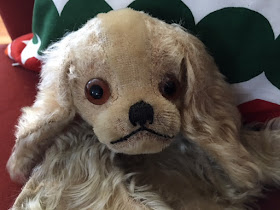
It's hip to be square with this marvelous 1930s era Steiff Charly the King Charles pajama bag. The bag itself is 30 x 30 cm, square shaped, and made from long, soft tan mohair. It closes with a metal zipper with a pull ring and is fully lined in textured light green fabric. All of these details appear to be original to the bag. The bag itself is decorated with the head of Steiff's signature Charley the King Charles Spaniel. Charly's head is made from mohair and measures about 15 cm long. It is head jointed to the bag and was designed to rotate. His face is detailed with oversized brown and black glass pupil eyes (one appears to be missing), a black hand embroidered nose and mouth, and oversized, floppy ears, just like the real dog. And cue the happy dance - this great novelty retains its long trailing "f" button as its Steiff ID. 


This functional favorite was made as part of a series of children's pajama bags in the late prewar period. They were formally called "night dress bags" and were the first style of pajama bags that Steiff launched to the world. For the most part, they are really rare and seldom seen on the secondary market as they were designed to be used and loved as toys as well as functional items. As such, most wore out or were lost to time. Their basic "template" was a simple, square shaped and lined bag with the head of a well-known Steiff pet of the era. They were produced from 1930-1937 overall and came with Teddy baby, Bully, Charly, a Scotty, a Sealyham, Molly, or a Siamese cat as the animal detailing. This is the first one Steiffgal has seen with a Charly as its featured animal.


This rare pajama bag appears to be in really nice condition overall. It is missing an eye, which sometimes happens. Replacing the lost eye would add to its appeal and presentation, and is not that difficult to do with the right needle and thread. However, it is sometimes challenging to find an exact ocular match in terms of size and era. And for some reason, eyes that don't match often look a little strange. As such, if Michael is not able to find an exact match, he may consider replacing BOTH eyes on this item to give the face a pleasing and authentic balance. Of course, it is important to note and disclose any and all known restoration on a vintage item if you are considering selling it at some point in the future.  


Steiffgal hopes this discussion on Steiff's Charly the King Spaniel pajama bag has been the crown jewel in your day today. 


Have a question about one of your Steiff treasures? Let's talk! Click here to learn more.

Sunday, December 19, 2021

Moving And Grooving With This Darling, Debut Steiff Doggie!

This next fantastic find is bad to the bone, but in the very best way possible! Check out this sweet baby pup that really knows how to move and groove. This recent addition to Steiffgal's collection arrived via an auction box lot win just a few weeks ago. Steiffgal couldn't be more pleased with him... but just who is this somewhat mysterious canine?

This precious pup is none other than Steiff's first and earliest Spaniel. Many thanks to Steiff super fan, and super friend, Karin Houben for her help in identifying him! He is fully jointed and measures 15 cm tall and 23 cm wide (nose to fanny) - not including his tail. His body, limbs, and muzzle are made from tan mohair, while the sides of his face and floppy ears are made from vibrant cinnamon mohair. He has tan hand embroidered claws. His face comes to life with a trimmed muzzle, proportional black and brown glass pupil eyes, and a hand embroidered brown nose and mouth. His IDs include a tiny long trailing f button and traces of a white ear tag. 

Spaniel appeared in the Steiff line for nearly two decades - a pretty significant time frame in dog years - or even people years. He was produced in 17, 22, 28, and 35 cm from 1908 through 1927 overall. Given this example's IDs, somewhat simple body form, and early facial detailing, Steiffgal suspects he was produced towards the very beginning of this time frame. 

It is interesting to note that this Spaniel design is utterly charming, but somewhat "invisible" in the Steiff line. 
Unlike some other popular and prolific Steiff dogs of his era, this pattern was not repurposed into a novelty like a puppet, roly poly, or pull toy. He does shares a number of design similarities with Steiff's fully jointed black and tan King Charles Spaniel and tan and cinnamon mohair St. Bernhard dogs of the same era. And, like many dog breeds in the line, this Spaniel pattern was dramatically updated and reintroduced in the mid-1920s to reflect a far softer, youthful, and playful aesthetic. You can see Steiff's earliest, fully jointed, brown and white Spaniel pattern as he appeared in the 1924 catalog; he is the dog on the far left pictured right below. Click on the image to make it bigger and easier to read. 


Steiffgal hopes this discussion on Steiff's darling, debut Spaniel has been a first of its kind for you!

Have a question about one of your Steiff treasures? Let's talk! Click here to learn more.

Sunday, February 21, 2021

Hands In The Air Over This Marvelous Prewar Steiff Charly Puppet!

The eyes have it with this marvelous Steiff creation. Steiffgal recently welcomed a rare Steiff prewar novelty into her collection... this marvelous Charly the King Charles Spaniel puppet! This darling dog has truly captured Steiffgal's heart via her irresistible expression as well as her place in the Steiff product development timeline. Admit it, you can't look away either! Come take a look at what makes this puppet such a top dog!

This happy handful is 17 cm tall, unjointed, and made from mohair.
Her body, ears, arms, and face are made from longer mohair, while her muzzle is made from slightly shorter mohair. Her head is stuffed with excelsior and is lined with a cardboard finger tube. Her ears are long, floppy, and stitched lightly to the sides of her head. Her mohair has faded overall and evenly to a mellow vanilla color. When she was new, her ears and parts of her face were light brown, and the rest of her was white. Charly has three hand embroidered black claws on each of her paws; these each have a little bit of excelsior in the ends to give them some dimension. Her pouty face comes to life with oversized brown and black glass pupil eyes and a black hand embroidered nose and mouth. She retains her long trailing "f" button as her Steiff ID. Her article number is 317, which translates to 3=mohair and 17=17 cm. This lovely puppet appeared in the line from 1928 through 1939 in this size only. 

This Charly puppet, of course, is a novelty based on the company's beloved and best selling prewar Charly the King Charles Spaniel.
Steiff introduced Charly in the late 1920s, a time of great creativity at Steiff. The original Steiff Charly was produced both sitting and standing; the two versions were head-jointed only. Charly dogs were made from light brown or orange-tipped mohair and white mohair; had extremely long fuzzy ears; large, childlike brown and black-pupil eyes; a very detailed facial seam structure; and a prominent tail. Their filling included soft kapok, meaning that they were lighter in weight and more cuddly than other animals stuffed exclusively with excelsior. Here on the left, you can see a picture of this Charly puppet, along with a number of other charming Steiff puppets in this vignette from the company's 1929 catalog. The image is from Carsten Esser's Steiff Kataloge 1920-1929.

Knowing a good thing when they saw it, the designers at Steiff recognized that Charly would be a great source for “theme and variation” product introductions, due to her popularity with collectors. As a result, she appeared as various novelties throughout the line through 1940 or so. In addition to the puppet discussed here today, other highlights included pincushions, music boxes; tiny Nomotta woolen miniatures, a purse, and a pajama bag. Perhaps the rarest Charly of all was a Pupp Animal Doll. This version was 28 cm and dressed in a playful purple outfit. She appeared in the line only from 1929 through 1930. In 2010, a Pupp Charly realized over $8,300 at auction at Christie's in London. She is pictured here on the left; the image is from Christies. 

Steiffgal hopes this discussion on Steiff's prewar Charly puppet has been a very paw-sitive experience for you. 

Have a question about one of your Steiff treasures? Let's talk! Click here to learn more.  

Sunday, June 5, 2016

Happiness Is A Warm (Steiff) Puppy From Morphy Auctions' Upcoming Toy Sale Event!

In the market for a new blue ribbon addition to your Steiff collection? There's practically an entire kennel of fabulous and unusual Steiff dogs on offer at Morphy Auctions' upcoming Premier Toy Sale on June 24th-26th, 2016. Paws and check out these collectible canine highlights and see what makes them so interesting from the design and feature perspectives.

Steiffgals' going out on a limb with this first pick - a Molliette "Charleston" dangling dog with ID. This is auction lot #802 and is cataloged as...

"This is a delightful 20 cm example of Steiff's "Molliette". She has a mohair puppy head; long, soft unjointed dangling limbs; and mohair hands, paws, and tail. Her body, arms, and legs are made from a lovely shade of lilac velvet that has darkened slightly over time. She has very large black and brown glass pupil eyes and black, hand embroidered claws, nose, and mouth. She retains her original bell, tattered lime green neck ribbon, ring, and pompom as accessories; her tan hanging ribbon may be a replacement. Molliette is one of a series of "play and car dolls" in the Steiff catalog from 1927-1932. These were based on the most popular named Steiff characters of the time. Each had the head of the character, mohair paws and feet, and dangling velvet limbs. Most were available in several bright, happy "jelly bean" colors and in 20, 30, and 43 cm. It has been suggested that the design of this series was based on a similar line from the Chad Valley Toy Company of England called "Tango Toys." Molliette has her most exceptional metal-rimmed chest tag as her Steiff ID. Condition: As noted. Slightly dusty but in very good to excellent condition overall. Provenance: From a Florida estate. Size 8-1/2'' T. Estimate: $800 - 1,600."

Good golly, what a great Molly! This Molliette design is a example of many of the influences that really took priority in the 1920's for Steiff. Its core "Molly the Puppy" pattern, introduced in 1925, was specifically designed to be as soft, fluffy, and child-like as possible. Her candy hued body - appearing in blue, pink, orange, purple, green, or yellow - reflected Richard Steiff's directive to add color and interest to the company's product lines, as well as a distinctly feminine appeal. And her novel design, based on the Charleston dance craze, shows how Steiff - despite its location in rural southern Germany - was keenly aware of worldwide cultural trends and their importance in growing their footprint and reputation as an international leader in the toy industry. Teddy Rose, pictured here on the left, was also in the line around the same time as Molliette, and shares many of these same design priorities. 

Steiffgal's second highlight, an early King Charles Spaniel, is eye candy in many ways. This is auction lot #818 as is cataloged as...

"This very interesting and early Steiff King Charles Spaniel is 21 cm tall and 37 cm wide, unjointed, and standing on all fours. She is made from white and copper colored mohair, which has thinned and darkened over time. She has long ears and a playful tail. Most interestingly, her oversized black eyes are backed in orange felt; this is the first time this cataloger has ever seen this outstanding and all original detailing. Her pouty face comes to life with a hand embroidered brown nose and mouth. This handsome design was produced in 17, 22, and 25 cm from 1924-1927. Condition: As noted. Spaniel retains her tiny trailing "F" Steiff button. Dog has been professionally cleaned and partially restuffed. With surface losses commensurate to age. In good to very good condition overall. Size 14'' L. Estimate: $200 - 300."

This sweet King Charles Spaniel is a prince of a pick. And, his felt backed eyes make him quite the looker. It was not that uncommon in the past for Steiff to add a felt backing to an animal's eye to help give its face a bit more depth and emotion. Perhaps the best example of this is the red felt the company used behind the eyes of its all-black Titanic Mourning bears from 1912. An 18" tall example of these rare and beloved bears - sold by Morphy's for $34,800 in 2011 - is pictured here on the left. Steiff has also used felt backed eyes on some of their rabbits, birds, and squirrels, among other species. However, this is the first time that Steiffgal knows of where the company has used orange felt to back the eyes of a dog, or any species at all!

This final auction highlight is truly Ivy League. This is lot #861, an extraordinarily rare Steiff standing Yale Bulldog. He is cataloged as...

"This standing, head jointed Yale Bulldog does not appear in the standard Steiff reference books. However, he is pictured in the 1951 FAO Schwarz catalog, along with seven other Steiff college and military mascots. His price at the time was $10.00. The dog is made from mohair and is realistically hand airbrushed with black, tan, and brown highlights. His comical face comes to life with one black ear and one tan ear; unusual “squint” style black and blue eyes; a black glass button nose; and elaborate jowls. He wears a blue and white felt Yale blanket and a red studded collar. He retains his US zone tag, button, and yellow ear tag as his Steiff IDs. Condition: As noted. Very good to excellent condition overall. Estimate: $600 - 1,200."

And just what makes this one top dog? His marvelous, clean condition; extremely appealing presentation; fantastic construction (with a face only a Steiff collector could love); and absolute rarity, to start with! It's also easy to take a shine to his black glass nose and black and blue glass eyes - both which are quite distinctive for his period. This style black glass nose is also seen on Steiff's early postwar poodles, while these blue and black eyes are also key design element of the company's legacy Lulac rabbit, introduced in 1952. This is only the second standing example Steiffgal has ever seen of this particular mascot pattern, the sitting ones are a bit more common. This examples is in by far the best shape of them all. You can see the original catalog page from the FAO Schwarz catalog here; click on the image to enlarge it a bit in a new window. 

Steiffgal hopes this review of fine canine highlights from Morphy's upcoming June, 2016 toy auction has got your tail a-wagging for this great event!

Have a question about one of your Steiff treasures? Let's talk! Click here to learn more.

Saturday, May 7, 2016

It's A Family Affair When It Comes To Steiff's Classic Pre-War Canines!


For many lucky collectors, Steiff is truly a family affair when parents, siblings, and other relatives also participate in the "button-in-ear" fun! Steiffgal "inherited" her love of Steiff, as well as some of her beloved Steiff family heirlooms, from her paternal Grandmother. Given that Mother's Day in the USA is right around the corner, Steiffgal thought it would be fun to share some of her favorite "family" photos. But don't worry, there's no embarrassing snapshots of cousins in ill-fitting swimsuits eating ice cream cones together on vacation in 1974. These are pictures of families of pre-war Steiff dogs doing what they do best - looking irresistible!

This first family has always been considered "royalty" among Steiff fans. Here we have a sweet trio of the company's "Charly" dogs. These, of course, are modeled after the King Charles Spaniel breed. Each is standing on all fours and made from mohair. All but the bitty baby are head jointed. This pattern is known for its very long, floppy ears and pert tails. Charly dogs traditionally come to life with expressive and oversized eyes, a prominent forehead, freckles on their muzzles, and hand embroidered noses and mouths. Papa Charly is 14 cm tall and 16 cm long; Mama is 8 cm tall and 10 cm long; and Baby is 6 cm tall and 9 cm long; these measurements do not include their tails. Overall, standing Charly was manufactured in six sizes ranging from 7 to 22 cm from 1928 through 1938.

Sit and stay and have a good look at this second Steiff family. These black and white beauties are, of course, a pack of Steiff's Bully dogs. Their pattern is based on the English Bulldog breed. These Bully dogs are all sitting and head jointed.  Papa and Mama are primarily made from black and white mohair and have poseable ears lined in wires. Baby is made from black and white velvet and has stationary ears. All have face and muzzle areas made from tan velvet, prominent jowls, very large brown and black glass pupil eyes, and black, hand-embroidered noses. Papa Bully is 19 cm tall; Mama is 15 cm tall; and Baby is 9 cm tall. Sitting black and white mohair Bully dogs were produced in 9 sizes ranging from 10 to 50 cm from 1927 through 1938 while sitting black and white velvet Bully dogs were produced in 4 sizes ranging from 7 to 17 cm from 1927 through 1939.  

Hold your horses! Most interestingly, these beautiful Bullies all retain some or all of their original and traditional horsehair collars. These are made from long, thin strips of material which are doubled over width-wise; the horsehair fibers are sewn in between the faces of the material. Each collar is held together with a little knot under Bully's chin. The horsehair collar was a typical accessory of the 1920s and indicated a "regal" nature of the item wearing it.

Great Scot, we've already made it to the third and final Steiff family under discussion today. These grey-black pups are utterly charming Steiff Scotty dogs. All are standing and made from black mohair that almost has a "salt and pepper" cast to it. Mama, on the left, is a rare example of the company's tail- turns-head Scotty. She has tri-color almond shaped glass eyes and felt lined ears. Baby, in the middle, and Papa, on the left, have dark black mohair ears, round black and brown glass pupil eyes, and handsome, original black and white woven leather collars that close with two Steiff buttons each. Papa is head jointed and Baby is unjointed. Papa Scotty is 14 cm tall and 20 cm long; Mama is 10 cm tall and 22 cm long; and Baby is 8 cm tall and 12 cm long; these measurements do not include their tails. Tail-moves-head Scotty was produced in 6 sizes ranging from 9 to 26 cm from 1931 through 1934 while the company's regular line standing Scotty dogs were produced overall in 8 sizes ranging from 8 to 35 cm in either gray or grey-black from 1930 through 1943.

Steiffgal hopes this discussion of these great Steiff dog trios has been a family affair for you!


Have a question about one of your Steiff treasures? Let's talk! Click here to learn more.

Saturday, May 18, 2013

This Singing Steiff Spaniel Has Things All Buttoned Up

Some Steiff items are worthy of royalty - especially the company's beloved King Charles Spaniels!  So it should come as no surprise that Steiffgal all but rolled out the red carpet when a dear friend and fellow collector brought this musical "Charly" to her attention!  This dog truly is best of show for so many obvious - and not so obvious - reasons.  Let's take a look at this crownworthy canine and see what makes him so interesting from the design and historical perspectives.


You can't help but want to break into song over this delightful doggy.  This "Musik-Charly" is standing, head jointed, and made from long mohair.  His body and legs are white mohair, while his tail, long playful ears, and the sides of his face are made from brown tipped mohair.  Charly has a very detailed facial seam structure which really emphasizes his sweet and innocent look. His face is detailed with oversized black and brown pupil eyes, a black hand embroidered nose and mouth, and a few freckles on his muzzle.  Charly's music box is activated by pulling on his tail.  Overall, this particular model of standing Musik-Charly was produced in 17, 22, and 25 cm from 1928 through 1931.  Steiff also produced a sitting version of Musik-Charly in 17 and 22 cm during the same time frame. 


Charly has two very interesting features that make him top dog.  The first is his musical mechanism.  In the late 1920's and early 1930's, Steiff produced a number of "Musik" animals based on the company's most popular designs of the day.  These included Molly the puppy, Bully the bulldog, Fluffy the cat, and a sweet standing lamb, among others.  These were all activated either by gently squeezing and releasing the midsection or loins of the animals, or by turning the animal's tail.  However, for the standing Musik-Charly, his music was produced by tugging gently on his tail - not by turning it.


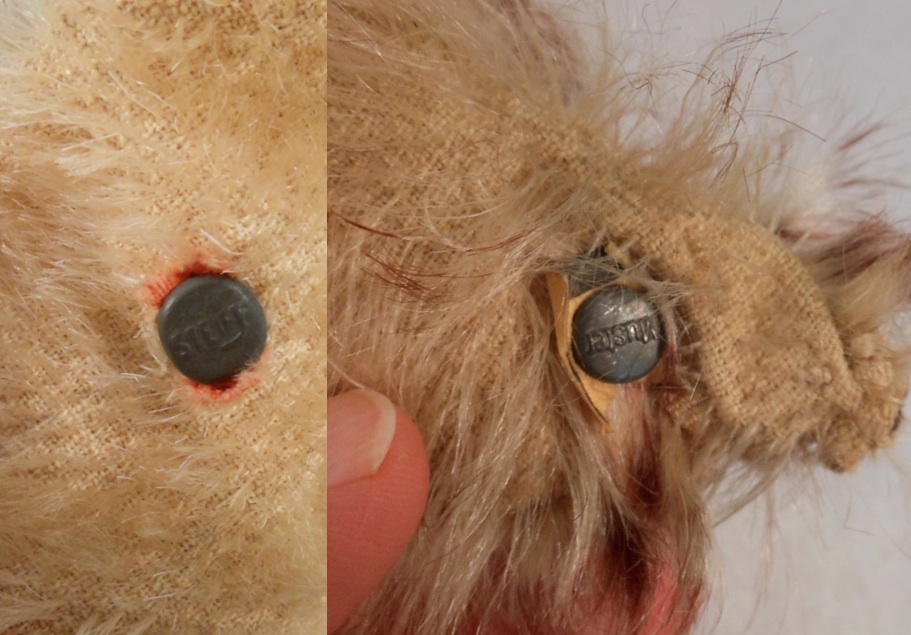
It won't take much to muster your attention towards Charly's second fantastic feature.  In addition to his standard Steiff trailing "f" style button in his ear (on the left size of the photo), Charly also sports a second button in his tail area.  This button, called the "muster" button, was used by Steiff pre-WWII on items considered samples, evolving designs, or prototypes. This is pictured here on the right side of the photo. In general, the button indicated that the item was Steiff property and was not intended for sale or distribution.  "Muster" translates loosely from German to English as "pattern" and in a sense, these "muster" items were just that.  This Charly's "muster" button suggests that he was made in 1928 or before, as the company was gearing up to put this model into production.  

It is interesting to note that Charly didn’t start out as a musical animal, but evolved into one. The original Steiff Charly dog was introduced in the late 1920s. He was produced both sitting (10, 14, 17, 22, 25, 30 and 35 cm) and standing (7, 10, 12, 14, 17 and 22 cm); the two versions were head jointed only. Their filling was soft kapok, meaning that they were lighter in weight and more cuddly than other animals stuffed with crunchy excelsior. An example of the 7 cm standing version is pictured here on the left.  Overall, the Charly pattern appeared in the line through 1936. 

Charly proved to be a great source for highly successful “theme and variation” product introductions, due to his popularity with collectors. He appeared as a 17 cm light brown and white mohair puppet from 1928 through 1939.  Both the sitting and standing versions were produced as pincushions in the 1929 through 1932 time frame.  He was also made as a 10 cm standing or sitting nomotta woolen miniature from 1935 through 1937, a 22 and 25 cm purse from 1927 through 1933, and as a playful, purple dressed 28 cm Pupp-animal doll (pictured on the left, photo from Christie's) from 1929 through 1930.

Steiffgal hopes the discussion on this most amazing vintage Charly dog has been like music to your ears.   

Have a question about one of your Steiff treasures? Let's talk! Click here to learn more.  
The teddy bear search engine