Showing posts with label mascot. Show all posts

Thursday, January 15, 2026

Let The Games Begin With This Sample Steiff Lake Placid Olympic Games Mascot!

Steiff's century-spanning anthropomorphic animal dolls are the best of all worlds. But is it possible there is one that is truly worthy of an Olympic gold medal? Steiffgal thinks so - and is over the moon thrilled to welcome one into her hug. This winter-themed wonder was purchased decades ago in Europe by his previous family. Check out this remarkable Steiff raccoon doll and see what makes him so COOL - literally - from the product design and historical perspectives.

Here we have a sample Steiff Roni the Raccoon doll, made as a possible licensed souvenir item for the 1980 Winter Olympic Games.
These were held in Lake Placid, NY from February 13th-24th, 1980. Roni, who was named as a nod to the venue's Adirondack mountain range, was the cartoon mascot for this event and was designed by commercial artist Donald Moss. Roni himself is 25 cm tall, standing, and unjointed. His head is made from short grey plush with an inset velvet facial mask. His pupil eyes are highlighted with black airbrushing to give him his traditional "raccoon bandit" look. He has a black embroidered nose and a pink painted mouth. His ears are lined in velvet and have a little pink airbrushing to them. He has a very long, fluffy, and bushy tail. Roni's winter garb, which is made from velvet and integral to his body, includes green gloves, a blue snowsuit, and red boots with brown soles. He wears a white bib which has the event's official Olympic logo hand rendered in black on either side.

Roni is branded with his Steiff ear tag and button.
Steiffgal doubts he was produced with a chest tag for two reasons; first, he was made as a sample so there really was not need for this tag. Also, his custom bib is so interesting and so integral to his chest, a chest tag would be redundant or even interfere with his presentation. His yellow ear tag is generic and without digits, so this pattern was probably never assigned an article number. This style of ear tag appeared on items made in the c. 1969/1970 through 1980 era. And his thick, brass style ear button with the script word Steiff on it debuted in 1979. So given the games were in 1980, and it could take a year or so for a licensed product to go from idea to production - all of these dates point to his production taking place in 1979.

It is not clear why Steiff's Roni doll never went into production.
He is on brand, matches the official event logo to a "T", isn't terribly complicated or expensive to manufacture, and is super, super cute! Steiffgal suspects it may have something to do with legal or financial complications often associated with international commercial licensing agreements. However, other companies were able to get production licenses to make Roni dolls, including a version on ice skates. Of course, these simpler patterns were nowhere as fabulous as Steiff's full blown interpretation of Roni! It is interesting to note that Steiff was able to produce Olympic branded and licensed items for other Olympic games, including the 1972 Munich games, the 1998 Nagano games, and the 2010 Vancouver games, among others.

It is nearly impossible to find out any additional details on Roni and this stalled Steiff Olympic project.
The only footnote Steiffgal could find was a reference in Dee Hockenberry's, book, Steiff Bears and Other Playthings Past and Present. Concerning the Roni doll, she notes: Prototype Raccoon: 11 inches. In 1978 and 1979, Steiff, through their US representative, made presentations to the American Olympic Committee in order to obtain a license to make 1980 Olympic souvenirs. Three prototype were made incorporating the Lake Placid mascot and Olympic logo. Although the samples were attractive, an official license was never granted. These are the only examples ever made.

Steifgal hopes this discussion on this Roni the Raccoon Olympic prototype doll has been one for the record books for you. 

Have a question about one of your Steiff treasures? Let's talk! Click here to learn more.

Sunday, August 20, 2023

What a Devilishly Interesting Steiff Mystery!

The devil made me do it! But in this case, it's all in good fun! Check out this note from a new friend who asks about an unusual item she found among her Mother's things. What do we have here? And could this man in red be made by Steiff? Darcie shares:

"I have a red devil doll with a Steiff tag but it is not attached. So I am not sure if it was made by Steiff. I thought Steiff’s have the metal button/tag on them. Can you help?"


Well hell-o handsome! What a great find! Although not specified, it would be Steiffgal's best bet that this devil doll is nearly identical to the blue felt version Steiff made of the Duke University Blue Devil mascot. The Duke Devil was jointed, with a felt body and a rubber head with horns. He was detailed with a blue felt suit, long blue felt tail, and white felt shoes, and carried a three pointed spear. He appeared in the Steiff line from 1954-1958, and then again from 1959-1963 as part of Steiff's early post war series of university and institutional mascots. These charming mascots were featured in F.A.O. Schwarz's catalogs in the early 1950s. 

So what might be the story behind this uncatalogued red version?
Steiffgal suspects it might be a sample or very low edition as she has never seen or heard of a red version previous to this one. The handwritten number "7128" on the early postwar ear tag provided by Darcie refers to 7= in caricature, 1= felt, and 28= 28 cm tall. This makes sense in terms of this guy for sure. 7128 is also the number of the earliest blue Duke Blue Devil mascot edition. Perhaps this red felt version with the US Zone tag and raised script button was made in the c. 1951-1953 time frame (before the launch of the Duke version) when you see items with the US Zone tag, for the most part. It is entirely possible that Steiff saw greater market potential and interest in making this rubber devil doll in blue as the Duke mascot than simply in generic red.

Steiffgal hopes this discussion on this rare devil doll has fired up your interest in the company's unusual mid-century production.

Have a question about one of your Steiff treasures? Let's talk! Click here to learn more!

Saturday, March 13, 2021

This Old School Steiff Mule Is Nothing But Cool!

Feeling a little stubborn today? Well, that just may come in handy in this particular situation! Take a look at this mysterious Steiff mule. Have you ever seen anything like him before? His rarity alone is worthy of military honors.

What we have here is Steiff's seldom seen, largest sized US Army Mule mascot.
He is standing, unjointed, and excelsior stuffed. He measures 34 cm long and 22 cm high. Mule is made from grey mohair that has been highlighted with darker grey airbrushing on his back and neck. His tail and the lining of his ears are made from dark grey felt. His mane and the tip of his tail are made from long black mohair. Mule's facial mask is made from slightly shorter mohair. He has an open, smiling peach colored felt lined mouth. And of course, you cannot help but notice his amazing eyes! They are made from turquoise and black glass and can be tilted to the left and right to create funny and varying facial expressions. Army mule is detailed with a red cord harness and two long, thin orange wool pom-poms - one on either side of his face. He has a squeaker in his belly. 

As far as Steiffgal can tell, this large mohair Army Mule does not appear in any standard Steiff reference books.
He retains his raised script button, traces of his yellow ear tag, and a frayed US Zone tag as his IDs. Given this configuration of IDs, and the dating available on other similar Steiff mascots, it is Steiffgal's best guess that he was made around 1952.

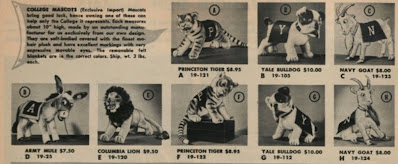
One place this fine fellow has made an appearance is in the F.A.O Schwarz catalog of 1952, along with a number of other Steiff mascots. You can see this catalog page here below; you can click on it to make it bigger. The Steiff Army Mule, on the far left, is listed at $7.50. Adjusted for inflation, $7.50 in 1952 is equal to $73.72 in 2021. The copy for this catalog page reads:

"COLLEGE MASCOTS (Exclusive Import) Mascots bring good luck, hence owning one of these can help only the college it represents. Each measures about 10" high, made by an outstanding manufacturer for us exclusively from our own designs. They are soft-bodied covered with the finest mohair plush and have excellent markings with very expressive, moveable eyes. The removable felt blankets are in the correct colors. Ship. wt. 3 lbs. each."

One thing that really stands out in this design is the Mule's eyes, which are even called out in the F.A.O. Schwarz catalog copy. This eye style appears infrequently on Steiff items, but when it does, it is Steiffgal's opinion that it is the company's way of saying, "don't take this piece too seriously - or literally!" This playful, cartoonish eye style debuted in the 1920's on some of Steiff's Cheerio dogs and Petsy the Baby Bears. Postwar, they appeared on Steiff's 1950's era Lulac rabbit models, as well as these larger mohair 1952 mascots. 

The 1950's and very early 1960's were Steiff's heyday years of producing mascots for the US market.
During this timeframe, Steiff made mascots for institutions including the US Army (mules) and Navy (goats), Columbia University of NY (lions), Princeton University of Princeton, NJ (tigers), Yale University of New Haven, CT (bulldogs), and Duke University of Durham, NC (doll devils), among others. Most of these mascots were based on existing designs in the Steiff portfolio that were modified via different eyes, proportional changes, and/or were accessorized with a lettered felt blanket. The Duke Devil was a completely new design. He was jointed, with a felt body and a rubber head with horns. He was detailed with a blue felt suit, long blue felt tail, and white felt shoes, and carried a pronged spear. You can see this handsome - ah, devil - here on the left; the photo is from Worthpoint. 

Steiffgal hopes this discussion on Steiff's largest mohair military mule ranks highly with you. 

Have a question about one of your Steiff treasures? Let's talk! Click here to learn more.

Monday, May 11, 2020

A Little Something To Celebrate!

I don't know about you, but the current state of affairs is making Steiffgal a little soft. Soft in the head, soft around the middle, and soft in housekeeping affairs - among a few others. Can you relate? In keeping with the theme of softness, Steiffgal would love to share with you two somewhat recent, but totally irresistible Steiff editions that she keeps around as desk decorations. Both were made as celebratory collaborations with other German companies or organizations. Hopefully you will find joy in them as well!

Check out that mug! Our first plush personality is this sitting, unjointed pug dog. He 12 cm tall and is made from tan and brown soft velvet material. His hugely oversized head comes to life with a tuft of long blonde plush, dimensional jowls, and embroidered features including round, black and white cartoon eyes and a big doggy smile. He has a tiny curly tail just like a real pug. And he wears a brown plush collar. His EAN is 990724, and he was produced in 2011. He does not have a chest tag. This precious pug is a "special edition," but not a numbered, limited edition. 

Ladies and gentlemen, may I introduce "Cobby," the goodwill ambassador for FCI, or Federation Cynologique Internationale. This translates to "World Canine Organization." FCI is an international federation of national kennel clubs, and is based out of Thuin, Belgium. Cobby is FCI's mascot, and he debuted on May 6th, 2011 in honor of the organization's 100 year anniversary event. Cobby was so beloved, and so well received, that he has become part of FCI's general communications and branding outreach. According to FCI's website, "Our mascot, which was designed by the well-known Steiff company in Germany, is perfect as a reward or as a present for anniversary events, but also for any event in general." And the Steiff loving world couldn't agree more!

Now let's turn the page to our second soft sweetie. Here we have "Mikael the bookworm." He is 15 cm long from start to finish and made from tan, brown, light green, and darker green plush. His unjointed body is "s" shaped. Mikael's preciously pensive and very studious face comes to life with a tuft of tan hair, black bead eyes, a pink smile, and black embroidered glasses. His EAN is 674655. His button and yellow tag are located on a tab on his body. He does not have a chest tag. Mikael is a "special edition" and arrived packaged in a commemorative box, but is not a numbered, limited edition.

Marvelous Mikael, like Cobby, was created to honor a centennial event. He was made in 2019 for a chain of bookstores in Germany called Thalia. This business opened in 1919 in Hamburg at the Thalia Theater. According to Wiki, "The Thalia Theater is one of the three state-owned theatres in Hamburg, Germany. It was founded in 1843 by Charles Maurice Schwartzenberger and named after the muse Thalia." Mikael has a special hang tag in German, which translates roughly to, "Here is Mikael the bookworm. He reads for a living. He is a completely original Steiff design and is only available through Thalia as a limited edition in honor of our 100 year anniversary. He feels most comfortable in hands that also like to leaf through books." As such, this Mikael has found a perfect home with Steiffgal. 

Steiffgal hopes this discussion on two sort of silly Steiff editions has added a little humor to your day.

Have a question about one of your Steiff treasures? Let's talk! Click here to learn more!

Saturday, December 31, 2016

Is This Steiff Jungle Gem A Diamond In The Rough?

Let's end 2016 in a wild way! Check out this note from a reader on the east coast who found an Ivy-League tier Steiff treasure and wants to learn more about it. Jacob, in part, writes...

"I was hoping you could tell me a bit more about a Steiff tiger that I found recently. It is similar to one you've written a blog post about already but with some noticeable differences. It is an approximately 40 cm long, 23 cm tall mohair tiger wearing a black felt vest with an orange "Princeton" P. It has a Steiff button in the ear and a tag that says "US Zone Germany." It is standing, rather than sitting and does not have a jointed head as the one you've written about did. However, it does have the "cartoon" eyes."

Wow, Steiffgal is seeing stripes over this cool cat. This indeed is the standing, larger version of Steiff's early 1950's Princeton Tiger. He is unjointed and made from mohair that has been hand airbrushed with black stripes. His face comes to life with a prominent, felt lined open mouth, white wooden teeth, and green and black "squint" style glass eyes. And, of course, what makes him head of the class is his orange and black felt "P" blanket. He was made as an exclusive for the upscale US toy retailer F.A.O. Schwarz in the c. 1951-1952 timeframe.

Now let's take a little trip backwards in time and check out some interesting things about this grrrr-eat example. Here you can see this tiger's original advertising from the 1951 F.A.O. Schwarz catalog. Other Steiff mascots listed with him include the sitting Princeton Tiger, a sitting and standing Yale Bulldog, a sitting and standing Navy Goat, an Army Mule, and a Columbia Lion. They ranged in price at the time from $7.50-10.00. This is the equivalent of $69.62 to $92.83 in 2016 dollars. Steiff is, and always has been, a premium product. Ironically, the mascots pictured just below the Steiff versions that were made in France are more expensive than the Steiff ones upon their introduction. It is Steiffgal's strongest suspicion that they would have mostly sentimental value today.
Steiff also created other smaller scaled school and institutional mascots in the late 1950's and early 1960's. These were all standing and included a 14 cm Yale Bulldog in 1957, a 10 cm Princeton Tiger in 1957-1958, 12 and 14 cm Army Donkeys in 1957, a 15 cm Navy Goat in 1957, and a 25 cm Navy Goat in 1957-60.

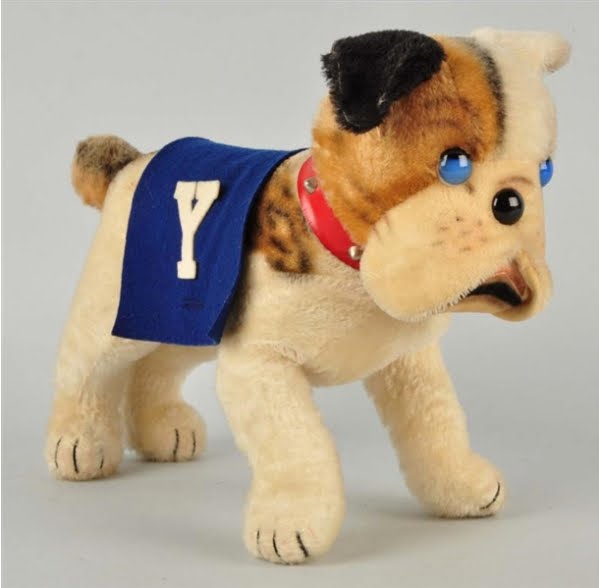
Is this jungle gem a diamond in the rough? Well, as always, something is worth what someone will pay for it. These marvelous mascots come on the secondary market quite infrequently, so "comps" are hard to come by. However, in June 2016, a standing Yale Bulldog illustrated along with the standing Princeton Tiger in the 1951 F.A.O. Schwarz catalog sold at auction here in the US. Estimated at $600-1,200, it realized $900.  This "Handsome Dan" is pictured here on the left. 

Steiffgal hopes this discussion of Jacob's great tiger puts you on the prowl for some great Steiff finds in 2017! Happy New Year, dear readers!

Have a question about one of your Steiff treasures? Let's talk! Click here to learn more.

Saturday, August 13, 2016

Put A Tiger In Your Tank With These Great And Unusual Steiff Postwar Tiger Designs!

Steiffgal has always had a thing for Steiff tigers. After all, who can resist their friendly/fierce personalities, delightful coloring, and the remarkable detailing that bring these big cats to life? Steiff has featured these grrr-eat wild animals in their line almost continuously since 1915, with the first cubs being made of mohair and fully jointed. Given their history and appeal, Steiffgal thought it would be fun to "catch a tiger by the tail" and check out three of the company's rarer post war examples.


Let's kick things off by sinking our teeth into this large and impressive Steiff Bengal tiger. This handsome cat is sitting, unjointed, 43 cm tall, and made from beautifully hand-airbrushed tan mohair. He has green and black pupil eyes, a pink and black shield-shaped embroidered nose, clear monofilament whiskers, and black embroidered claws. His chin, ears, and sideburns are made from long, white mohair. His most distinctive feature is his well formed and open mouth - which is lined in peach colored felt - and detailed with four large embedded wooden teeth. He is either grinning broadly or yawning; perhaps this depends on the time of the day! 


This beautiful Bengal beast was made in 14, 22, and 43 cm from 1959 through 1961 only. The medium and large ones are quite rare on the secondary market. Only the medium and large examples have wooden teeth; the smallest baby size one is toothless - perhaps Steiff thought he was still teething when he was being designed! All three sizes have impressive, long tails.

Our next tiger highlight truly has spirit - school spirit, that is! Here we have Steiff's seldom seen, 25 cm tall Steiff tiger made as a mascot for Princeton University. Smarty-pants is sitting, head jointed, and made from tan mohair that has been brought to life with realistic orange and black airbrushing. He has green and black pupil eyes "cartoon" style eyes, an early pattern pink nose outlined in black, clear monofilament whiskers, and black embroidered claws. His sideburns are made from  long, white mohair. Like his Bengal buddy, this pattern also features a prominent, well designed open mouth - which is lined in peach colored felt - and detailed with four proportionally sized, embedded wooden teeth. He has a working squeaker in his belly. When he was new, he left the factory in Giengen wearing a black and orange felt "Princeton" blanket. 

This Princeton University Prince was made in this size only in 1952 as a special edition for the United States. Other larger Steiff mascots produced in the early 1950's included a 28 cm lion for Columbia University, a 21 cm lioness for Columbia University, a 28 cm bulldog for Yale University, and a 28 cm goat for the Navy, among others. Smaller 1950's era cataloged mascots included a 14 cm bulldog for Yale University, 12 and 14 cm donkeys for the Army, as well as a 12 cm donkey wearing a "DEM" felt blanket for the US Democratic party! (To keep things balanced, Steiffgal once saw a small Steiff elephant wearing a "REP" felt blanket.  This example was probably made as special item for the US Republican party but somehow did not make it into the standard Steiff reference books or cataloging.)

Well, if this discussion hasn't put you to sleep yet, this final example should do the trick. Here we have a most unusual Steiff tiger pajama bag. He measures about 40 cm long and about 20 cm tall. He is in Steiff’s “lying” position, meaning he is curled up with his legs resting gently to his side. He has piercing green and black eyes, a pink embroidered nose, and tufts of longer mohair around his jowls. Tiger is head jointed and made from short tan mohair, which has been "tiger-ized" with careful orange and black airbrushing. Right down the middle of his back is a long metal zipper that extends from practically his neck to his tail; this hides his internal silk-lined pouch designed to  hold the sleepwear of a toddler!

As far as Steiffgal can tell, this tiger pajama bag does not appear in any of Steiff's standard reference books. It is her guess that this tired tiger is probably a modification of Steiff’s standard-line lying tiger cub, which was produced from 1953 through 1978 in 17, 28, 43, and 60 cm.  Steiffgal has also heard of other uncataloged Steiff pajama bags made from standard line designs including turtles and lions.

Steiffgal hopes this review of rare Bengals, mascots, and novelties has indeed put a tiger in YOUR tank!


Have a question about one of your Steiff treasures? Let's talk! Click here to learn more.

Sunday, June 5, 2016

Happiness Is A Warm (Steiff) Puppy From Morphy Auctions' Upcoming Toy Sale Event!

In the market for a new blue ribbon addition to your Steiff collection? There's practically an entire kennel of fabulous and unusual Steiff dogs on offer at Morphy Auctions' upcoming Premier Toy Sale on June 24th-26th, 2016. Paws and check out these collectible canine highlights and see what makes them so interesting from the design and feature perspectives.

Steiffgals' going out on a limb with this first pick - a Molliette "Charleston" dangling dog with ID. This is auction lot #802 and is cataloged as...

"This is a delightful 20 cm example of Steiff's "Molliette". She has a mohair puppy head; long, soft unjointed dangling limbs; and mohair hands, paws, and tail. Her body, arms, and legs are made from a lovely shade of lilac velvet that has darkened slightly over time. She has very large black and brown glass pupil eyes and black, hand embroidered claws, nose, and mouth. She retains her original bell, tattered lime green neck ribbon, ring, and pompom as accessories; her tan hanging ribbon may be a replacement. Molliette is one of a series of "play and car dolls" in the Steiff catalog from 1927-1932. These were based on the most popular named Steiff characters of the time. Each had the head of the character, mohair paws and feet, and dangling velvet limbs. Most were available in several bright, happy "jelly bean" colors and in 20, 30, and 43 cm. It has been suggested that the design of this series was based on a similar line from the Chad Valley Toy Company of England called "Tango Toys." Molliette has her most exceptional metal-rimmed chest tag as her Steiff ID. Condition: As noted. Slightly dusty but in very good to excellent condition overall. Provenance: From a Florida estate. Size 8-1/2'' T. Estimate: $800 - 1,600."

Good golly, what a great Molly! This Molliette design is a example of many of the influences that really took priority in the 1920's for Steiff. Its core "Molly the Puppy" pattern, introduced in 1925, was specifically designed to be as soft, fluffy, and child-like as possible. Her candy hued body - appearing in blue, pink, orange, purple, green, or yellow - reflected Richard Steiff's directive to add color and interest to the company's product lines, as well as a distinctly feminine appeal. And her novel design, based on the Charleston dance craze, shows how Steiff - despite its location in rural southern Germany - was keenly aware of worldwide cultural trends and their importance in growing their footprint and reputation as an international leader in the toy industry. Teddy Rose, pictured here on the left, was also in the line around the same time as Molliette, and shares many of these same design priorities. 

Steiffgal's second highlight, an early King Charles Spaniel, is eye candy in many ways. This is auction lot #818 as is cataloged as...

"This very interesting and early Steiff King Charles Spaniel is 21 cm tall and 37 cm wide, unjointed, and standing on all fours. She is made from white and copper colored mohair, which has thinned and darkened over time. She has long ears and a playful tail. Most interestingly, her oversized black eyes are backed in orange felt; this is the first time this cataloger has ever seen this outstanding and all original detailing. Her pouty face comes to life with a hand embroidered brown nose and mouth. This handsome design was produced in 17, 22, and 25 cm from 1924-1927. Condition: As noted. Spaniel retains her tiny trailing "F" Steiff button. Dog has been professionally cleaned and partially restuffed. With surface losses commensurate to age. In good to very good condition overall. Size 14'' L. Estimate: $200 - 300."

This sweet King Charles Spaniel is a prince of a pick. And, his felt backed eyes make him quite the looker. It was not that uncommon in the past for Steiff to add a felt backing to an animal's eye to help give its face a bit more depth and emotion. Perhaps the best example of this is the red felt the company used behind the eyes of its all-black Titanic Mourning bears from 1912. An 18" tall example of these rare and beloved bears - sold by Morphy's for $34,800 in 2011 - is pictured here on the left. Steiff has also used felt backed eyes on some of their rabbits, birds, and squirrels, among other species. However, this is the first time that Steiffgal knows of where the company has used orange felt to back the eyes of a dog, or any species at all!

This final auction highlight is truly Ivy League. This is lot #861, an extraordinarily rare Steiff standing Yale Bulldog. He is cataloged as...

"This standing, head jointed Yale Bulldog does not appear in the standard Steiff reference books. However, he is pictured in the 1951 FAO Schwarz catalog, along with seven other Steiff college and military mascots. His price at the time was $10.00. The dog is made from mohair and is realistically hand airbrushed with black, tan, and brown highlights. His comical face comes to life with one black ear and one tan ear; unusual “squint” style black and blue eyes; a black glass button nose; and elaborate jowls. He wears a blue and white felt Yale blanket and a red studded collar. He retains his US zone tag, button, and yellow ear tag as his Steiff IDs. Condition: As noted. Very good to excellent condition overall. Estimate: $600 - 1,200."

And just what makes this one top dog? His marvelous, clean condition; extremely appealing presentation; fantastic construction (with a face only a Steiff collector could love); and absolute rarity, to start with! It's also easy to take a shine to his black glass nose and black and blue glass eyes - both which are quite distinctive for his period. This style black glass nose is also seen on Steiff's early postwar poodles, while these blue and black eyes are also key design element of the company's legacy Lulac rabbit, introduced in 1952. This is only the second standing example Steiffgal has ever seen of this particular mascot pattern, the sitting ones are a bit more common. This examples is in by far the best shape of them all. You can see the original catalog page from the FAO Schwarz catalog here; click on the image to enlarge it a bit in a new window. 

Steiffgal hopes this review of fine canine highlights from Morphy's upcoming June, 2016 toy auction has got your tail a-wagging for this great event!

Have a question about one of your Steiff treasures? Let's talk! Click here to learn more.

Friday, August 21, 2015

Dressed To The Nines With This Fantastic Steiff Mascot Rarity

It's just about back to school time around here. Accordingly, lots of families are off to the stores to pick up new shoes, clothing, and backpacks for the new academic year. If Steiffgal could do her fall shopping anywhere on the planet, it would most definitely be at Breuninger, a high end department store in Germany. And why is that? Their logo - a bear of course - that was made into one of the most sought after Steiff editions ever! Take a look at this little guy and see what makes him so interesting from the collector's perspective.
 

They say clothes make the man - but perhaps they make the bear in this case as well? Here we have a fantastic example of Steiff's Breuni bear. He is about 13 cm tall, standing, and head jointed. He is made from blonde mohair. His arms are lined in metal wires and are posable; his legs and torso are stationary. Breuni has oversized, felt soled flat feet designed for standing. His charming face is detailed with black button eyes, a felt muzzle, distinctive black nose, and a simple brown hand embroidered mouth. Breuni is dressed to the nines in blue felt shorts, a red and white double breasted blazer with buttons, a blue bow tie, and fingered white gloves. He retains his Steiff chest tag, raised script button, and legible ear tag with the numbers "714" on it; this translates to 7=in caricature and 14=14 cm.
 

Talk about a personal shopper! This treasure was produced exclusively for Breuninger in this size only in 1956 and 1957; it is Steiffgal's understanding that he was not actually produced as an item for sale but as a premium that the store distributed to customer contest winners and employees. As such, very few were produced and he was not available to the general public - adding to his rarity. 

Now let's catalog one more really cool thing about this Ted. If you look closely, you will see that he is holding a tiny copy of the store's toy catalog. It is titled Breuninger Spielwaren 1956, (Breuninger Toys 1956) and is suspended like a shopping bag around his right hand. And, if you pull out a magnifying glass, you can make out a teeny tiny Steiff Niki rabbit, as well as a Steiff Mecki hedgehog doll on it. Both of these items were introduced in the early 1950's and were extremely popular at the time. The catalog cover also features two toy vehicles which theoretically could also have been made by Steiff, as Steiff was producing these sorts of items in the mid-1950's as well. However, they are just too tiny for Steiffgal to tell for sure.
 
Breuni was introduced as Breuninger's logo mascot in 1952. He was often featured in store advertising and print catalogs; you can see him on the cover of a 1954 publication here on the left. He is still used for store marketing today, and is a beloved and well recognized brand, especially with kids. In 1995, Steiff produced a delightful replica of their original Breuni in an edition size of 1,500. However, unlike the original that was technically 14 cm, this reissue was slightly taller at 20 cm. 

Steiffgal hopes this discussion on Breuninger's rare and well dressed Steiff cub has suited you well.

Have a question about one of your Steiff treasures? Let's talk! Click here to learn more. 

Saturday, September 29, 2012

An Ivy League Style Steiff Mystery

Eye, eye, eye... who is this?  That's the question that immediately popped into Steiffgal's head when she saw this little bug-eyed Steiff fellow at a delightful vintage doll and toy store in Connecticut recently.  Any ideas?  Well, here's a clue to help you out with this mystery.  He's one top dog, representing a top tier Ivy League university!  

Let's take a closer look at his report card.  This brilliant Bulldog is standing on all fours, unjointed, and 14 cm tall. He is made from tan mohair that has been detailed with black, brown, and tan airbrushing and has googly, round eyes.  These great peepers are very similar in style to those of Steiff's Basset Hounds, which were in the line from 1961 through 1963. Bulldog's jowls are elaborately constructed and lined in pink velvet.  Interestingly, his nose is made from black glass and he purposefully has one ear down and one ear up, giving him a most inquisitive look.  Perhaps he is listening to a lecture on ancient history or physics? 

Go to the head of the class if you recognized this Bulldog as the mascot of Yale University.   According to the Steiff Sortiment book, this bulldog pattern appeared with a red and white felt blanket for Brown University or a blue and white blanket for Yale University.  It is interesting to note that Brown University never had a Bulldog as a mascot; their logo has been a bear since the turn of last century.  So the Brown Bulldog reference may be incorrect.  In any case, he is a highly sought after United States exclusive and was produced in 1957 only.  Since this particular model doesn't have his blanket, it is impossible to tell if he was made for Yale or the mystery "B" school.  However, Steiffgal purchased just a few miles from New Haven, home of Yale, so there is a good chance he started out his life as a Yalie in blue and white!

Smarty-pants Bulldog is just one in a series of interesting university and institutional mascots Steiff produced in the 1950's and early 1960's.  For colleges, Steiff made a Columbia University lion and lioness pair, a Duke University devil, a much larger sized Yale University bulldog (pictured above; he also has a black glass nose), and three versions of the Princeton University tiger.  In addition to higher ed mascots, Steiff also made several versions of the US Army donkey and US Navy goat.  Most mascots bore felt blankets bearing the first initial of the school or military branch. 

Being a Cornell graduate, Steiffgal is disappointed that Steiff never made a mascot for her school, whose logo is "The Big Red Bear."

Steiffgal hopes this class on Steiff's 1950's era mascots has been a true educational adventure for you.

Have a question about one of your Steiff treasures? Let's talk! Click here to learn more.
The teddy bear search engine