Showing posts with label Steifgal. Show all posts

Friday, March 28, 2025

Getting Cosi With Steiff's Poodle Named Tosi

Poodles are amongst the most popular dog breeds globally and are regularly celebrated for their distinctive good looks, superior intelligence, and fun-loving personalities. These wonderful dogs, often sporting fantastic hair-dos, are so important to Steiff that several were featured in the company's debut catalog in the early 1890's. Since then, Poodles have appeared almost continuously in the Steiff line to this day.

One of the rarer Steiff poodles, Tosi, tops the wish lists of many collectors today. This is most likely due to her unique presentation, unusual detailing, and place in the company's product development timeline. A deeper dive into her history suggests she is a case study in early postwar design, development, and distribution. Here is the story behind this precious pup!

Given the breed's appeal, Steiff started manufacturing Poodles as soon as possible once the factory reopened for toy making business after the conclusion of WWII.
The first new postwar Steiff Poodle design was Tosi. Here you can see her on the cover of the company's 1950 product catalog. Tosi's design strategy was based on two of Steiff's key business drivers at the time - to produce quality, appealing toys as quickly and efficiently as possible and to regain their status as a premier, worldwide toy manufacturer. However, Steiff still had alot to manage operationally in the earliest midcentury period, including rebuilding their infrastructure, optimizing new regulations and distribution channels, and dealing with material and talent shortages, among other factors.

Many of Tosi's design elements reflects these postwar realities.
She was standing and simple in design and only head jointed in the larger sizes. She had minimal seams and labor intensive details. Because mohair fabrics during this period were limited and expensive, this model was made from wool plush. Her coat was in a "Karakul" trim, meaning that it was fluffy but uniformly the same length all over her body. This gave her a sweet and youthful appearance, but also required no additional hand-trimming or work on her legs and torso. Tosi's face was detailed with a round, black glass button nose and soulful, almond shaped white, brown, and black eyes. These facial features did not require facial hand embroidery, which can be time consuming and require special expertise to execute. Her accessory was a simple red leather collar, which was easy to manufacture and attach to the dog. And, her small size and compact form made her light and easy to pack and ship worldwide. Here on the left you can see Tosi in a variety of color and size combinations as she appeared in Steiff's 1950 new product catalog. 

Overall, Tosi was produced in black or white wool plush in four sizes ranging from 14 to 28 cm from 1950 through 1953.
Because of her time of manufacturer, Tosi would have left the factory with either a short trailing f, blank, or raised script button; yellow ear tag; a red or blue imprinted chest tag; and a cloth US Zone tag in her leg seam as her Steiff IDs. You can see these IDs on the white Tosi above; the image is from www.invaluable.com. Examples in excellent to as new condition with all IDs today can trade hands in the high three digits - low four digit range.

Steiffgal hopes this discussion on Steiff's Tosi poodles has you feeling quite rosy!

Have a question about one of your Steiff treasures? Let's talk! Click here to learn more.

Saturday, January 7, 2017

Getting Around To Solving This Unusual Steiff Mystery

Well, here's a little Steiff history-mystery! Check out this note about Steiff bear with some cryptic writing on his belly. Could this bear be a musical prototype? A new friend, in part, writes...

"I found your blog and thought I would reach out. Today I acquired what, from your blog, I have determined to be a mohair Musical Teddy. Unfortunately, it does not have the ear tag, though still has the made in Germany on the back, and has been signed on one paw by Hans Otto and the other paw is dated 1983. 

Interestingly, there is also writing on the red musical circle that appears to say 1954-55 and then has a series of numbers underneath that. The antiques store where I bought it seemed to think it was a "salesman sample". I just wondered if you had ever run across such a thing?"

Well, let's strike up the band and see what we have here. This bear is 
definitely an example of Steiff's Music Teddy. This bear was produced from 1951 through 1957. He is 35 cm, five ways jointed, and made from caramel colored mohair. His hand and foot pads are made from tannish peach colored felt. His face is detailed with brown and black glass pupil eyes and a brown hand embroidered nose and mouth. Smack dab in the middle of his belly is a red felt circle; when he was new, it had the word "music" in printed in white on it. When this spot was squeezed and released, it played a sweet lullaby. 

Let's paws for a second here and check out the information on the bear's feet. From the writing on the bear's lower pads, it appears that this piece was brought to a Steiff sponsored event in the early 1980's and signed by Hans Otto Steiff. Hans Otto Steiff was the former President of Steiff in Germany and a direct descendant of the founder, Margarete Steiff. Hans Otto and and his wife Brigit toured the USA several times in the 1980's, meeting collectors, attending events, and signing Steiff items.

Now let's circle back to the strange marks on his red felt belly patch. After thinking about this for awhile, it is Steiffgal's strongest suspicion that these numbers do not indicate that this bear is a prototype. The date on the patch, which reads 1954/5, doesn't really align with anything in this bear's production history. This bear was introduced in 1951 and was in the line from 1957. So if it was a prototype, meaning that it was produced prior to general line introduction, the date on the red circle would probably read 1950 or 1951. Or if it were a piece designed for the archives after manufacturing was complete, the date might read 1951/7, or something like that.

So what does this all mean?  Although there is no way to tell for sure, his presentation suggests that he was a beloved toy at one point in his life, based on his playwear pattern. Steiffgal speculates that that the date 1954/5 refers to the year that he was purchased or adopted, and the other numbers (12 9335,3) refer to the numbers that were on his original ear tag, which has since gone missing. These correspond to 12 = bear, 9 = mechanical, 3 = mohair, 35 = 35 cm, and 3 = with music box. Perhaps his owner put the dates and numbers on the red circle so they would forever be attached to his history, as the ear tags very often get lost to time. Or, it is possible that someone bought him from the owner, and asked them about the year they purchased him, or it could have been information from an antique dealer provided to someone at purchase. Besides his red felt circle, there really is no other place to record any writing or marks on him.

Steiffgal hopes her evaluation of this red-bellied mystery has been spot on with you.

Have a question about one of your Steiff treasures? Let's talk! Click here to learn more.

Friday, August 21, 2015

Dressed To The Nines With This Fantastic Steiff Mascot Rarity

It's just about back to school time around here. Accordingly, lots of families are off to the stores to pick up new shoes, clothing, and backpacks for the new academic year. If Steiffgal could do her fall shopping anywhere on the planet, it would most definitely be at Breuninger, a high end department store in Germany. And why is that? Their logo - a bear of course - that was made into one of the most sought after Steiff editions ever! Take a look at this little guy and see what makes him so interesting from the collector's perspective.
 

They say clothes make the man - but perhaps they make the bear in this case as well? Here we have a fantastic example of Steiff's Breuni bear. He is about 13 cm tall, standing, and head jointed. He is made from blonde mohair. His arms are lined in metal wires and are posable; his legs and torso are stationary. Breuni has oversized, felt soled flat feet designed for standing. His charming face is detailed with black button eyes, a felt muzzle, distinctive black nose, and a simple brown hand embroidered mouth. Breuni is dressed to the nines in blue felt shorts, a red and white double breasted blazer with buttons, a blue bow tie, and fingered white gloves. He retains his Steiff chest tag, raised script button, and legible ear tag with the numbers "714" on it; this translates to 7=in caricature and 14=14 cm.
 

Talk about a personal shopper! This treasure was produced exclusively for Breuninger in this size only in 1956 and 1957; it is Steiffgal's understanding that he was not actually produced as an item for sale but as a premium that the store distributed to customer contest winners and employees. As such, very few were produced and he was not available to the general public - adding to his rarity. 

Now let's catalog one more really cool thing about this Ted. If you look closely, you will see that he is holding a tiny copy of the store's toy catalog. It is titled Breuninger Spielwaren 1956(Breuninger Toys 1956) and is suspended like a shopping bag around his right hand. And, if you pull out a magnifying glass, you can make out a teeny tiny Steiff Niki rabbit, as well as a Steiff Mecki hedgehog doll on it. Both of these items were introduced in the early 1950's and were extremely popular at the time. The catalog cover also features two toy vehicles which theoretically could also have been made by Steiff, as Steiff was producing these sorts of items in the mid-1950's as well. However, they are just too tiny for Steiffgal to tell for sure.
 
Breuni was introduced as Breuninger's logo mascot in 1952. He was often featured in store advertising and print catalogs; you can see him on the cover of a 1954 publication here on the left. He is still used for store marketing today, and is a beloved and well recognized brand, especially with kids. In 1995, Steiff produced a delightful replica of their original Breuni in an edition size of 1,500. However, unlike the original that was technically 14 cm, this reissue was slightly taller at 20 cm. 

Steiffgal hopes this discussion on Breuninger's rare and well dressed Steiff cub has suited you well.

Have a question about one of your Steiff treasures? Let's talk! Click here to learn more. 

Sunday, May 18, 2014

Snap To It And Check Out This Truly Remarkable Steiff Dicky Bear!

Steiffgal hates to be bossy... but she totally encourages you to SNAP TO IT and take a look at an exceptional Steiff Teddy on offer at the upcoming James D. Julia Antique Advertising, Toy, and Doll auction event on June 13, 2014.  This item, produced only as a prototype, is as interesting as it is rare.  Let's take a look at this utterly dandy Dicky Bear and see what makes him so fascinating from the design and historical perspectives.

It's hard not to get bent out of shape over this Steiff "Snap Dicky" Teddy bear. Dicky is 30 cm, made from golden blond mohair and stands on two flat feet.  He is head and arm jointed. His face is detailed with an inset muzzle, brown and black pupil eyes, a brown hand stitched nose, and three stitches to his lower lip. Like many Dicky bears, he has peach colored velvet pads with stenciled paw prints.  But here's where it gets interesting... very, very interesting!  Snap Dicky has spring joints on his hands, feet, legs, and mouth, meaning that they were designed to have movement and snap back and forth into different playful positions.  And, just when you thought things could not get any better with this rarity, they do!  Snap Dicky further comes to life with a working tail turns head mechanism.  A little research reveals that this bear is one of six known examples, three of which are in the Steiff archive.  Snap Dicky retains his long trailing “F” style button and traces of his red ear tag as his Steiff ID.  Steiff Dicky does not appear in the standard Steiff reference books;  and it is best estimated that he was produced in the circa 1933 to 1936 time frame.

Dicky's unusual jointing was an experiment in the Steiff line that lasted about as long as a finger-snap.  In the early 1930's, Steiff introduced its tail moves head mechanism, which gave their toys movement, interest, and premium status in the line.  Steiff selected some of their most popular items of the time for this feature, including dogs, rabbits, and cats.  The way this worked was when the tail was shifted gently to the right or the left, the head would shake in tandem. To build on this "movement momentum," Steiff experimented with a handful of "snap" style items, which had internal metal joints which allowed these top tier toys further flexibility in their body positioning.  

From what Steiffgal can tell, four such "snap" models were produced. The first, of course, is this wonderful Snap Dicky.  There is little published historical information on him, consistent with his prototype status.  The second, and perhaps best known, was a 30 cm brown mohair Circus Bear with disk jointed arms, leg snap joints, and a tail moves head mechanism.  He was in the line from 1935 through 1939 and approximately 897 models were manufactured.  The third was a grey or white mohair Circus Elephant with disk jointed arms, leg and mouth snap joints, and a tail moves head mechanism.  Like Snap Dicky, he had velvet paws with stenciled pads.  He was produced in 25 and 28 cm from 1931 through 1940 and approximately 1,040 models were manufactured. Circus Elephant is pictured above along with an xray of his amazing (for the time) snap jointing system.  This photo is from Cieslik's excellent book, Button in Ear The History of the Teddy Bear and His Friends.    

The fourth snap item was called "Dream Baby No. 103" and is so rare that Steiffgal had not even heard of it until doing research for this post.  According to Cieslik...

"The head was made by the Rheinische Gummi Co. (turtle mark) and filled with excelsior.  The body was in good quality felt, and the doll had a "Mama" voice box. The doll had the new jointing in the legs, so that it could assume both sitting and standing positions.  Four versions of the doll were made - all 11 inches tall, with white skirts, colored sweaters and caps:  "Greta" in light green; "Blonda" in light blue; "Rose" in pink; and "Angeli" in orange.  (1934 - 1937 - total production = 4,553."  "Rose" is pictured here on the left; the photo is also from Cieslik.

Even though these snap items were long on appeal, they lasted a short time in the Steiff catalog.  And why would that be?  It is Steiffgal's best guess that alot had to do with timing, finances, and supply and demand factors.  It is possible that towards the later part of the 1930's, the materials needed to manufacture these toys were becoming scarce or even rationed based on the geo-political realities of the time.  Additionally, these treasures were quite complicated to manufacture and required a great deal of time and resources to do so.  As a result, they were undoubtedly quite expensive to purchase.  As such, given the economic situation across the region, demand may not have been terribly high and Steiff may have determined that it did not make financial sense to continue production of these top-tier items. 

Despite their brief - if at all - appearances in the line, Steiff has created relatively recent replicas of their Snap Dicky, Circus Bear, and Circus Elephant rarities. A blond Snap Dicky was produced in 1996 in an edition size of 5,000, a brown Circus bear was produced in 1994 in an edition size of 4,000, and a novel orange tipped Circus Elephant was produced in 2009 in an edition size of 1,000. Each would be a delightful addition to any Steiff collection!

Steiffgal hopes this discussion on Steiff's wonderful and rare metal jointed items from the 1930's - including this remarkable prototype Dicky - has added a little snap, crackle, and pop to your day!

Have a question about one of your Steiff treasures? Let's talk! Click here to learn more. 

Sunday, November 10, 2013

This Well Dressed Steiff Rabbit Doll Deserves A Standing Ovation

Steiffgal certainly finds most Steiff items appealing, but there are some that are truly outstanding - literally!  Most recently, she has had the pleasure of welcoming a somewhat rare standing rabbit into her collection.  And with his stylish apparel, it is fair to say he has a leg up in the fashion department as well!  Take a look at this handsome hare and see what makes him so interesting from the design and historical perspectives.

It's so hard not to break into a big smile when it comes to this happy go lucky fellow.  Here we have Ossili.  He is 30 cm and made from mohair.  His arms are on wires and are poseable and he is head jointed.  He has a very dear little tail;  large, flat cardboard lined feet that are covered with synthetic leather paws; and sweet hand-paws that are stitched with little fingers.  His darling face is detailed with a peach colored felt lined open mouth, a pink hand embroidered nose, clear mono-filament whiskers, and large oversized black and brown pupil eyes.  He wears a red felt necktie and a green felt apron decorated with a yellow felt pocket. Ossili was produced in this size only from 1962 through 1974.

So what's in a name, especially Ossili?  It is Steiffgals' best guess that Ossili's name may be a nod to the German word Ostern, which translates to the delightful, and bunny-centric holiday of Easter!

Face it, sweet Ossili really resembles another well known and beloved standing dressed rabbit design called Nikili.  Nikili was produced as a bub, or boy, and a maedel, or girl, in two versions.  The earlier version was in  production from 1951 through 1957; the boys wore Dutch style green felt overalls and the girls wore calico skirts and matching green tops.  This set was produced in 25 and 35 cm.  The later version was in production from 1958 through 1963; the boys wore dark felt shorts and red vests and the girls work red polka-dotted skirts and white felt tops.  This second set was produced in 26 and 36 cm.    In all cases, Nikili was head and arm jointed and had the head of the very famous and beloved Niki rabbit, who is pictured here on the left.

It seems logical that Ossili is the next "generation" of the pupp-hase (doll rabbit) Nikili based on his timeline and design.  In terms of timeline, Nikili stopped production in 1963 and Ossili was introduced n 1962. So this aligns just right. In terms of design, the changes that occur between Nikili and Ossili are quite typical in the way that Steiff updated items in the product line over time - for cost and manufacturing efficiencies.  These core elements included:

  • Jointing:  Nikili was three ways jointed and Ossili was head jointed only, with unjointed arms that were posable on metal wires.  Jointing is very expensive, and by reducing the number of joints, the company could save on material and manufacturing expenses.
  • Clothing:  Nikili was fully dressed head to toe, including shoes.  Ossili wore only a simple felt necktie and felt apron, and did not have shoes.
  • Materials:  Ossili's footpads were made from synthetic leather, not felt.  This same treatment (going from felt footpads to faux leather over time) is also noted on the company's beloved panda bears and Teddy Baby patterns.
  • Handiwork details:  Nikili's nose was hand embroidered in pink with a black outline; Ossili's nose was quite similar without the extra step of a black outline.  
Steiffgal hopes this discussion on Steiff's charming and delightful Ossili rabbit is worthy of a standing ovation!

Have a question about one of your Steiff treasures? Let's talk! Click here to learn more.  

Saturday, July 14, 2012

The 2012 Steiff European Super Fan Tour

Better have your passport in hand to enjoy this exciting Steiff travelogue!  Steiffgal just recently had the wonderful experience of accompanying 38 Steiff super fans on a nine day tour of Switzerland and Germany.  Our destinations?  All things Steiff, and Steiff related!  Here is a not so brief diary of some of our many trip highlights.
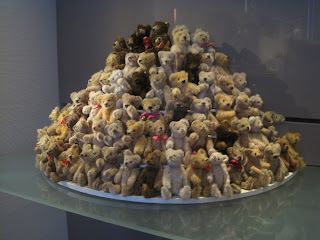
And we're off!  After a long day and night of travel, the super fans all gathered in Basel, Switzerland.  Our first activity was a fun group dinner, where we all finally met in person and talked about our collections and interests.  The next day, we were off in the pouring rain for a full morning at the Spielzeug Welten Museum Basel, which used to be called the Puppenhaus, or Dollhouse Museum.  This amazing Steiff mecca has perhaps the best and most comprehensive Steiff collection on the planet!  Above is just one photo of an amazing grouping of tiny Steiff Teds - it would be impossible to capture the scope of this museum in even 1,000 photos.  This is a MUST SEE destination for all Steiff fans who find themselves in this part of the world. While in Basel, Steiffgal had the awesome pleasure of spending time with a long-time friend she met online - but never in person. A delightful reunion all around - and made far sweeter by the fact that she provided everyone in the tour group with a giant Swiss chocolate bar as a welcoming gesture to her country!

After our museum adventure, we boarded our coach for a long journey towards Bonn, our second destination.  This leg took us through Switzerland, Germany, France, and then again Germany - all within a few hours.  Very cool from a geography perspective!  Our driver basically followed the Rhine River as it wove around the countryside.  Our hotel in Bonn was lovely and historical, and right on the Rhine.  Many famous, and some infamous, people had visited our hotel, and you could just tell the walls had many stories to tell.  Most super fans truly enjoyed the hotel's authentic after hours biergarten.  Here above on the left you can see a shot of the view from our hotel window, showing the Rhine River and the biergarten with its retractable all seasons roof!  Interestingly, the sun did not set until about 10:30 or 11pm in the evening, so we could enjoy eachother's company over beers in the daylight even though it was clearly evening!  

Our first night in Bonn included a preview of the upcoming Steiff Sommer 2012 auction, hosted by Teddy Dorado.  Everyone loved seeing and holding the precious and rare auction items firsthand, and Carsten Esser, Teddy Dorodo's owner and auctioneer, was there to present the goodies and answer questions.  A few lucky super fans also had their photos taken with Othello, the historically important Steiff Titantic Mourning bear who was one of the highlights of the auction.  

As there is no rest for the weary, our next day truly was off to the races.  Our coach took us to Steiff Shulte, the fabric company that has been making Steiff's outstanding and high quality fabrics since the turn of last century.  It was remarkable to see how simple materials, like cotton and wool, are transformed into glorious textured and colored mohair.  After our tour, we headed towards Koln, known for its famous cathedral which is the largest Gothic church in Northern Europe and has the largest facade of any church in the world.    In Koln, many super fans enjoyed an hour long boat cruise on the Rhine, a self-tour through the Lindt chocolate museum (yes, samples were included!), a visit through the awesome cathedral, and a stroll through the city center.  One of the trip highlights for Steiffgal and Steiffguy was enjoying a few rounds of ice cold pils beer with new and old friends in an urban biergarten right in the shadows of the city's most famous landmark.    

Our next day was primarily dedicated to travel, where we headed off from Bonn to Heidenheim.  The five hour journey was bisected with a stop at Rothenburg, an ancient walled city that really had the look and feel of times past - way past. This wonderful destination featured cobble stoned streets, century-old buildings, majestic gardens, and spectacular views of the surrounding areas.  Here on the left you can see a "typical" Rothenburg house with its interesting, aged, and historical facade. When the super fans finally arrived in Heidenheim at our final hotel destination, the group had the pleasure of enjoying dinner with Inge Zinnecker, who runs the Steiff club, and Ralf Fahrig, who is in charge of events for Steiff. 

The next two days of the adventure were truly dedicated to Steiff fun 24/7.  The group arrived early Friday morning in Giengen and was given first access to the Steiff sales tent area at the 2012 Steiff Sommer Festival.  It goes without saying that the super fans had a wonderful - and successful - time scooping up bargains and favorites by the armful.  Other festival highlights included a dealer's area which featured new and vintage treasures from around the world; a "flea market", which sold Steiff accessories, parts, and pieces; a community area which highlighted local craftspeople and their high quality wares; a food pavilion; and a stage area for singing and dancing performances.  (The photo above on the left shows one vintage dealer's incredible collection of Steiff treasures for sale!) The group was also given private guided tours of the Steiff Museum and Margarete Steiff's birth house.  Some super fans participated in a Teddy bear making workshop while others took side trips to the city of Ulm and the fairy tale village of Braighausen, a remarkably detailed miniature medieval village created by one of Steiff's legendary designers.  

The second evening of the Steiff Festival featured the 2012 Steiff Sommer Auction produced by Teddy Dorado.  This standing room only event was held in a town-hall style building just a few hundred yards from the Steiff campus in Giengen.  For many of the super fans, it was their very first live Steiff auction, and you could feel the energy and excitement in the room.  The auction featured almost 90 museum quality new and vintage items, including Othello, the 1912 black Steiff Titanic Mourning bear.  Steiffgal had the once in a lifetime experience of presenting many items for sale, including Othello, to the audience from the stage.  Other interesting items included a very large, mechanical Steiff rabbit from the 1920's; a sweet 1920's large eyed, tipped mohair bear; a lovely white Dicky bear in wonderful condition, and a velvet Steiff Peter Rabbit from around 1909.  You can see the online catalog for this July, 2012 auction event here by clicking here.  100% of the item sold at or significantly above the opening price - a wonderful sign in terms of the state of the marketplace for lovely Steiff collectibles.   And yes, Steiffgal did win an auction treasure... a set of 1960's-era "Jumbo" elephants in 35 and 15 cm... a delightful souvenir from one of the best days of her life!

Our last day abroad found the super fans on the road again, this time to Stuttgart There we all toured the remarkable and contemporary Mercedes Benz museum, which tells the story of the creation of the modern automobile as we know it today, as well as features pristine examples of cars from the turn of last century onward.  The museum itself is located on the Mercedes Benz headquarters campus.  It is eight stories high; its interior is constructed somewhat like the Guggenheim Museum in New York City.  Visitors take an elevator to the top floor and simply follow a gently sloping downward walkway to each lower floor.  Displays feature hands on exhibits, videos, newsreels, and accessories, and follow a timeline tied to well known global historical events.  It was so exciting to see Princess Diana's maroon Mercedes, the "Pope Mobile," and other famous Mercedes cars that were featured in well known TV shows and movies.  

Our final evening was spent enjoying a tour and dinner at Castle Katzenstein, a castle whose history dates back 900 years.  The super fans enjoyed an authentic medieval style meal, complete with tunics, a singing and storytelling mistrial, snuff, and honey mead.  Here on the left, you see the mistrial "demonstrating" a wooden period disciplinary device, which Steiffgal was forced to wear as well after declining some after-dinner snuff.  Luckily, Steiffguy was there to rescue her!  After this late night, we all boarded the coach back to our hotel in preparation for a 6am departure to the Stuttgart airport for our voyage home the next day. 

Overall, the trip was a magical, once in a lifetime experience.  The super fans came together as strangers and left as friends.  Many of us also met other colleagues and "Facebook friends" - sometimes for the first time - at the Festival as well, adding to the fun and universality of the event.  Everyone contributed towards the success of the trip in their own way, and all efforts were sincerely appreciated.  And given that each person on the trip "adopted" at least 10 new or vintage Steiff treasures over the course of the 9 day journey, Steiffgal guesstimates that the adventure netted close to 400 new Steiff items "crossing the pond" and entering America on July 9, 2012 - the day we all returned home from our fairytale adventure.

Steiffgal hopes this Steiff travelogue has been just the ticket you needed to consider seeing these remarkable sights and attending next year's 2013 Steiff Sommer Festival in person!

Have a question about one of your Steiff treasures? Let's talk! Click here to learn more 
The teddy bear search engine