Sunday, December 11, 2022

You'll Be All Ears Over This Happy Hoppy Hybrid Hare!

Talk about a rare hare... combined with LOVE AT FIRST SIGHT! That's was exactly Steiffgal's reaction when it came to an absolute rarity she spotted on eBay recently. Take a look at this remarkable little Steiff prewar rabbit... and just try not to fall in love with it as well!

This tiny guy is a super cool bunny made as a woolen miniature, but with mohair detailing. He is pictured here on the left and the photo is from ebay. According to the eBay listing, he is a..."Rare Steiff Wool Rabbit is approximately 5 inches high. Has mohair ears with underscored FF button. Glass eyes. 1935-1939." Additionally, he is lined in wires and is poseable, probably head jointed, and detailed with glass pupil eyes and a small painted mouth. Steiffgal suspects he left the factory in Giengen with clear monofilament whiskers. This happy handful was made in 7 and 10 cm (measured without ears) in light brown and white or all white from 1935-1939 overall.

Steiff's woolen miniatures debuted in the very early 1930s. They were introduced as a low cost, entry level priced line for the company at a challenging economic period. The first woolies were birds and bunnies; their natural forms and shapes were easily interpreted in Nomotta wool pom-poms of different sizes and color combinations. As time went on, Steiff produced more and more elaborate woolen miniatures with greater detailing. These included other materials - like lace and ribbons - and accessories - like perches, voice boxes, and aviaries - in their designs in addition to Nomotta pom-poms.

In the mid 1930s, Steiff made a number of woolen miniatures that included relatively expensive woolen mohair fabric.
This material was used to create the ears of several different dogs (including a St. Bernhard, Chin-Chin, and King Charles Spaniel), a few rabbits (including one on skis), and even a really unusual Teddy bear made from long white yarns. Given their elaborate construction, like the rabbit under discussion here today, Steiffgal suspects that the introduction of these "hybrid" mohair/woolen miniatures was Steiff's way of "upscaling" the woolen miniature line a bit. The mohair ears were "stitched into" the core of woolen threads to keep them in place... or at least that is how the mohair ears on the woolen miniature Teddy bear are engineered. You can see this terrific Ted pictured here on the left; he was made in 22 cm from 1936-1938.

Today, it is extremely rare to find Steiff's highly sought after woolen miniatures with mohair features on the secondary market.
That is one reason Steiffgal was tickled pink to see this one on eBay. Given their appeal and petite scale, it is very possible that many were "loved to death" and simply lost to time over the years. Steiffgal also suspects that in reality, very few were actually made. The mid- to late 1930s were really tough years in Germany and it is quite probable that supply chain and labor issues really limited the number actually manufactured and sold during that time. And, of course, any enthusiast lucky enough to have one of these absolute rarities in their collection already is probably not in any rush to move it along! It's just supply vs. demand at its finest. 

Steiffgal hopes this discussion on woolen miniatures with mohair features has been a cheerful earful for you. 

Have a question about one of your Steiff treasures? Let's talk! Click here to learn more.

Thursday, December 1, 2022

Sit and Stay and Check Out This Tiny Steiff Mechanical Marvel!

Now who is a good dog? Those are every puppy's favorite words, and in some ways, Steiffgal's as well! Check out this happy handful of a Steiff 'herd... German Shepherd, that is! This prewar treasure packs a lot of features and design elements into a very small body. He'll have you smiling ear to ear for sure.

This blue ribbon buddy is Steiff's tail-turns-head German Shepherd dog.
He is 15 cm tall, sitting, and made from wool plush (that has practically been entirely loved off.) His cheerful face comes alive with pert triangular ears; brown and black glass pupil eyes; a black hand embroidered nose; and an open, felt lined, smiling mouth. He is solidly stuffed with excelsior, which is a manufacturing feat in itself, given how small he is, and how narrow his limbs are. The excelsior stuffing holds his metal tail-moves-head apparatus in place; it would tend to shift or settle if it was packed in kapok or other lighter filling. This mechanism enables his head to move in a circle when his sweet little tail is twisted. 
This little lovely was made in 15, 18, 23, 29, and 36 cm from 1931-1935 overall. 

One of the most astonishing things about this example is his IDs.
They are great in themselves, but it is sort of a miracle that they even exist at all, given how much love and use this guy clearly has had over the years. He wears his all original brown leather collar. It is held together with two long trailing "F" Steiff buttons. He also retains his original, red imprinted, watermelon shaped named chest tag. It is interesting that on the back of the chest tag, it is stamped "Int. pat. app. for" meaning "International Patent Applied For". Steiff was very proud of its tail-moves-head technology, and other companies were starting to copy it starting in the early 1930s. It really is amazing that he still has his collar and tag, given how ephemeral they really are, relative to his sturdy overall construction.

This pretty puppy has a great place in Steiff's prewar and early midcentury German Shepherd production history.
German Shepherds have been featured almost continuously in the line since 1923. Perhaps the best known Steiff German Shepherd design is Arco, who was introduced in 1935 but got his name in 1937. Pre-war Arco was made from mohair and had prominent, felt lined ears and a smiling, open, felt lined mouth. He was made standing on wheels (in 35, 43, 50, 60, and 70 cm), standing (in 14, 22, 28, 35, 43, 50, and 60 cm), and sitting (in 17, 22, and 28 cm) from 1937 to 1943. During this time, Arco was sometimes also referred to as "The Police Dog." As one of Steiff's most beloved late pre-war dog designs, early Arco again graced the line from 1951-1956 in the form of a 10, 17, and 22 cm standing version. These guys strongly resembled their pre-war pattern. A 43 and 50 cm standing version on wheels was also manufactured from 1949-1956.

Steiffgal hopes this discussion on this tiny Steiff treasure has brought a big slice of joy to your day.

Have a question about one of your Steiff treasures? Let's talk! Click here to learn more.

Thursday, November 17, 2022

This 1930s Steiff Tail-Turns-Head Novelty Is Simply Ele-Fantastic!

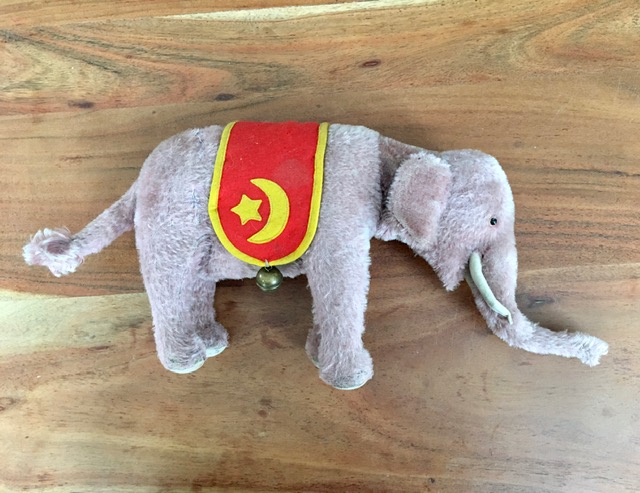
Steiff wishes can come true! Check out this note from Carey, a new friend from north of the border. She was gifted a jumbo surprise from her husband - one that just happens to be simply ele-fantastic. Steiffgal is certain you'll agree. She shares in part:

"Hi Steiffgal! I’m emailing from Ontario, Canada. Yesterday my husband gifted me an amazing find from Kijiji from an elderly couple who were downsizing. The elephant belonged to the woman’s father, and they immigrated to Canada from Poland.

Our new blushy pink/mauve Steiff elephant, based on what I could find from the button, is I think from the 30s. The tail makes the head move in a circle and the trunk is posable. It’s stuffed with straw, and due to the wear of the mohair around the foot pads, which are heavy felt, you can see black toes stamped onto the fabric. It’s about 8" tall, and the body excluding the tail and trunk is about 10" long. If it made any sounds when it was new, it doesn’t now."

There's not a drop of junk in the truck when it comes to this playful pachyderm.
This tail-move-head example is standing, head jointed, and made from mohair which has mellowed to a light pink color over time. This sometimes happens with originally grey mohair over time. His pads are made from grey felt, and his prominent tusks are made from white felt. He comes to life with floppy ears, black button eyes (which may be backed in felt - but it’s not clear from his photos) and a smiling, open mouth. His red and yellow felt blanket with bells is original to him. When you twist his mohair tipped tail in a circle, his head moves 360 degrees as well. This amazing tail-moves-head elephant was produced in 18, 23, and 29 cm from 1931-1934 overall; Carey's example is most likely the 18 cm version.


Steiff introduced its patented tail-moves-head line in 1931.
These nifty novelties were made with an internal metal movement mechanism that enabled the heads to move in a circle when the tails were rotated. These items were stuffed with excelsior to hold this mechanism firmly in place. Tail-moves-head animals appeared in the line from the early 1930s - early 1940s; over time, about 25 different examples were made. The line included cats, dogs, rabbits, penguins, goats, and lambs, and even Mickey Mouse! Most were based on popular designs of the ear, but a few - like a bulldog - were brand new patterns. These tail-moves-head items were considered luxury toys of the time. You can see Carey's elephant in action in the video above. 

Carey's elephant appeared on the cover of a 1931 marketing brochure titled "1931 Addendum to the Main Catalogue."
The other "cover girls and boys" included a Scotty, penguin, tabby Bulldog, Rattler Terrier, Molly, chimp, Fox Terrier, lamb, cat, and goat. The copy on the brochure, in part, translates to:

"The year 1931 has presented us with the animals with the new head movement… The simplicity of the mechanism, though which the splendid movement is produced, cannot be beaten, yet it is unbreakable and allows lifelike play, full of variety and mimics… When buying new supply in plush toys please be sure to include the STEIFF animals with the new head movement; all numbers equipped with it are marked ‘H.’" You can see this brochure cover here on the left; you can click on the image to make it bigger. 

Steiffgal hopes this discussion on this really rare elephant has made a huge impression on you.

Have a question about one of your Steiff treasures? Let's talk! Click here to learn more.

Wednesday, November 9, 2022

This Cool Cat Novelty Is Really Hot Stuff!

Brrr... the temperature has shifted from 80 degrees to 40 degrees overnight so it’s definitely time to share something Steiff-y to warm the heart and soul! Check out this amazing cat doll that does double duty... making her totally hot stuff indeed. Have you ever seen this hybrid treasure before?

This Steiff functional novelty is called "Cook Cat Coffee Cozy."
She is 43 cm tall and is arm and head jointed. Her body and arms are made from red felt to resemble a shirt, her skirt is made from green felt, and her head and hands are made from white mohair. She wears her original white cotton apron. She come to life with pert triangular felt ears, early style green and black slit pupil glass eyes, and a hand embroidered pink nose and mouth. Her hollow body is lined in double thick felt to keep a pot of coffee, tea, or cocoa warm. She was made in this size only from 1906-1910.

Cook Cat Coffee Cozy was also produced with a bear's head or a rabbit's head. These heads were identical to the current rabbit and bear designs of the early 20th century. These cousins also measured 43 cm tall. The bear appeared in the line from 1906-1908 and the rabbit appeared in the line from 1906-1909. Like the cat version, these featured a mohair head and hands and were dressed in a red felt shirt, a green felt skirt, and a white apron. This happy group is a good example of Steiff's long tradition of "form and variation" - modifying a popular design slightly to produce a number of "new" products for their catalogs. You can see a picture of the "Cook Rabbit Coffee Cosy" here on the left; the photo is from Pfeiffer's 1892-1943 Sortiment book.

Cook Cat Coffee Cozy - and her bear and rabbit friends - are based on Steiff's earliest character coffee warmer which debuted in 1904.
This was a cozy in the form of Mama Katzenjammer from the popular comic strip the Katzenjammer Kids. She was called "Cook Coffee Cozy." Cook Coffee Cozy also wore a red and green felt dress and white apron, but had a felt head and fingered hands that resembled her character. Cook Coffee Cozy was made in four sizes ranging from 43-100 cm from 1904 through 1943 overall. Her longevity in the line indicates how popular she was over nearly four decades. 
You can see a picture of the "Cook Coffee Cosy" here on the left; the photo is from Pfeiffer's 1892-1943 Sortiment book. 

This fantastic feline fits right into Steiff's early 20th century product development timeline and history.
The Giengen company is well known for producing functional novelties for home, school, and work use in addition to the company's plush animal, doll, and bear production. This tradition goes back to the late 1800s, when Margarete Steiff produced and marketed a series of oversized, embroidered felt "pockets" designed as newspaper holders, bed wall bags, duster holder bags, and brush holders, among others. Other early and mostly prewar novelties include egg cosies, pen wipes, and pincushions. These rarities are treasured among collectors today.

Steiffgal hopes you found this discussion on Cook Cat Coffee Cozy the pause that refreshes.


Have a question about one of your Steiff treasures? Let's talk! Click here to learn more.
The teddy bear search engine