Showing posts with label nose. Show all posts

Friday, March 28, 2025

Getting Cosi With Steiff's Poodle Named Tosi

Poodles are amongst the most popular dog breeds globally and are regularly celebrated for their distinctive good looks, superior intelligence, and fun-loving personalities. These wonderful dogs, often sporting fantastic hair-dos, are so important to Steiff that several were featured in the company's debut catalog in the early 1890's. Since then, Poodles have appeared almost continuously in the Steiff line to this day.

One of the rarer Steiff poodles, Tosi, tops the wish lists of many collectors today. This is most likely due to her unique presentation, unusual detailing, and place in the company's product development timeline. A deeper dive into her history suggests she is a case study in early postwar design, development, and distribution. Here is the story behind this precious pup!

Given the breed's appeal, Steiff started manufacturing Poodles as soon as possible once the factory reopened for toy making business after the conclusion of WWII.
The first new postwar Steiff Poodle design was Tosi. Here you can see her on the cover of the company's 1950 product catalog. Tosi's design strategy was based on two of Steiff's key business drivers at the time - to produce quality, appealing toys as quickly and efficiently as possible and to regain their status as a premier, worldwide toy manufacturer. However, Steiff still had alot to manage operationally in the earliest midcentury period, including rebuilding their infrastructure, optimizing new regulations and distribution channels, and dealing with material and talent shortages, among other factors.

Many of Tosi's design elements reflects these postwar realities.
She was standing and simple in design and only head jointed in the larger sizes. She had minimal seams and labor intensive details. Because mohair fabrics during this period were limited and expensive, this model was made from wool plush. Her coat was in a "Karakul" trim, meaning that it was fluffy but uniformly the same length all over her body. This gave her a sweet and youthful appearance, but also required no additional hand-trimming or work on her legs and torso. Tosi's face was detailed with a round, black glass button nose and soulful, almond shaped white, brown, and black eyes. These facial features did not require facial hand embroidery, which can be time consuming and require special expertise to execute. Her accessory was a simple red leather collar, which was easy to manufacture and attach to the dog. And, her small size and compact form made her light and easy to pack and ship worldwide. Here on the left you can see Tosi in a variety of color and size combinations as she appeared in Steiff's 1950 new product catalog. 

Overall, Tosi was produced in black or white wool plush in four sizes ranging from 14 to 28 cm from 1950 through 1953.
Because of her time of manufacturer, Tosi would have left the factory with either a short trailing f, blank, or raised script button; yellow ear tag; a red or blue imprinted chest tag; and a cloth US Zone tag in her leg seam as her Steiff IDs. You can see these IDs on the white Tosi above; the image is from www.invaluable.com. Examples in excellent to as new condition with all IDs today can trade hands in the high three digits - low four digit range.

Steiffgal hopes this discussion on Steiff's Tosi poodles has you feeling quite rosy!

Have a question about one of your Steiff treasures? Let's talk! Click here to learn more.

Sunday, March 25, 2018

Who Nose Why This Turn Of Last Century Steiff Bear Is So Extraordinary?

This bears repeating - Steiffgal's never seen anything like this terrific Ted before! Steiffgal had the privilege of handing this astonishingly special cub for a friend. Yes, he's got traditionally handsome Steiff good looks, but he also has a little secret to him that places him at a really interesting point in Steiff's product development history. Can you guess what that might be? Let's take a closer look at this Steiff rarity and see what makes him outstanding in so many ways.

It's nothing but Teddy hugs when it comes to this fine fellow.  This bear is 35 cm sitting or 50 cm standing, fully jointed, and made from long, thick, white mohair.  He is solidly stuffed with excelsior. His paw pads are tan felt. He has five brown hand embroidered claws on each of his hands and feet.  Typical to very early Steiff bears, he has long and narrow feet, extra-long arms with prominently curved wrists, and a very pronounced back hump. His sweet and baby-like face comes to life with black shoe button eyes and and a brown hand embroidered nose and mouth.   And just when you think things could not get better with him - they actually could.
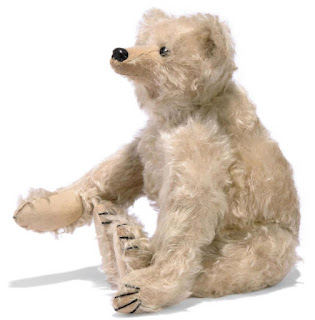
His little secret just might test your metal. Believe it or not, this bear is rod jointed... dating him right at the turn of the last century. Steiff only produced white rod bears in 1904 and 1905! Steiff's rod jointed bears are extraordinary in their own right. These early bears are best known for their chunky forms, almost (American) football-shaped torsos, simple and somewhat "puppy like" expressions, and gutta percha noses. A somewhat more "typical" white rod bear is pictured here on the left. This photo is from Christies and this bear, which had its original elephant button, sold in 2010 for 13,125 pounds. But as you can see, the rod bear under discussion today really has the face - and the facial stitching - of a c. 1905 to 1912 Steiff bear!

So who nose what's going on here? There are a few possibilities, but it is clear that this all-original bear is a transitional example that spans the company's c. 1903 to 1905 rod bears with gutta percha noses and their c. 1905 onward disk jointed bears with embroidered facial features. As such, it is Steiffgal's best guess that this very bear was one of the very last rod jointed bears made - and at the same time - one of the very first bears to feature a hand stitched nose. How remarkable is that?

Let's take a breather here and talk about gutta percha. Gutta percha is a natural latex product made from the sap of the Palaquium gutta tree. Gutta percha noses were very labor intensive to produce on bears. Each one required an artisan to place individual drops of this black, sticky, rubbery substance on the tip of the bear's muzzle until enough built up to resemble a nose. The artisan also was required to constantly shape the cooling material into a nose shape, which explains why early and original gutta percha noses often are asymmetrical and have fingerprints and nicks on them. You can see a close up shot of a Steiff gutta percha nose here on the left. Richard Steiff himself thought this process was way too time consuming, and insisted that the company's bear production incorporated stitched noses from around 1905 onward.  

Steiffgal hopes this discussion on this extremely rare transitional rod bear has been a one in a million experience for you!

Have a question about one of your Steiff treasures? Let's talk! Click here to learn more.
The teddy bear search engine